
Offshore Staff Augmentation: Models, Real Costs, and Where It Breaks


In this article
- What offshore staff augmentation actually is
- The models: staff augmentation vs outsourcing vs managed services
- The real cost of offshore staff augmentation
- Where it breaks: you have to have something to augment to
- How to make offshore staff augmentation work
- Frequently asked questions
- You can’t augment nothing
Quick Answer: Offshore staff augmentation fails most often when a company has no in-house technical leadership to direct the work, or when requirements get handed over the wall instead of communicated directly to the developers. The model works when you already have someone who can review code, run standups, and give the team direction; it breaks when it’s treated as a way to skip having engineering leadership entirely. Full Scale runs this model with senior developers in the Philippines, built around the client keeping that direction in-house.
I have hired developers in Russia, Belarus, Uruguay, Colombia, India, Pakistan, and the Philippines. Every one of those engagements started with a written proposal that either told me the truth or didn’t. The Philippines is where I landed, and where I’d point anyone toward the best offshore developers I’ve found. Some of those teams were great. Some of them were a mess. The thing that decided which was which had almost nothing to do with the hourly rate or the country on the invoice.
It came down to one question. Did the company have something for those engineers to plug into?
That is the part most articles about offshore staff augmentation skip. They sell it as a faucet you turn on to get cheaper developers. In reality, the model only works when you already have in-house technical leadership for offshore engineers to work under. You have to have something to augment to. I learned that the hard way at Full Scale and at the companies I ran before it. I actually avoided offshore development for years until I stumbled into a version that worked. Most teams never get there because one bad hire teaches them why a dev team will not work with offshore developers. The results come down to managing an augmented team well, not just hiring one. Knowing what a fair rate for affordable IT staff augmentation services actually buys you is the difference between the two.
This guide covers the models, what it actually costs, and the specific point where it breaks.
Who actually employs and supports those offshore developers shapes whether they stay, which is the real story behind choosing an employer of record versus a staffing agency.
What offshore staff augmentation actually is
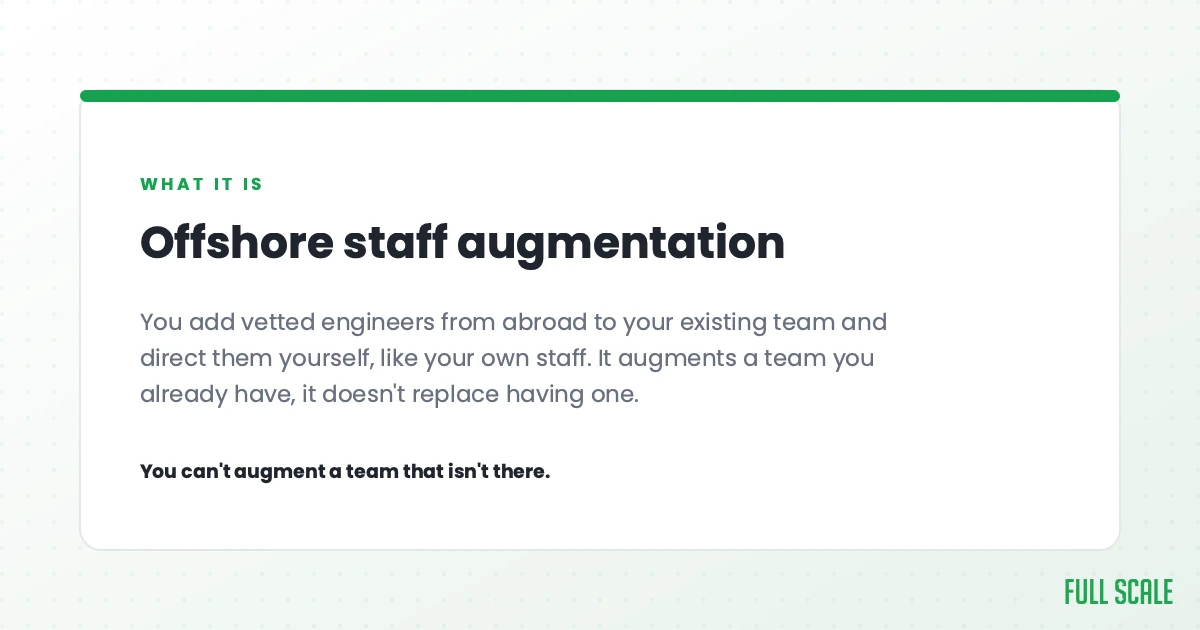
Offshore staff augmentation means you add engineers in another country to your own team and manage them directly, the same core model covered in what is staff augmentation. They work for you, on your roadmap, on a long-term basis. You assign the tasks. You review the work. They sit in your standups and your code reviews like any other member of the team.
That is the whole idea, and it is different from outsourcing a project. With project outsourcing you hand a spec to a firm and wait for them to hand something back. With offshore staff augmentation services, there is no handoff. The engineers are yours to direct. Some firms sell that same arrangement as offshore leased staff in the Philippines, but the rule holds: you are building a team, not renting seats. It matters most for scarce, expensive skills. If you are building VR products, the Unity and Unreal specialists you need are rare enough that an integrated offshore team is often the only practical way to staff the work.
You will also see this called offshore IT staff augmentation, because most of the demand is for software and IT roles. The label changes, but the model is the same: it is IT staff augmentation with the engineers working directly under your leadership. Outside the US you will often hear the same arrangement called outstaffing, and the benefits of outstaffing are exactly the benefits we are describing here. They are also the payoff of choosing an outstaffing partner that runs the model well.
I have always thought of it simply: we do staff augmentation and build long-term dedicated dev teams for our clients. These are not short engagements or body-shop seats you fill and forget. They are teams you keep working with for years.
Running staff augmentation offshore just means the talent lives somewhere with a lower cost of living, the same dynamic behind backend development cost. That is a budget decision rather than a quality one, and I will come back to why the distinction matters. How IT staff augmentation actually works is the same base model whether the engineer lives offshore or across town.
The models: staff augmentation vs outsourcing vs managed services
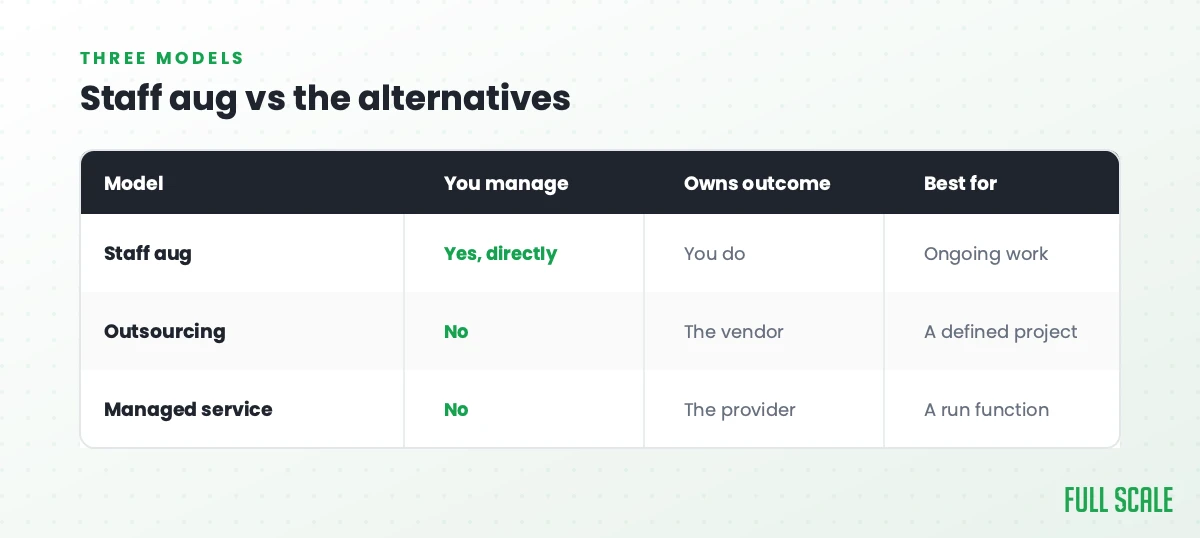
Buyers get these three mixed up constantly, and the confusion costs them. Here is how they actually differ.
| Offshore staff augmentation | Project outsourcing | Managed services | |
|---|---|---|---|
| Who manages the day-to-day work | You do | The vendor does | The vendor does |
| Who owns the roadmap | You | Shared or vendor | Vendor, against an SLA |
| What you get | Engineers on your team | A finished deliverable | An ongoing function run for you |
| Best for | Scaling a team you lead | A defined, one-off build | A system you want off your plate |
| Where it fails | No in-house leadership to direct the team | The spec was wrong and nobody told you | You needed control you gave away |
The short version: offshore staff augmentation keeps you in control, and the other two trade control for convenience. That trade is fine when you want it. It is a disaster when you didn’t realize you were making it. If you want the longer breakdown, I wrote a whole piece on staff augmentation vs outsourcing.
People also ask whether offshore is better than nearshore or onshore. My honest answer is that geography matters far less than people think. Nearshore buys you a few more overlapping work hours. Onshore buys you a shared accent. Neither one fixes a team that has no one leading it. Pick the location that fits your budget and your meeting schedule, then spend your real energy on how you run the team.
The real cost of offshore staff augmentation
This is the section the ranking guides wave their hands at, so let me put real numbers on the table.
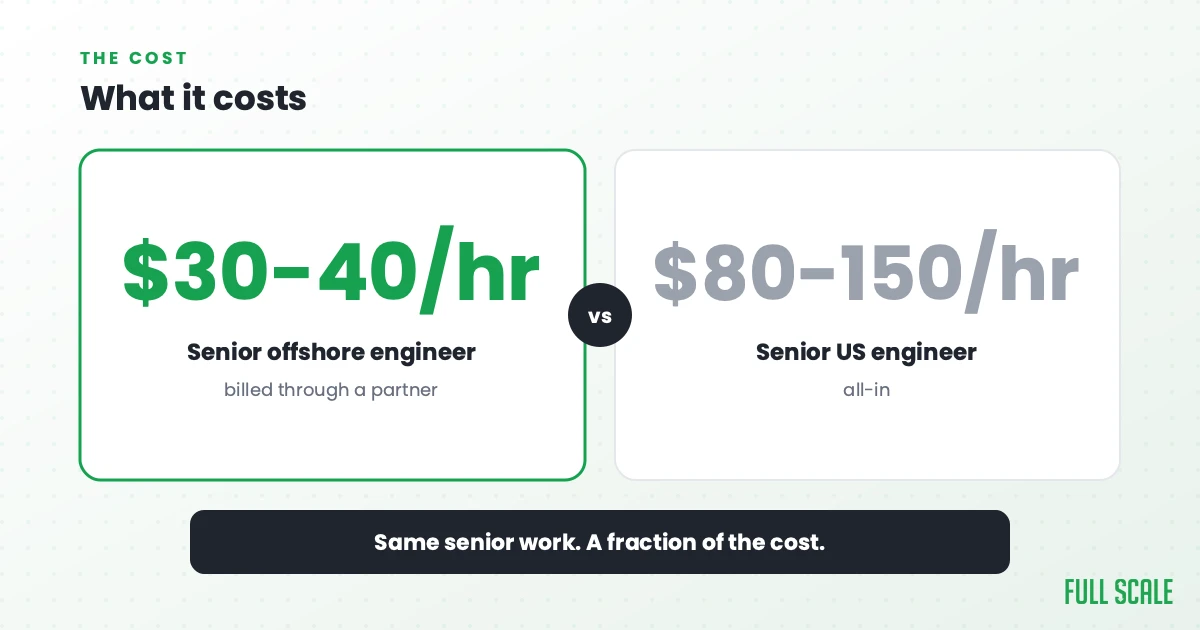
A senior Filipino software developer earns roughly $15 to $30 an hour, depending on experience. When you engage that developer through a company like ours, the offshore software development billing rate runs about $30 to $40 an hour. A comparable senior developer in the United States costs $80 to $150 an hour all in, once you add benefits, payroll taxes, recruiting, and equipment. The median software developer wage alone runs well into six figures before any of those extras.
| Role | Hourly cost | What it includes |
|---|---|---|
| Senior US developer (in-house) | $80-$150 | Salary, benefits, payroll tax, recruiting, equipment |
| Offshore developer (client billing rate) | $30-$40 | The engineer’s time, billed through the provider |
| Filipino developer (local pay) | $15-$30 | What the developer actually earns locally |
Those local numbers look low through an American lens. They are not low where the work happens. My brother-in-law in the Philippines works at Jollibee, the country’s biggest fast food chain, for about $1.25 an hour. My sister-in-law works as a virtual assistant for $5 an hour, four times what he makes. A software engineering salary in that economy is life-changing. Some people will call offshore pay exploitation. The people earning it, and feeding their families on it, tend to see it differently.
The cost that nobody publishes is the cost of doing it badly. A cheap developer you can’t communicate with is the most expensive engineer you will ever hire, because you pay for the hours and get nothing you can ship. The savings only show up when the model is run well, which is exactly what doing offshore development right comes down to.
There is also the cost of turnover. US tech turnover runs around 13 to 15 percent a year, and every departure means re-hiring and re-ramping. Our developer retention is over 93 percent, and that is not a vanity number. It means the person who learned your codebase last year is still on your team this year. Continuity is where the real money is saved. Holding retention that high comes from the daily work to keep your offshore team motivated, not from perks, and it's exactly the continuity you have to rebuild deliberately with an outsourcing transition plan if you ever do change vendors.
Where it breaks: you have to have something to augment to
Here is the rule I wish someone had told me twenty years ago. You always need technical leadership in-house.
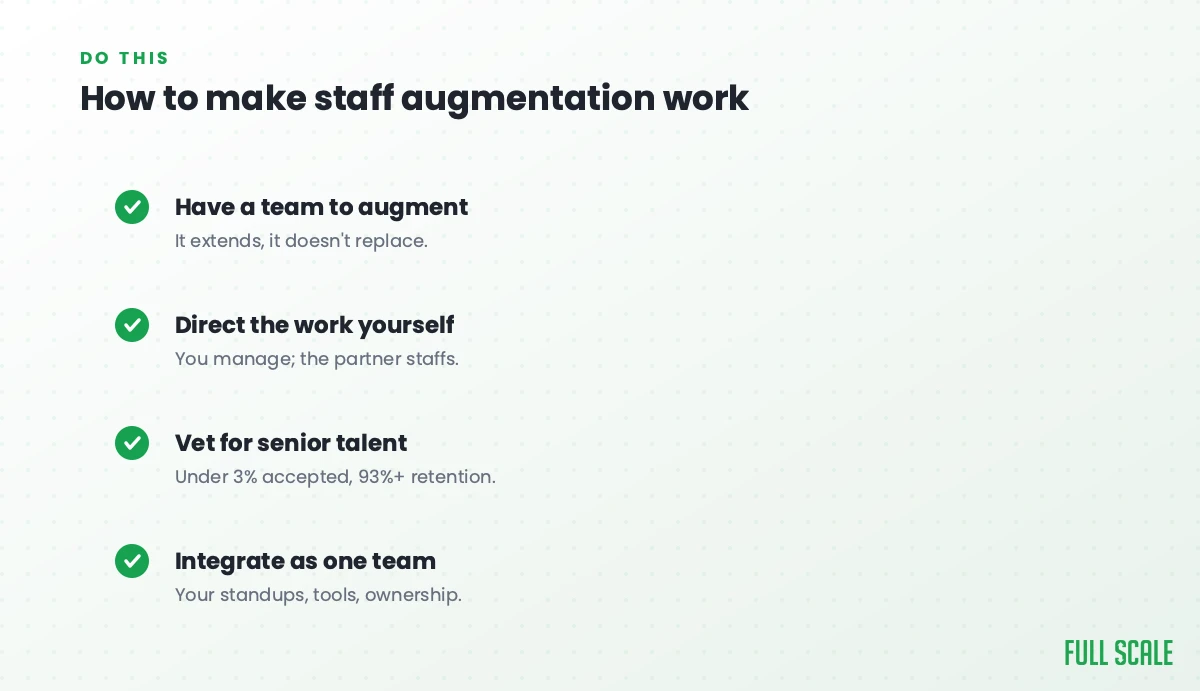
Offshore staff augmentation augments a team. It does not create one out of thin air. If you have no internal engineering leader, no product owner, and no clear roadmap, then handing the work to offshore developers does not solve your problem. It hides it. The engineers wait for direction that never comes, build the wrong things, and you blame the offshore development model you chose for a hole that was yours all along.
Most offshore collaboration fails because people simply hand a bunch of requirements over to an outsourcing firm and then expect to get back a successful project. I have watched it happen dozens of times. The requirements were never as clear as the founder thought, nobody on the other side felt safe pushing back, and the gap only surfaced at the demo.
The classic failure mode has a face: the middleman. I have talked to founders running teams in other countries where they only ever spoke to one person, the technical project manager. Every other developer hid behind that person. Sometimes it was a language gap, sometimes a cultural rule about who is allowed to talk to the client. Either way, you end up with a team you can’t actually communicate with, and a middleman in the way of every decision. The people writing your code became strangers.
So when is it the wrong call? A few honest cases:
- You are a non-technical founder with no engineering leader and no one to own the product. Hire that person first.
- You have a single, fixed-scope project with a hard deadline and no ongoing roadmap. That is a job for project outsourcing, not a team.
- Your existing team already struggles to work remotely. If communication breaks down across a hallway, it will not improve across an ocean.
If your team works well remotely, it will work well globally too. If it doesn’t, fix that before you scale it.
How to make offshore staff augmentation work
When offshore worked for me, three things were true every time. None of them had anything to do with the contract. They came down to treating offshore engineers like a product team that owns the work, which is the same approach I wrote about in Product Driven. Done right, it’s how you get a team of 10x engineers without paying 10x salaries.
First, I knew the talent was real. Software developers everywhere are smart and capable. The struggles people tell horror stories about usually trace back to one market and one set of bad vendor habits, not to a shortage of skill. I wrote up how we learned to build an offshore team that works after years of learning what does and does not work. Choose where you hire on cost of living and English fluency. The Philippines is the third-largest English-speaking country in the world, which is a big reason it works so well for American teams.
Second, I hired teams, not projects. Offshore works much better when you hire talent to work directly for you on a long-term basis. You know who is doing the work. They know your product. They stick around long enough to get good at it. This is the difference between hiring dedicated developers in the Philippines and renting anonymous capacity. It is also what separates real offshore staff augmentation services from a body shop.
Third, I built a hybrid structure with local leadership. That setup is the hybrid onsite-offshore model. At Stackify we ran up to four teams at once, and the pattern that worked was a lead developer in Kansas City managing two to five offshore developers. The local lead set direction and unblocked people. The offshore engineers did the bulk of the building. That structure is exactly what “augmenting an existing team” looks like in practice, and it is why the in-house leadership point is not optional.
Underneath all three is communication. Software development is about communication more than almost anything else. Video calls are non-negotiable, because you need to see whether someone actually understood you or just said yes to be polite.
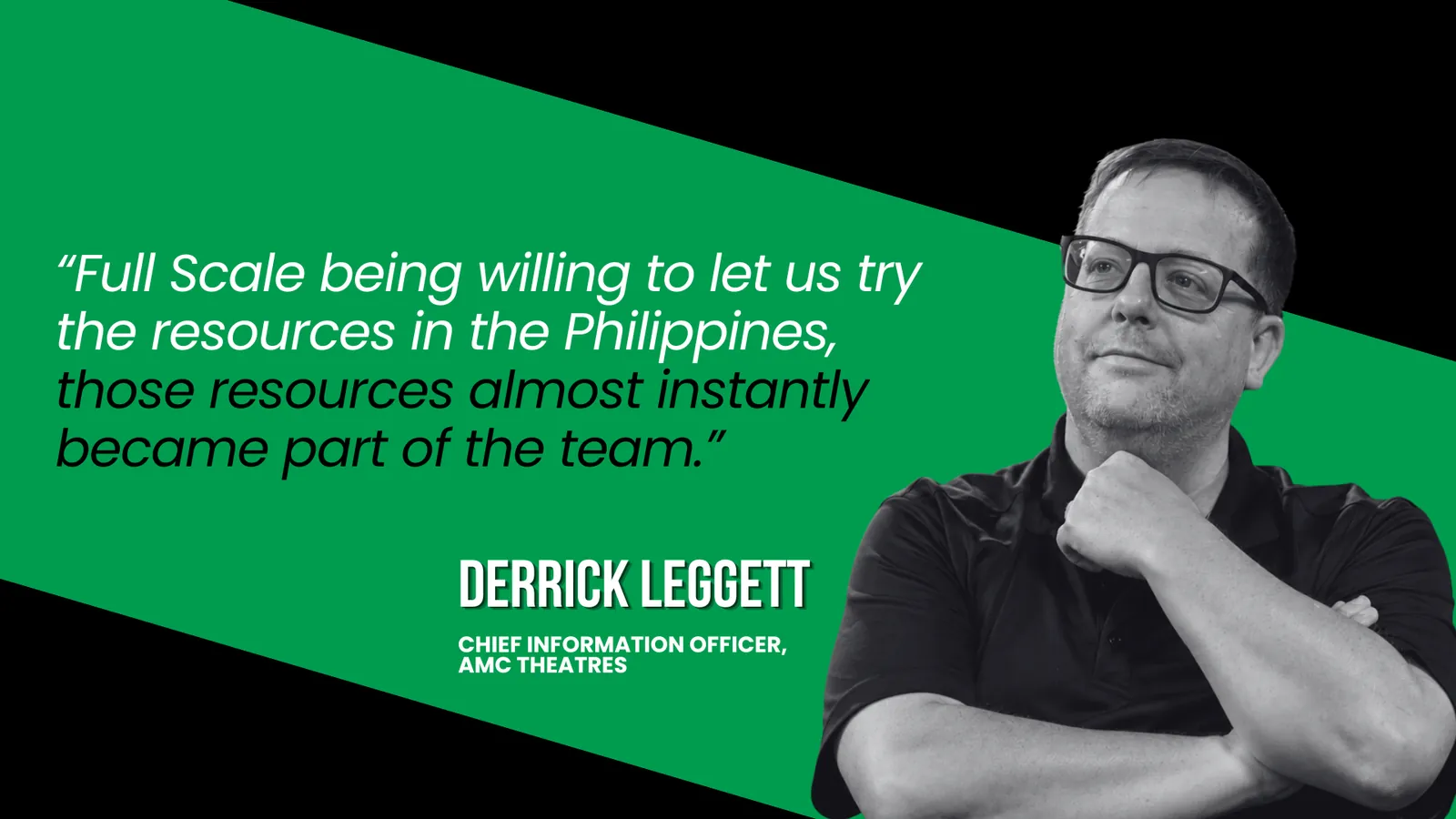
The best example I can point to is AMC Theatres. The developers we placed in the Philippines are treated as full AMC engineers rather than outside contractors. There is no middleman between AMC and the people writing the code, and those developers care about the product the same way the in-house engineers do. That is what makes offshore actually work.
The best providers make this structure the default instead of something you have to fight for. If you want help vetting one, I put together a guide on how to choose a staff augmentation company that walks through the questions worth asking the firms on your shortlist.
Frequently asked questions
What is offshore staff augmentation?
Offshore staff augmentation is a model where you add engineers in another country to your own team and manage them directly, on a long-term basis. They work on your roadmap, join your standups, and report to your leadership, rather than delivering a project at arm’s length. It is staff augmentation using offshore talent in lower-cost markets, the same model other guides cover when they walk through how resource and staff augmentation works.
What is the difference between offshore staff augmentation and outsourcing?
With this model, you direct the engineers and own the roadmap; the developers are an extension of your team. With project outsourcing, you hand a defined scope to a vendor and receive a finished deliverable, with the vendor managing the work. Staff augmentation keeps control with you, which is why it suits teams that are scaling rather than buying a one-off build.
How much does offshore staff augmentation cost?
Through a provider, it typically bills around $30 to $40 an hour for a senior engineer, compared with $80 to $150 an hour all-in for a comparable senior developer in the United States. The bigger savings come from retention and continuity, since re-hiring and re-ramping is what makes cheaper-looking options expensive. That continuity is what separates a staffing partner from a freelance marketplace when you compare Toptal alternatives for a long-term team.
Is offshore or nearshore staff augmentation better?
Neither is automatically better, because geography matters less than how you run the team. Nearshore gives you more overlapping work hours, while offshore usually costs less. Both succeed or fail on the same thing: whether you have in-house leadership and clear communication. Pick the location that fits your budget and meeting schedule, then invest in how the team is managed.
What makes offshore staff augmentation fail?
It fails most often when a company has no in-house technical leadership to direct the team, or when a middleman project manager sits between the client and the developers so real communication never happens. Offshore staff augmentation augments an existing team; if there is no roadmap, no product owner, and no one leading, the engineers have nothing to plug into. That in-house leadership gap is exactly what a fractional CTO exists to fill for a founder who does not have it yet.
You can’t augment nothing
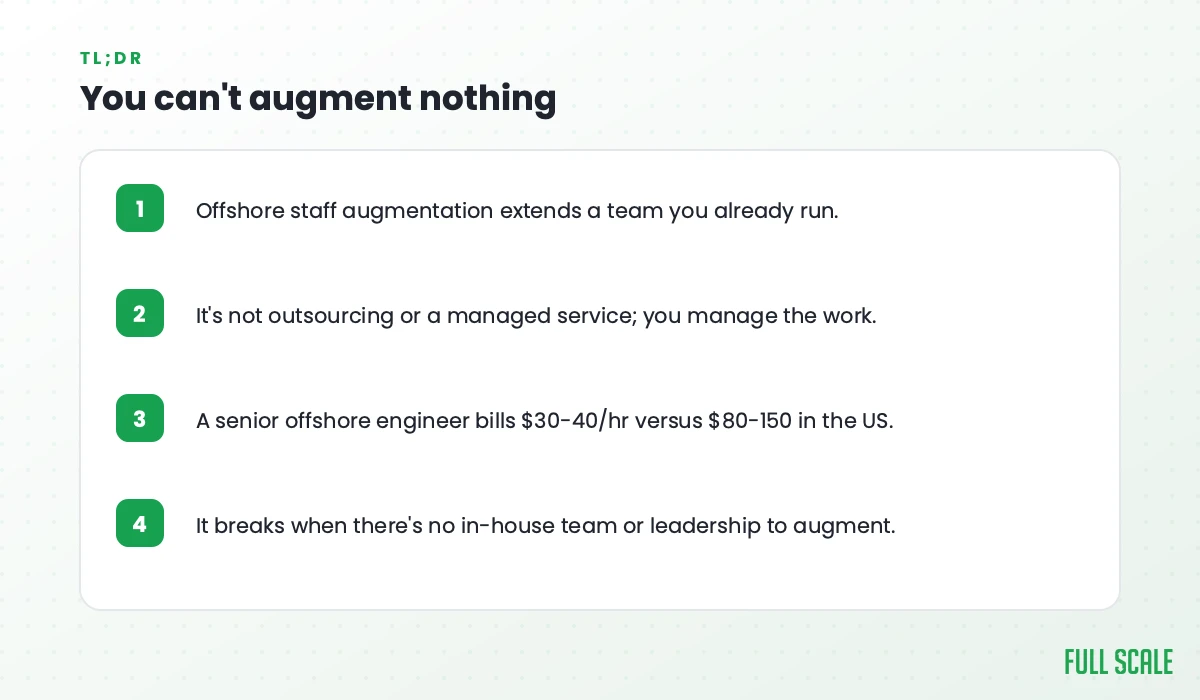
Offshore staff augmentation is the right way to scale a development team, and it has been good to me across four companies and a half-dozen countries. But it is only ever as good as the team it is augmenting. Build the in-house leadership first, then augment it with offshore talent, and the model pays off for years. Skip that step and no hourly rate will save you. Get the leadership right first, and you’re ready to hire dedicated offshore developers who make the team better instead of masking the gap.
If you want to talk through whether it fits your team, schedule a call with us and we will give you a straight answer.