
Best Offshore Developers in 2026: Why I Bet on the Philippines (A CEO’s Honest Case)


In this article
Every founder I talk to asks some version of the same question: where do I actually find offshore developers who are any good? So let me answer it straight. The best offshore developers I’ve worked with are in the Philippines, and I’ve bet a whole company on that answer. But finding good people is the easy part next to the first call you have to make: whether to outsource developers or build an in-house team in the first place.
Full disclosure before you read another word. I run Full Scale, a company that staffs developers in the Philippines, so I have an obvious bias. But I’ve also hired offshore developers in four countries myself, going back to my Stackify days in Russia, Uruguay, and Colombia. I’m not here to sell you the Philippines. I’m telling you where I’d put my own money, and why.
Why the best offshore developers are in the Philippines
There are smart engineers all over the world. I’ve worked with great ones in Russia, Latin America, India, and Pakistan, and most software developers don’t even live in the US. So this was never about one country having a monopoly on talent. It’s about which country gives you the best odds of building a team that actually works. Here’s my case.
Communication is the whole job now, and it starts with English
Software development is about communication more than anything else. That has never been more true than it is today, when AI writes more and more of the actual code.
Think about what’s left once the AI handles the typing. You’re figuring out what to build, explaining it clearly, catching the moment someone misread the spec, and pushing back when the requirements are wrong. All of that runs on language, so the first thing I screen for is English, and it is what I weight hardest in a remote technical interview.
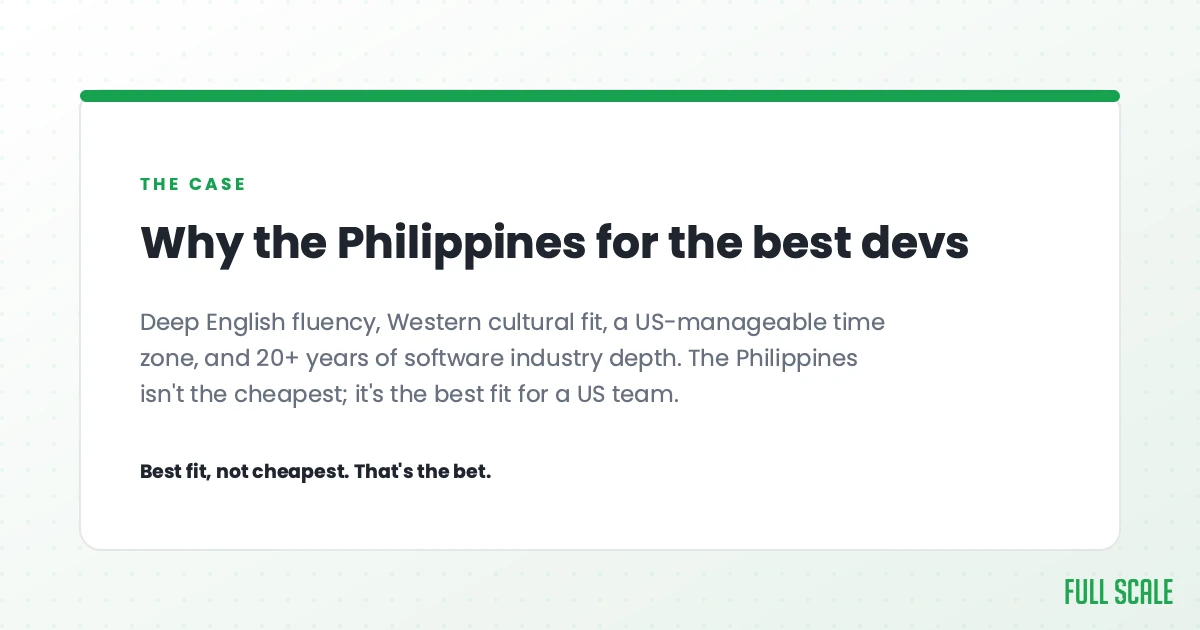
The Philippines is one of the best places in the world for it. It’s the third-largest English-speaking country on earth. Filipino engineers grow up speaking English and consuming American culture, so there’s no real language barrier on a call. The data agrees: the country ranks second in Asia for English proficiency on the EF English Proficiency Index, comfortably above the global average.
When a developer can say “I don’t understand this part” or “I think this spec is wrong,” you have a teammate. When they can’t, you have a problem no hourly rate can fix.
Filipino culture lines up with how Western teams work
The second reason is culture. Filipino culture is close enough to Western culture that integrating a developer into a US team just takes less effort.
Standups, code reviews, direct feedback, the normal back-and-forth of a workday, all of it feels familiar to them. You spend less time bridging a cultural gap and more time shipping software.
They make great teammates
Filipinos are some of the friendliest people in the world. It’s part of why they fill so many service and hospitality jobs across the globe, and it matters more on an engineering team than people expect.
A friendly, easygoing teammate who genuinely wants the project to go well is a gift at 9am on a rough Monday. That personality is close to perfect for a remote team, where most of your contact is a video call and a Slack thread.
The work ethic is real
Filipino developers work hard, and more than that, they don’t want to let you down. The pride they take in the work shows up once you’ve managed a team there for a while.
I give them a lot of the credit for why Full Scale has grown the way it has, and why our developer retention sits at 93 percent. I’ve laid out the fuller, personal version of why hire developers in the Philippines if you want the whole case. It is the same reason leased staff in the Philippines only pays off when you build a team you keep.
The talent pool is deep enough to bet a company on
There’s one more reason, and it’s the one buyers worry about quietly: is the supply real, or do I exhaust it after two good hires?
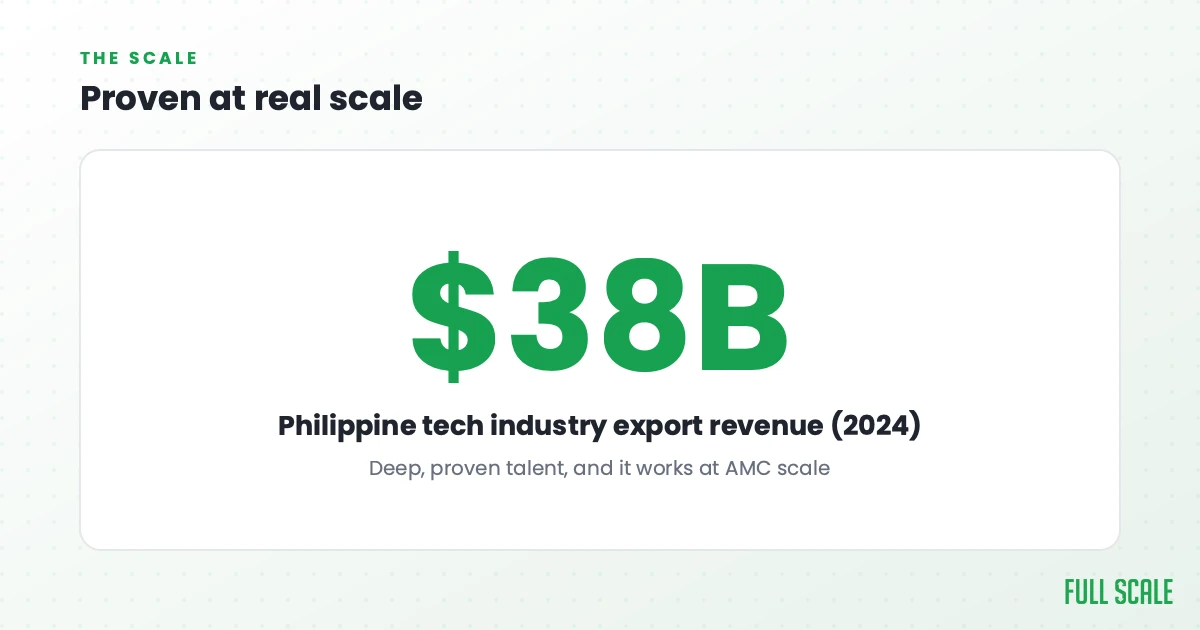
It’s real. The country’s IT and business process industry employs more than 1.8 million people and earned about $38 billion in 2024, with a steady pipeline of new IT and engineering graduates every year. You’re not fishing in a small pond. There’s enough senior talent to staff a team, replace someone who moves on, and keep growing, which is the difference between a lucky hire and an offshore model you can actually build on. We set that against the wider market in our IT staffing report.
It works at Fortune 500 scale, just ask AMC Theatres
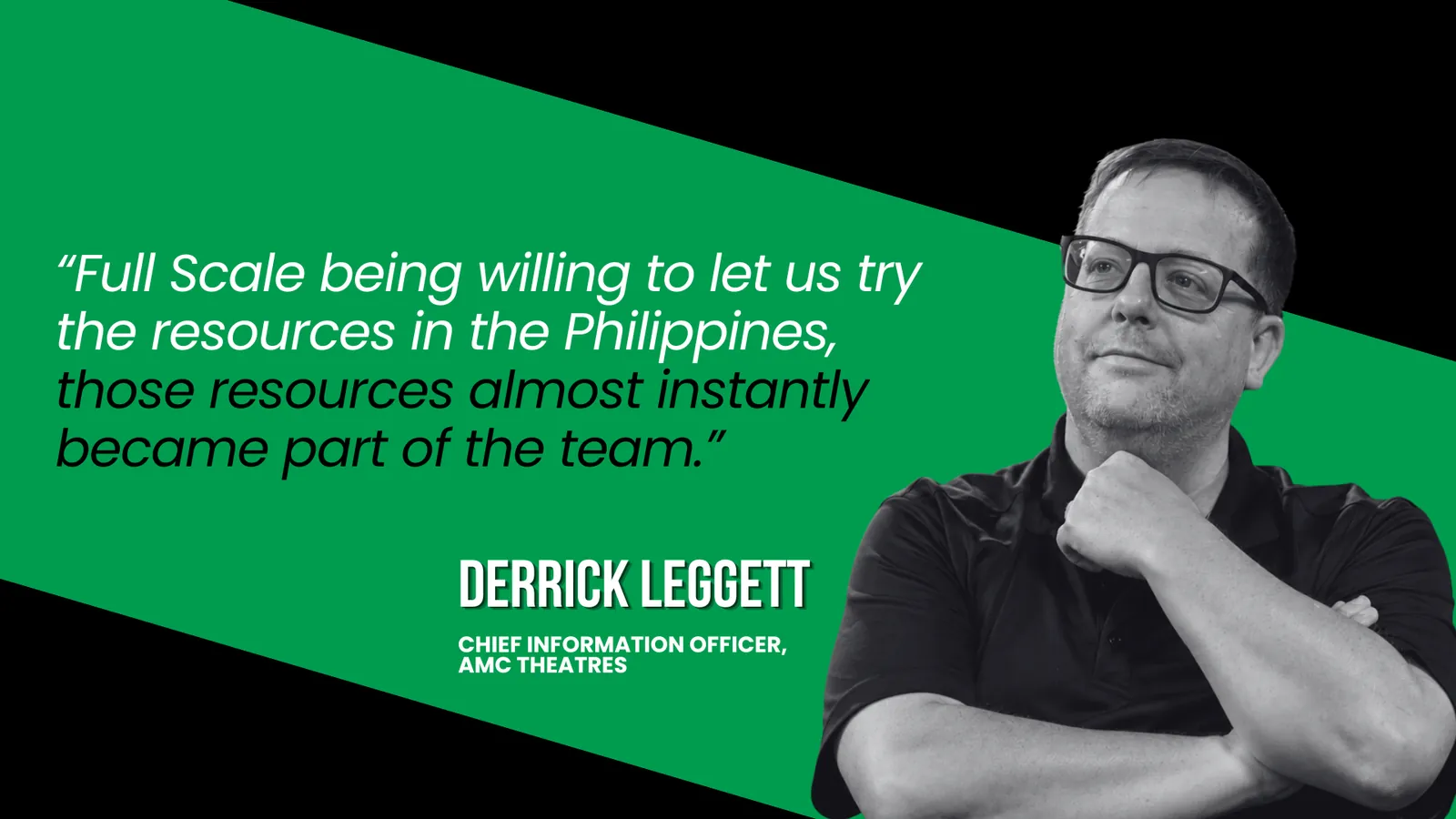
If you think this only works for scrappy startups, look at AMC Theatres. Their CIO built a global engineering organization where developers in the Philippines are treated as full AMC engineers, not contractors held at arm’s length. They join the same code reviews, hold to the same standards, and own their piece of the product like anyone else on the team.
That’s a household name running serious, high-stakes software with Filipino engineers on the team. If it works for a company that size, the question almost answers itself: why wouldn’t it work for you?
The real reason offshore hiring fails isn’t the talent
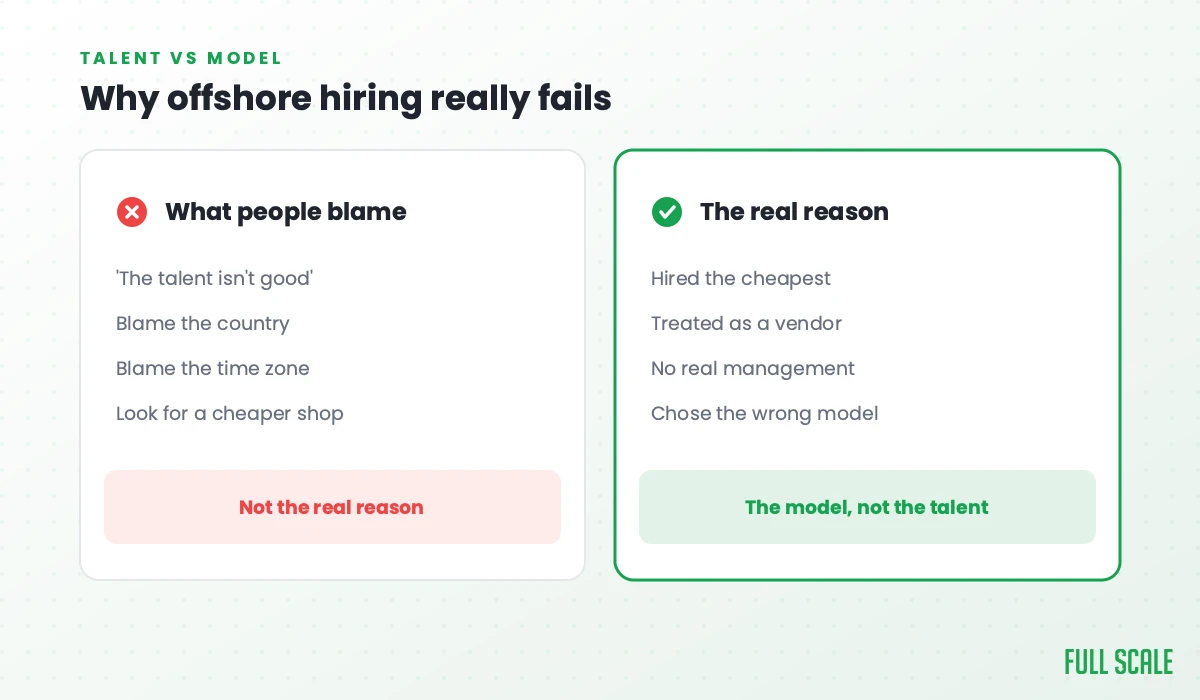
Now the honest part. Plenty of people have had a miserable experience with offshore developers, so they walk into the next attempt expecting it to fail. Often it does, but usually not for the reason they think.
Hiring software developers goes wrong when you don’t have the right engineering leadership. That’s true onshore too. It’s just more obvious offshore, where you can’t lean on hallway conversations to paper over the gaps. The model you pick matters too: how offshore software development actually works explains why staff augmentation succeeds where the traditional agency model doesn’t.
The teams that fail are the ones that skip the management time. They hand over a pile of requirements, dodge the daily meetings, and hope something good comes back. It doesn’t, and then they blame the country.
The teams that succeed do the opposite. They meet with the developers every day. They give them the vision, the focus, and the clarity to understand what they’re building and why it matters. Over time they hand them real ownership of the work and treat them like part of the team, because they are. None of that is a Philippines thing. It’s just good engineering leadership, and it’s the heart of the Product Driven approach I wrote about in my book.
The full setup for running an outsourced development team this way, from accountability structure to daily communication, is what I’ve written about separately for founders who want the complete model.
And yes, sometimes the real problem is that you hired weak talent. That happens anywhere. But the best offshore developers really are in the Philippines, and you only find them if you come in with an open mind and put in the leadership time. Skip that, and no country on the map will save you.
Jason Flowers, who leads engineering and DevOps at AG Mednet, is the proof. He had failed at offshoring before he tried the Philippines, which is exactly why his advice carries weight:
It’s right for folks who’ve failed at offshoring before. They haven’t tried Full Scale in the Philippines. Give it a try again.
Jason Flowers, Head of Software Engineering and DevOps at AG Mednet, on working with Full Scale
How to hire the best offshore developers in the Philippines
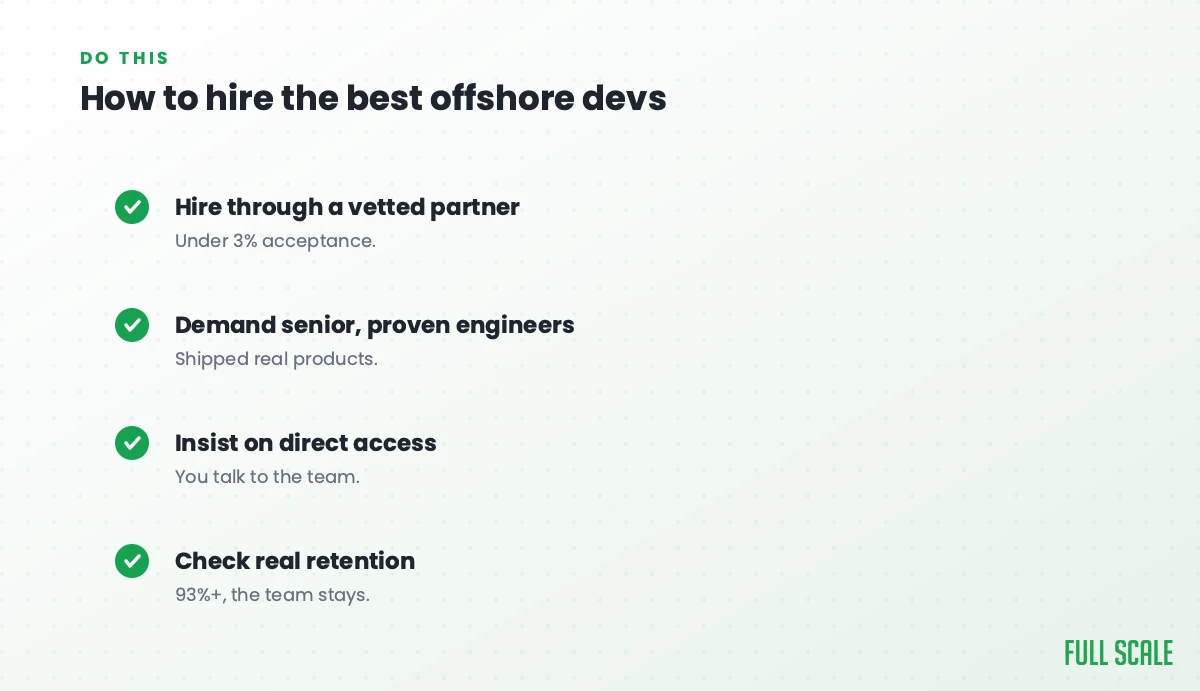
When people ask me how to hire offshore developers, my answer is always the same: hire a dedicated team, not a project handoff. You want dedicated offshore developers who work directly for you on a long-term basis, the same way an in-house hire would, just based in the Philippines. It also helps to walk in knowing what Filipino engineers actually earn, so your offer lands at the top of the local market.
Be realistic about the time zone. The Philippines is about 14 hours ahead of the central US, so you don’t get the natural overlap you’d get from Latin America. What you get is overlap by design. Most of our clients run a half-day overlap of three to four hours, which turns out to be plenty, and some teams work full US hours.
If you’d rather have the senior engineers, the vetting, and the day-to-day management support handled for you, that’s the whole job at Full Scale. You can hire dedicated developers in the Philippines and have them in your standups within a couple of weeks. Smart people are everywhere. Your job is to lead them well.
Frequently Asked Questions
Which country has the best offshore developers?
After hiring across four countries, my answer is the Philippines. It offers the best mix of English fluency, cultural fit with Western teams, and work ethic for building a long-term software team, which matters far more than shaving a few dollars off an hourly rate.
Why are developers in the Philippines so good at English?
English is an official language in the Philippines and the medium of instruction in schools, and the country is the third-largest English-speaking nation in the world. Filipino engineers grow up speaking it and consuming American media, so communication on a daily standup feels natural rather than strained.
How much do offshore developers in the Philippines cost?
We pay our Filipino developers at the top of the local market. Hired through a staffing partner, a senior engineer typically runs $30 to $40 an hour to the client, compared with $80 to $150 for a comparable US hire. For a fuller breakdown, see our offshore pricing.
Are offshore developers worth it?
They’re worth it when you treat them as a long-term team and invest the leadership time, and they’re a headache when you treat them as a cheap place to dump a project. The deciding factor is your management, not the developers, as the return on an offshore team shows once it’s set up right.
How do I make sure offshore developers communicate well?
Hire for English fluency and for the willingness to speak up, keep video calls non-negotiable so you can see whether someone understood you, and run a real daily standup. Communication is the actual job, so screen for it as hard as you screen for technical skill. That shift is the biggest change in evaluating a developer’s skills for a remote role. The best hires now are offshore developers who know how to use AI to do the work of several. That’s the same standard we hold to when we help companies hire vetted offshore developers, not just fill a seat.