
How to Choose an Outstaffing Company: 5 Questions That Actually Matter

In this article
- What an outstaffing company actually is
- 1. Who actually employs the developers, and who’s accountable when something goes wrong?
- 2. How do you find developers, or do you just screen whoever applies?
- 3. What’s your retention rate, and what do you do to keep people?
- 4. Will I talk to the developers directly, or to an account manager who hides them?
- 5. What happens when I just want the cheapest option?
- A good outstaffing company wants you to ask these questions
- Frequently Asked Questions
I run an outstaffing company. So when I read most of the “how to choose an outstaffing company” guides out there, I notice what they leave out. Before you choose, understand the difference between a PEO, an EOR, and staff augmentation.
They tell you to check reviews, look at a portfolio, and “assess cultural fit.” That advice isn’t wrong. It’s just the easy stuff, and it’s the stuff every vendor is ready for. The questions that actually tell you whether a partner is real or whether you’re about to hire a body shop are the ones the guides skip, because the people writing them have never sat on my side of the table.
I’ve heard the horror stories. A founder who fired a developer, only to have that developer hold the codebase hostage on the way out. Another who hired a “remote engineer” who turned out to be working from North Korea. A long line of people who came to Full Scale tired of the freelancer circus, where the person you hired ghosts you the week you need them most.
Almost all of that traces back to one thing: they picked the wrong partner, and they picked it by asking the wrong questions.
Here are the five I’d want you to ask any outstaffing company before you sign. Including mine.
What an outstaffing company actually is
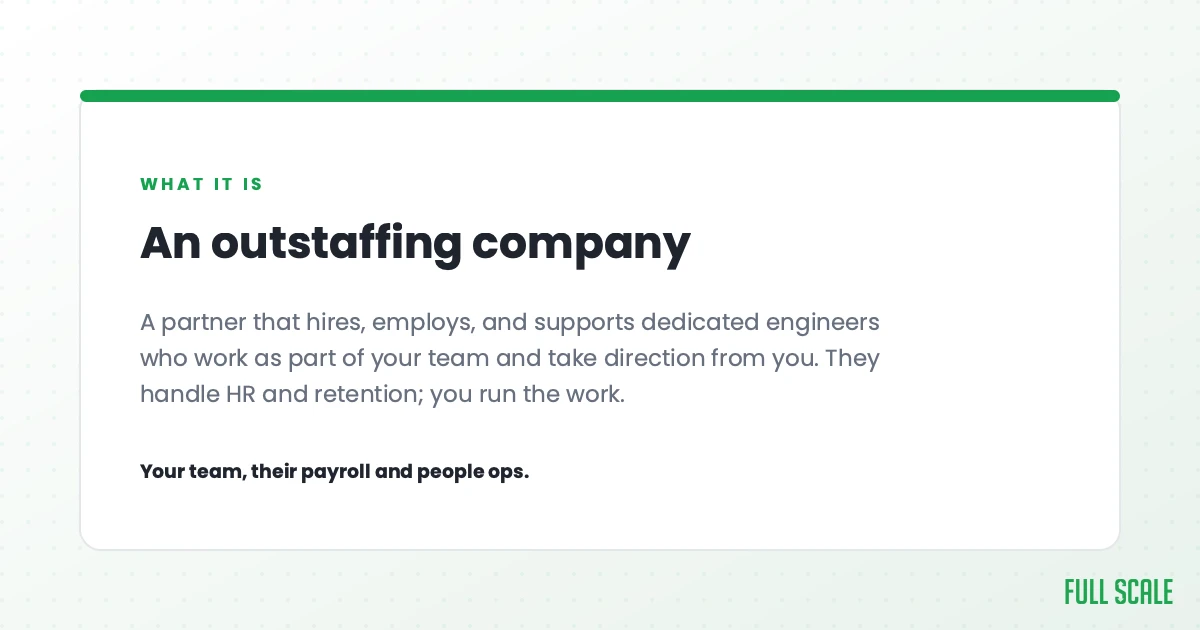
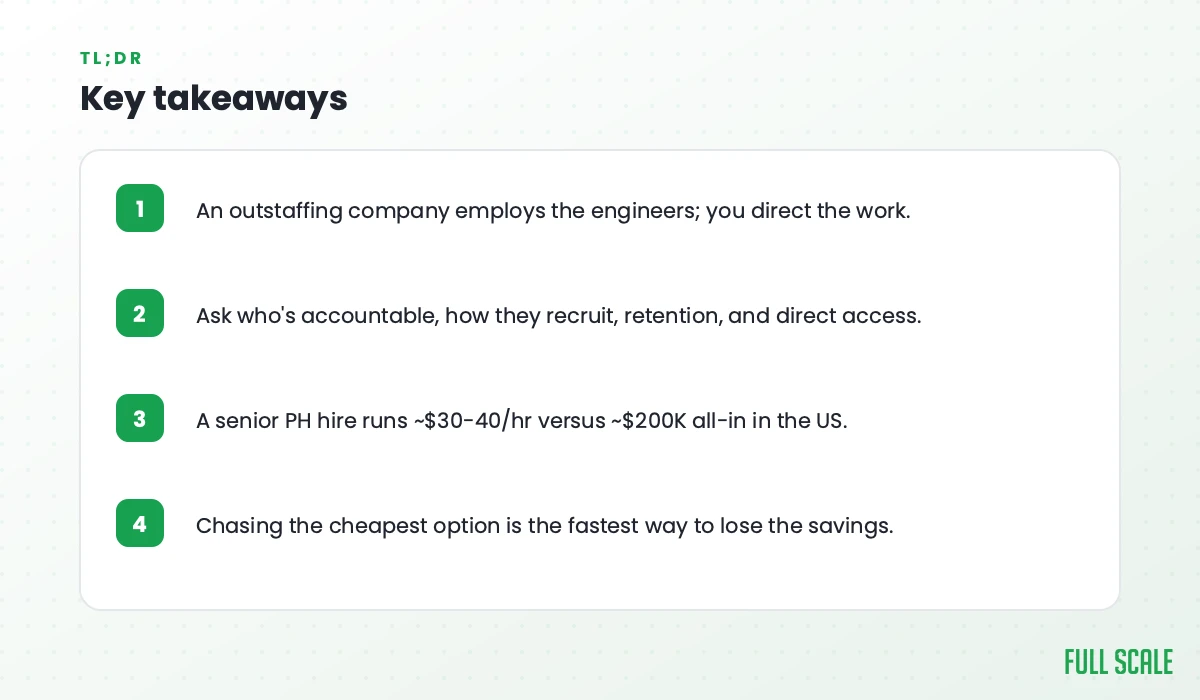
An outstaffing company hires developers who work exclusively on your projects, under your day-to-day management, while the outstaffing firm stays the legal employer and handles payroll, HR, equipment, and compliance.
That last part is the whole point. You direct the work. They carry the employment.
Done well, the benefits of outstaffing are real: senior talent without the cost of direct employment, and the freedom to scale up or down as the work changes.
It’s the same arrangement whether the marketing calls it outstaffing, team extension, or staff augmentation. The label changes; the criteria for picking a good one don’t. (If you’re still deciding between this and handing off a whole project, that’s the outsourcing versus outstaffing question, and it’s a different decision.)
So the real work isn’t understanding the outstaffing model. It’s figuring out which vendor will actually deliver on it. That’s what the five questions are for.
1. Who actually employs the developers, and who’s accountable when something goes wrong?
This is the question that separates a company from a marketplace, and most buyers never ask it.
When you work with a US-based outstaffing company, you sign your confidentiality, IP-assignment, and contract terms with the vendor. One US company, governed by US law. If something goes sideways, you’re enforcing an agreement you understand in a court system you understand.
Compare that to the alternatives. A freelancer in another country can vanish and leave you with no real recourse. With a foreign-only firm, any dispute plays out in a court system you’ve never dealt with. And stringing together five contractors across five countries just multiplies the problem.
The accountability only works if the developers are actual employees of the vendor, not contractors the vendor found for you.
That distinction is everything. Our developers are Full Scale employees. That gives us real authority to hold them accountable, and it means an engineer won’t ghost the way a freelancer can, because they answer to their employer, not just to you. The code-hostage story I mentioned earlier doesn’t happen when there’s a real company standing behind the person.
In the entire history of Full Scale, we’ve never had a single IP or confidentiality issue. I’ll say that plainly because I can.
So ask the vendor directly: are these your employees, or are you reselling contractors? Who signs the IP agreement? What’s my recourse if a developer walks off with my code? A real partner has a clean answer. A body shop changes the subject.
2. How do you find developers, or do you just screen whoever applies?
Every vendor says their developers are “pre-vetted” and “hand-picked.” It’s the most meaningless claim in the industry, because it describes posting a job and reading the resumes that come in.
Here’s what 25 years of hiring taught me: the best developers are not looking for a job. They already have one, and they’re good enough that they’re not browsing job boards. The people who flood your job post have often applied to a hundred roles in six months and landed none of them.
If a vendor’s entire recruiting strategy is screening inbound applicants, they’re fishing in the wrong pond.
Finding the good ones takes active work. At Full Scale we run several full-time, in-house recruiters whose only job is to find the strongest engineers in the country and recruit them away from their current employers, backed by referrals from our team of 350-plus engineers. That’s a different motion from “we’ll screen who applies,” and it’s the harder, more valuable half of the job.
Then there’s vetting, which is where most people don’t even know what to ask. Our background checks in the Philippines go further than what’s normal in the US:
- Character reference checks with people who actually know the candidate
- Education verification to confirm the degree is real
- An NBI criminal-record check, the Philippine equivalent of an FBI check
- And a neighborhood check, where we physically talk to a candidate’s neighbors about who they are
That last one surprises people. Philippine addresses don’t always map to a clean street address, so new employees draw a hand-drawn map showing where they live. It’s the kind of detail nobody thinks about until they’re trying to hire across a border on their own.
Ask the vendor how they source. If the answer is “we screen applicants,” keep looking.
3. What’s your retention rate, and what do you do to keep people?
This is the question nobody asks, and it’s the one that costs the most when you skip it.
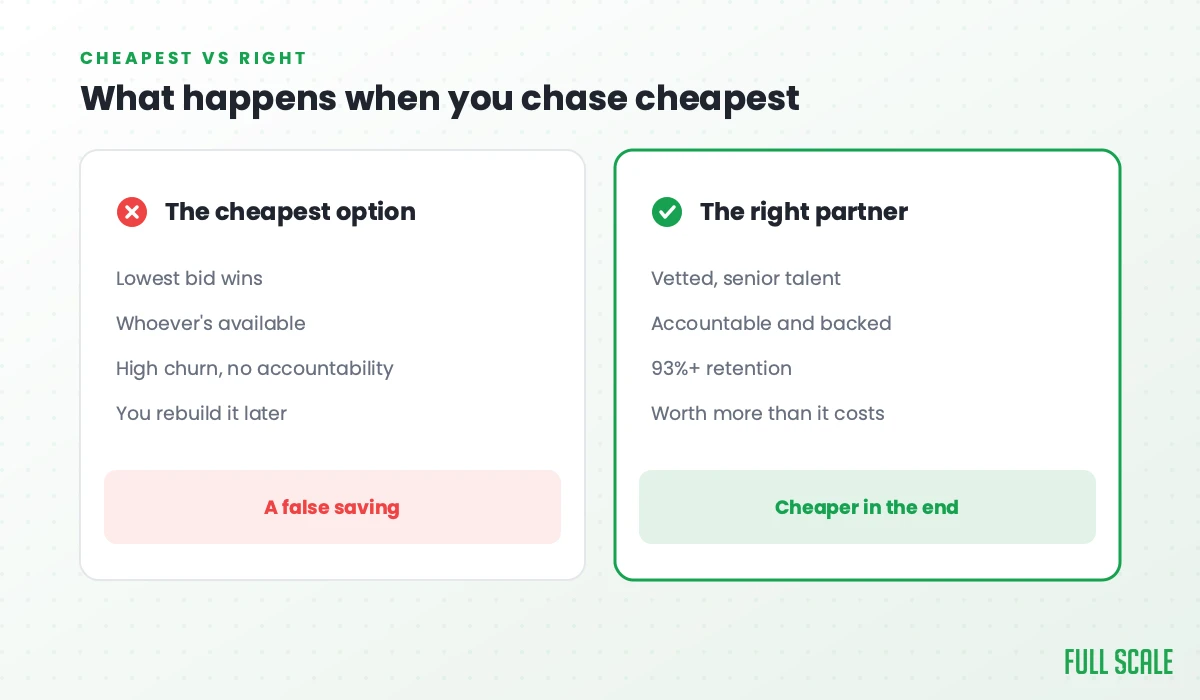
You can hire a great developer and still lose, because if that developer quits four months in, you’re back to square one: re-recruiting, re-onboarding, and re-explaining your codebase to a stranger. A cheap developer who churns is more expensive than a good one who stays.
Turnover in offshore staffing can be brutal. The Philippine call-center and BPO industry, for comparison, runs some of the highest attrition of any sector in the country, with voluntary attrition reported around 30 percent in 2023. A vendor that loses a third of its people every year is a vendor whose instability becomes your instability.
Our developer retention is over 93 percent. Most of the tech industry sits closer to 75 or 80 percent, and plenty of offshore shops are well below that. Holding 93 isn’t an accident, and it isn’t luck.
Retention is a feature you’re buying, not a number you hope for.
A big part of how we hold it is a role we call the Customer Success Manager, which is deliberately not the same as an “account manager.” Their job isn’t to renew a contract. It’s to make sure the engagement works for you and that the engineers stay happy and supported. They have the hard conversations behind the scenes, the ones a client can’t easily have directly with an offshore engineer and the ones the engineer can’t easily raise with the client. That relief valve is a real reason people stay.
Being a place people want to work helps too. Full Scale is Great Place to Work Certified in the Philippines, with 95 percent of employees saying it’s a great place to work versus 65 percent at a typical company there.
So ask: what’s your retention rate, and what specifically do you do to keep developers? A vendor that’s proud of the number will tell you fast. A vendor that dodges is telling you something too.
4. Will I talk to the developers directly, or to an account manager who hides them?
There’s a vendor pattern I want you to watch for, because it’s common and it’s a trap. One account manager fronts a team of five or more developers you never actually talk to. Communication runs through that one person, barely flows, and when something breaks, no one is really accountable.
That’s the middleman anti-pattern, and it’s a vendor-side problem specifically.
You should be in direct daily contact with the developers building your software. They should be in your Slack, in your standups, and accountable to your product manager, working like members of your team rather than a department behind a curtain.
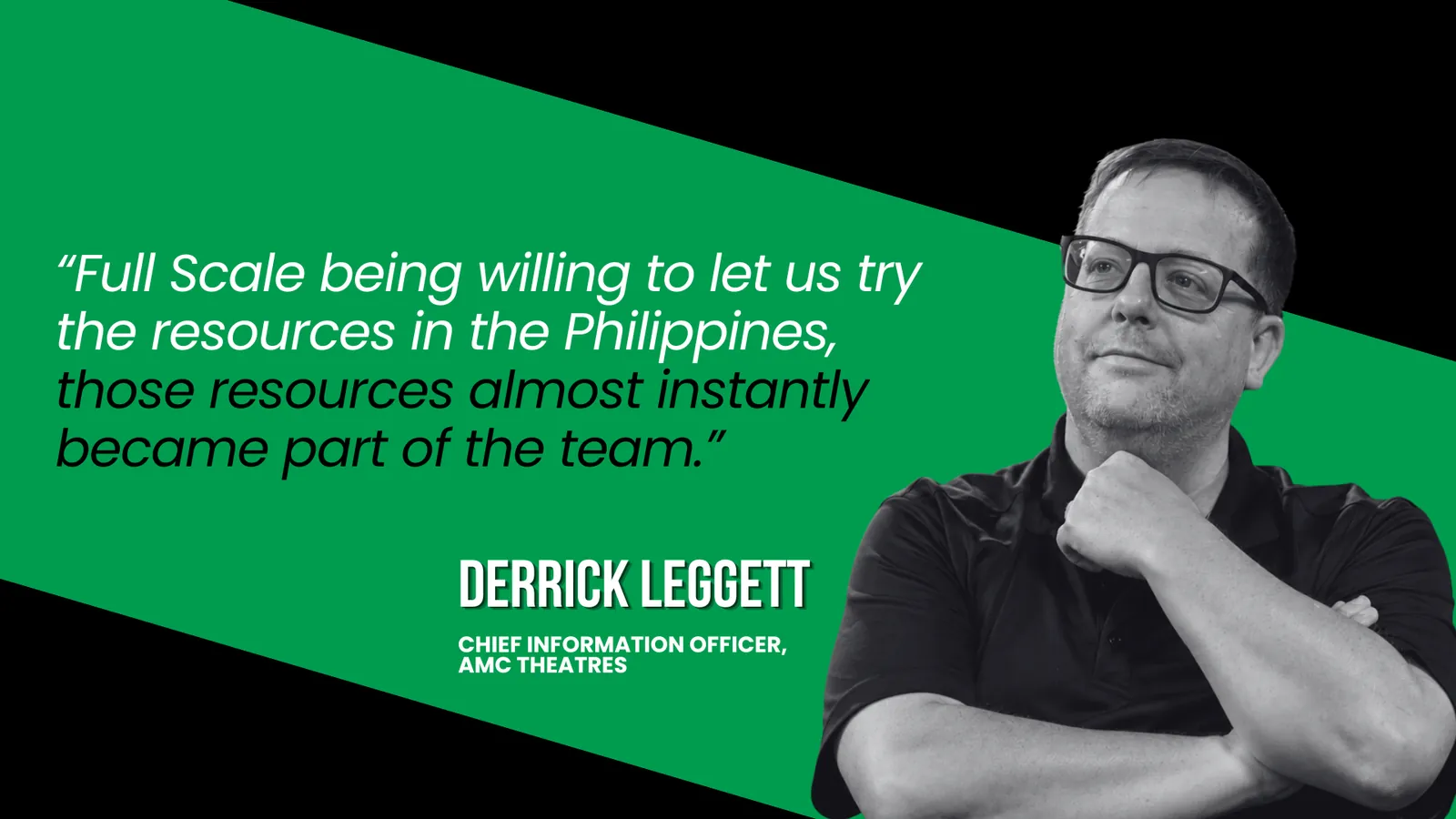
That’s how AMC Theatres runs the Full Scale developers on their team. They’re treated as full AMC engineers, held to the same code review and standards as everyone else, not as outside help kept at arm’s length. Their CIO, Derrick Leggett, puts it plainly: “It’s a fully integrated team. It’s just some of the people happen to be living in the Philippines.”
Working directly only matters if you can actually reach people, which brings up the clock. The Philippines is about 12 hours ahead of the US, so a distributed team lives or dies on overlap. We aim for three to four hours of shared working time with your engineering hours, which is enough for standups, code review, and the quick back-and-forth that keeps work moving. If a vendor won’t commit to a real overlap window, that friction shows up in every sprint, so ask for the number.
One nuance worth getting right: a point person on your side is not a middleman. If you have a founder, a VP of Engineering, or a fractional CTO coordinating the work, that’s leadership, and it’s exactly what the engagement needs. The test is whose payroll the manager is on, and whether you still have direct contact with the engineers.
In fact, accountability has to sit on your side. A vendor can’t credibly grade its own homework. Think of it like a home renovation: you hire a general contractor you trust, you stay involved, and the contractor manages the trades.
If you have no engineering leadership of your own, the honest advice is to get a technical leader who works for you first, rather than trusting the vendor to run everything. The teams that own what they’re building, rather than just taking tickets, are the whole idea behind Product Driven.
Ask whether you’ll work with the developers directly or through a gatekeeper. The answer tells you what kind of company you’re dealing with.
5. What happens when I just want the cheapest option?
Most people shopping for an outstaffing company are partly shopping on price. That’s fine. But there’s a specific way it goes wrong, and it has a name.
I call it cheapshoring: hiring the absolute cheapest developers you can find, from the lowest-bid shop or a random freelancer marketplace, and optimizing for the rate alone. It almost never works. You save money now and lose more later, in rework, missed deadlines, and the churn from question three.
Here’s the part worth understanding, because it’s where the real opportunity is. Hiring globally is dramatically cheaper than hiring in the most expensive US markets, at the same quality. Those two facts live together.
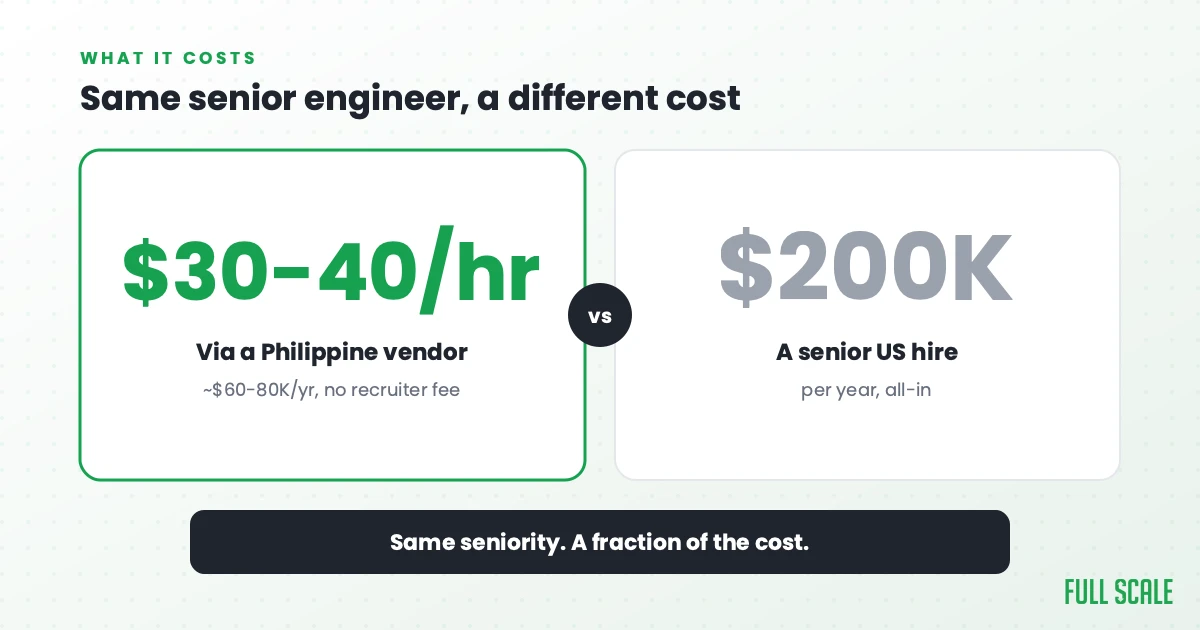
A senior US developer costs a lot more than the salary alone. The Bureau of Labor Statistics puts the median software developer base pay around $133,000, and senior engineers run higher, often $160,000 or more. Load on benefits, payroll taxes, equipment, and overhead, which MIT’s standard estimate puts at 1.25 to 1.4 times base, and a senior US hire lands around $200,000 a year, all in. That’s before the recruiter fee to find them, which in my experience runs 20 to 25 percent of first-year salary, up to 30 percent for senior roles (Eddy puts the agency range around 15 to 25 percent).
That same senior engineer, hired through a vendor in the Philippines, bills somewhere around $30 to $40 an hour. That works out to roughly $60,000 to $80,000 a year, all in, with no separate recruiter fee on top. Same skill, about a third of the cost.
Paying three times the price for a US zip code is not the same as paying for three times the skill.
The right move is high-quality talent, hired globally, from a vendor you trust. That’s the actual arbitrage, and it’s a different thing from cheapshoring.
One more thing to ask in 2026: how do your engineers use AI? I half-joke with clients that we’re all paying developers to babysit AI now, reviewing what it generates and steering it toward something useful. It’s an oversimplification, but it’s not entirely wrong, and it raises the bar. A good vendor is training engineers to think about the product, not just to produce code an AI could write. That’s the difference between a software developer and a code typist, and it’s what you don’t want to cheap out on.
A good outstaffing company wants you to ask these questions
Here’s the meta-point. A real partner welcomes all five of these questions, because the answers are their advantage. A body shop deflects, hedges, or redirects you back to the portfolio and the reviews.
That’s the actual test: not the polished website, but the willingness to answer hard questions plainly.
Full Scale has placed more than 700 developers with clients since 2018 and works with over 200 tech companies, and the thing we sell isn’t a low rate. It’s the hard part: recruiting developers who are genuinely good, managing the engagement so it works, and keeping people long enough that your team stays stable. When it’s done right, the developer wins, the client wins, and so do we.
If you’re weighing outstaffing partners and want to put these five questions to a real one, book a call with our team. Ask us the hard ones. That’s the point.
Frequently Asked Questions
What is the difference between outstaffing and outsourcing?
With outsourcing, you hand an entire project to an outside company and they control how it gets built and delivered. With outstaffing, you hire developers through a third-party employer to extend your own team, and you keep day-to-day management and control. Outsourcing is hands-off; outstaffing keeps you in the driver’s seat.
Can I hire just one developer, or do I need a whole team?
Either. A good outstaffing company can place a single specialist to fill one skill gap or assemble a full team for ongoing product work. The model flexes to what you actually need, which is one of its main advantages over a fixed scoped project.
What should I ask an outstaffing company before signing?
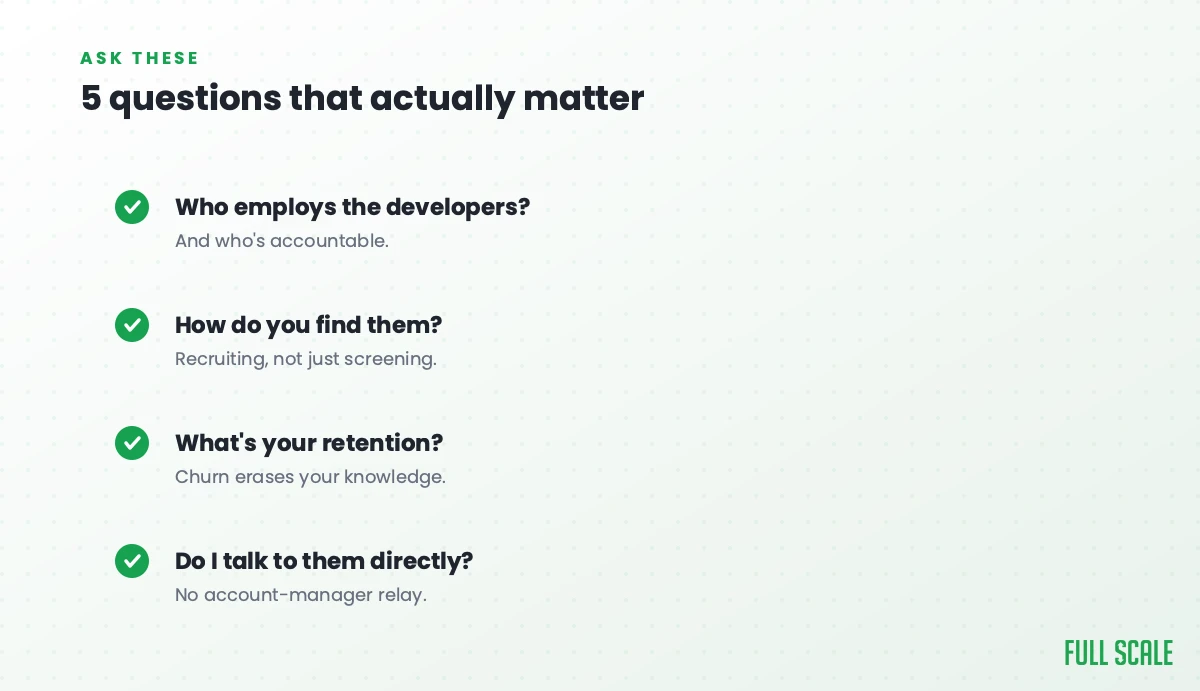
Ask who legally employs the developers and who’s accountable if something goes wrong, how they find and vet engineers, what their developer retention rate is, whether you’ll work with the developers directly or through an account manager, and how they think about cost versus quality. The answers separate a real partner from a body shop faster than any portfolio.
Where are the best outstaffing developers based?
The Philippines is one of the strongest places to hire software talent. It’s the third-largest English-speaking country in the world, has a deep IT talent pool, and offers a large cost advantage at quality parity. It’s where Full Scale builds its teams.