IT Staff Augmentation: What It Actually Means, From Someone Who’s Placed 700+ Engineers

In this article
- IT staff augmentation means the engineer joins your team, not a vendor’s
- Where staff augmentation sits between outsourcing and a straight hire
- What a traditional IT staffing agency actually costs you
- When staff augmentation actually works
- When staff augmentation doesn’t work, and nobody selling you the guide will say so
- What this looks like on an actual team
- The numbers, since every other guide dodges them
- Where to go from here
- Frequently asked questions
I read a dozen “IT staff augmentation guides” this month, since I was curious what my own industry tells people before they ever call a company like mine. The worst one ran forty-three subheadings deep and still never said what any of it costs. Not one of the twelve named an actual client, and not one admitted there’s a version of your situation where this is the wrong call.
I run one of the companies that would show up in that search, so consider the bias disclosed upfront. What I won’t do is hand you the same vague “it depends” that got twelve other guides written in the first place.
Here’s IT staff augmentation, straight, including the parts the “complete guides” leave out.
IT staff augmentation means the engineer joins your team, not a vendor’s
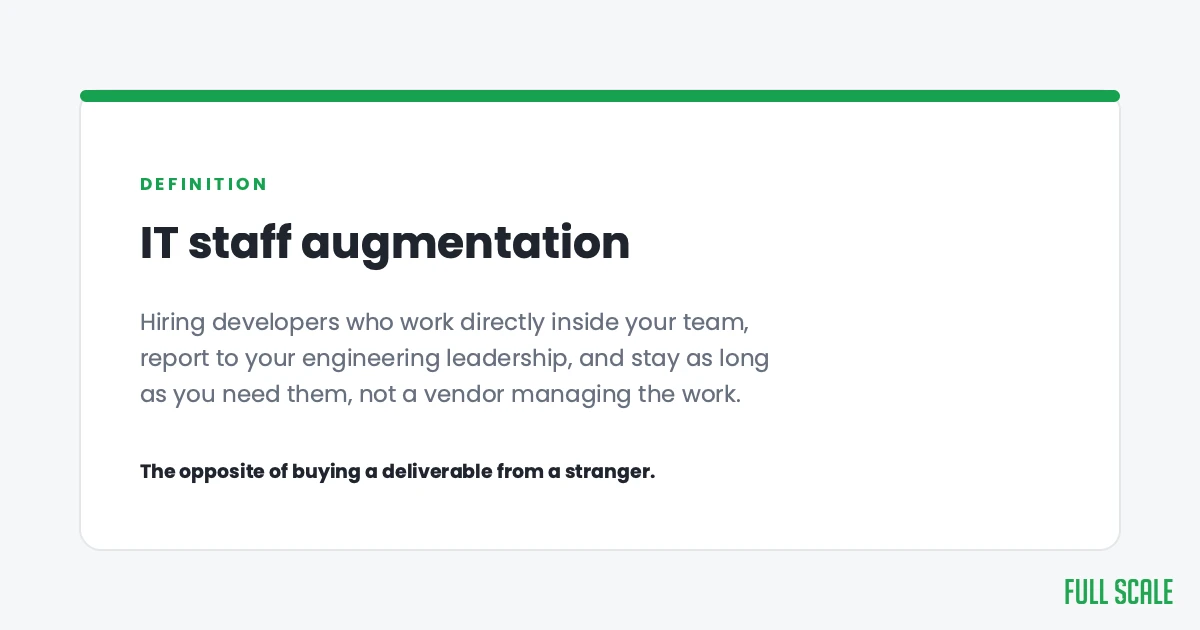
The clean version: IT staff augmentation is hiring individual developers, QA engineers, or DevOps specialists who work directly inside your team, not through a separate company that manages the work for you. They join your standups and push to your repo. They report to your engineering leadership, not to an account manager on the other side of a contract.
That’s different from the fuzzy definition most glossaries use, something like “temporary workers who supplement your team.” Temporary is the wrong word for what actually works. Staff augmentation answers one question: are you buying a deliverable, or building a team? Everything else follows from that one choice. It’s the same ownership argument I make in Product Driven: the team that owns the outcome builds better software than the team that’s just executing a spec.
I didn’t learn this from a market research report. I learned it in 2018, when I needed ten more developers for Stackify, my second startup, and Kansas City wasn’t going to get me there fast enough. A friend introduced me to developers in the Philippines, people I’d add to a team on reputation alone. Every Filipino coworker I’d had up to that point was sharp, easy to work with, and better at English than half the Americans I’d hired.
Those developers weren’t a vendor handing off tickets. They were on our team, in our Slack, running our standups, the same model that decides the best offshore staffing partner for scaling engineering teams. The rest of that story, what it did for Stackify and how Full Scale grew out of it, is worth its own read. The short version: the staffing industry has a name for this now, and we were just trying to ship software.
There’s a question underneath every version of this search, and most guides never say it out loud: how do I keep control? Usually the person typing “IT staff augmentation” into Google has already been burned by a project vendor once, or heard enough horror stories to be careful. If that describes you and you're already mid-engagement, how to switch offshore development providers without losing the codebase is the more immediate question. That’s the actual thing staff augmentation has to prove, more than cost or speed. The developers report to you, and you direct the work. The staffing partner’s job is to disappear into payroll and HR, not to stand between you and your own team.
The American Staffing Association counted 12.7 million temporary and contract placements across the US in 2023. IT staff augmentation is the software-specific slice of that market, and it exists for the same reason every one of those placements exists: hiring permanent local headcount is slow, and the work doesn’t wait.
Where staff augmentation sits between outsourcing and a straight hire
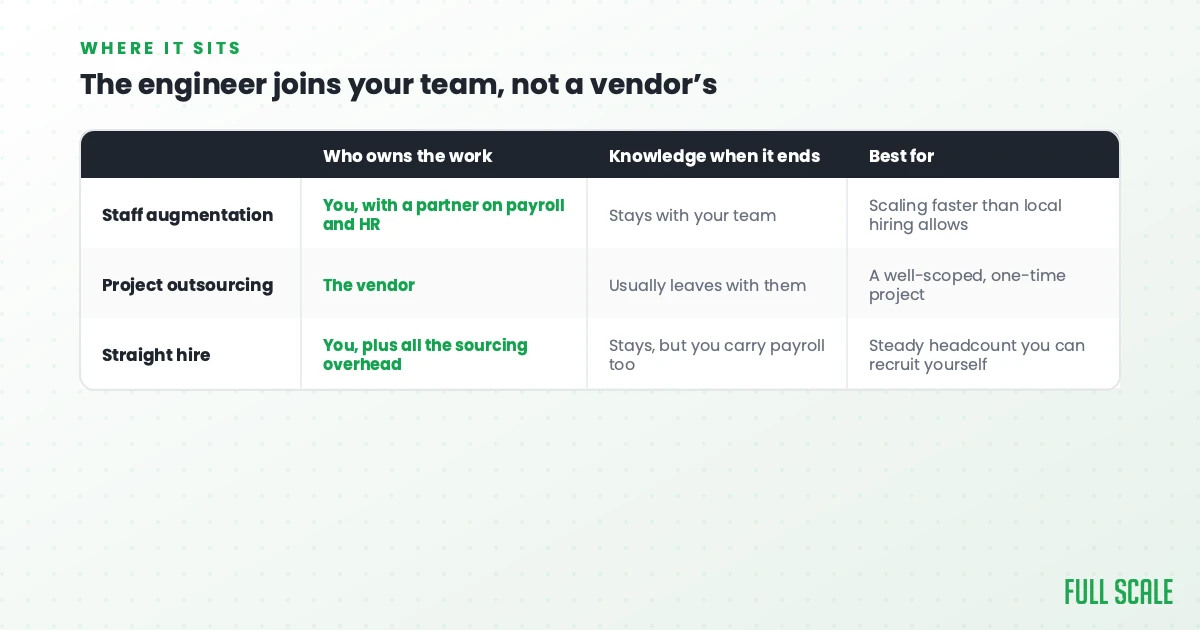
Three models get lumped together constantly, and the differences decide who owns your codebase in three years.
Project outsourcing hands a deliverable to a vendor. You describe what you want, they own how it gets built, and when the contract ends, the institutional knowledge usually leaves with them. It’s a fine model when you have a well-scoped, one-time project. I’ve used it myself, for a couple of WordPress builds and an Elasticsearch project, because I didn’t need a full-time WordPress developer once the site was live.
A straight hire is a full-time employee you recruit, onboard, and manage yourself, with all the sourcing time and payroll overhead that involves. An employer of record is a fourth, narrower option, useful when you’ve already found the person and just need someone to legally employ them in a country you don’t have an entity in; the EOR-versus-staffing comparison is its own question and worth reading separately.
Staff augmentation sits in between, but closer to the hire than the outsource. You get the engineer directly on your team, under your direction, for as long as you need them, while the staffing partner handles recruiting, payroll, benefits, and HR in the background.
| Who owns the work | Knowledge when the engagement ends | Best for | |
|---|---|---|---|
| Project outsourcing | The vendor | Usually leaves with them | A well-scoped, one-time project |
| Straight hire | You | Stays, but you own all the sourcing and payroll overhead | Steady headcount you can recruit fast enough yourself |
| Staff augmentation | You, with a partner handling payroll and HR | Stays with your team | Scaling faster than local hiring allows |
Three years from now, one of these rows still has your institutional knowledge sitting in a codebase you control, the only distinction on this table that actually matters once you’ve picked one. Staff augmentation versus outsourcing makes that argument out in full, if you want it.
What a traditional IT staffing agency actually costs you
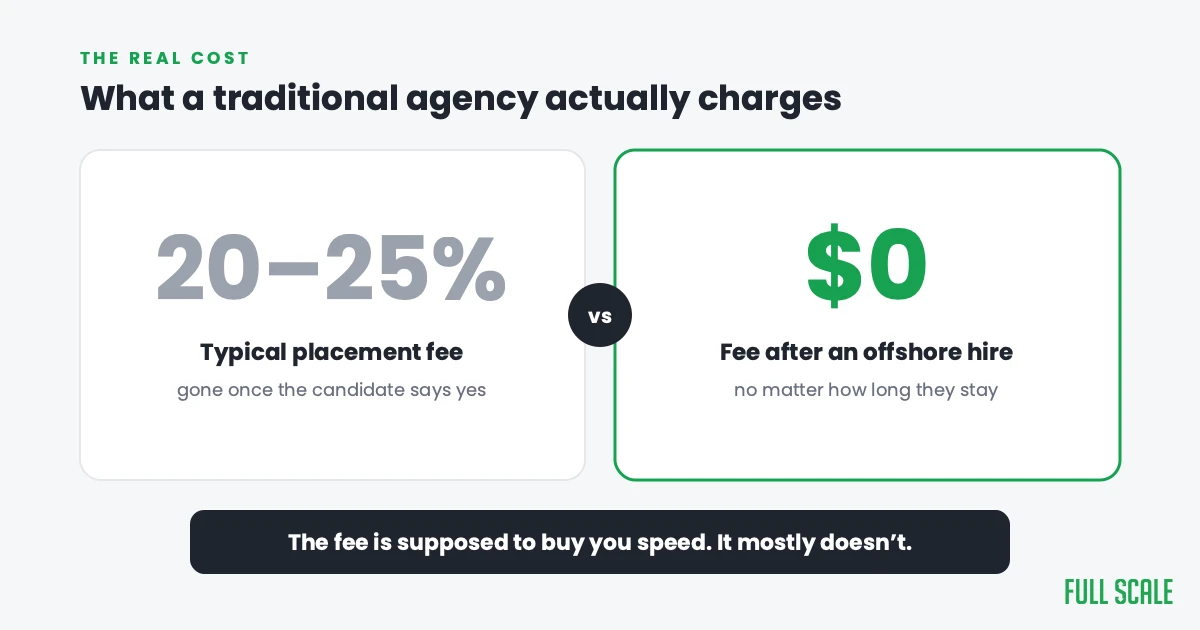
Our head of sales came from traditional IT staffing before joining Full Scale, and the math he described is not close. Placement fees start around 15 to 25 percent of first-year salary industry-wide, by Eddy HR’s own count. For developer roles specifically, what he’s seen runs higher, 20 to 25 percent, sometimes closer to 30 percent for a senior hire, stacked on top of an already-expensive US salary. That fee is gone the moment the candidate says yes, whether the hire lasts six months or six years. I’ve laid out the full math on why that fee rarely pays for itself elsewhere.
The fee is supposed to buy you speed, and it mostly doesn’t. Traditional placements commonly drag on for weeks while an agency sources, screens, and negotiates one candidate at a time. Offshore staff augmentation, done right, still gets a vetted senior engineer in front of you inside days. That engineer is onto the team in about two to three weeks total, with no fee owed after the hire. “Vetted” isn’t a throwaway word here either. We accept fewer than 3% of the engineers who apply to work with Full Scale, which is what the word is supposed to mean before anyone’s willing to attach a number to it.
Traditional staffing still has a place. If you need a genuinely hard-to-find local leader, a senior engineering manager or an on-site specialist, paying the fee for that one hire is worth it. It stops being worth it when it’s the default way you fill every open developer seat. You’re paying agency prices for a role a global market can fill faster and for less. A full breakdown of what those actual pricing models look like is worth reading before you sign anything.
When staff augmentation actually works
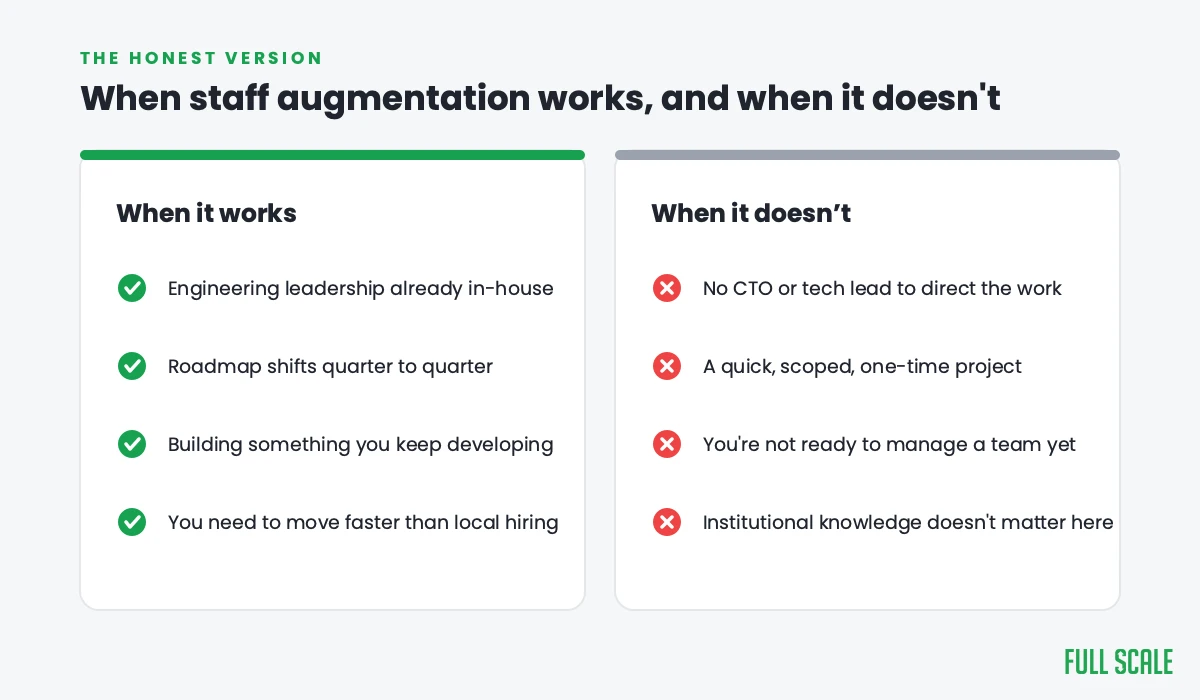
Staff augmentation works when you already have engineering leadership in-house and you need to build faster than local hiring allows. If someone on your team can own the roadmap, review the code, and direct the work, augmenting them with staff augmentation multiplies what that person can already do instead of replacing them.
It’s also the right call when the roadmap shifts quarter to quarter. A fixed-bid outsourcing contract assumes you know exactly what you’re building for the next six months, down to the ticket. Most product teams don’t. A client who plans to spend Q3 on a mobile rewrite and pivots to a compliance deadline in week three can redirect a staff-augmented team the same week; the same pivot means renegotiating a change order with a project vendor.
“If your team works well remotely, it will work well globally, too.” Direction is what makes that true, not skill.
When staff augmentation doesn’t work, and nobody selling you the guide will say so
There are two situations where I’d tell you not to do this, and I’d tell you even though it costs me a lead: no one in-house who can own the “what” and the “why” (you always need technical leadership in-house, full stop), or a quick, scoped, statement-of-work project like the WordPress and Elasticsearch work I mentioned earlier, where you don’t need the skill on staff after launch. I’ve made the full case for both elsewhere. The short version: hire a shop for the second one, and get real technical leadership in place before you try the first.
Staff augmentation is a commitment, but it’s not the kind that traps you. If it isn’t working in the first two weeks at Full Scale, you get your money back, and after that it’s 30 days’ notice to walk away, no long-term contract holding you in. Those are the real, written terms. If you’re not ready to manage a team even with an easy way out, don’t hire one yet.
What this looks like on an actual team
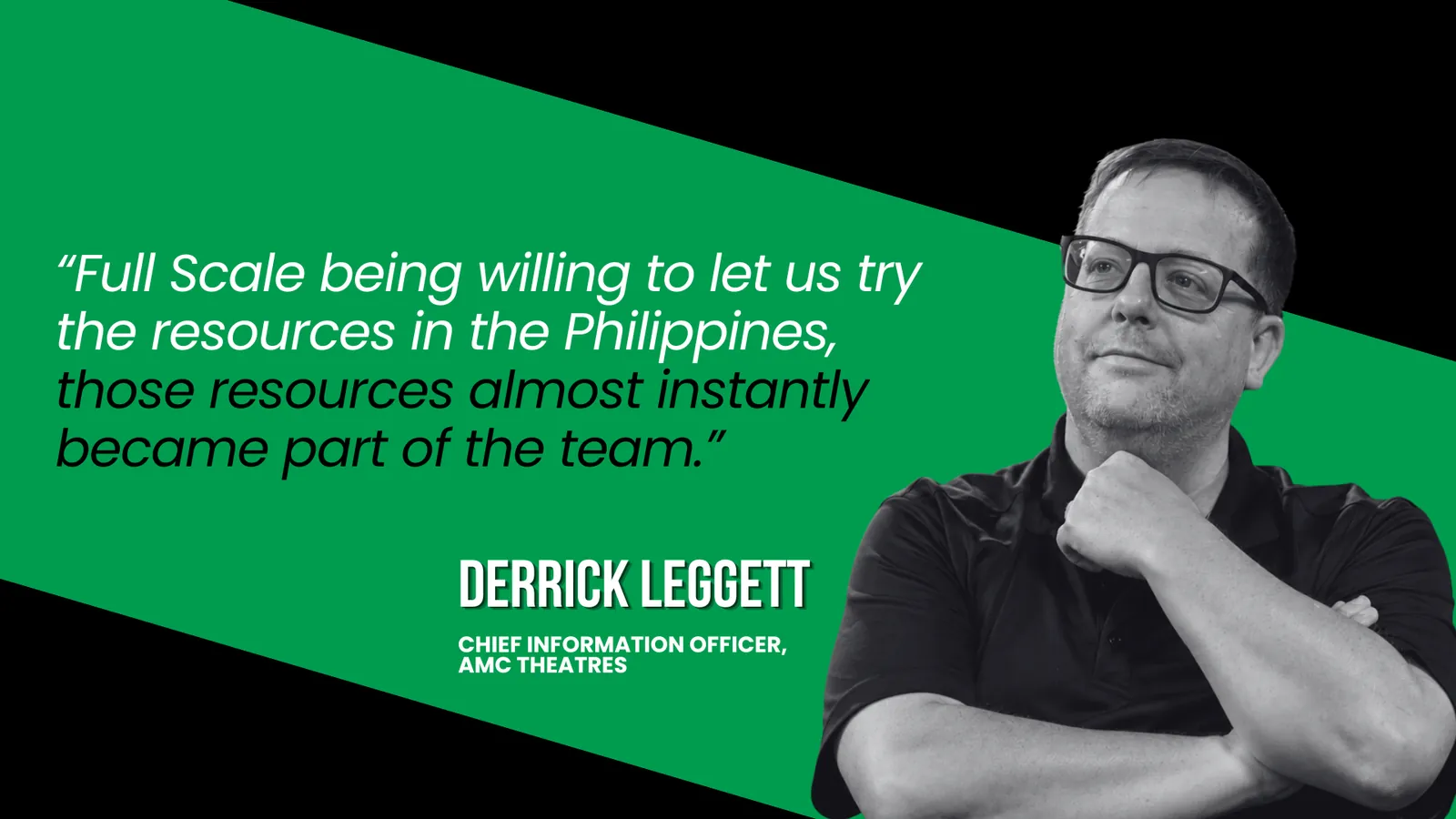
AMC Theatres runs its .NET engineering with a Full Scale team that CIO Derrick Leggett treats as full AMC engineers. It’s checkable, unlike a “many companies” claim you have to take on faith. Same Slack threads, same code review process, same standards as anyone sitting in a Kansas theater chain’s home office.
A vendor works behind a wall you can’t see through. The AMC team doesn’t. No one there is waiting for a deliverable to get thrown over a fence, and no one’s checking whether “AMC’s developers” actually means AMC’s developers or somebody else’s subcontractors wearing an AMC badge for the call.
The numbers, since every other guide dodges them
This is the checklist version, the one you should hand any vendor before you sign anything, since “cost-effective” and “highly skilled” aren’t figures:
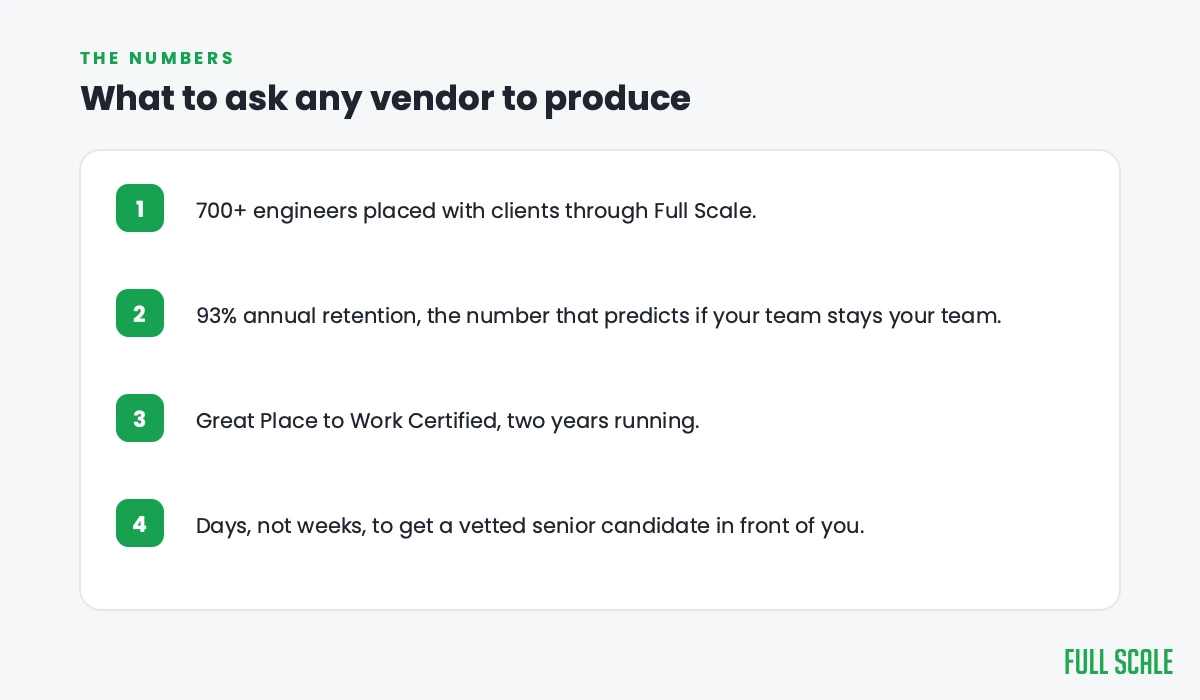
- 700+ engineers placed with clients through Full Scale, 200+ US companies staffed since 2018
- 93% annual retention. SHRM puts the cost of replacing a technical employee at 50 to 200 percent of their annual salary once you count the ramp time and the institutional knowledge that walks out the door. A boring retention number is the most expensive line item to get wrong
- Great Place to Work Certified, two years running, with 95% of our Philippines team saying it’s a great place to work, against 65% at a typical company there
- The rest of the scorecard, 700+ engineers placed, 200+ companies staffed since 2018, and days instead of weeks to see a candidate, is the same math behind everything above
A company that can’t produce these numbers, especially the retention rate, is telling you it hasn’t measured whether its own model works.
Where to go from here
Everything above comes back to the same choice: a deliverable from a stranger, or a team you actually direct. If you already know which one you want, here’s where the real follow-up questions get honest answers:
- Choosing a partner: how to vet an IT staff augmentation company without falling for the resume-count trick
- What it costs: the actual pricing models, spelled out instead of left vague
- “Affordable” versus cheap: why the cheapest bid usually costs more, a mistake I call cheapshoring
- The offshore-specific version: where offshore staff augmentation actually breaks, and how to avoid it
- The fuller comparison: the deliverable-versus-team argument, made out in full
- Where AI fits: what “AI staff augmentation” actually means, since that phrase gets used three different ways
Frequently asked questions
What is IT staff augmentation?
IT staff augmentation means hiring individual developers, QA engineers, or other technical talent who join your team directly and work under your engineering leadership, while a staffing partner handles recruiting, payroll, and HR. The meaning that actually matters: you’re building a team, not buying a deliverable from a vendor.
How is IT staff augmentation different from outsourcing?
Outsourcing hands a project to a vendor who owns how it gets built and usually takes the institutional knowledge with them when the contract ends. IT staff augmentation puts the engineer on your team, under your direction, for as long as you need them, so the knowledge stays with you.
What are the benefits of IT staff augmentation?
The real benefits are speed and continuity: you can scale a team faster than local hiring allows, keep the roadmap flexible instead of locked into a fixed-bid contract, and retain institutional knowledge instead of losing it when a project wraps. That speed is the real draw for founders comparing Upwork alternatives for hiring multiple developers at once, since adding headcount does not mean starting the sourcing process over each time. Cost matters too, but it’s a byproduct of accessing a global talent market, not the main reason to choose this model.
How much do IT staff augmentation services cost?
The honest comparison point is a traditional IT staffing agency’s placement fee, typically 20 to 25 percent of first-year salary, which staff augmentation avoids entirely. Beyond that, the actual rate depends on the pricing model, hourly, fixed monthly, or salary-plus-fee, and the region you hire from.
Is IT staff augmentation the same as using a staffing agency?
No. A traditional staffing agency charges a one-time placement fee and hands you a resume; IT staff augmentation providers like Full Scale handle ongoing recruiting, payroll, benefits, and retention for engineers who stay on your team long-term, with no separate fee owed after the hire.
What if the engagement doesn’t work out?
At Full Scale, if it isn’t working in the first two weeks, you get your money back. After that, it’s 30 days’ notice to end the engagement, with no long-term contract locking you in.