
Staff Augmentation Best Practices: What 700+ Placements Taught Me

In this article
- The best practice starts before you ever hire anyone
- Choose a partner you trust to actually vet people
- Vet turnover, because it’s the complaint we hear most
- Over-communicate, because going quiet is the number one killer
- Raise issues early, in the checkpoints you keep skipping
- Learn the culture, then drive your pace
- Onboard them like employees, not like guests
- Get the cost right, and structure the deal so you can walk away
- Track outcomes, and resist the urge to hover
- Take security seriously, because it’s boring until it’s not
- The honest one: don’t do staff augmentation in India
- What the successful clients do, side by side
- Frequently asked questions
- Get the team, skip the mistakes
Quick Answer: The staff augmentation best practices that matter most are about how the client shows up: arrive with a product vision, treat the partner as a partner, vet how the partner screens and keeps its engineers, and stay in constant contact with the team. After placing 700+ engineers with 200+ companies, Full Scale has found that the clients who struggle usually treat the engagement as renting labor instead of building a team.
I’ve placed more than 700 engineers with over 200 companies through Full Scale, and I’ve watched those engagements succeed and fail in slow motion. So when I read most of the staff augmentation best practices floating around online, they frustrate me. They all list the same seven things: define your goals, communicate well, track performance. That’s about as useful as telling someone the best practice for driving is to steer. Getting the engagement right starts with the terms worth negotiating in the contract, not the org chart.
The practices that actually decide whether staff augmentation works aren’t the ones on the generic lists. Some of the famous best practices are box-checking. A few of them decide everything.
Here’s what I’ve learned from the clients who got it right, and the ones who didn’t.
The best practice starts before you ever hire anyone
The single biggest predictor of success has nothing to do with the developers. It’s how the client shows up.
Our most successful clients arrive with a strong product vision. They know what they’re building and why. They don’t need someone to tell them what to make. They need to scale a team to go make it faster. Usually there’s in-house leadership driving that vision. You can succeed without it, but it’s a steeper hill, because someone has to own the “what” and the “why,” and that someone shouldn’t be a contractor you met last week.
The clients who struggle treat staff augmentation like a vending machine. They want a warm body to knock out a small project and then disappear. That’s a one-off transaction, and transactions don’t compound into anything. Most of that confusion traces back to a fuzzy idea of what is IT staff augmentation in the first place.
This is also why timing matters. If you’re swimming in ambiguity and you don’t yet know what to build, the last thing you should do is hire a bunch more people to build the thing you’re not sure how to build. You’ll just create more expensive confusion, faster. Staff augmentation is how you scale a plan, not how you find one. Get clarity on the “what” first, even a rough version, then bring in the team to execute it. Hiring your way out of uncertainty is one of the costliest mistakes I see, because now you’re paying a full team to spin while you figure it out.
So before you sign anything, decide whether you’re building a long-term team or renting labor for a task. A team gets better every month it stays together, learns your codebase, and stops needing hand-holding. If you are weighing that decision against Upwork specifically, I broke down Upwork alternatives for long-term teams in more detail. Treat the first ninety days as an investment that pays back for years, and you’ll make completely different decisions than someone shopping for the cheapest hourly rate they can find. Everything downstream flows from that one choice.
There’s an attitude that comes with that choice, and it matters more than people expect. Our best clients treat us like a partner. The ones where things struggle treat us like a body shop, a place to rent hands by the hour. The hardest version I see is when a business leader mandates that some engineering leader go hire an offshore team, and that engineering leader isn’t bought in, or has been burned before and walks in half-expecting it to fail. That expectation has a way of coming true, because nobody manages a thing they’ve already decided is doomed. You don’t have to be naive about it. You do have to come in open-minded and give it a real shot.
Choose a partner you trust to actually vet people
Pick the partner whose vetting you trust, because the vetting is what you’re actually paying for.
People tend to choose the partner with the longest list of resumes. That’s the wrong test. A stack of resumes tells you nothing about talent. The real question is whether the partner’s screening process matches your standards, your timeline, and your tech environment. I laid out the fork that actually decides this, whether you get someone off a working bench or wait on a cold search, in the bench-vs-recruit fork.
A good partner does the hard part before you ever see a candidate. They interview. They test. They filter hard. At Full Scale we accept fewer than 3% of applicants, so the people you meet have already survived a gauntlet. That’s the point of a partner. If you have to do all the vetting yourself, the partner is really just a job board with a markup.
Ask any potential partner exactly how they screen, and make sure you get to interview and approve every person who joins your team. The same standard applies to their proposal: read it for the same specifics before you sign anything. You’re still the one who has to work with them. A partner who resists letting you interview candidates is a partner telling you something.
If cost is the only thing driving your choice, you’re about to make the classic mistake. I call it cheapshoring: hiring the cheapest developer you can find and hoping talent shows up anyway. It rarely does. The savings look great on the spreadsheet right up until the rework starts.
Vet turnover, because it’s the complaint we hear most
Turnover is the staff augmentation worry that comes up more than any other, ahead of cost and quality.
The number one complaint we hear from potential customers is that their last vendor churned people constantly. You finally get an engineer up to speed on your codebase, they learn your quirks, they start to actually contribute, and then they’re gone. Now you’re onboarding their replacement, paying the ramp-up tax all over again, and losing the context that lived in the person who left. A team that turns over every few months isn’t a team. It’s a revolving door with a login.
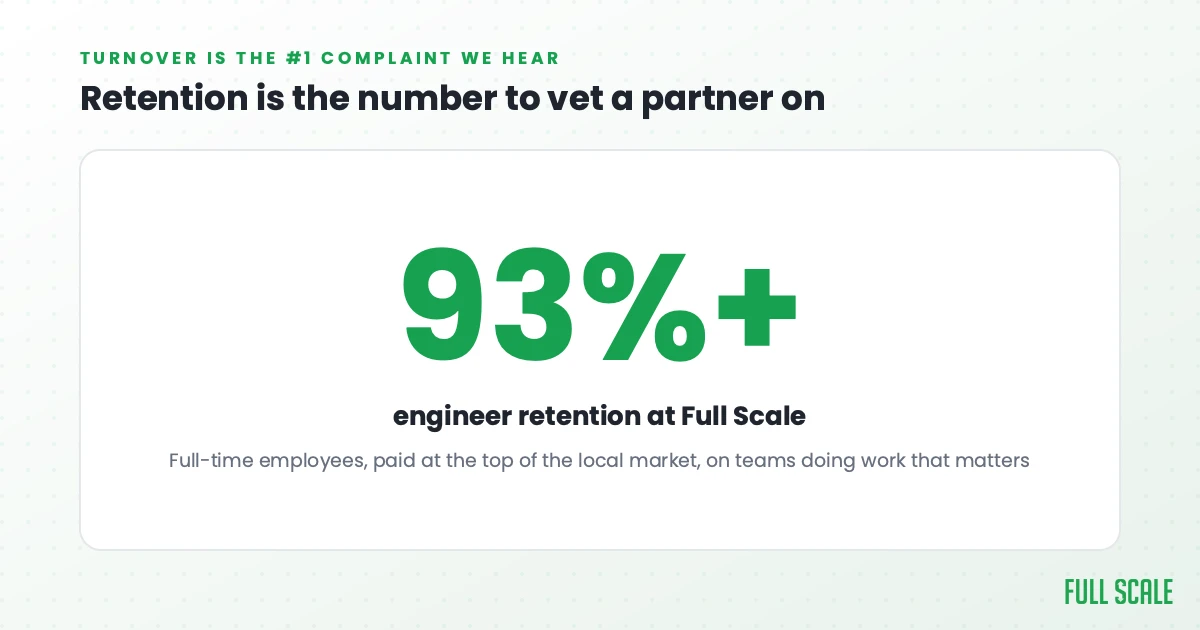
So make turnover a vetting question, not an afterthought. Ask any partner what their retention rate is, and ask why it’s that number. A vendor who can’t answer, or who has never measured it, is telling you something. Retention is what determines whether you’re building a team or renting a series of strangers. A developer turnover rate that keeps climbing is the clearest sign the vendor is the problem, not the market.
This is the part where I’m supposed to be modest, and I’m going to skip that. Our retention at Full Scale is above 93%, and it’s not an accident. Our engineers are full-time employees, not gig workers we rent by the week. We pay at the top of the local market, we give people real careers and real growth, and we put them on teams doing work that matters. People stay when the job is good. The retention number is just the scoreboard for whether you’ve built something worth staying for. When you’re vetting a partner, that’s the thing to dig into.
Over-communicate, because going quiet is the number one killer
The most common reason augmented teams fail is silence, not skill.
The biggest mistake I see is clients who don’t communicate with their team enough. When you’re busy, the daily standup feels skippable. The Slack check-in feels optional. You tell yourself the team knows what to do. Then two weeks later you’re surprised the work went sideways, and the honest answer is that nobody gave the team direction, so they filled the vacuum with guesses.
Augmented engineers aren’t mind readers. They need the same leadership your in-house team needs, arguably more, because they’re newer to your world. Daily standups, real-time chat, a clear roadmap, and someone available to answer questions are the job, not overhead you can trim.
This is also where time zones earn their reputation. If your team is in the Philippines, you’ve got most of a workday between you, and that gap is real. The fix is boring and it works: set a few hours of daily overlap, run your standup inside it, and get disciplined about async handoffs so nothing stalls waiting for someone to wake up. Teams that do this well feel like one team. Teams that don’t feel like they’re managing a distant vendor, and it becomes a self-fulfilling prophecy.
Raise issues early, in the checkpoints you keep skipping
Tell your partner about a problem in week one, not month four. Communication isn’t only the daily standup. It runs the whole length of the engagement: giving a clear requirement so the team knows what you actually want, staying involved through candidate selection, being present for onboarding, and then keeping the loop open once the work is underway. Every one of those is a spot where a five-minute conversation prevents a five-week problem.
The structured version of this is a regular checkpoint. We run monthly checkpoint meetings with clients for exactly one reason: to surface feedback and catch small issues before they pile into big ones. Say the thing while it’s still small, and it stays small.
Here’s the pattern that breaks it, and I’ve watched it more than once. A client gets quietly unhappy about something. They skip the checkpoint meetings. They stop answering emails. They give us no feedback at all. Months go by, and then one day they’re furious about a problem they never once raised. Almost every time, it’s something we could have solved in a week if we’d heard about it in week one.
This is what our customer success managers are for. A client who actually uses them, who shows up and tells us what’s working and what isn’t, almost never ends up in that spot. The feedback loop is sitting right there. Use it.
Learn the culture, then drive your pace
Learn the working norms of the culture your team lives in, then set the pace you want. This one is underrated, and it’s where offshore teams live or die.
If you’re hiring in the Philippines, India, Latin America, or anywhere else, spend a little time understanding the culture you’re working with. Not stereotypes. Actual norms around communication and work style. It changes how you lead.
Here’s a real dynamic I’ve watched play out many times. Engineers from some cultures will stay quiet and wait to be told what to do. It usually comes from respect, not a lack of ability. They don’t want to overstep, so they do exactly what you asked and nothing more. If your working style assumes people will push back, flag problems early, and chase things down on their own, that gap will bite you.
At Full Scale we train our engineers to push past that instinct, to ask more questions and drive urgency. But the client has to meet them halfway. You have to invite the questions and model the pace you want. Make it clear that speaking up is welcome, that “I think this approach is wrong” is a sentence you want to hear, and that you’d rather get shit done than get politeness. Some cultures don’t carry that built-in sense of urgency by default. Your leadership is what installs it.
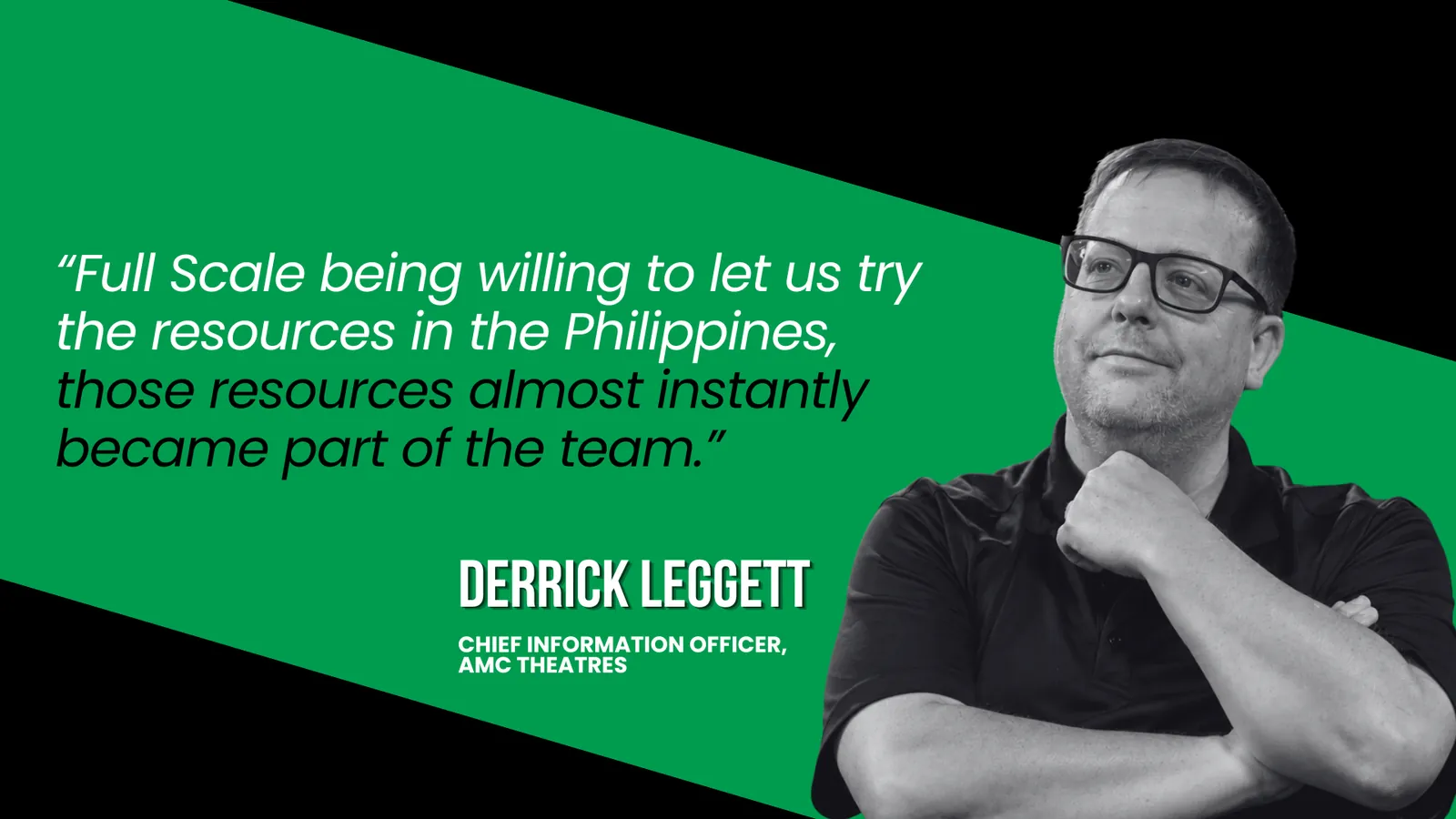
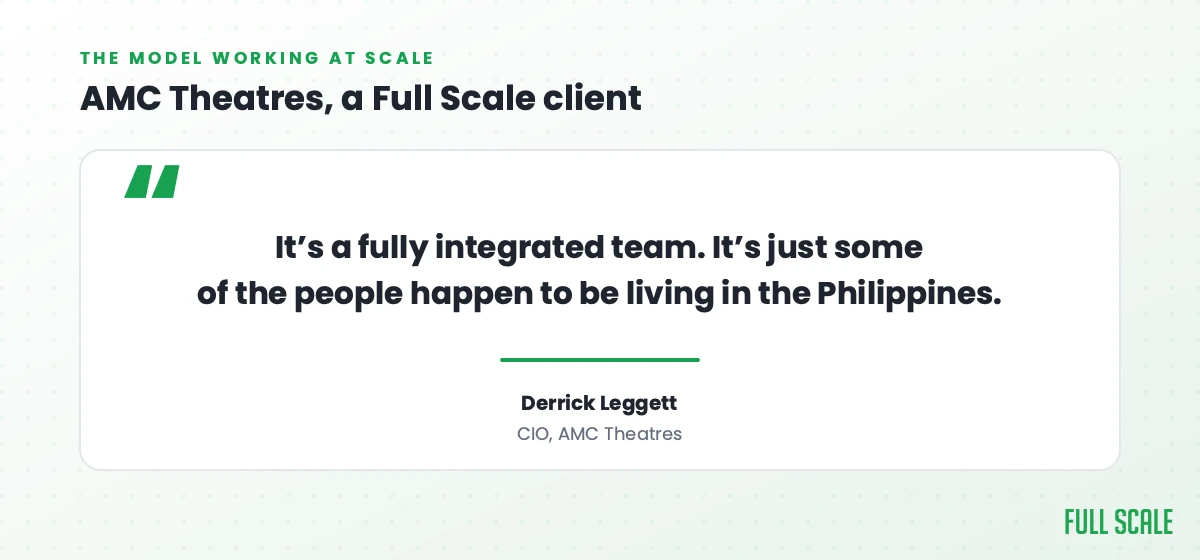
Our client AMC Theatres is the best example I have of this working at scale. Derrick Leggett, their CIO, has built a global engineering org where the developers in the Philippines are treated as full AMC engineers, not a vendor on the other side of a wall. As he puts it in our case study:
“It’s a fully integrated team. It’s just some of the people happen to be living in the Philippines.”
That’s the whole game. And notice how he gets there:
“For any long-term staffing relationship to evolve into a partnership, you have to start with trust. You have to lead with trust through the process and adjust with trust when things go wrong.”
Trust, communication, and treating people like teammates. None of it is complicated. Almost none of it is expensive. It’s just work that a lot of people skip.
Onboard them like employees, not like guests
The clients who get value fastest onboard augmented engineers the same way they onboard a full-time hire.
That means access to the code, the docs, the tools, the standups, and the roadmap on day one. Someone owns walking them through your architecture and your quirks. They’re in the same Slack, doing the same code reviews, held to the same standards as everyone else. It’s the same discipline that makes any offshore engagement work.
Good onboarding is what turns “starts in a week” into “productive in a week.” An engineer can start in as little as seven days, but starting and being fully onboarded into your codebase are different milestones. Full onboarding usually runs a couple of weeks. Documentation and a real onboarding plan are what compress that time. Skip it, and you pay for the same ramp-up twice.
Get the cost right, and structure the deal so you can walk away
Staff augmentation should save you money. Saving money isn’t the same as buying cheap, though, and the difference is the whole ballgame.
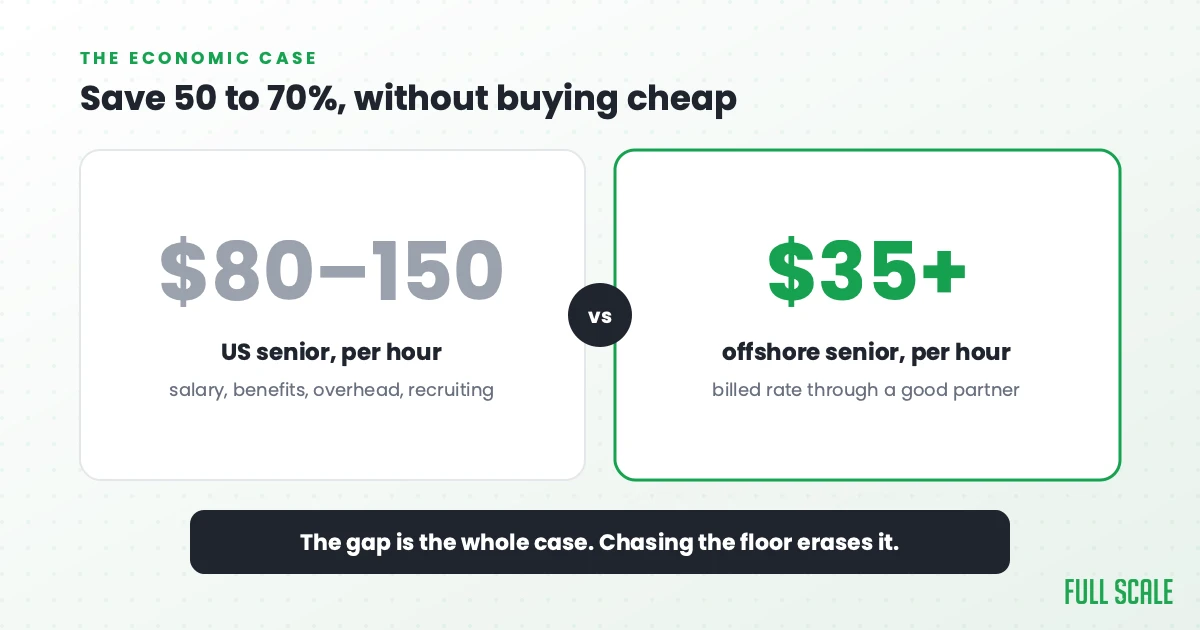
The math is straightforward. A fully-loaded US senior developer runs $80 to $150 an hour once you count benefits, overhead, and recruiting. A strong offshore engineer through a good partner bills starting around $35 an hour, which lands most clients 50 to 70% under the cost of hiring locally. That gap is real, and it’s the entire economic case for the model. The trap is reading that number as permission to chase the floor. The cheapest option almost always costs more once you count the rework.
Then structure the engagement so you’re never trapped. At Full Scale there’s a two-week money-back guarantee. If it isn’t working out in the first two weeks, you get your money back. After that, it’s 30 days’ notice to cancel, no long-term contract. That flexibility matters more than people realize, because it means you can scale the team up when you’re busy and down when you’re not, without signing away a year to find out whether a partner is any good. A fixed-price SOW cannot flex like that by design, which is the whole case for staff augmentation vs sow as the decision to get right up front.
Track outcomes, and resist the urge to hover
Set clear expectations up front, then evaluate against them regularly. Are we shipping what we said we’d ship? Is cycle time holding? Is the quality where it needs to be? Give feedback early and often, the same as you would for anyone on your team.
What you shouldn’t do is confuse tracking with hovering. Watching every commit and demanding constant status updates doesn’t produce better work. It produces engineers who spend their day writing status updates. The sweet spot is clear direction plus real autonomy. Tell people where the goalposts are, then let them play. Micromanagement and going fully hands-off both fail. Aim for the middle.
Take security seriously, because it’s boring until it’s not
This is table stakes, but table stakes still have to be on the table.
Any real staff augmentation setup needs the basics handled: access controls, signed agreements covering IP, secure code and data practices, and a clear answer to who can touch what. Ask any partner how they handle security and IP protection, and get it in writing before anyone touches your repo. It’s a five-minute conversation that saves you a very bad quarter.
The honest one: don’t do staff augmentation in India
I’ll probably get email about this one. I’m going to say it anyway, because it’s the most useful thing I can tell you.
From dozens and dozens of conversations with founders and engineering leaders, the pattern is hard to ignore. You’ll be more successful with staff augmentation almost anywhere else in the world than in India. I don’t say that to be unkind to Indian engineers, plenty of whom are excellent. I say it because of two problems that come up again and again.
The first is that hiring and interviewing there is brutally hard. Candidates constantly back out of accepted offers, usually for a counter-offer somewhere else, so roles sit open and half-filled for months. The second follows from the first. Because the vendors have such a hard time hiring, they tend to hand you whoever they can get rather than the person who actually fits, so the real vetting you were counting on never happens.
There’s more to it than that, and I wrote an entire research piece on why outsourcing to India fails if you want the whole story. Read it, then make your own call. My honest advice, after watching it play out over and over, is to look at the Philippines or Latin America instead.
Am I biased here? Completely. For a rundown of vetted options, see this list of staff augmentation company Philippines specialists. Full Scale staffs senior engineers from the Philippines, so of course I think it’s a great place to build a team. But the bias runs the other way from what you’d expect. I built the company in the Philippines for a specific reason, and it wasn’t the cost. The engineers stay, they integrate, and they treat your product like it’s theirs. That’s the same reason our retention runs as high as it does. If you want a team that behaves like the successful clients in this article expect, that’s the kind of place you find it.
What the successful clients do, side by side
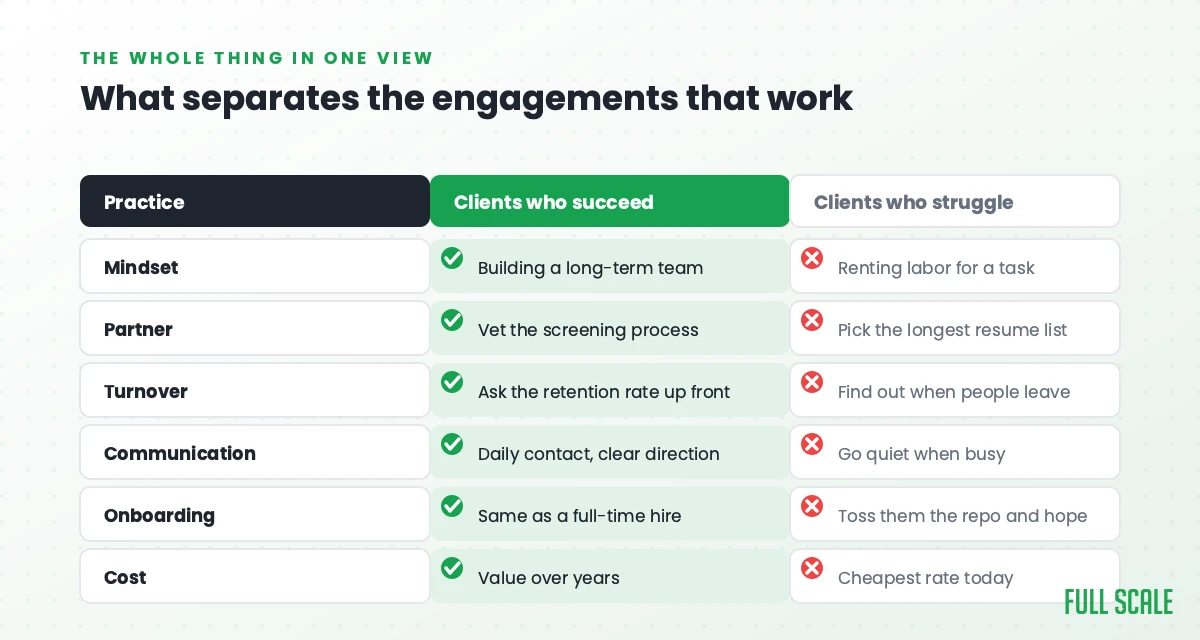
Here’s the whole thing in one view.
| Practice | Clients who succeed | Clients who struggle |
|---|---|---|
| Mindset | Building a long-term team | Renting labor for a task |
| Attitude | Bought in, treat us as a partner | Mandated, treat us as a body shop |
| Vision | Strong in-house product vision | Expecting the team to define it |
| Partner choice | Vet the screening process | Pick the longest resume list |
| Turnover | Ask the retention rate up front | Find out when people start leaving |
| Communication | Daily contact, clear direction | Go quiet when busy |
| Feedback | Monthly checkpoints, issues raised early | Silent until furious |
| Culture | Learn norms, drive urgency | Assume everyone works like them |
| Onboarding | Same as a full-time hire | Toss them the repo and hope |
| Cost | Value over years | Cheapest rate today |
| Management | Clear goals, real autonomy | Hover or disappear |
None of this is free, and I won’t pretend it is. A distributed team carries real coordination overhead, onboarding takes time, and a half-day time gap is a genuine tax. Weighing the honest pros and cons of staff augmentation before you sign is how you decide whether that tax is worth paying. These practices are how you earn that back, not proof the cost isn’t there. But none of them are hard, which is the frustrating part. Staff augmentation is a simple model that people undermine with a handful of avoidable habits. The practices hold steady, but the model itself keeps shifting. I cover what actually changed in staff augmentation this year in a separate piece.
Frequently asked questions
What is the most important staff augmentation best practice?
Communication. The most common reason augmented teams underperform is that the client goes quiet and stops providing direction. Daily standups, real-time chat, and a clear roadmap matter more than any other single practice. Treat your augmented engineers like teammates who need leadership, not vendors who run themselves.
How do I choose a staff augmentation partner?
Judge the partner on how they screen talent, not how many resumes they can send. Ask exactly how they interview and test candidates, confirm you get to interview and approve everyone who joins your team, and check that their process fits your timeline and tech stack. Ask their retention rate too, since turnover is the most common way these engagements fall apart. A partner who does the hard vetting up front is the entire value.
What is the difference between staff augmentation and outsourcing?
With staff augmentation, the engineers join your team, work in your tools, and report to your leadership. You direct the work. With traditional outsourcing, a vendor takes a project, works behind their own account manager, and hands back a result. Staff augmentation keeps you in control and avoids the overhead layers that outsourcing adds. It works best when you have a clear product vision and want to scale the team executing it.
What is the biggest mistake companies make with staff augmentation?
Treating it as a cheap, short-term transaction instead of a long-term team investment. That mindset leads to chasing the lowest hourly rate, skipping onboarding, and under-communicating. The clients who win treat augmented engineers as part of the team and invest in them accordingly.
Why do staff augmentation engagements fail?
Usually because of how the client approaches it, not the talent. The most common failure is a transactional, body-shop mindset, which shows up hardest when a business leader mandates an offshore team and the engineering leader running it isn’t bought in. Add under-communicating, chasing the cheapest rate, and skipping onboarding, and the engagement struggles. The ones that work treat the partner like a long-term team, come in open-minded, and keep the feedback loop open with regular checkpoints.
How long does it take to onboard an augmented developer?
An engineer can start in as little as seven days, depending on availability. Being fully onboarded into your codebase usually takes around two more weeks. Good documentation and a real onboarding plan are what shorten that ramp. Starting and being productive are two different milestones, and onboarding is what connects them.
Get the team, skip the mistakes
Staff augmentation works when you build a real team, communicate like you mean it, and pick a partner who does the hard vetting for you. It fails when you treat it like a spreadsheet exercise.
If you want to scale your engineering team with senior developers who join your standups, learn your codebase, and stick around long enough to compound, let’s talk. We’ll help you do this the way the successful clients do it.