
Choosing Employer of Record vs. Staffing Agency Is About Retention

In this article
- What an employer of record actually does
- What a staffing agency actually does
- Employer of record vs staffing agency, side by side
- The benefits of each
- The real difference is retention
- When an employer of record is the right call
- When a staffing agency is the right call
- Can you use both an employer of record and a staffing agency?
- Frequently asked questions
- Retention is the question, so answer it first
Search “employer of record vs staffing agency” and read the first ten results. Almost every one is published by an employer of record company. So you can guess where they land. They explain the difference, nod politely at staffing agencies, then steer you toward an EOR. This pairs with our breakdown of PEO vs EOR vs staff augmentation for hiring developers.
I’ve spent the last several years on the other side of that pitch. I run Full Scale, a software staffing company with more than 350 engineers in the Philippines, and the hard part of this business was never payroll. Payroll is a solved problem. The hard part is finding great developers and then keeping them, year after year, when they sit thousands of miles from the company they work for. European companies weighing the same choice can start with my Europe-to-Philippines hiring guide.
That’s hard to do in the Philippines, where turnover can be brutal. The country’s huge call center and business process outsourcing (BPO) industry is known for churn. Even after a few years of decline, voluntary attrition was still running near 30 percent in 2023, down from 36 percent in 2021, according to the Contact Center Association of the Philippines, and plenty of shops have run much higher. In a lot of that industry, a third of your team walking out the door every year is just normal.
Full Scale doesn’t run that way. Our developer retention is over 93 percent. We’re Great Place to Work Certified in the Philippines two years running, and 95 percent of our people say it’s a great place to work, compared to 65 percent at a typical company. That gap, between the local norm and what we actually deliver, is the whole case for a real staffing agency over a payroll service. Retention is the deciding factor when you weigh staff leasing in the Philippines too.
That’s the lens this comparison is missing. An employer of record (EOR) and a staffing agency look like competitors on a feature chart, but they answer different questions. One asks how you pay someone legally. The other asks who finds that person and who keeps them.
If you’re hiring developers for the long haul, retention is the whole ballgame, and only one of these two models is built to deliver it. That retention also shows up in our Great Place to Work certification in the Philippines.
Quick answer: An employer of record is the legal employer for someone you already hired, handling payroll, taxes, benefits, and compliance in a country where you have no legal entity. A staffing agency finds and places the talent, and the good ones manage and keep them too. Use an EOR when you already have the person; use a staffing agency when you need someone to find, support, and retain them.
What an employer of record actually does
An employer of record is a company that legally employs workers on your behalf. You find the person and decide what they’re paid. The EOR signs the employment contract, runs payroll, withholds taxes, provides benefits, and makes sure all of it follows local labor law. Companies like Deel and Globalization Partners built their whole business on this. In the Philippines that means inheriting Philippine labor law too, including 13th month pay and a termination process with no at-will equivalent.
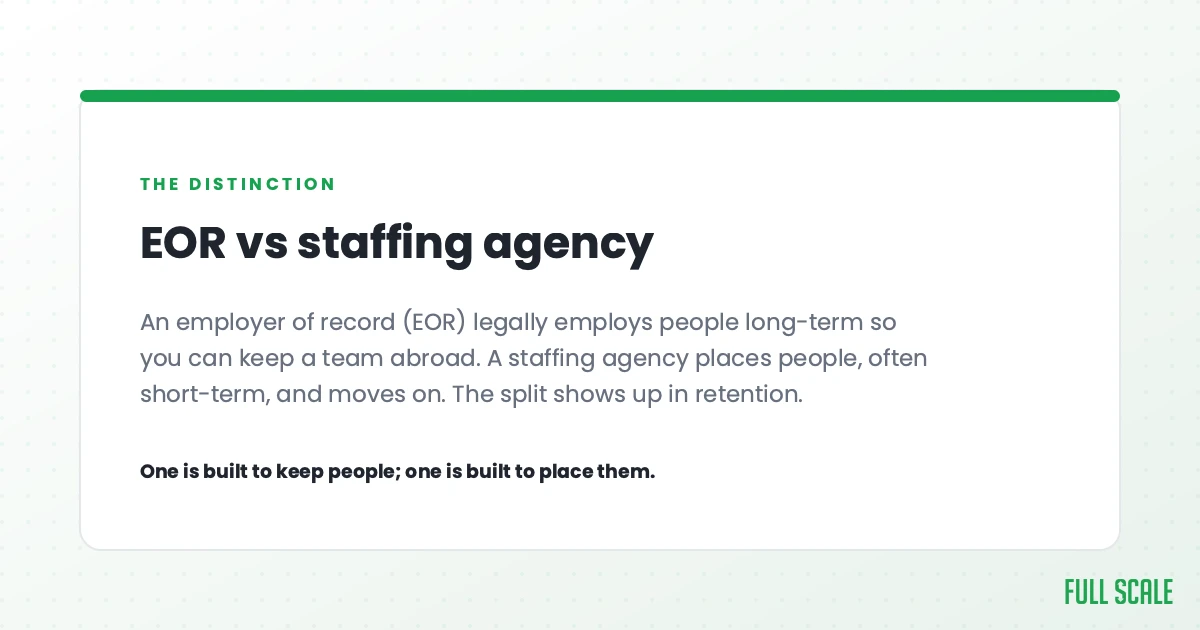
The key thing to understand is what an EOR does not do. It doesn’t recruit. You bring the candidate, and the EOR makes it legal to employ that candidate in a country where you don’t have your own office or legal entity. (An EOR is sometimes confused with a professional employer organization, or PEO, but a PEO co-employs staff where you already have an entity, while an EOR employs them where you don’t.)
That’s genuinely useful. If your company is based in Chicago and you want to hire one engineer in Portugal, setting up a Portuguese legal entity is slow and expensive. An EOR lets you employ that person next week instead. The cost is usually a flat monthly fee per worker, or a percentage of salary.
For one already-found hire in a country where you have no presence, that’s a good deal. An EOR is infrastructure, not a talent partner.
What a staffing agency actually does
A staffing agency starts where the EOR stops. Its job is to find people. A good agency sources candidates, screens them, checks their skills, and places the ones who fit. Recruiting is the product.
Here’s where it gets confusing, because “staffing agency” covers two very different things.
The first kind is a transactional temp shop. It fills a seat, sends an invoice, and moves on. You get a warm body and a markup, and not much else.
The second kind is a managed staffing partner. It still recruits, but it also employs the developer, supports them day to day, and works to keep them on your team for years. That second model is what we do at Full Scale, and it’s closer to staff augmentation than to old-school temp staffing. If you want the full rundown of how these firms operate, I broke it down in a separate guide on engineering staffing agencies.
Stack an EOR against a temp agency and it’s close to a coin flip. Stack it against a managed staffing partner and the gap is obvious, because now one side owns recruiting, management, and retention while the other just runs payroll.
Employer of record vs staffing agency, side by side
| What it does | Employer of Record | Staffing Agency (managed) |
|---|---|---|
| Finds and recruits talent | No | Yes |
| Vets candidates | No | Yes |
| Acts as legal employer | Yes | Yes |
| Runs payroll, tax, benefits, compliance | Yes | Yes |
| Manages day-to-day work | No | Yes |
| Owns retention and turnover risk | No, you do | Yes |
| Understands local culture on the ground | No | Yes |
| Best for | A person you already found | Talent you need found and kept |
| Typical cost | Flat fee or percent of salary | Markup over salary |
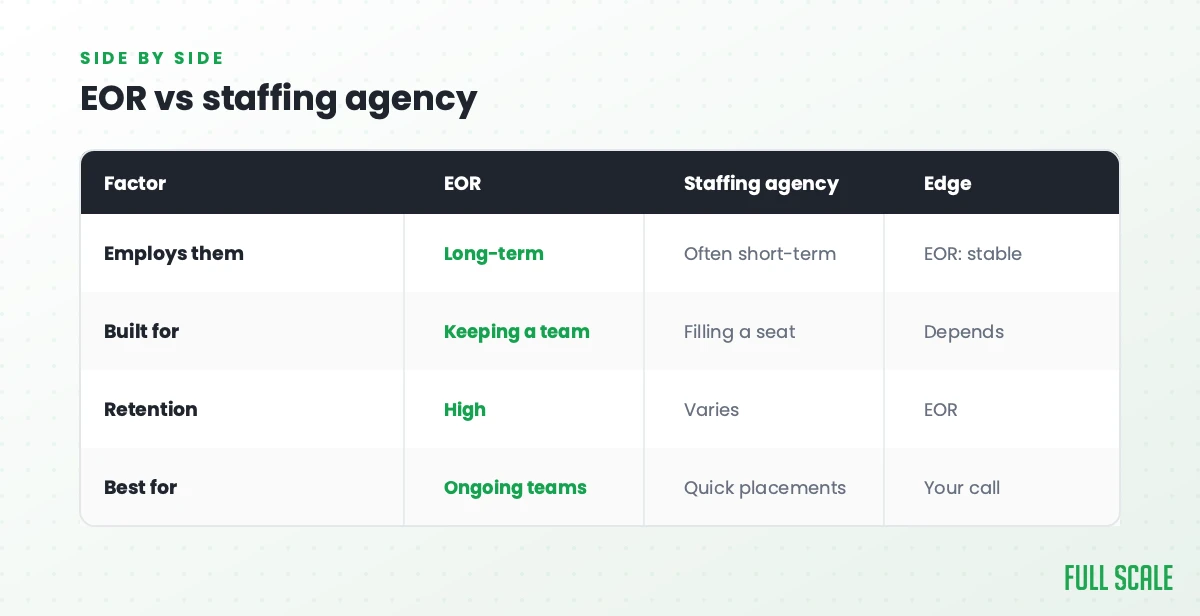
Look at the table and the truth jumps out. An EOR and a staffing agency aren’t really rivals, they solve different halves of the same problem. The overlap everyone argues about is employment, and the row that quietly decides everything is the one about retention.
The benefits of each
Both models earn their keep, so it helps to be honest about what each one is good at.
An employer of record is the right tool when speed and compliance are the whole job. Its benefits:
- You can employ someone abroad in days, with no legal entity of your own.
- Local labor law, payroll, and benefits are handled and stay compliant as the rules change.
- Overhead is low and predictable for a single hire.
- You keep full control of the work, because the person is already yours.
The trade-off is just as clear. An EOR won’t find anyone for you, won’t manage them, and won’t lift a finger to keep them. If your developer takes a better offer and walks, that’s your problem to solve, and you start the search over from zero.
A staffing agency is the right tool when you need people found, supported, and kept. Its benefits:
- It does the recruiting, so you’re not posting jobs and screening resumes.
- It vets for skills and fit before anyone reaches your team.
- A managed partner handles employment, daily support, and the work that keeps engineers happy.
- Turnover becomes the agency’s job to prevent instead of your mess to clean up.
The trade-off there is cost and trust. You pay a markup over bare salary, and the model only pays off if the agency actually does the retention work instead of just billing for it. That’s the real case for the advantages of staff augmentation over a bare payroll service.
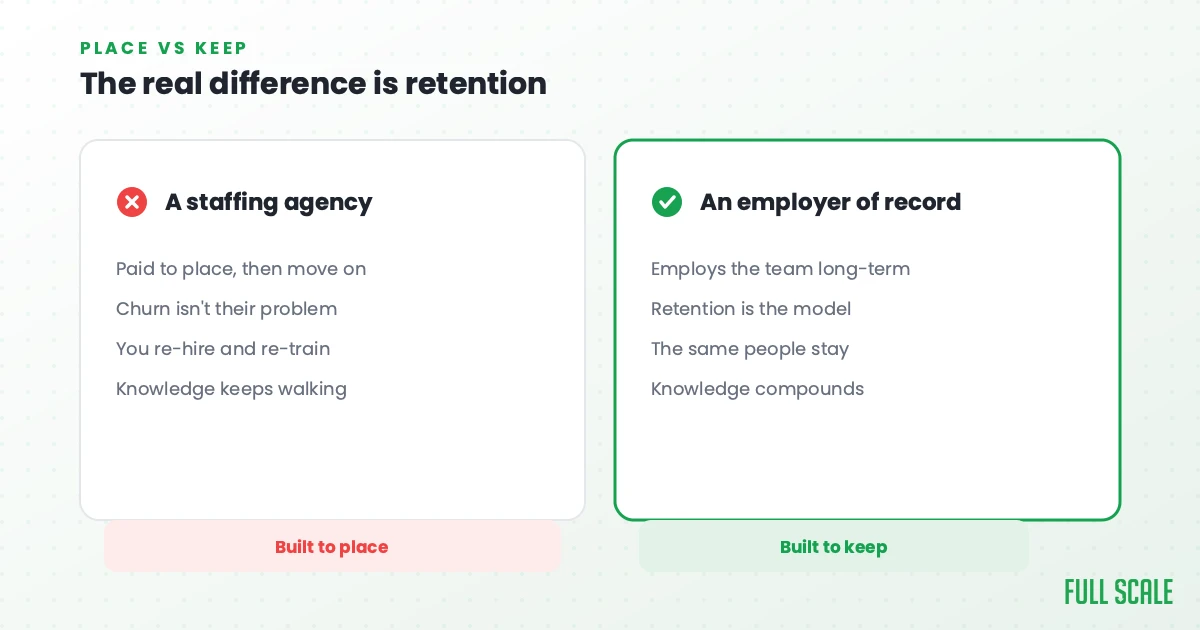
The real difference is retention
Here’s the part the EOR-written articles skip, because they can’t sell it.
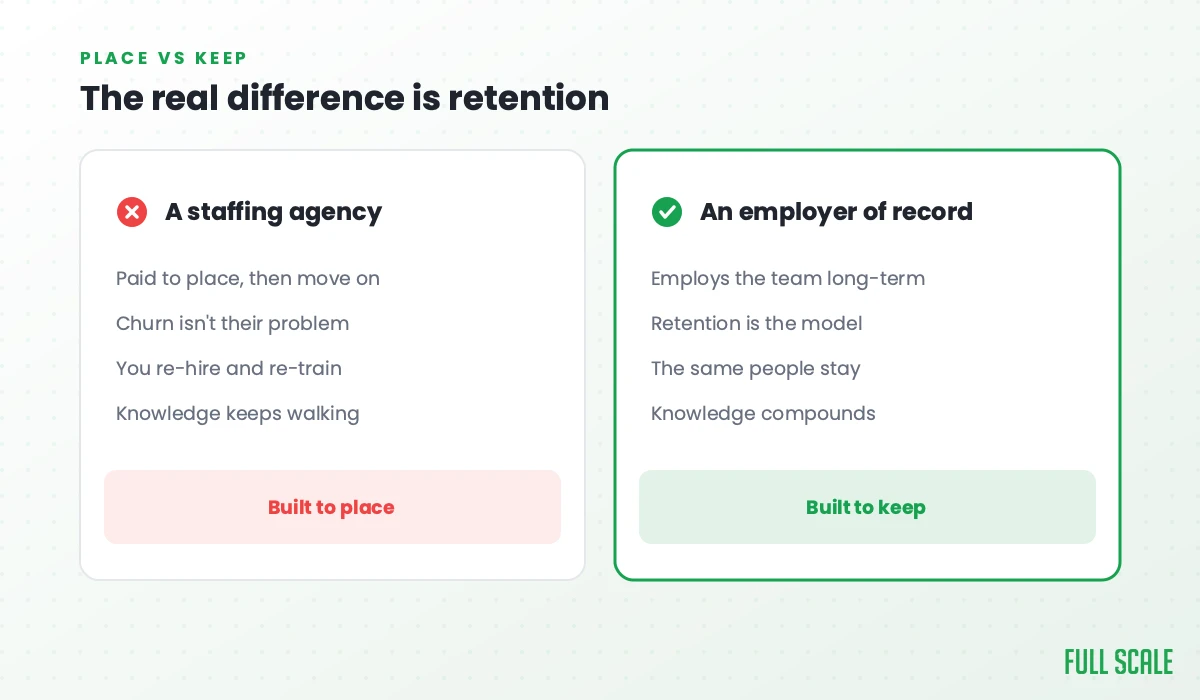
A payroll rail does not care if your developer quits. With an employer of record, the moment someone resigns, the EOR simply stops running their payroll. The lost momentum, the half-finished work, the months of hiring to replace them, all of that lands on you.
And developers do leave. US tech turnover runs around 13 to 15 percent a year, according to the Bureau of Labor Statistics. Replacing a senior engineer takes about two to three months, and the new person needs weeks to learn your codebase before they’re productive. Every departure is a tax on your roadmap.
This is the problem a real staffing partner exists to solve, and it’s why those retention and Great Place to Work numbers from the top of this post matter so much. The 93 percent isn’t payroll, it’s the work behind the payroll. The reason it matters to you is simple: happy engineers don’t leave, and a team that stays is a team that keeps shipping.
The hardest part of keeping people happy is that they sit thousands of miles from the company they work for. That distance is exactly where most offshore arrangements break down, and it’s where we put the most effort.
We’re on the ground with our engineers in the Philippines, so we understand the local culture and the small things an American head office would never think about, from how local holidays work to what good career growth looks like there. We run the events, the team activities, and the in-person support that make a job feel like a real home instead of a remote contract. Our Customer Success Managers (CSMs) treat engineer happiness as half of their job, and they have the honest conversations a client thousands of miles away simply can’t. This is the machinery behind offshore augmentation that an employer of record was never built to provide.
It helps that the Philippines is the third-largest English-speaking country in the world, which removes the communication gap that sinks so many offshore teams before culture even comes up.
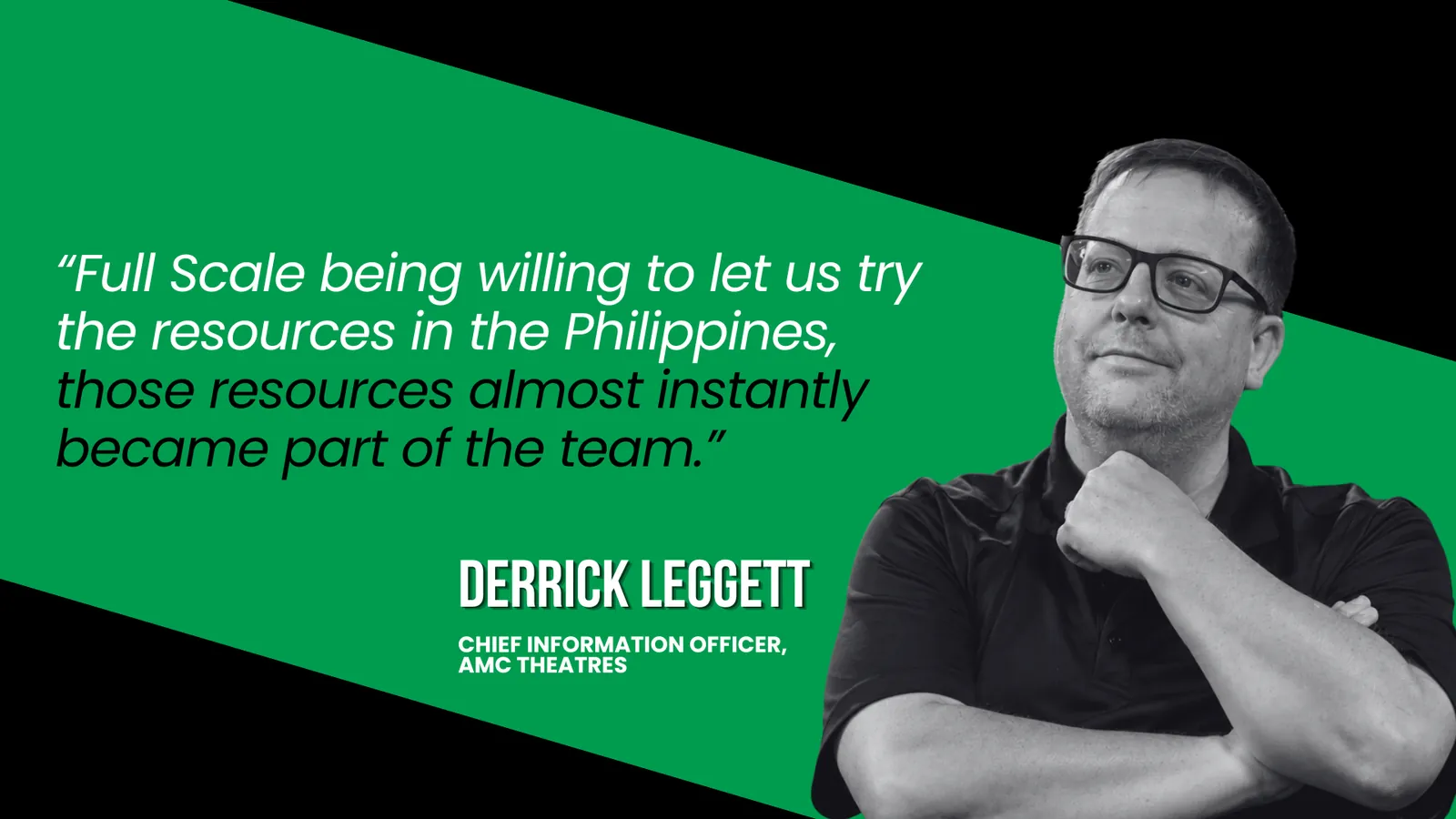
The clearest proof is a client like AMC Theatres. Their developers in the Philippines aren’t treated as contractors behind a vendor wall, they’re full members of the engineering team. Their CIO, Derrick Leggett, put it best:
It’s a fully integrated team. It’s just some of the people happen to be living in the Philippines.
Derrick Leggett, CIO, AMC Theatres
That’s the outcome you’re actually buying when you choose a staffing partner over a payroll service. It’s the same idea behind the Product Driven approach I wrote about, that the people who build your software should own it, not just rent a desk in it.
When an employer of record is the right call
I’m not here to talk you out of an EOR when it fits. Plenty of times, it’s the smart choice.
Reach for an employer of record when you’ve already found the person yourself. Maybe a freelancer you’ve worked with for a year is ready to go full-time, and you want to make it official without the freelancer headaches. An EOR turns that contractor into a compliant employee in a country where you have no entity, and that’s a clean, cheap solution.
It’s also the right call when you’re hiring one or two people in a new country, you already run your own recruiting, and you want to keep all the management and culture in-house. You don’t need an agency for that. You need a legal rail, and that’s exactly what an EOR is.
The mistake is paying a staffing agency to do a job an EOR does better. If you already have the person and just need to employ them, don’t overbuy.
When a staffing agency is the right call
When a staffing agency is worth it comes down to one thing: whether finding and keeping people is your actual problem.
Choose a staffing partner when you need developers you haven’t found yet. Recruiting good engineers is slow and competitive, and a partner with a vetted bench saves you months. This is the whole reason companies hire developers in the Philippines through a partner instead of building a recruiting team from scratch.
Choose one when you don’t want to run human resources (HR), culture, and retention for a team on the other side of the world. And choose one for long-term core roles, where continuity and low turnover matter far more than shaving a few points off the bill. A developer who stays three years and knows your product cold is worth more than a cheaper one who leaves in nine months.
Can you use both an employer of record and a staffing agency?
Yes, and some companies do. If you run your own recruiting but hire across many countries, you might pair your in-house sourcing with an EOR in each location. That’s a reasonable setup.
But notice what’s happening: you’re rebuilding, piece by piece, what a managed staffing partner already gives you in one relationship. A partner that recruits, employs, supports, and retains your developers has folded the EOR’s job into the package. The real question isn’t “one or the other or both.” It’s who you want responsible for keeping your team together. EOR and staffing agency are just two of the six labels people group under “staffing.” I lay out the full set, including project-based staffing and traditional recruiter placement, in staff augmentation vs. staffing.

Frequently asked questions
What is the difference between an employer of record and a staffing agency?
An employer of record legally employs and pays a worker you already found, handling payroll, taxes, benefits, and compliance. A staffing agency finds and places the talent for you, and a managed agency also supports and retains them. In short, an EOR handles employment, while a staffing agency handles finding and keeping people.
Is an employer of record cheaper than a staffing agency?
For a single long-term hire you already sourced yourself, an EOR is usually cheaper, because you pay a flat fee or a small percentage of salary instead of a recruiting markup. But the comparison isn’t really fair, since an EOR doesn’t find or retain anyone. A staffing agency costs more because it does far more.
Does an employer of record recruit candidates?
No. An employer of record does not recruit. You bring the person you want to hire, and the EOR makes it legal to employ them. If you need help finding candidates, that’s a staffing agency’s job, not an EOR’s.
Can a staffing agency act as an employer of record?
Often, yes. A managed staffing partner usually employs the developers it places, which means it already performs the EOR function as part of the service. That’s why hiring through a full-service agency rarely requires a separate EOR on top.
Which is better for hiring offshore developers, an EOR or a staffing agency?
If you’ve already found the offshore developer and just need to employ them compliantly, an EOR works fine. If you need to find strong developers and keep them on your team for years, a staffing agency that owns recruiting and retention is the better fit. For most companies building an offshore team, retention is the deciding factor.
Is it cheaper to set up your own offshore entity or use an employer of record?
For most companies, no. Setting up a legal entity in the Philippines or elsewhere means real incorporation costs, ongoing local accounting and legal fees, and staff to run payroll and compliance, usually tens of thousands of dollars a year before you have hired anyone. An EOR or a staffing agency spreads that same infrastructure across many clients, so you pay a per-employee fee instead of building the entity yourself. Your own entity only pencils out once headcount is large enough, typically 30 or more employees in one country, to make the fixed cost worth it.
Retention is the question, so answer it first
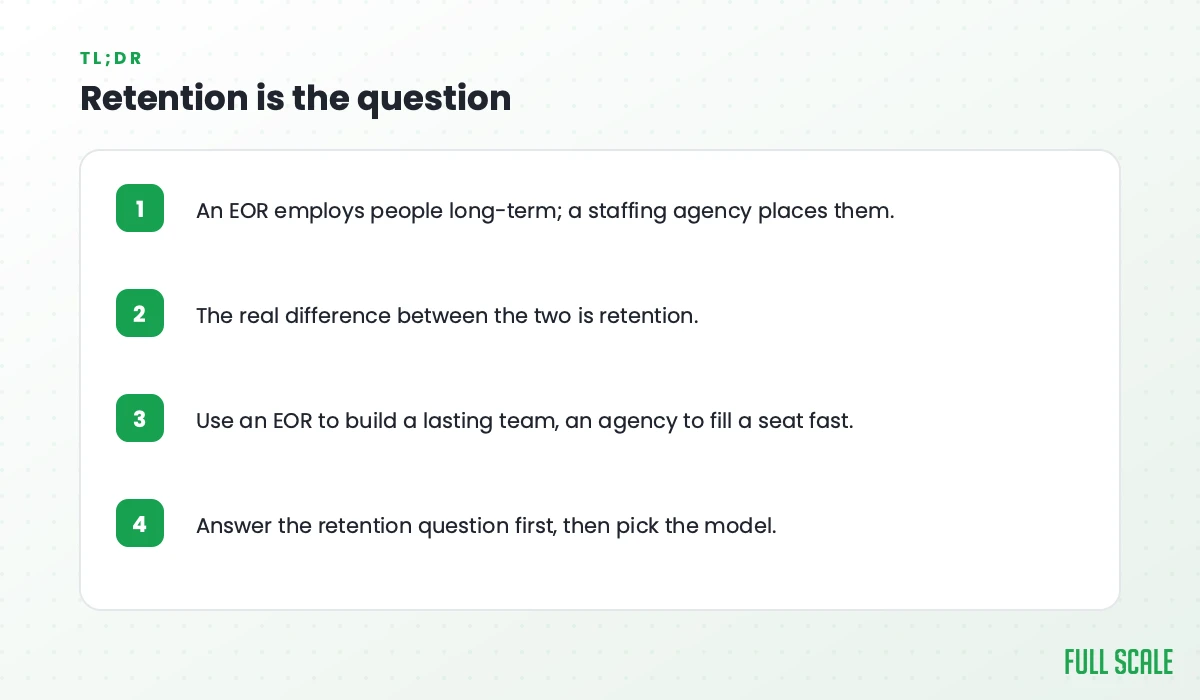
Before you choose between an employer of record and a staffing agency, decide what you actually need. If you’ve found your person and just need to pay them legally abroad, an EOR is the simple answer. If you need to find great developers and keep them for the long haul, you need a partner whose whole job is making that happen.
That second job is the one we’ve built our company around. If you want to see what an integrated, high-retention offshore team looks like, schedule a call with Full Scale.