Your Dev Team Doesn’t Want to Work with Bad Offshore Developers

In this article
- The patterns behind why your team won’t work with bad offshore developers
- Some of that is the offshore setup, and some of it is your own team
- Hire offshore developers instead of outsourcing a project
- Why the Philippines, specifically
- What good offshore developers look like on your team
- How to tell a good offshore partner from a bad one
- Your developers will actually want to work with the right offshore team
- Frequently asked questions
- Ready to add offshore developers your team will trust?
I’ve hired developers in Russia, Latin America, and the Philippines, and I had different levels of success with all of them. So when an engineering leader tells me their team is dragging its feet on the idea of offshore developers, I don’t argue. There are smart people all over the world, and there are also a lot of bad offshore stories floating around, and your engineers have probably heard most of them.
Here’s the part most leaders get backwards, though. Your team usually isn’t resisting offshore developers as an idea. They’re reacting to a handful of specific things they’ve seen go wrong, and almost none of those things are about whether a developer in another country can write good code. That is the whole point: a skilled offshore developer is still not good enough on its own if the setup around them is broken.
If you want the resistance to go away, you have to name the patterns underneath it. Some come from the offshore setup itself. Others are really about leadership. And a couple, honestly, trace back to your own engineers. Once you can see which pattern you’re actually dealing with, every one of them has a fix. On a .NET team, the fix usually starts with how you hire C# developers: screen for judgment, not framework trivia.
The patterns behind why your team won’t work with bad offshore developers
When a senior engineer pushes back on bringing in an offshore team, the objection sounds like one thing (“offshore doesn’t work”) but it’s almost always one of these four patterns wearing that costume.
They’ve been burned before. This is the most common one. A good engineer who resists offshore is usually picturing a specific kind of pain they already lived through. They inherited a codebase from a cheap outsourcing shop and spent three weekends untangling it. They sat on a call where nobody on the other side would answer a direct question. They watched a “12-week project” turn into a year of rework. That reaction is earned. They’ve seen what bad looks like up close, and you should respect it. My friend Gleb Braverman, founder of HackerPulse, said it well on Startup Hustle: good engineers want to work with other good engineers, and they protect that bar. Ask them to babysit code they don’t trust, and you’ve taxed the people you most want to keep.
The leadership was never really there. A lot of failed offshore engagements had no one steering them. The work got handed off and nobody on the client’s own side was managing it day to day, setting priorities, or holding anyone accountable. I have a friend who hired 16 developers in Pakistan and was frustrated the team wasn’t shipping. The 16 developers could code fine. What he lacked was anyone on his side steering them toward the right work. Adding cheap bodies to a team with no leadership just gives you a bigger team that ships the wrong thing faster. The buyer most at risk here is a founder with no technical leader in-house, which is often exactly the person shopping for an outsourced team.
They won’t make time for the meetings. This one stings because it’s about your team, not the offshore one. A dedicated offshore developer in the Philippines can give you three to four hours of real overlap with a US workday, which is plenty to run a standup, pair on a hard problem, and unblock each other. But that only works if your in-house engineers actually show up for it. I’ve watched the same loop more than once: a senior dev skips the standup, never answers the offshore engineer’s questions, then three weeks later complains that the offshore engineer built the wrong thing. The spec was fuzzy, nobody clarified it, and the work went the wrong way. That’s a communication failure, and it would have sunk an in-house hire just as easily.
They’d rather just do it themselves. Some engineers don’t want to work with offshore developers because they don’t really want to work with anyone. “It was easier to just do it myself” is the most honest sentence in software, and it’s also how you build a team where one person is the single point of failure for half the system. Offshore is just the moment the instinct shows up, because now there’s a new teammate to bring up to speed, document for, and review. A developer who won’t delegate to a teammate three time zones away usually won’t delegate to the one sitting next to them either. That’s a coaching problem for you to solve, and it’s worth solving, because a team that can’t take on a new member can’t grow.
Notice how little of any of that is about coding skill. Three of the four are about communication, leadership, and how your team works together. That matters more now than it used to, because as AI takes over more of the routine coding, the work that’s left is the human part: understanding the problem, talking it through, and working well with other people. The teams that resist all of that are the ones AI will expose first.
Some of that is the offshore setup, and some of it is your own team
Once you split the patterns up, the fix gets obvious, because the patterns don’t all belong to the same owner.
The “been burned before” pattern and a lot of the trust gap come from how the engagement is structured, and that’s something you choose when you pick a partner. The meeting and the lone-wolf patterns are yours to coach. And the leadership pattern is the one nobody likes to claim, but it’s usually the biggest lever, because good leadership is what makes the other three fixable in the first place.
I should be fair about the one case where your team is right. If the work is a genuinely scoped, hand-it-off project with a clear finish line, a statement of work project with the right shop can be the better tool, and your engineers aren’t wrong to say so. This post is about the other situation, the one most companies are actually in: ongoing product work that needs a real team. For that, the answer your team is reaching for (“let’s just not do offshore”) doesn’t fix anything. The move is to refuse to do it badly.
Hire offshore developers instead of outsourcing a project
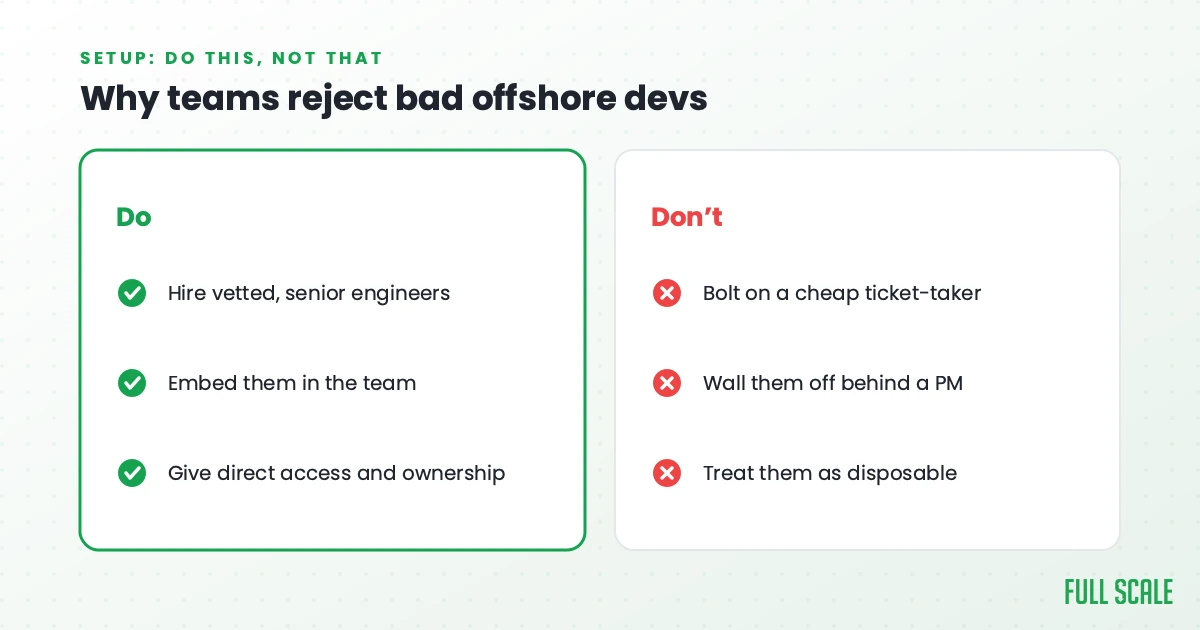
I avoided offshore development for years because of outsourcing horror stories from people I trusted. You can read the whole story of why I avoided it and what changed my mind. The short version is that offshore didn’t start working for me until I stopped treating it like a project and started treating it like hiring.
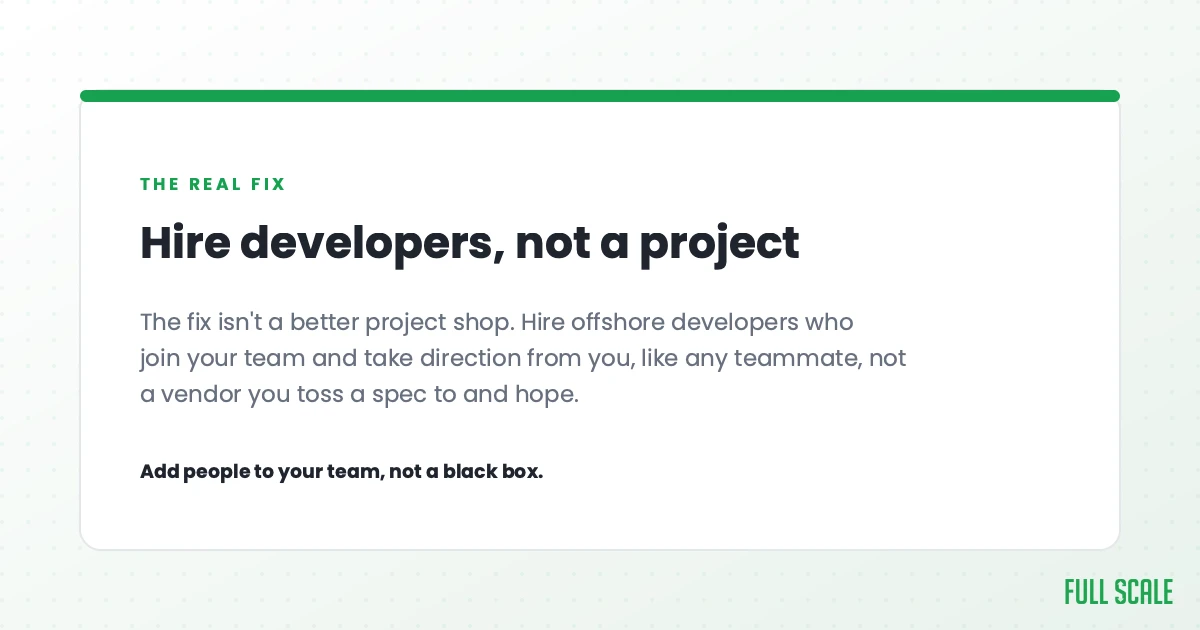
That’s what staff augmentation is. You bring on talent to work directly for you, long-term, the same way you’d hire a local engineer. They sit in your standups, use your tools, and own their part of the roadmap. There’s no account manager fronting a team you never meet, so your engineers talk to the offshore developers every day and the developers care about the product the way your in-house team does.
The thing that wrecks most offshore engagements is the middleman. You talk to a technical project manager, and every developer hides behind that person, sometimes because of an English gap and sometimes because of a rule about who’s allowed to talk to the client. Either way you end up with a team you can’t reach and a layer sitting between you and every decision. The fix is management on your own side of the table. Put a technical leader you actually employ, even a fractional one, in charge of the team day to day, and keep the developers on your Slack and in your standups where you can reach them.
One more trap to name while we’re here. When cost is the only reason you’re going offshore, you buy the cheapest thing on the menu, which is a freelancer who vanishes mid-sprint or a project shop running your account next to five others. I call that cheapshoring, and it’s the fastest way to earn every bad offshore story your engineers already believe. Cost is a fine reason to hire offshore, it just can’t be the only one.
Why the Philippines, specifically
I didn’t pick the Philippines by accident, and it’s not mainly about cost. Software development runs on communication more than anything else, and that’s where the Philippines stands out. Filipinos speak English fluently and grow up immersed in American culture, so the back-and-forth that kills most offshore engagements just isn’t an issue. The country is the third-largest English-speaking country in the world.
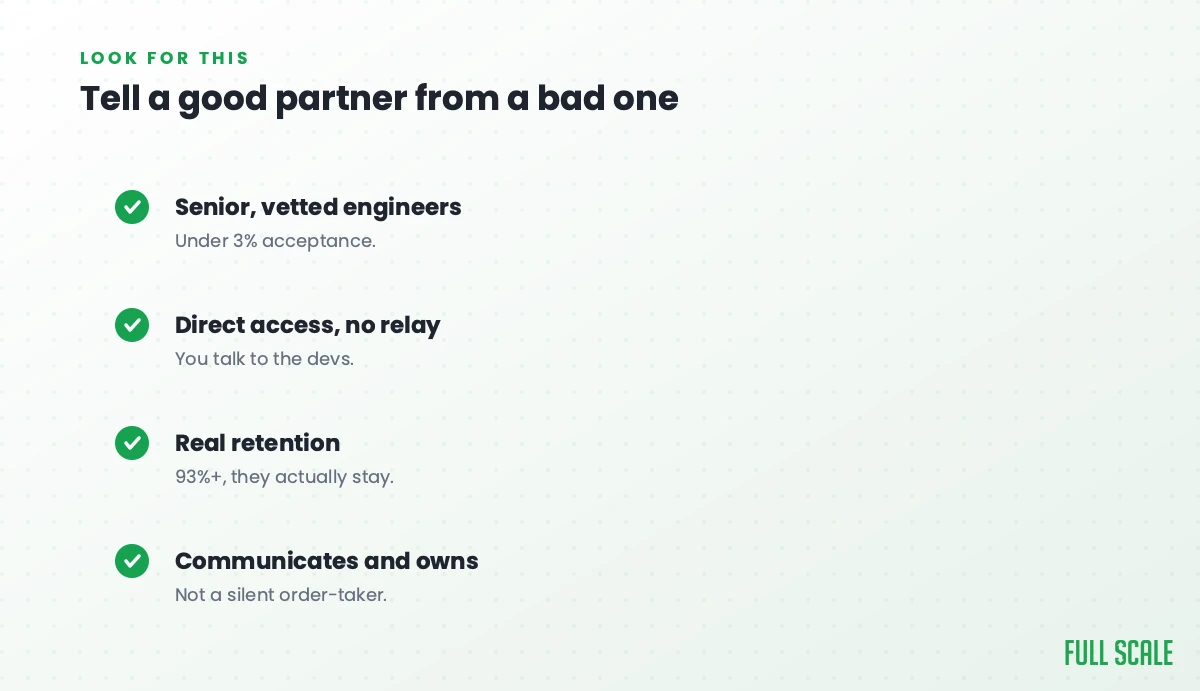
Then there’s retention, which is where the “bad offshore developer” stereotype really falls apart. The business process outsourcing (BPO) industry in the Philippines is known for brutal turnover, with call-center attrition that has run around 30 percent a year and historically higher. At Full Scale, our developer retention is over 93 percent. We’re Great Place to Work Certified two years running. 95 percent of our Philippines team say it’s a great place to work, compared to 65 percent at a typical company there. That matters to your engineers for one reason: a developer who stays long enough to learn your system is a developer your team gets to trust. Turnover is the hidden cost that makes offshore feel unreliable, and most of the bad reputation goes away when you solve it.
What good offshore developers look like on your team
My best proof here comes from a client who has run this at enterprise scale for years.
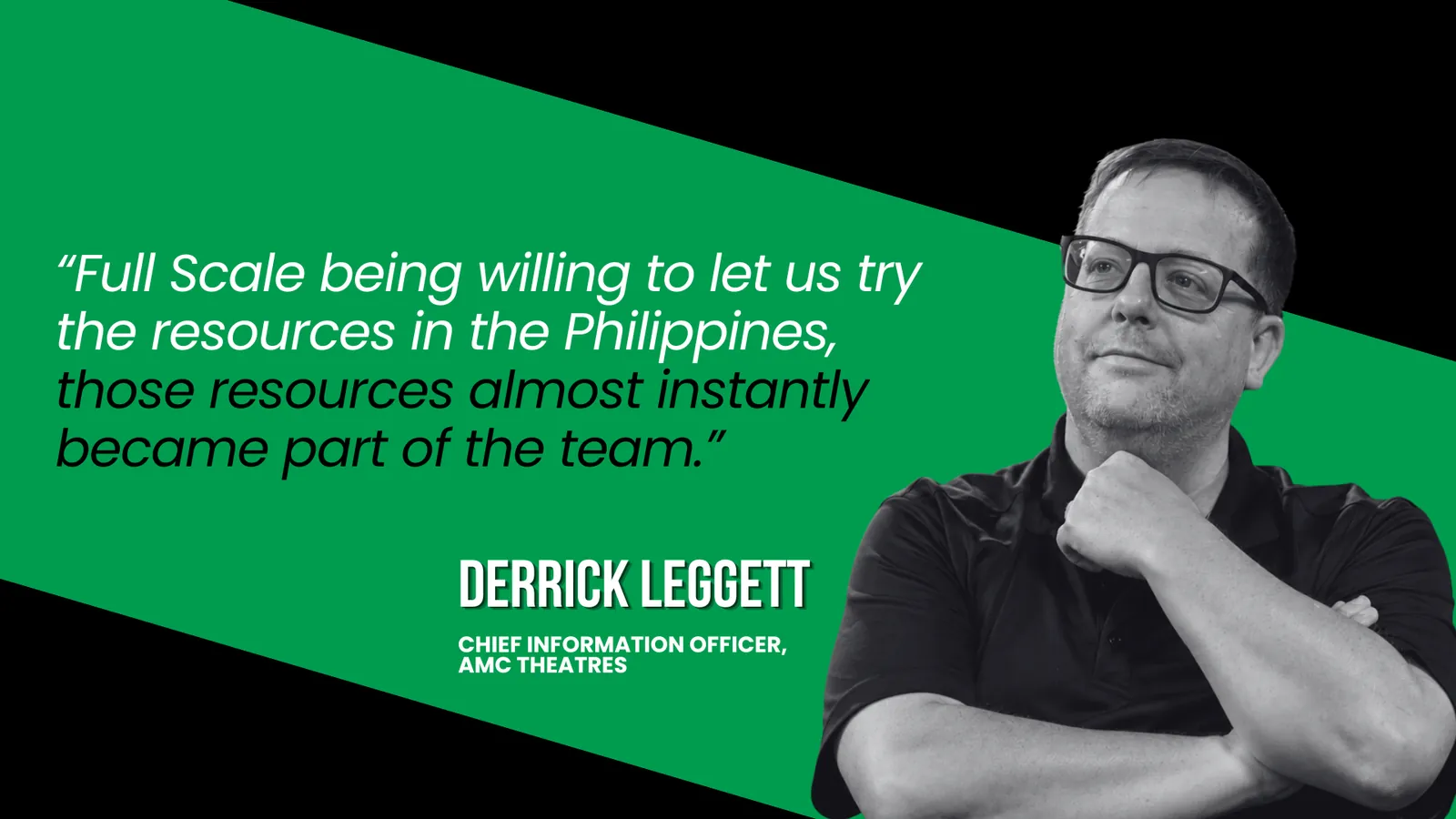
AMC Theatres grew from around 170 theatres with no website and no app to over 900 theatres running the largest movie-ticketing platform in the world. Their engineering org spans the US, South America, India, and the Philippines, mostly remote. Their CIO, Derrick Leggett, built that team to treat Full Scale’s Filipino engineers as full AMC engineers, not contractors on the far side of a wall. Here’s how he puts it:
“It’s a fully integrated team. It’s just some of the people happen to be living in the Philippines.”
That’s the bar. Those engineers join the same standups and the same Slack channels, push code through the same review, and get held to the same standards as everyone else. When AMC’s CEO has an idea, it gets built fast, because there’s no vendor layer to route it through. Derrick also named the thing that holds it together: “For any long-term staffing relationship to evolve into a partnership, you have to start with trust. You have to lead with trust through the process and adjust with trust when things go wrong.” Trust like that builds with daily contact, which is exactly what the integrated model gives you and the middleman model takes away.
How to tell a good offshore partner from a bad one
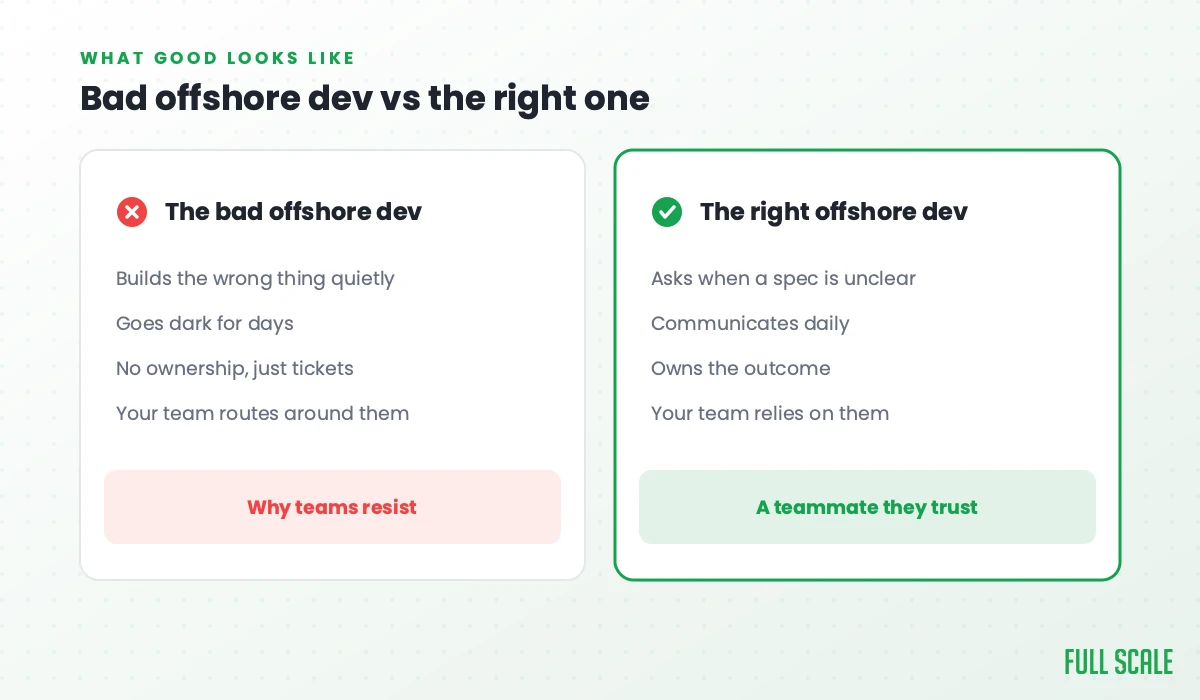
This is the decision actually in front of you, so here’s the checklist I’d use. The difference between an engagement your team resents and one they fight to keep usually comes down to these.
| Signs of a bad offshore setup | Signs of the right offshore partner |
|---|---|
| You only talk to a project manager, never the developers | You talk to your engineers directly, every day |
| Developers split across several clients at once | Developers dedicated full-time to your product |
| Staffed for a fixed project, then gone | A long-term team you build and keep |
| Quality is a black box until the code arrives | Same code review and standards as your in-house team |
| High turnover, new faces every few months | A stable team that stays long enough to earn trust |
| The cheapest hourly rate wins | Communication, ownership, and fit win |
The pattern under all of it is communication, ownership, and the courage to speak up when something’s wrong. Those are three of the ideas at the center of my book, Product Driven: as the mechanical parts of coding get automated, the human skills are what decide whether a team works. A great offshore developer does more than write clean code. They’ll tell you the spec is wrong before they build it. That kind of honesty needs daily contact and some skin in the outcome, which is exactly what a developer hiding behind a middleman never gets the chance to have.
If you want the longer version of what we’ve learned making this work, I wrote up the lessons from running offshore dedicated teams and a guide to offshore staff augmentation done right.
Your developers will actually want to work with the right offshore team
Go back to where we started. Your engineers don’t want bad offshore developers, and honestly, neither do I. That instinct is correct and you should respect it.
But once you name the patterns, “my team won’t work with offshore developers” turns from a verdict on offshore into a to-do list. A dedicated team you actually manage gives trust the daily contact it needs to form. The meetings get better the moment your own engineers show up for the overlap hours. The lone wolves need coaching through their first real handoff, which usually means pairing them with the new teammate, making code review the forcing function, and treating delegation as part of how you judge a senior engineer. And the whole thing needs leadership on your side of the table, because nothing else holds without someone steering it. Do that, and the resistance fades. Your developers relax, and the new folks become what they always were: good engineers who happen to live somewhere else.
There are smart people all over the world. The only question is whether you’ve built a team that lets your own engineers see it.
Frequently asked questions
Why doesn’t my development team want to work with offshore developers?
In almost every case your team is reacting to a few specific patterns rather than to offshore developers as a whole: a bad experience they had before, an engagement with no real leadership steering it, the extra meetings remote work requires, or a preference for just doing the work themselves. Most of those come down to communication and how the team is run. Whether an offshore developer can code is rarely the actual issue. Name which pattern you’re dealing with and each one has a fix.
Are offshore developers actually lower quality than in-house developers?
No. Most “low quality” offshore experiences trace back to offshore software development challenges in the engagement model rather than the developers’ skill. Project-based outsourcing shops staff whoever is on the bench across several clients, wall the developers off behind a project manager, and optimize for closing tickets. A dedicated staff augmentation model, where developers work directly for you long-term, produces a completely different result. Skill exists everywhere. What varies is the structure around it.
How do I integrate offshore developers without alienating my existing team?
Treat them as employees. Put them in the same standups, the same Slack, the same code review, and hold them to the same standards as your in-house engineers. Give your team direct daily contact instead of routing everything through a middleman, and make sure your own engineers make time for the overlap hours. When the offshore developers are clearly held to the same bar and your team can talk to them directly, integration stops feeling like a threat. Part of being held to the same bar is being just as direct when somebody is not, which is a separate process.
What’s the difference between hiring offshore developers and outsourcing a project?
Outsourcing hands a set of requirements to an outside firm and expects a finished product back, usually for a fixed project. Offshore staff augmentation is hiring: you bring on dedicated developers who work directly for your team long-term, like any other engineer. The first model creates the middleman and the quality black box that give offshore a bad name. The second is the one your existing developers will actually want to work with. That second model is worth doing right, and doing it right starts with how carefully you hire the right offshore developers in the first place.
Ready to add offshore developers your team will trust?
If your team has resisted offshore before, it’s worth figuring out whether the problem was offshore or the way it was set up. Book a 15-minute call and we’ll talk through your roadmap, your team, and whether dedicated engineers from the Philippines are the right fit. Schedule a call with Full Scale.