
How to Choose an Offshore Staff Augmentation Company: A CTO’s Guide

In this article
- What a Staff Augmentation Company Actually Does (and What It Doesn’t)
- The Five Categories of Staff Augmentation Companies (Most Buyers Are Comparing Apples to Oranges)
- The Five Criteria That Actually Predict a Good Fit
- What Goes Wrong (and How to Spot It Before You Sign)
- 15 Questions to Ask Any Vendor Before You Sign
- When Staff Augmentation Is the Wrong Call
- The Honest Case for Geographic Specialist Body Shops (and Where the Model Breaks)
- Frequently Asked Questions
- The Bottom Line
“We have five developers working on your project.”
“Great! Can I meet with them?”
“No, but you can talk to me.”
That exchange happens more than any of us want to admit. It’s how most staff augmentation engagements quietly go sideways. Months in, the client is talking to a sales-trained “lead” who filters everything, and the actual engineers are heads-down on a spec the client never wrote. Nobody is really owning the work, and that’s the whole problem. If you are comparing engagement models, start with PEO vs EOR vs staff augmentation.
I’ve been on both sides of this conversation. I co-founded VinSolutions (nine-figure exit), built Stackify (sold in 2021), and somewhere in there I hired offshore development teams in Russia, Uruguay, and the Philippines, three for three, none of them through a company I’d built. Now I run Full Scale’s IT staff augmentation company, which is a geographic specialist body shop based in Cebu. We go deep in the Philippines, we provide developers who work directly on your team, and we run the model long-term. So I’ve been the CTO trying to pick a vendor, and I’ve been the founder building the kind of company you’re trying to pick. Both seats teach you something the other doesn’t.
The thing both seats agree on: this whole model rises or falls on ownership. Pick a vendor that protects it, and a staff augmentation team out-ships most domestic-only competitors. Getting there starts with an honest look at the pros and cons of staff augmentation, not just the vendor pitch. Pick a vendor that mediates it, and you’ll write the post-mortem. That ownership principle is especially sharp for Rails: when companies outsource Ruby on Rails development through a project vendor, they get code without the engineers who understand it.
What a Staff Augmentation Company Actually Does (and What It Doesn’t)
A staff augmentation company recruits, hires, and supports engineers who join your team, the model covered in depth in what is staff augmentation. You direct the work. They handle hiring, payroll, retention, and HR. You scale talent without scaling overhead.
That’s the model in one sentence. Now the part most posts skip.
It’s not project outsourcing. With outsourcing, you hand a project to an external team and check back later. Staff augmentation keeps you in control, the engineers report to your managers, and you own the code from day one. We aren’t in this for some 3-month project. The whole point is the opposite of that. If you want the plainest version of what IT staff augmentation actually means, that’s worth reading on its own.
It’s not freelance hiring. A freelancer is yours to vet, manage, and replace on your own. A staff augmentation company does the recruiting, the vetting, the payroll, the retention, and the replacement when something goes wrong. You get the talent, they handle the operational tax. I walked through the mechanics of the engagement end to end, from picking a vendor to running the team day to day.
It’s not a traditional staffing agency. Old-school staffing optimizes for placement velocity. The agency wins when the seat is filled and stays neutral afterward. A real staff augmentation company has to keep showing up for years, because their model depends on long-term integration with your team. The incentives are different.
Here’s the quick contrast in one table.
| Model | Who manages the work | Who owns the code | Time to a developer | Typical cost (senior) | Engagement length |
|---|---|---|---|---|---|
| Staff augmentation | You | You | 2–3 weeks | $25–60/hr offshore, $100–200/hr US | Years |
| Project outsourcing | Vendor | Often the vendor (negotiable) | 4–8 weeks | Fixed-scope quote, varies | Defined by scope |
| Freelance | You | You | 1–4 weeks | Highly variable | Single engagement |
| Direct hire | You | You | 3–6 months (senior) | $180–280K loaded | Permanent |
Cost numbers are the same as our outsourced product development guide and our staff augmentation vs. outsourcing comparison. They’re not aspirational. They’re what this market looks like in 2026. If you’re specifically adding a group of developers to an existing team, see our team augmentation breakdown for how the model works.
If your situation matches the first row, you’re shopping for a staff augmentation company. The next question is what kind.
The Five Categories of Staff Augmentation Companies (Most Buyers Are Comparing Apples to Oranges)
Most “top 25 staff augmentation companies” listicles treat the category as one bucket. It isn’t. There are five distinct vendor types that show up in the same search results with nothing in common except their LinkedIn keywords.
Every “staff augmentation company” is fundamentally a body shop in the literal sense: they provide bodies (developers) who join your team. The differences are about what kind of body shop, and in two cases (project shops and marketplaces) whether they’re a body shop at all. Underneath all of it: does the model protect your ownership of the work, or mediate it?
1. Commodity body shops
The “$25/hour offshore” Craigslist of dev shops. Cheap, transactional, resume-forwarders. They optimize for billable hours and placement velocity. Quality and retention are downstream. Often Indian though not exclusively. High churn, weak vetting, junior-heavy bench.
Your offshore developer might make $25 an hour. Not because of their skills. Because of where they live. One of the best engineers I’ve ever hired is in Cebu and spent six years at IBM before joining us. He might be the smartest developer I’ve ever worked with. The rate is about geography, not capability, and confusing the two is the most expensive mistake in this list.
Ownership impact: Heavy. Engineers rotate, build no context, and never get close enough to your problem to push back on bad requirements. When to use: Rarely. The cheapest option becomes the most expensive choice once you count rework, ramp time, and turnover.
2. Geographic specialist body shops
The body-shop model done with regional depth. Vendors go deep in one country (Philippines, LatAm, Eastern Europe) instead of spreading across continents. Better vetting, better retention, deeper recruiting networks, stronger cultural alignment. Long-term focus. This is Full Scale’s category.
The reason it exists: staff augmentation done well requires operational depth that doesn’t scale across geographies. Hiring senior engineers in Cebu is a different job from hiring senior engineers in Krakow, and a vendor doing both at the same time is doing both worse.
Most offshore collaboration fails because people simply hand a bunch of requirements over to an outsourcing firm. Then they expect to get back a successful project. The ones who succeed know you can’t hand product development off and walk away. Geographic specialists run the model the opposite way: hire talent to work directly for you on a long-term basis.
Ownership impact: Low if the vendor runs the model with the right principles (direct access to engineers, no gatekeeper layer, long-term assignment). Engineers stick around long enough to actually build context with your product and your customers. Example providers: Full Scale (Philippines), BairesDev (LatAm), Accelerance (multi-region). Be skeptical of any vendor here that tries to be everything to everyone.
3. Niche-skill specialist body shops
Body shops focused on one technology: AI/ML, MLOps, security engineering, mobile, embedded firmware. They charge a premium because the talent depth is real. ThirstySprout fits here for AI work. More common as specialty one-off placements than as long-tail team builds.
If you need an MLOps engineer to set up production model deployment, you don’t need a generalist staff augmentation company. You need a specialist who vets specifically for that skill, because generalist vendors charge the same rate to send you someone who’s seen a Jupyter notebook.
Ownership impact: Low when the engagement is scoped and the engineer integrates directly. Higher when the vendor adds a project-management layer. When to use: When the skill itself is the bottleneck and your local market can’t deliver it in a reasonable timeline.
4. Project shops (managed services)
Not body shops. A different model entirely. The vendor delivers a defined output, the vendor’s PM owns the work, and you stay arms-length. Convenient for hands-off engagements but the output is competent and generic, not software that wins. The team doesn’t report to you. They report to the vendor. Your product strategy never fully lands inside that team because there’s a layer in between.
Ownership impact: Maximum, by design. That’s the value proposition for buyers who want it. The problem is most people who buy this should have bought staff augmentation. When to use: Genuinely fixed scopes you already understand: a website rebuild, a migration, a fixed-feature engagement. I’ve used project shops myself for WordPress builds and a focused Elasticsearch project. Not for new product development.
5. Marketplaces
Not body shops in the agency sense. You self-serve from a vetted pool. Toptal, Upwork Enterprise, Arc, Gun.io. Higher per-hour rates than equivalent agency talent because the marketplace takes a cut and the engineers are freelance.
Marketplaces work for individual hires. They break down when you need a team. You’re doing your own vetting, your own onboarding, your own retention, and your own replacement. Some companies love this model. Most underestimate the operational tax.
Ownership impact: None on the vendor side. Maximum on your side. When to use: Short-term, single-engineer placements where you have the internal bandwidth to vet, onboard, and manage directly.
The category map at a glance
| Category | Who manages work | Optimized for | Ownership impact | Example providers |
|---|---|---|---|---|
| Commodity body shop | You | Lowest rate | Heavy (engineers rotate, no context) | Many anonymous Indian shops, aggregators |
| Geographic specialist body shop | You | Regional depth, long-term integration | Low if run well | Full Scale, BairesDev, Accelerance |
| Niche-skill specialist | You (mostly) | Specific technical capability | Low to medium | ThirstySprout (AI), and others |
| Project shop | Vendor’s PM | Vendor-managed delivery | Maximum (by design) | Various consultancies |
| Marketplace | You | Self-service hiring | None on vendor side, maximum on yours | Toptal, Upwork, Arc |
Most buyers comparing “staff augmentation companies” are looking at one row without knowing the other four exist. Picking the wrong category is a bigger mistake than picking the wrong vendor inside the right category.
The Five Criteria That Actually Predict a Good Fit
Once you’ve picked the right category, you’re evaluating individual vendors. Most posts will give you the standard list (technical skill, communication, cultural fit). That list is fine and almost useless, because every vendor will claim all of it.
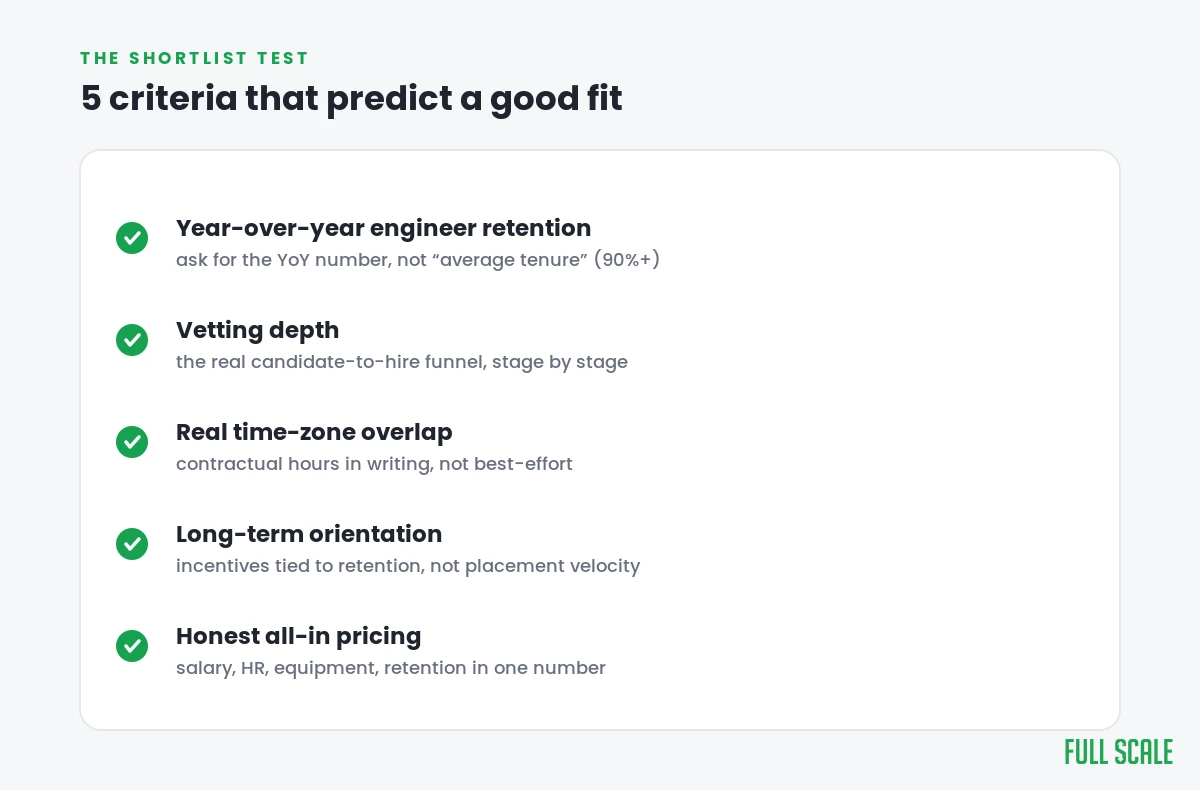
These are the five criteria that actually predict the outcome at month 12.
1. Year-over-year engineer retention
The single most predictive number in this whole decision. A vendor’s retention tells you what your engagement looks like a year from now. High churn means your project resets every few months with new ramp time and lost context. That’s a tax you pay forever.
Ask for the year-over-year number specifically, not “average tenure.” Tenure gets gamed at young companies. Full Scale’s developer retention runs 93%+, and that number is one of our recruiting advantages on both sides of the engagement.
2. Vetting depth, the specific version
“We hire the best” is not an answer. Ask the vendor what their candidate-to-hire funnel looks like. How many people do they screen per placement? What stages does the vetting include? At Full Scale we interview roughly 100 candidates per hire, with technical, system design, communication, and reference checks. That’s the floor for a serious provider. A vendor who hand-waves this is telling you what their bench looks like.
3. Communication model and actual time-zone overlap
“Our engineers work in your timezone” means different things to different vendors. Some guarantee three to four hours of contractually committed daily overlap. Others mean the engineer is awake during some of your working hours but mostly works asynchronously. The first version is real. The second version is collaboration theater.
If your team works well remotely, it will work well globally, too, but only if the overlap is real. Ask for the specific window in hours, and ask if it’s contractual or best-effort.
4. Long-term orientation
The criterion that separates the embedded operators from the bench-stuffers. Vendors whose incentives are tied to placement velocity burn through engineers. Vendors whose incentives are tied to long-term client retention treat engineer churn as their own problem.
Make sure you work with a dev agency that cares about your product, not just your project. The signal: their engineer retention rate and their longest active client engagement should both be measured in years.
“Waking up each morning to collaborate with the Full Scale team has become the highlight of my day. Their work ethic, pride in craftsmanship, and the sheer quality of their output have not only met but exceeded our expectations. The most significant impact has been the seamless integration of their team with ours, making every challenge surmountable and every success sweeter.”
Andy Kallenbach, CEO of LendingStandard
5. Honest pricing, all-in
Some vendors quote engineer compensation and bill separately for management overhead, equipment, workspace, retention programs, and HR. Others quote all-in. If you’re comparing a $3,500/mo all-in rate against a $3,000/mo + $800 management fee + $500 equipment deposit, the “cheaper” vendor isn’t cheaper.
Ask specifically: does the rate include salary, HR, payroll, equipment, workspace, and retention? Anything that comes back as a separate line item is a future surprise.
This is where the most expensive mistake lives. The $25/hr offshore developer becomes a $200K mistake once you count high turnover, six-month ramps that happen twice, and the rework from junior engineers shipping the wrong thing. Cheap is the most expensive choice in this market.
The scorecard
| Criterion | Question to ask | What “good” looks like |
|---|---|---|
| Retention | YoY engineer retention rate | 90%+ |
| Vetting | Candidate-to-hire funnel ratio | Multi-stage, ~50:1 or tighter |
| Time zone | Contractual overlap window | 4+ hours, in writing |
| Long-term orientation | Longest active client engagement | Multiple years |
| Pricing | Is the rate all-in? | Yes, with no line-item surprises |
What Goes Wrong (and How to Spot It Before You Sign)
The model isn’t what breaks. The vendor selection is what breaks. The signs are obvious if you know what you’re looking at.
The Gatekeeper Problem
The intro of this post opens with the dialogue. Here’s the full pattern.
Your dev agency assigns multiple developers but you can only talk to one “lead” who filters everything. Your product vision gets diluted, your feedback gets sanitized, simple clarifications turn into multi-day email chains. I’ve seen this red flag sink more products than any other. If you can’t talk directly to the people building your software, you’re not getting what you paid for. Demand direct access to every engineer on your engagement, in writing, as a condition of the contract.
The Serbia call
A CTO friend of mine fired his offshore team in Serbia last year. Same reasons I’ve heard a hundred times: the team produced a quarter of the output of his local talent, there was no US-hour overlap, and communication broke down on top of it.
This is not an offshore problem. It’s a vendor-selection problem. He picked a commodity body shop based on rate, signed without checking the actual time-zone overlap, and inherited the engineer pool of a company optimized for placement velocity. The same engineers, working for a vendor with the right model, would have shipped. I’ve heard variants of this story enough times to make a chart. The dollar amount is always different. The mechanics are always the same.
The other big red flags
- Treating offshore engineers as “code monkeys” instead of real engineers (mostly a buyer-side failure, but vendors that encourage the mindset are the ones to avoid)
- “Trust us, we’re handling it” instead of actual updates from the engineers themselves
- A vendor pushing a fixed-price project model for what’s clearly a long-term team need (they’re selling the model they have, not the one you need)
- No clear answer about engineer retention, or who actually owns the IP
- Junior engineers being pitched as senior on the sales call, then arriving with less experience than the resume implied
- Vague vetting process (“we hire the best”) with no specifics
- Pricing that requires a sales call to reveal
You always need technical leadership in-house to read the signals on any of these. A vendor relationship without an in-house engineering leader to manage it amplifies whatever you bring to it, including the gaps.
15 Questions to Ask Any Vendor Before You Sign
Print these and send them to every vendor on your shortlist. The vendors who answer all 15 with specifics are worth your time. Their written answers are effectively a staff augmentation proposal, so hold it to the same standard. The vendors who deflect, generalize, or steer you toward a sales call are telling you something.
On vetting
- Walk me through your full vetting process for a Senior [Role] hire. What does each stage evaluate?
- What’s your candidate-to-hire ratio?
- Can I be in the final interview loop with the engineer before they’re placed?
On retention
- What’s your year-over-year engineer retention rate?
- What happens if my engineer leaves your company? Replacement process and timeline?
- What’s the longest engagement you’ve had with a single client?
On pricing and contracts
- What’s included in the monthly rate? Salary, HR, payroll, equipment, workspace, retention?
- What happens if an engineer is not the right fit early on, and are you locked into a long-term contract?
- What are your direct-conversion terms if we want to hire the engineer onto our payroll later?
On communication and operations
- What’s the specific time-zone overlap your engineers commit to, in hours per day? Contractual or best-effort?
- Who is the engineer’s day-to-day manager, me or your account manager?
- How do you handle performance issues? What’s the escalation path?
On references and culture
- Can I talk to a current client (not just former) in my industry?
- Do your engineers participate in your client’s customer calls and product strategy discussions?
- What’s your view on engineers who push back on bad requirements?
That last question matters more than it looks. Vendors that train their engineers to nod and build are selling you a problem. You want the kind who push back when something doesn’t make sense, because that’s the only kind who add value beyond the headline rate.
When Staff Augmentation Is the Wrong Call
Staff augmentation is the right model for most product engineering work. It is not the right model for everything.
When the work is genuinely scoped and one-off. I’ve outsourced WordPress builds. I’ve outsourced a focused Elasticsearch project. Quick, finite deliverables don’t need a long-term team. A project shop is the right call there. That same logic applies to .NET: when scope is truly fixed, outsourcing your .NET project beats building a team you don’t need.
When you don’t have an internal product owner. Someone on your side has to own decisions, write requirements, make tradeoff calls, and respond to the team within a day. If that person doesn’t exist, you’ll have an unhappy team and a stalled product no matter how good your vendor is. The augmented team amplifies what you bring. Bring chaos, get chaos faster.
When you’re using offshore as a stick to fire your US engineers. This one shows up sometimes. Morale tanks, knowledge walks out the door, the new team inherits a codebase nobody wants to touch. Staff augmentation as a layoff strategy costs you more than it saves.
Fix those first. Then come back to the vendor decision.
The Honest Case for Geographic Specialist Body Shops (and Where the Model Breaks)
This is the part where I make the case for the category I run.
In Product Driven, the book I wrote about engineering leadership, I argue that engineering breaks down when ownership of the work is unclear or mediated. The Ownership pillar is one of the five in the framework. It applies inside your in-house team and it applies to vendor selection in exactly the same way. Engineers who think like owners outperform those who wait for tickets. That’s true whether they’re in your office in Kansas City or in our office in Cebu.
A geographic specialist body shop run the right way protects ownership. The vendor handles the operational tax (recruiting, payroll, HR, retention) and gets out of the way. Your engineers work directly with your team. They join your standups, your retros, your customer calls. They own outcomes. They push back on requirements that don’t make sense. Over years, not months, they accumulate context that no marketplace freelancer or rotating commodity-shop developer ever could.
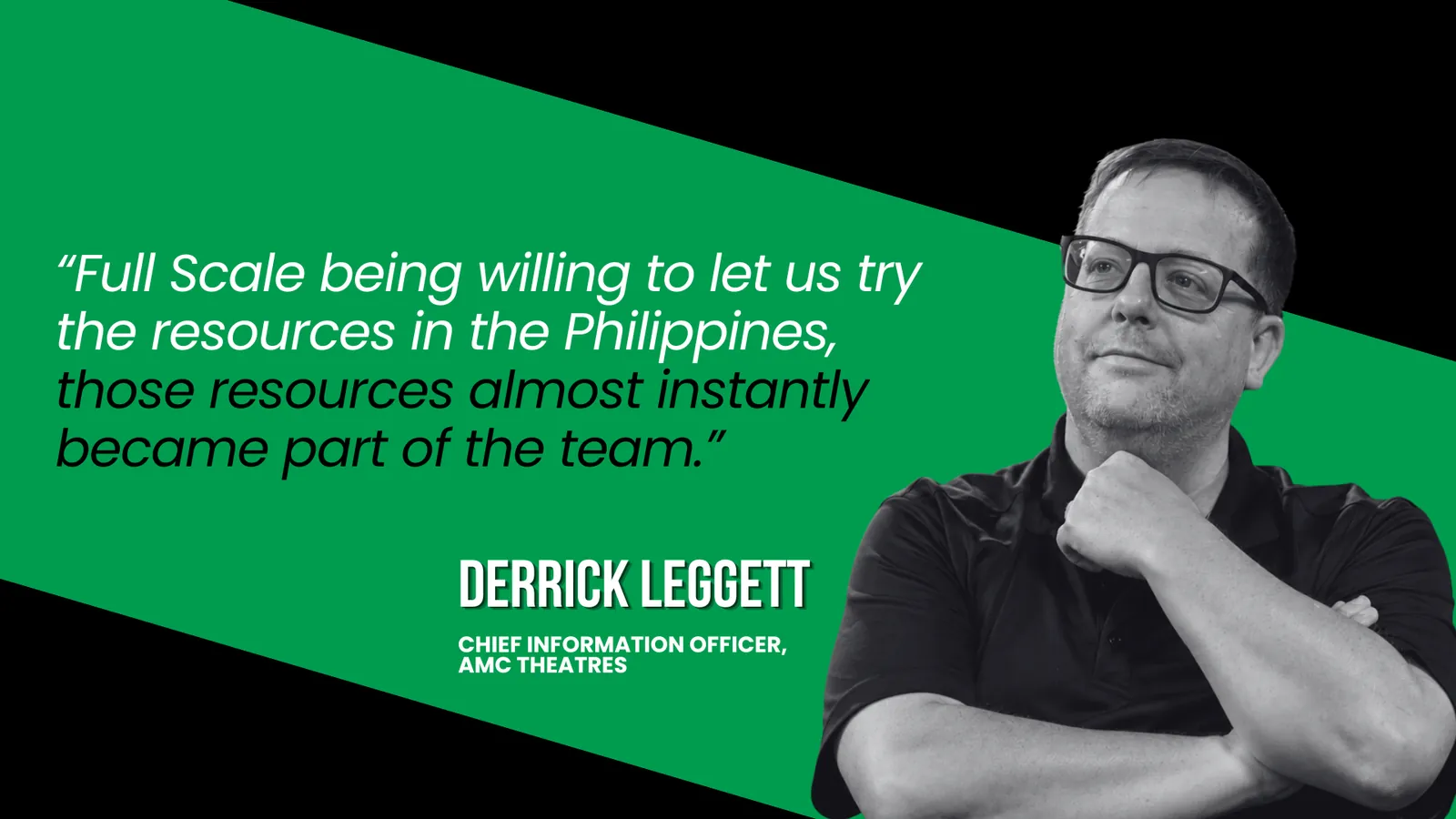
When this category wins. You’re building a product, not finishing a scoped project. You have internal product leadership. You need senior engineers who think like engineers, not contractors. You’re willing to invest in long-term integration. You want a vendor that treats retention as a core function instead of a sales metric. Done right, this is what good looks like: at AMC Theatres, Derrick Leggett has built a global engineering organization where the developers in the Philippines are treated as full AMC engineers, not contractors. That’s the bar.
When this category breaks. Pure scoped work, no internal product owner, or you genuinely want arms-length managed delivery. Go with a project shop instead. Trying to use a geographic specialist body shop the way you’d use a project shop is the most common cause of dissatisfaction in this category. The model isn’t broken. The fit is wrong.
I run a geographic specialist body shop. We’re not the right choice for every reader of this post. We’re the right choice for product engineering teams that want long-term Philippines-based senior developers who act like part of their team. Everyone else, the category map above is meant to point you toward the right place.
Staff augmentation is the right way.
Frequently Asked Questions
How much do staff augmentation companies charge?
Rates depend on geography, seniority, and what’s bundled in the all-in price. A quality offshore senior developer runs $25–60/hr through a reputable provider; a US-domestic equivalent runs $100–200/hr fully loaded. The more important question is what’s in the headline rate. Two vendors quoting the same price can have very different actual costs once management overhead, equipment, retention, and HR are accounted for.
What’s the difference between staff augmentation and outsourcing?
Staff augmentation extends your team with vetted engineers who report to your managers and integrate into your daily work. Outsourcing hands a project to an external team that delivers a result, you stay arms-length. For ongoing product work, staff augmentation wins. See our comparison post for the full breakdown.
How long does it take to hire through a staff augmentation company?
A quality provider should have vetted candidates in front of you within one to two weeks and an engineer integrated into your stand-ups within 14 days of contract signing. Compare that to about two to three months for domestic hiring of senior engineers. If a vendor quotes longer than two weeks to first candidate, ask why.
What happens if the engineer isn’t a good fit?
Any reputable staff augmentation company stands behind the match. Ask two things: what happens in the first couple of weeks if an engineer clearly is not right, and how hard is it to make a change after that. The strongest answer pairs a money-back guarantee on that early window with no long-term contract, so you are never locked in. If it is not working, you stop; if you need to swap someone later, you give reasonable notice and move on. The vendor to walk away from is the one that buries you in a long contract with no early out.
Where do most staff augmentation engagements fail?
They fail because the buyer treats the relationship like project outsourcing instead of team extension. The engineers get no customer context, no product strategy, no real decision authority, and then management is surprised when the output is generic. The model amplifies what you bring. Bring clarity and ownership, and a staff augmentation team out-ships most domestic-only teams. Bring chaos, and it accelerates the chaos.
The Bottom Line
Choosing a staff augmentation company isn’t really a vendor decision. It’s a decision about who owns the work. A good vendor protects ownership and disappears into your team. A bad vendor mediates ownership and inserts itself between you and the engineers building your product. Pick the kind that disappears.
If you want to see what the geographic-specialist body-shop model looks like inside a real engagement, talk to our team about your engineering needs. We’ll tell you honestly whether we’re the right fit, and if we aren’t, we’ll point you toward what is.
Find the vendor that gets out of the way. That’s the only version of this model that actually ships products.