
How to Motivate Your Offshore Team: What Actually Works

In this article
Quick answer: You motivate an offshore team the same way you motivate any developer, by giving them purpose, ownership, and a real seat on the team. The only difference is that distance strips away the motivation an office hands you for free, so you have to do it on purpose. Treat your offshore engineers like employees, not like a vendor down a phone line, and most of the problem disappears. Done right, that culture is part of why Full Scale became a certified great place to work.
Motivation doesn’t die loudly. It fades quietly, one ignored release at a time, until even your best engineers start going through the motions.
I wrote that in my book, Product Driven, and it’s just as true for a developer in Cebu as it is for one in Kansas City. But search “how to motivate your offshore team” and you’ll find a dozen articles selling you a special offshore playbook: exotic perks, tracking software, a list of tools. Most of it misses the point.
Here’s what I actually believe after years of running offshore teams at Full Scale, and before that as a CTO who hired developers in Russia, Latin America, and the Philippines back at Stackify.
Motivating an offshore team isn’t a special skill
Trying to motivate an offshore team isn’t much different from motivating local developers. People want the same things everywhere. They want to do work that matters, they want to be trusted, and they want to feel like part of something. Retention improves once you understand Filipino work culture and coach across the communication gap.
What changes with offshore and remote teams is that some of that gets harder to deliver.
When everyone’s in the same office, motivation comes for free. People hear the rah-rah from leadership at the all-hands, feel the energy in the room when a big deal closes, and pick up the mission just by being around it.
Your offshore developers get none of that by default.
So the real job isn’t inventing offshore-specific tricks. It’s being deliberate about the things an office used to do automatically. That takes more intention and more dedicated time. It is not complicated, but you can’t coast on it.
Why offshore teams actually go quiet
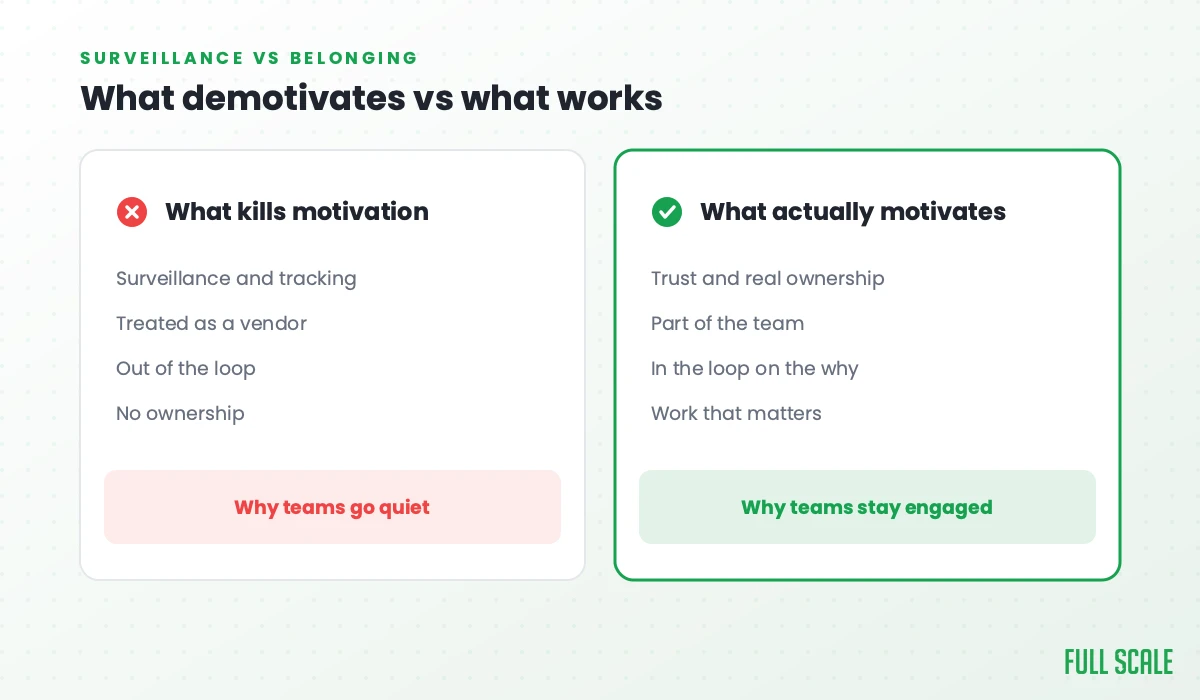
When an offshore engineer checks out, it’s rarely about money or perks. It’s almost always one of three things.
They don’t understand the “why.” They get handed tasks instead of goals, so they’re filling out tickets without any idea what they’re building or who it’s for.
They feel like an outsider. Decisions happen in a meeting they’re not in, in a time zone they’re not awake for, and they find out after the fact.
Or they feel like a vendor. They’ve been told, in a hundred small ways, that they’re the help, not the team.
Fix those three and motivation mostly takes care of itself. Pile on gift cards and game nights without fixing them, and you’ve just decorated the problem.
Gallup’s research finds that managers account for 70% of the variance in team engagement. That is good news if you manage offshore engineers, because the biggest lever is already in your hands.
Stop trying to motivate with surveillance
Activity-tracking software does not motivate offshore developers, and the articles that recommend it contradict themselves. The same articles that tell you to “avoid micromanagement” also tell you to install tracking software to watch your offshore developers work.
You can’t do both. Nothing says “we trust you” like a screenshot of your desktop every ten minutes.
You do not motivate engineers by tracking them harder or piling on more perks. People do their best work when they own the outcome and feel safe enough to say what they actually think. Ownership grows out of trust and the freedom to be wrong. Pressure and monitoring don’t create it. An engineer who’s scared to push back will never care about your product the way you need them to.
Ownership is built through trust and safety, not accountability pressure.
Matt Watson, Product Driven
Most teams don’t resist ownership. They just don’t believe it’s safe to take it. Watching them through a webcam tells them, loud and clear, that it isn’t.
The move that actually works is the opposite of surveillance. Stop handing out tasks and start handing out goals. Tell people the why, then ask them how they’d solve it. That’s how you turn a ticket-taker into someone who owns the result.
If any version of visibility is worth keeping, it is the opposite of the webcam. The thing actually worth watching for is not whether someone is slacking, it is whether your most loyal person is quietly burning out. Mark Simblante, one of our customer success managers at Full Scale, watches for exactly that:
“Some of our members don’t feel like filing an overtime. But for me as a manager, it’s very important, because this is how we gauge if there’s really a need of an additional resource for the client. We don’t want our employees doing overtime every week.”
The thing that matters most: make them part of the team
Offshore developers feel like part of the team when they work directly with you every day, the way Full Scale’s dedicated developers do. This is the one piece that really is offshore-specific, and it’s the whole game.
The reason so many offshore relationships feel flat is the model underneath them. Classic project outsourcing is a handoff. You write a spec, throw it over the wall, and a team you’ve never met builds to it. Nobody on that team feels like yours, because they aren’t.
The fix is a staff augmentation model: dedicated developers who work directly with you and your team, every day, like they’re your own employees.
Once you’re working that way, the motivation playbook is short and obvious.
Invite them to the company town hall and put them in the same Slack channels, standups, and ship celebrations as everyone else. Give them the swag, share the wins and the changes, and do everything you’d do for any other employee. As far as the work goes, they are one. Most of the benefits of collaborative software development come from exactly this kind of inclusion, not from any tool.
None of this means pretending the pay is identical. You hire in the Philippines because the cost of living is lower, and that’s fine. What has to be the same is the standards, the ownership, the respect, and the path to grow. Pay tracks the local market, and everything else tracks the team.
Treat your offshore developers like real team members and you don’t need a separate motivation strategy for them. You just need the one you already have. This is the same idea behind leading local and offshore developers as one team.
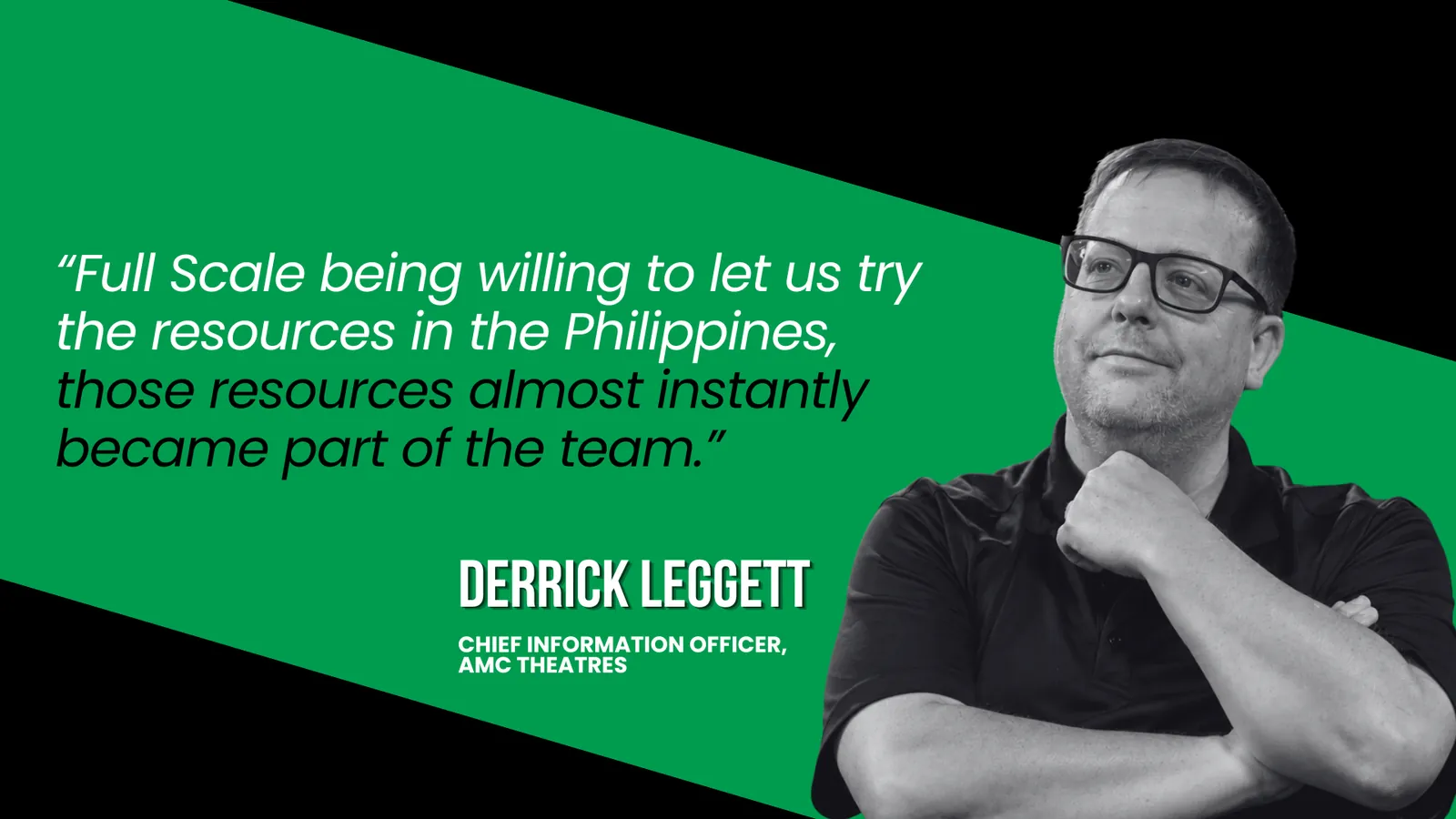
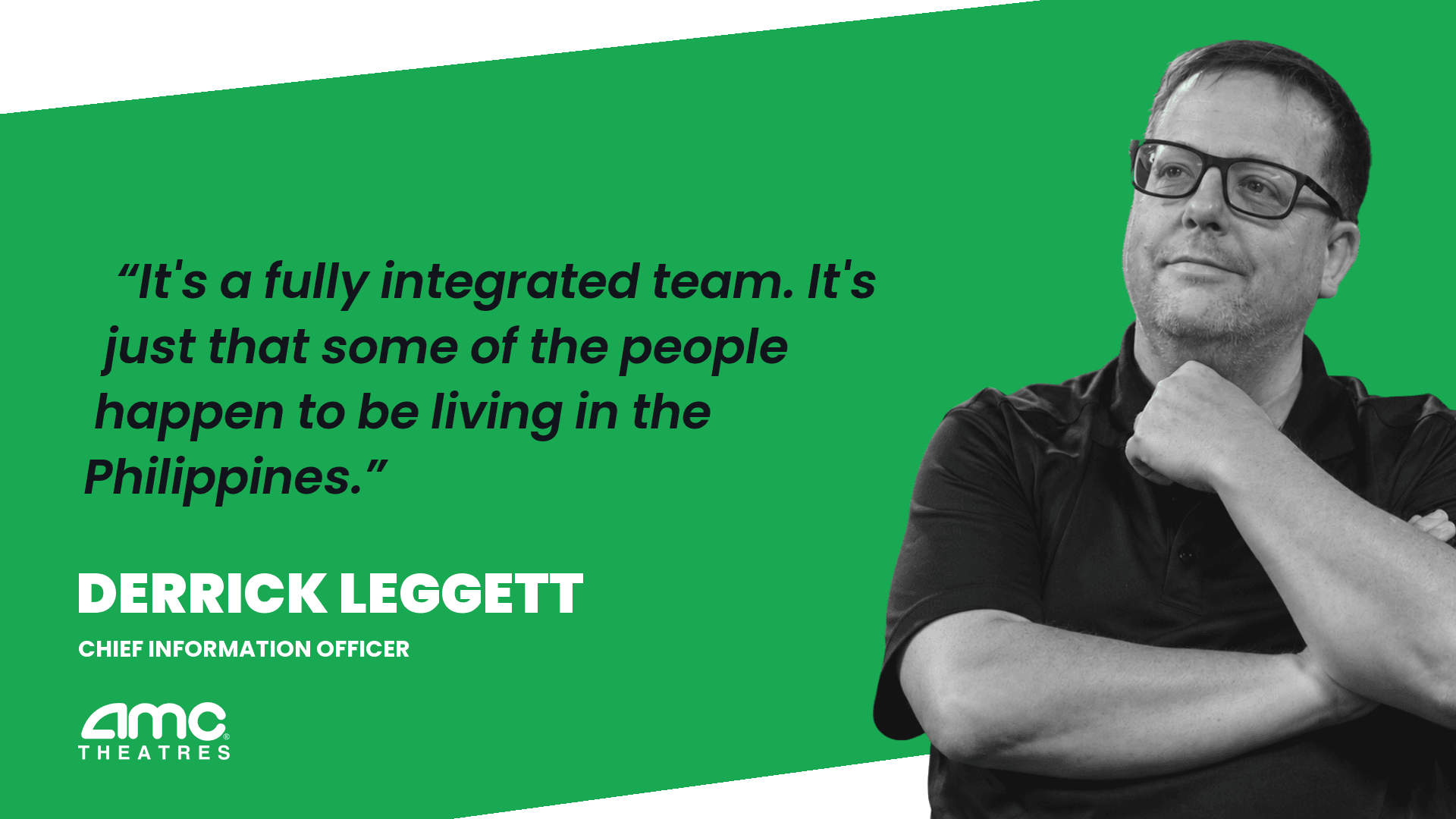
It’s also how AMC Theatres runs engineering. Derrick Leggett, their CIO, has built a global team where the Full Scale developers in the Philippines are AMC engineers, full stop.
It’s a fully integrated team. It’s just some of the people happen to be living in the Philippines.
Derrick Leggett, CIO, AMC Theatres
And they back it up in person. AMC’s Kansas City team has flown out to our Cebu office to spend real time with the engineers there: karaoke, a day at the beach, exploring the city together. That kind of time together is what tells a developer on the other side of the world that they’re genuinely part of the team, and people who feel that way don’t quietly check out.
The table stakes still matter, so don’t skip them
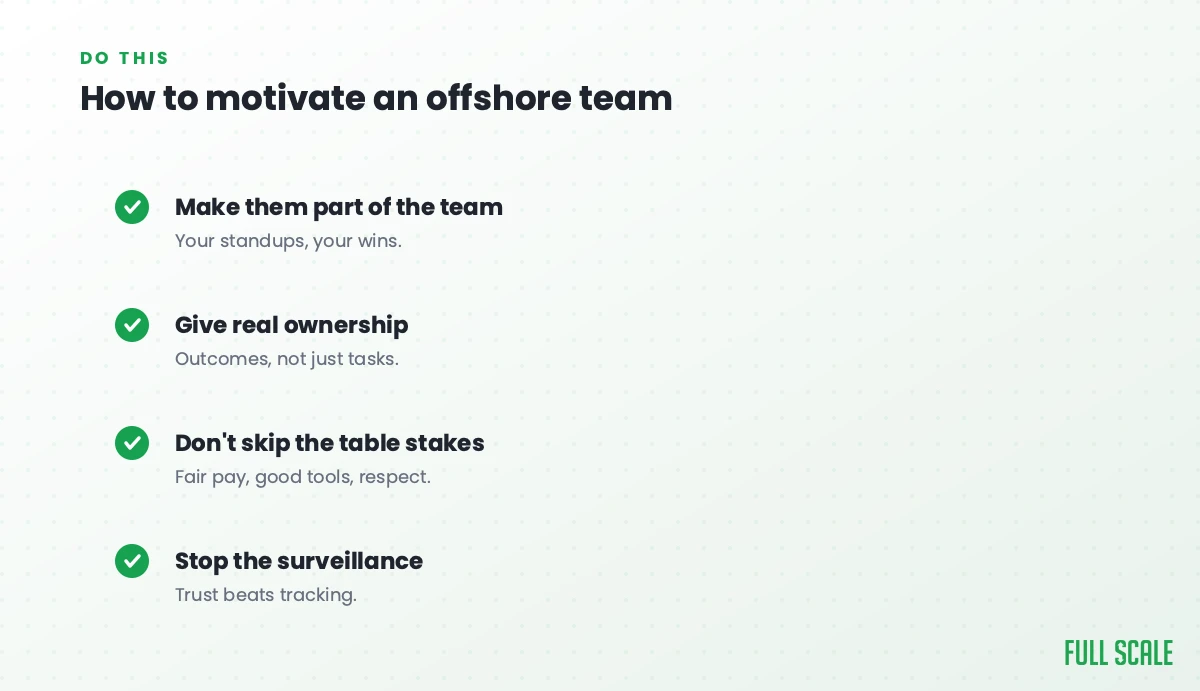
Five basics do the rest, and most of them are just good management applied with intention:
Set clear goals, and explain how each person’s work connects to the customer. Recognition should be public and specific, not generic “great job” noise. Watch the time zones so the offshore side isn’t always the one taking the 10pm call. And give people a real path to grow, because a developer who can see a future with you is one who stays. Underneath all of it, keep a steady communication rhythm so nobody’s left guessing. Every one of these rests on remote team communication done on purpose, not left to chance.
If you want the deeper operational version of these, I’ve written separately about how to manage and work with offshore developers. The point here is that tactics sit on top of trust. Skip the trust and the tactics turn into noise.
What it’s worth: people who stay
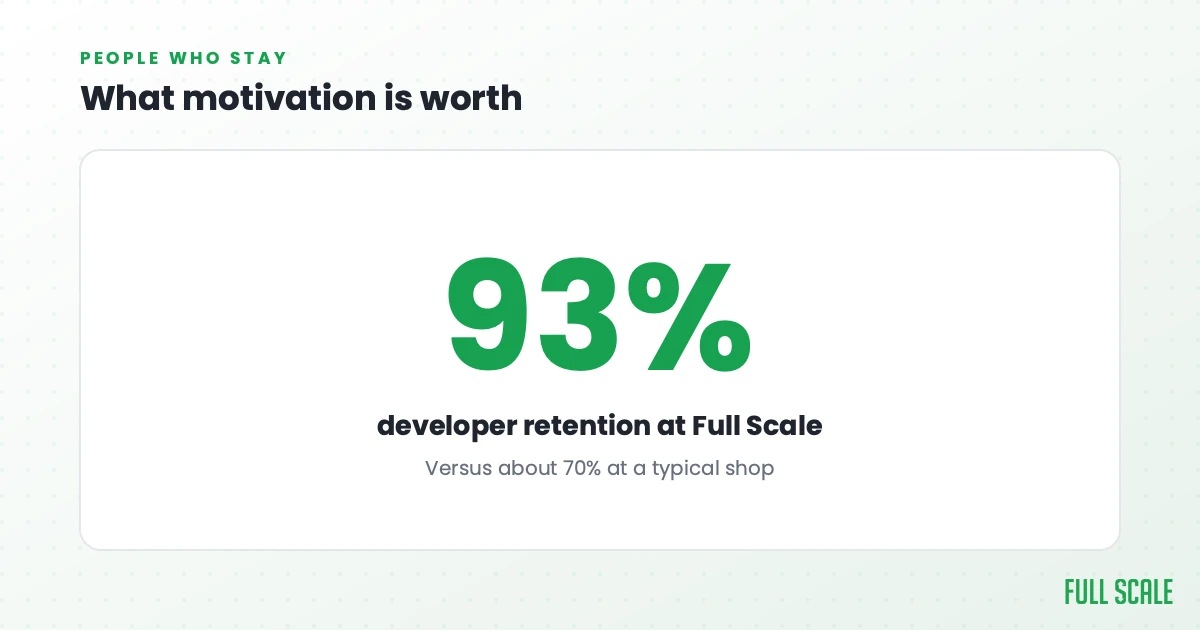
Get this right and people stay. Our developer retention at Full Scale runs about 93% a year. Across the Philippine outsourcing industry, voluntary attrition has run around 30% in recent years, so a typical shop keeps closer to 70% of its people. The country isn’t what drives that gap. How people are treated and managed is.
It isn’t luck, either. Full Scale is Great Place to Work Certified in the Philippines two years running, with 95% of employees saying it’s a great place to work, against 65% at a typical company there. Great Place To Work also ranked Full Scale #15 on its 2026 Southeast Asia Best Workplaces in Technology list, in the medium-company category.
Retention isn’t just a feel-good number. The engineers who stay know your systems, your codebase, and your customers. Constant churn means a rotating cast of strangers touching your product. A motivated, stable team is a better team, and it’s cheaper than the alternative once you count what turnover actually costs you. SHRM puts the cost of replacing an employee at 50% to 200% of their annual salary, and specialized technical roles sit at the high end of that range. (Here’s the full breakdown of how we hold 93% retention.)
Do this well and motivation compounds into retention over time. Treat your offshore team like the team they are, and you get both.
Frequently asked questions
What are the most common motivation problems with offshore teams?
The big ones are isolation from the business, getting tasks instead of goals, and feeling like a vendor rather than a teammate. Time zones, language, and culture get blamed a lot, but they’re usually surface issues. The root cause is almost always that the developer doesn’t feel connected to the purpose or trusted to own their work.
How do I make offshore developers feel like part of my team?
Give them the same access everyone else gets. Invite offshore developers to the company town hall, add them to the same Slack channels and standups, and share the wins, the changes, and the swag. At Full Scale, developers work directly with your team every day, so they are treated as your employees. Keep the standards, the ownership, and the path to grow identical to your local team’s, and let only the pay follow the local market.
How often should I meet with my offshore developers?
Often enough that they never feel out of the loop, which for most teams means daily standups plus a real weekly sync, on top of normal day-to-day chat. The exact cadence matters less than the consistency. Protect some overlapping hours so there’s live time every day, and don’t make the offshore side absorb every inconvenient meeting slot.
Do incentives and bonuses actually motivate offshore developers?
They help, but only after the basics are in place. Recognition, growth, and ownership do the real work. A bonus on top of a job where someone feels trusted and connected is a nice reinforcement. A bonus bolted onto a job where they feel like an outsider just buys a little quiet before they leave anyway.
How do I handle an offshore developer who’s underperforming?
Treat it exactly like you would with a local employee. Get specific about expectations, give direct and timely feedback, and figure out whether the problem is skill, clarity, or motivation, because the fix is different for each. Often the cause is upstream: unclear goals or no sense of why the work matters. Fix that before you assume it’s the person.
Ready to build an offshore team that acts like part of your team from day one? Book a discovery call and we’ll talk through what you’re building.