

Offshore software development that ships, not just staffs
Full Scale is an offshore software development company that supplies senior dedicated engineers from the Philippines and full offshore software development services for U.S. teams. Every engineer on the bench is pre-vetted, full-time, and ready to ship real code in a week. They join your standups instead of running a parallel one, and the pricing is a flat monthly rate per engineer with no recruiting fees or surprise invoices.
Offshore software development teams trusted by U.S. SaaS, enterprise, and Fortune 500

Previously founded VinSolutions ($150M+ exit) and Stackify
I tried offshore development in five countries before I built one I'd actually use
Before I started Full Scale, I'd already burned myself on offshore software development at three different companies. Russia, Latin America, India, then Vietnam. Some of it worked, most of it didn't, and the failures all had the same shape: a vendor in the middle who treated engineers like billable hours instead of people on a team, and a model that rewarded the agency for selling more hours rather than for shipping the product.
Full Scale is the offshore software development company I wished existed back then. We hire senior engineers in the Philippines, integrate them directly into your team, and charge a predictable per-engineer rate so the math is honest. There are no layered project managers between you and the developer, the engineer doesn't rotate off your account in six months, and the invoice you get next year looks like the invoice you got this month. If you've been burned by offshore before, this page is going to read very differently from what you're used to.
Offshore software development is hiring engineers in a different country to build and run your product alongside your U.S. team.
The clean definition: offshore software development means standing up engineering capacity in a lower-cost country and running it as part of your team instead of as a separate vendor project. The work happens in your codebase, in your tooling, on your roadmap. The engineers attend your standups and report up into your engineering leadership. Payroll, benefits, equipment, and HR all live with the offshore partner so you don't have to run a foreign entity.
The terminology is noisy because three different terms get used interchangeably: offshore (Asia-Pacific), nearshore (Latin America for U.S. buyers), and onshore (same-country). They're not interchangeable. They solve different problems at different price points, and the trade-offs decide which one fits your roadmap.
Here is how the three models actually compare side by side.
For a U.S. team building a product they'll keep developing for years, offshore is usually the right answer. The cost savings are real, the talent pool is deep, and a well-designed mid-shift overlap closes most of the time-zone gap. The catch is that offshore done badly is a horror story, and almost every team that ends up unhappy with offshore is unhappy because of the model the vendor sold them, not because of where the engineers live.
Offshore software developers trained on Product Driven principles
Most offshore software development companies adopting AI are shipping more code without shipping better software. Tickets go from open to merged in a day, the slop volume climbs, and the client's senior engineers spend their week cleaning up code that shouldn't have been written. The savings on the rate card get eaten by the cleanup tax.
Full Scale offshore engineers are trained on something different: the Product Driven approach from Matt's book, combined with the full modern AI toolkit. They think first, type second, and use AI for the parts where judgment doesn't add value. That combination is rare in offshore software development services, and it's what U.S. teams should actually be hiring for in 2026.
Product Driven engineering
Our offshore engineers are trained on the five pillars from Matt's book: Vision, Focus, Clarity, Ownership, and Courage. The result is offshore developers who push back on bad product decisions, ask whether a ticket should exist before writing it, and own the outcome of what ships. They are not order takers, and they don't write code they think is wrong just because the ticket asked for it.
Read Product Driven, the bookAI as a thinking partner
Every offshore engineer on our bench works with GitHub Copilot, Claude, and Cursor every day. They use AI to explore options, scaffold the boring parts, generate test suites, and review their own pull requests before a human ever sees them. Judgment stays with the engineer, the grunt work moves to the machine, and the cost per shipped feature drops sharply.
The thing I learned the hard way running offshore teams across five countries is that the bottleneck is never the code. It's the judgment behind the code. We train our engineers to think like product owners first, and then we hand them AI to make the typing fast. That's how offshore actually works.
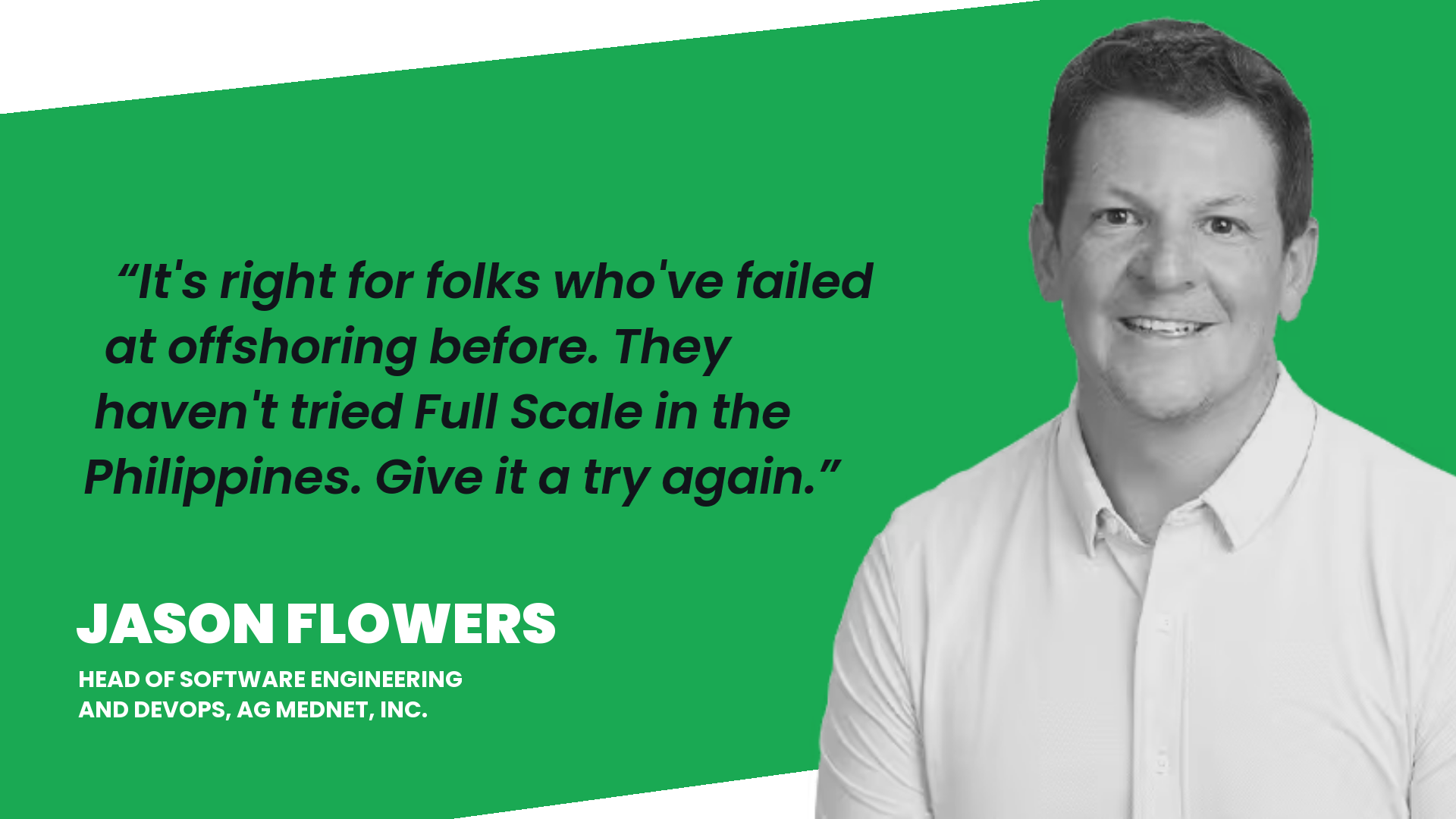
Offshore that finally stuck for AG Mednet
Jason Flowers had offshored to India and nearshored to Brazil before AG Mednet. Neither stuck. His embedded Full Scale QA team in the Philippines did, and it costs less than one of the nearshore developers it replaced.

Dedicated offshore developers, starting at $35 an hour
That rate is fully loaded. A senior engineer in the Philippines working full-time on your project, with payroll, benefits, HR, and equipment all handled by Full Scale. The same role hired locally in the U.S. typically costs $150K to $200K a year, so offshore software development services through Full Scale come in at roughly 40 to 50% of the all-in U.S. cost. The math is what gets most of our clients on the phone.
- Full-time, dedicated offshore engineer
- Pre-vetted by senior engineers on our team
- Works your hours, your tools, your codebase
- Payroll, HR, equipment, benefits handled by us
- U.S.-based account manager you can escalate to
- Two-week money-back guarantee if it isn't a fit
Full Scale has made the Inc. 5000 five years in a row and is Great Place to Work certified. We have been running offshore software development for U.S. teams since 2018. Pricing isn't the only reason clients stay, but it's the easiest reason to call.
The reason offshore software development actually works here.
English-fluent by default
The Philippines is the third-largest English-speaking country in the world. Standups, code reviews, and customer calls work the way they do with any U.S. team member, with no translation layer in between.
Real time-zone overlap
Most of our engineers shift their hours toward the US business day, giving 3-4 hours of real-time overlap with East and West Coast teams. Decisions happen live during shared hours instead of crawling through 24-hour async handoffs.
Deep engineering talent pool
Cebu and Manila produce tens of thousands of CS and IT graduates a year. The country has been the offshore software development home for U.S. companies for two decades, and the bench depth shows.
Cultural alignment with U.S. teams
Filipino engineers grow up on U.S. business norms, U.S. TV, and U.S. tech culture, so agile rituals, direct feedback, and collaborative workflows feel familiar from day one. Teams integrate fast instead of needing constant management.
The model is broken, not the developers
When clients tell me their last offshore software development experience was a disaster, I ask one question: was the agency charging by the hour with project managers in the middle? The answer is almost always yes. The horror stories blamed on offshore engineers are really stories about a broken commercial model. The fixes don't need a new country, they need a different relationship between the buyer, the engineer, and the vendor. Here are the six failure modes Full Scale designs around, and how an offshore software development company that actually works is structured differently.
Middlemen between you and the engineers
Most offshore software development companies stack three layers of project managers between the client and the people writing code. By the time your question reaches the engineer it's a different question, and by the time the answer comes back you've already shipped the wrong thing.
Rotating heads on the project
Traditional offshore vendors swap engineers on and off your account based on what's billable that week. The person you onboarded in March is on a different project in May, and the new engineer is starting from scratch on a codebase you've been paying to build for a year.
Contractor mentality instead of ownership
When the agency model rewards billable hours, engineers learn to wait for tickets instead of thinking about the product. The result is offshore developers who write exactly what the spec says even when the spec is wrong, and feature shipping that crawls because nobody is asking the obvious questions.
Communication that fails async
Offshore goes sideways when the only overlap with the U.S. team is a 30-minute morning standup. Questions stack up overnight, decisions get delayed by 24 hours, and the offshore engineer fills the gap by guessing. The fix isn't more meetings, it's designing the schedule so live collaboration is part of the day.
Opaque pricing that eats the savings
The headline rate looks great, then the invoice arrives with line items for recruiting fees, onboarding costs, equipment, and "team coordination." By month six the all-in cost matches a U.S. hire, but the engineer has none of the same context.
Vetting that's optimized for selling, not shipping
Most offshore software development services run a 15-minute screening interview and call it vetting. The engineer who passes it can talk about Spring Boot fluently and fail at writing a class that compiles. The vetting our clients need is the kind that catches that gap before the engineer ever joins their team.
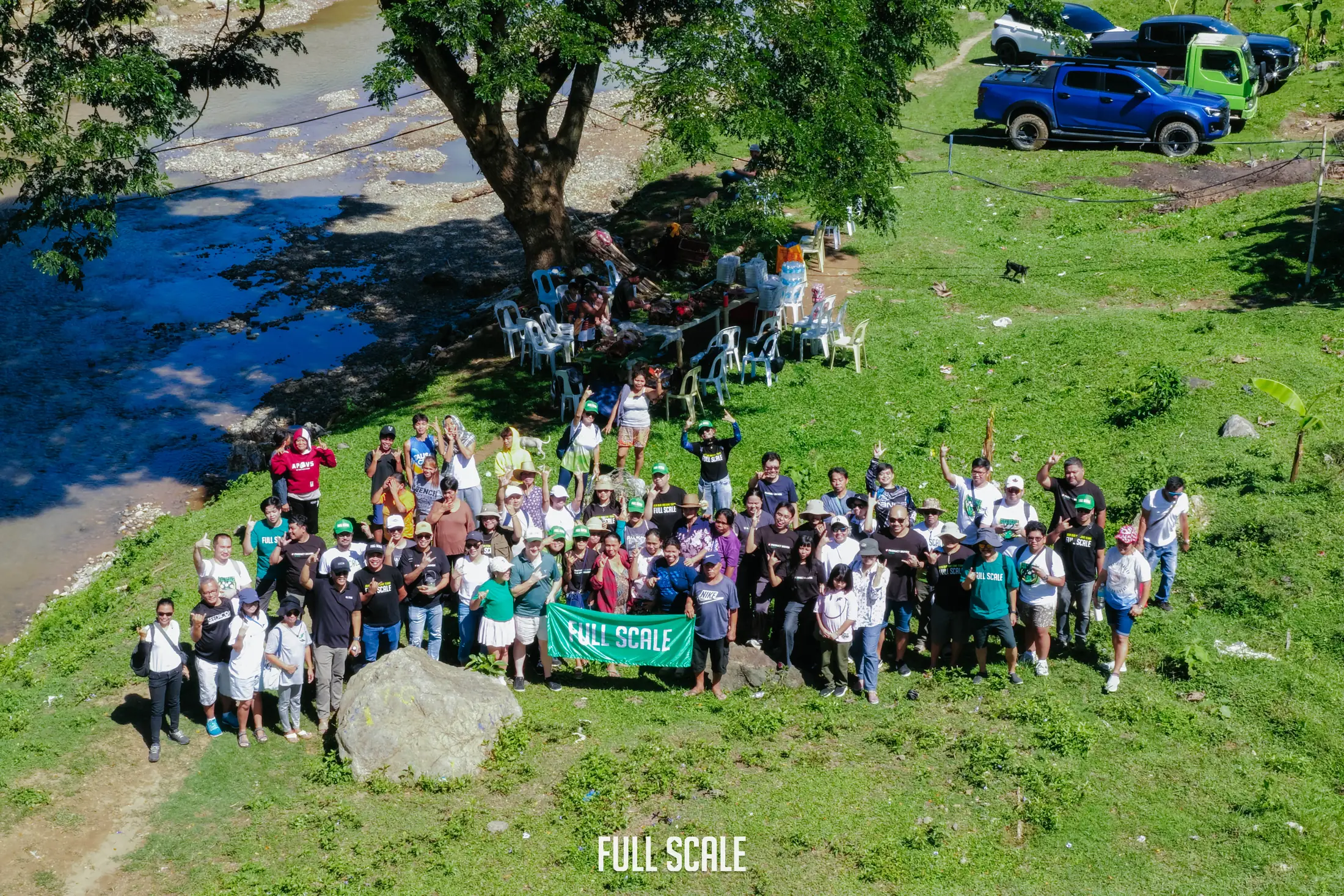
Offshoring done right puts money back into the community
Chasing the cheapest developer treats a country like a discount bin. We treat the Philippines as somewhere we belong. Every year the whole company takes a paid day to give back to the places we hire from, from donating computers to schools to planting mangroves to funding animal shelters. We call it CSR Day. It's part of why our engineers stay, and why the teams we build for clients don't reset every six months.
Hire dedicated offshore developers for the work that actually matters
Offshore software development covers a lot of ground, and most hiring conversations skip past the actual project. What kind of offshore work do you need done? A web app, a mobile build, an API rewrite, a data pipeline, a QA backlog, a cloud migration that's been open for six months? Full Scale's offshore software development services cover all of it. Here are the engagements U.S. teams hire us for most often.
Custom offshore web application development
Greenfield builds and feature work on modern web stacks (React, Next.js, Vue, Angular on the front; Node, Python, Go, Java, or .NET on the back). Our offshore engineers ship end-to-end features against your roadmap, not against a fixed-scope contract.
Offshore mobile app development
Native iOS (Swift) and Android (Kotlin) builds, plus cross-platform work in React Native and Flutter. The bench includes mobile engineers who have shipped through the App Store and Play Store review process dozens of times.
Offshore application development guideOffshore API and backend development
REST and GraphQL API design, microservices, event-driven systems, and integration work. We staff backend engineers fluent in Postgres, Redis, Kafka, RabbitMQ, and the cloud-native infrastructure that holds it all together.
Offshore data engineering and AI
Data engineers building pipelines on Snowflake, BigQuery, Databricks, and Airflow, plus ML/AI engineers shipping production inference on top of the modern LLM stack. The data side of offshore software development services is now one of our fastest-growing specialties.
Offshore software testing and QA
Offshore software testing through Full Scale means SDETs building real test pyramids in Playwright, Cypress, Selenium, and Pytest. We staff offshore QA engineers who own automated test suites and CI gates instead of doing manual click-testing at the end of the sprint. The same bench runs both standalone offshore QA engagements and full-team builds.
Hire offshore QA engineersOffshore DevOps and cloud infrastructure
DevOps engineers running AWS, Azure, and GCP environments end-to-end. CI/CD pipelines, infrastructure as code (Terraform, Bicep), Kubernetes, observability (OpenTelemetry, Datadog), and the on-call rotation that keeps your production healthy overnight.
Eight offshore engineering roles, one vetted bench
Most offshore teams need more than one role. Hire senior engineers, tech leads, software architects, and QA specialists from a single offshore software development company instead of piecing the team together from four different vendors. Mix and match seniorities as the project requires, and add or remove heads as the roadmap changes.
Senior Software Engineers
Five to ten years of shipped production code, comfortable owning a feature end-to-end. Most of our placements are seniors, because that's the level where offshore software development actually pays for itself.
Tech Leads
Senior engineers who also run a small pod: technical direction, code review, mentoring, hiring input. The right fit when a U.S. team wants offshore engineers to operate with less day-to-day management.
Software Architects
System design specialists for distributed services, event-driven architectures, and high-throughput data systems. They write ADRs and run architectural reviews alongside your in-house principal engineers.
Backend Engineers
API, business logic, and data access specialists across Node, Python, Java, Go, and .NET. They ship REST and GraphQL services, message queues, and the integrations behind the product.
Mobile App Engineers
Native iOS (Swift), native Android (Kotlin), plus React Native and Flutter cross-platform builds. Comfortable with App Store and Play Store release cycles, native performance work, and offline-first design.
Data and AI Engineers
Pipeline builders on Snowflake, BigQuery, Databricks, and Airflow, plus ML engineers shipping production LLM and inference systems. The bench has grown fastest in this category over the last 18 months.
DevOps and Site Reliability Engineers
AWS, Azure, GCP, Kubernetes, Terraform, and the full observability stack. They own CI/CD, infrastructure as code, and the on-call rotation that catches production fires while your U.S. team is asleep.
QA and Automation Engineers
SDETs who build out test pyramids in Playwright, Cypress, and Pytest, plus QA engineers who own the gates in your CI pipeline. They replace manual click-through testing with real automated coverage.
Offshore engineering tuned to your industry
As an offshore software development company that has been running U.S. engagements for over a decade, we have placed dedicated offshore developers into nearly every major industry. Domain knowledge cuts onboarding time in half, so we match engineers to projects where they've already shipped real code.
SaaS & Scale-ups
B2B SaaS is the home turf of Full Scale's offshore software development services. Our engineers have shipped multi-tenant architecture, subscription billing, role-based access, and white-label theming at every stage from seed-stage to public companies.
From React and Node to Python, Java, .NET, and beyond
Full Scale's offshore software development services cover every major engineering stack. Hire offshore React and Node engineers for a SaaS build, Python and data engineers for an analytics platform, Swift and Kotlin engineers for a mobile launch, or .NET engineers for an enterprise modernization. The bench covers all of it, and you mix and match the stacks per engagement.
Hire offshore developers, two ways
Most clients start with a single dedicated offshore developer and grow into a full team. Either way, you get full-time engineers who sit on your standups, work your hours, and ship code against your roadmap. Both models run agile offshore development the same way your in-house team does, with the same sprint cadence, the same code review process, and the same retros. These aren't freelancers, they aren't shared between clients, and they aren't sitting at a project shop on the side. See how the same dedicated developer model works across every stack we staff offshore.
Dedicated developer
Full-time, exclusive, sits on your standups.
- Full-time offshore engineer assigned only to your project
- Works your hours, your tools, your codebase
- Joins your standups, reports to your tech lead
- We handle payroll, HR, equipment, retention
- Two-week money-back guarantee
Dedicated offshore team
Multiple engineers, embedded as a pod.
- 2-10 offshore engineers staffed together as one pod
- Optional QA, DevOps, and tech lead included
- Operates as a dedicated offshore development team inside your org
- Scale up or down by a head with 30 days notice
- Account manager you can escalate to in the U.S.
Offshore software development versus the four alternatives most teams consider
Vendor pitches blur these models together, but they solve different problems. Picking the wrong one is the most common reason teams end up unhappy with an offshore engagement, so it's worth getting this part right before you sign a contract.
Offshore vs nearshore software development
Offshore puts your engineers in Asia-Pacific (Philippines, India, Vietnam) at the deepest discount and the largest talent pool. Nearshore puts them in Latin America with closer time-zone overlap and a smaller cost gap. Offshore wins on cost and bench depth; nearshore wins on real-time pair programming hours. A well-designed mid-shift offshore schedule closes most of the time-zone gap for the U.S. teams that pick it.
When to pick which: Pick offshore for long-running products where the savings compound. Pick nearshore for short engagements that need full-day overlap with no async at all.
Read Philippines vs Latin America comparisonOffshore vs onshore software development
Onshore means hiring engineers in your own country at full local cost. Offshore software development services run at roughly 40 to 70% of that all-in number, with a deeper talent pool. The trade-off is the time-zone overlap and the operational lift of running international employment, which a good offshore partner takes off your plate.
When to pick which: Pick onshore when regulation requires it, the work is short, or you need someone physically on-site. Pick offshore when the work is long, the budget matters, and the talent pool you actually need is bigger than the one in your zip code.
Offshore staff augmentation vs project outsourcing
Project outsourcing hands a vendor a defined deliverable and they go build it. Offshore staff augmentation runs the other way around: you hire offshore developers directly onto your team and they ship into your codebase for years. The first model buys you a project, the second builds you a team. Most offshore horror stories come from project outsourcing that should have been staff augmentation in the first place.
When to pick which: Outsource when the work is bounded and you don't need a full-time engineer after it ships. Augment when the code outlives the contract, which is most of the time for a product company.
Read the full staff aug vs outsourcing comparisonOffshore software development company vs freelance marketplaces
Freelancers on Upwork or Toptal work for themselves, juggle multiple clients, and have no long-term commitment. Offshore software development companies like Full Scale supply full-time engineers employed by the partner, assigned exclusively to one client, with retention measured in years not weeks. The partner also handles IP assignment, background checks, payroll, and the employment side of running an offshore team.
When to pick which: Hire freelancers for short fixed-scope jobs you don't need anyone around for afterwards. Hire an offshore software development company when you're building a product and you want the same engineers there in year three.
Read the contractor vs staff aug breakdownPhilippines vs India vs Eastern Europe vs Latin America
For U.S. teams building long-lived products, the success of offshore software development depends on more than hourly rates or time zone proximity. Full Scale hires exclusively in the Philippines because the combination of English fluency, real time-zone overlap, retention, and cultural alignment shows up there in a way it doesn't show up anywhere else at the same price. Here's how the four regions stack up.
| Factor | Philippines | India | Eastern Europe | Latin America |
|---|---|---|---|---|
| English fluency | Very High | Varies | Moderate | Moderate |
| Time zone compatibility (U.S.) | Good (mid-shift overlap) | Poor | Poor | Very Good |
| Cultural alignment | High | Moderate | Moderate | High |
| Retention | High | Varies | Moderate | Moderate |
| Technical expertise | Very Strong | Very Strong | Strong | Strong |
| Political stability | Stable | Stable | Varies | Stable |
| Infrastructure quality | Good | Good | Very Good | Good |
| Typical hourly rate range | $25-$55 | $15-$45 | $45-$95 | $40-$85 |
For a long-running U.S. engineering roadmap, the Philippines is the only region where English fluency, real time-zone overlap, retention, and cultural alignment all show up at once at an offshore price point.
A time zone difference that works in your favor
Most offshore teams struggle because their schedules fight the work. The U.S. side is asleep when the offshore side is online, decisions take 24 hours to make, and by the time the offshore engineer asks the clarifying question the sprint is already over. The Philippines has the right geography for U.S. overlap, but geography alone doesn't fix the schedule problem. What fixes it is how the offshore software development company designs the model around that overlap.
The mid-shift model
Full Scale designs overlap on purpose. Your offshore engineers work a mid-shift schedule built to balance two things: real-time collaboration with your U.S. team, and uninterrupted build time for the deep work. Most engineers are online from roughly mid-afternoon through late evening Philippine time, which puts them in your standups, your design reviews, and your incident channels live.
- Work progresses while your U.S. team is offline, and there's a real handoff at the end of the day instead of a black hole
- Decisions happen live during shared hours, not 24 hours later
- Context carries forward cleanly because the same engineer is in the conversation when the question gets answered
- Meetings shrink, output grows, because async plus overlap beats full overlap with constant interruption
Async plus overlap beats full overlap with constant interruption.
How to hire offshore developers from Full Scale
The 3-6 week recruitment cycle doesn't apply here, and there's no sourcing from cold. Our bench of vetted offshore developers in the Philippines is already built (here's how we hire engineers). Every step below is real, and every step has a named owner on our side.
Discovery call
30 minutes with our team. We learn your stack, your roadmap, the seniority level you need, and the specific offshore software development services that fit. There's no sales pitch on the call, just a working conversation about what you need.
Engineer match
We pull 1-3 pre-vetted offshore engineers from the bench whose skills, seniority, and prior project experience line up with what you described. You see their full profile and their actual project history.
Technical interview
You interview the candidates the way you would interview any senior hire: live coding, system design, language-specific gotchas, and architectural reviews. Pass anyone you don't believe in.
Contract and onboarding
Sign once. We handle every contract, payroll, equipment, and HR detail in the Philippines so you don't have an offshore entity to manage. You just get a developer.
First commit
Your developer joins your standups, picks up tickets in your sprint, and ships code in their first week. Agile offshore development works when the engineer runs the same rituals your in-house team runs, not a parallel cadence in another time zone. Our delivery managers stay involved to make sure ramp-up doesn't stall.
Full Scale vs the other ways to hire offshore developers
Every offshore hiring path has trade-offs. Here is how a Full Scale dedicated offshore engineer compares against the alternatives most teams consider first.
| Feature | Full Scale | Freelancer / Upwork | Traditional offshore agency | U.S. recruiter / FTE hire |
|---|---|---|---|---|
| Pre-vetted senior offshore bench | ||||
| Time to first hire | 7 days | 1-3 days | 3-6 weeks | 6-12 weeks |
| Dedicated full-time, not shared | ||||
| Founder ran offshore teams for 20+ years | ||||
| Sits on your standups, your tools | ||||
| Long-term retention | 93%+ | low | varies | varies |
| Two-week money-back guarantee | ||||
| Handles payroll, HR, equipment offshore | n/a | |||
| U.S.-based account management | n/a | |||
| Typical fully-loaded cost vs U.S. | ~40-50% | varies | ~50-65% | 100% |
Real offshore engineers, named and vetted
A sample of the offshore engineers on our team. These are real Full Scale developers working remotely from across the Philippines, and you'll meet candidates like them during your interview round.

A senior software developer with 12 years of experience across C#, Xamarin, and ASP.NET.

A software developer building with React, Vue.js, and JavaScript.

A software developer who ships production work with Next.js, React, and Vue.js.

A software developer building with Material UI, Next.js, and React.

A software developer who ships production work with HTML, JavaScript, and React.

A software developer who ships production work with JavaScript, TypeScript, and C#.
The numbers behind an offshore software development company that actually works.
From the people we actually staff offshore teams for
The team at Full Scale brought our vision to life with their offshore engineering skills. They helped us navigate technical requirements with ease, resulting in a robust platform our users trust.
Full Scale's offshore development team was pivotal in elevating our facility management software. Their expertise turned complex challenges into seamless functionalities, enhancing user experience and operational efficiency.
Deeper guides to offshore software development
Nearshore vs offshore
When each model wins, from a CEO who has run both.
Outsourcing vs offshoring
The distinction most CTOs get wrong, and why it matters.
What offshore development really costs
The real numbers behind offshore rates and total cost.
The ROI of offshore development
The math behind 50-70% development cost reductions.
Offshore development best practices
How to avoid the common ways offshore engagements go wrong.
Offshore due diligence checklist
What to vet before you sign with an offshore partner.
Everything you wanted to know about offshore software development
Build your offshore software development team with engineers who stay
30-minute discovery call with our team. We'll learn what you're building, walk you through which offshore developers are on the bench, and you'll meet candidates within a week. The call is a working conversation about your roadmap, not a sales pitch.