
7 Real Benefits of Outstaffing (From a CEO Who Runs One)

In this article
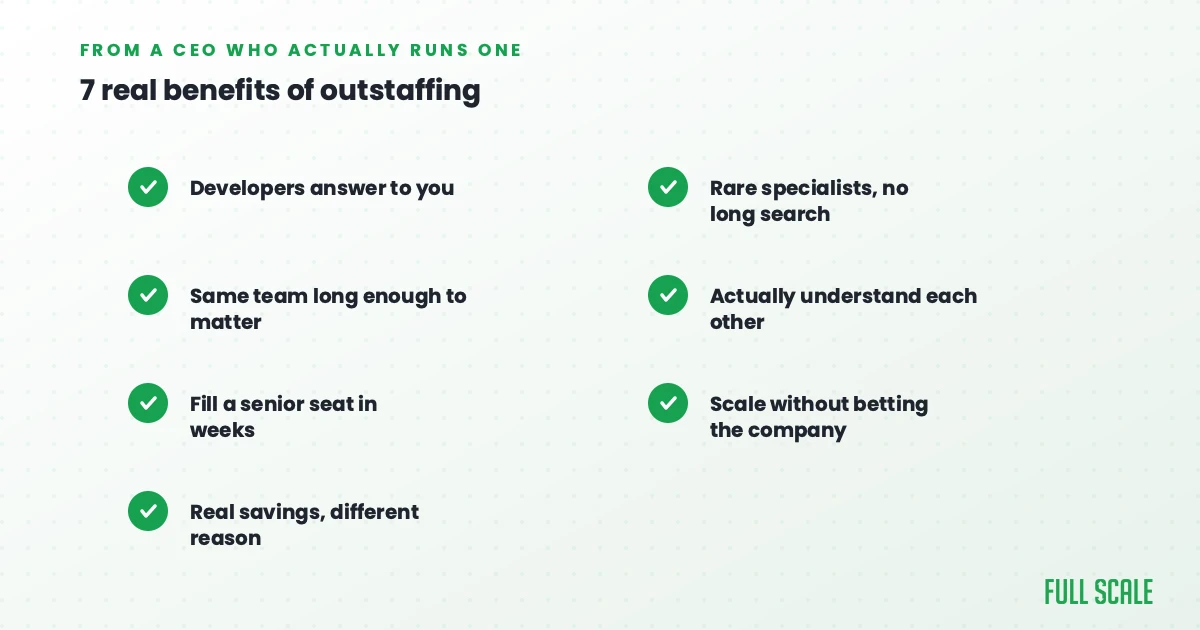
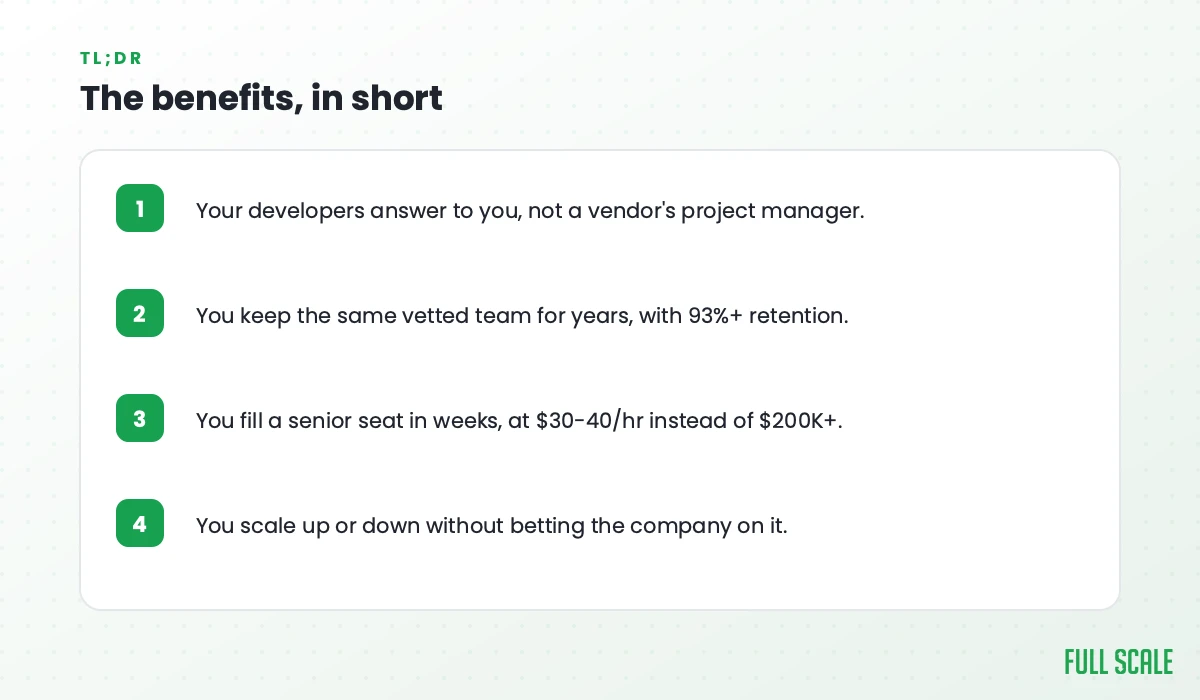
- 1. Your developers answer to you, not to a vendor’s project manager
- 2. You keep the same team long enough for it to matter
- 3. You fill a senior seat in weeks instead of quarters
- 4. The cost savings are real, but not for the reason the other posts give
- 5. You get the rare specialist without the year-long search
- 6. You can actually understand each other
- 7. You can scale up or down without betting the company on a hire
- What about protecting your IP?
- When outstaffing is the wrong call
- Frequently asked questions
Quick Answer: The real benefits of outstaffing are direct access to the developers, a team you keep long enough for the work to compound, and filling a senior seat in weeks instead of quarters, at 50-70% less than a comparable US hire. It works best when someone in-house can direct the engineering; it does not work well for a short project with a defined finish line, where a fixed deliverable is simpler. Full Scale runs this model with senior developers in the Philippines, with retention running 93%+.
Most articles about the benefits of outstaffing are written by people who have never had to make one of these engagements work past month three. I have, for years, and the list of advantages looks different once you’ve actually run it. That edge is clearer once you see where developer hiring is headed.
I came to it the slow way. In 2012 I hired Java developers in St. Petersburg almost by accident, through a friend’s agency, while I was still half-convinced offshore was a bad idea. By 2018 I was running a team of more than 20 Filipino engineers at Stackify, and that team was a big part of why we exited in 2021. Today I run Full Scale, and we’ve helped more than 200 tech companies grow engineering teams this way. It is the same reason a marketing team can hire a MarTech developer offshore and finally get the engineer they could never get approved for locally.
So when I list the benefits below, I’m not pulling them off the other articles on this page. They’re the ones that actually showed up.
One thing to settle first, because the words get used loosely. Outstaffing means hiring developers who work directly for you on a long-term basis, embedded in your team and your process, rather than handing a project to a vendor. If you want the full definition, here’s what outstaffing actually means. It is the same arrangement as staff augmentation, and the same thing European and Latin American firms sell as team extension. The benefits and advantages of outstaffing here apply to all three names. The harder part is choosing the right outstaffing company to actually deliver them.
1. Your developers answer to you, not to a vendor’s project manager
This is the benefit everything else depends on, so I’ll start here.
In a typical outsourcing deal, you don’t talk to the engineers. You talk to a project manager who works for the vendor, and that person relays your questions to a team you never meet. Every clarification gets a round trip through someone whose job is to manage the relationship, not build your product. Decisions slow down, context leaks out, and you slowly lose the thread of what’s even being built.
Outstaffing takes that layer out. The developers show up in your standups, your code reviews, and your ticket tracker, and they follow your branch and release process like anyone else on the team. When you want to know the status of a feature, you ask the person writing it.
It’s worth being precise about the word middleman, because it trips people up. A middleman is someone on the vendor’s payroll who stands between you and developers you’ll never speak to. A technical lead, a VP of engineering, or a fractional CTO that you employ is not a middleman. That’s leadership, and you need it. The thing to cut is the stranger filtering your communication, not the person on your side directing the work.
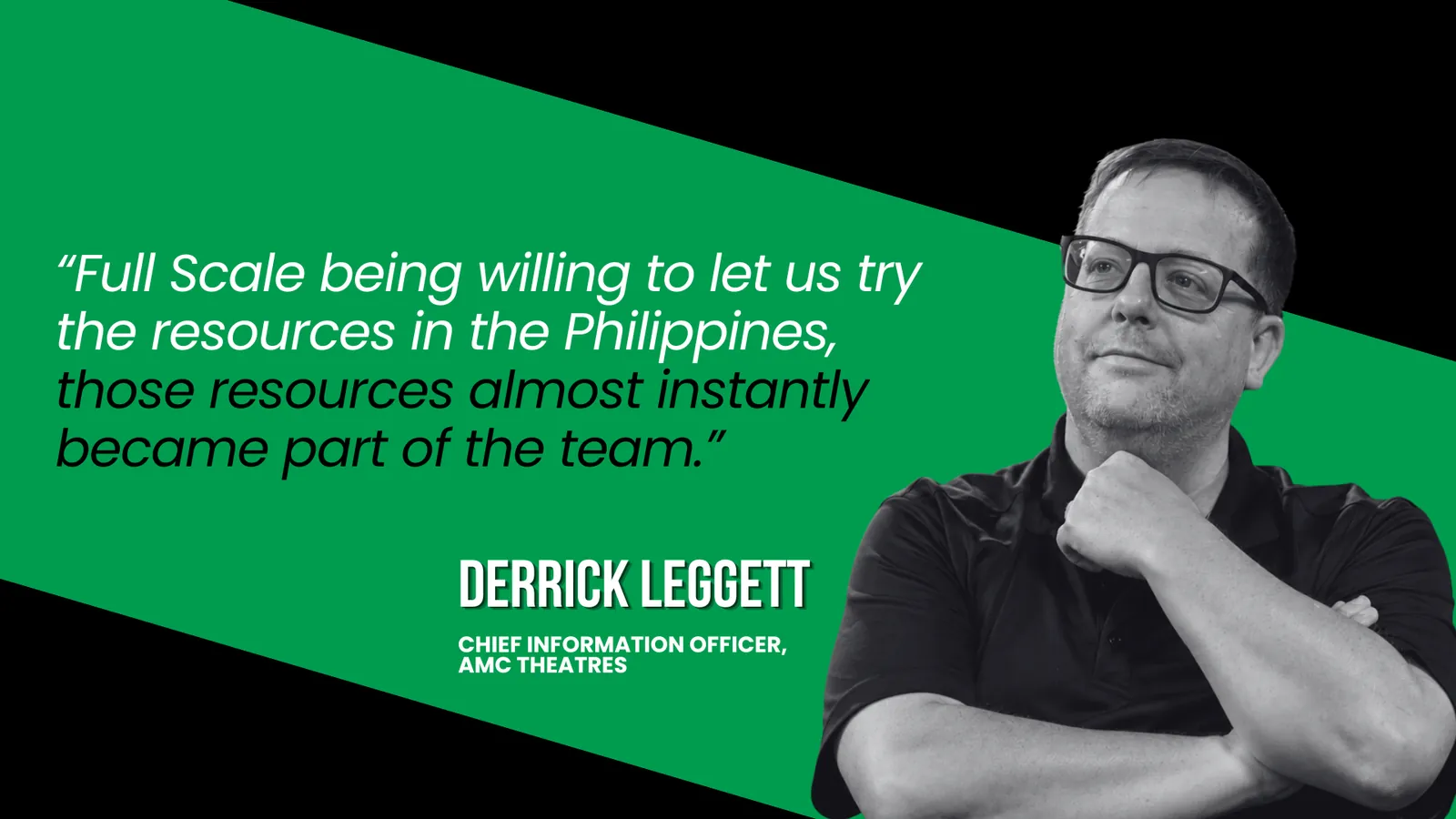
Derrick Leggett, the CIO of AMC Theatres, runs his whole global org on this principle. As he puts it: “It’s a fully integrated team. It’s just some of the people happen to be living in the Philippines.” His Full Scale engineers sit in the same Slack channels and the same review process as everyone else at AMC, with no agency layer in between.
Make sure you work with a dev agency that cares about your product, not just your project.
If a provider insists on putting a project manager between you and the engineers, you’re buying a project no matter what the contract calls it.
2. You keep the same team long enough for it to matter
The quiet worry with any offshore arrangement is turnover. You suspect you’re renting a rotating cast who will move to the next account the moment something better comes along. In a lot of outsourcing setups, that’s accurate, because the vendor makes more money the more clients each developer touches. The same advantages hold whether you call it outstaffing or offshore staff leasing, as long as you build a team and keep it. The same stability helps with securing a distributed team: fewer hands cycle through your systems.
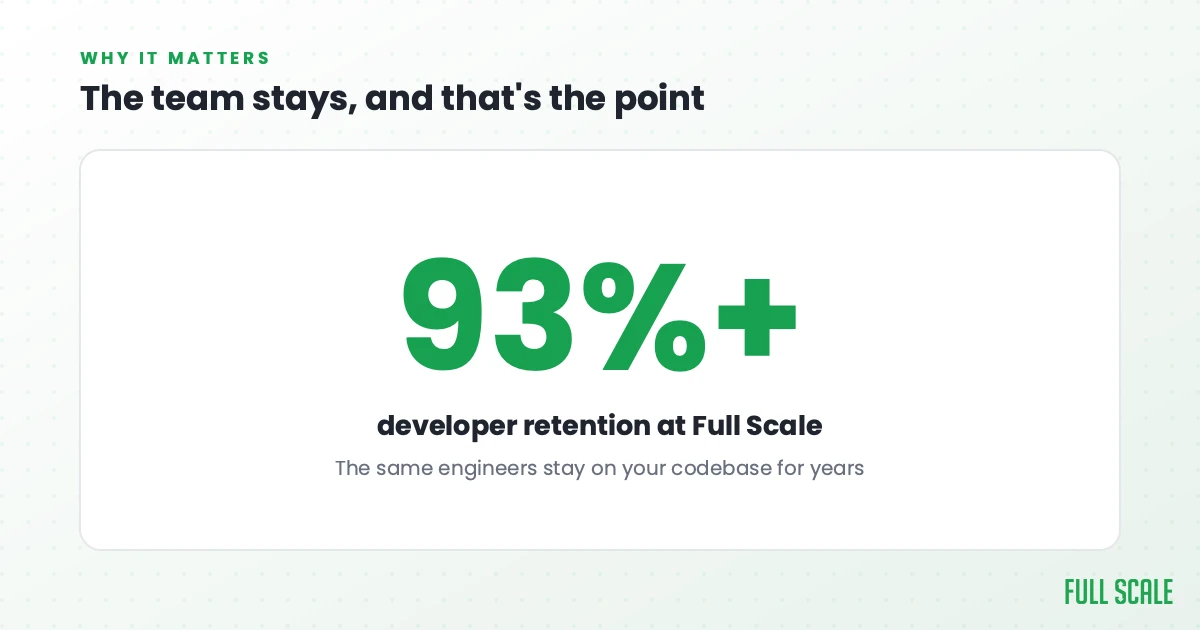
The outstaffing model is built the other way. The model keeps a developer on one client so they learn the codebase and stay with the product. Our retention runs north of 93 percent a year. The BLS Job Openings and Labor Turnover Survey puts US tech turnover at 13 to 15 percent, so our Philippine teams are actually more stable than the engineers most companies hire at home.
That stability isn’t an accident of geography. We’re Great Place to Work Certified in the Philippines two years running, with 95 percent of employees calling it a great place to work against 65 percent at a typical company there. For contrast, the Philippine call-center industry has the highest attrition of any sector in the country. Keeping people is a choice you make on purpose, and it’s the difference between a team that compounds and one that resets every year.
Why does continuity matter so much? Because the engineer who built your billing system in year one is the one who remembers, in year three, exactly which edge case will break if you touch it. A project handoff throws that knowledge away every time, which is why transitioning to a new development team has to be slower and more deliberate than a simple swap.
Andy Kallenbach, the CEO of LendingStandard, described what that looked like from his side of the table:
“Waking up each morning to collaborate with the Full Scale team has become the highlight of my day. Their work ethic, pride in craftsmanship, and the sheer quality of their output have not only met but exceeded our expectations. The most significant impact has been the seamless integration of their team with ours, making every challenge surmountable and every success sweeter.”
We aren’t in this for some 3-month project.
I spent a whole pillar of my 2025 book Product Driven on ownership, and this is why. People can’t own something they’re about to be reassigned away from. These are the same benefits we count on in staff augmentation, under a different label.
3. You fill a senior seat in weeks instead of quarters
Almost every engineering leader I meet has a role that’s been open embarrassingly long. The US hiring market is rough: sourcing, screens, loops, an offer, a counter, then notice and ramp. Half a year can disappear before anyone writes code.
Outstaffing shortcuts most of that. Our engineers in the Philippines are pre-vetted, average seven-plus years of experience, and can be in your standups in roughly two weeks. You’re choosing from people who have already cleared a bar, not waiting for a recruiter to find them.
An empty seat is expensive in ways that don’t show up on a budget line. The roadmap slips, your current engineers absorb the overflow and burn out, and the launch you promised this quarter quietly moves to next.
Cut the wait from two quarters to two weeks and the list of things you can honestly promise the business shifts with it.
Here’s how the three common options compare:
| What you’re comparing | US in-house hire | Outstaffing | Project outsourcing |
|---|---|---|---|
| Time to a productive engineer | 3 to 6 months | 2 to 3 weeks | Days, but for a project, not a teammate |
| Who they actually work for | You | You | The vendor |
| Continuity over years | High, if they stay | High, 93%+ retention | None once the project ends |
| When the fit is wrong | Severance, legal risk, cleanup | Swap them out in about a week | End the contract |
| Where it shines | Anchor roles you’ll keep for years | Growing a real team | Scoped projects |
None of this means you stop hiring locally. It means you no longer have to pick between a perfect local hire three months out and shipping nothing until then.
4. The cost savings are real, but not for the reason the other posts give
Every competing article on this keyword opens with cost and a number that’s suspiciously exact. I want to be more honest than that.
The gap between a senior developer in Manila and one in San Francisco is real, and it has nothing to do with skill. It’s cost of living, local salary norms, and labor economics. The same engineer is simply cheaper to employ in one place than another. About 90 percent of the world’s developers live outside the United States, per the Stack Overflow Developer Survey, so the global pool is far deeper than your local one and priced very differently.
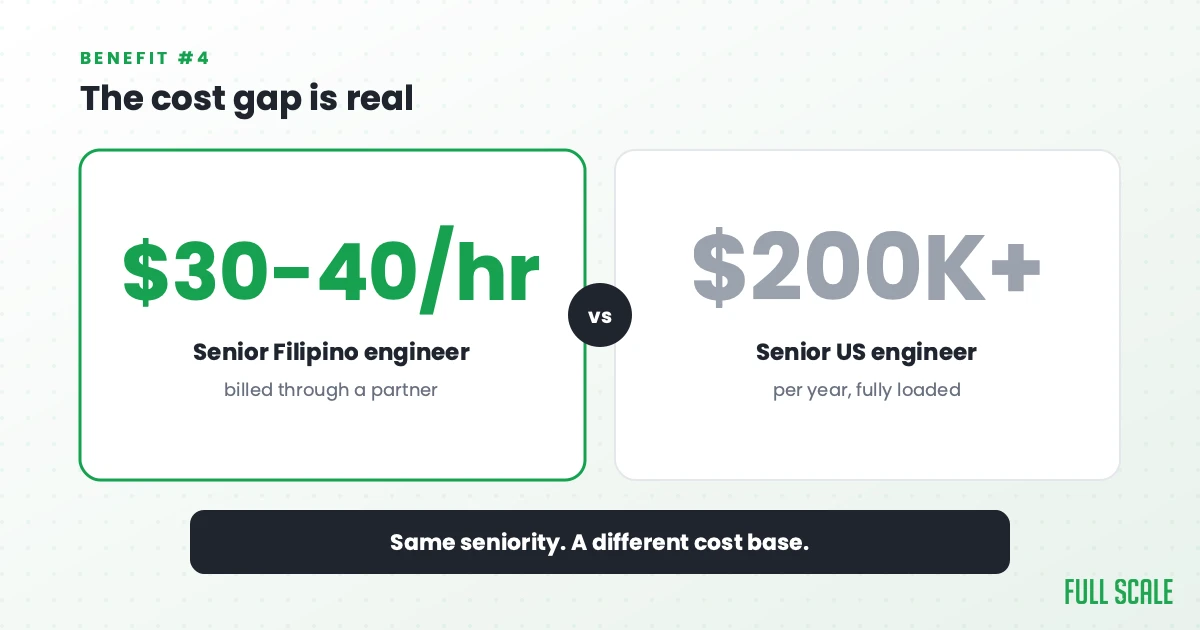
The math is worth seeing in full. The Bureau of Labor Statistics puts the median US software developer’s base pay near $133,000, and a senior engineer with five or more years lands in the $150,000 to $185,000 range. Add benefits, payroll taxes, equipment, and overhead, and the fully loaded cost is about 1.25 to 1.4 times that base, which puts a senior US hire north of $200,000 a year. A senior Filipino engineer with us bills at $30 to $40 an hour. That’s where the 50 to 70 percent savings comes from, and the skill level never moved.
Now the trap. The minute this turns into a hunt for the cheapest possible developer, everyone loses. I call it cheapshoring. Chase the lowest rate and you’ll get exactly what you paid for, then join the long line of founders who tried offshore once and swore it off forever. The buyer braces for bad work and finds it, the developer feels disposable, and the only way to protect the margin is to keep swapping in cheaper bodies, which destroys the continuity that made the model worth doing.
The calmer framing is this. For a product you intend to keep building for years, outstaffing buys you more senior engineers at a per-head cost you can keep paying month after month. It reads as a smaller line item, but the real payoff is capacity: more people working a roadmap that only gets longer. If you need to win that argument internally, I wrote a separate piece on making the case to finance.
5. You get the rare specialist without the year-long search
Try to hire a senior mobile engineer, a security specialist, or someone who knows your exact cloud stack, and you’ll find the local bench is thin. These are the hardest roles in technical recruiting. Most teams wait months, settle for a weaker fit, or grow someone into the role over a couple of years.
Outstaffing opens a second door. A vetted pool that’s deep in specific stacks means a hard-to-find specialist can be on your team in weeks rather than whenever one finally turns up locally.
The honest catch: this only works for roles you’ll keep. A strong specialist won’t sign up for a 90-day stint, and you wouldn’t want to eat the onboarding cost on someone leaving that fast anyway. I once hired out a one-off Elasticsearch build precisely because I didn’t need an Elasticsearch person afterward. But every standing specialist role I’ve had to fill, from backend to DevOps to mobile, has gone better through outstaffing than through local hiring alone.
6. You can actually understand each other
Of everything on this list, this is the one I’d put first if the title let me.
The biggest predictor of whether an offshore team works isn’t the rate and isn’t even the country. It’s whether you can communicate cleanly. Software is a communication problem before it’s a coding problem, and a team you can’t talk to will build the wrong thing very efficiently.
It’s most of why we staff in the Philippines. It’s the third-largest English-speaking country in the world, the engineers are fluent, they grow up steeped in American culture, and they’re direct and easy to work with. You spend your time deciding what to build, not reverse-engineering what someone meant on the last call.
Time zones are the other half, and they’re a question of overlap hours, not which country the team sits in. We run three patterns depending on what a client needs:
- Half-day overlap, sharing three to four hours of your workday. This is the common one, and it’s enough for most teams.
- Full US-hours coverage, where the team works your business day end to end.
- Async-first, where the team runs on written handoffs and rarely meets live.
What I’d warn against is treating the time difference as free “round-the-clock productivity.” Overlap is the lever that matters. Set it on purpose rather than assuming the gap is doing you a favor.
7. You can scale up or down without betting the company on a hire
A full-time US hire is a heavy commitment. Get it wrong, or watch the project get cut, and unwinding it means severance, legal exposure, and weeks of cleanup. That downside is exactly why so many roadmaps stay understaffed. Waiting feels safer than committing.
Outstaffing lowers the stakes on the decision. You add engineers when the work grows and ease off when it shrinks, month to month, instead of signing up for a multi-year liability. The provider is the legal employer, so payroll, local compliance, and benefits sit with them rather than landing on you. And if a particular engineer isn’t the right fit, we can swap them inside a week, without the cost and risk of firing a full-time employee at home.
That flexibility earns its keep most in a growth phase, when your needs move faster than any hiring plan can. You act on the opportunity in front of you now instead of waiting a quarter to feel safe enough to staff for it.
What about protecting your IP?
This is the first thing most CTOs ask, and it’s a fair question. The honest answer is that a good outstaffing partner usually gives you more legal protection than the alternatives, not less, and that matters most for a US-based company.
Here’s how it works with us. We sign a master services agreement with every client that covers confidentiality and assigns the intellectual property to you. We also hold proper employment contracts with our engineers, and because we have a real legal presence in the Philippines, those developers legally work for Full Scale. That unbroken chain of contracts, from the client to us and from us to the engineer, is what actually protects your code. Set that against handing your source to a loose group of freelancers, or to a vendor with no legal entity where the work is being done, and it isn’t a close call.
When outstaffing is the wrong call
I won’t pretend this fits everyone. Two situations are genuinely better off with project outsourcing.
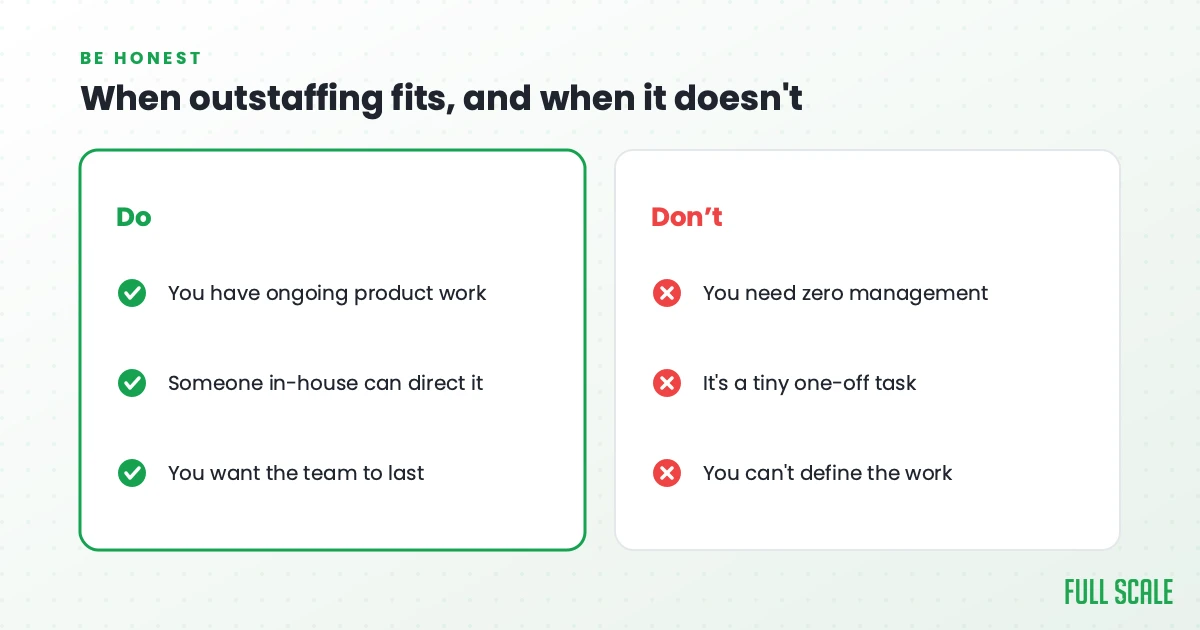
The first is having no engineering leadership in-house. The model leans on you having someone who sets direction, signs off on architecture, reviews the code, and carries the outcome. If there’s no CTO, VP of engineering, or senior tech lead in the building, then a team that needs steering is the wrong tool, and you’d be better served by a vendor who owns the outcome end to end. You always need technical leadership in-house for this to work.
The second is a scoped, self-contained project. A marketing site rebuild, a one-time data migration, an integration with an API that won’t change much: clear start, clear end, clear definition of done, and no need to keep a full-time person on it afterward. Hand that to a vendor, give them the spec, and pay for the deliverable.
Most teams I work with land on a mix. The standing product team is outstaffed, and the scoped, one-and-done work goes to a project shop. That split is how I’ve run engineering myself, and it’s the truthful answer to which model is better: each one wins at a different job. If you want the side-by-side, I broke down staff augmentation versus outsourcing separately.
Outstaffing isn’t a hack for dodging the hiring market. It’s how you scale an engineering team when there’s leadership steering it and a product that isn’t going anywhere.
Full Scale runs this model with senior developers in the Philippines. If you’ve got an engineering team and you need it bigger, let’s talk.
Frequently asked questions
What is outstaffing?
Outstaffing is hiring developers who work for you directly and long term, embedded in your team and reporting to your managers, while a provider handles their employment, payroll, and benefits. You direct the work; they handle the paperwork of employing people abroad. IT outstaffing is just the same idea applied to software and engineering roles, and Europe and Latin America tend to call it team extension.
What is the difference between outstaffing and outsourcing?
Outsourcing is a handoff. You give a vendor the requirements, they return a finished deliverable, and a project manager sits between you and whoever built it. With outstaffing, the developers join your team and take direction from you, often for years, and you speak to them with no one in between.
Is outstaffing actually cost-effective?
For software you’ll keep building, yes. The lower cost traces back to where people live and what local markets pay, not to thinner skills. For a single scoped project, ordinary outsourcing may beat it, since you avoid paying to keep a standing team you won’t need afterward.
When does outstaffing not work?
Mainly two situations. If nobody in-house can steer the engineering, the model has no one to take direction from. And for short projects with a defined finish line, it’s simpler to buy a fixed deliverable than to stand up a team for it.
What are the benefits and drawbacks of outstaffing for the developers themselves?
For the developer, outstaffing usually means competitive local pay, real benefits, and stable, long-term work on one product instead of chasing project after project. The tradeoff is that they legally work for the outstaffing partner, not the client company, so career growth and equity upside depend on how well that partner treats its people, which is exactly why retention rate is worth checking before you sign as a client. A partner with high turnover is often a sign the developers are not getting a fair deal either.
How does outstaffing protect your intellectual property?
Through a chain of contracts. A reputable outstaffing partner signs a master services agreement with you that covers confidentiality and assigns IP to your company, and it holds real employment contracts with the developers, who legally work for the partner. For a US company, that’s more enforceable protection than handing code to unattached freelancers or a vendor with no legal entity where the work happens.
Can a small company use outstaffing?
Yes, as long as someone technical is directing the work. A startup with one technical founder can outstaff a couple of engineers and run them directly. Headcount isn’t the deciding factor; having someone in-house to own the technical direction is.