
Team vs. Project: The Real Staff Augmentation vs. Outsourcing Debate

In this article
- The Real Difference Is Ownership and Time Horizon
- Side-by-Side Comparison
- Where Managed Services and Consulting Fit
- When Outsourcing Is Actually the Right Call
- When Staff Augmentation Wins
- What This Looks Like in Practice: Two Kansas City Companies That Built Teams
- The Hybrid Most Companies Should Actually Run
- The Cost Conversation (and Why Most Get It Wrong)
- How to Choose: A Decision Framework
- Frequently Asked Questions
- The Bottom Line
Quick Answer: Staff augmentation and outsourcing solve different problems. Staff augmentation adds developers who join your team and work under your direction long-term; outsourcing hands a scoped project to a vendor who owns the outcome. At Full Scale we run staff augmentation because it builds a team you keep, not a project you close out. Pick outsourcing for a short, well-defined deliverable, and staff augmentation when the work keeps evolving.
I started Full Scale because I needed to augment my existing team, not hand a project off to an agency.
That’s not a marketing line. It’s the actual reason. I was running engineering at Stackify, we were trying to scale, and every comparison I had to make between staff augmentation and outsourcing came down to the same question: am I trying to ship one deliverable, or am I trying to build something I’ll keep developing for years? Whichever model you land on, the habits that make staff augmentation work are the same: a clear vision, a vetted partner, and constant communication. Either way, the engagement runs on a contract, and knowing the contract terms that matter keeps the paperwork from dragging.
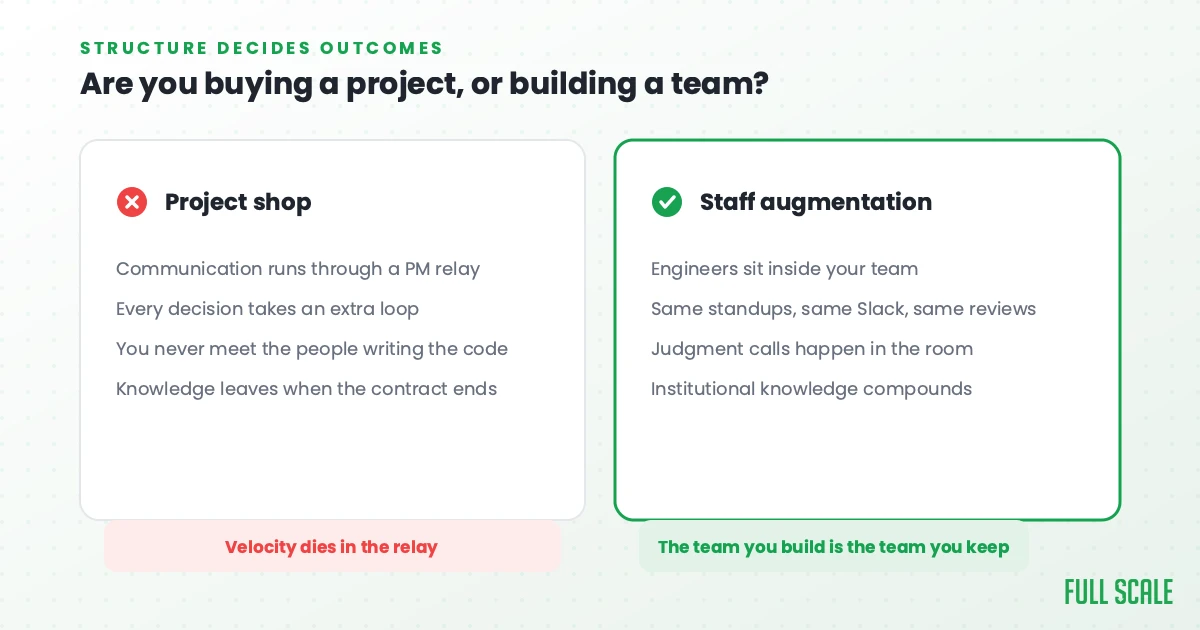
That question is the one the definitions skip over. They get stuck on who manages whom, who signs which contract, who’s billable by the hour. Those things matter, but they’re not the decision. The decision is whether you’re buying a project or building a team.
Get that right and the rest of the comparison falls out cleanly. Get it wrong and you’ll burn six months on the wrong model.
The Real Difference Is Ownership and Time Horizon
The usual definitions all say the same thing. Staff augmentation is when external developers join your team. Outsourcing is when a vendor takes the project. Both are technically correct. Neither tells you anything useful about which one you should pick. The choice gets murkier once AI enters the picture, which is why it pays to know how to vet AI staff augmentation companies specifically.
The actual difference is about ownership and time horizon.
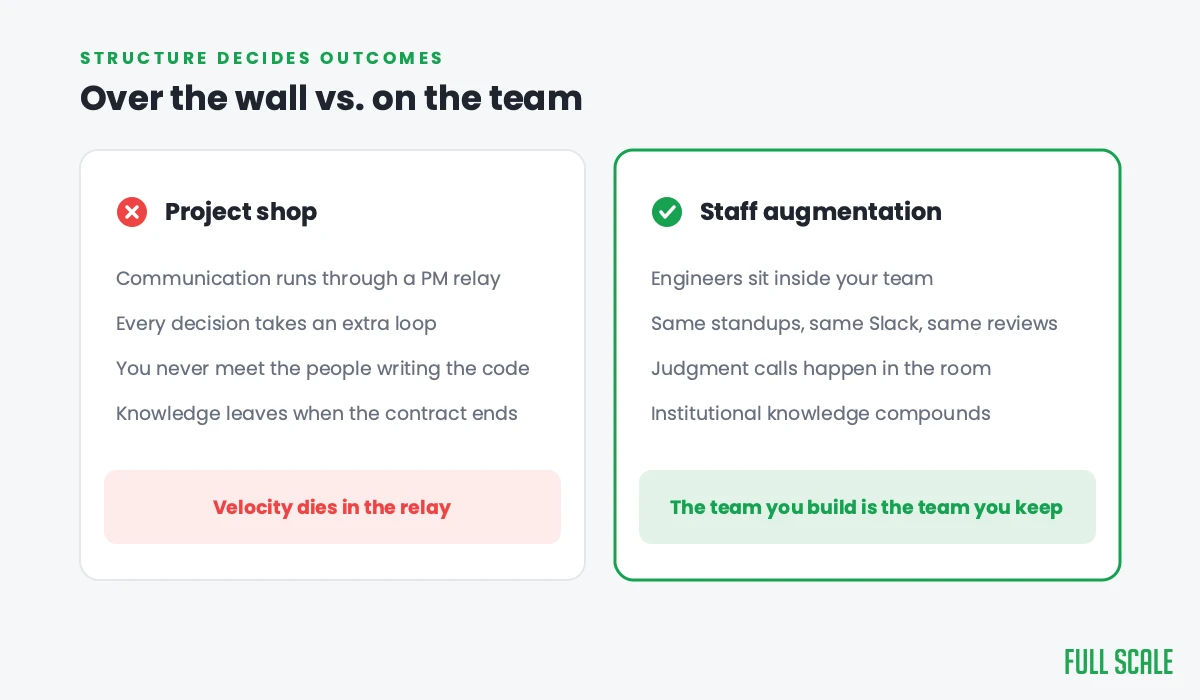
Outsourcing is buying a deliverable
You hand over the requirements, the vendor owns the outcome, and you pay for the result rather than the process. Good outsourcing arrangements work like construction contracts: clear scope, defined acceptance criteria, an end date everyone agreed to. That shape is exactly what a good software outsourcing contract locks down.
This works for things with a defined scope and an end. It breaks down the second the scope starts moving, because every change becomes a contract negotiation. I go deeper on that exact fork, staff augmentation vs a SOW, in a separate piece.
Staff augmentation is renting capacity for a team you’re building
The developer joins your team, reports to your tech lead, codes in your repo, and shows up in your standups. They’re not delivering a project, they’re contributing to one that doesn’t have an end date.
You manage them and direct them, you pay a monthly rate instead of a fixed bid, and the institutional knowledge they build up stays close to the work because they’re still on the work.
The line that matters
Building software requires building a long-term team that works together no matter where they sit.
If the thing you’re building has an end date, you can outsource it. If the thing you’re building is a product you’ll keep extending for years, you need a team. There’s no third option.
Side-by-Side Comparison
Here’s the whole comparison in one table. Use it as the quick reference.
| Dimension | Staff Augmentation | Project Outsourcing |
|---|---|---|
| Who owns the outcome | You do | The vendor does |
| Who manages the developer day to day | Your tech lead | The vendor’s PM |
| Where the developer sits in your org | Inside your team | Outside, behind a contract |
| Contract structure | Month-to-month, per developer | Fixed scope, fixed bid |
| Cost model | Predictable monthly rate | Lump sum or milestone-based |
| Time to first contribution | 1 to 2 weeks | 4 to 8 weeks (kickoff plus spec) |
| IP and codebase ownership | You own from day one | You own on delivery (sometimes) |
| Knowledge after engagement ends | Stays with your team | Walks out the door |
| Best for | Long-term product work | Defined, scoped deliverables |
| Hardest part | Managing them well | Writing the requirements right |
That last row is the one most people skip. The hard part of staff augmentation is your problem, and the hard part of outsourcing is also your problem. They’re just different problems.
Where Managed Services and Consulting Fit
People also ask about staff augmentation vs. managed services and staff augmentation vs. consulting, so it’s worth drawing the lines quickly.
Managed services is closer to outsourcing. A provider owns an ongoing function, say your DevOps or your QA, and runs it to an agreed service level. You’re buying an outcome, not directing the people. If you want to keep directing the work, that’s staff augmentation, not managed services. I go deeper on that split in our staff augmentation vs. managed services breakdown.
Consulting is different again. A consultant advises, recommends, and sometimes architects, but usually doesn’t stay to build and maintain the thing. Staff augmentation vs. consulting comes down to whether you need an opinion or a contributor. If you need someone in the repo every day, you don’t need a consultant. I go deeper on that specific split in staff augmentation vs. consulting. And if you’re trying to place any of these labels, staffing agencies, EOR arrangements, project-based work, inside one bigger picture, I map how they all relate in staff augmentation vs. staffing. People also lump in BPO, but that’s a bigger scope question than any of these, since a BPO takes over a whole business function rather than just adding developers to your team — I lay out that split in staff augmentation vs. BPO.
When Outsourcing Is Actually the Right Call
Most of the content on this topic is written by staffing companies, so most of it concludes that outsourcing is bad. That’s lazy. Outsourcing has its place, and pretending otherwise is the fastest way to lose a reader who actually needs to make this decision.
I’ve outsourced work myself, including WordPress builds and an Elasticsearch project. In both cases I did it because I needed the thing done and I didn’t need a long-term WordPress person or an Elasticsearch specialist sitting around between projects. The vendor owned the work, shipped it, and we moved on. That’s exactly what outsourcing is for.
Outsourcing also does a few things genuinely well. You get budget certainty on a fixed scope, you carry almost no management overhead, and the vendor absorbs the delivery risk. For the right kind of work, those are real advantages, not consolation prizes. There are two scenarios where outsourcing is the right call. With augmentation the people are yours to meet, and ours are background checked like employees because that is what they are.
You don’t have engineering leadership in-house
If you don’t have a CTO, a tech lead, or anyone who can direct developers on a day-to-day basis, staff augmentation will not work for you. The developers will show up, sit there waiting for clarity that never comes, and you’ll burn cash watching it happen.
This describes most non-tech companies that need a piece of software built: a property management firm that needs a tenant portal, a law firm that needs a client intake system, a manufacturer that needs an inventory app. None of them have a CTO, and most of them don’t want one. They want the thing built and someone else to own it. That’s outsourcing, and there’s nothing wrong with it.
You have a quick, scoped deliverable
Think marketing sites, one-time integrations, compliance-driven tools you’ll never touch again after audit season, or expert specialties like WordPress or Elasticsearch where you need someone who already knows it cold and you don’t need them around after the work is done.
The defining characteristic here is that when the work is shipped, you don’t care who shipped it. The continuity doesn’t matter, so outsource it.
When outsourcing is NOT the right call
If you’re going to keep developing the thing past the initial delivery, if the codebase becomes your IP and competitive moat, or if the engineer who wrote it needs to still be around in eighteen months to debug, extend, or rewrite it, outsourcing is the wrong call.
If your software is your product, outsourcing the building of it is one of the most expensive mistakes you can make. The savings on the initial build rarely recover the cost of losing every person who knew how it worked.
When Staff Augmentation Wins
For everyone else, this is the model. It fits tech companies building software products they intend to keep improving, and especially engineering organizations that have more work than hands but already know how to direct the people they bring in. There are smart people all over the world. Roughly 90 percent of software developers live outside the US, so widening the hiring pool is just common sense.
You already have engineering leadership but not enough hands
This is the scenario Full Scale was built for. It’s also the scenario where I personally first got offshore right.
At my first attempt with offshore developers, my friend’s dev agency placed two Java engineers from St. Petersburg, Russia. This was 2012, long before the geopolitics that would rule out hiring there today. I didn’t know they were in Russia until the first phone call. To my surprise, they were excellent: communication was solid, code quality was high, and we worked with them for the next couple of years. That experience changed my opinion of offshore overnight.
Later at Stackify, I tried Latin America. I hired a firm in Uruguay to help with a separate startup idea, and they did something I’ll never forget: they assigned me a proxy product owner. He took my product vision, managed the team, and iterated on it while I was buried in my main company. We later hired several of those developers full-time onto Stackify.
By 2018, I needed to hire ten more developers, and Stackify was bootstrapped. A friend had developers in the Philippines. I knew Filipinos personally and they were the nicest people I’d ever met, with impeccable English. The Philippines is the third-largest English-speaking country in the world, it was less expensive than Latin America, and the time zone, which looked like a problem on paper, turned out to be a feature: Filipino culture commonly works evening shifts to align with US business hours, and that meant we got on-call coverage for free.
We opened a small office in 2018. The Stackify team there grew to over twenty developers and was a big part of our 2021 exit.
That accidental setup became Full Scale. Friends kept asking how we did it, so we spun the office out as its own company. We hired a hundred developers in our first year. (I wrote about that whole journey, including why I avoided offshore for years before I tried it, in this newsletter. The hard-won lessons are also in our guide to offshore development best practices.)
The reason I’m telling you all this isn’t biography. It’s that every single one of those engagements was staff augmentation, not project outsourcing. Every developer worked directly with my team, reported into my engineering leadership, and pushed code through my normal code review. There was never a “project handoff” because there was never a project, just product, and product never ends.
You’re building a product that keeps evolving
If you’re going to keep developing the thing after launch, the people building it need to keep being there after launch. Otherwise you spend month thirteen explaining month one to a developer who just joined. This is the whole premise behind Product Driven, the book I wrote about building engineering teams that own outcomes instead of just closing tickets.
We aren’t in this for some three-month project. The companies that work best with us aren’t either.
Priorities change every quarter
Roadmaps shift. With staff augmentation you can swap a React developer for a Python developer mid-engagement. You can scale up before a launch and scale down after. With fixed-bid outsourcing, every change becomes a contract amendment.
The team itself is the asset
Our developer retention is over 93 percent. That means the engineer who learned your codebase last year is still here this year. Compare that to typical agency outsourcing, where every new contract brings a new face. Knowledge compounds when people stay, and evaporates when they don’t.
What This Looks Like in Practice: Two Kansas City Companies That Built Teams
The reframe is easier to defend with named examples. Both of these companies are based here in Kansas City, both came to Full Scale because hiring locally couldn’t keep up, and both adopted the long-term team mindset that makes this model work.
AMC Theatres (Derrick Leggett, CIO)
AMC Theatres is one of the largest movie theater chains in the world. They’re headquartered in my hometown, and I’ve had a working relationship with their engineering organization for years.
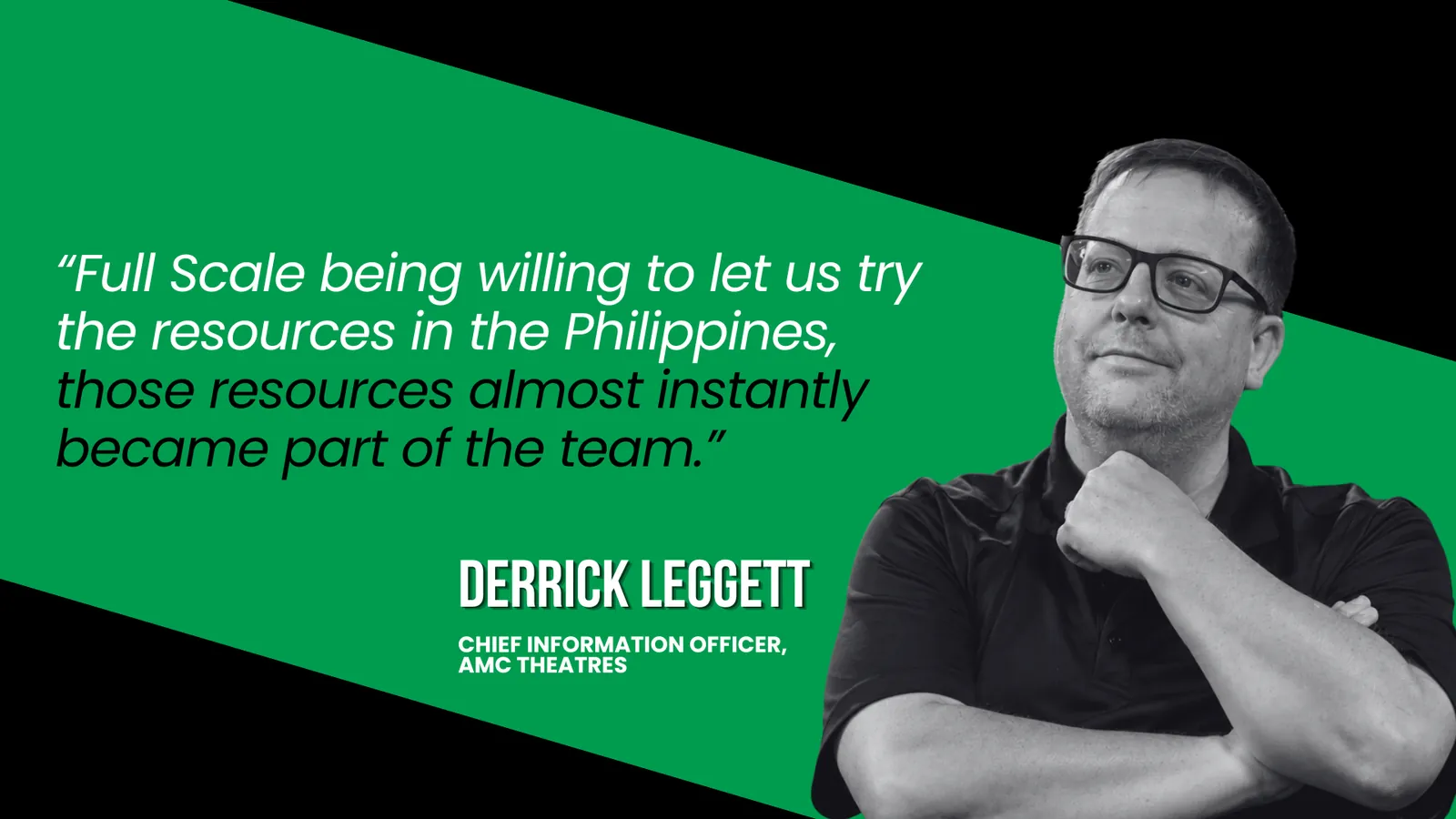
Their CIO, Derrick Leggett, has built a global engineering organization that treats developers in the Philippines the same as developers in Kansas City: same codebase, same standards, same place in the team. They aren’t a separate vendor team working behind a Statement of Work, they’re AMC engineers who happen to sit somewhere else.
That distinction is the whole game. Their Philippines team members aren’t shipping outsourced features over the wall. They’re contributing to AMC’s product, debating architecture in the same Slack threads, and staying with the codebase long enough to actually own it.
In other words, their developers in the Philippines belong to AMC, full stop.
LendingStandard (Andy Kallenbach, CEO)
LendingStandard runs a software platform that processes roughly 30 percent of the affordable multifamily property loans in the country. They’re also based in Kansas City, and like AMC they ran out of local hiring options before they ran out of growth.
They tried the alternatives first: local recruiting, vocational programs, hiring directly from colleges. None of it scaled at the pace the business needed, so they came to us specifically because they couldn’t hire fast enough on their own.
What they got from Full Scale wasn’t an outsourced delivery team. It was an integrated extension of their engineering organization. Their CEO, Andy Kallenbach, put it this way in our case study with them:
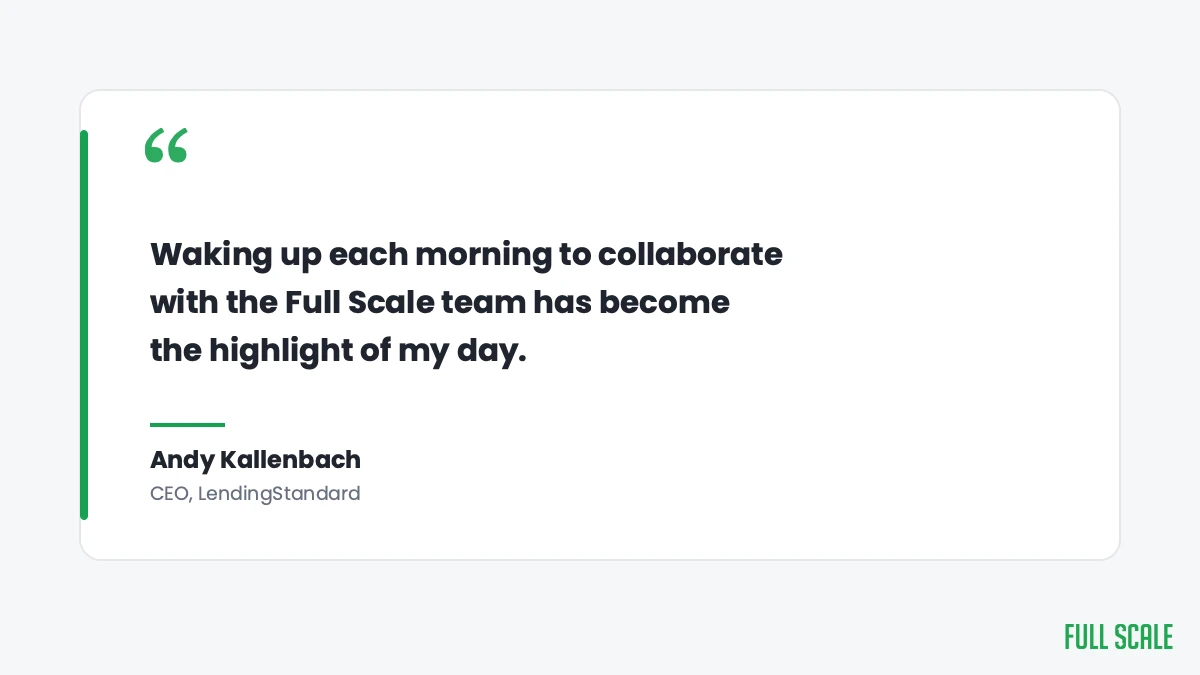
“Waking up each morning to collaborate with the Full Scale team has become the highlight of my day. Their work ethic, pride in craftsmanship, and the sheer quality of their output have not only met but exceeded our expectations. The most significant impact has been the seamless integration of their team with ours, making every challenge surmountable and every success sweeter.”
That’s what staff augmentation done right sounds like when it’s working. It doesn’t sound like project handoffs. It sounds like a team.
Both AMC and LendingStandard could have outsourced this work. They chose to build teams instead, and the people on those teams have been there for years. That pattern shows up across our client case studies.
The Hybrid Most Companies Should Actually Run
It’s tempting to treat staff augmentation and outsourcing as either/or. In practice, you should usually be running both, deliberately, for different kinds of work.
Use staff augmentation for the long-term product engineering: your core platform, your customer-facing software, and the roadmap features you’re going to keep extending.
Use outsourcing for one-off, scoped work outside that core: marketing sites, niche integrations, and expert deliverables in technologies you don’t want a full-time person on (WordPress, Elasticsearch, compliance-driven builds).
The mistake isn’t choosing one model. It’s using the wrong one for the work. I’ve personally done both at different points and the simple rule has held up: if the work has an end date, outsource it. If it doesn’t, build a team.
The Cost Conversation (and Why Most Get It Wrong)
The cost comparison comes up in every FAQ on this topic. It deserves an honest answer, and the real answer is more nuanced than either side usually admits. (If you want the deeper finance-side version of this argument, I wrote a separate guide to staff augmentation cost.)
Outsourcing looks cheaper. It usually isn’t.
The fixed bid is a number you can put in a spreadsheet. Finance loves that. What finance doesn’t see, until later, is the scope churn that comes with every change request, the knowledge transfer cost when the engagement ends, and the rebuilding cost when whatever you got back doesn’t quite fit your product.
In my experience, scope churn alone routinely adds 20 to 40 percent on top of the original quote. The “cheap” project usually wasn’t.
Staff augmentation looks pricier, but it usually wins on total cost
The monthly billable rate looks higher than the outsourcing line item, line for line. But you’re paying for a person who learns your codebase and stays. Less rework, less context loss, less premium for “unexpected complexity.”
Hiring a senior developer in the Philippines through Full Scale runs roughly 50 to 70 percent less than a comparable US hire, all-in, and we publish real ranges on our pricing page. That math works year one and gets better every year the developer stays.
The honest comparison
For scoped one-off deliverables, outsourcing is usually cheaper in absolute dollars. For continuous product development, staff augmentation wins on every cost dimension that actually matters past month six.
The error mode in both cases is the same: people compare the first invoice instead of the total cost over the actual life of the work.
How to Choose: A Decision Framework
You’ve seen the comparison and the use cases. Here’s the decision framework I’d actually use, in the order I’d ask the questions. For a rundown of the specific companies that do this well, see this list of IT staff augmentation companies in the Philippines.
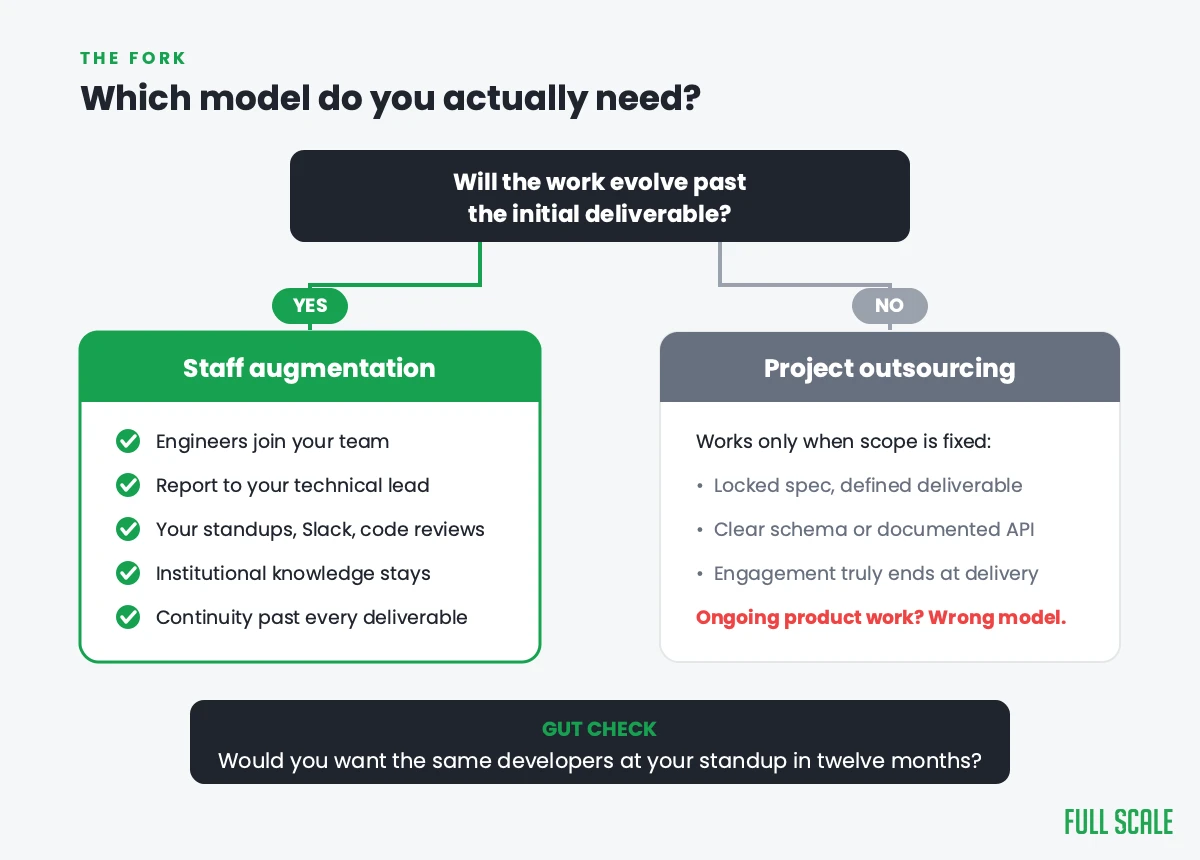
Four questions to answer before you commit
- Do you have engineering leadership in-house? This one is the gate. If no, outsource, no matter how you answer the rest. Staff augmentation requires someone in your org who can direct the work, and it's also what makes the vendor transition checklist so much shorter if you ever need to switch providers.
- Will the code outlive the contract? If yes, you need a team. Staff aug.
- Is the scope going to change? If yes, staff aug. Fixed-bid outsourcing turns every change into a renegotiation.
- Does the institutional knowledge need to stay? If yes, staff aug. If the team can walk out the door at the end, outsourcing is fine.
If you cleared the gate on question 1 and answered “yes” to any of questions 2, 3, or 4, the answer is staff augmentation. You can probably stop reading.
The fifth question (the unspoken one)
How much do you actually want to manage the work?
If your honest answer is “not at all, I just want it delivered,” you need outsourcing. Accept the tradeoffs that come with it: less control, less visibility, knowledge that doesn’t stay. If your honest answer is “I want to see the code shaped right,” you need staff augmentation. Accept the tradeoff there too: you’re now managing a team, including the part of it that sits somewhere else.
Both models work, for different reasons and different kinds of work and different kinds of leaders. The model is rarely the problem. The fit between the model and the situation is what decides how it goes.
Frequently Asked Questions
Is a dedicated team or extended team different from staff augmentation?
No. Dedicated team, extended team, and staff augmentation describe the same engagement: a vendor sources and employs developers who work full-time on your team under your direction, while the vendor handles payroll, HR, and retention in the background. Vendors just pick whichever term ranks in their market and brand around it. See our full breakdown of team extension vs. staff augmentation for exactly how the naming differs and why it doesn’t change what you’re buying.
What is the difference between staff augmentation and outsourcing?
Staff augmentation adds developers to your team who you manage directly. Outsourcing hands a defined project to a vendor who owns the outcome. The simplest way to remember it: staff augmentation rents team capacity, outsourcing buys a deliverable. It is also why AI coding tools won’t replace your offshore team, they just become another tool that team uses.
Is staff augmentation a type of outsourcing?
Technically both use external labor, but the working relationship is fundamentally different. Outsourcing transfers ownership of the work to a third party. Staff augmentation keeps ownership in-house and brings in the people. Lumping them together causes most of the confusion in this category.
Is staff augmentation cheaper than outsourcing?
For long-term product work, almost always yes. For a one-off scoped project, usually no. Outsourcing offers a fixed bid that looks cheaper in a spreadsheet, but scope changes, knowledge transfer, and rework usually erode the savings within a few months. Staff augmentation costs more per hour but eliminates the change-order premium.
When should I use staff augmentation instead of outsourcing?
Use staff augmentation when you have engineering leadership in-house, when the code you’re building will outlive the contract, when priorities are likely to shift, and when you want institutional knowledge to stay with your team. If none of those apply, outsourcing might be the better call.
Can you use both staff augmentation and outsourcing at the same time?
Yes, and most growth-stage tech companies should. Use staff augmentation for your long-term product engineering. Use outsourcing for scoped deliverables outside your core, like marketing sites, niche integrations, and expert work in technologies you don’t want a full-time person on. Running both is normal. What fails is putting the wrong model on the wrong work. Whichever model you pick, ask the vendor what happens when it is not working before you sign rather than after.
What’s the biggest risk with each model?
With outsourcing, the risk is that the vendor delivers something that technically meets spec but doesn’t fit your product, and nobody who knows the code stays around to fix it. With staff augmentation, the risk is that you don’t have the engineering leadership in-house to direct the developers, so they sit around waiting for clarity that never comes. Either model fails when the model doesn’t fit the situation.
The Bottom Line
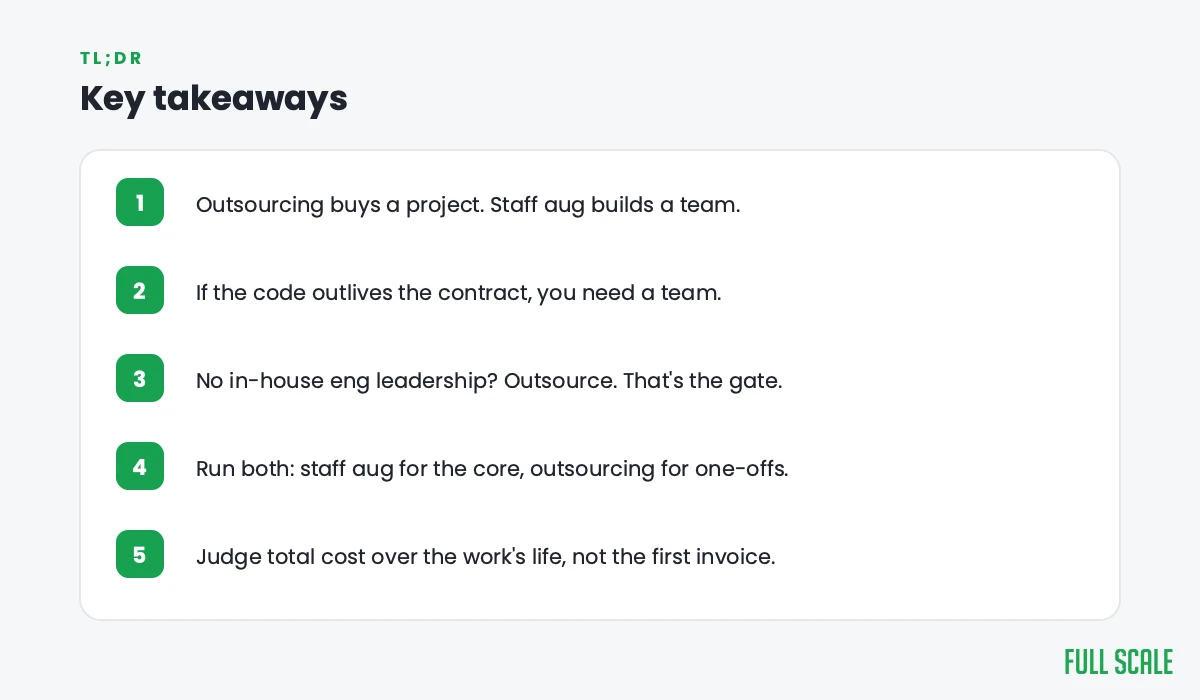
Outsourcing buys a project. Staff augmentation builds a team. Most software work is the second thing. Make sure you’ve named which one you’re actually buying. If you want to see how real Philippine vendors split across that line, I broke down software outsourcing companies in the Philippines by exactly this model.
If you’re building a long-term product team and you need senior developers in two weeks, that’s what Full Scale’s staff augmentation model is built for. We’ve done it for over 200 tech companies, including AMC Theatres and LendingStandard, and we’ve landed on the Inc. 5000 five years running. Book a discovery call and we’ll talk through how we’d staff your team.