
PEO vs EOR vs Staff Augmentation: Which Model for Hiring Offshore Developers?

In this article
- PEO, EOR, and staff augmentation in one table
- PEO vs EOR: the actual difference
- Why neither is built for hiring developers
- Staff augmentation: the option these comparisons skip
- A simple way to choose
- What each one costs
- The model is not the whole answer
- What this means for hiring developers in the Philippines
- Frequently asked questions
You looked up “PEO vs EOR” because you want to hire someone in another country and the acronyms are a wall. PEO stands for professional employer organization, EOR stands for employer of record, and both exist to get a person legally employed in a place where you are not set up to employ anybody. Then somebody says “co-employment” and the wall gets taller. Everyone selling one swears it is the answer. If the country in question is the Philippines, it helps to know what a Philippine employer actually owes before you decide who should hold that employment relationship.
Here is what almost every comparison leaves out. If what you actually want is developers on your team, neither a PEO nor an EOR is really built for that. A third model fits the job, and the companies that rank for “PEO vs EOR” never mention it, because they sell the other two.
I run Full Scale, a staff augmentation company that puts software engineers on US teams. So I will be upfront: we are not a PEO and not an EOR. That is exactly why I can lay out all three honestly, including when ours is the wrong choice. A staff augmentation contract handles the same IP and payment questions through a US-based agreement instead.
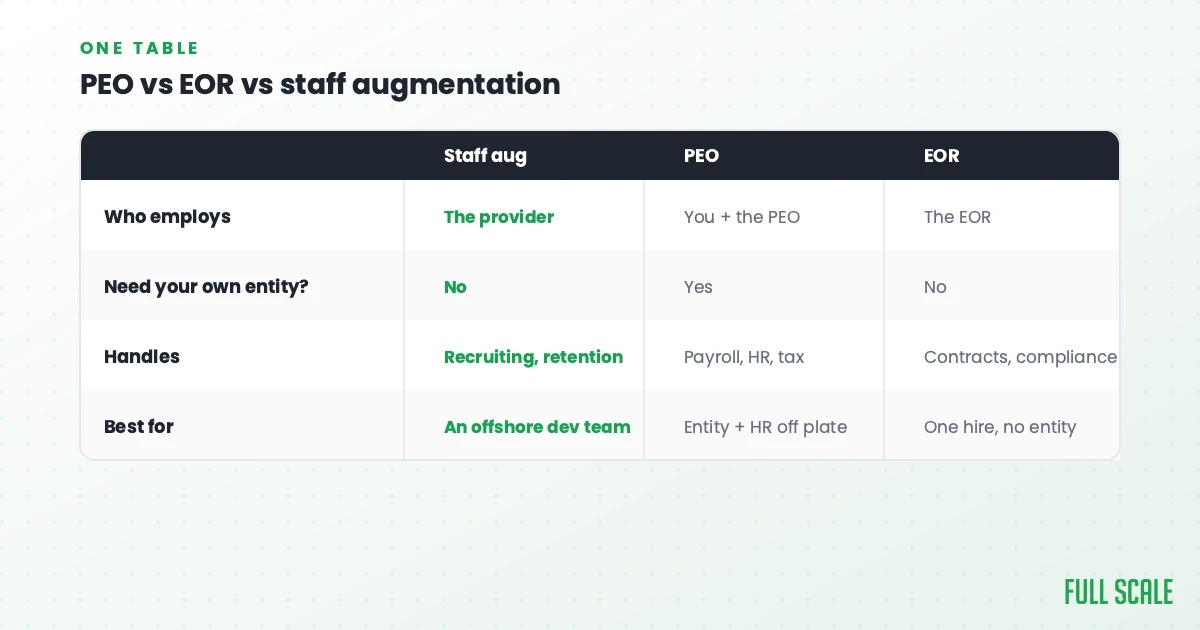
PEO, EOR, and staff augmentation in one table
Start with what each one actually is. The difference that matters most is simple: who legally employs the person, and whether you need your own legal entity to use it.
| Model | Who legally employs the worker | Need your own entity? | The provider handles | Best for |
|---|---|---|---|---|
| PEO Professional employer organization | Co-employment: you and the PEO share it. You stay a legal employer. | Yes | Payroll, benefits, tax filing, HR compliance | A company with its own entity that wants HR and payroll off its plate |
| EOR Employer of record | The EOR is the sole legal employer | No | Contracts, payroll, statutory benefits, compliance, terminations | Hiring one person where you have no legal entity |
| Staff augmentation | The provider employs the developer | No | Recruiting, vetting, employment, payroll, retention | Getting offshore developers onto your team under your direction |
Sources for the PEO and EOR definitions: the US Chamber of Commerce and Deel, which both lay out the co-employment-versus-sole-employer split clearly. This is general information, not legal advice, so confirm the specifics with your own counsel before you set anything up.
PEO vs EOR: the actual difference
Two distinctions separate them, and once you have them, the rest follows.
A PEO, a professional employer organization, is co-employment. You and the PEO both sit on the employment relationship. The PEO runs payroll, benefits, and compliance, but you are still a legal employer, and you keep part of the liability. Crucially, a PEO needs you to already have a legal entity in the place you are hiring. It is mostly a US-domestic arrangement for companies that have employees and want to outsource the HR machinery. (You may also see an ASO, an administrative services organization, which does the same payroll and HR admin as a PEO but without the co-employment, so you stay the sole legal employer.)
An EOR, an employer of record, is the sole employer. The EOR’s name is the only one on the contract. It takes on the full compliance burden, and you do not need your own entity, which is the whole point. An EOR is how a US company legally employs one person in a country, or a US state, where it has no presence.
One warning, because it trips people up. Some vendors market their EOR product as a “global PEO,” which is not a real thing. A domestic PEO (co-employment, you need an entity) and a so-called global PEO (which is just an EOR) are different legal arrangements. If a sales page says “global PEO,” read it as EOR.
The clean rule: PEO if you have an entity and want HR handled; EOR if you need to employ someone where you have no entity.
Why neither is built for hiring developers
PEO and EOR are both employment plumbing. Neither one finds you a good engineer.
An EOR is an infrastructure partner, not a recruiting partner. It will employ and pay the developer compliantly, but you still have to source, vet, interview, and choose that person yourself, in a country whose market you do not know. A PEO is even further from the job, since it will not work at all unless you have already set up a legal entity wherever you are hiring.
So you do all the hard parts, finding the talent, judging the talent, keeping the talent, and the PEO or EOR just makes sure payroll is legal. That solves the paperwork problem. It does nothing about the talent problem, which is the one you actually have.
Staff augmentation: the option these comparisons skip
The third model answers what the “PEO vs EOR” searcher usually wanted in the first place.
With staff augmentation, the provider employs the developer, but the work is yours. The provider recruits, vets, and retains the engineer. You direct the day to day: your tools, your sprints, your code review, your roadmap, your IP. There is no co-employment to manage and no entity to set up, and you are not the one sifting résumés in a market you have never hired in. It also does the part that matters most and that an EOR never will: it actively recruits good engineers, the kind who rarely answer job posts because they already have jobs.
This is different from a staffing agency, which mostly sources a candidate and then either marks up a contractor or hands the hire off to become your employee. It is also why the closest related comparison, employer of record versus a staffing agency, is its own question. Staff augmentation is about an ongoing, embedded team member, not a placement.
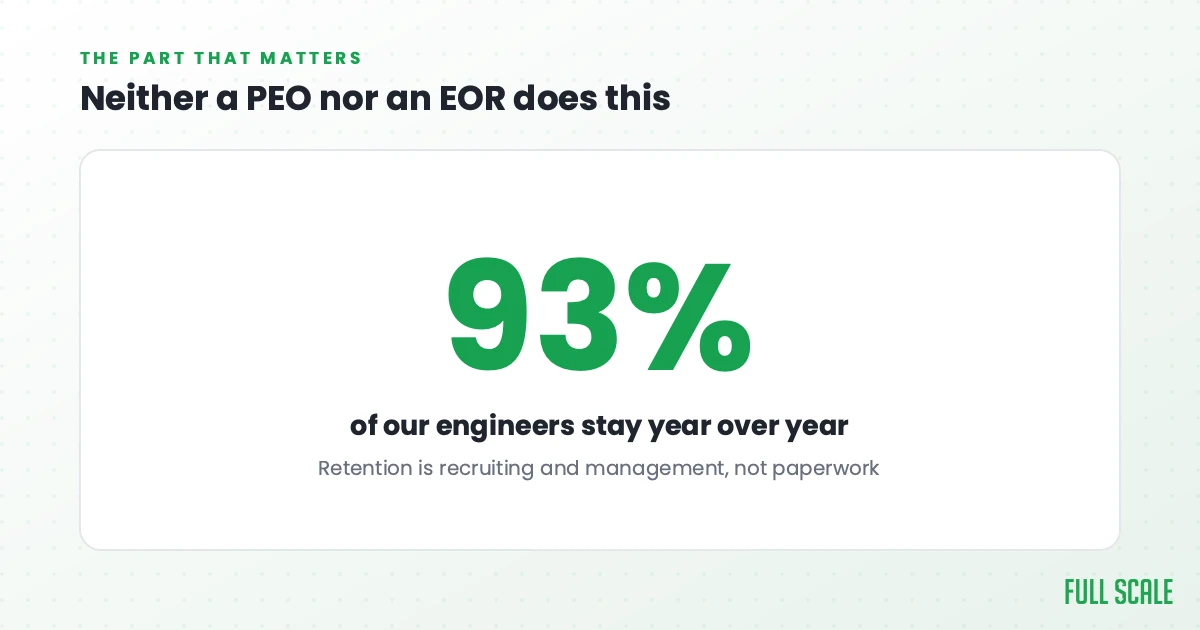
The point of staff augmentation is that you get the developer on your team without becoming an HR department or a recruiter. We keep 93% of our engineers year over year and have built teams this way since 2018. That number is not magic. It is the part a PEO or EOR never touches: recruiting well, then managing and growing people so they stay. An integrated engineer who stays beats a compliant stranger every time.
A simple way to choose
You do not need a chart with twelve branches. You need three questions.
- Do you have a legal entity where you are hiring, and just want HR and payroll handled? That is a PEO.
- Do you need to employ a specific person in a country or state where you have no entity? That is an EOR.
- Do you want offshore developers on your team without recruiting, vetting, or employing anyone yourself? That is staff augmentation.
Most engineering leaders who start at “PEO vs EOR” are actually in the third case. They do not want to become a foreign worker’s legal employer. They want good developers, working on their team, without the overhead.
Staff augmentation is not always the answer, though, and I will say so plainly. If you want the engineer to be your own employee for the long haul, with your equity and your name on the contract, an EOR fits better. If you have already found the specific person you want and just need them employed compliantly, that is an EOR job, not ours. And if you are big enough to stand up your own offshore entity, a PEO or a captive center can make sense. Ours is the model for the common case: you want good developers on your team and you do not want to become a recruiter or an employer to get them.
What each one costs
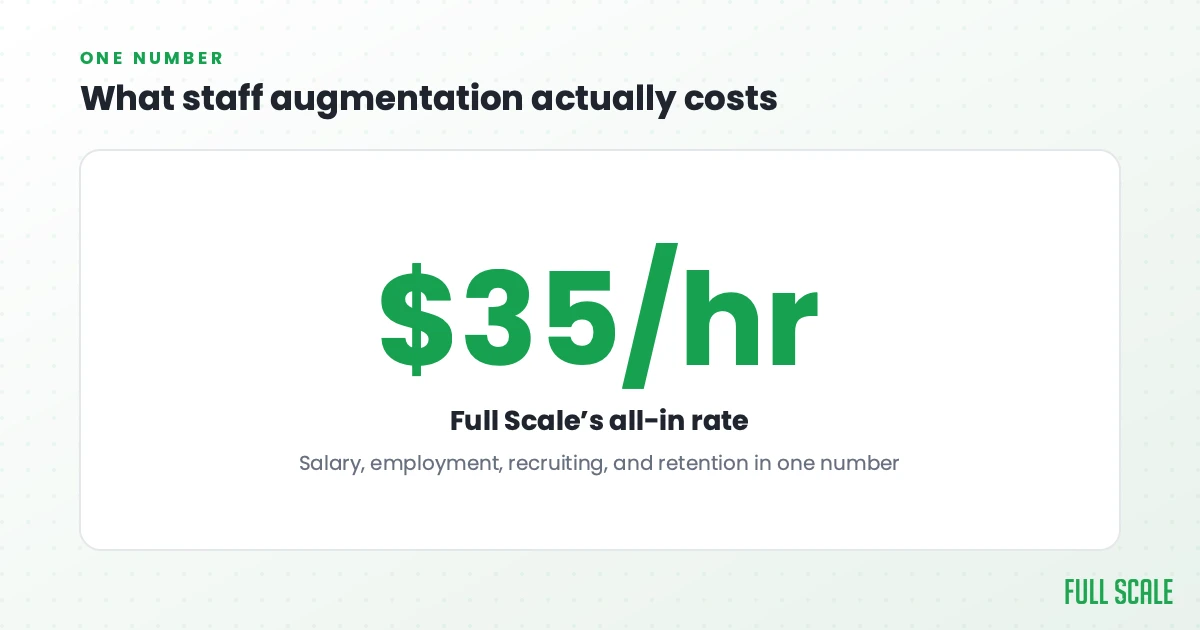
The price shapes differ as much as the models do. A PEO charges a fee on top of the salary you still pay, usually a percentage of payroll or a per-employee monthly fee. An EOR charges a per-employee monthly fee or a markup, again on top of the salary. Staff augmentation is an all-in number: one blended rate, often around $35 an hour fully loaded, that bundles the salary, the employment, the recruiting, and the retention into a single figure.
That all-in rate looks higher than a bare EOR fee until you remember what it includes. With a PEO or an EOR you still pay, in time or money, to find and vet and keep the engineer yourself. With staff augmentation that work is already in the number.
The model is not the whole answer
Picking the right model does not save you from doing it badly. The fastest way to fail with any of them is to chase the lowest price, which I call cheapshoring: hire the cheapest body, hand off a pile of requirements, hope for the best.
What works is the opposite, an engineer who is part of the team and owns what they ship. That is the whole argument of Product Driven: the teams that win are built to own outcomes, not just complete tickets. The engagement model is the wrapper. The team is the product.

What this means for hiring developers in the Philippines
If your goal is offshore developers, say in the Philippines, the model question usually answers itself. You do not want to stand up a Philippine entity for a PEO, and an EOR still leaves you recruiting and vetting engineers half a world away. If you are hiring from the EU or the UK, the extra legal wrinkles get their own guide: hire Philippine developers from Europe.
Staff augmentation closes that gap. A partner that already hires developers in the Philippines handles the employment, the recruiting, and the retention, and you get engineers on your team. The acronyms matter less than the result, which is whether the people are good and whether they stay.
Frequently asked questions
What is the difference between a PEO and an EOR?
A PEO, or professional employer organization, is a co-employer: you and the PEO share the employment relationship, you remain a legal employer, and you need your own legal entity in the jurisdiction. An EOR, or employer of record, is the sole legal employer, takes on the full compliance burden, and lets you hire someone in a country or state where you have no entity. The short version is that a PEO suits a company that already has an entity and wants HR handled, while an EOR is for hiring where you have no presence.
Is staff augmentation the same as an EOR?
No. An EOR is an employment-and-compliance layer: it legally employs a worker you already found, but it does not recruit, vet, or manage anyone. Staff augmentation provides the developer, recruited and vetted and retained by the provider, and embeds them in your team under your direction. With an EOR you still do the hiring; with staff augmentation the hard talent work is done for you.
Which model is best for hiring offshore developers?
For offshore developers who work as part of your team, staff augmentation is usually the best fit. A PEO typically requires a local entity, and an EOR still leaves you to source and vet engineers in a market you do not know. Staff augmentation handles employment, recruiting, and retention while you keep day-to-day direction and IP ownership.
Do I need a PEO or EOR to hire developers in the Philippines?
No. You do not need to set up a Philippine entity (which a PEO would require) or take on the role of sole employer through an EOR. A staff augmentation partner already employs developers in the Philippines and places them on your team, so you skip the entity, the compliance, and the recruiting and simply direct the work.
PEO and EOR are just two of several labels people group under the word "staffing." See how all six actually compare.
Trying to figure out the right way to hire offshore developers? Schedule a call with Full Scale and we will help you sort out which model actually fits your situation.