
Toptal Alternatives in 2026: How to Choose the Right One for What You Need

In this article
- First, what Toptal is good at, and what it actually costs
- The real question: what are you trying to do?
- Job 1: a one-off task or a short, defined project
- Job 2: a short-term contract, a local hire, or a niche skill
- Job 3: a team you keep (the one Toptal isn’t built for)
- A quick way to choose
- Frequently asked questions
- Build the team, not just the hire
Search “Toptal alternatives” and you get ten listicles that all have one thing in common: each one was written by a company that ranks itself at the top of its own list. So they all answer the wrong question.
The question that actually matters is “what am I trying to build?” Because Toptal is a genuinely good product for one specific job, and a frustrating, expensive choice for a different one. Pick the alternative that matches your job and you’ll be happy. Read a ranked list instead and you’ll end up with the same mismatch that sent you looking in the first place.
I run Full Scale, a software staffing company, so I’m one of the people with a horse in this race. I’ll tell you up front where we fit and where we don’t, and I’ll point you to Upwork or a local staffing firm when that’s the honest answer. By the end you’ll know which of three buckets you’re in and the best option for each.
First, what Toptal is good at, and what it actually costs
Toptal screens hard. They market access to the “top 3% of applicants”, and the vetting is real: skills tests, live problem-solving, a trial project. If you need one senior freelancer for a defined gap and you don’t want to wade through a hundred applicants yourself, that model works. You describe the role, they match you, you get a vetted person in a week or two. (If your first question is simpler than which platform to pick, I answered whether Toptal is legit on its own.)
The catch is the price, and how it scales.
Toptal runs on a blended hourly rate. The client sees one number, typically $60 to $150 an hour, with specialists past $200, and that number quietly bundles the freelancer’s pay, Toptal’s margin, and the cost of the platform. The margin isn’t small. Independent breakdowns put the markup as high as 50%, and Toptal never shows you the split. On top of the rate there’s a $500 refundable deposit and a $79 monthly fee.
For one person on a short engagement, that’s a fair trade. The math gets ugly when you multiply it.
Take a mid-to-senior developer at $110 an hour, near the middle of Toptal’s range. Full time, that’s about $17,600 a month before fees. Now picture the thing most growing companies actually want, which is four or five engineers working together for a year or more. You’re paying that markup on every one of them, every month, with no end date. That is the point where Toptal stops being the smart choice. It was built to fill a seat, not to build you a team.
Which is why “what’s the best Toptal alternative” has no single answer. It depends on the job.
The real question: what are you trying to do?
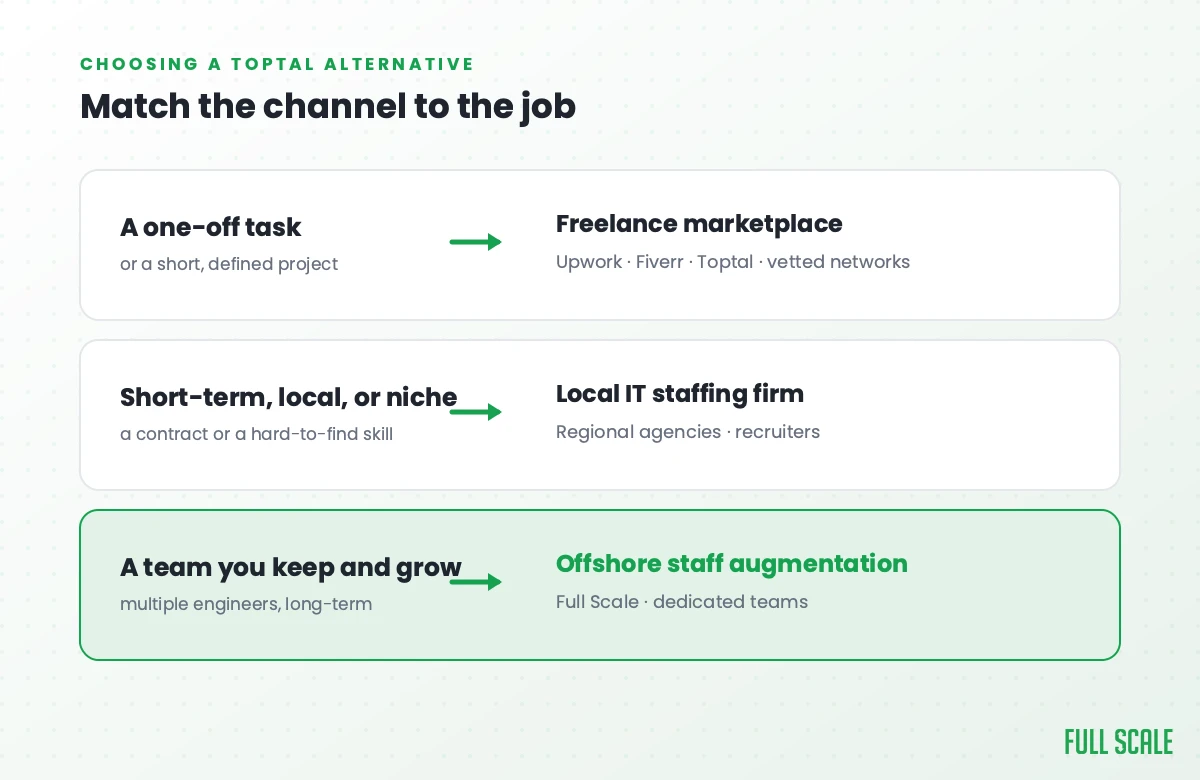
Almost every search for a Toptal alternative comes down to one of three jobs. Find yours first, then pick the channel.
| What you’re hiring for | Best channel | Examples | Cost shape | Commitment |
|---|---|---|---|---|
| A one-off task or short project | Freelance marketplace or vetted network | Upwork, Fiverr, Toptal, Turing | Per task or per hour | Low, disposable |
| Short-term, local, or a niche skill | Local IT staffing firm | Regional agencies, recruiters | Local rate plus agency markup | Medium, contract |
| A team you keep and grow | Offshore staff augmentation | Full Scale, dedicated teams | Flat hourly, no markup games | High, ongoing |
The rest of this guide is those three rows, in detail, with the honest tradeoffs.
Job 1: a one-off task or a short, defined project
You need a logo. A landing page. A WordPress plugin fixed by Friday. A script that runs once and you never think about again.
For this, you don’t need a staffing partner, and you don’t need to pay Toptal’s premium. Go to a freelance marketplace, or a Philippine job board if you want local candidates instead of a global pool. Upwork has the deepest pool and tiered options if you want a little vetting on top. Fiverr is built for small, fixed-scope gigs where you know exactly what you want. Jobbers.io skips the commission entirely, so the freelancer and the client settle payment between themselves instead of handing the platform a cut. If the task needs senior judgment, the vetted networks built to compete directly with Toptal live here too. Turing, Gun.io, and Arc all pre-screen developers and usually come in below Toptal’s rate with fewer strings.
I’ve done this myself. Years back I outsourced a couple of WordPress builds and an Elasticsearch project through marketplaces, because each one was quick and well scoped. A defined task with a clear finish line is exactly what these platforms are for.
Here’s the tradeoff nobody on those platforms will say out loud. When you hire off a marketplace, you are the vetting and you are the management. Even on a platform that runs real vetting, how to actually vet a software development company once you have its profile in front of you is still on you. The platform hands you a profile and a rating, and the rest is on you: whether the person is good, whether they’ll still be around next month, whether they’ll answer on the day something breaks.
I’ve heard the other version of this story from a lot of founders, and it tends to go the same way. The freelancer is great right up until they go quiet, usually at the worst possible moment. It works for throwaway tasks because the stakes are low. It falls apart once the work matters and stretches on.
This is also where people make the cheapshoring mistake, my word for hiring the cheapest developer you can find and calling it a strategy. You get what you pay for. For a weekend task that’s a fine trade. For anything your business depends on, it isn’t.
If your job is a discrete task with a clear finish line, stop reading and go open an Upwork account. For the fuller picture across every option, not just Toptal, see upwork alternatives for hiring developers. That’s the right tool. We go deeper on where this model ends and a real team begins in our breakdown of staff augmentation versus independent contractors.
Job 2: a short-term contract, a local hire, or a niche skill
Sometimes the work is bigger than a gig, but you’re not ready to build a standing team. You need a senior contractor for a six-month push. You need someone who can sit in your office, or at least your time zone. You need a hard-to-find specialist, a security auditor or an embedded-systems engineer, that a general marketplace won’t surface.
This is the option the listicles skip entirely, and it’s often the right one: a local IT staffing or recruiting firm.
A good local agency handles the sourcing, the screening, and the contract paperwork, then places someone with you on a defined term. You get a person who’s geographically close and an agency that owns the compliance headaches. I’ve seen this be the right call for regulated industries and on-site security work, the kind of roles where a few hours of time-zone overlap genuinely isn’t enough. There are remote versions too, like the vetted networks mentioned above, which sit between a raw marketplace and a full staffing firm.
The tradeoff is cost. Local talent carries local prices, and the agency adds its markup on top. Expect a local contractor through an agency to run well above a comparable offshore engineer, often 1.5 to 2 times the rate once the agency takes its cut. If you genuinely need boots in the building or a rare skill fast, that’s money well spent. If you don’t, you’re paying for proximity you won’t use, and the next bucket is where you belong.
Job 3: a team you keep (the one Toptal isn’t built for)
Here’s the job most companies are actually hiring for, even when they start by searching for a freelancer. You don’t want a person for a project. You want engineers who learn your codebase, sit in your standups, build the thing this quarter and the next, and are still there a year from now. You want a team.
That’s a staffing problem, and the channel for it is offshore staff augmentation, or what’s sometimes called a dedicated team model.
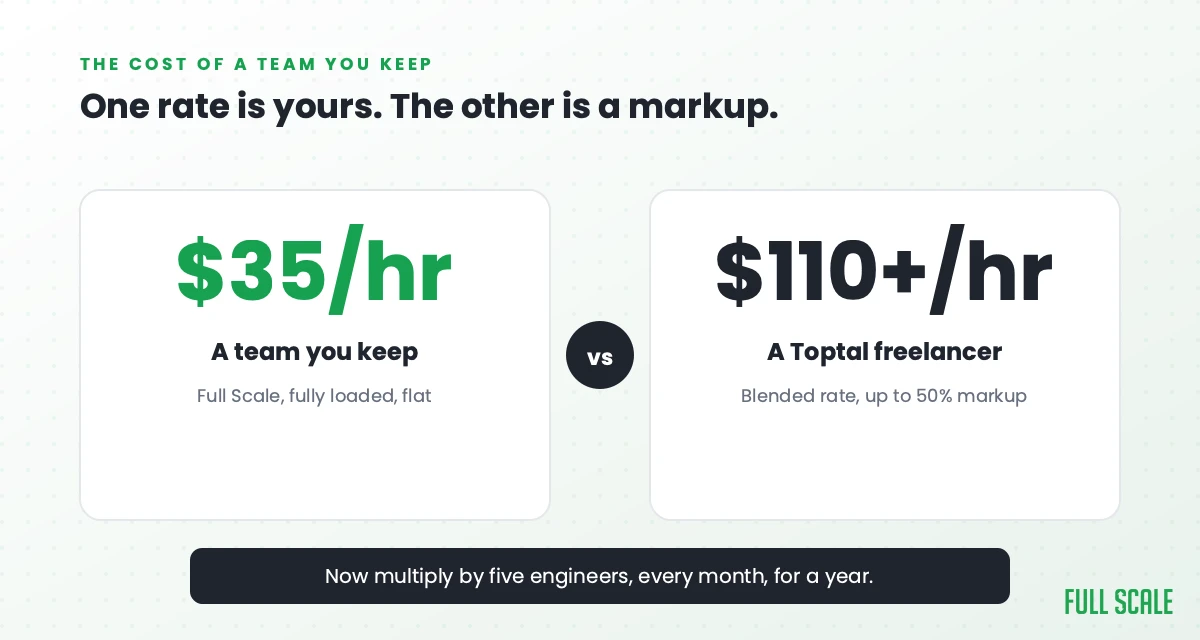
Start with the cost, because it’s the cleanest contrast. Where a marketplace stacks its markup on every developer every month, a staff augmentation partner places engineers at a flat, fully-loaded rate. At Full Scale that’s around $35 an hour, all in. Run that against $110-plus an hour for a blended freelancer, then multiply by five people over a year, and you’re looking at two completely different ways of buying engineering. That same math applies once you look past Toptal at nearshore staffing platforms too, since some price senior and specialist roles close enough to US costs to erase the whole point of going nearshore, which is the exact gap I map in our bairesdev alternatives breakdown.
And it isn’t a quality tradeoff. Full Scale accepts under 3% of the developers who apply, so you keep the kind of bar Toptal sells you on and drop the markup that comes with it.
Cost is only the start, though, because the cheapest hire and the best outcome are rarely the same thing. The real reason a kept team beats a rotating cast of freelancers is continuity.
- They stay. Our developer retention runs over 93%, so the engineers who built up context on your product are still there next quarter instead of walking out the door with it.
- You can hold someone accountable. Our engineers are Full Scale employees, and you sign your IP and confidentiality agreements with a US company, enforceable under US law. An employee doesn’t ghost their employer the way a freelancer can ghost a client. We’ve never had a single IP or confidentiality issue in the history of the company.
- There’s no middleman. The engineers join your tools, your standups, and your roadmap directly, and they care about your product the same way your in-house team does, because they’re treated like part of it.
This is the ownership mindset I wrote about in Product Driven: the work goes better when the people doing it care about the outcome, not just the ticket. And it’s the part AI doesn’t touch. Handing a spec to a vendor and waiting for code back is exactly the work that automation is starting to eat. A team that understands your product and makes real judgment calls about it is the part that keeps mattering.
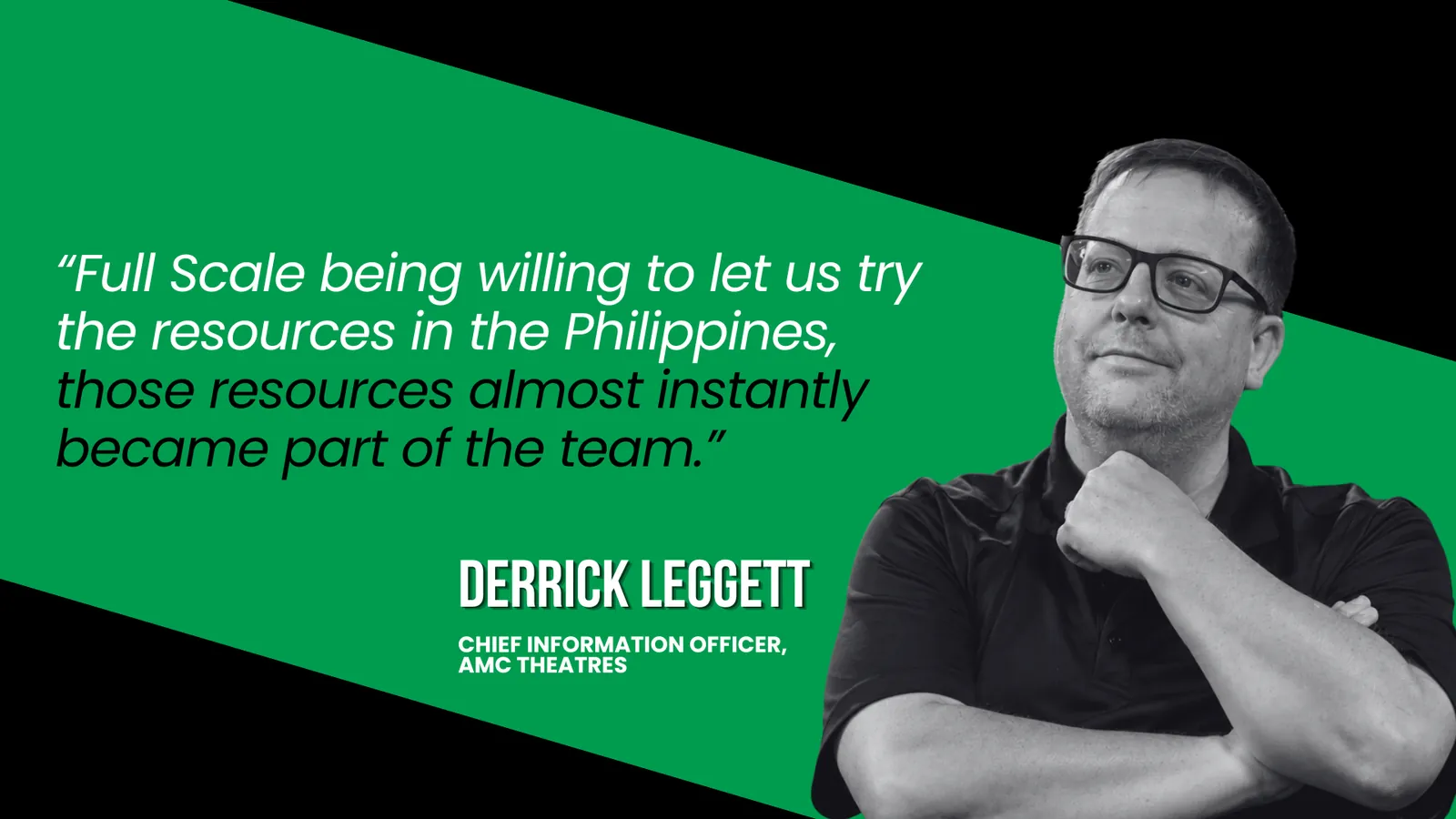
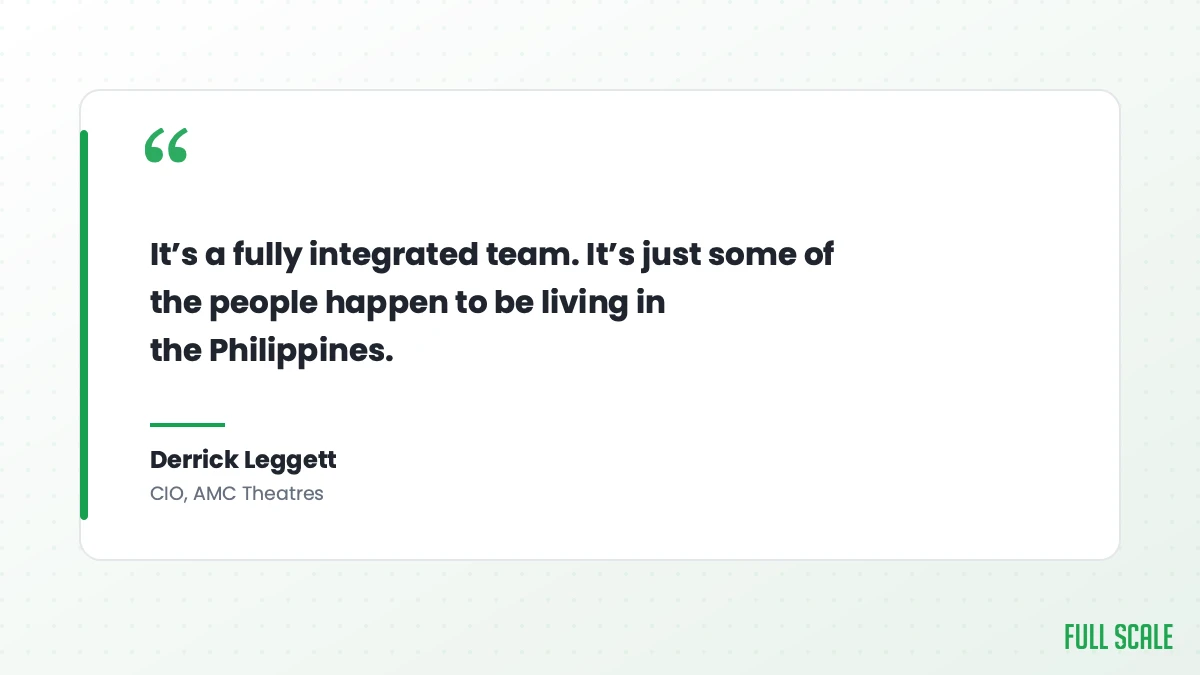
You don’t have to take my word for the model working. AMC Theatres builds engineering this way. Their CIO, Derrick Leggett, who I’ve known for 25 years, long before Full Scale existed, put it plainly in our case study:
“It’s a fully integrated team. It’s just some of the people happen to be living in the Philippines.”
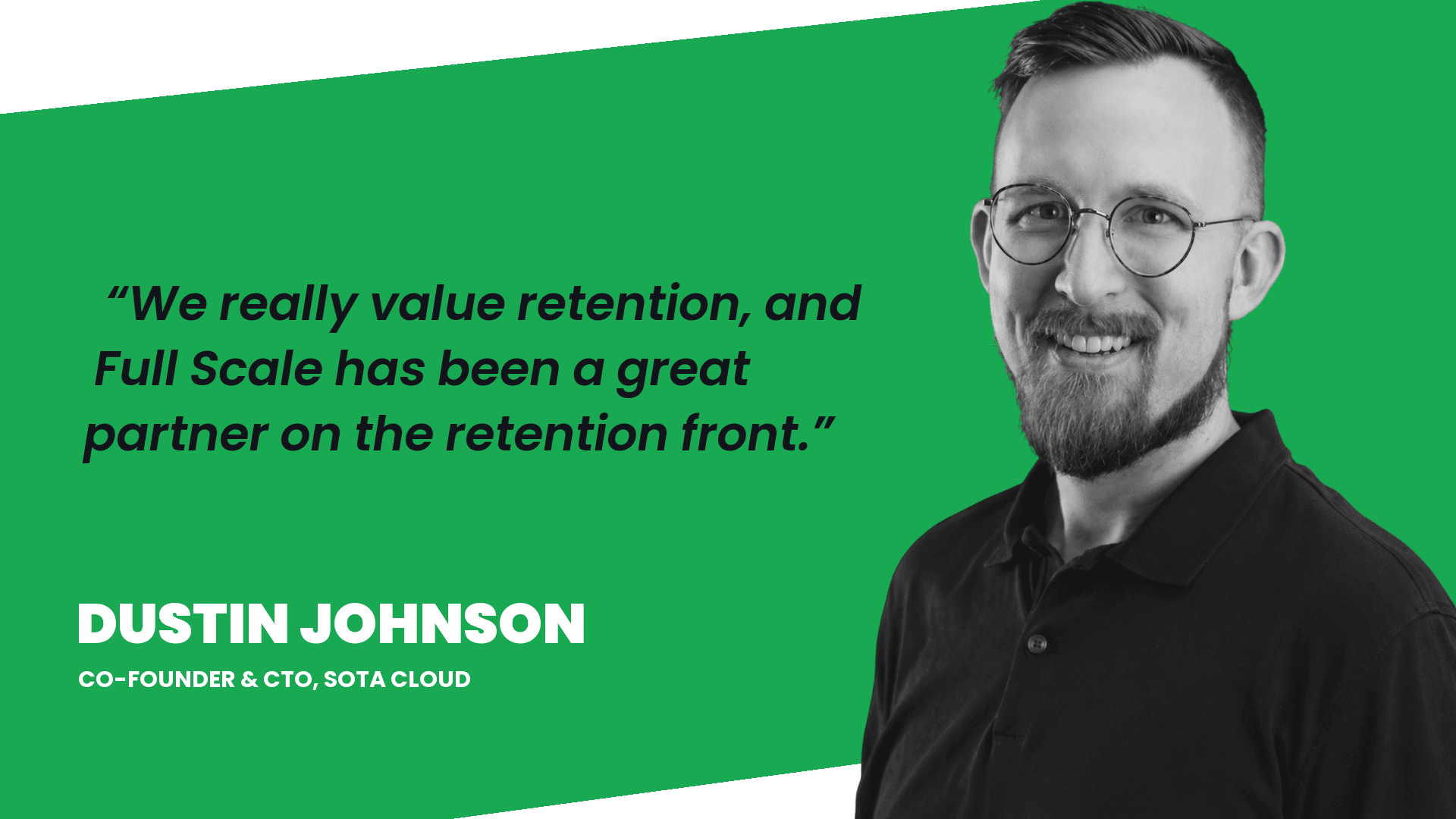
SOTA Cloud, an FDA-cleared dental imaging company, hired the same way and points at the thing Toptal can’t sell you. As co-founder and CTO Dustin Johnson said:
“We really highly value retention and so Full Scale has been a great partner on the retention front to ensure that we have continuity with the folks that we really value on our team.”
Continuity is the word a freelance marketplace will never put in its pitch, because its whole model runs on the opposite.
If a team you keep is what you’re after, that’s the work we do. You can see the full picture on our staff augmentation services page, our breakdown of what staff augmentation actually costs, or how we hire developers in the Philippines.
A quick way to choose
If you only remember one thing, make it this: match the channel to the job, not to whoever wrote the most confident list.
- Throwaway task, clear finish line? Upwork, Fiverr, a vetted network, or Toptal. Low stakes, low commitment, and you own the management.
- Bigger contract, local presence, or a rare skill? A local staffing or recruiting firm. You pay more for proximity and for someone else to handle the paperwork.
- A team you’ll keep and grow? Offshore staff augmentation. The markup that’s a minor annoyance for one freelancer becomes the whole problem across five, and continuity turns into the thing that actually decides the outcome.
Toptal is good at the first job and workable for the second. The mistake is reaching for it on the third.
Frequently asked questions
What is the best alternative to Toptal?
There isn’t one best alternative, because it depends on what you’re hiring for. For a one-off task, Upwork or Fiverr will cost far less. For a local or short-term contract, a regional IT staffing firm is usually the better fit. For a long-term team of multiple engineers, offshore staff augmentation gives you a flat rate and continuity instead of a freelance markup that grows with every hire, the exact tradeoff I break down in how the numbers actually compare. Match the channel to the job and the choice is straightforward.
Why is Toptal so expensive?
Toptal charges a blended hourly rate, often $60 to $150 or more, that bundles the freelancer’s pay with Toptal’s own margin. Independent breakdowns estimate that markup as high as 50%, and the split is never shown to clients. There’s also a $500 deposit and a $79 monthly fee. For a single short engagement that’s reasonable. Across several developers over a long period, the markup is what makes it costly compared to a staffing partner with a flat rate.
What do people on Reddit recommend instead of Toptal?
Threads on Reddit and Quora tend to split along the same lines as this guide. People with small tasks point to Upwork and Fiverr. People who got burned by freelancer churn and want a real team point toward staffing partners and dedicated-team providers. The recurring advice is to stop comparing platforms in the abstract and first decide whether you need a freelancer or a team, because that single choice settles most of the debate.
What is the cheapest Toptal alternative?
For one-off work, Upwork and Fiverr are the cheapest by hourly rate. But the lowest hourly rate is not the lowest total cost when you’re building something that lasts. Chasing the cheapest possible developer, what I call cheapshoring, usually costs more in rework and turnover than it saves. For a long-term team, a flat fully-loaded rate around $35 an hour beats a low freelance rate that comes with churn and management overhead.
Toptal vs Upwork, which should I use?
Use Upwork when you have a clearly defined task, a tight budget, and you’re comfortable doing your own vetting. Use Toptal when the task needs senior judgment and you’d rather pay a premium to skip the screening. Neither is built for a standing engineering team, so if that’s your goal, look at staff augmentation instead of either marketplace. I go deeper in a full Toptal vs Upwork comparison.
Build the team, not just the hire
Once you need several people working together for the long haul, you’re no longer shopping for a freelancer. You’re building a team, and that’s a different decision with different math. Toptal isn’t a bad product. Most people searching for an alternative have simply outgrown the narrow job it’s good at.
If that’s where you are, let’s talk about what your team should look like.