
Offshore Leased Staff in the Philippines: You’re Building a Team, Not Renting Seats

In this article
- What “offshore leased staff” in the Philippines actually means
- The seat-rental trap: throwing bodies at a problem
- Why this matters even more in the AI era
- The DIY version burns people: Upwork and freelancers
- The real job is retention, not the cheapest seat
- How to pick a partner, not a seat vendor
- Why the Philippines is worth it anyway
- Don’t lease seats when you mean to build a team
- Frequently asked questions
Search for offshore leased staff in the Philippines and almost every result says the same thing. Lease a seat. Save up to 70 percent. No markup, no long contracts, full control. The pitch treats a developer like a copier you rent by the month.
I’ve spent the last several years running Full Scale, a software staffing company with more than 350 engineers across the Philippines. Before that, I hired developers in Belarus, Colombia, India, and the Philippines. I had different levels of success with all of them, and the price per hour turned out to be a terrible predictor of which teams worked.
It came down to whether I was building a team or just renting seats.
That distinction is the whole article. Staff leasing is a real model and it works fine for a lot of back-office jobs. But software isn’t a back-office job, and if you hire offshore developers the way you’d lease a row of call-center seats, you will be disappointed. You are not renting bodies. You are building a team you have to lead.
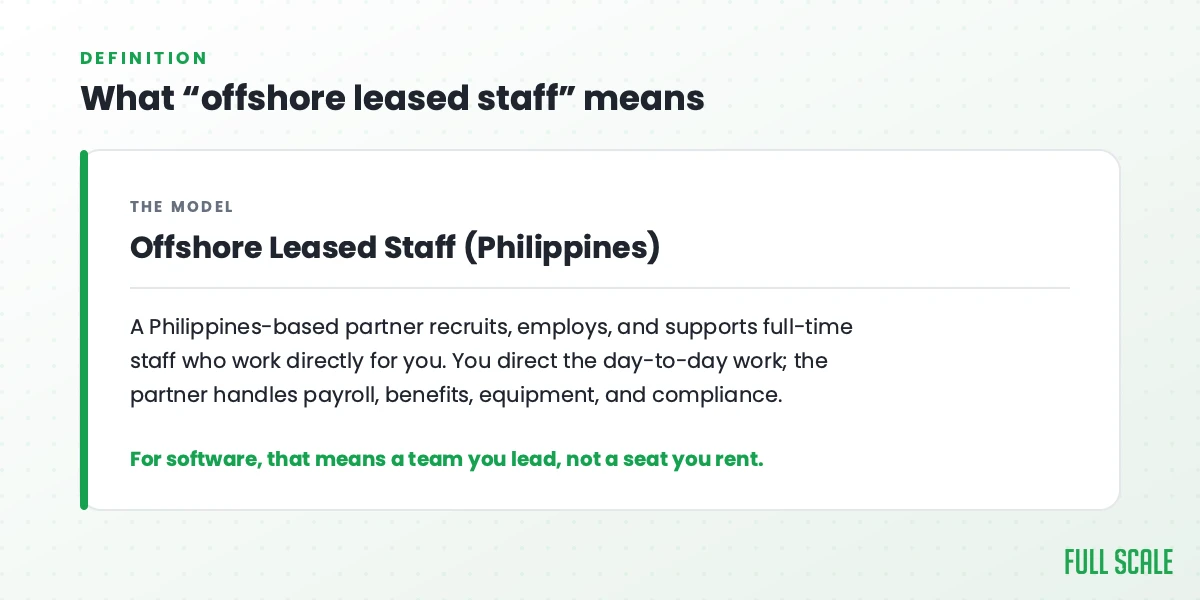
Quick Answer: Offshore leased staff in the Philippines means a local partner recruits, employs, and supports full-time staff who work directly for you, while it handles payroll, benefits, equipment, and compliance. For back-office roles you can treat it like leasing seats. For software, treat it as building a long-term team you direct, because the value is in people who stay and own the work.
What “offshore leased staff” in the Philippines actually means
Strip away the marketing and the model is simple. A partner in the Philippines finds the people, puts them on its payroll, and assigns them to work directly for you full time. You manage their day-to-day work. The partner handles employment: salaries, benefits, taxes, hardware, office space if it’s needed, and local labor compliance. You get the developer. They handle the paperwork. That split is also the simplest answer to the legal side of hiring remote workers in the Philippines, because the partner carries the statutory obligations.
The term “staff leasing” comes from the country’s enormous call-center and business process outsourcing (BPO) world, where you really can lease a seat the way you’d lease office space. You’ll also see the same arrangement sold as staff leasing services, offshore staff leasing, or building a dedicated offshore team in the Philippines. The labels shift. The mechanics don’t.
It’s the same family as offshore staff augmentation, where I break down the models, the real costs, and exactly where the approach breaks. I won’t repeat all of that here. The point for this article is narrower: the leasing frame is borrowed from a world where the work is interchangeable, and software is not that world.
The seat-rental trap: throwing bodies at a problem
Here’s the mistake I watch companies make. They have too much work and not enough engineers, so they go looking to lease a few cheap seats and shovel tasks at them. More hands, more output. That’s the theory.
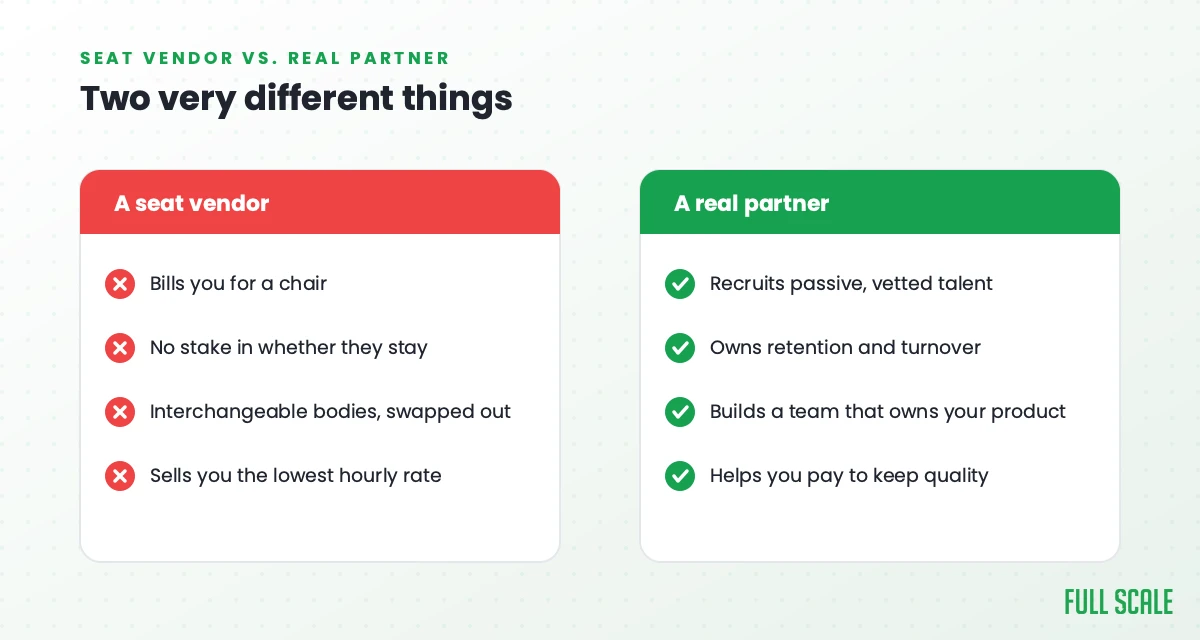
It doesn’t play out that way with software. If you’re just trying to throw bodies at a problem, that doesn’t make any sense. You have to build a team and build ownership in that team so the people can actually solve problems, instead of you standing over every seat directing each move. A developer who only does exactly what the ticket says, and stops thinking the moment the instructions run out, is not cheaper. They’re more expensive, because now you’re the bottleneck on everything.
The leasing pitch papers over this with one comforting line: “you stay in total control.” Control of what, though? A queue of strangers waiting for instructions will never behave like a team. Real control is having people who understand the product well enough to make good calls without you in the room.
This is also where the cost math turns on you. Renting the cheapest available seat is the exact move I call cheapshoring, and it’s the most expensive mistake in offshore development. The cheapest developer almost always costs you the most once you count the rework, the missed context, and the time you burn managing someone who never owns anything.
There’s a real exception, and I’ll be honest about it. If you have a short, well-scoped job with a clean ending, a marketing site, a one-time data migration, a specialty integration nobody on your team needs to own afterward, then renting a seat for a scoped project is the right tool. I’ve done exactly that myself. The trap is using that model for the software you’ll keep building for years, because that work needs a team that sticks around and learns your product.
Why this matters even more in the AI era
A few years ago you could at least argue that throwing bodies at a problem got you more raw code. That argument is gone.
Google’s CEO said in April 2026 that roughly 75 percent of the company’s new code is now AI-generated. He described the work as agentic now, with engineers supervising AI instead of writing most of the lines by hand. Read that twice. The typing is no longer the scarce part. The judgment is. What you need from a developer now is the ability to decide what to build, catch what the AI gets wrong, and own the outcome.
That is exactly what a rented seat can’t give you. Ownership is the one thing AI can’t hand you, and a developer treated as interchangeable headcount has no reason to bring it. The leasing model was always a weak fit for software, and AI only widened the gap. The teams that win are the ones who build software like they own it, not the ones who lease the most hands.
We take this seriously enough to run an internal program for it, the Spartan Training Academy, that puts every engineer through ongoing AI training, from a Claude Masterclass series to short weekly sessions. I’d rather over-invest there than wake up a year from now with a team that never learned to work with AI.
The DIY version burns people: Upwork and freelancers
The cheapest way to “lease” a Filipino developer is to skip the partner entirely and hire one off Upwork or another freelance marketplace. I talk to founders who tried exactly that, and a lot of them got burned.
The pattern is consistent. They overpay for talent that turns out to be mediocre, because nobody vetted the person beyond a profile and a star rating. The good freelancer is juggling three other clients. The cheap one disappears the week you need them most. And there’s a darker edge to it now, with the US Department of Justice indicting fraud rings that place fake remote developers through these platforms. I went deep on all of this in a separate piece on staff augmentation versus independent contractors, including a founder who got a literal ransom note from an Upwork hire.
The value a real partner adds is the thing the marketplace can’t. We make sure you’re paying fair local-market wages for genuinely good people, and that both of those are true at once. You don’t overpay for low quality, and you don’t lowball your way into someone who walks in a month. Getting pay and quality right together is most of the job, and it’s invisible until you’ve tried to do it yourself.
The real job is retention, not the cheapest seat
If you only take one thing from this article, take this. The hard part of offshore staffing is not finding a body. It’s keeping a great one.
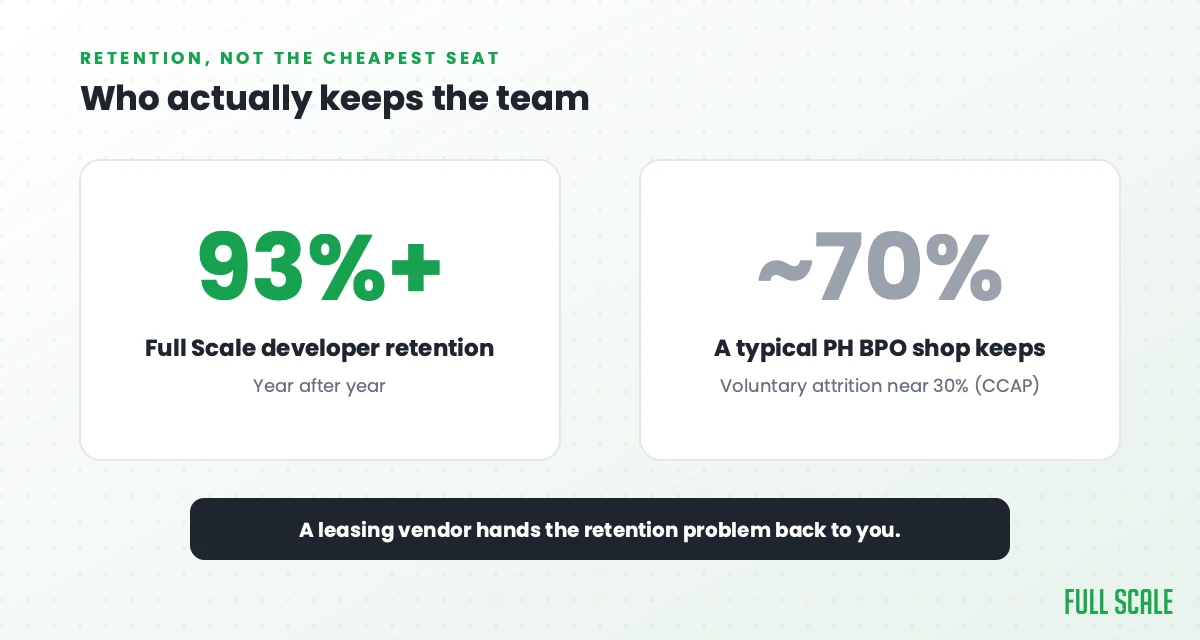
Turnover in the Philippines can be brutal. The country’s BPO industry is famous for it. Even after a few years of decline, voluntary attrition was still running near 30 percent, according to the Contact Center Association of the Philippines. That means a typical shop holds on to only about 70 percent of its people from one year to the next.
Full Scale doesn’t run that way. Our developer retention is over 93 percent. We’re Great Place to Work Certified in the Philippines two years running, and 95 percent of our people say it’s a great place to work, against 65 percent at a typical company. That gap, between the local norm and what we actually deliver, is the entire reason a real partner beats a seat vendor.
A leasing company that just bills you for a chair has no real stake in whether your developer stays. When they quit, the vendor stops running payroll and you eat the loss: the half-finished work, the lost context, the months of hiring to replace them. A seat vendor never owned the retention problem in the first place, so the moment your developer quits it lands right back on you.
A real partner does the opposite, and retention is built on three things the leasing pitch never mentions:
- It recruits the right people in the first place. The best developers are not applying to job posts. We run full-time in-house recruiters who find passive talent and pull them away from their current employers, backed by referrals from our own team. Going direct gets you the flood of mass applicants, not the engineers who are already great and already employed.
- It helps you pay them right. A good partner advises you on what to actually pay so you land and keep quality, instead of guessing or lowballing. We pay at the top of the local market on purpose, and I lay out the real numbers in the software engineer salary in the Philippines guide.
- It does the work to keep them. Career growth, real management, and treating offshore engineers like full members of the team instead of a vendor behind a wall. That is the same reason the choice between an employer of record and a staffing agency comes down to retention.
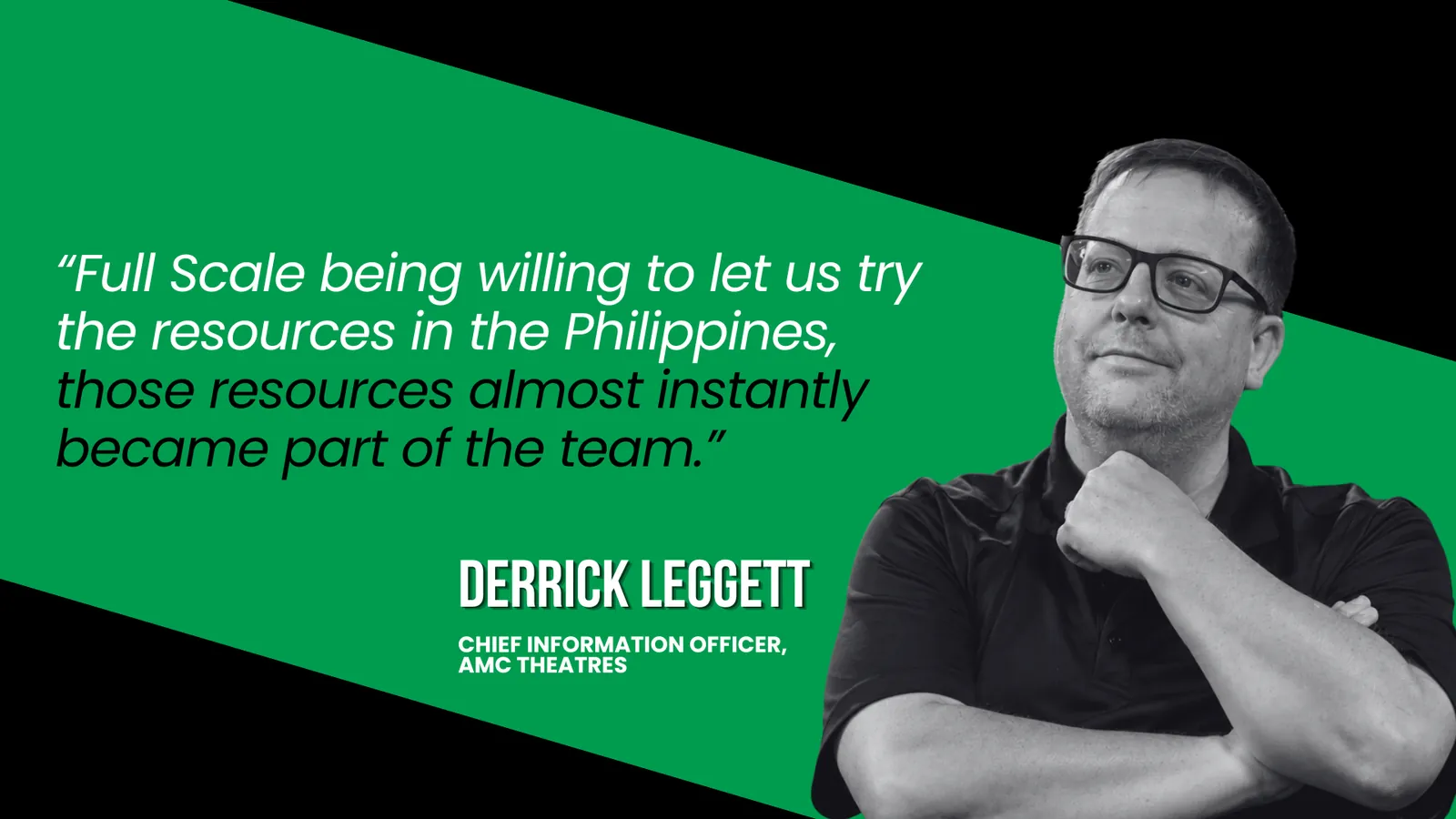
When that work is done right, clients stop thinking of the team as offshore at all. Derrick Leggett, CIO of AMC Theatres, put it simply:
It’s a fully integrated team. It’s just that some of the people happen to be living in the Philippines.
Derrick Leggett, CIO, AMC Theatres
A developer who stays three years and knows your product cold is worth far more than a cheaper one who leaves in nine months. The cheapest seat is rarely the cheapest outcome.
How to pick a partner, not a seat vendor
Most of the providers ranking for staff leasing in the Philippines lump software developers in with virtual assistants, data-entry clerks, and medical transcriptionists. That should tell you something. A partner who treats every role as the same leasable seat is not built for engineering.
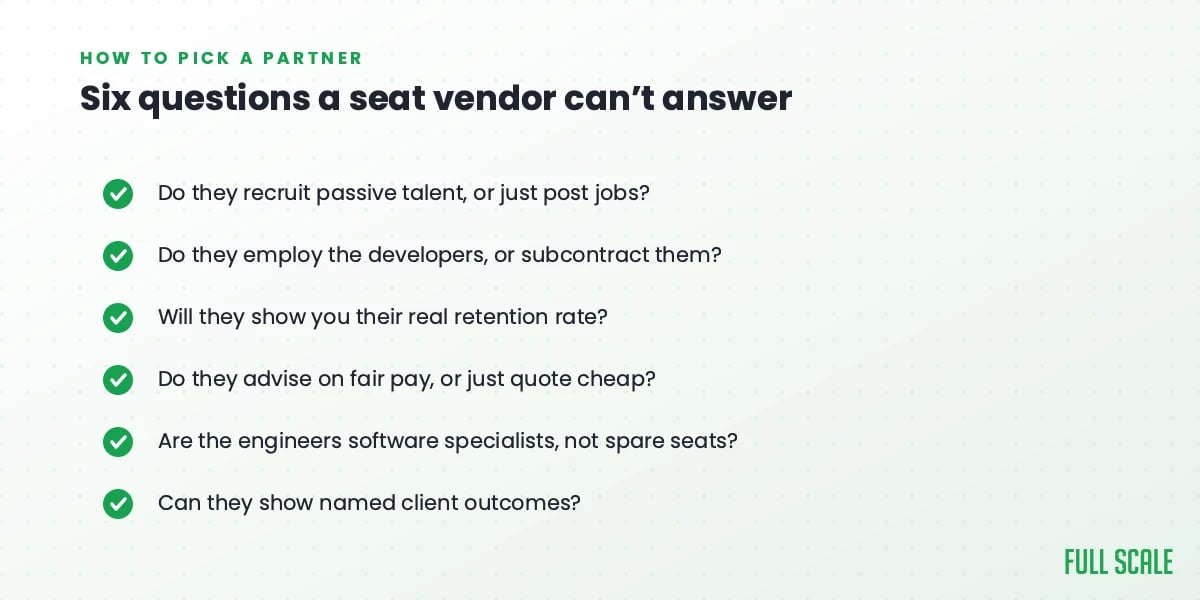
When you evaluate a provider, ask these:
- Do they recruit passive talent, or just post jobs? Posting jobs gets you whoever is currently unemployed and applying everywhere.
- Do they actually employ the developers, or subcontract them? You want one accountable party, not a chain of middlemen.
- What’s their real retention rate, and will they show it to you? If they dodge the question, you have your answer.
- Will they advise you on fair pay, or only quote the lowest rate? The lowball quote is a tell, not a deal.
- Are the engineers software specialists, or seats that happen to be free? You want people vetted for the work you actually do.
- Can they show named client outcomes? AMC Theatres and SOTA Cloud run real product teams with our developers in the Philippines, and less than 3 percent of the people who apply to us make it through.
If a provider can’t answer these, you’re not hiring a partner. You’re leasing seats and absorbing all the risk yourself. The full version of this decision lives in our staff augmentation services and in the way we run a dedicated team model instead of a body shop.
Why the Philippines is worth it anyway
None of this is an argument against offshore. It’s the opposite. The Philippines is where I landed after trying half a dozen other countries, and I’d make the same call again.
A few things make it work:
- English is everywhere and the accent is neutral, which closes the communication gap that sinks so many offshore teams before culture even comes up.
- Our engineers shift their hours to overlap the US workday, so you get real-time collaboration instead of a relay race across time zones.
- The talent pool is deep. The Philippines runs a 40-billion-dollar IT and outsourcing industry with about 1.8 million workers, so this is a proven place to staff a team, not an experiment.
I made the full case in why I bet on the best offshore developers in the Philippines, and the cost advantage is real on top of all of it.
Offshore doesn’t go wrong because of where the developers sit. It goes wrong when you treat them like rented seats. Get a good team in the Philippines and lead them like a team, and it’s one of the best decisions you can make. The benefits of that model compound the longer the team stays together.
Don’t lease seats when you mean to build a team
The companies that fail at offshore development almost always started by trying to rent the cheapest seats they could find. The ones that win started by deciding to build a real team and then found a partner who could recruit, pay, and keep that team for the long haul.
Lease offshore staff the cheap way and you’ll spend the next two years managing churn and rework. Build a real team and it gets better every quarter, because the people stay long enough to know your product cold. One is an expense you keep refilling. The other compounds.
If you want to see what a high-retention, fully integrated offshore team actually looks like, schedule a call with Full Scale.
Frequently asked questions
What is offshore leased staff in the Philippines?
Offshore leased staff means a local partner recruits and employs full-time workers in the Philippines who work directly for you, while the partner handles payroll, benefits, equipment, and compliance. You direct the day-to-day work and the partner owns the employment relationship. For software, the better way to think about it is building a dedicated team rather than renting interchangeable seats.
Is staff leasing the same as staff augmentation?
They’re close cousins. “Staff leasing” comes from the BPO world and often implies renting a seat by the month, while staff augmentation usually means adding dedicated engineers to your own team for the long haul. The mechanics overlap, but the mindset is different, and for software development the staff augmentation framing is the one that actually works.
How much does it cost to lease offshore staff in the Philippines?
Most providers advertise savings of up to 70 percent versus hiring in the US, and the cost is genuinely lower. But the lowest rate is the wrong thing to optimize for. The real question is whether you’re paying enough to land and keep good people, because the cheapest seat usually costs the most over time. For reference, our fully loaded rate runs around 35 dollars an hour.
Is leasing offshore staff better than hiring freelancers on Upwork?
For long-term software work, yes. Freelancers off a marketplace are unvetted, juggle multiple clients, and offer no continuity and no one standing behind the work if they walk. A staffing partner vets the developers, employs them, and stands behind the placement, so continuity is their problem to solve, not yours. Freelancers make sense for small, one-off projects with a clean ending, not for a team you’re trying to build.