
Staff Augmentation Proposal: What I Look For Before It Goes Out

In this article
- What’s actually in a staff augmentation proposal
- You don’t always need a formal RFP to get a real proposal
- What the proposal reveals about the people who’ll run your project
- Named engineers beat bench numbers every time
- Read past the headline rate to the math underneath it
- The guarantee language is where proposals oversell the most
- Ask who actually did the vetting
- Green flags and red flags, side by side
- Frequently asked questions
- The document is the audition
I read staff augmentation proposals from two seats. I read the ones my own team writes, because nothing goes out to a prospect without passing my desk first. And more and more, I read the ones a prospect got from somebody else, because they forward it to me and ask what I think before they sign.
Scope, rates, and security certifications matter, and I’ll cover all of them. But the part that actually decides whether a staff augmentation proposal is legitimate lives somewhere else, in the specifics most people skim past.
What’s actually in a staff augmentation proposal
Start with the table stakes, because a proposal missing these isn’t ready to evaluate at all.
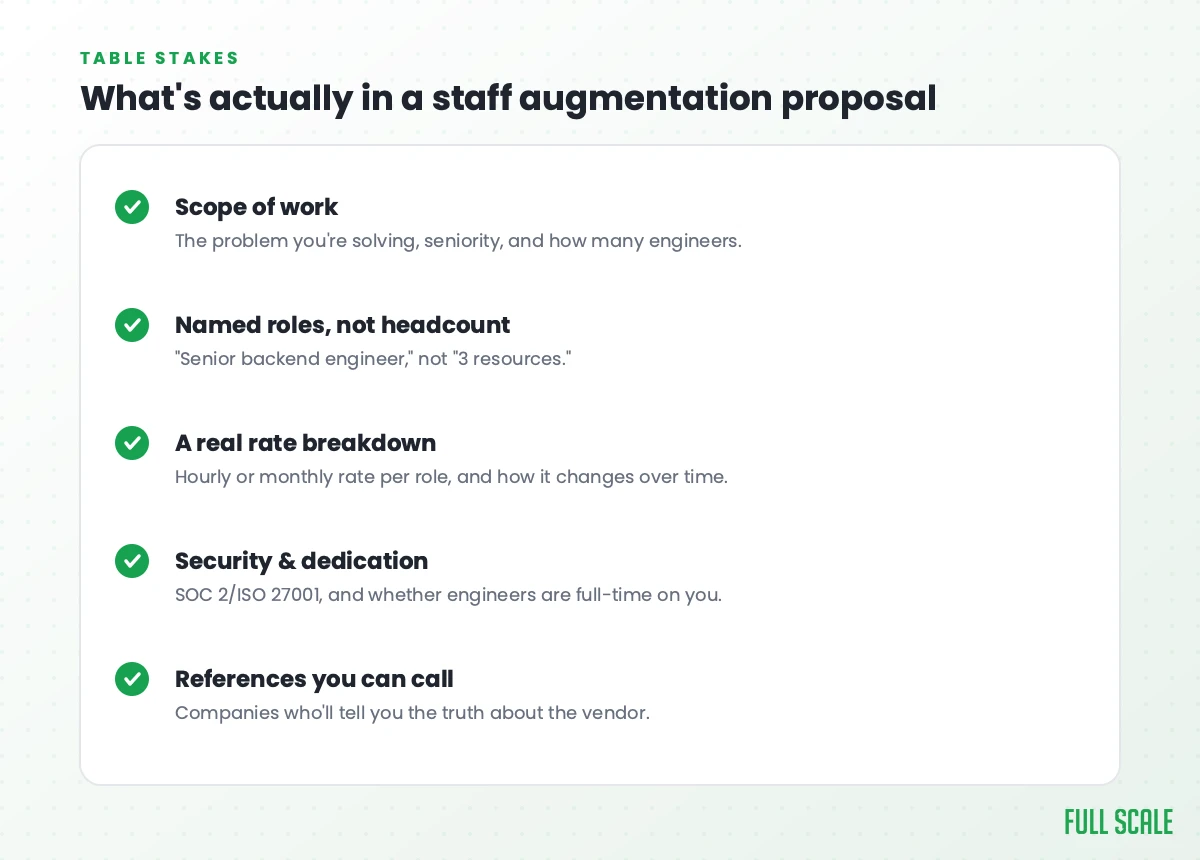
A real proposal names the scope, the roles, the rates, and the exit. Specifically:
- Scope of work. What problem you’re solving and roughly how many engineers, at what seniority, for how long.
- Named roles, not just headcount. Senior backend engineer, QA lead, not “3 resources.”
- A real rate breakdown. Hourly or monthly rate per role, and whether it changes over time and by how much.
- A timeline that separates two dates. When someone starts, and when they’re realistically expected to be contributing. Those aren’t the same milestone.
- Security, access, and IP basics. Who owns the code, how access is controlled, and a real certification or control you can verify, not just a sentence about taking security seriously. SOC 2 or ISO 27001 is what a credible answer usually looks like.
- Whether the people named are dedicated to you. A proposal should say plainly whether an engineer is full-time on your project or splitting time across other clients. Get it in writing either way.
- References. Companies who’ll tell you the truth about what it’s like to work with this vendor. A useful reference call asks about a rough patch and how the vendor handled it, not just whether they’d recommend them.
None of that is exotic. Every credible vendor proposal has some version of this list. If one doesn’t, stop reading and ask for the missing pieces before you spend another minute on it.
The rate and contract mechanics deserve their own deep dive. I’ve written one covering payment cycles, rate escalators, IP ownership, and cancellation, in the kind of detail a checklist can’t. Treat this article as what happens before that one.
You don’t always need a formal RFP to get a real proposal
Some of what you’ll find searching this topic assumes you’re running a full request for proposal process. That means a written RFP document, a scoring rubric, a formal evaluation committee, the whole procurement machine. If you’re at a large enterprise or a government agency, that process exists for a reason and you should run it.
Most companies looking at staff augmentation aren’t that. You don’t need a formal RFP to get a proposal worth evaluating. A clear conversation about your scope, timeline, and budget, followed by a written proposal covering everything above, gets you the same information without weeks of procurement overhead. Save the full RFP machinery for engagements large enough, or regulated enough, to actually need the paper trail.
What you shouldn’t skip, formal process or not, is putting your requirements in writing before you ask for proposals. A vendor can’t give you a specific answer to a vague ask, and the clearer your scope, the more a proposal’s specificity actually tells you something.
What the proposal reveals about the people who’ll run your project
The proposal is also a writing sample from the team that’s about to run your project.
If the language is generic, the delivery will be generic too. You know the tell when you see it: a “Success Stories From Industry Leaders” section that could belong to any vendor selling any service, a paragraph about being “customized to your unique needs” that reads exactly like the paragraph in the last three proposals you got. Nobody wrote that for you. They wrote it once, and it goes out with every logo swapped in.
A proposal that actually engages with your specific problem, stack, and timeline was written by people who read your brief. A generic one was written by people who’ll manage your engagement the same way once you’ve signed.
I’ll admit my own team’s first drafts aren’t immune to this. Part of my job is catching the templated line before it goes out and asking someone to actually say something specific. If a vendor’s proposal reads like nobody did that on their end, that’s a preview of how they’ll run your project.
This is the same idea behind Product Driven: the standard you hold your own work to is the standard your clients actually get. A proposal is the first place that standard shows up, or doesn’t.
Named engineers beat bench numbers every time
The proposal shows you sample resumes that read like a dream team. Then the engineers who actually show up two weeks later are a different, junior group entirely.
That’s a bait and switch, and it’s one of the more common ways a staff augmentation engagement goes sideways before it even starts. It’s also preventable with one question.
Ask for the actual names of the people who’ll work on your project, and insist on interviewing and approving every one of them before they start. Don’t accept “a candidate with similar experience” as an answer; get the name of the actual person who will do the work. If a vendor hedges on that, or tells you their process doesn’t really work that way, you’ve learned something important before you’ve spent a dollar.
I’ve written about this from the buyer’s side in more depth in staff augmentation best practices, including exactly what to ask a partner about how they screen. The short version for a proposal specifically: a bench number (“12 senior React developers available”) tells you the vendor has people, not who you’re actually getting. Only a name does that.
Read the bios themselves with a little skepticism, too. Every candidate profile claims to be a collaborative self-starter who thrives in fast-paced environments, the professional equivalent of a dating profile where everyone is “easygoing” and “up for anything” right up until the first actual disagreement. Ask what they’ve actually shipped.
Read past the headline rate to the math underneath it
A proposal with a suspiciously low rate is a question you haven’t asked yet.
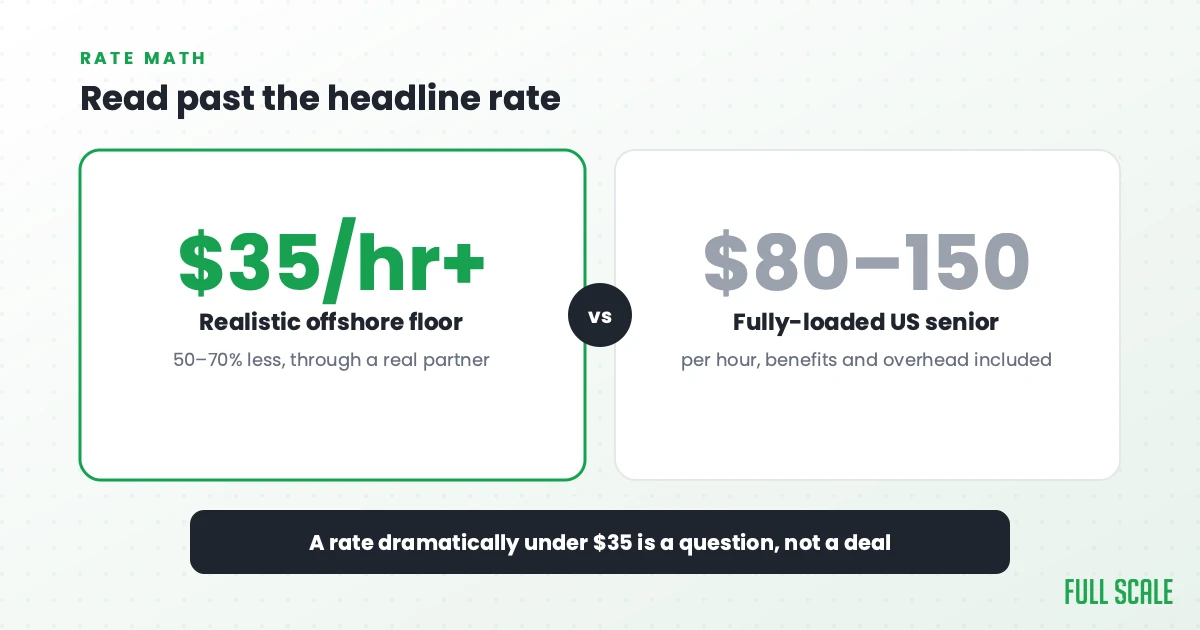
Offshore staff augmentation should land you real savings, typically 50 to 70% less than a fully-loaded US senior developer running $80 to $150 an hour. Rates starting around $35 an hour are realistic for a strong offshore engineer through a legitimate partner. When a number comes in dramatically under that, somebody’s cutting a corner you can’t see yet, usually screening, usually retention, sometimes both. I’ve written a whole piece on this exact trap and named it cheapshoring: hiring the cheapest developer you can find and hoping the talent shows up anyway. It rarely does, and the savings on the spreadsheet evaporate the moment the rework starts.
The other half of the math is what happens to the rate over time. A credible proposal discloses exactly one annual increase, spelled out in plain language. Something like a flat 6% a year is a reasonable, disclosed figure to expect, not a vague “rates subject to change” buried in an appendix. Full Scale holds itself to the same rule: we tell you the one number before you sign, and we don’t stack a second one behind it. If you see two separate levers pulling the same direction in a proposal, a cost-of-living clause AND a separate “market adjustment” clause, ask why. That’s two undisclosed chances to raise your bill instead of one plain one.
Vendors structure these rates four different ways: cost-plus, fixed markup, blended, and time and materials. I broke down what each one hides in a separate piece, worth reading before you sign anything.
The guarantee language is where proposals oversell the most
Read the guarantee section of any staff augmentation proposal twice, because this is where the exaggeration tends to concentrate.
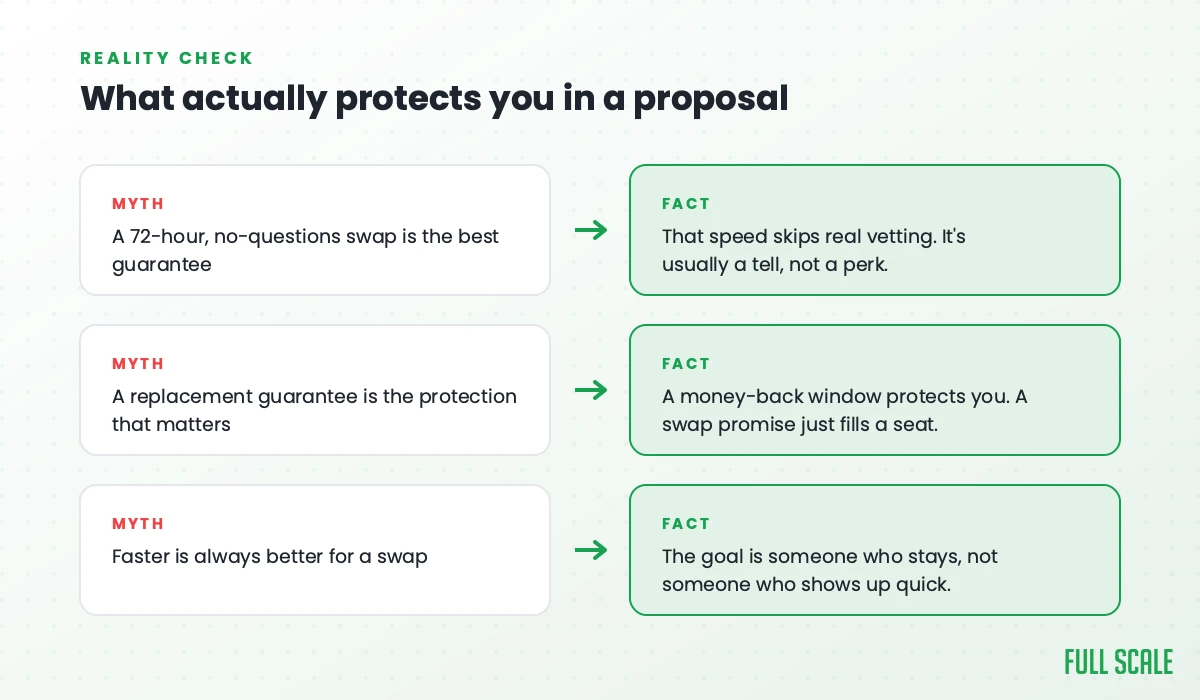
A vendor should be willing to move someone off your team when it is not working out. What you want in writing is a money-back window you can actually use, not a promise about how fast they can swap in a stranger. “Replace anyone within 72 hours, at our cost, no questions asked” sounds generous, but read it again: nobody vets and onboards a real replacement that fast. In reality it depends on the bench. Someone with the right skills may be available in about a week, and recruiting for a specific stack takes longer, with time built in to hand off context, because the point is a developer who sticks around, not a warm body who shows up quickly and leaves just as fast. A guarantee promising a same-day or next-day swap is usually a tell that the underlying screening is thin enough that swaps are routine, not rare.
The honest version of a guarantee is narrower: a two-week money-back window, then 30 days’ notice to change anything after that, no long-term contract locking you in. Ours reads that way on purpose. I go into exactly why in the contract terms breakdown. The guarantees that sound the most reassuring tend to be the most heavily qualified clause in the whole document, once you read the fine print. A proposal that under-promises on this section, plainly, is usually more trustworthy than one that over-promises.
Ask who actually did the vetting
The proposal will tell you a vendor has great people. Ask how they know that.
Start with retention, because it predicts something an acceptance rate doesn’t. A vendor who keeps engineers for years has proven those engineers were worth keeping, and that the people on your project actually stuck around long enough to learn your codebase. Ours runs above 93%. Ask any partner theirs, and ask why the number is what it is.
Acceptance rate is worth asking about too, but read it with some skepticism. Nearly every vendor in this space advertises an elite screen, Full Scale included, ours runs under 3%, so a low number by itself proves less than it sounds like it does. What separates a real screen from a marketing line is whether that low acceptance rate shows up later as low turnover. If a vendor can quote you their acceptance rate but goes quiet on retention, that’s the tell.
Put both numbers next to the sample bios in the proposal. If the bios are strong but the vendor won’t say how long people actually stay, you’ve found your answer.
Green flags and red flags, side by side
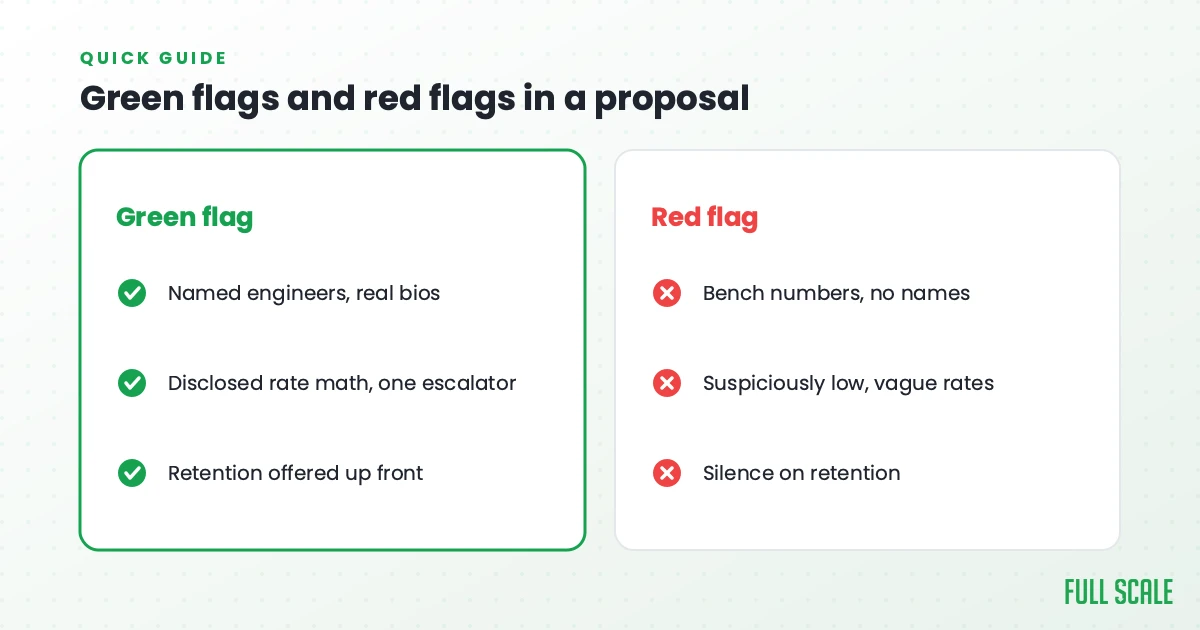
The green flags and red flags in a staff augmentation proposal, in one view:
| Signal | Green flag | Red flag |
|---|---|---|
| Roles | Named people, real bios you can verify | Bench numbers, no names offered |
| Language | Specific to your project and stack | Generic, could go to any client |
| Rate | Disclosed math, one clear escalator | Suspiciously low, or vague “subject to change” |
| Guarantee | A money-back window and honest notice terms | Same-day or 72-hour “no questions asked” swap promise |
| Vetting | Leads with retention, offers the number unprompted | Leads with acceptance rate, goes quiet on retention |
| Interviews | You approve every person before they start | “We’ll just assign someone” |
| References | Offered proactively | You have to ask twice |
None of these checks take long to run. That’s what makes it frustrating how often they get skipped. Reading a proposal carefully takes about twenty minutes, and skipping that step is what costs you months later.
Frequently asked questions
What should a staff augmentation proposal include?
A credible proposal names the scope of work, the specific roles and seniority levels involved, and a transparent rate breakdown that includes how rates change over time. It also covers a realistic start and ramp-up timeline, security certifications like SOC 2 or ISO 27001, and whether the named engineers are dedicated full-time. Add client references you can actually call. If any of these is missing or vague, ask for it before moving forward.
How do you evaluate a staff augmentation proposal?
Check the table-stakes items first: scope, rates, timeline, security, references. Then read past them for named engineers, language specific to your project, disclosed rate math, and a guarantee that sounds honest. Each one is a sign the proposal was written for you, not copied from the last one that went out.
What are red flags in a staff augmentation proposal?
The biggest ones: bench numbers with no named engineers, generic language that could apply to any client, and a rate far below the realistic $35-plus range without explanation. Also watch for a guarantee that promises an instant, no-questions-asked swap instead of a money-back window you can actually use, and a vendor who leads with their acceptance rate but won’t share their retention rate.
Is a staff augmentation proposal the same as a contract?
No. The proposal is how you choose a partner. The contract is what you sign once you’ve chosen one, and it covers the legal details, payment terms, IP ownership, and cancellation terms, in binding language. Read our contract terms breakdown once you’re at that stage.
How long should a staff augmentation proposal take to prepare?
A vendor who already knows their own rates, screening process, and standard terms should turn around a solid proposal in a few days once they understand your scope. A proposal that takes weeks to produce, or that arrives full of placeholder language, is telling you something about how the rest of the engagement will run.
The document is the audition
A staff augmentation proposal is the first work sample you get from the team that wants to run your project. Read it that way, and most of the mistakes take care of themselves.
If you want to see what an honest one looks like, schedule a call and we’ll walk you through ours, names, numbers, and all.