
Offshore Development Best Practices: How to Avoid the Cheapshoring Trap (and Hire Right)

In this article
- The Cheapshoring Trap
- The Four Ways to Source Offshore Talent
- Why a US-Based Staff Augmentation Vendor Changes the Math
- Intellectual Property Protection That Actually Works Across Borders
- Background Checks That Actually Verify International Talent
- Security Concerns Specific to Offshore Work
- Red Flags When Vetting an Offshore Vendor
- Frequently asked questions
- Wrap-Up: The Real Offshore Arbitrage
Quick Answer: Offshore development best practices come down to avoiding the cheapshoring trap: picking a vendor on rate alone instead of vetting for real talent, IP protection, and security. The safest model is a US-based staff augmentation partner who employs the developers directly, handles IP assignment and background checks, and gives you direct access to the engineers instead of a black box. Full Scale has placed 700+ developers this way since 2018, with 93%+ retention.
As the founder of Full Scale, I’ve talked to hundreds of founders over the last few years about their offshore experiences. I’ve heard every horror story you can imagine.
One founder fired a developer and the developer tried to hold his company hostage because he still had a copy of the code. Another hired what looked like a great senior engineer and later figured out the person was actually working from North Korea. A third was trying to extract himself from an engagement that had quietly tangled with a cartel in Mexico. Plenty more got tired of the Upwork circus, where freelancers ghost the moment something hard comes up and the person who shows up to the call isn’t the one writing the code. Many of the same habits show up in our staff augmentation best practices for running an augmented team.
After hundreds of those conversations, here’s what I’ve learned.
Most offshore failures don’t trace back to the developers. They trace back to the engagement model the founder picked before the first line of code got written, and to one specific mistake inside that decision.
They went cheap.
I call it cheapshoring, and it’s what this article is about. In seven years of running Full Scale, with 700+ developers placed across dozens of companies, we have never had a single one of those horror stories.
The Cheapshoring Trap
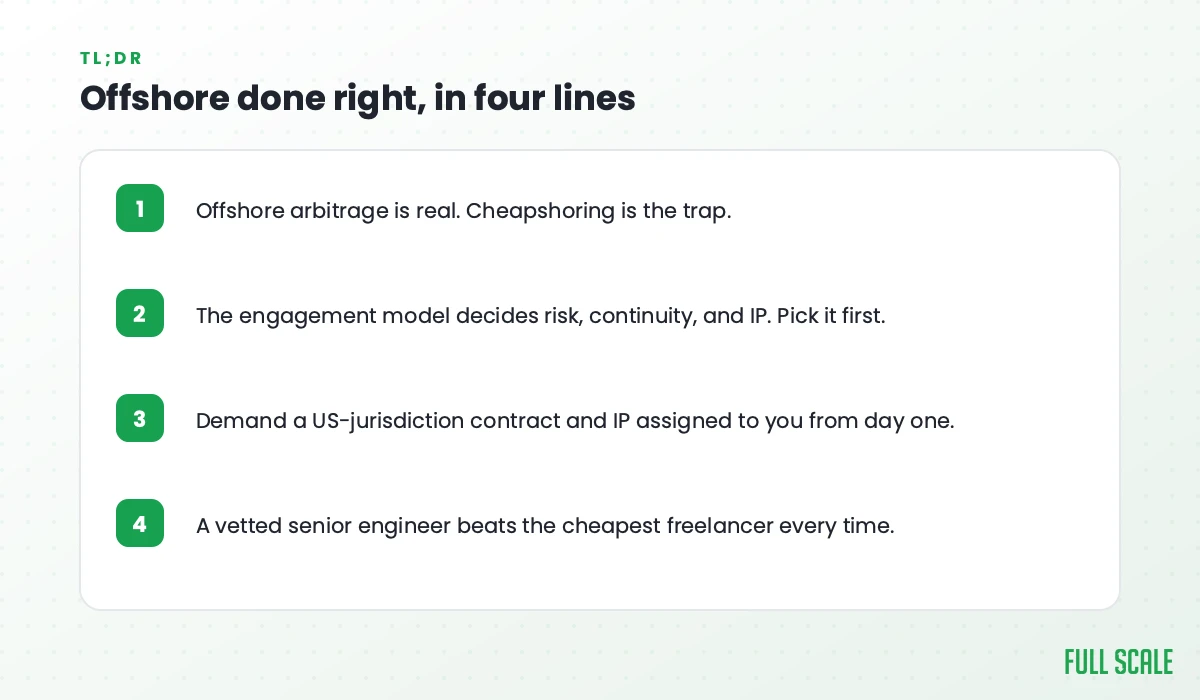
Offshore software development is real arbitrage. A senior engineer in Manila or Cebu at the top of the market costs roughly a third of what an equivalent engineer in San Francisco costs, at the same skill level. The market for talent doesn’t follow the market for cost of living, so cost of living is where the gap lives, and you can capture that gap legitimately.
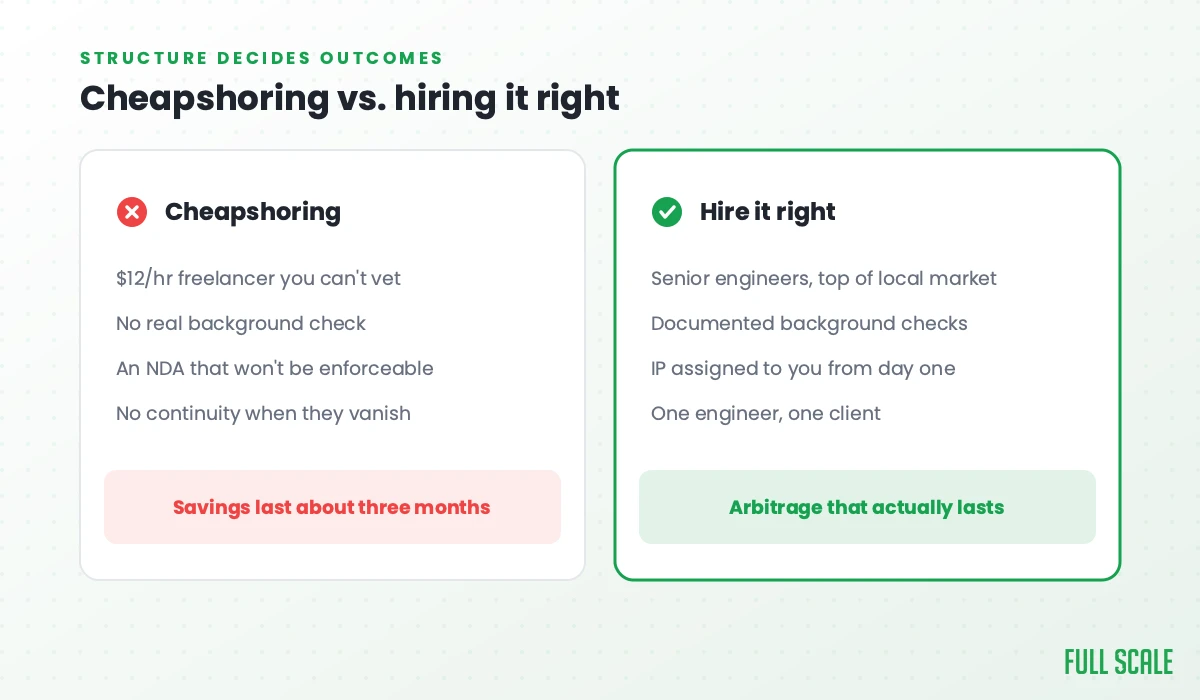
The trap is what most founders do with that knowledge. They look at a 3x cost difference and ask whether they can push it to 5x or 8x by hiring the absolute cheapest option available. They wind up on Upwork hiring a $12-an-hour freelancer in a country they couldn’t find on a map, without a background check, with an NDA that won’t actually be enforceable, no continuity of staffing if the freelancer disappears, and almost no recourse when something goes wrong. The savings are real for about three months.
Then the engagement falls apart, and the founder spends six months and another budget cycle cleaning up the mess.
You don’t get what you pay for in either direction here. Paying a US engineer four times the going rate for a great global engineer at the same skill level is paying for the zip code, not the talent. Paying the lowest possible rate for the cheapest possible offshore freelancer is also paying for nothing, because the skill, vetting, accountability, and IP protection are all missing.
The right move is the middle.
Hire high-quality global talent through a vendor you trust, at a rate that reflects the talent and the operational infrastructure that comes with it. That’s the arbitrage worth capturing. You don’t have to pay top of US market to get quality work, but you do have to pay enough to land at a real vendor instead of a freelance auction site. The same logic applies to security: building secure software with an offshore team comes down to the engagement model and the controls around it.
The Four Ways to Source Offshore Talent
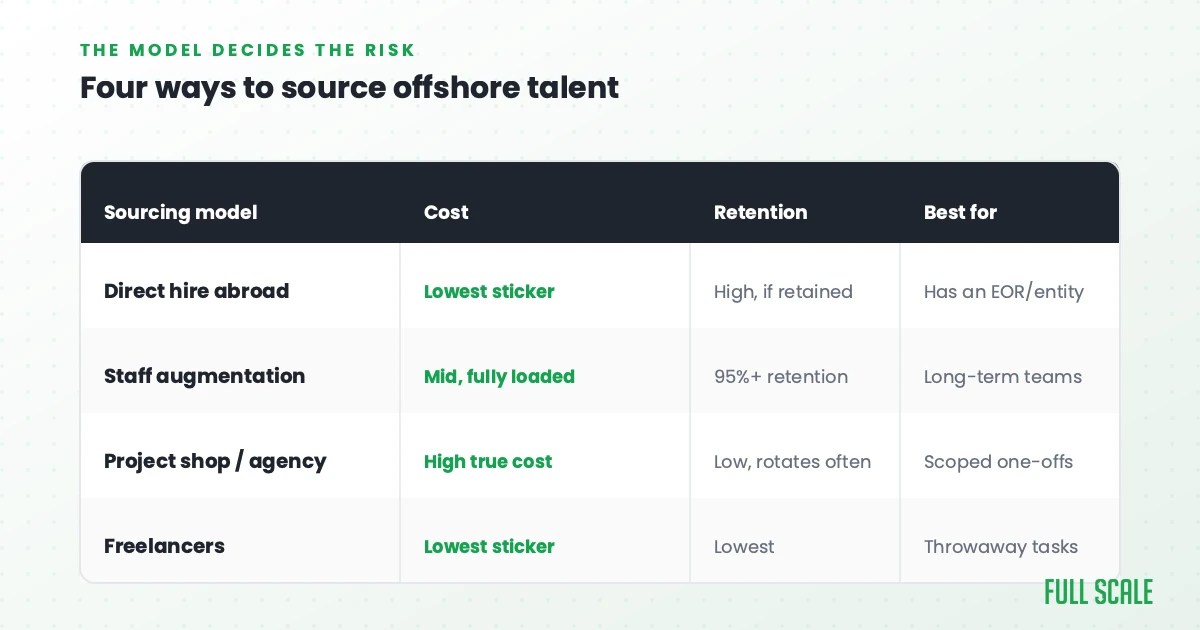
Most “offshore best practices” articles skip the most important decision a founder makes, starting with whether to hire or outsource developers and then how they engage offshore talent in the first place. The engagement model decides almost everything else, including the risk profile.
| Sourcing model | Hourly rate | Continuity | IP risk | Quality variance | Best for |
|---|---|---|---|---|---|
| Direct hire in another country | Lowest sticker | High if retained | Low if structured right | Low if you can vet | Companies with an EOR partner or local entity |
| Staff augmentation (e.g., Full Scale) | Mid | 93%+ retention | Low | Low | Long-term product teams |
| Project shop / outsourcing agency | High true cost | Low (engineers rotated) | Medium | Medium | One-off projects with tight scope |
| Freelancers (Upwork, Toptal, direct) | Lowest sticker | Lowest | Highest | Highest | Discrete throwaway tasks |
Direct hire in another country sounds straightforward and is the cheapest on paper. The problem is the operational overhead. You’re now an international employer, which means taking responsibility for international payroll management, taxes, benefits, equipment, HR and labour law in a jurisdiction you may not fully understand. Employer of Record providers help, but you’re still carrying employment risk you weren’t carrying before. This works for companies mature enough to handle it, and it tends not to work for early-stage startups that thought they were just hiring a developer.
Staff augmentation is the model Full Scale runs. You get dedicated engineers who work exclusively for one client, the vendor handles payroll, HR, benefits, equipment, and compliance, and the contracts run through a US entity. The engineer is on the vendor’s payroll. You’re paying a single monthly rate per engineer and getting one accountable party for the entire engagement.
Project shop or traditional outsourcing agency is the model most offshore failure stories come from. The agency profits by billing as many hours as possible, often by rotating the same engineers across multiple clients. Your “dedicated” team turns out to be three engineers split across four projects, and the senior you interviewed isn’t on yours past month two. I wrote in detail about why this model structurally fails, and the short version is that the billing model creates incentives that work directly against your interests.
Freelancers on Upwork, Toptal, or direct hires off LinkedIn are the cheapest sticker price and the highest real risk. Whatever vetting exists is what the platform claims to do, which leaves you as the only real screen and makes how to conduct remote technical interviews the skill that decides the outcome, continuity is whatever the freelancer feels like this month, and accountability is limited to whichever dispute system the platform happens to run. The horror stories I hear come from this tier more than any other.
If you take one thing from this section, take this.
The cost difference between the worst sourcing model and the best one is smaller than people think, and the risk difference is enormous. (I’ve written a longer piece on offshore development due diligence for founders going through the vendor selection process for the first time.)
Why a US-Based Staff Augmentation Vendor Changes the Math
When you work with a US-based staff augmentation company like Full Scale, you’re signing every confidentiality agreement, intellectual property assignment, and contractual commitment with a US company. You’re not signing with an engineer in Vietnam or a freelancer in India. The contracts are enforceable under US law, in US courts, with US legal recourse. That legal-structure gap is one more reason the it outsourcing vietnam comparison against the Philippines matters before you pick a country.
That sounds like a formality until something goes wrong.
Then it’s the entire ballgame.
If a freelancer in another country breaches your NDA, takes your code, or refuses to hand over a repo, your options are limited. You can try to enforce a contract in a jurisdiction you don’t know, against a person whose address you may not be able to verify, with a legal system that may or may not recognize what you signed. Most founders, faced with that math, write off the loss and move on. The freelancer knows that, which is part of why the freelancer can act the way they do.
When you have a US vendor in the middle, the math flips. The vendor signed enforceable contracts with you, and the vendor also signed employment contracts with the engineer in the engineer’s country, under terms the engineer knows are enforceable. That gives the vendor leverage to hold the engineer accountable that you, as an external client, will never have on your own. The engineer is not going to ghost their employer the way they’d ghost a one-off Upwork client, because their job depends on it.
That structural accountability is what you’re actually buying when you pay more than the bottom-of-the-market freelancer rate. You’re buying a US legal layer, a vendor with real leverage over the person writing your code, and a single throat to choke when anything goes wrong.
In seven years of operating Full Scale, with hundreds of engineers placed at dozens of companies, we have never had a single IP incident, code leak, ghosting episode, or contractual dispute that touched a client.
That isn’t luck. It’s the difference between hiring a stranger off the internet and hiring through a vendor whose own business depends on the relationship working.
Intellectual Property Protection That Actually Works Across Borders
The first horror story I mentioned (the developer holding a company’s code hostage after being fired) is a more common failure mode than most founders realize. It usually plays out the same way. The founder signed an NDA with the freelancer, but didn’t think hard about what the NDA would actually do across borders. The freelancer had full repo access, often as admin. The relationship soured, the founder cut the contract, and discovered that the code is now distributed across two GitHub accounts and one external machine, none of which the founder controls.
The legal recourse for that situation, on paper, is real.
The practical recourse is close to zero unless you’re willing to spend more on lawyers in two jurisdictions than the code is worth.
There are a few things that actually protect IP across borders, and most of them are about the structural setup rather than the contract language.
Sign your IP assignment with a vendor in your jurisdiction. When you hire through Full Scale, the IP assignment runs through Full Scale’s US entity. If a single engineer somehow tried to claim ownership of code they wrote, the vendor’s legal position would be unambiguous, and the engineer’s would be unenforceable. This is fundamentally different from a one-off NDA signed with an individual in another country.
Use role-based access tiers from day one. Not every engineer needs admin on every repo. Build the principle of least privilege into your access controls before the team grows. A team of ten where two people have full admin and eight have scoped access is far more recoverable than a team of ten where everybody has admin and a quarter of them are about to be reassigned to other clients.
Rotate secrets when people leave. Tokens, keys, deployment credentials, and third-party API keys all need to be rotated the day someone exits, every time, with no exceptions. This is one of those practices that seems obvious until you watch a founder discover that a former contractor still has their AWS root key.
Understand what an NDA does and doesn’t do. An NDA prevents disclosure. It doesn’t retrieve code that’s already been copied, force someone to hand over a credential they’re holding, or stop a former contractor from using your code as the starting point for their next contract. Treat NDAs as a baseline.
They aren’t a defense on their own.
Background Checks That Actually Verify International Talent
This is the part that nobody thinks about when hiring internationally, and it’s where the biggest gap exists between hiring through a serious vendor and hiring direct.
In the US, a background check is mostly a credit check, a criminal record search, and a few reference calls to former employers. Hiring infrastructure is dense enough that LinkedIn, professional networks, and standardized credentialing carry most of the verification load. None of that infrastructure works the same way abroad. LinkedIn profiles in many countries are sparse or curated. Reference networks are smaller. Standardized credentialing is hit or miss.
The signals US-based hiring relies on don’t transfer.
Here’s what we actually do in the Philippines:
Education verification. We don’t assume the degree on the resume is real. We confirm it directly with the school. This sounds basic. It’s far less common than you’d think, including with vendors that claim to vet.
NBI criminal record check. The National Bureau of Investigation in the Philippines is roughly equivalent to the FBI in the US. Every Full Scale employee clears an NBI background check before they start. It’s the standard for serious employers in the country and uncommon for freelancers.
Character reference checks. We don’t stop at former employers. We also talk to people who actually know the candidate over time and can speak to how they show up consistently. Professional references at scale in the Philippines aren’t as load-bearing as they are in the US, so character references fill the gap.
Neighborhood checks. This is where it gets specific. We actually go to where the candidate lives and talk to their neighbors. We ask about their reputation in the community, their reliability, how long they’ve been there, and whether the person we’d be hiring matches the person their neighborhood knows. This sounds invasive to a US ear. In the Philippines, it’s a standard practice for serious employers and the candidate expects it.
Address verification by hand-drawn map. Addresses in the Philippines don’t work like US addresses. A lot of homes don’t have a street number you’d recognize. So we ask candidates to draw a map showing where they live, with landmarks, so we can verify the address physically. There’s no Zillow lookup that will do this for you.
None of these things are exotic. They’re the standard practices of any serious employer in the Philippines. They’re also the kinds of things you cannot do as a US founder hiring direct, because you don’t know the local infrastructure, you don’t have people on the ground, and you don’t speak the local language for the parts of the verification that happen in person.
This is one of the strongest reasons to work with a vendor in the country instead of trying to do international hiring yourself. The vendor has spent years building the operational layer that makes verification real. When you hire a vendor like Full Scale, what you’re really buying isn’t just recruitment, it’s the entire trust infrastructure that makes the hire safe to make.
Security Concerns Specific to Offshore Work
A few practical security expectations to set with any offshore vendor before you sign a contract.
Endpoint security on developer machines. Are the laptops managed by the vendor with disk encryption, antivirus, and remote-wipe capability? Or is the engineer using a personal laptop that has half the family’s data on it? This is the difference between a serious operation and a freelance shop.
VPN and access logging. Production systems, internal tools, and code repositories should sit behind authentication that logs access. Username and password alone doesn’t cut it in 2026, so SSO and MFA should be the baseline. If a vendor doesn’t expect this, that’s its own answer about how seriously they take security.
Secret management. Nobody should be emailing .env files around or pasting production credentials into Slack channels. Use a secrets manager (AWS Secrets Manager, HashiCorp Vault, Doppler, 1Password) and treat the practice as non-negotiable. Vendors that don’t have an opinion on this haven’t thought about security.
Compliance frameworks. For regulated industries (healthcare, finance, government), the vendor should be operating against the relevant compliance frameworks. ISO 27001 and SOC 2 are common baselines, though for a staff-augmentation or dedicated-team engagement specifically, “operating against” means following your own controls, not the vendor holding its own certificate; see does an offshore vendor need its own SOC 2 certification for the full distinction. If you’re handling EU personal data, GDPR compliance is the floor, and data residency questions need real answers.
Data residency. Where is the code stored, where are the dev machines physically located, and where is the data processed? For some clients these questions are abstract; for others, the answers determine whether you can legally use a given vendor at all.
Red Flags When Vetting an Offshore Vendor
If you’re talking to a potential offshore partner, the questions below sort the serious vendors from the rest fast.
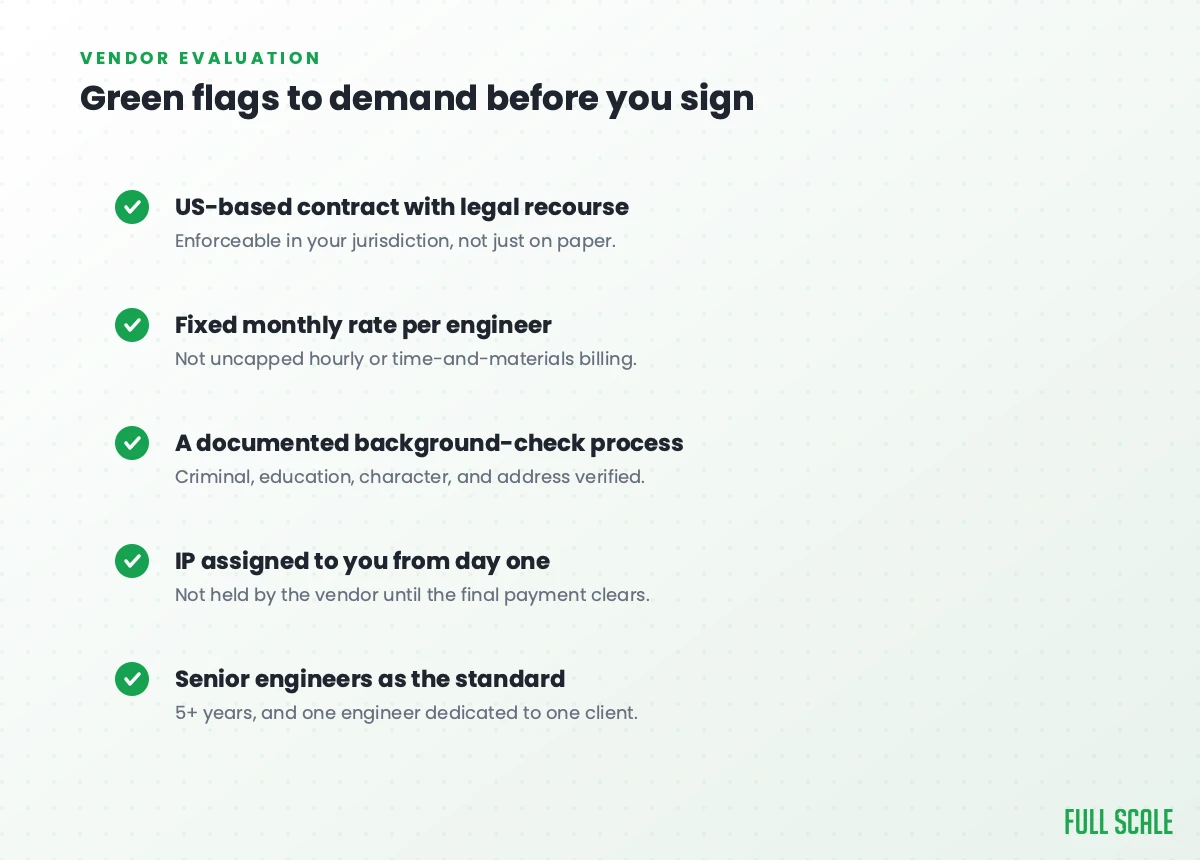
| Red flag (run) | Green flag (good sign) |
|---|---|
| Vendor is not in your country or one with enforceable contracts | US-based (or your jurisdiction) with clear contractual recourse |
| Hourly or time-and-materials billing without a cap | Fixed monthly rate per engineer |
| No documented background-check process | Specific, documented background-check practices (criminal, education, character, address) |
| “Project-based” deliverables with vague scope | Dedicated engineer, defined work, month-to-month flexibility |
| IP belongs to the vendor until final payment | IP assignment to you from day one |
| Engineers split across multiple clients | One engineer, one client |
| Junior engineers offered “to save money” | Senior engineers (5+ years) as the standard |
| No exit clause or 90-day notice required | Month-to-month, exit on reasonable notice |
| Vendor handles security ad hoc | Documented endpoint security, secret management, compliance posture |
The single best question to ask any vendor you’re evaluating is this: “If something goes wrong with one of your engineers, who is on the hook, and in what jurisdiction?”
The wrong answer is a vague reference to the engineer’s employment contract or a deflection about how it’s never happened. The right answer is a specific, structural description of how the vendor sits between you and the engineer, what contractual recourse you have, and which legal system enforces it. If the vendor can’t answer that question crisply, they haven’t thought about it.
If you already signed with a vendor who fails this list, switching software development vendors is its own process, and it goes better slow and deliberate than sudden.
Which means you’ll be the one thinking about it when something goes wrong.
Frequently asked questions
What are the prerequisites for successful offshore software development outsourcing?
Three things need to be true before you start. You need a technical leader on your side who can direct the work and review it, since offshore developers execute well but still need direction. You need a real process already in place, code review, ticketing, documented decisions, because a scattered internal process just gets exported offshore along with the developers. And you need to budget real management attention for the first few months, since a new team, offshore or not, needs more hands-on time than people expect. Skip any of the three and the arrangement fails regardless of how good the developers are.
What checklist should I use before hiring offshore developers?
Confirm the vendor employs developers directly rather than subcontracting, get a documented background-check process in writing, insist on day-one IP assignment in the contract, and check the retention rate, since a company that churns developers resets your codebase knowledge every year. Then check yourself: do you have someone who can technically direct the work, and can you commit real time in the first few months. A cheap rate that fails any of those checks costs more than it saves.
Wrap-Up: The Real Offshore Arbitrage
Offshore software development works. The companies that have built lasting offshore engineering operations (Microsoft and Google in the Philippines, dozens of mid-market SaaS companies through staff augmentation, Full Scale’s own client list) are real, and the arbitrage is real. The cost difference between a senior engineer in Manila and an equivalent senior engineer in San Francisco is large enough to fund another two or three engineers of equal quality, and the talent pool is deep enough that the people you hire are excellent.
What doesn’t work is cheapshoring. A $12-an-hour Upwork freelancer isn’t really a senior offshore engineer, no matter what the profile says. The vendor that can’t walk you through a documented background-check process probably doesn’t have one. An agency that promises a dedicated team and rotates your engineer across four clients was always going to do that.
Hire below the floor of the serious market and you’ll pay twice, once for the engagement that fails and once again for the cleanup.
The right move is high-quality global talent through a US-based vendor with real vetting, real IP protection, dedicated engineers, and contracts that hold up where you live. That’s the arbitrage worth capturing. The rest of the practices in this article (the access tiers, the secret rotation, the compliance frameworks) all sit on top of that structural choice. That’s the whole reason it’s worth taking real care in how you hire senior offshore developers, not just where they’re located.
Get the engagement model wrong and no amount of process will save you.
If you want to go deeper on the leadership side of offshore work, I’ve written a full guide to managing offshore teams and working with offshore developers. It pairs with this article. This one is about how to engage offshore talent. The other is about how to lead the team you end up with.
When you’re ready to build an offshore team that won’t be a horror story, book a discovery call with Full Scale and we’ll walk through what a dedicated, vetted team for your stack would look like.