
Affordable IT Staff Augmentation Services: A Buyer’s Vetting Guide

In this article
I once talked a vendor down a few dollars an hour on a staff augmentation deal and felt genuinely clever about it for about two weeks, right up until I met the engineer they sent. A careful read of the proposal catches some of that before you sign, not after.
I run Full Scale, an IT staff augmentation company built around Filipino engineers, so I’ve had that conversation from both chairs. I’ve been the buyer trying to stretch a budget. I’ve also been the one deciding which client gets our best senior engineer when three clients want the same person. That second seat taught me something most buyer’s guides skip entirely: the rate you negotiate is not just a cost decision. It’s a talent-allocation decision.
Quick Answer: Affordable IT staff augmentation means paying a fair, cost-of-living-adjusted rate for offshore talent, typically $30 to $40 an hour all-in for a senior engineer, saving 50 to 70% versus a comparable US hire. It's not the same as chasing the cheapest bidder: the rate you negotiate is a talent-allocation decision, not just a cost decision, since staffing vendors put their best senior engineers on the clients paying full rate. A vendor who won't say what's included in the rate is the real red flag. Full Scale's fully loaded rate starts at $35 an hour, and the final rate depends on seniority, specialty, and team size.
What “affordable” actually means in IT staff augmentation services
IT staff augmentation, sometimes called software development staff augmentation when the roles are engineering-specific, means hiring developers who join your team directly and report to your managers. A provider handles recruiting, payroll, and retention behind the scenes, while you run the actual work inside your own process. If you want the full model breakdown, what is staff augmentation covers it in depth.
“Affordable” in this context means paying a fair, cost-of-living-adjusted rate for the country you’re hiring in, instead of paying US rates for offshore talent. Chasing whatever the cheapest bidder will accept is a different game entirely.
That distinction sounds small, and it costs people every year. Confusing the two turns a good idea, affordable global talent, into a vendor who ghosts you mid-project or an engineer who’s clearly two levels below what you needed.
How it stacks up against the alternatives
Staff augmentation is the middle option among four ways to add engineering capacity: you keep day-to-day control, and the provider keeps the person employed, paid, and replaceable. It isn’t the right fit for everything, so here is what each option really gives you.
- Project outsourcing hands a scoped deliverable to a vendor and you check back at milestones. You get less control, and the code often belongs to the vendor unless you negotiate otherwise.
- Managed services hand off an entire function, like your whole QA org or DevOps practice, to a provider who owns the outcome and picks who delivers it.
- Freelancers are yours to vet, manage, and replace on your own, with none of the recruiting or retention support a staffing partner provides. (I’ve hired off a freelance marketplace exactly once. Once.)
- Staff augmentation sits in the middle: you keep day-to-day control and ownership, the provider keeps the person employed, paid, and replaced if something goes wrong.
For the full comparison against project work, see staff augmentation vs. outsourcing. For picking a vendor once you’ve settled on the model, how to choose an offshore staff augmentation company walks through it. For the model’s honest tradeoffs, the pros and cons of staff augmentation covers what each column actually costs you.
The math behind the savings
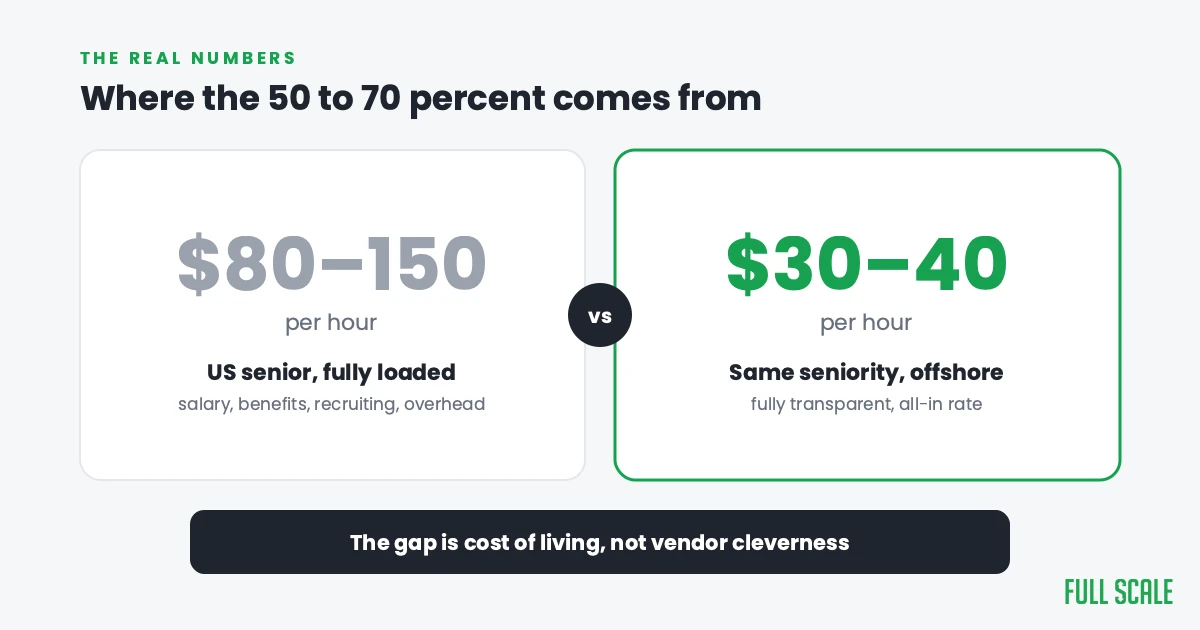
Offshore IT staff augmentation saves 50 to 70 percent versus hiring the same seniority in the US. Here’s the receipt behind it: a senior developer earning $15 to $30 an hour where they live costs a US company $80 to $150 an hour fully loaded, and a fair billed rate for that same engineer lands around $30 to $40 an hour. The whole gap comes from cost of living. If you want the full pricing mechanics behind that number, the four common billing models are broken down in staff augmentation cost.
Where it gets slippery is when a vendor’s marketing rounds that number up to make their pitch look better, or hides what’s actually included in the hourly rate. A rate with no visibility into benefits, taxes, and overhead is a mystery box you’re being asked to sign.
When affordable turns into cheapshoring
Round the savings number up and chase it past a fair rate, and you’ve crossed into a failure mode I have a name for: cheapshoring. It’s what happens when a buyer picks the absolute lowest bid, gets a freelancer or project shop with no real accountability, and gets burned. The failure almost always traces back to treating price as the only variable, and the developer’s skill was rarely the actual issue.
There’s a real, legitimate reason to ask for a lower rate: you need a mid-level engineer for lower-stakes maintenance work rather than a senior one for a greenfield build. That’s right-sizing, and it’s smart. Asking the same vendor to shave the standard rate for the same seniority level is a different thing entirely, and that’s the behavior that turns affordable into cheapshoring. The fix is knowing what a fair rate buys, and why grinding a vendor down past that point works against you.
Why negotiating the rate down doesn’t get you the same engineer for less
Staffing companies allocate their best engineers to whoever pays full rate, and vendors don’t put that in the pitch deck. I will.
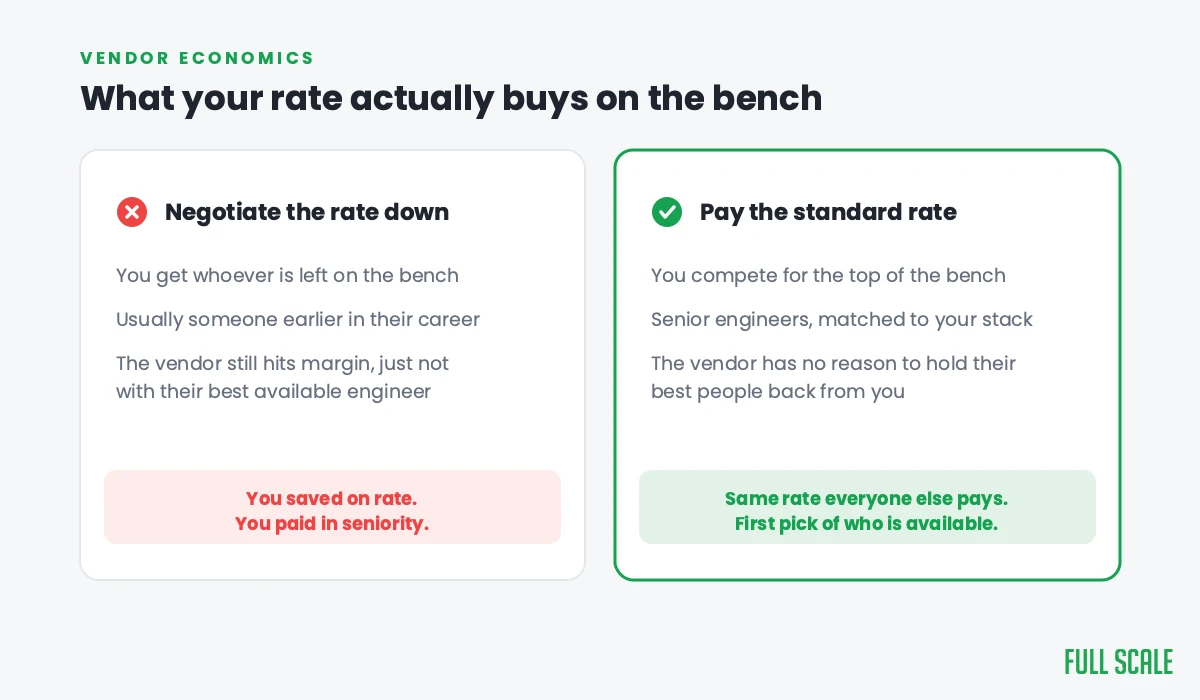
A staffing company has a finite bench of senior talent, and it wants to maximize revenue from that bench. If one client is willing to pay the standard rate and another client is grinding for a discount, the client paying full rate gets first pick of the best available engineer. The client who negotiated hard gets whoever’s left, which usually means someone earlier in their career.
It’s simply how a business allocates a scarce resource, nothing personal about it. Handing your best senior engineer to the client paying a thousand dollars less, when another client will happily pay full rate for that same person, doesn’t make sense for anyone running the business.
Pay the fair rate, and you’re competing for the top of the bench instead of the bottom of it.
There’s a second pattern that shows up almost every time, worth saying plainly: in my experience, the clients who pay the standard rate are almost always the easiest to work with. The ones constantly fighting over the invoice are usually the hardest to keep happy. If you’re negotiating a staff augmentation deal down to the last dollar, you might already be answering the question of what kind of client you’re going to be for the next two years.
Don’t be that client.
What a fair rate buys you
At Full Scale, our fully loaded rate starts at $35 an hour, and the final number reflects seniority, specialty, and team size. That rate pays for four things:
- Retention that protects your project. Our developer retention sits at 93 percent or higher, against a Philippine BPO industry that keeps closer to 70 percent retention. A team that stays is a team that keeps its context.
- A real vetting bar, before you ever meet anyone. We accept fewer than 3 percent of applicants, so the engineer you meet already survived a filter most freelance platforms don’t run.
- Speed without a fire sale. Onboarding a new engineer can take as little as 7 days when the bench has the right fit already available, longer when we’re recruiting fresh for a specialty. Nobody has to gut the rate to hit that timeline.
- Terms that don’t rely on hope. A two-week money-back guarantee if the fit isn’t right, and 30 days’ notice to cancel with no long-term contract locking you in.
None of that shows up as a line item on an invoice. Two years later, it shows up as a developer who’s still around instead of one who left by month four.
You’re paying for a position on the bench. If you’re ready to see what that looks like for your team, Full Scale’s staff augmentation services page has the details. Or schedule a call and we’ll talk through your specific stack, timeline, and budget directly.
Frequently asked questions
Is staff augmentation actually cheaper than hiring in-house?
Usually, yes, in the 50 to 70 percent range versus a comparable US hire, mostly because of cost-of-living differences rather than any pricing trick. The savings evaporate fast if you chase the cheapest possible rate and end up replacing a bad hire twice.
What’s the difference between staff augmentation and managed services?
Staff augmentation adds a person who works inside your process and reports to your team. Managed services hand off an entire function or outcome to a provider who owns the delivery. Pick staff augmentation when you want control over how the work gets done, and managed services when you want to stop thinking about it entirely.
Is a staff augmentation agency the same as a staff augmentation company?
Mostly, yes. Both mean an external partner recruits, employs, and supplies developers who join your team. “Agency” tends to describe a placement-focused business, while a staff augmentation company that sticks around for years of retention and management is the version worth hiring, whichever word is on their homepage. Either way, the real meaning of IT staff augmentation matters more than which label a vendor picked.
What’s a fair rate to expect from an affordable IT staff augmentation agency?
For a senior offshore engineer, a fully transparent, all-in rate typically starts in the $30 to $40 an hour range, depending on specialty and seniority. If a vendor won’t say what’s included in that number, that’s the actual red flag.