
What Is Resource and Staff Augmentation? One Model With Two Names

In this article
- Resource and staff augmentation, defined in one sentence
- Resource augmentation vs staff augmentation: why there are two names
- The problem with calling people “resources”
- How resource and staff augmentation actually works
- The model I accidentally turned into a company
- When resource and staff augmentation is the right call
- What it costs
- How it differs from outsourcing, managed services, and a dedicated team
- Where the model breaks
- Frequently asked questions
- The bottom line
Two software firms will pitch you the same exact service and give it two different names. One calls it staff augmentation. The other calls it resource augmentation. A third puts both words in the title and sells you “resource and staff augmentation,” like sticking the terms together builds something new.
It doesn’t.
I run Full Scale, a company that places Filipino software engineers onto other companies’ teams. That is staff augmentation. Some of our competitors call the identical service resource augmentation. The label changes, but the model underneath stays the same. In plainer terms, Full Scale runs software development staff augmentation services for U.S. engineering teams.
Resource and staff augmentation is one staffing model with two names: you add skilled outside people to your team for as long as you need them, and you manage them like your own. I know because I accidentally built a company around it.
That same people-first logic is what decides how an employer of record compares to a staffing agency: one just runs payroll, the other keeps the team together.
Resource and staff augmentation, defined in one sentence
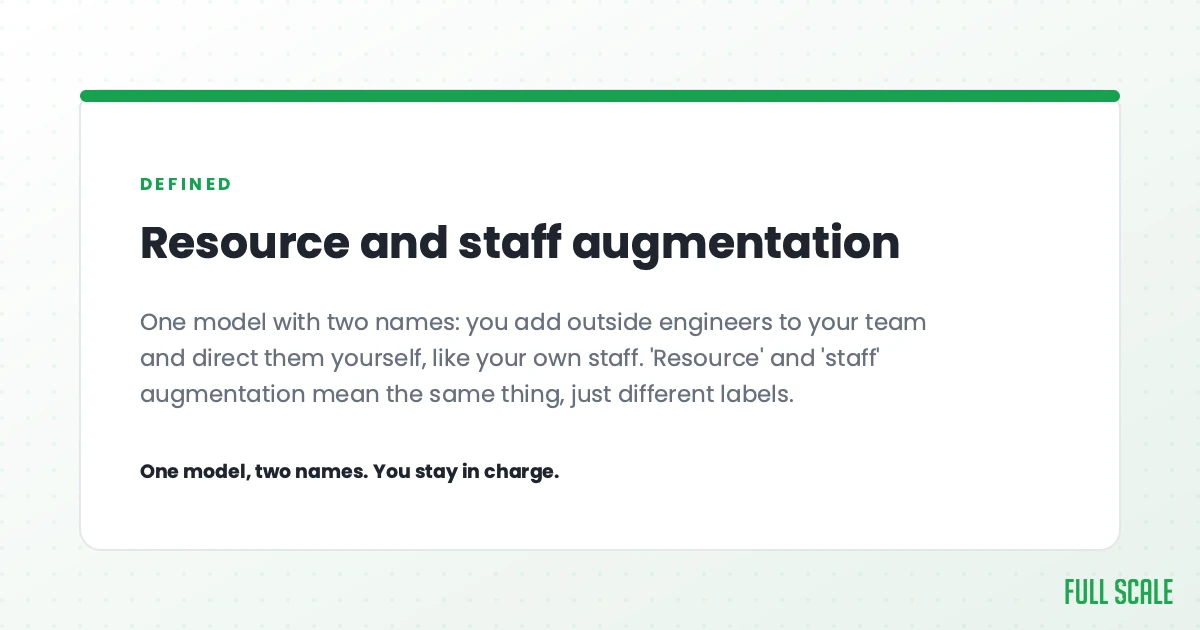
Quick answer: Resource and staff augmentation is a staffing model where you bring skilled outside professionals onto your existing team for as long as you need them. You direct their day-to-day work and they report to you, and you pay an hourly or monthly rate instead of a full-time salary. “Resource augmentation” and “staff augmentation” describe the same arrangement.
The core idea is control.
You stay in charge of the work, the priorities, and the people. A staffing partner finds and employs the engineer, handles payroll and benefits, and bills you for their time. You treat that engineer like a member of your team, because for the length of the engagement, they are.
That single fact separates this model from everything else. With staff augmentation, you own the project. With most other arrangements, someone else does. The neutral definition on Wikipedia says the same thing in drier words: outside personnel work under your direction, which is what makes it different from handing a vendor a finished spec.
Resource augmentation vs staff augmentation: why there are two names
Here is the honest version of the difference, and it’s smaller than the vendors selling it want you to think.
“Staff” puts the focus on the person. You’re adding a developer, a designer, a QA engineer to your headcount for a while. “Resource” puts the focus on the skill or the capacity. You need React expertise for six months, so you bring in a React resource. IT and consulting firms tend to say “resource” because that’s the word in their project plans. Staffing firms tend to say “staff” because they think in people.
In practice, both words point at the same arrangement: a skilled person joins your team, under your management, without a full-time hire. Some firms will tell you resource augmentation is broader because a “resource” can be a tool or a license, not just a person. Maybe in a procurement spreadsheet. When a real company searches for resource and staff augmentation, they want engineers who can write code. Nobody is shopping for software licenses. Outstaffing is yet another name for the same setup, and why outstaffing works when you run it right is no different from what makes any of these arrangements work.
So I’ll use the terms interchangeably for the rest of this post, the same way Google does. The search results for this phrase are full of staffing companies explaining staff augmentation under a “resource and staff augmentation” headline. We’re all describing the same thing.
The problem with calling people “resources”
Here’s my honest issue with the word “resource.”
Inside staffing and IT, people get called resources all the time. I’ll admit it slips into how we talk internally at Full Scale too. Someone will say we need to add a resource to an account, or that a resource rolled off a project. It’s industry shorthand and it’s everywhere.
The trouble is that the word hides the actual point. A resource sounds like a server you spin up or a line item you can swap out. What we’re really doing is building a team.
When we place engineers with a client, the goal isn’t to rent out a resource. It’s to build one team from two groups of people: the client’s own employees and ours, working the same backlog, in the same standups, toward the same product. The strongest engagements stop sounding like “their employees and our resources” within a few weeks. By then it’s just the team. That’s the whole idea behind treating an offshore group as a real extension of your in-house team. I broke down what actually happens after you say yes to a partner, step by step.
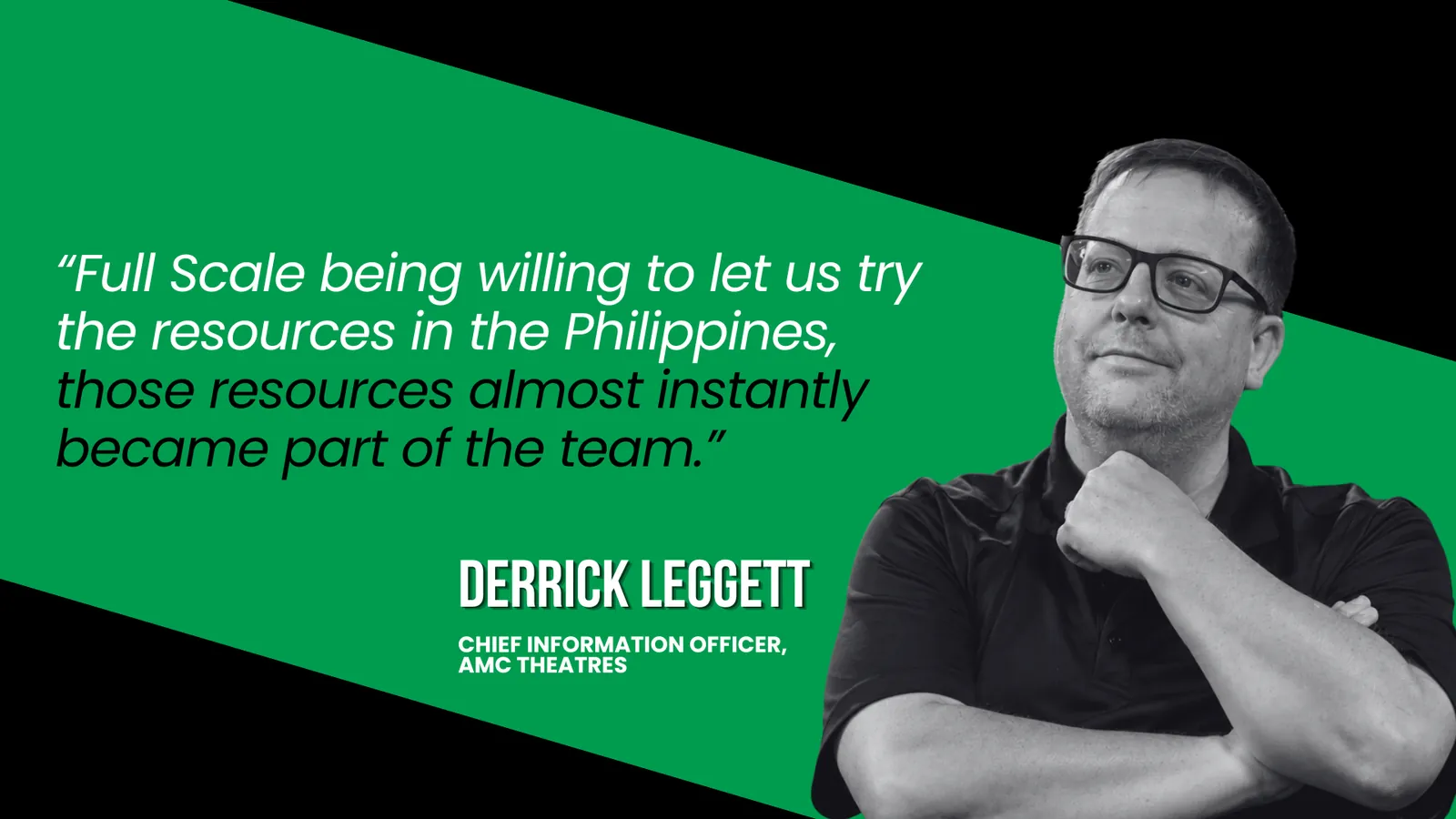
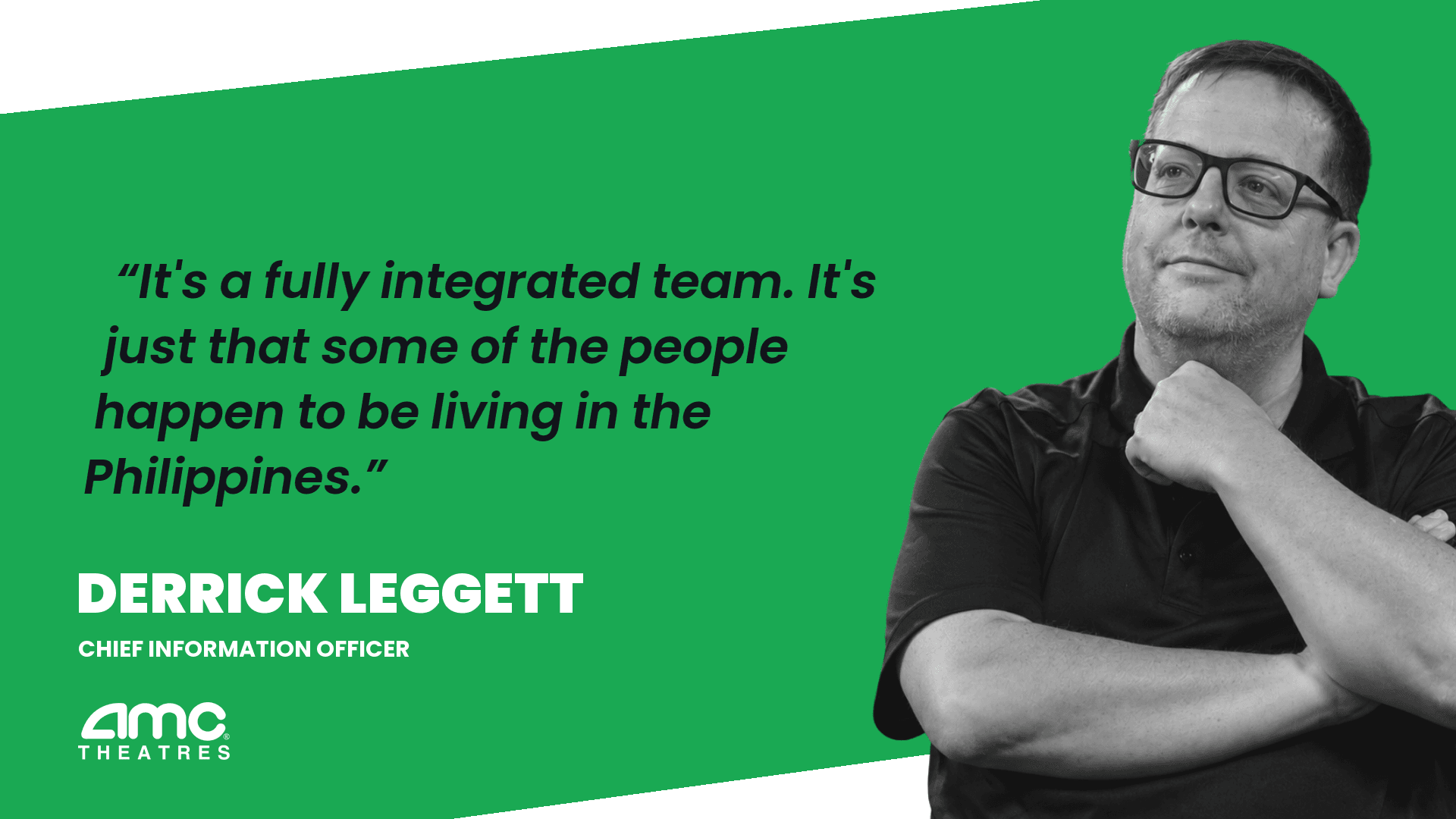
The client who proves this best is AMC Theatres. Their CIO, Derrick Leggett, runs a global engineering org with people in the US, South America, India, and the Philippines. He flatly refuses to treat the Philippines engineers as a walled-off vendor: “It’s a fully integrated team. It’s just some of the people happen to be living in the Philippines.” Those engineers join AMC’s standups, work on AMC’s tools, and ship against AMC’s roadmap, same as anyone on the Kansas City team.
“It’s a fully integrated team. It’s just some of the people happen to be living in the Philippines.”
Derrick Leggett, CIO, AMC Theatres
That’s the whole thesis in one sentence, from a CIO running the largest movie-theatre ticketing platform in the world. The word “resource” never enters into it.
So when you read “resource augmentation,” picture people rather than units of capacity. The clients who get the most out of resource and staff augmentation are the ones who stop thinking of anyone as a resource at all. Hire talent to work directly for you on a long-term basis, treat them like your own, and the line between resource and teammate disappears.
How resource and staff augmentation actually works
The mechanics are simple, which is part of the appeal. A typical engagement looks like this:
- You name the gap. A senior backend engineer, two React developers, a QA lead for a release crunch. You define the skills and the seniority.
- The partner sources and vets. They find candidates from their bench or their hiring pipeline, screen them, and send you a short list. You interview and pick. At Full Scale we usually have vetted developers ready inside two to three weeks.
- The person joins your team. They sit in the same standups, the same Slack channels, and the same code reviews, held to the same definition of done. They take direction from you, not from a project manager sitting between you and them.
- You pay for their time. An hourly or monthly rate covers their salary, benefits, equipment, and HR. You don’t pay recruiting fees or severance, and there’s no long-term commitment beyond the engagement.
The model is sometimes called team augmentation when you’re adding several people at once, or offshore staff augmentation when those people sit in another country. Those are the same arrangement with a different word in front of it. If you want the full breakdown of the base model, we wrote a separate piece on what staff augmentation is and how to scale with it.
The model I accidentally turned into a company
I didn’t set out to build a staff augmentation business. I backed into one.
Back at Stackify, the developer tools company I founded, US engineering hiring was brutal and expensive. I’d already worked with developers in Russia, Uruguay, Colombia, and a few other places over the years, so I knew good engineers existed far outside Kansas City. In 2018 I set up a small team in the Philippines to work directly on Stackify’s product. They weren’t a vendor I emailed requirements to. They were my own people, joining my standups and reporting to me. That is a different arrangement than a freelancer for a one-off task, which is why it pays to pick the Toptal alternative that matches your need.
It worked better than anything offshore I’d tried before. That team grew past 20 developers and became part of the company when I sold Stackify in 2021.
Then other founders started asking if they could get access to the same thing. So we built Full Scale to give it to them. That’s the whole origin story, and I tell the longer version in how I accidentally built Full Scale. Today we’ve placed more than 700 developers with over 200 companies, kept developer retention above 93 percent, and landed on the Inc. 5000 five years running.
The reason it worked is the same reason staff augmentation works at all: we hired people to join teams for the long haul, not to crank out a three-month project and disappear. Hire talent to work directly for you on a long-term basis, and offshore stops being a gamble.
When resource and staff augmentation is the right call
This model is not always the answer. It fits a specific set of situations well, and a few it fits badly.
It’s a strong fit when:
- You have a skill gap. Your team is solid but nobody knows Kubernetes, or mobile, or the one framework this project needs. Bringing in that skill for the project beats hiring a full-time specialist you won’t need next year.
- You need more hands, fast. The work is clear and your people are good, you just need three more of them to hit a deadline without overstaffing once it ships.
- You’re bridging to a hire. A key engineer left, recruiting is slow, and you need someone keeping the lights on while you fill the seat.
- You’re scaling and US hiring is too slow or too costly. This is where offshore comes in. Most software developers don’t live in the United States anyway, per the Stack Overflow Developer Survey, and US tech turnover keeps churning teams at double-digit rates according to BLS data.
It’s a weak fit when the work is a fully self-contained project you’d rather hand off and forget. That’s outsourcing, and it’s a different tool. There’s a real list of benefits of staff augmentation worth reading if you’re weighing it against the alternatives.

What it costs
Cost is usually the reason companies start looking at this model, especially offshore.
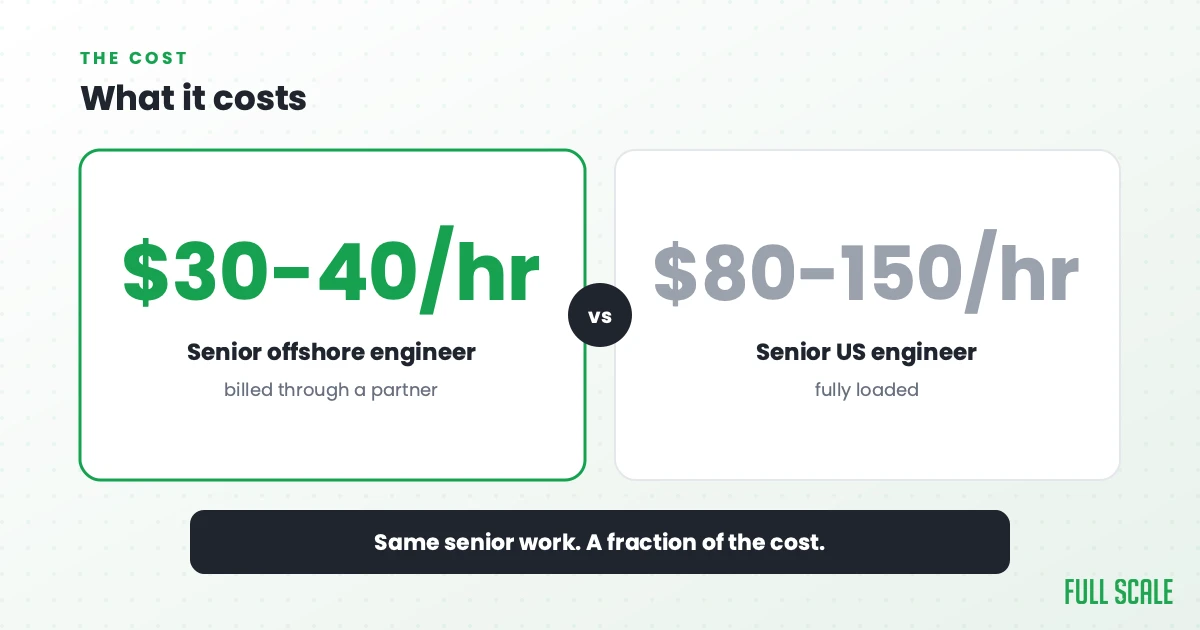
A senior software engineer in the US runs roughly $80 to $150 an hour once you load in salary, benefits, and overhead. Offshore changes that math. Filipino developers earn about $15 to $30 an hour depending on experience, and a firm like ours bills clients in the $30 to $40 range for a senior engineer’s time. That’s a 50 to 70 percent cut against US rates.
The savings come from cost of living, not from cutting corners on talent. A salary that’s modest in San Francisco is a strong professional wage in Cebu or Manila. The Philippines is also the third-largest English-speaking country in the world, which is why communication holds up. I break the pricing model down further in our guide to what staff augmentation costs.
How it differs from outsourcing, managed services, and a dedicated team
The fastest way to understand resource and staff augmentation is to put it next to the offshore software development models people confuse it with.
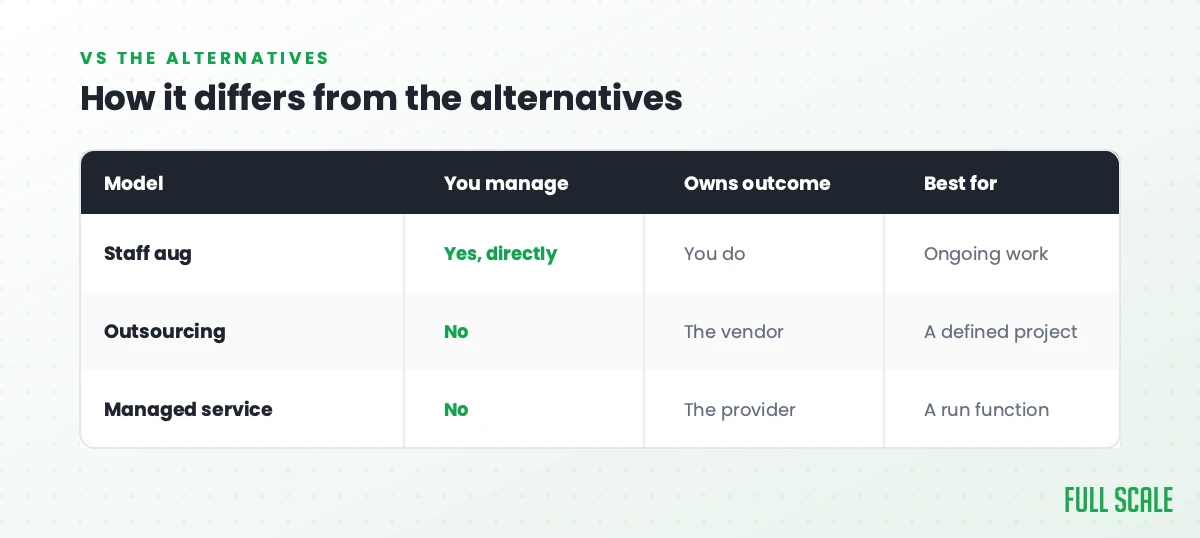
| Model | Who manages the work | Best for |
|---|---|---|
| Resource / staff augmentation | You do | Adding skills or capacity to a team you run |
| Outsourcing | The vendor does | Handing off a defined project end to end |
| Managed services | The vendor does, against an outcome | Ongoing functions like support or infrastructure |
| Dedicated team | You do, with a stable long-term group | Building a lasting extension of your engineering org |
The line that matters runs down the “who manages” column. With augmentation you keep the wheel. With staff augmentation versus outsourcing, the difference is ownership: augmentation gives you people, outsourcing gives you a deliverable. The gap between staff augmentation and managed services is similar, except managed services are paid against a result rather than hours. And when an augmented team stays together long enough to feel permanent, it becomes a dedicated development team, which is the model I think most companies should actually want.
Where the model breaks
I’d rather you go in clear-eyed, so here’s where resource and staff augmentation goes wrong.
The biggest failure mode isn’t the developers. It’s treating them like disposable headcount on someone else’s spreadsheet. Knowing the real pros and cons of staff augmentation up front is how you avoid that trap. People who get handed a ticket queue and no context, with a project manager wedged between them and the actual team, never become real contributors. At a lot of offshore firms you only ever talk to one technical lead, and every other developer hides behind that person. You end up with a team you can’t communicate with and a middleman in the way of every decision.
There’s also real ramp-up time. An augmented engineer needs to learn your codebase and your product, same as a new hire would, so the “instant capacity” pitch oversells it. And critics will point out that hiring an offshore developer for a few dollars an hour sounds like exploitation. My own brother-in-law works at a Jollibee in the Philippines for about $1.25 an hour, and my sister-in-law makes $5 an hour as a virtual assistant. A real engineering salary changes a family’s life there. What looks low from the US is life-changing locally.
The fix for the headcount problem is structural rather than motivational. Hire for the long term, give people the full context, and cut out the middleman so your developers care about the product the way your in-house engineers do. That’s the difference between augmentation that works and augmentation that quietly fails.
Frequently asked questions
What is resource augmentation?
Resource augmentation means adding skilled outside people to your team for as long as you need them while you direct their work. IT and consulting firms say “resource” because that is the word in their project plans, where a person counts as capacity. It is the same model as staff augmentation, so the resource augmentation model and the staff augmentation model work the same way.
Is resource augmentation the same as staff augmentation?
Yes, for almost every practical purpose. Both describe adding skilled outside people to your team under your own management. “Resource” emphasizes the skill or capacity and “staff” emphasizes the person, but firms use the terms interchangeably and so does Google.
What is an example of resource and staff augmentation?
A SaaS company with a deadline hires three React developers through a staffing partner for four months. The developers join the company’s standups, take direction from its engineering manager, and ship features alongside the in-house team. When the project ends, the engagement ends, with no layoff.
How is staff augmentation different from outsourcing?
With staff augmentation you manage the people and own the project, while the partner just employs them. With outsourcing you hand a defined project to a vendor who manages it and delivers a finished result. Augmentation gives you people, outsourcing gives you a deliverable.
How much does resource and staff augmentation cost?
It’s billed as an hourly or monthly rate that includes salary, benefits, and overhead. Offshore engagements often run 50 to 70 percent below US rates because of cost-of-living differences rather than lower skill. A senior offshore engineer commonly bills in the $30 to $40 an hour range versus $80 to $150 for a comparable US hire.
Is resource and staff augmentation only for IT?
No. It’s most common in software and IT, but the same model is used in engineering, design, marketing, and other knowledge work. Anywhere you need a specific skill for a defined stretch without a permanent hire, augmentation fits.
The bottom line
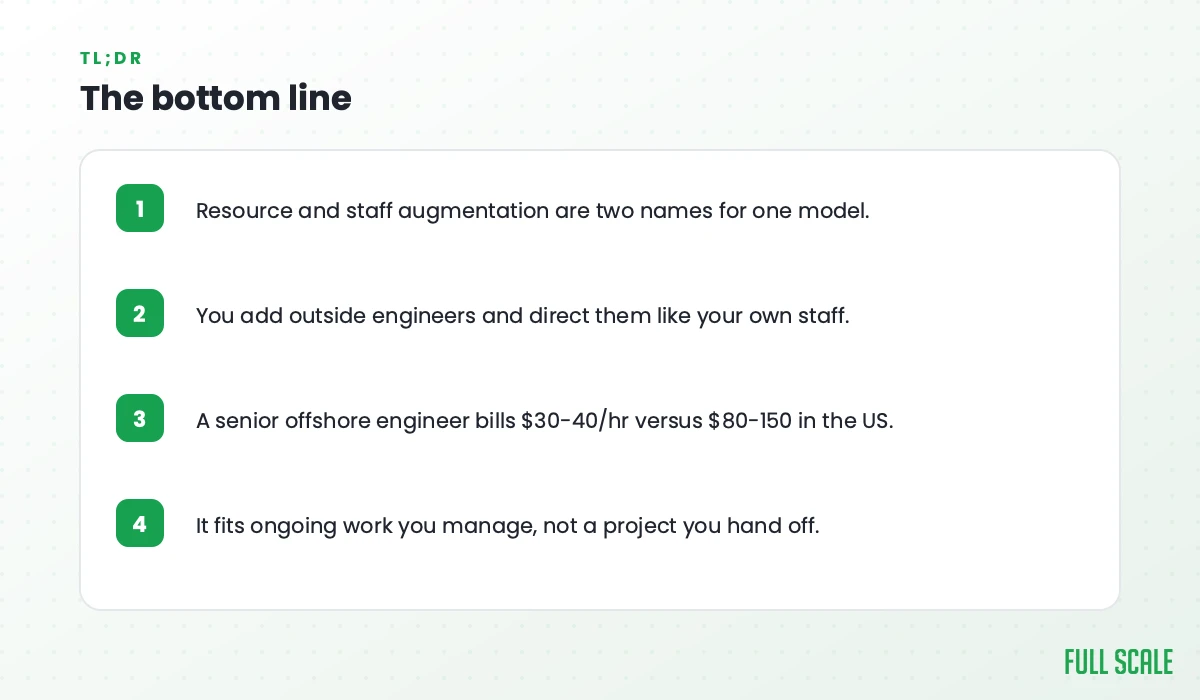
Don’t get hung up on whether a vendor says “resource” or “staff.” They’re selling you the same model: skilled people who join your team, work under your direction, and leave when the work is done. The words are marketing. The model is what matters, and the version that works is the one where you treat those people like your own and keep them for the long haul.
If you’re weighing it for your own team, talk to us about what you’re trying to build and we’ll tell you straight whether augmentation is the right fit.