
How to Build an Offshore Team That Actually Works

In this article
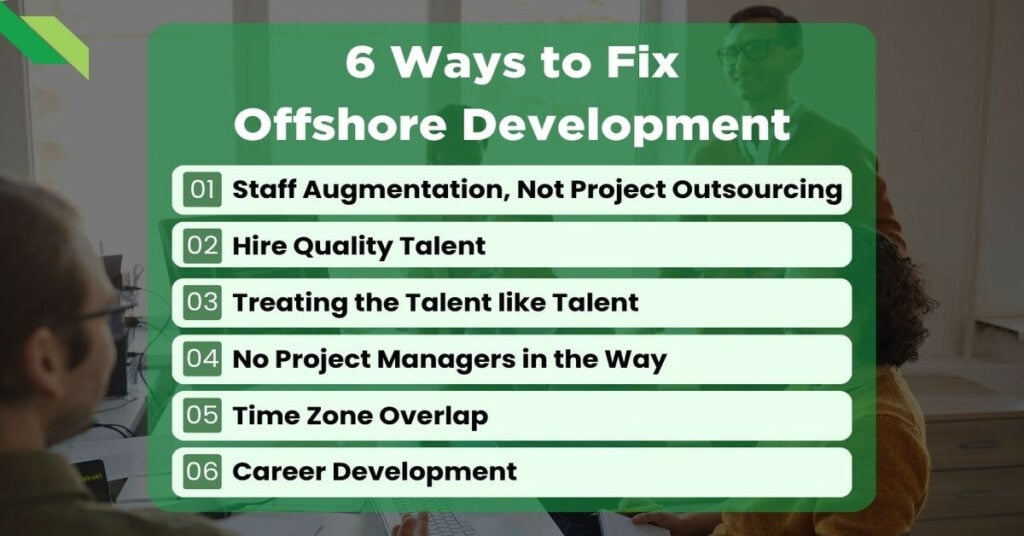
- 1. Use Offshore Staff Augmentation, Not Project Outsourcing
- 2. Hire Quality Talent
- 3. Treat the Talent Like Talent
- 4. Keep Project Managers Out of the Way
- 5. Build in Real Time Zone Overlap
- 6. Invest in Career Development
- Where Offshore Staff Augmentation Is Not the Easy Answer
- Frequently Asked Questions
- Ready to build an offshore team that works?
Have you worked in software for a long time? If so, you have probably worked with an offshore development team, and you may have struggled to make it work. Most people have horror stories about going offshore to India or other countries. I avoided it for the first 15 years of my career because of those stories. What changed my mind was learning how to build an offshore team the right way, using a handful of practices that actually hold up. If your stack is .NET, the same principles apply to offshore .NET development: direct developer access, real communication channels, and a staffing model rather than a project shop. Doing it the right way is the inverse of the offshore mistakes that derail most teams.
My first offshore project happened by accident, when I hired developers in Russia at Stackify. Since then I have worked with developers across many countries in Eastern Europe, Latin America, and Southeast Asia. The reality is that about 81% of software developers do not live in the United States, according to the Stack Overflow Developer Survey. If you want the best engineers in the world, most of them are offshore.
I have been doing offshore work for more than 10 years, and I have talked to hundreds of founders and engineering leaders. I have heard every offshore success and failure story there is. Here are the top reasons offshore development fails:
- Hiring unqualified developers
- English fluency and communication gaps
- Slow, low-quality output
- Late-night meetings caused by schedule differences
- A weak team structure
- Developers who feel like contractors, not teammates
When offshore didn’t work for someone, this is the line I hear most:
“It was easier to just do the work myself.”
That is what failure sounds like. But it doesn’t have to go that way. The practices below are what we figured out at Full Scale when we set out to build an offshore team that actually works. They are the same ones I would give any CTO starting out today.
If there is one thread running through all six, it is this: you treat the offshore team like a real product team that owns the work, not a pile of cheap hands renting out hours. That is the same idea I wrote a whole book about, Product Driven. Engineers who understand the product and own the outcome run circles around the ones who sit and wait for the next ticket, and it does not matter one bit which country they happen to sit in. That setup is exactly what I describe in what makes an outsourced development team work long-term.
In 2018 I started outsourcing developers in the Philippines to build my own team and do offshore the right way. That experiment became Full Scale. Today we serve over 200 tech companies with a team of 350+ engineers and operations staff in the Philippines. Here are the six practices that made the difference.
1. Use Offshore Staff Augmentation, Not Project Outsourcing
Traditional offshore work was project outsourcing. You wrote a pile of requirements, handed them to another company, and hoped the code came back working. That model can work for huge multi-year builds, but it falls apart in a fast-moving startup where requirements change every week. That model is still common with .NET work; our guide to outsource .NET development covers when it fits and when it backfires.
The better model is staff augmentation offshore, where the developers work directly inside your team instead of behind a vendor’s wall. You keep control of the whole process, you can change direction on the fly, and you get a real global team instead of a black box. Most offshore collaboration fails because people simply hand a bunch of requirements to an outsourcing firm and expect a finished product back. If you want a deeper breakdown, we wrote a full piece on staff augmentation versus outsourcing.
So what is the single biggest key to offshore success? Understanding that staff augmentation is the model that actually works in fast-paced tech companies. That model question is exactly what separates successful Python development outsourcing from the stories that end in frustration: staff augmentation keeps the engineers on your team, project contracts do not. Angular makes that lesson concrete: offshore Angular development works well because the framework’s strict conventions reduce the ambiguity that breaks distributed teams. The shared language of Angular travels across time zones.
2. Hire Quality Talent
When you do staff augmentation, the talent works directly for you, so the quality of that talent is everything. After hiring hundreds of offshore developers in the Philippines for our clients, we know what good looks like, and we know the difference between success and failure. It comes down to hiring the right people and training them. That quality emphasis is why an offshore Python team built on the staff augmentation model performs differently than one bought as a project deliverable: the engineers who own your codebase are the ones who improve it.
Project outsourcing never demanded the same quality bar. If you pay $5,000 on Upwork for a project, you don’t really care who does it or how long it takes. Plenty of offshore partners still hire weak developers and then hope to find a client who will take them as contractors. We don’t put a developer on a client’s team if we wouldn’t trust them to do great work. Success starts with the right people.
3. Treat the Talent Like Talent
To hire the best talent, you have to treat people like talent. In a lot of offshore markets, developers are still treated like call center staff, crammed into tiny cubicles on cheap computers, with no real tools or training. That principle applies across every stack we staff, including Laravel: the engineers who make offshore Laravel development work are the ones treated as full team members, not contractors delivering output to a spec.
The best developers in the US want good equipment, real training and mentoring, interesting projects, and a clear path to grow. Why would an offshore developer want anything less? At Full Scale we give our engineers in the Philippines those same things, because that is how you keep good people.
4. Keep Project Managers Out of the Way
Software development is about clear communication more than anything else. Being able to tell the team why you are building something, what to do, and what not to do is what makes a project succeed. Any communication problem turns into delays or failures fast.
Putting extra people in the middle of that communication is a problem too. A friend of mine runs an offshore development company in Mexico where the developers don’t speak English, so he hires technical project managers to translate and plan. You can see why that is hard to win with. Every other developer ends up hiding behind that one person, and you have a middleman in the way of every decision.
Teams work better when everyone works together as one team. Product owners and project managers should help guide the team, not act as the interpreter or gatekeeper for the developers.
5. Build in Real Time Zone Overlap
Nobody wants to work all day and then take an 8 p.m. call with a team in India. In many countries it is genuinely hard to get developers to shift their hours to match a US schedule. So your offshore partner should shift to your schedule, not the other way around.
This is one reason the Philippines works so well. It is the third-largest English-speaking country in the world, per the Philippine Embassy. Night-shift work is normal there because of the country’s large BPO industry. From experience, you want at least two hours of daily overlap with your developers so you can check in, run meetings, and unblock them. Most of our developers work a mid-shift in the Philippines, from 3 p.m. to midnight, which gives our clients three to five hours of overlap a day. When you are managing an offshore development team, that overlap is where the real work of staying aligned happens.
6. Invest in Career Development
Success or failure often comes down to the partner you choose. Clients tell us the same thing over and over. They want us to treat our Full Scale engineers as well as they treat their own US employees. Our people are mission-critical to their companies, so we also help when performance issues come up.
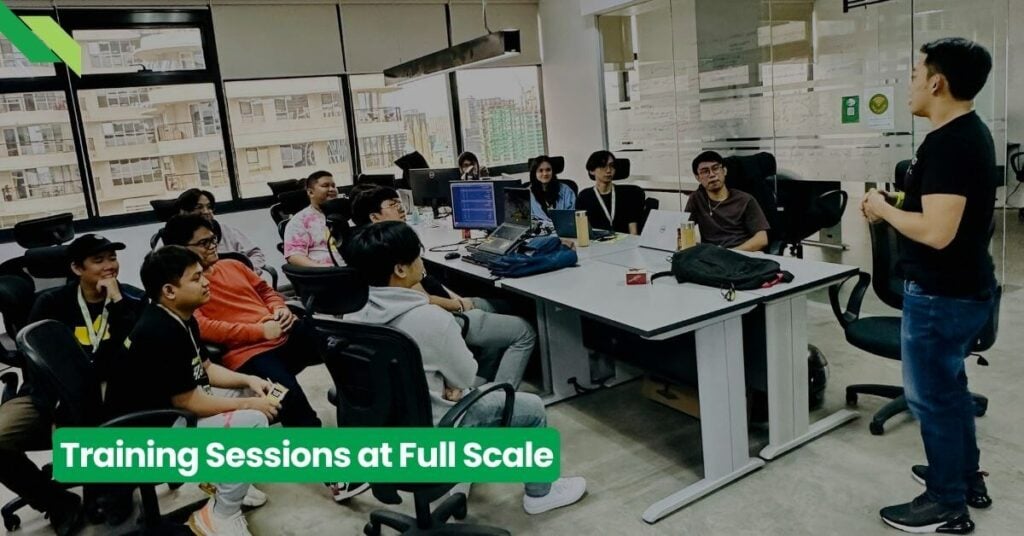
A lot of that work happens behind the scenes. It starts with the basics: following local labor laws, paying competitive wages, and offering real benefits. Since we mostly do staff augmentation, our product is our people. That makes their career development one of our biggest jobs. We provide development managers who run ongoing training, mentoring, and growth plans. Plenty of US companies struggle to do that on their own. With 350+ employees, we have the size to do it well.
Where Offshore Staff Augmentation Is Not the Easy Answer
I am not going to pretend the model is free of tradeoffs. Staff augmentation works best when you have technical leadership in-house. The developers integrate into your team, they don’t run the project for you. If no one is there to own architecture and priorities, a fully managed project may fit better for now. You still have to do the hiring, onboarding, and the day-to-day work of managing offshore development teams.
One question I get early is about IP and security, and it is a fair one. The difference with staff augmentation is that the developers work inside your systems, your repositories, and your access controls, the same way a local hire would. You own the code, you set the permissions, and you can revoke them in a day. That is a different risk than handing your requirements to an outsourcing firm and hoping their security is as tight as yours. The contract still has to do its job, so put IP assignment, NDAs, and data handling in writing before anyone touches the codebase. If you want the full version, we wrote a framework for protecting IP with offshore developers.
Time zone overlap is not always something you can force, either. If your work needs constant real-time pairing, or an engineer on call around the clock, a few hours of daily overlap will not cover it. The same is true if your own team cannot meet during those hours. In that case you have two honest choices: build enough async habits that the overlap you do get is enough, or hire for that role closer to your own time zone. I would rather say that to a client up front than watch a good engineer sit idle for half a day waiting on an answer.
There is also the harder question people raise about offshore wages. Some will tell you that paying a developer in the Philippines less than a US salary is exploitation. I see it the other way. We pay competitive local wages with real benefits and a real career path, and those are some of the best jobs in their market. We call it a win-win-win: a win for our employees, a win for our clients, and that makes it a win for us. For that to hold, we have to be one of the best places to work in the Philippines, not just the cheapest.
The key to offshore development success is the same as it has always been. Pick the right partner, then treat the work as a long-term team instead of a short-term project. We help our clients with both software development and QA testing, and the goal is always a team they can keep.
Frequently Asked Questions
What does it take to build an offshore team that works?
Start by using staff augmentation instead of project outsourcing, then hire and train quality developers and treat them like real team members. From there, keep project managers from blocking communication, build in daily time zone overlap, and invest in career development. Those six are what separate offshore teams that work from the ones that fail. That model is how offshore Ruby on Rails development works at its best: Rails engineers embedded in your team, following the same conventions your in-house developers use, owning the codebase over time.
Why does offshore development usually fail?
It fails when companies hire weak developers, hit English and communication gaps, put a middleman between the client and the team, or treat developers like short-term contractors. Almost every failure traces back to communication and the wrong engagement model, not to offshore talent itself. For Rails specifically, those failure modes are compounded by convention violations: outsourced Ruby on Rails development that ignores the Rails Way is harder to inherit than bad code in a less opinionated framework. For Laravel specifically those failure modes compound: outsourcing Laravel development to the wrong vendor adds convention violations to the communication problems, producing PHP spaghetti in a Laravel file structure that is harder to fix than starting from scratch. For Angular, those failure modes compound: outsourced Angular development from the wrong vendor adds DI misuse and RxJS subscription leaks to the communication problems, creating technical debt that the framework’s strictness makes impossible to hide.
How much time zone overlap do you need with an offshore team?
At least two hours of overlap a day is enough to run meetings, check in, and unblock developers. Our Philippine teams usually work a mid-shift that gives clients three to five hours of daily overlap.
Is offshore staff augmentation better than outsourcing?
For most fast-moving tech companies, yes. Staff augmentation keeps the developers inside your team and your control, so you can change direction quickly. Full project outsourcing only tends to work for large, well-defined builds with stable requirements.
Ready to build an offshore team that works?
Book a free consultation and we will help you build your offshore team with vetted engineers from the Philippines.