Our model
Full Scale is the best place to hire software developers. Here is why.
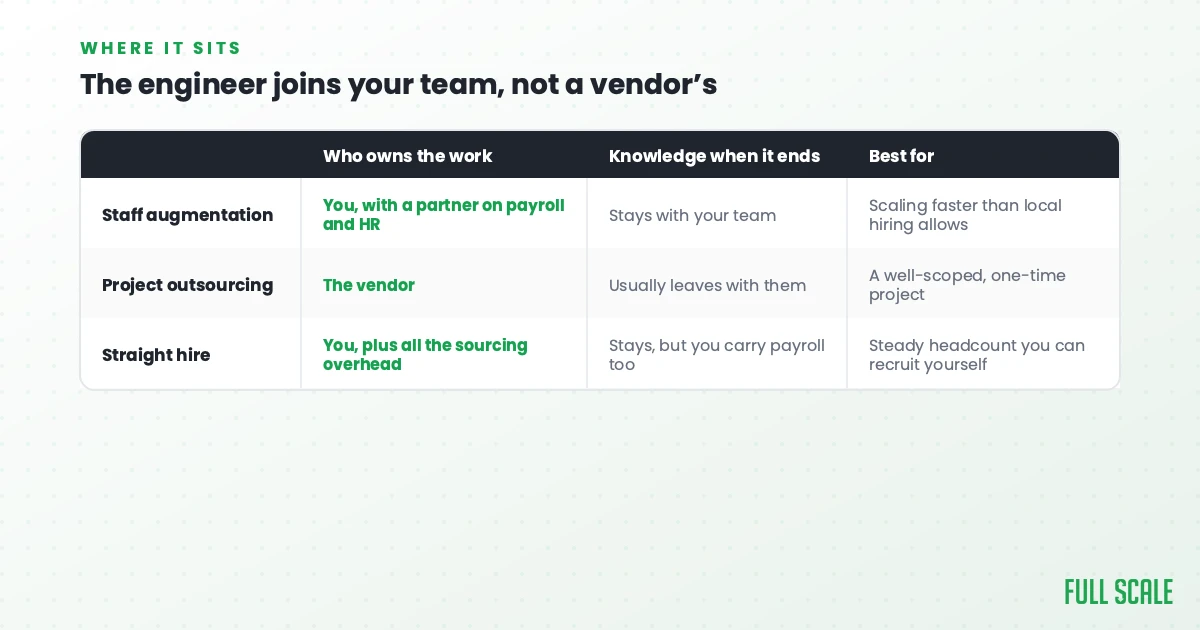
The industry calls it staff augmentation, which is an ugly name for a simple thing. You hire dedicated engineers in the Philippines who work only on your product, full time. You manage them day to day the way you manage the rest of your team. We employ them, pay them, train them, and handle everything else, especially employee retention.
Other vendors never really explain how the model works. This is your full guide to the entire staff augmentation model: why we are the best at recruiting, interviewing and retaining top talent. Including the mistakes we have made and lessons learned over the years. Here is the full transparency into how our model works.

Recognized by


Why the Philippines
The country case: what it costs, why it works, and when it is the wrong call.
Go thereWhy Full Scale
The objections, the comparison, and the model behind six-plus year relationships.
Go thereCase studies
AMC Theatres, SOTA Cloud and others, with the outcomes attached.
Go thereWhat it costs
Rates start at $35 an hour fully loaded, with the math on the page.
Go thereWorking with us
How our clients work with us
Before any of our internal process matters to you, four things do: what this model is, where it does not fit, who you would be working with, and what you are signing. So the model is explained by somebody who has placed 700 engineers into it, the drawbacks are named rather than buried, you pick your own people from real profiles rather than a bench count, and the contract is plain language with a capped rate increase and your IP yours from the moment it is created.

Written after 700+ placements
What staff augmentation actually means
The model explained by somebody who runs it: what you are buying, who manages the work, and how it differs from outsourcing a project.
Read it
Including the cons, from the people selling it
The honest pros and cons
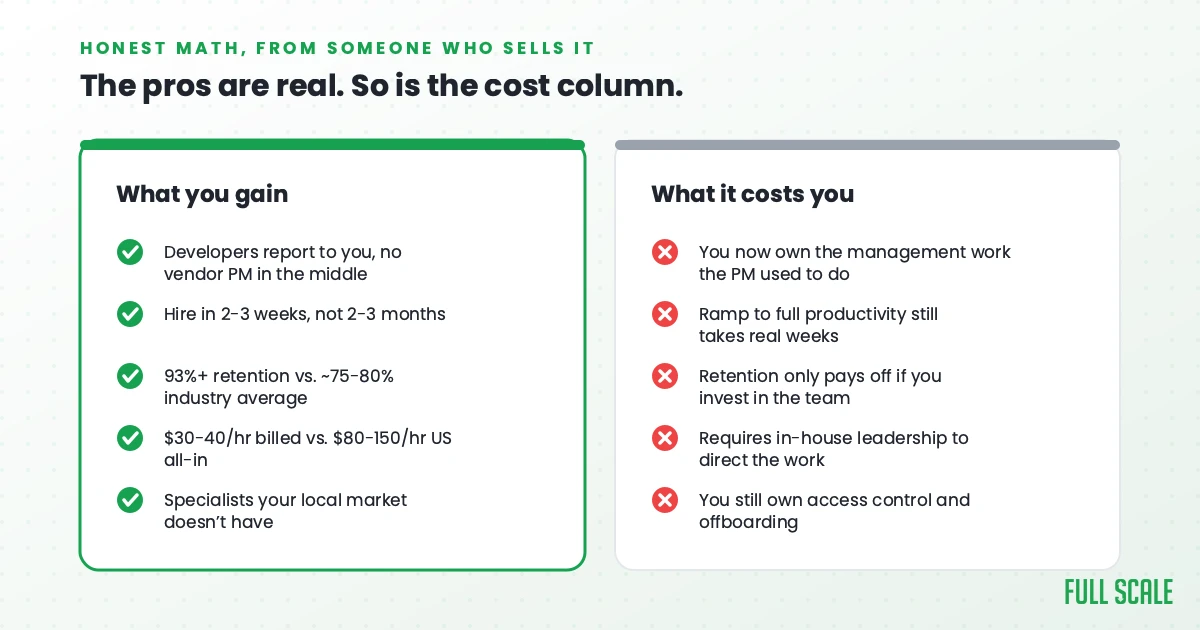
The advantages that hold up under pressure, the drawbacks nobody selling this model names, and when it is simply the wrong call.
Read it
Real profiles, with video
How our clients pick their team members
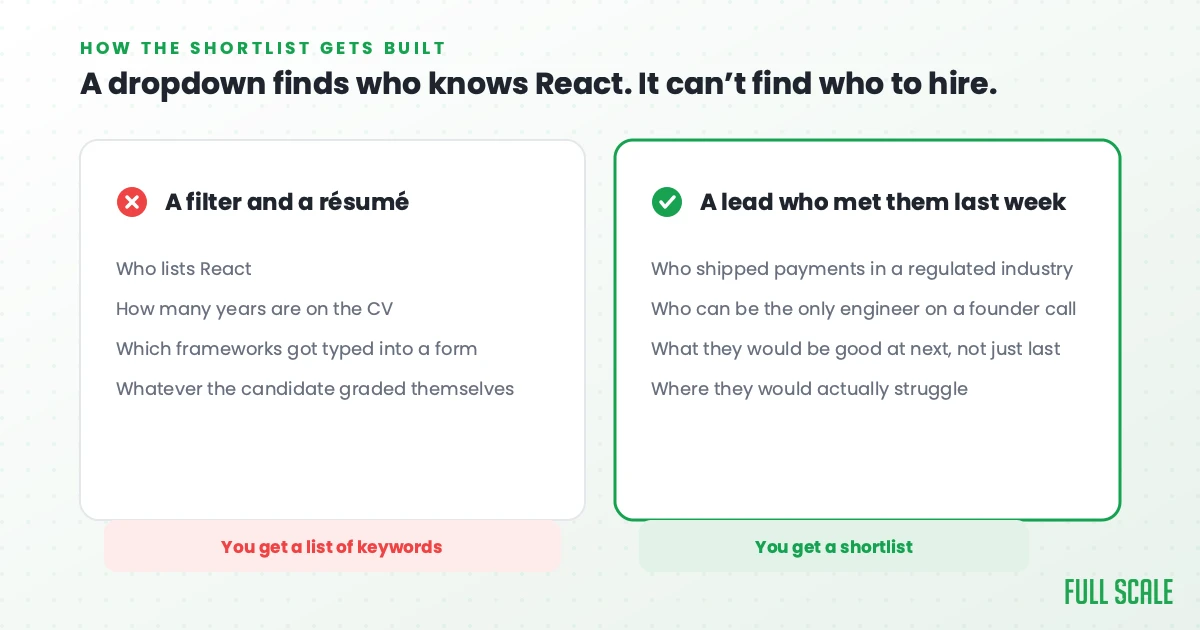
We write a profile for every engineer, shortlist against what you need, and then you interview them yourself.
Read it
6% annual cap, IP yours from creation
The contract terms that actually matter
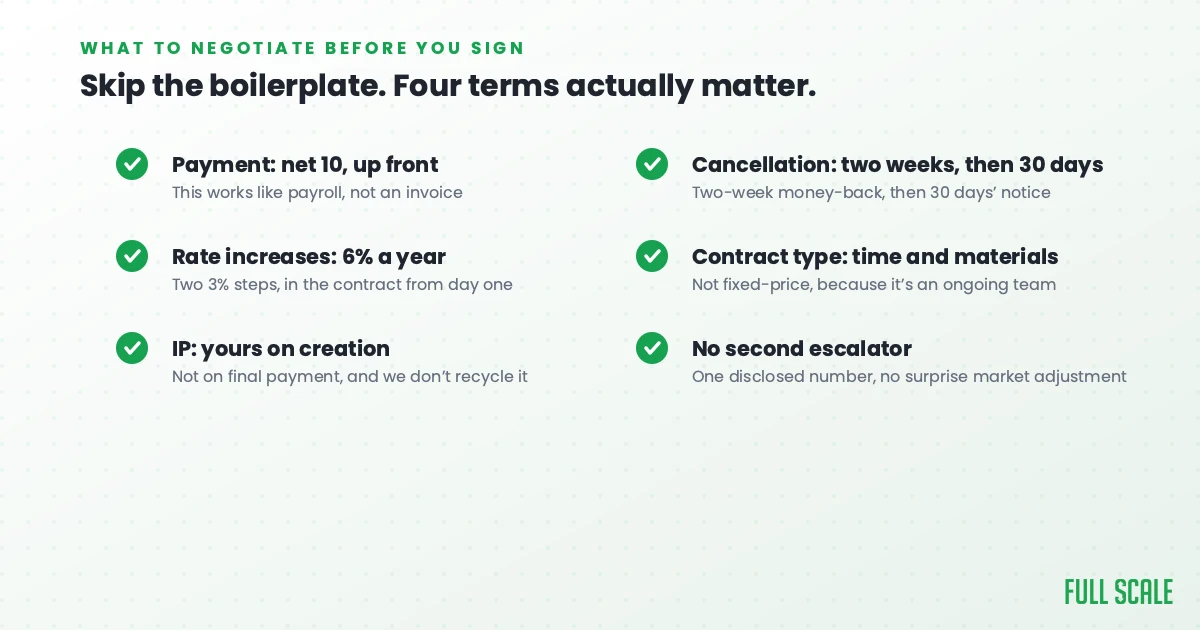
Payment that works like payroll, a capped rate increase, and cancellation terms in plain language rather than a footnote.
Read it
An unbroken chain of custody
How your code and IP stay yours
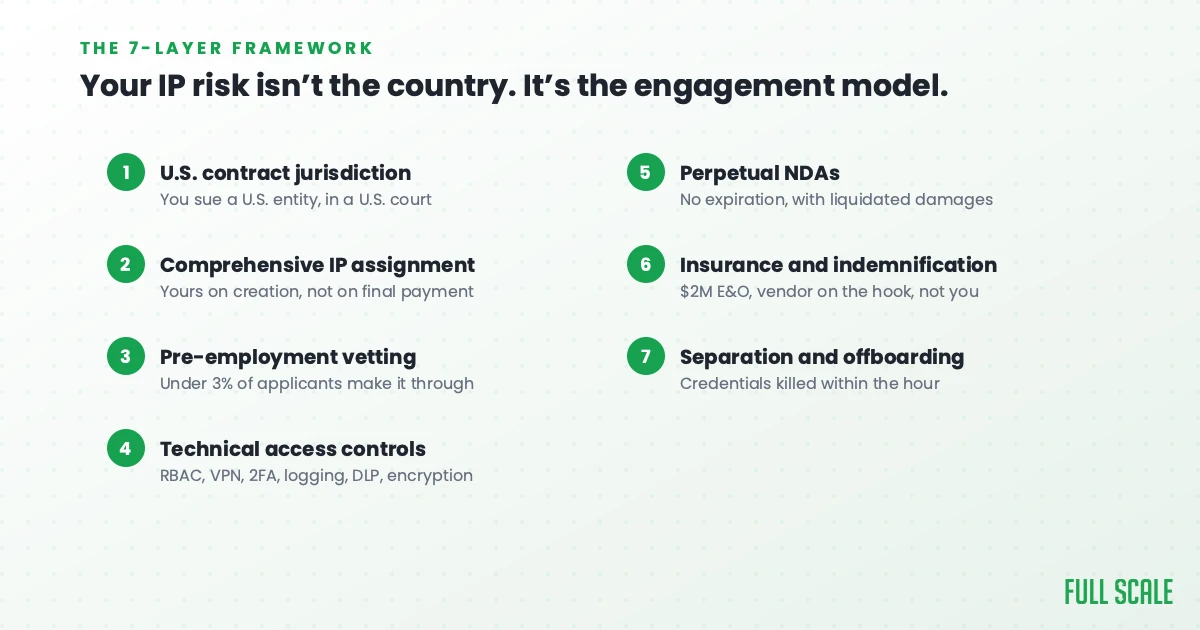
One US contract, real employment agreements with every engineer, and IP assignment that runs end to end with no gaps.
Read itRecruiting and vetting
How we recruit top talent in the Philippines
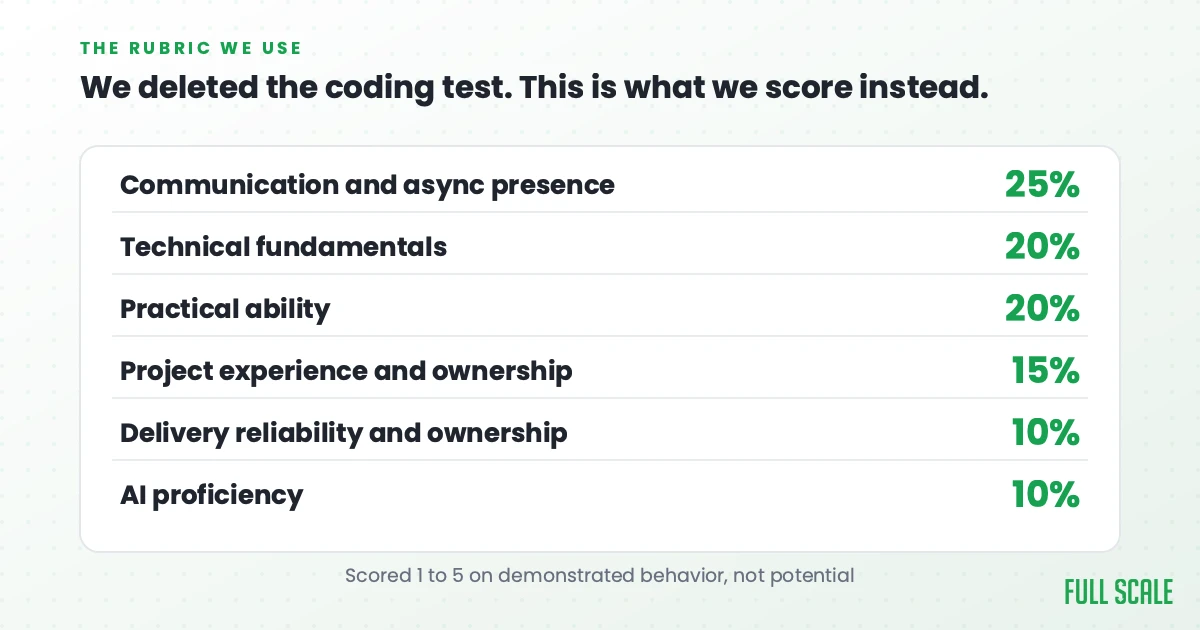
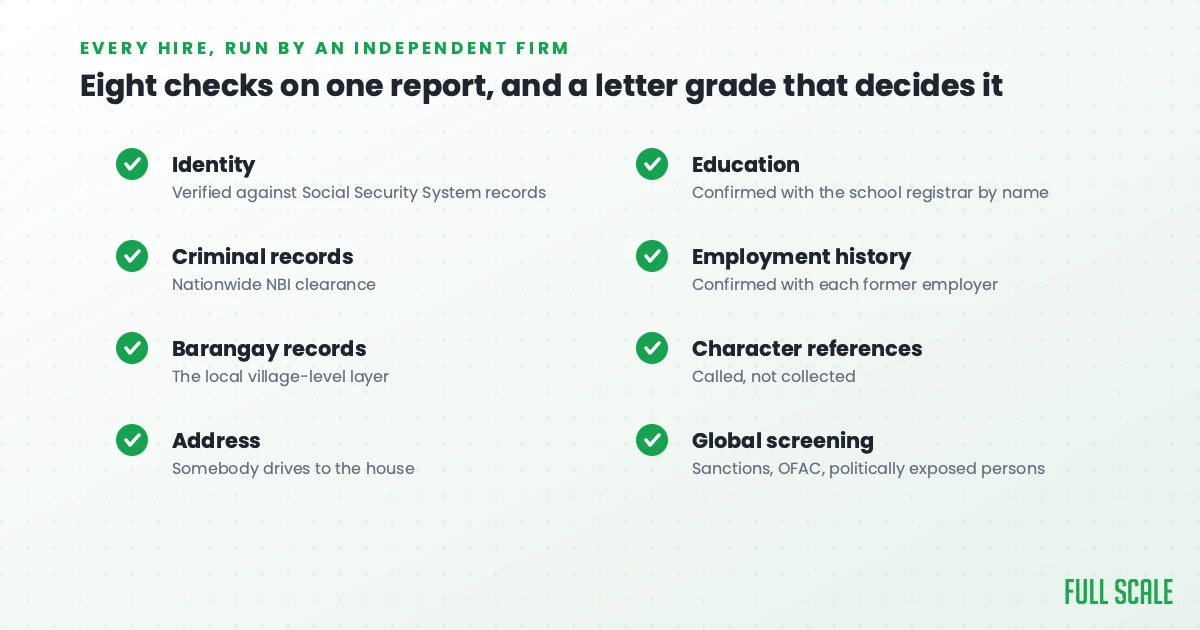
Everything downstream depends on this, and it is the part vendors describe most vaguely. We turn down more than 97 percent of applicants, and the reasons somebody gets rejected are worth more to you than the number itself. The interview rubric is published, and every hire clears eight background checks before touching a client codebase.

Under 3% of applicants get an offer
How we hire
The whole funnel, from application to offer, and what gets somebody rejected at each step.
Read it
The actual rubric, published
How we interview developers
The scorecard our engineers are graded against in a live interview, including the parts candidates fail most.
Read it
Eight checks before anyone starts
How we background check every hire
Criminal, education, employment and identity verification, including an in-person address check most vendors skip.
Read itAnd here are some of the people it produces
Real Full Scale engineers, in their own words, on the work and the career behind it.
Running your engagement
Then somebody has to actually manage it
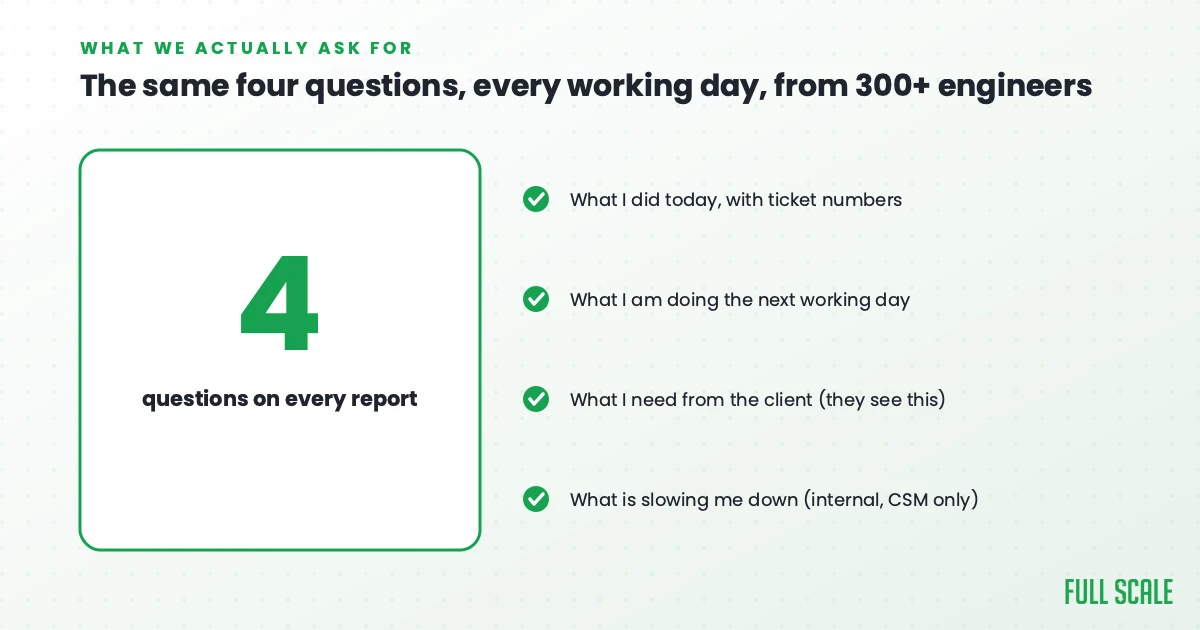
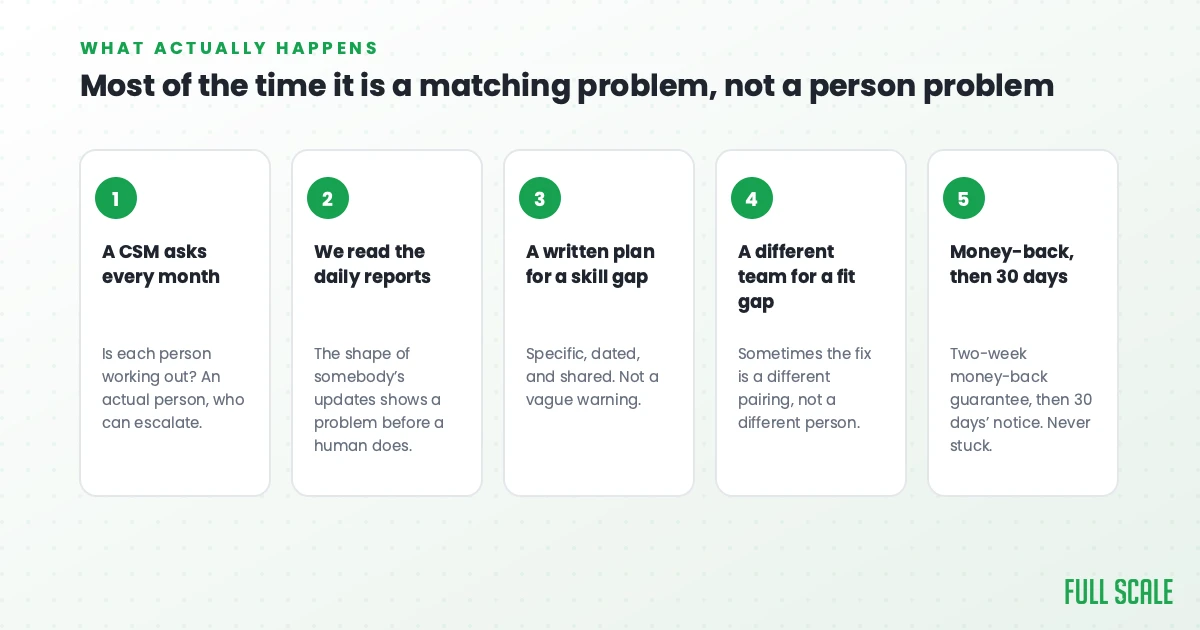
This is where most offshore engagements quietly go wrong, usually because a small problem sat unspoken for two months. Every engineer files a report at the end of every shift, a customer success manager is capped at 70 developers so they know the accounts rather than triage a queue, and we have written down exactly what happens on the day somebody is not working out.

Capped at 70 developers each
What a customer success manager does
The person whose job is catching a problem while it is still small, and the cadence that makes that possible.
Read it
Every engineer, every shift
Daily reports and how we read them
What each developer files at the end of the day, who sees it, and the two report shapes that tell us something is wrong.
Read it
Four of five pass the improvement plan
What happens when a developer is not working out
The performance plan, what Philippine labor law requires of us, and the mistake we used to make with underperformers.
Read itHow we retain great talent
The same people, two years from now
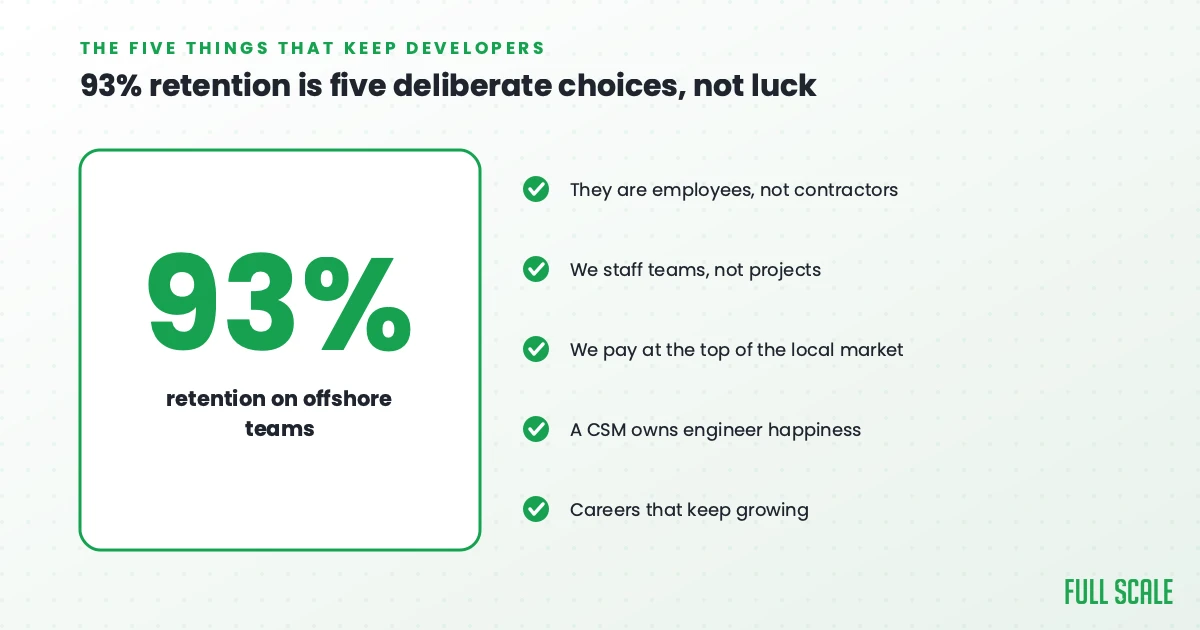
Two things decide whether your team still looks like your team in two years: whether the engineers are still good, and whether they are still here. An engineer who was excellent in 2024 and has learned nothing since is a problem you pay for quietly, so we train continuously and score judgment rather than years served. The result is 93 percent of our people still here a year later, which is the number your roadmap actually feels, and it is not an accident: we put real money back into the places we hire from.

93% are still here a year later
How we keep retention at 93%
How the number is actually measured, the five things that keep people, and where the model breaks down.
Read it
284 of 314 finished the mandatory AI course
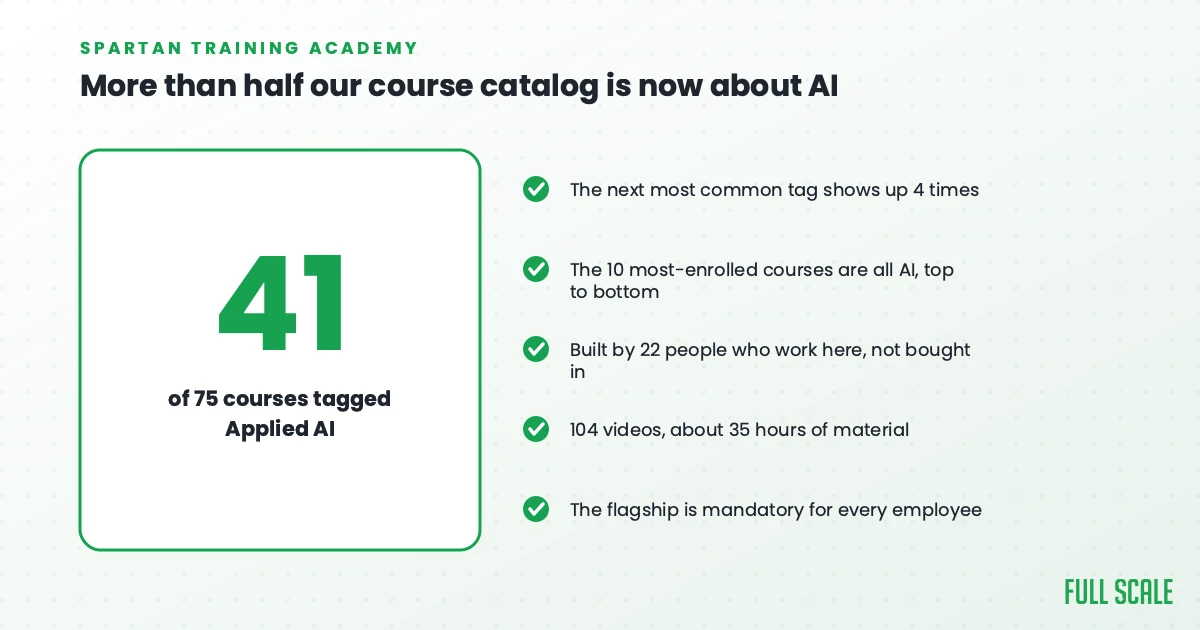
How we train 300+ engineers
The Spartan Training Academy: 75 courses built by 22 of our own engineers, and the completion rate we actually measure.
Read it
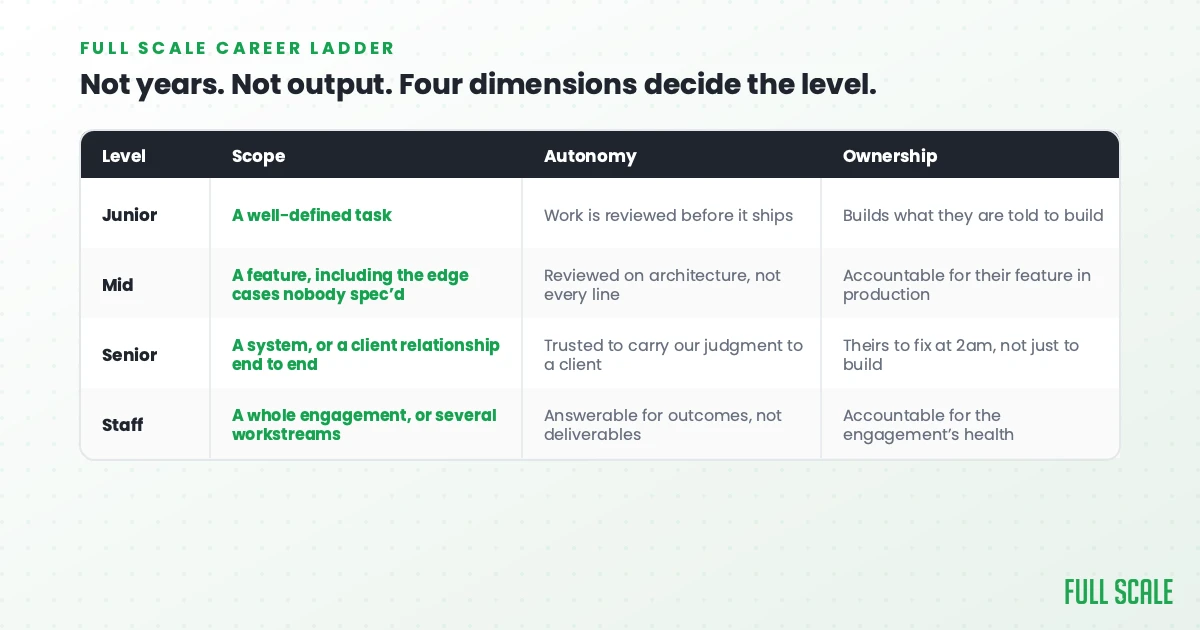
Fourteen scored items, not years served
How we level developers
AI flattened output as a signal, so we score judgment and scope instead. Here is every item we grade.
Read itA great place to work
Full Scale is a great place to work
Literally, and certified. Great Place To Work put us at number 15 on its 2026 Best Workplaces in Technology list for Southeast Asia, and 95 percent of our team told that same survey Full Scale is a great place to work, against 65 percent at a typical Philippine company. A survey measures that, it does not produce it. What produces it is below: CSR Day, five company-wide events a year, and nine clubs the team started and runs itself.

Seven projects, four regions, one paid day
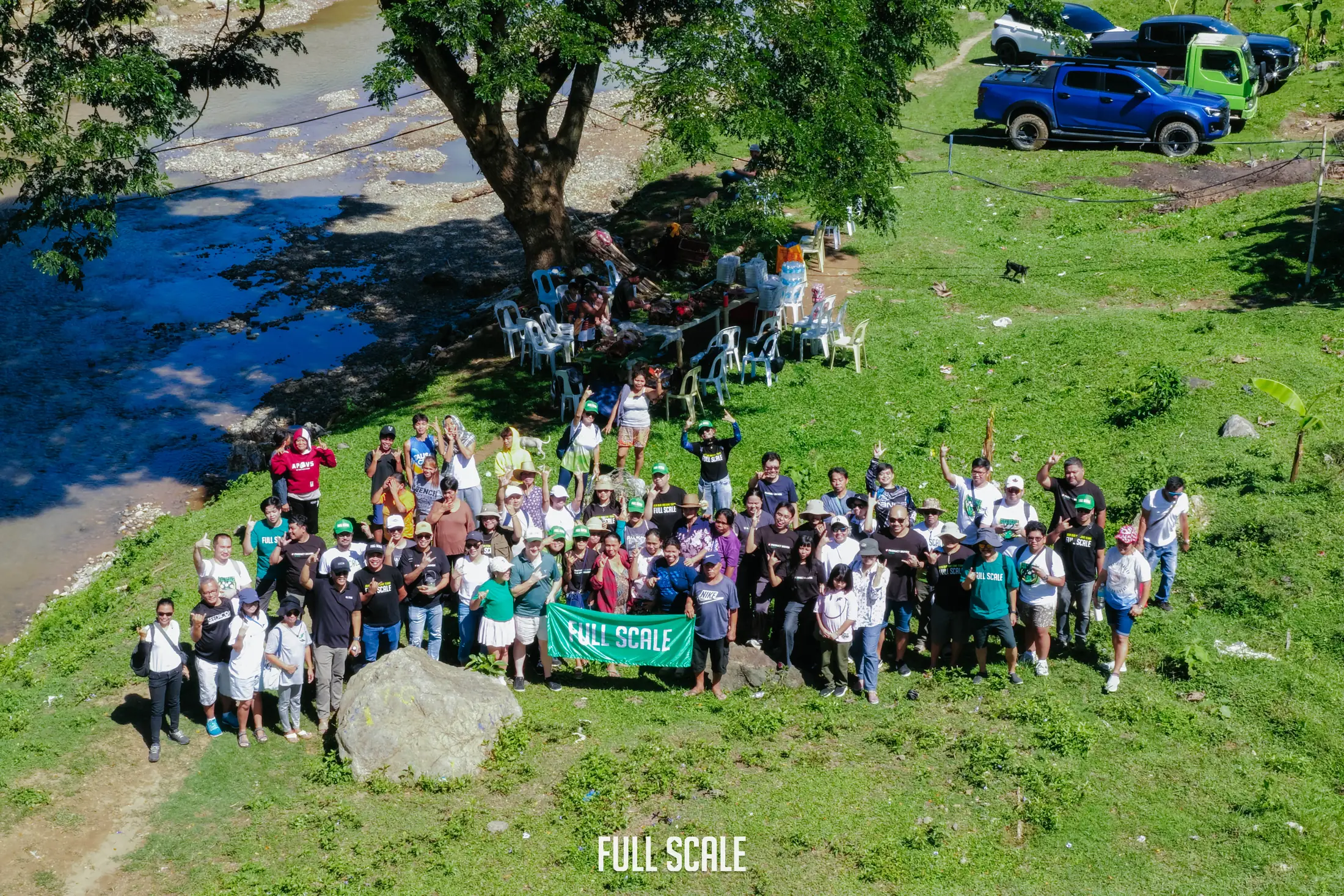
What we put back into the Philippines
Four pillars chosen and led by our own employees, every year. Not a press release, and not a one-off.
Read it
Five a year, whole company
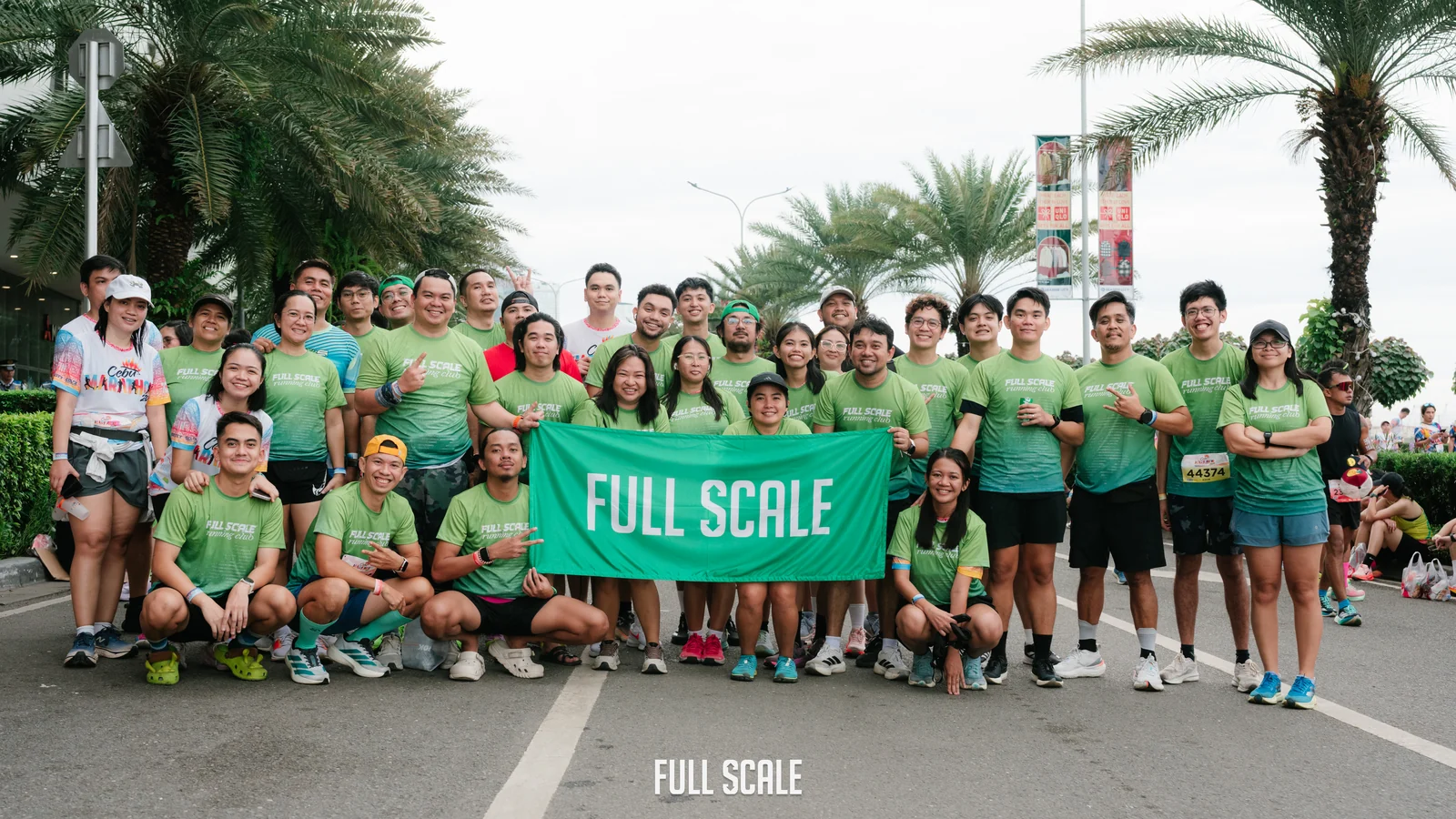
Five company events a year
The whole team in one place, more than once a year. This is the Full Scale running club at the Cebu Marathon.
Page coming soon
Nine of them, employee-run
Nine employee clubs
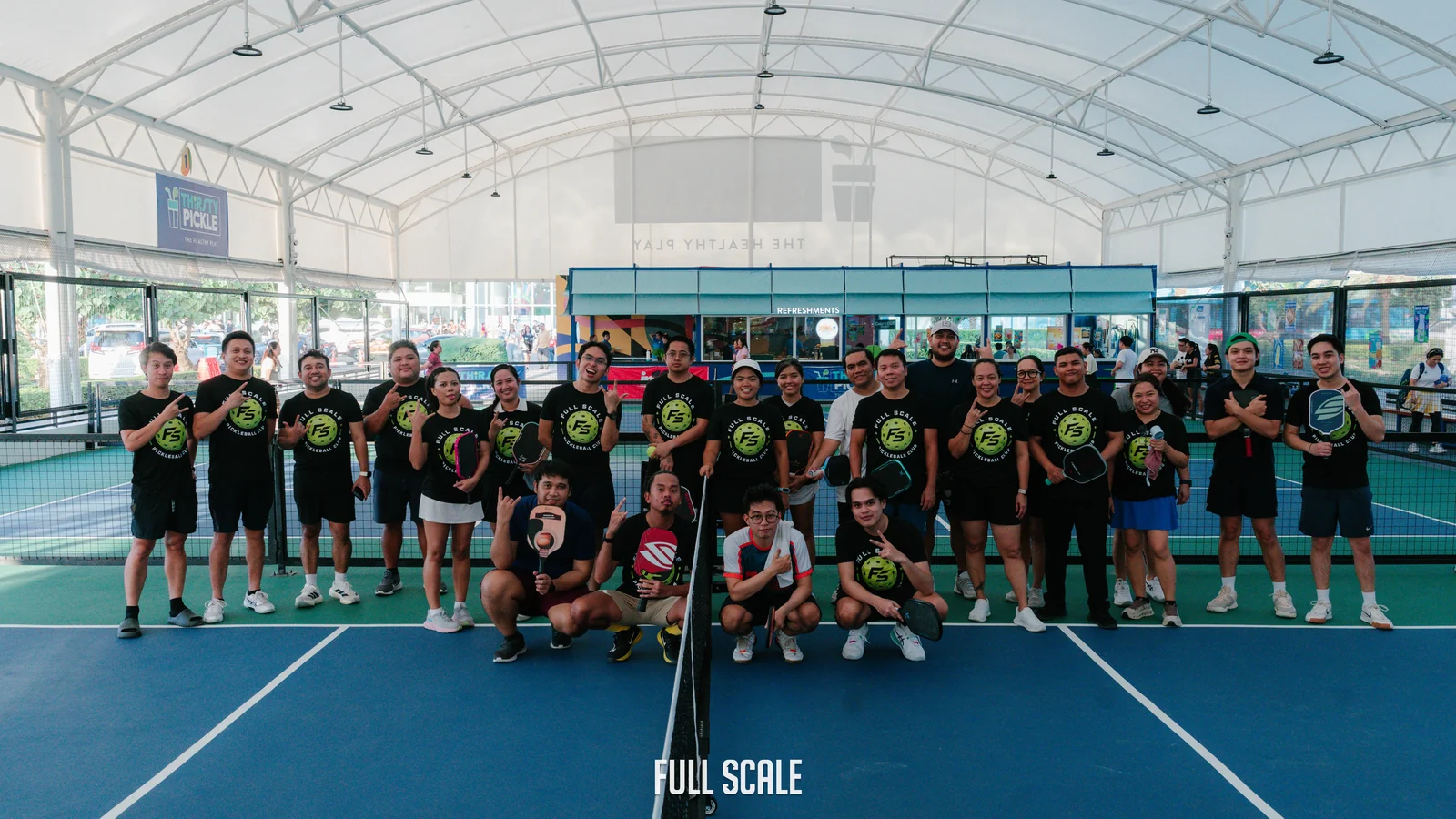
Started and run by the team, not by HR. This is the Full Scale pickleball club, one of nine.
Page coming soonAsk any vendor to show you the same thing
Ask for their completion rate, their rejection rate, and what happens on the day a developer is not working out. The answers, or the absence of them, will tell you more than a capabilities deck.
Book a discovery call