Pros and Cons of Staff Augmentation: What Works and When to Skip It

In this article
- What staff augmentation actually means
- The advantages of staff augmentation are real, and they hold up under pressure
- The cons nobody selling you this model wants to name
- Pros and cons of staff augmentation, at a glance
- When staff augmentation is the wrong call
- How to decide, in one question
- Frequently asked questions
Quick Answer: The pros and cons of staff augmentation come down to trading management work for control. You get developers who report directly to you, hire in 2 to 3 weeks instead of quarters, and pay $30 to $40 an hour billed through Full Scale against $80 to $150 for a US hire, with 93%+ retention against a 75-80% industry average. The cost: you inherit the management work a vendor PM used to absorb, and it only works if someone in-house can actually lead the team.
I run Full Scale. I’ve been hiring people outside the US since 2012, first by accident at Stackify, then on purpose here since 2018. That sits on top of 20-plus years running engineering teams overall. Some of those hires were among the best engineers I’ve ever worked with. A couple of engagements taught me exactly where this model breaks, the kind of lesson that cost real time and real money. Both sides are worth knowing before you sign anything.
None of the other lists like this one tell you what actually goes wrong. The people writing them are selling the model too, and a stock photo of a handshake doesn’t cost them anything to publish.
What staff augmentation actually means
Staff augmentation means hiring developers who work directly for you on a long-term basis. They join your standups, follow your branching strategy, and answer to your engineering manager, not to a vendor project manager sitting between you and the work. The staffing partner handles payroll, benefits, and HR, while you handle the actual direction.
That’s different from project outsourcing, where you hand a spec to a vendor and get a deliverable back. It’s also different from a freelance marketplace, where you’re renting time from whoever happens to be available this week. Staff augmentation is a team you build, not a project you buy or a gig you post.
The advantages of staff augmentation are real, and they hold up under pressure
I’ve written a full breakdown of the benefits of staff augmentation elsewhere, and four of them matter more than the rest.
Your developers report to your team, day to day
They’re in your code reviews, assigned in your tracker, and reporting bugs to the same Slack channel as everyone else. There’s no middleman translating requirements into a different set of requirements by the time they reach an actual engineer.
You hire in weeks instead of quarters
A senior US hire routinely takes roughly two to three months from job posting to first day, and that’s before the new hire ramps to actual productivity. Full Scale places senior engineers in about two to three weeks. The vetting that gets someone into that pool matters less than what happens after. The ones who make it through are the same ones who show up in the retention number below.
Retention is the underrated benefit
Full Scale’s developer retention runs 93%+, against roughly 75-80% annual retention across the broader US tech industry once you count both voluntary and involuntary departures. The voluntary slice alone runs 13-15% a year, per the Bureau of Labor Statistics’ JOLTS data.
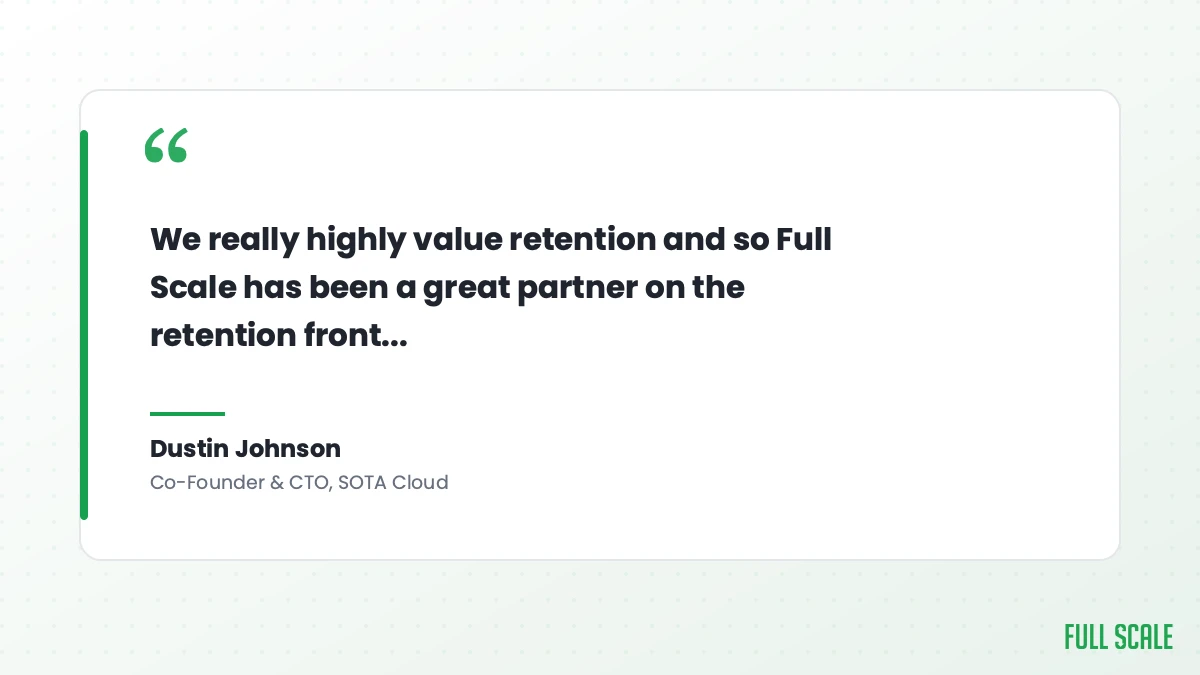
Dustin Johnson, co-founder and CTO of SOTA Cloud, put it plainly in their case study. “We really highly value retention,” he said, “and so Full Scale has been a great partner on the retention front to ensure that we have continuity with the folks that we really value on our team.”
Continuity compounds.
The engineer who built your billing system in year one is the one who remembers where the edge cases are buried in year three.
The cost gap comes down to cost of living
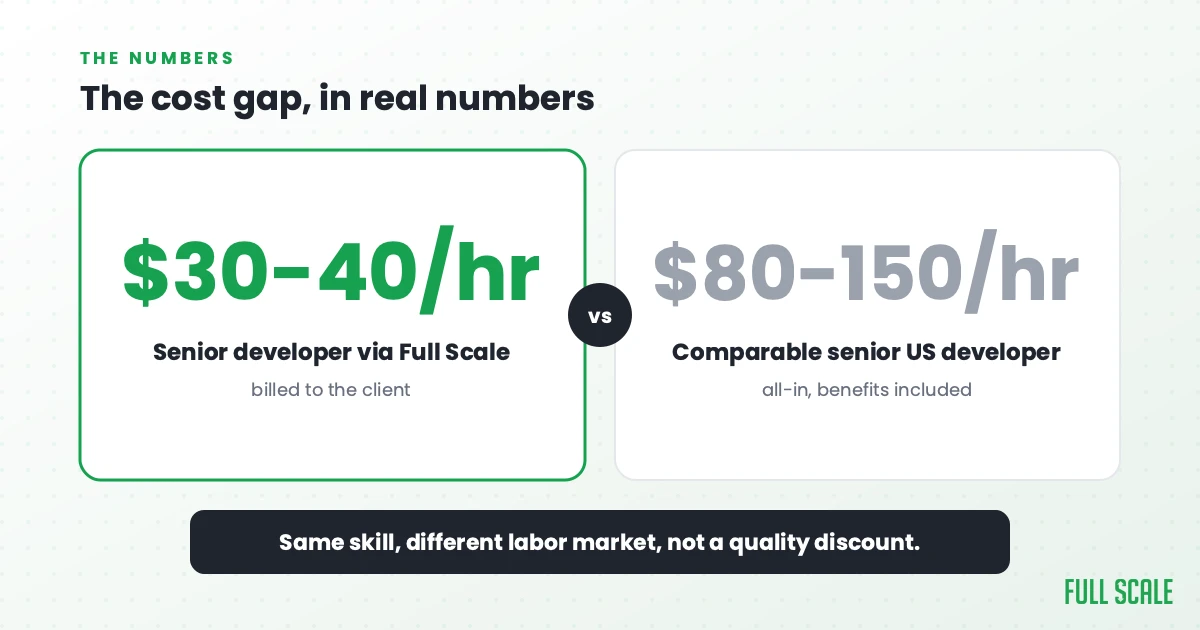
A senior developer through Full Scale runs $30 to $40 an hour billed. A comparable senior US developer costs $80 to $150 an hour all-in once you count benefits, payroll tax, and recruiting. The Bureau of Labor Statistics puts the median US software developer salary north of $130,000 a year in base pay alone. Same skill, different labor market. I go deeper on the full pricing breakdown in what staff augmentation costs.
The same pool that makes this fast also makes it useful for specialists. A senior mobile engineer, a security specialist, or anyone whose skill set is thin in your local market shows up in weeks, not after a year of a recruiter striking out.
The cons nobody selling you this model wants to name
The cons that change the outcome are structural, and they’re the ones I’ve personally paid to learn. Communication and time zones are the two staff augmentation challenges every generic list leads with. They’re genuine, but manageable. Philippines-based teams commonly shift their schedule to overlap US business hours by four hours or more, and video calls (not Slack messages) settle most of what people worry about.
You inherit the management work a vendor PM used to absorb
When you staff augment, the performance issues, motivation, and awkward conversations about why someone’s output dropped this sprint land on your engineering manager. On an outsourced project, the vendor’s project manager absorbs all of that. Your engineering manager is doing one-on-ones, code review coaching, and career conversations with someone who may be twelve time zones away and whom they’ve never shared a physical room with. Nobody puts that part in the sales deck.
You didn’t remove the management burden, you just moved who carries it.
That’s the right trade if you actually want control over how the work gets done, which is usually the entire reason people choose this model over outsourcing in the first place. But teams budget for “a cheaper developer” and forget to budget for the manager-hours it takes to actually run one, and that gap is usually a sign the real question, is my company ready for offshore development, never got a straight answer. That gap is how teams end up disappointed by a model that was never broken to begin with.
It’s also why we treat management quality as an actual deliverable, not an afterthought. Full Scale is Great Place to Work Certified in the Philippines, and the payoff of doing that management work well is exactly the retention number above. I’ve written up the actual practices that make an augmented team work for anyone who wants the operating manual instead of just the warning.
“Two weeks to hire” does not mean two weeks to productive
The marketing version of staff augmentation makes hiring sound instant. The honest version: finding and placing a vetted engineer in two to three weeks is true. It’s also dramatically faster than the two to three months a US in-house search usually takes just to get someone in the door. But getting that engineer to full productivity on your specific codebase, your conventions, your product context still takes actual ramp time, the same ramp time any new hire needs anywhere.
Undersell this and a client’s first month goes worse than it should, because they expected day-one output and got a normal onboarding curve instead. Oversell it and you’ve set yourself up to look slow for doing exactly what a new hire always does.
Building a long-term team means taking on a long-term team’s obligations
Full Scale’s 93%+ retention is a genuine advantage, and it’s also the flip side of a real cost. Building a long-term team means you’re taking on the obligations of a team: career growth conversations, morale, the awkward stretch where a good developer starts wondering if there’s a ceiling. Replacing anyone, on any team, costs real money.
SHRM puts the cost of replacing a technical employee at 50 to 200% of that person’s annual salary. That range covers the recruiting, the ramp, and the institutional knowledge that walks out the door. Someone always absorbs that cost. Staff augmentation just decides whether it’s you, on a team that remembers what it learned, or whoever inherits the mess after the contract ends.
The upside is that a team you invest in stays invested back. That’s the whole logic behind Product Driven, the book I wrote on engineering ownership. People build like owners when the relationship is built to last. That only happens if you’re willing to treat it like one.
It only works if someone in-house can actually lead it
Staff augmentation augments a team. It does not create engineering leadership out of thin air.
You always need technical leadership in-house. If there’s no CTO, no product owner, and no roadmap, adding developers to that vacuum hides the gap for a few sprints. Then it resurfaces at the worst possible time, usually in front of a customer. More on exactly where offshore staff augmentation breaks.
Your data and code are now accessible to people outside your building
This is the one every generic list mentions and no vendor wants to actually answer. Augmented developers need genuine access: your repos, your staging environment, sometimes production. Full Scale developers work under US-based contracts with the same confidentiality and IP-assignment terms as a local hire, which closes most of the gap. Access control and offboarding discipline stay your job regardless, the same as they’d be for any employee with production access, augmented or not.
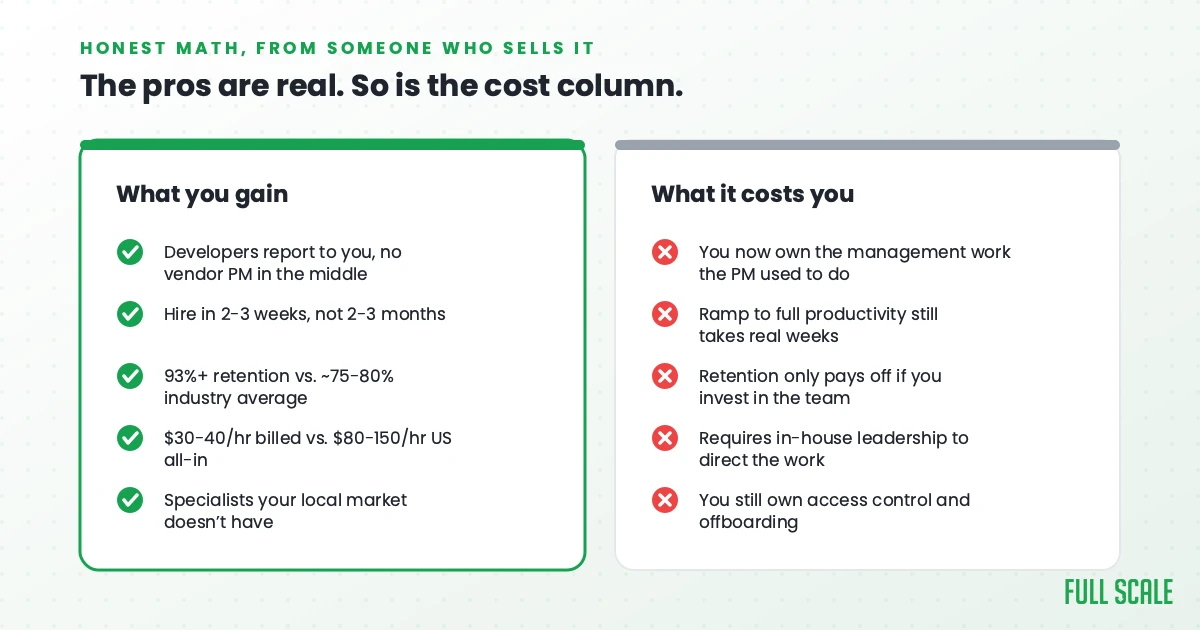
Pros and cons of staff augmentation, at a glance
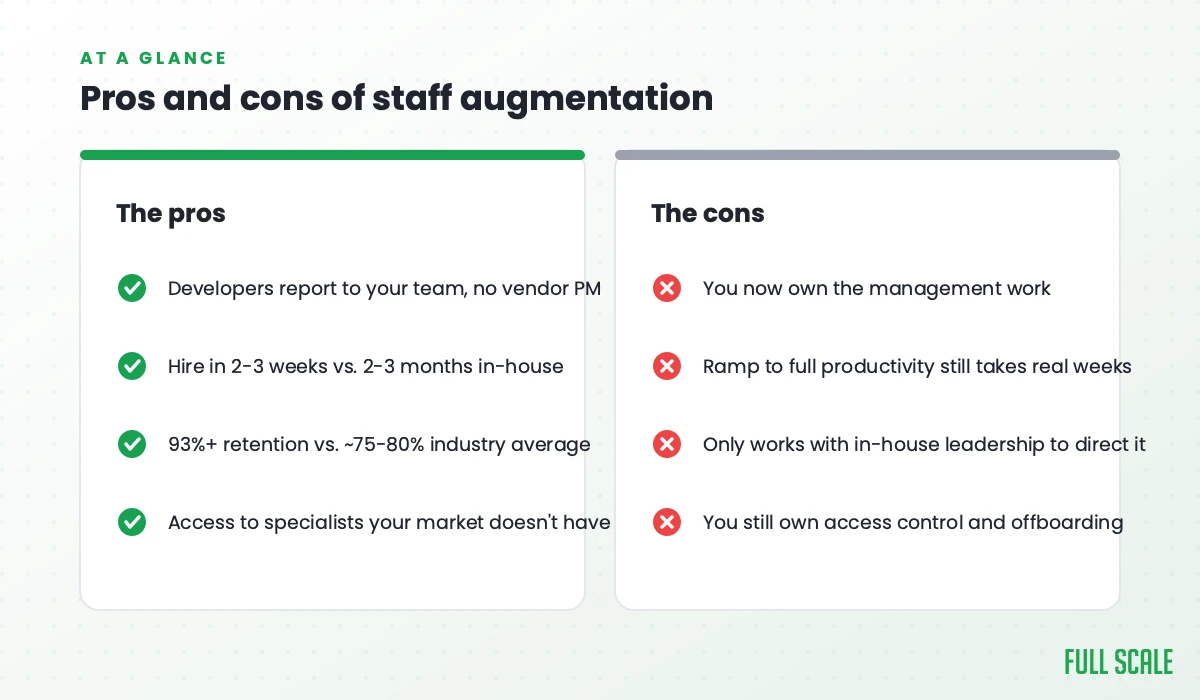
| Pros | Cons |
|---|---|
| Developers report to you, no vendor PM in the middle | You now own the management work the vendor PM used to do |
| Hire in 2-3 weeks vs. 2-3 months to a US in-house hire’s first day | Ramp to full productivity still takes real weeks, not zero |
| 93%+ retention vs. ~75-80% industry average | Retention only pays off if you invest in the team, which is its own ongoing cost |
| $30-40/hr billed vs. $80-150/hr US all-in | Requires in-house leadership to direct the work, or it fails |
| Access to specialists your local market doesn’t have | You still own access control and offboarding for anyone with repo or production access |
When staff augmentation is the wrong call
Two situations, and I’d tell you this even if it cost me the deal. First: if you don’t have a CTO, a VP of engineering, or at least a senior tech lead who can direct the work, hire that person first. Or find a vendor willing to own the outcome instead of a team that needs your direction. Second: if the work is a scoped, self-contained deliverable, a project vendor is the cheaper, simpler answer.
Think marketing site rebuilds, one-time data migrations, an integration you won’t need a specialist for again. I’ve personally outsourced WordPress builds and an Elasticsearch project for exactly this reason. I go deeper on how to weigh the two models in staff augmentation vs. outsourcing.
One more honest note. If you’re choosing a partner on price alone, you’ll get what you paid for. Hiring the cheapest available developer regardless of fit is a mistake common enough that I gave it a name: cheapshoring. It’s the fastest way to turn a real cost advantage into a real quality problem.
How to decide, in one question
Skip the 40-point vendor checklists. The two situations above tell you whether staff augmentation fits your project. This one question tells you whether you’re actually ready to run it: are you willing to manage the relationship, not just pay the invoice? That means real one-on-ones, real feedback, and treating the augmented developers like your own people, because that’s exactly what they are.
If the honest answer is yes, this model will outperform almost anything else available to you. If it’s no, that’s useful information too. It just saved you a bad year.
If it’s a yes, the next filter is who you build that team with. I put together a guide to choosing a staff augmentation company that covers the questions worth asking before you sign.
Frequently asked questions
What is staff augmentation?
Staff augmentation means hiring developers who work directly for your team on a long-term basis. They join your standups and follow your process, while a staffing partner handles their payroll, benefits, and HR. It’s different from project outsourcing, where a vendor manages the work and hands you a finished deliverable instead.
What are the biggest disadvantages of staff augmentation?
The real disadvantages are structural, not just the communication and time-zone friction every generic list leads with. You take on the management work a vendor project manager used to absorb, which is worth weighing through the full offshore project manager pros and cons before you decide to run it yourself. Ramp time to full productivity is genuine even with a fast hire. You still own access control for anyone with repo or production access. And the model only works if you already have engineering leadership in-house to direct it.
Is staff augmentation cheaper than hiring in house?
For long-term product engineering, usually yes. A senior developer through Full Scale typically bills $30 to $40 an hour, against $80 to $150 an hour all-in for a comparable US in-house hire. The savings come from cost-of-living differences in the global labor market, not from lower skill or a discount on quality. See what staff augmentation costs for the full pricing breakdown.
When should you not use staff augmentation?
Skip it if you have no in-house engineering leader to direct the work. Same if the project is a short, well-defined deliverable with a clear end date, like a one-time integration or a marketing site rebuild. Both situations are better served by a project vendor who owns the outcome instead of a team you need to lead yourself.
Is staff augmentation better than hiring an agency?
It depends on who should own the outcome. With staff augmentation, the developers answer to your team, which suits ongoing product work when you have an engineering leader in-house to direct them. With an agency or project vendor, the vendor owns the deliverable and the management of it, which suits a scoped build with a clear end date. Pick the first when you want control, and the second when you want a finished result handed back.
Is staff augmentation different from an employer of record?
Yes. Staff augmentation is a staffing partner who recruits, employs, and manages developers for your team long-term. An employer of record is a narrower legal service: it puts a company on paper as the employer so you can pay someone in another country, but it doesn’t recruit, vet, or manage anyone. See our full breakdown of PEO vs. EOR vs. staff augmentation for how the three models actually differ.
Is staff augmentation worth it?
It’s worth it for ongoing product work when you already have someone in-house who can direct the team and you’re willing to manage the relationship, not just pay the invoice. It’s not worth it if you’re hoping it fixes a missing engineering leader or replaces a short, defined project with a clear end date.
If it still sounds right for where you are, take a look at Full Scale’s staff augmentation services. Or schedule a call with us. We’ll give you a straight answer about whether it fits.