
How We Background Check Every Developer We Hire

In this article
- The stranger problem is not hypothetical anymore
- What our background check actually covers
- The grade that decides whether somebody gets hired
- Every employee is screened against OFAC and global sanctions lists
- Somebody drives to the house
- We collect three separate criminal records
- How long it takes, and how often anyone fails
- The real value is knowing where to find somebody
- Frequently asked questions
- Why we bother publishing this
Hire a developer off a marketplace and ask yourself a question you probably haven’t asked. Who is that person?
Not the profile. I mean their legal name, the city they sleep in, and whether anyone has ever confirmed either one. If your customer database walked out the door six months from now, would you know who to call, or even which country’s police to call?
For most companies buying development help online, the honest answer is no. You have a username, a payment address, and some very good reviews that somebody else wrote.
That gap is the thing background checks exist to close, and it’s a bigger part of what Full Scale sells than most of our staff augmentation clients realize when they sign.
The stranger problem is not hypothetical anymore
North Korean operatives have been getting hired as remote IT workers at American companies using stolen and fake identities. In one round of enforcement, the Justice Department said those workers had landed jobs at more than 100 U.S. companies, helped along by people in the United States, China, the United Arab Emirates, and Taiwan.
Some of those employers paid people hundreds of thousands of dollars over several years without ever knowing who was on the other end.
Nobody in that story was careless in a way that feels careless. They posted a remote job, interviewed somebody competent, checked references that were also fake, and put them on the payroll. The candidate did the work, and verifying who actually shows up is a separate job from the interview itself. That’s the unsettling part.
So when I say every person we hire gets a full background investigation, I’m not describing a compliance checkbox. I’m describing the difference between an employee and a stranger with a bank account.
What our background check actually covers
Every Full Scale hire goes through an investigation run by Infovision Research Systems, an independent Philippine firm. Independent matters here. It isn’t us grading our own homework and telling you we passed.
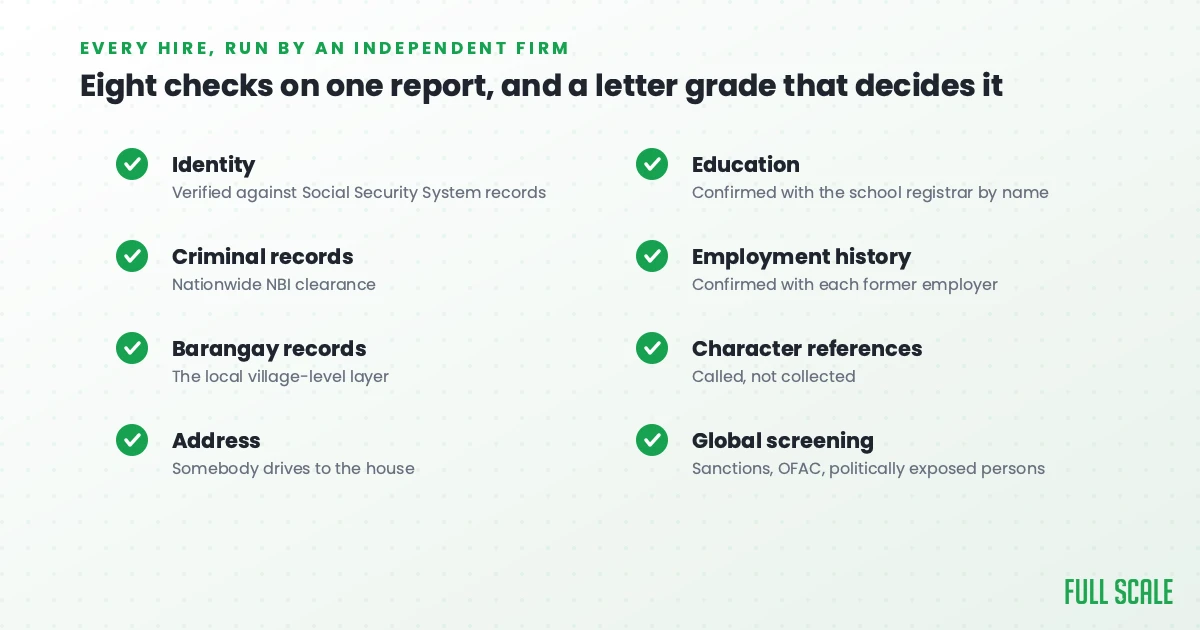
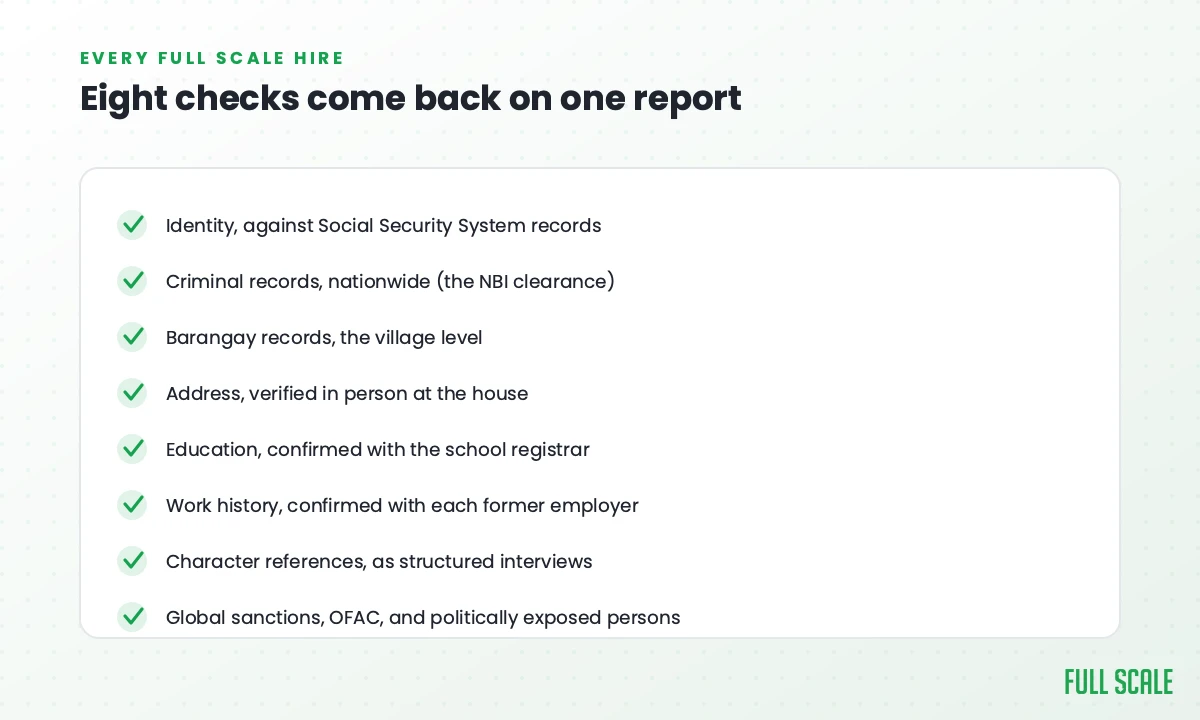
Eight separate checks come back on one report:
– Identity, verified against Social Security System records – Criminal records, nationwide (the NBI clearance) – Barangay records, which is the local village-level layer – Address, verified in person – Education, confirmed with the school registrar – Employment history, confirmed with each former employer – Character references – Global database screening for sanctions and politically exposed persons
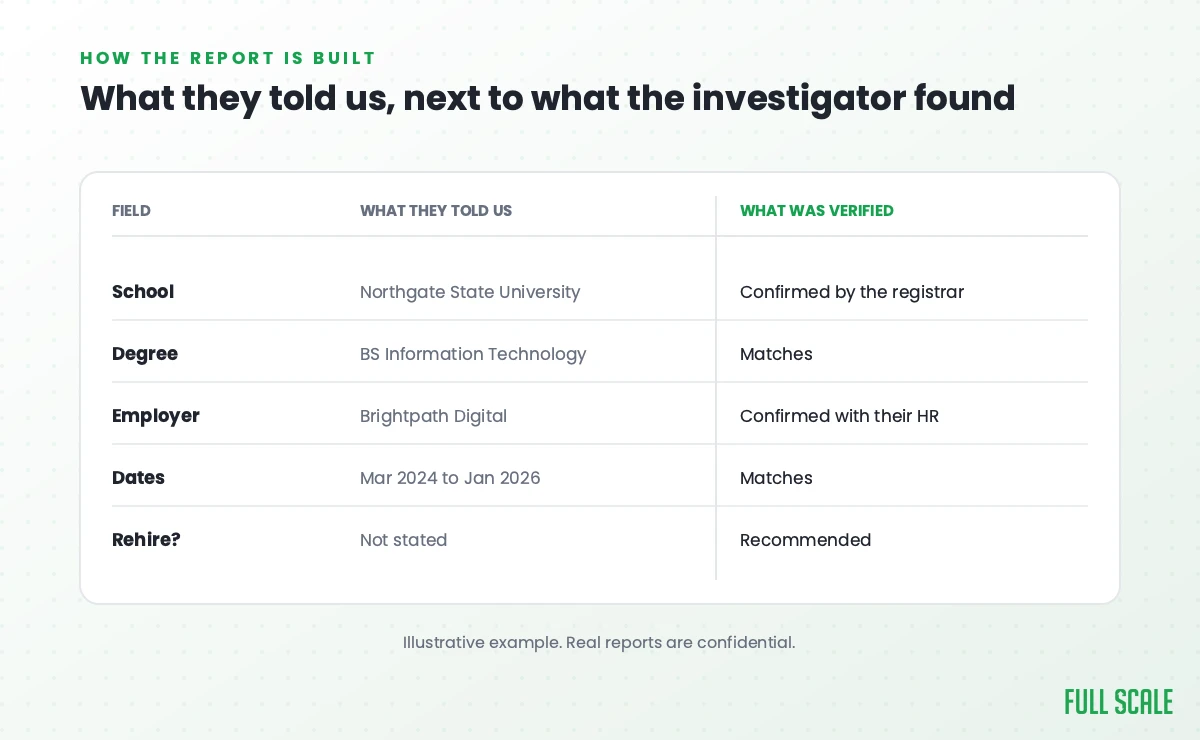
Everything checkable is reported in two columns, what the candidate told us and what the investigator found. Education comes back with the name, title, and institutional email of the registrar who confirmed it. That structure is the whole point. A background check that only prints a conclusion is asking you to trust the checker. Ask any vendor for the two-column version. It belongs on your offshore due diligence checklist.
This runs on every employee, not just engineers. Sales, marketing, recruiting, and finance hires go through the same investigation a developer does.
The grade that decides whether somebody gets hired
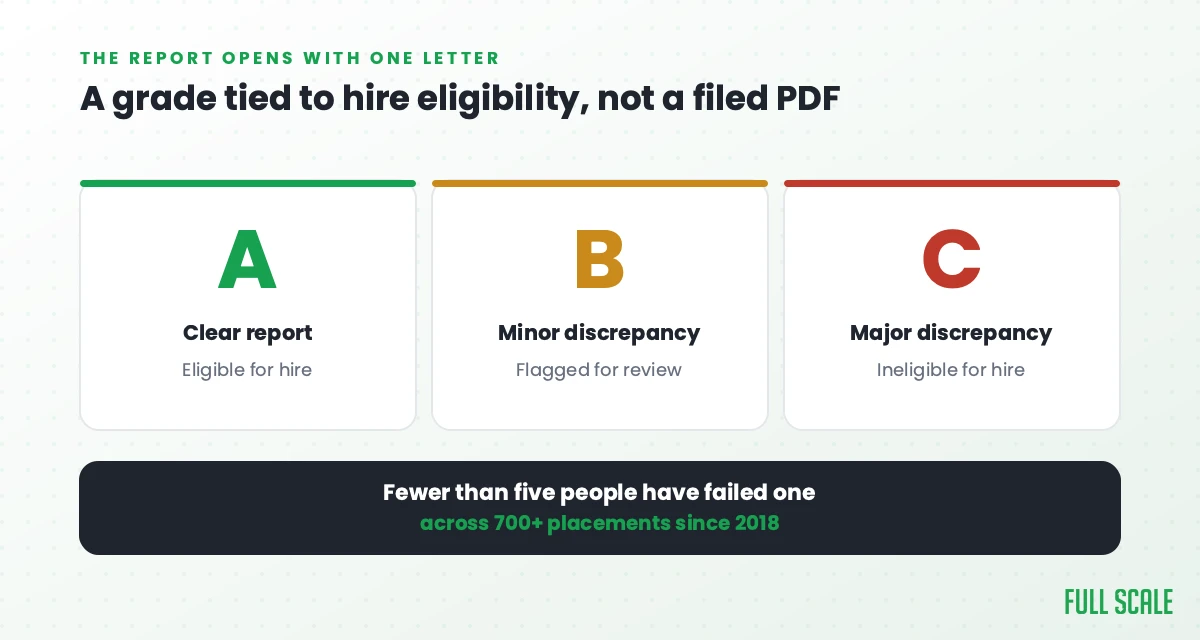
A Full Scale background report opens with one letter.
A is a clear report and eligible for hire. B is a minor discrepancy, flagged for review. C is a major discrepancy and ineligible for hire.
That’s what makes it a gate instead of a document. Plenty of companies run a check, file the PDF, and hire the person regardless of what came back, which is a very expensive way to generate paperwork. It is one of the quieter challenges in offshore recruitment. The process exists, it just never decides anything.
The two-column format is also where the honest failures show up. Sometimes a school confirms somebody attended and then withholds the rest, because of a records policy or an unsettled obligation, and the report says exactly that instead of rounding it up to verified. Some former employers refuse to answer questions about performance or whether they would hire the person again, and the report prints “Confidential” rather than guessing.
A vendor whose reports occasionally say “we could not confirm this” is a vendor whose “confirmed” means something.
Every employee is screened against OFAC and global sanctions lists
This is the check I have never seen in a competitor’s marketing, and it’s the one a regulated buyer actually needs.
Every Full Scale employee is screened against global sanctions and watchlists:
– Politically exposed persons, including their close associates and family – The global sanctions list – Law enforcement and regulatory lists – Negative media – The U.S. System for Award Management – A separate OFAC check
If you build fintech software or healthcare software, that’s one of the paragraphs your auditor wanted. We have done this on every hire since 2018 and never thought to mention it. Engineers are famously bad at marketing themselves, and it turns out the companies full of them are no better.
Somebody drives to the house
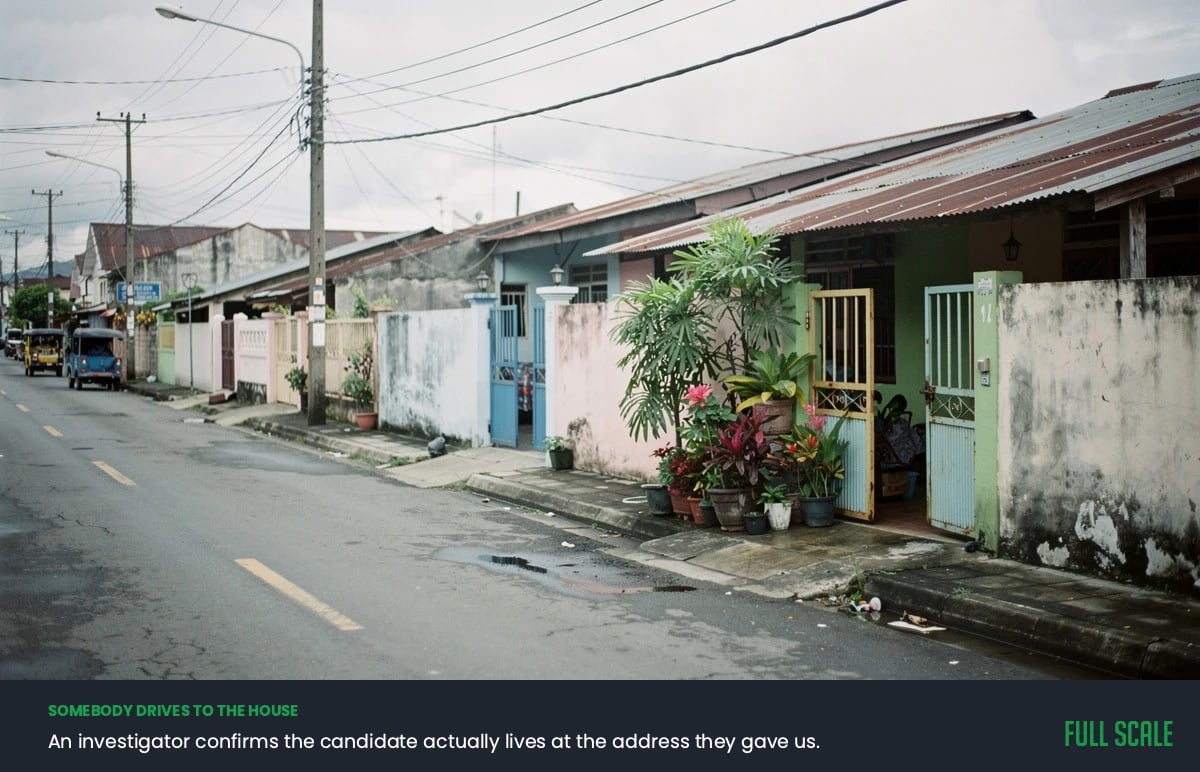
The address check isn’t a database lookup. An investigator drives to the address the candidate gave us and confirms somebody lives there. The report comes back with the landmark near the house, how many years they have been there, whether they own or rent, and the name of the person who confirmed it. Sometimes that person is the elected barangay captain, which is a village official putting their name to it.
The report used to carry a ninth check. Investigators interviewed two named neighbors about the candidate’s reputation in the community, separately, each on the record. We dropped it in mid-2026 because it wasn’t earning its keep relative to what it cost and how long it added.
I mention a check we deliberately stopped doing because the alternative is pretending our process only ever grows. Some verification is theater. The trick is knowing which.
The address verification stayed, because knowing where somebody actually lives is not theater. Every engineer you hire through us in the Philippines has had somebody stand at their front door.
We collect three separate criminal records
“The clearance” gets used loosely in Philippine hiring, and it covers three different documents that don’t cover the same ground.
| Document | Issued by | Covers |
|---|---|---|
| NBI clearance | National Bureau of Investigation | Nationwide criminal records |
| Police clearance | City police office, under the PNP | The issuing city’s jurisdiction |
| Barangay records | The barangay (village) office | Local records and standing |
We get all three layers. The candidate provides the NBI clearance, which is roughly the Philippine equivalent of an FBI check, plus the city police clearance underneath it. The investigator checks barangay records as part of the report.
Work history is checked the same way, straight to each former employer’s HR team, including whether they would hire the person again. It also crosses borders. When somebody’s previous employers are overseas, the investigator goes to those companies directly rather than taking anyone’s word for it.
The character references are structured interviews rather than a friendly phone call. Five skills get rated one to five with written comments. There are direct questions about any warnings or discipline. Then comes the one I like best: name another colleague who could serve as a reference. It is much harder to stack a reference list when the list keeps growing itself.
How long it takes, and how often anyone fails
A Full Scale background check takes about two weeks.
Across 700+ engineer placements since 2018, fewer than five people have failed one. A couple of those were discrepancies in a college transcript or previous employment dates, small stuff rather than deal breakers.
That number sounds low enough to be suspicious, so here is why it is low. The check is the last gate in the process rather than the first filter. By then the candidate has already come through a hiring funnel that turns away the overwhelming majority of applicants. People with something to hide also tend to withdraw once they hear an investigator will visit their house.
Which sets up the part I would rather say out loud than have you discover. We often start people while the check is still pending. They know a bad result is grounds for immediate termination, and they accept that, because it happens well under 1% of the time. If we held every start for two weeks, we would lose good people to companies that never check at all.
Some clients require the completed check before anyone touches their systems. Those starts get held, no argument, and you should tell us on the discovery call if that’s you.
One more thing worth being straight about: we run the check before hire, and we don’t re-run it every year afterward.
That sounds like a gap until you look at what replaces it. A marketplace freelancer disappears between contracts and nobody is watching anything. Our engineers are on payroll, under an employment contract, with a manager, a verified address on file, and access we grant and revoke. A background check is a snapshot taken once. Employment is the part that keeps running, and the access controls that go with it are covered in how we handle security on remote teams.
The real value is knowing where to find somebody
The report is the evidence. The argument it supports is the part that actually matters.
When you hire a freelancer through a marketplace, your relationship is with a profile. If something goes genuinely wrong, and I mean worse than a missed deadline, you have to work out who this person really is, which country they sit in, and whose laws apply. Usually you just eat it.
Our engineers work for us, most as regularized employees and some as contractors, and every one goes through the same investigation. We know their legal name, their checked address, their government-confirmed identity, and their work history, because a third party looked into all of it. Full Scale is a US company, so your contract is with us under US law. Full Scale Teams PH, Inc. is our registered Philippine entity, and it employs the engineers. That chain runs unbroken from you to us to the person writing your code, which is also how we go about protecting your intellectual property.
When something goes wrong, there is a US company on the other end of your contract and a person we can actually find.
That’s the actual product. The rubric and the interview process decide whether somebody is good, and I’ve written about how we interview developers in detail. The background check decides whether they’re real. You want both, and the cheapest option on the internet gives you neither, which is the whole argument against cheapshoring in one sentence. And once they start, their daily reports are where you see whether the work is actually moving.
Frequently asked questions
Does Full Scale background check every developer?
Yes, every hire without exception, including non-engineering roles. An independent Philippine firm, Infovision Research Systems, runs it. It covers eight areas: identity, nationwide criminal records, barangay records, an in-person address check, education, work history, character references, and global sanctions screening. Full Scale also collects an NBI clearance and a city police clearance separately.
How long does a background check take at Full Scale?
About two weeks, start to finish. Reports come in two stages, an interim one and then the final one. Some clients require a fully cleared check before an engineer touches their systems. Those placements are held until the report completes, and clients should raise that requirement during the discovery call.
Are Full Scale employees screened against sanctions lists?
Yes. Every employee is screened against global sanctions and watchlists, including politically exposed persons and their close associates and family members, global regulatory and law enforcement lists, negative media, the U.S. System for Award Management, and a separate OFAC check. The screening runs at hire. It is a point-in-time check, not ongoing monitoring. That is usually the exact answer fintech, healthcare, and government buyers need for their compliance teams.
How often does someone fail a Full Scale background check?
Fewer than five people have failed one across 700+ placements since 2018. Most of those were small mismatches, like a college transcript or old job dates not lining up with what they gave us. The failure rate is well under 1%. Because of that, Full Scale sometimes starts an engineer while the check is still pending. The deal is explicit: a bad result and they are let go that day.
What is the difference between an NBI clearance and a police clearance?
The NBI clearance comes from the Philippine National Bureau of Investigation and covers the whole country, which makes it the closest thing to an FBI check. A police clearance comes from a city police office and covers that city. Barangay records cover the village level. They pull from different sources, which is why Full Scale gets all three layers instead of treating one as enough.
Why does hiring through a marketplace carry more risk than hiring through a staffing partner?
The real difference is verification and a legal entity, not the label on the arrangement. Staffing firms have been targeted by the same schemes, so a partner is not automatically safer. What matters is whether somebody independently confirmed the person exists, and whether there is a company that can be held responsible if they turn out not to be who they claimed. The Justice Department has indicted North Korean nationals who used stolen identities to get hired as remote IT workers at more than 100 U.S. companies, most of them hiring directly.
Does Full Scale re-run background checks after someone is hired?
No. The investigation happens before hire and is not repeated each year. We would rather say that plainly than imply we watch people forever, because we do not.
Why we bother publishing this
Most companies treat their vetting as a line item on a sales deck. One bullet, no detail, next slide.
We’d rather show you the machinery, because the machinery is the argument. The full interview rubric and two real scorecards are already public, and this is the other half of it.
If you want engineers who go through all of this before they join your team, tell us what your team needs.