
Staff Augmentation Contract: The Terms That Actually Matter

In this article
- The staff augmentation contract that was built to sell popcorn
- Payment terms: This works like payroll, not an invoice
- Rate increases: 6% a year, no surprises
- IP ownership: Yours from the moment it’s created
- Cancellation: Two weeks money-back, then 30 days’ notice
- The other clauses, and why they don’t need a month of redlines
- Frequently asked questions
Quick Answer: The staff augmentation contract terms actually worth negotiating are payment terms (billed like payroll, not project invoices), rate increases (capped on a set schedule, usually around 6% a year), IP ownership (assigned to you the moment code is written), and cancellation (a two-week money-back guarantee, then 30 days’ notice to drop a developer, scale the team down, or end the engagement). Everything else, NDAs, non-solicitation, liability caps, is standard boilerplate that rarely needs a redline. Full Scale builds every contract around those four terms.
Every staff augmentation deal I’ve ever signed has gone through the same ritual. The business side agrees on scope, budget, and start date in about twenty minutes. By then you should already know what a solid staff augmentation proposal looks like, because that’s what you agreed to. Then the contract goes to legal, and it disappears for a month.
Nobody’s being difficult on purpose. Legal teams are paid to find risk, and a staffing contract is unfamiliar territory for a lot of them. They redline everything, including the clauses that don’t matter, because it’s hard to tell which ones do until you’ve been through a few of these.
I’ve been through more than a few. Here are the four terms in a staff augmentation contract worth fighting over, and the shorter list of stuff that isn’t. These four terms are also part of a bigger shift: see our roundup of staff augmentation trends in 2026 for how contracts fit the wider picture.
The staff augmentation contract that was built to sell popcorn
Let me start with a story about how this goes wrong, because it makes the point better than a checklist can.
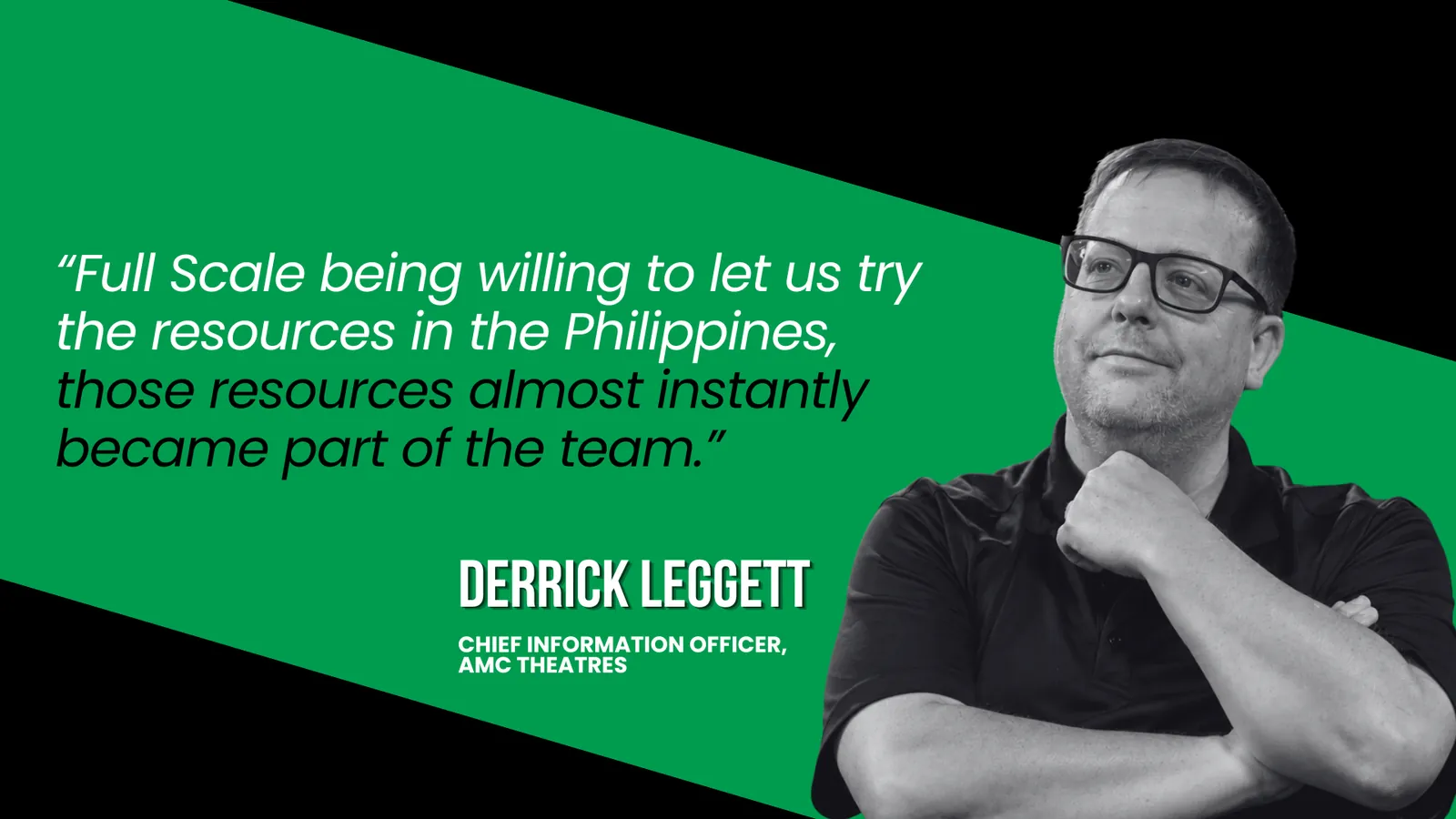
AMC Theatres wanted to use their own contract instead of ours. Reasonable ask on its face. Big companies have procurement standards, and a staffing agreement is a small thing next to everything else their legal team handles in a given week.
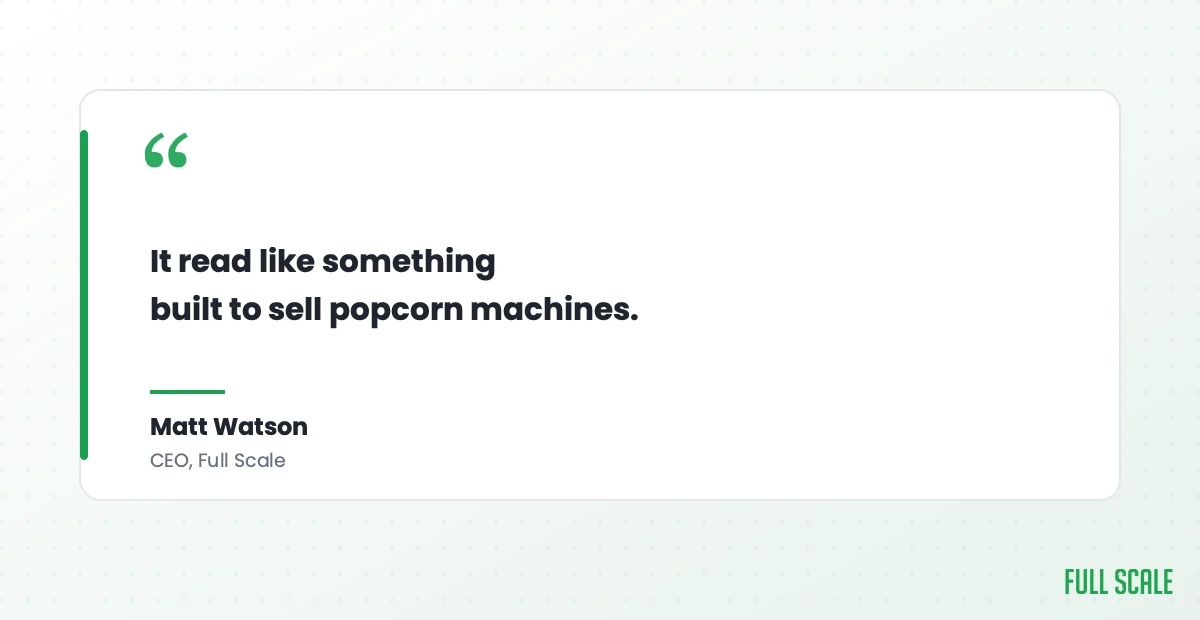
The document they sent over was a generic vendor contract, the kind built for buying equipment or ordering supplies. It read like something built to sell popcorn machines, right down to a liability clause written for defective equipment rather than people, which is a strange thing to find when the “equipment” is a software engineer. Then they asked us to redline it. The honest answer was that we’d have to redline almost the whole thing, because hardly any of it fit staffing a software team.
Here’s the lesson. A contract from a staff augmentation vendor is not the same document as a standard procurement contract, and treating the two as interchangeable is where the weeks disappear. A staffing agreement is built around the few things that govern engineers embedded on your team: how you pay, who owns the code, how rates change, how you cancel. A generic vendor template written for buying goods has none of that shape, so bending a staffing engagement to fit it means rebuilding it clause by clause anyway. Starting from the vendor’s staffing contract is almost always faster than forcing your own.
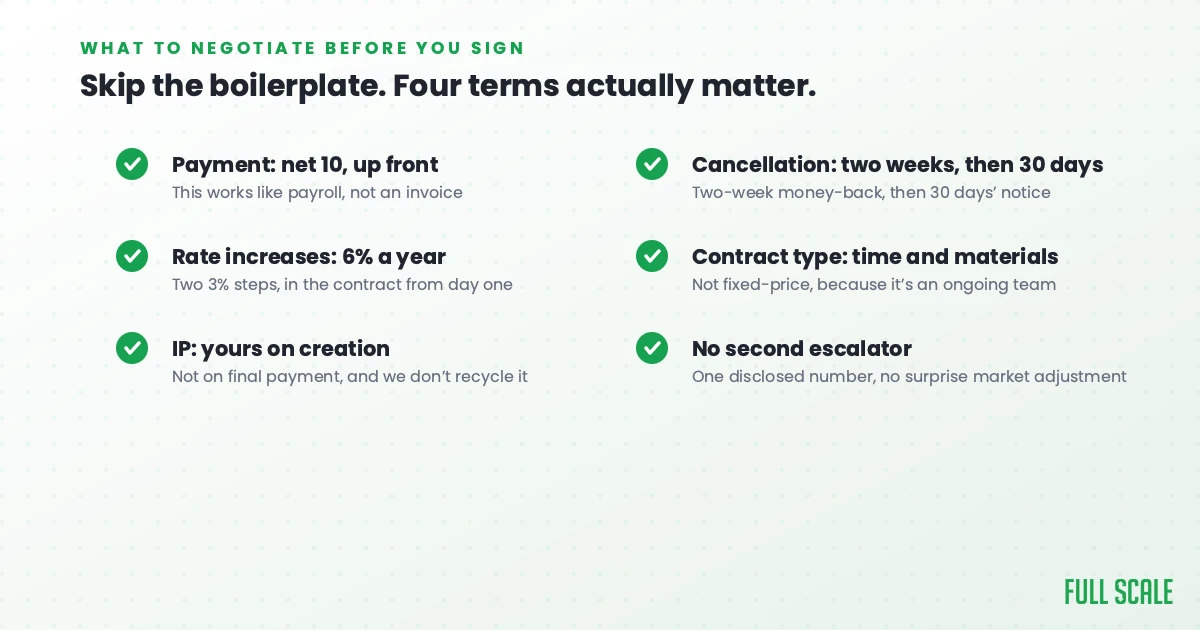
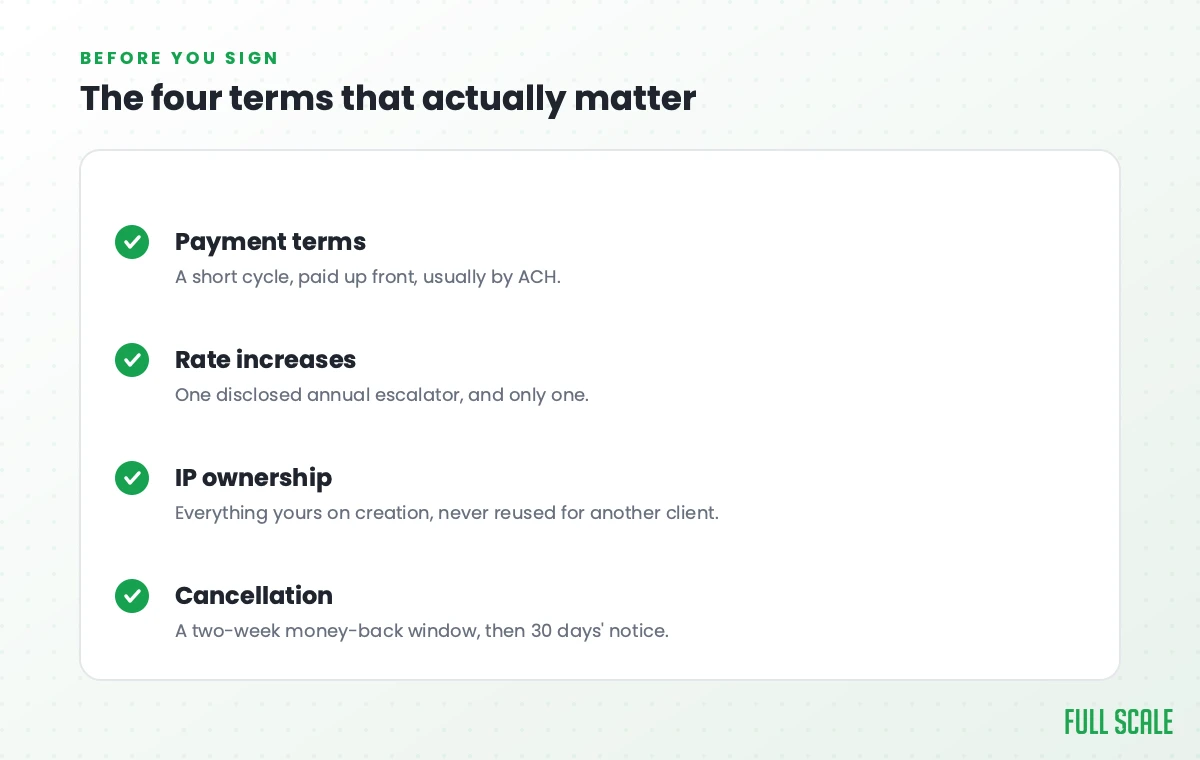
A real staffing contract comes down to a handful of clauses. Before you sign, know where you land on the four that matter:
- Payment terms: a short cycle, paid up front, usually by ACH.
- Rate increases: one disclosed escalator, applied as two 3% raises a year, never stacked with a second one.
- IP ownership: everything yours the moment it’s created, and never reused for another client.
- Cancellation: a two-week money-back window, then 30 days’ notice.
One more to know going in: non-solicitation usually means you can’t hire the developers directly. More on that below.
Payment terms: This works like payroll, not an invoice
Most vendor relationships run on net-30 or net-60, paid after the work is done. Staff augmentation runs backward from that, and the reason is simple once you see it.
It also runs on a time and materials contract, not a fixed-price one. You pay for the hours or months an engineer is embedded with your team, the way you’d cover a salary, and that fits an ongoing team better than a fixed-deliverable project with a hard end date.
The right mental model here is payroll. Full Scale has to pay its employees whether or not a client’s invoice has cleared yet. We can’t float that gap across a long payment cycle the way a software vendor can float an invoice for a product that’s already built and sitting on a server.
That’s why our terms are short and paid up front on autopay through ACH: net 10, billed before the engagement starts.
Clients used to a normal vendor relationship sometimes push on this, assuming it’s a cash-flow preference on our side. It’s structural. A staffing company financing a client’s payroll on long terms is one bad quarter away from missing its own payroll, and then nobody’s getting any work done. The trade you’re making is giving up some invoice leverage in exchange for a team that gets paid on time and stays on your project instead of getting pulled onto someone else’s. Paying up front isn’t a blind leap either, since the first two weeks are covered by a money-back guarantee, which I’ll get to below.
If your legal team wants to negotiate one thing on payment, make it the invoicing detail. The cycle length is the one part we can’t move, and it has nothing to do with us wanting your money faster.
Rate increases: 6% a year, no surprises
Every staff augmentation contract we sign has a built-in rate escalator of 6% a year, applied as two 3% increases, one every six months. It’s in the contract from day one, spelled out in plain language before you sign.
The reason is that we give our engineers raises, and the billed rate has to move with them. Early in a career those raises run big. A strong junior developer might earn 10% to 12% more a year for their first five years, because that is what it takes to keep someone whose skills are compounding fast. The gentler 4% to 6% cost-of-living bump comes later, once someone is established.
Six percent is the blanket we apply across the board to average those two stages out. These raises track a local market where developer pay has climbed for years, and if the rate we billed you stayed flat, we’d end up absorbing the gap until the math broke and you lost the person. A contract that locks in one number for years straight guarantees turnover on your team eventually.
The 6% isn’t only a pass-through on salary, either. It also covers the ongoing cost of the things that keep engineers here: a dedicated Customer Success Manager on every engagement, and the training, events, and culture investments that back our retention numbers. That budget rises with inflation and cost of living the same way salaries do, and funding it is as much a part of the 6% as the raise itself.
I’ll be straight with you: 6% a year is on the higher end of what you’ll see recommended. Some contract guides suggest capping increases lower, as the safer, founder-friendly move. We hold to 6% because it reflects the raises we give our engineers, averaged across a career, rather than a number chosen to look easy to sign.
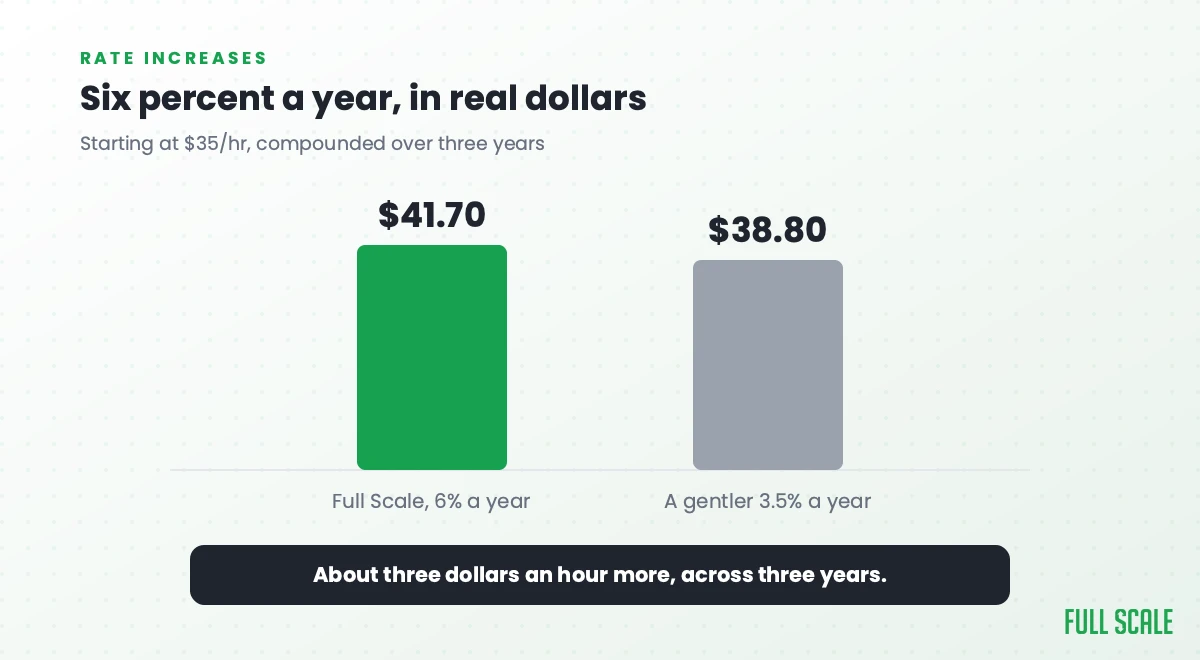
The gap is smaller than it sounds. Run the math on a $35-an-hour engagement over three years:
| Rate path | Starting | After 3 years |
|---|---|---|
| Full Scale: 6% a year | $35/hr | ~$41.70/hr |
| A gentler 3.5% a year | $35/hr | ~$38.80/hr |
That comes to about three dollars an hour over three years. Understand it before you sign, and weigh it against everything else the engagement gives you. The contract is one step in a longer sequence, and what actually happens after you sign matters just as much as the terms themselves.
What we won’t do is stack a second “market adjustment” on top of the disclosed one. If a vendor’s contract has both a cost-of-living (CPI) clause and a separate discretionary increase clause, that’s two levers pulling the same direction, and you should ask why. Ours is one number, disclosed up front, and that’s it. If you want the fuller breakdown of how staff augmentation gets priced overall, our pricing model guide covers the rest of the math.
IP ownership: Yours from the moment it’s created
IP ownership generates a surprising number of redlines for something that was never really in dispute. Everything your augmented team produces is yours the moment it’s created: the code, the documentation, the architecture. That’s not a position we’re willing to trade away, and it shouldn’t need to be, because it’s how every reasonable staffing arrangement works.
What usually happens is clients want their own IP-assignment language in the contract, even though the outcome is the same. That’s fine. If your legal team sleeps better seeing their own wording, use it. The substance doesn’t change: you own what you paid to build.
Ownership also means we don’t recycle your work. If we build a framework or a module for you, it stays yours, and it doesn’t quietly show up in the next client’s codebase. Some vendors treat what they build for one client as reusable inventory for the next, which is a quiet way to leak your competitive edge to whoever hires them after you. We don’t do that. What gets built on your dime stays with you.
The part to check, regardless of whose language it’s written in, is that IP transfers on creation, not on final payment. Some vendor contracts quietly gate ownership behind the last invoice, which means your code is functionally held hostage until the contract closes out. That shouldn’t be how any staffing contract works.
The bigger structural point, which our IP protection framework covers in more depth: your contract is with Full Scale, a US company under US law. If something goes wrong, you’re dealing with a reachable US entity you can hold accountable, and the exact phrasing of the assignment clause matters less than who’s on the other side of the signature.
Cancellation: Two weeks money-back, then 30 days’ notice
This is the section every competitor’s contract guide fills with a “replacement guarantee.” Most offer a free replacement within some number of business days, at the vendor’s cost, like a warranty on a dishwasher. It sounds reassuring until you read the fine print on what counts as a qualifying replacement event.
We do it differently, and I think it’s the more honest version.
The first two weeks come with a money-back guarantee. If it’s genuinely not working, you get your money back, returned to you as a refund.
After that, it’s 30 days’ notice to remove someone: drop a developer, scale the team down, or cancel the whole engagement. There’s no long-term contract locking you in, and no penalty for changing your mind as your project changes. Canceling the whole engagement to switch vendors mid-project is easier when the notice terms are this loose, but the switch itself still deserves its own plan.
Adding someone runs the other direction, and it isn’t gated by that notice period at all. If a developer with the right skills is open on our bench, we can get them started in as little as 24 hours. In practice, we’re rarely the slow part of that process. It’s usually the client’s own legal and procurement getting an MSA signed, or lining up the internal decision-makers, that takes the longest step, the same problem the popcorn-contract story above ran into.
A swap isn’t a months-long restart, either, though it runs a bit slower than adding someone brand new because there’s a handoff to manage. If someone with the right skills is available, a replacement can start in as little as a week, longer when we need to recruit for a specific stack, with time built in to hand off context before the outgoing developer rolls off. It won’t be full productivity on day one, since nobody ramps into a codebase overnight, but you’re not starting from zero either.
What we don’t offer is a bolted-on replacement guarantee with its own separate terms. I’d rather give you a money-back window up front and straightforward notice terms than sell you a “guarantee” that turns out to have three conditions attached to it in a footnote. Read a few of these contracts and you’ll notice the guarantees tend to be the most heavily qualified clause in the whole document.
The other clauses, and why they don’t need a month of redlines
A staff augmentation contract has other clauses, and they’re fine to have, just not where your legal team should spend its energy going line by line.
- NDA and confidentiality. Standard. It should bind the provider and each individual engineer separately, down to the person doing the work.
- SLA basics. A service-level agreement sets response times, working-hour overlap, and escalation paths. Fine to ask for, though it rarely causes fights.
- Non-solicitation. This one matters more to us than the others. You generally can’t hire the developers directly, and that’s by design: our whole job is finding great engineers and keeping them, so the last thing we want is to lose one. A couple of times a client has wanted someone badly enough that we worked out a buyout and released them to go in-house, but it’s rare, and it goes against what we’re trying to do, which is keep our best people for the long haul.
- Your own contract. Large companies often want their own template. That’s normal, but as the AMC story shows, a generic procurement contract usually needs heavy rebuilding to fit a staffing engagement, so starting from the vendor’s staffing contract is usually the faster path.
None of these need a month of redlines. If your legal team is deep in the weeds here, it usually means nobody’s told them yet which clauses matter.
Frequently asked questions
What is a staff augmentation agreement?
A staff augmentation agreement is the contract between a company and a staffing provider that supplies engineers to work as part of the company’s own team. It typically covers scope, billing, IP ownership, confidentiality, and how either side can end or change the arrangement. That scope language is exactly where it diverges from a fixed-price deal; I break down staff augmentation vs sow as contract structures in a separate piece.
What is an example of a staff augmentation contract term?
A rate-escalation clause is a good example: language disclosing that hourly or monthly rates will increase by a set percentage on a set schedule, so cost changes are predictable instead of a surprise partway through the engagement.
Is staff augmentation considered outsourcing?
Not in the traditional sense. Staff augmentation adds engineers directly onto your existing team under your management, while classic outsourcing hands off a whole project to an outside vendor’s own team and process. We’ve written about staff augmentation vs. outsourcing in more detail if you’re weighing the two.
Do staff augmentation contracts include a replacement guarantee?
Many vendors advertise one, usually a free replacement within a set number of days if a developer isn’t a fit. Full Scale takes a different approach: a two-week money-back guarantee up front, then 30 days’ notice if you want to drop a developer, scale the team down, or cancel after that, with no long-term lock-in. Adding someone doesn’t need that notice. If the right skill set is open on our bench, we can start them in as little as 24 hours.
What legal protections should a staff augmentation contract include?
Past IP ownership, the contract should require an NDA covering both the vendor and each individual engineer, and if you’re handling sensitive data, explicit language on access controls and how that data is protected. These aren’t the clauses people fight over, but they’re the ones that matter if something goes wrong. Full Scale’s due diligence checklist and IP protection framework cover the specific clauses to check for before signing.
What are the key components of an offshore software development contract?
An offshore software development contract needs four things spelled out: payment mechanics (how and when you’re billed), a rate-increase schedule so cost changes are predictable, IP ownership assigned to you the moment code is written, and clear terms for ending the engagement. Everything past that, NDAs, non-solicitation, liability caps, is standard boilerplate that rarely needs negotiating. Full Scale’s staff augmentation contracts are built around exactly those four terms.
Most of the fight over a staff augmentation contract is spent on clauses that were never in question. Get the payment terms, the rate structure, the IP language, and the cancellation terms right, and the rest of the document takes care of itself. If you want to see what that looks like in practice, schedule a call and we’ll walk you through ours.