How to Protect Software Intellectual Property With Offshore Developers

In this article
- Why geography is the wrong question
- How to protect software intellectual property with offshore developers: the 7-layer framework
- What about enforcement, the question nobody answers
- HIPAA, SOC 2, and GDPR with offshore teams
- Five questions to ask any offshore vendor
- When offshore isn’t the right call
- So, what country is your contract in?
- FAQ
Quick Answer: Protecting software intellectual property with offshore developers comes down to the engagement model, not the country. At Full Scale we use a U.S. contract under U.S. law, assign IP the moment it’s created, run real background checks, lock down technical access, and require perpetual NDAs with liquidated damages. Geography was never the risk. An unaccountable contract is.
A founder told me a story I still think about.
He fired a developer who had been working on his product remotely. The next morning, that developer still had a full copy of the source code, and he made it clear he wasn’t going to forget that. He wanted money to go away. The founder had no signed IP assignment, no NDA with teeth, and no idea which country’s court he’d even be standing in if he tried to fight it.
That developer was not offshore. He was three states away.
I’ve heard a lot of these stories. Founders who hired off Upwork and got ghosted. A founder who found out one of his “remote contractors” was actually logging in from North Korea, which is exactly why verifying who and where your developer is matters more than the flag on the map. A steady stream of people show up at our door tired of freelancers who vanish right when a release is due. The common thread is never the country on the developer’s address. It’s the structure of the deal they signed.
Most legal teams miss this. When a CTO brings up offshore development, the room goes quiet and someone asks, “What country are the developers in?” The question that actually protects your code is, “What country is the contract in?”
I’m Matt Watson), a 4x founder. I bootstrapped VinSolutions to a nine-figure exit, and over the years I’ve personally hired developers in Uruguay, Colombia, and the Philippines, with different levels of success in all of them. Not one of the problems I ran into ever traced back to the country on the map. I built Full Scale to do offshore development the right way, and across more than 700 developer placements since 2018, we’ve never had a single IP or confidentiality incident.
Here’s the framework that gets there, and why geography is the wrong thing to fixate on.
Why geography is the wrong question
Everyone focuses on where developers live. What actually decides whether your IP is safe is how those developers are engaged.
The belief that offshore equals risky is comforting, and it falls apart fast. If geography decided IP security, San Francisco would be the safest place on earth to hire engineers, and every CTO knows how that story ends when a senior dev leaves to start a competitor. Geography is not the control. Verifying who the engineer actually is is what a real background investigation covers.
The real variable is the engagement model sitting under the contract.
Look at the models people actually choose, and geography stops mattering. The freelancer you found on a marketplace signed a thin platform agreement with almost no enforcement behind it, and they’re juggling four other clients at the same time. An overseas project shop owns your code until you make final payment, under a jurisdiction you’ve never read. And a lone contractor, wherever they happen to sit, splits their loyalty across whoever is paying this week.
| Engagement model | Works for other clients? | Contract jurisdiction | IP assignment | Theft risk |
|---|---|---|---|---|
| U.S. freelancer (platform) | Usually | Platform terms / state law | Often ambiguous | High |
| Overseas project shop | Always | Foreign, varies | Ties to payment | High |
| U.S. full-time hire | No | State employment law | Work-for-hire | Low |
| Staff augmentation (U.S. vendor) | Never | U.S., the vendor’s entity | Immediate and total | Low |
The highest-risk rows are the models that split a developer’s loyalty and water down who you can actually hold accountable, and those have nothing to do with being offshore.
Staff augmentation through a U.S. vendor flips every one of those columns. The developers work only for you, under a contract governed by U.S. law, with IP that transfers to you the moment it’s written. And here’s the part that does the real work: the people writing your code are the vendor’s employees rather than independent contractors who can disappear. An employee answers to an employer who can fire them, sue them, and end their career. A freelancer answers to no one once the invoice clears. The same discipline shows up in the staff augmentation contract terms that decide who owns the code and when.
To be clear, a direct in-house hire is just as safe on paper, and if you can find and afford the right engineer locally, hire them. Staff augmentation matters when you can’t, because it gets you the same contractual footing as an employee without the freelance lottery. That’s the whole game. Here’s how you build it, layer by layer.
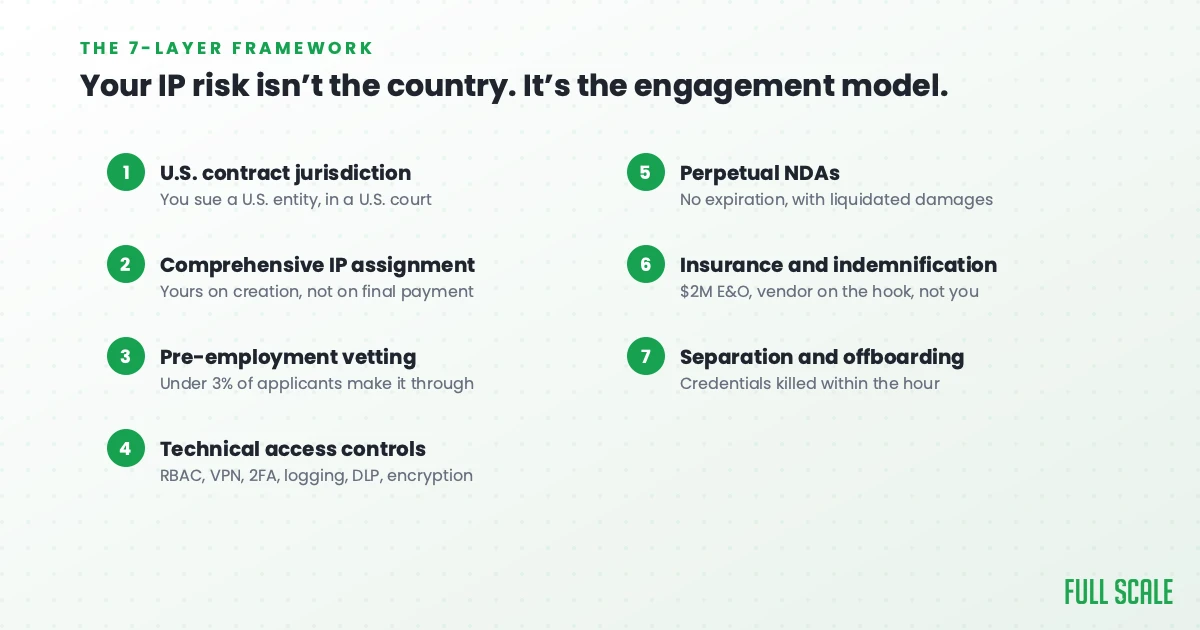
How to protect software intellectual property with offshore developers: the 7-layer framework
Most offshore companies hand you an NDA and call it IP protection. That’s a lock on the front door while every window stays open.
Real protection comes from layers that each cut risk on their own and together make theft a bad bet. None of these depend on where a developer sits.
U.S. contract jurisdiction, the foundation
Every developer contract is governed by U.S. law, and your contract is with the U.S. company, not with an individual in another country and not with a foreign subsidiary. The structure underneath is ordinary and recognizable to any legal team: a master services agreement (MSA) sets the terms, each engagement is a scoped statement of work (SOW), and the IP-assignment and NDA terms run through both.
That one fact changes your worst-case scenario. If something goes wrong, you’re filing in a U.S. court, against a U.S. entity, with U.S.-based assets to collect against. You are not flying to Manila to find a person and learn a legal system on the way.
Ask any vendor: what jurisdiction governs my contract, and where would I sue if this went sideways?
Comprehensive IP assignment
Work-for-hire language plus an explicit IP assignment clause covers every developer, so all work product belongs to you the instant it’s created.
Not after the project ships, and not after final payment. It’s yours the moment it’s written, and the transfer is irrevocable.
That covers source code, documentation, designs, and algorithms. This is the same IP protection a local employee gives you, written down and enforceable, the same trade-secret and work-product principles WIPO’s own guidance on protecting trade secrets lays out for any company, offshore or not. The single most common gap I see in offshore contracts is IP that transfers “upon final payment,” which is just code held hostage with extra steps. Project shops sometimes paper over the same fear with source code escrow, a third party that holds the code in case the vendor vanishes. With clean assignment you don’t need it, because you already hold the code, not a promise to get it later.
One thing worth getting right in 2026: AI-assisted code muddies ownership, because U.S. copyright doesn’t protect output with no human authorship behind it (per the U.S. Copyright Office). Your assignment language should explicitly cover AI-assisted work product, not just what a human typed by hand. It’s one of the ways offshore development is shifting in the AI era, and a current contract should account for it.
Pre-employment vetting
This is where a real vendor pulls away from a marketplace, and it’s the part nobody can fake.
Before a developer ever touches your repo, we run a background check on every developer we hire in the Philippines that goes deeper than what most U.S. employers bother with. There’s an NBI clearance, the Philippine national criminal-record check that’s roughly the equivalent of an FBI check, plus education verification and employment history. Then come the parts that surprise people: we talk to a candidate’s actual neighbors about who they are, and because addresses in the Philippines often don’t map to a clean street number, new hires draw a map by hand to show where they live so it can be verified.
Only about 3% of applicants make it through. You don’t hear that number from a freelance platform, because a platform isn’t doing any of this.
Technical access controls
We run role-based access to the repository, require a VPN and two-factor authentication, log every access event, and layer data-loss-prevention tooling on top. Code is encrypted in transit and at rest. You decide who can see what.
That gives you two things at once: a deterrent, because people behave differently when access is logged, and a detection system, because unusual activity sets off an alert. These are the same controls a serious in-house security program runs, and they pair naturally with secure development practices across the whole team. You also don’t have to hand over everything. Plenty of smart teams keep their crown-jewel algorithm in-house and give the vendor the surrounding work, and segmenting access that way is good practice no matter how much you trust who’s on the other end.
Offshore developer NDAs
The NDA has no expiration date, so confidentiality survives long after a developer rolls off your project. Developers are explicitly barred from reusing your code, sharing your technical approach, or keeping copies after they leave.
There are signed NDAs with both the vendor and the client, and liquidated-damages language puts a real dollar figure on a violation. An NDA without the technical controls above is a speed-limit sign with no police behind it. It only works if everyone chooses to obey it. What actually gives that NDA teeth in a U.S. court is the Defend Trade Secrets Act, the federal law that lets a company sue for trade-secret theft regardless of where the person who took it happens to live.
Insurance and indemnification
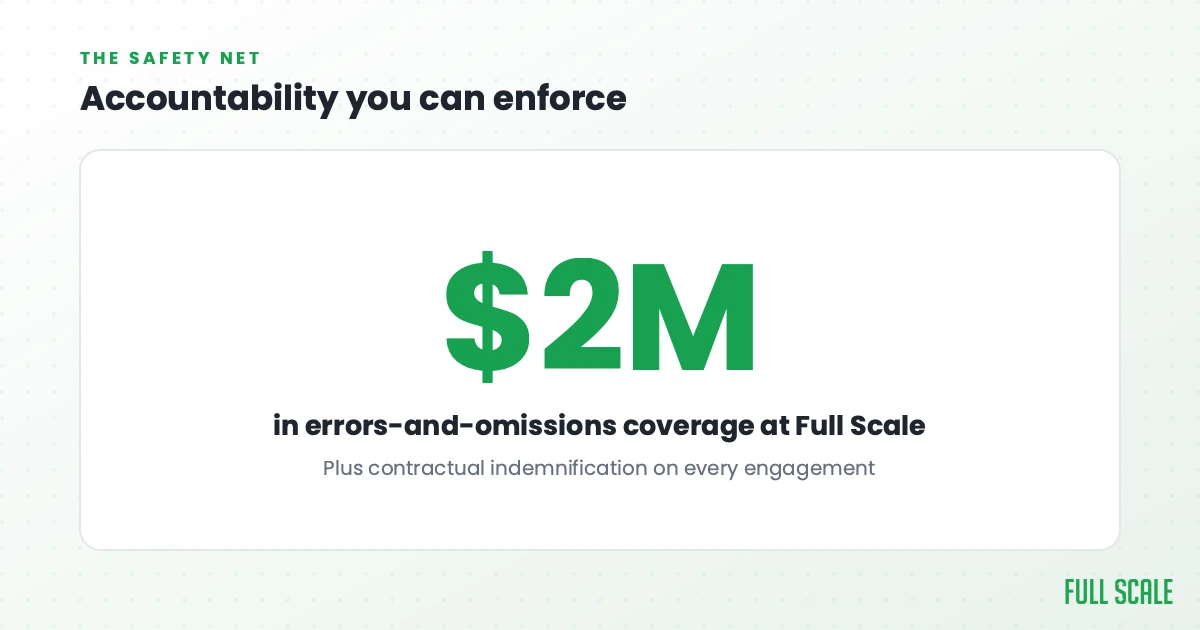
Full Scale carries $2M in errors-and-omissions coverage, and contractual indemnification puts the vendor, not you, on the hook for a developer’s IP violation.
That moves the financial risk off your balance sheet. Most freelance platforms and project shops carry little or no coverage, which means when something breaks, the cost lands entirely on you.
Separation and offboarding
The riskiest moment in any engagement is the day someone leaves. Offboarding starts within the hour: every credential is killed, devices are returned and confirmed, an exit interview restates the perpetual IP obligations, and written confirmation of no retained code goes in the file.
A clean exit is where most homemade arrangements fall apart, and where a structured one quietly does its job.
What about enforcement, the question nobody answers
A framework looks great on paper, but frameworks don’t protect you. Enforcement does that, and it’s the part most vendors won’t talk about.
So here’s the objection I hear most: sure, you’ve got contracts, but can you actually enforce them across an ocean? Most offshore vendors dodge that question. It deserves a straight answer.
You don’t sue a developer in the Philippines. You sue the U.S. vendor in a U.S. court.
Your contract is with Full Scale, a U.S. company. If a developer violates their IP obligations, the vendor is in breach of your U.S. agreement, and you pursue a U.S. company under U.S. law with standard litigation. Any developer-side enforcement in the Philippines is the vendor’s problem to handle and the vendor’s cost to carry, not yours.
There are really three layers of recourse. First, a direct breach-of-contract claim against the vendor, with liquidated-damages and attorney-fee clauses. The E&O policy can also pay out without waiting on a verdict. And any developer-level action happens in-country, run and funded by the vendor.
Here’s the honest part. We’ve never had to use any of it across 700-plus placements. The framework’s whole point is to make a violation a terrible decision before it can happen. Think about it from the developer’s side: the downside is a destroyed career, civil liability, and criminal exposure, and the upside is stolen code that can’t be sold without getting traced. When ownership is assigned cleanly from day one, the dispute never starts. The best enforcement strategy is building an engagement where you never need to enforce anything.
HIPAA, SOC 2, and GDPR with offshore teams
“We can’t go offshore, we’re HIPAA-regulated.” I hear that about once a month, and it’s a misunderstanding of how compliance actually works.
Compliance frameworks don’t ban offshore development. They require controls. And those controls are often easier to put in place with a staff-augmentation vendor than with a pile of freelancers, because the vendor is one accountable entity you can audit.
Auditors don’t care where a developer lives. They care whether you have controls, documentation, and enforcement.
HIPAA needs Business Associate Agreements, access controls, encryption, incident response, and training, all of which a real vendor executes and documents. With SOC 2, an auditor isn’t asking “is the vendor certified,” they’re asking “do you have controls over the vendor,” and audit-ready logs answer it. GDPR is the one people worry about most, and it has a real wrinkle: the Philippines isn’t on the EU’s own list of adequacy decisions, so you cover the data transfer with Standard Contractual Clauses on top of a Data Processing Agreement, plus sub-processor notice and support for data-subject requests. Penalties run up to 4% of global annual revenue, so it’s worth getting right, and it’s gettable. I walk through the whole Europe-side setup in GDPR when hiring from Europe.
Five questions to ask any offshore vendor
Understanding the framework is one thing. You still need a way to tell whether a given vendor actually delivers it, because most of the contracts I’ve read have real gaps under the marketing.
If a vendor can’t answer these five clearly and fast, they don’t have answers, they have marketing copy they’ve never had to defend.
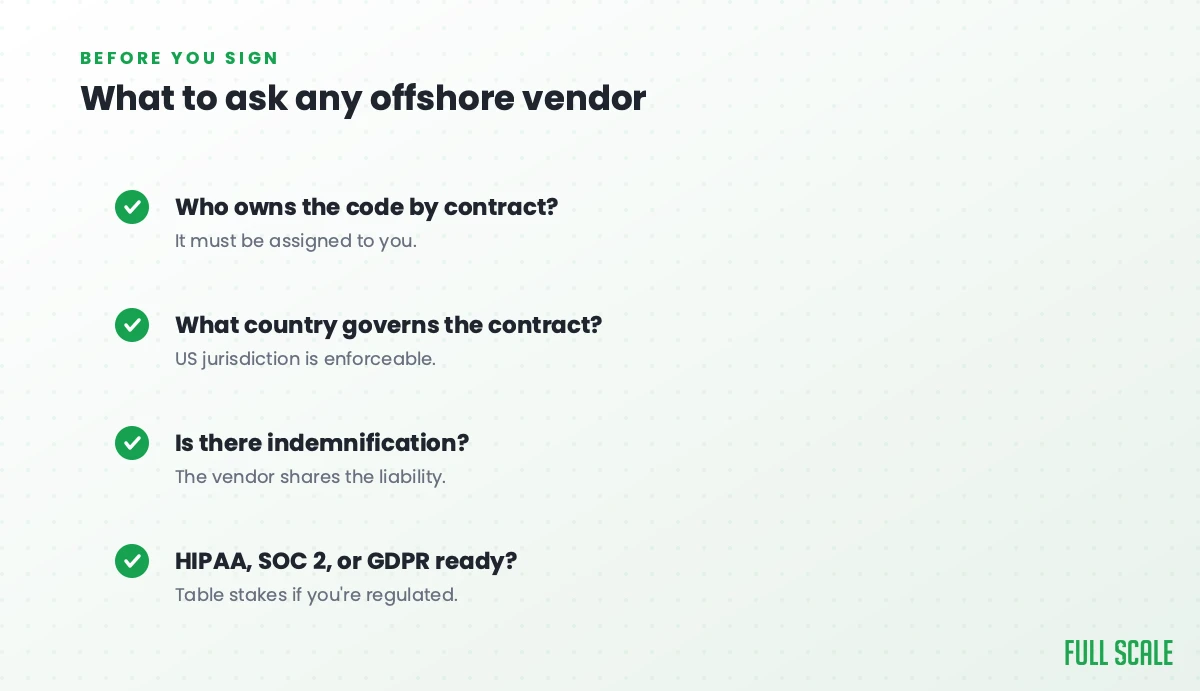
- What jurisdiction governs my contract? Right answer: U.S. law, and you’d sue us in U.S. courts. Wrong answer: “it depends,” or “international arbitration.”
- Who directly employs the developers? Right answer: we do, as full-time employees assigned to you. Wrong answer: they’re independent contractors.
- Show me your IP assignment language. Right answer: here’s the actual clause showing immediate, unconditional transfer. Wrong answer: “it’s in our standard agreement,” but they won’t show it.
- What happens to my IP if you shut down? Right answer: you already own it, our status changes nothing. Wrong answer: “we’d transfer it during wind-down.”
- Do the developers work only for me? Right answer: only for you. Wrong answer: “they work across projects to optimize utilization.”
A few contract terms should make you walk away on the spot. If IP only transfers “upon final payment,” your code is being held for ransom. Foreign governing law leaves you unable to enforce anything without international litigation, and “developers are independent contractors” is a quiet admission of split loyalty, no insurance, and no real oversight. The trap that catches the most people is an NDA sitting there with no IP assignment beside it, which hands you confidentiality but leaves ownership fuzzy.
This is the line between real protection and rolling dice with the cheapest bidder. Speaking of which: hiring the absolute cheapest developer you can find almost never works. I call that cheapshoring, and it’s a different mistake from going offshore. The real win is hiring high-quality talent globally, at quality parity, from a vendor you trust, not chasing the lowest hourly rate from a shop with none of the layers above. If you want the longer version of that argument, it’s the heart of the case for offshore done right.
When offshore isn’t the right call
We turn down clients when offshore isn’t a fit, because honesty earns more trust than a promise I can’t keep. There are real cases where this framework isn’t enough.
If your software falls under ITAR (International Traffic in Arms Regulations), offshore is legally off the table no matter how airtight your contracts are. A stealth-mode startup whose entire edge is that nobody knows what it’s building may not want the extra surface area until after launch. Certain export-controlled technologies, like advanced cryptography or sensitive AI work, need a legal review first. And a team that genuinely can’t work asynchronously, and needs constant real-time pairing, will feel the time-zone gap, though that’s a workflow problem, not an IP one.
Outside those cases, the framework holds. General IP worry is exactly what it’s built to solve, compliance with HIPAA, SOC 2, and GDPR is reachable, and a skeptical legal team usually signs off once it reads the actual contract structure.
So, what country is your contract in?
Most CTOs think their current setup is safer than it is. A marketplace freelancer usually comes with a thin platform agreement, no exclusivity, no technical controls, and no insurance. The local contractor has a state-level agreement, several other clients, and often no background check at all.
A properly structured offshore engagement through staff augmentation beats both of those, and it stands shoulder to shoulder with a great in-house hire. You get U.S. contracts, developers who work only for you, deep vetting, technical controls as standard, insurance behind it, and a real offboarding process. It’s how our AMC Theatres developers work as one team with their in-house engineers, and how the day-to-day of managing an offshore team ends up looking the same as managing anyone else.
One caveat: I run a staff-augmentation company, not a law firm. Treat this as the informed read of someone who has structured hundreds of these engagements, not as legal advice, and have your own counsel review any contract before you sign it.
So the question was never “can offshore protect my IP.” It’s “which model protects it best,” and the honest answer is staff augmentation with a U.S. vendor and direct integration. If you want to compare your current setup against that, talk to us about offshore development and we’ll walk your legal team through the actual contract, or read more on hiring offshore developers the right way.
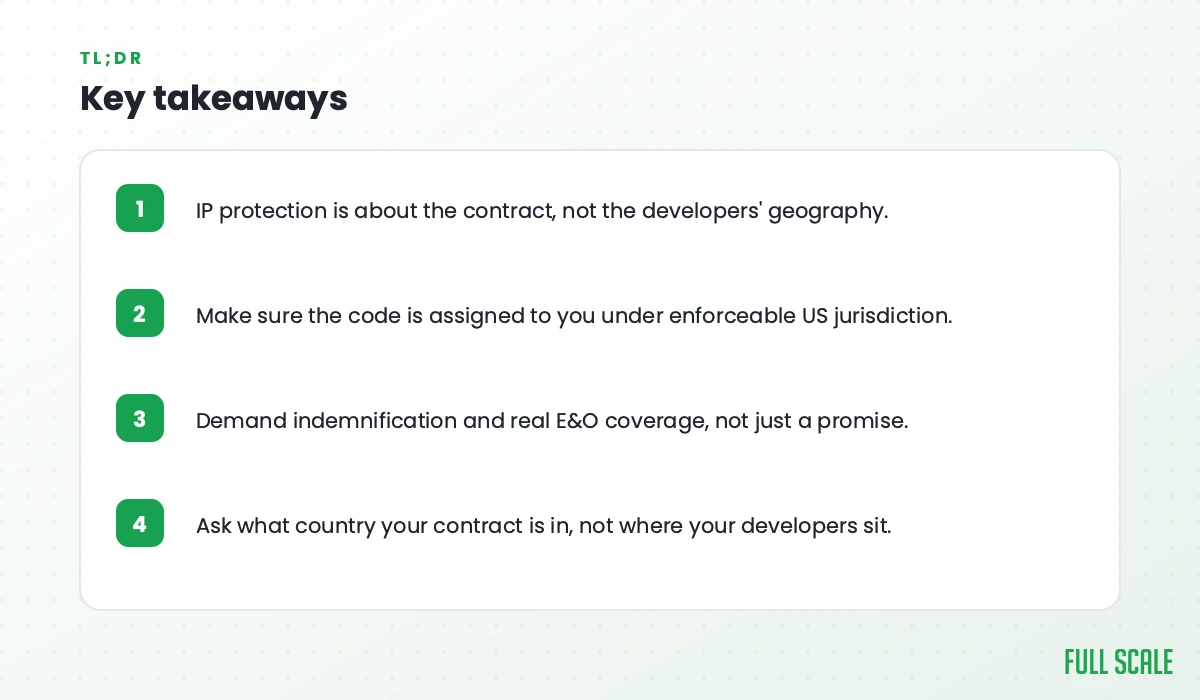
Geography doesn’t determine IP risk. Your engagement model does.
FAQ
Can offshore developers steal my source code?
It’s possible under the wrong engagement model, but the risk comes from how a developer is engaged, not where they live. A freelancer or an overseas project shop rates high on theft risk in practice, because the contract is thin and enforcement across borders is expensive or impossible. A U.S. staff augmentation vendor rates low: the developer is a full-time employee under a U.S. contract, bound by a perpetual NDA with liquidated damages, and the federal Defend Trade Secrets Act lets you sue for trade-secret theft regardless of where the person lives. The engagement model is the real control, not the passport.
Use a layered model rather than a single NDA: a U.S. contract jurisdiction, immediate IP assignment, real background vetting, role-based technical access controls, perpetual NDAs, E&O insurance, and a secure offboarding process. Together these create stronger protection than most local-contractor setups. Across 700-plus Full Scale placements since 2018, there have been zero IP incidents.
Who owns the code my offshore developers write?
You do, immediately and unconditionally, as long as the contract uses work-for-hire plus an explicit IP assignment clause. Ownership should transfer the moment code is written, not after project completion and not after final payment. Reject any agreement that ties IP transfer to payment or uses “license” language instead of “assignment.”
Are NDAs enforceable with offshore developers?
Yes, when the contract is with a U.S. vendor. If a developer breaks confidentiality, the U.S. vendor is in breach of your U.S. agreement, so you litigate against a U.S. company under U.S. law rather than chasing an individual through a foreign court. The vendor handles any developer-level enforcement in-country.
Is offshore software development safe for IP if I’m HIPAA or SOC 2 regulated?
Yes. Neither HIPAA nor SOC 2 prohibits offshore development; both require controls. A real vendor signs Business Associate Agreements, implements encryption and access controls, keeps audit-ready documentation, and supports your vendor risk assessment. Auditors evaluate your controls over the vendor, not the developers’ location.
What’s the biggest IP mistake companies make when outsourcing development?
Treating geography as the risk and an NDA as the solution. The actual risk is the engagement model: a freelancer or project shop with split loyalty, foreign jurisdiction, and payment-tied IP transfer is far more dangerous than a vetted developer working under a U.S. staff-augmentation contract, wherever they happen to live.