
Managing Distributed Teams: How to Lead Local and Offshore Developers as One Team

In this article
- Most distributed teams fail before anyone writes a line of code
- Keep your technical leadership in-house
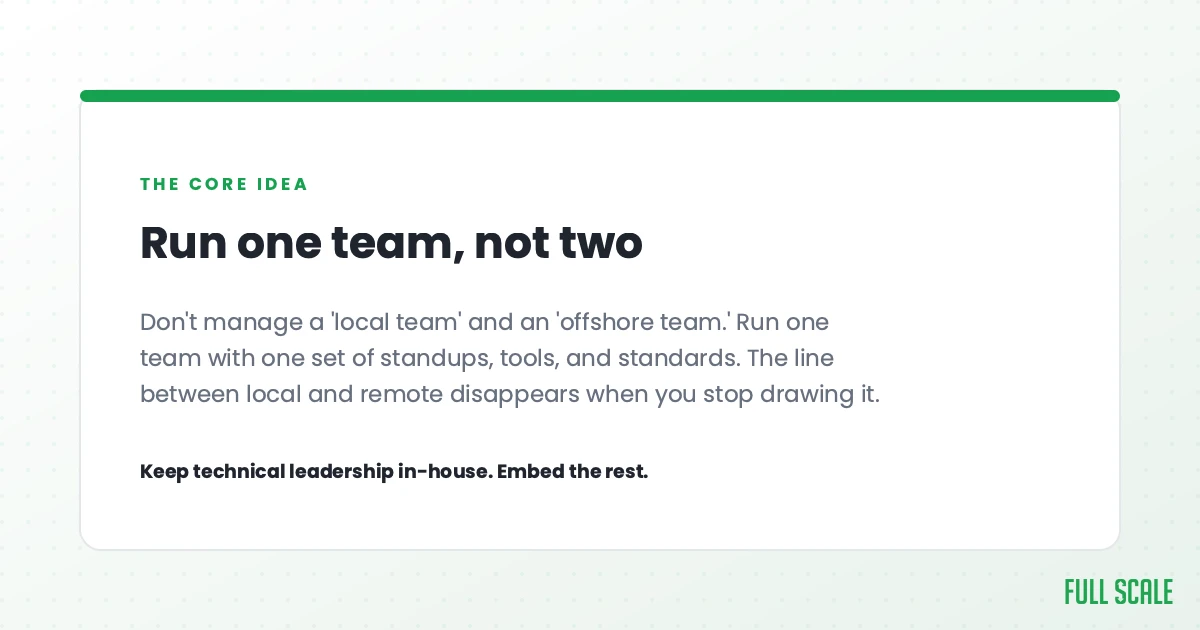
- Run one team, not two
- The hardest part of managing local and distributed teams is a culture change
- Time zones are a design problem, not a dealbreaker
- Communication is the whole job
- Treat your offshore team like employees, not resources
- What it costs and what you actually get
- Best practices for managing distributed teams, in one list
- The bottom line
- Frequently asked questions
- Ready to build your distributed team?
Quick Answer: Managing a distributed team across time zones comes down to picking one overlap pattern on purpose, half-day overlap, full US hours, or async-first with a short daily handoff window, then building your process around it. Reserve shared hours for what genuinely needs everyone live: planning, thorny technical decisions, pair programming. Push everything else into async channels. Full Scale staffs all three patterns, with most clients surprised how little real-time overlap they actually need to run one team, not two.
The hardest part of managing a distributed team isn’t the time zones, and it isn’t the hiring. It’s that you quietly end up running two teams instead of one, and most leaders don’t notice it happening until the two halves have stopped talking to each other. It also helps to understand why offshore developers sometimes go quiet instead of flagging a problem early.
You keep your local team close because they’re right there in front of you. The offshore group sits on the other side of a wall, gets handed work, and slowly turns into a separate unit you manage at arm’s length. That blend of local and offshore staff is what a lot of people mean by a hybrid team, and managing hybrid teams falls apart at exactly this point. The failures almost never come down to the people offshore being bad at the work.
I would know. I’ve hired developers in Russia, Belarus, Uruguay, Colombia, India, Pakistan, and the Philippines, and the experiments that fell apart fell apart for the same reason every time: I was running two teams that happened to share a codebase and calling it one.
Managing distributed teams well comes down to a single decision: you run one team, not two. The catch is that this asks more of you than it asks of anyone offshore, because it means changing how your whole company communicates, not just how you treat the people who sit far away. This guide is written for engineering leaders, since that is where I’ve lived it, but the playbook holds for almost any offshore team. It walks through how to actually do that when half your team sits near you and the other half sits eleven time zones away, hired through offshore staff augmentation rather than a project-based outsourcing contract. I’ve built this model at Full Scale, and I’ve watched our clients build it too.
Most distributed teams fail before anyone writes a line of code
The damage is usually done at the buying stage, not the managing stage.
Here is the pattern I see over and over. A company decides it needs more capacity, usually in engineering. Local hiring is slow and expensive, so they look offshore. They find an outsourcing firm, write up a pile of requirements, hand it over, and expect a finished product to come back. Most offshore collaboration fails for exactly this reason. You can’t toss a spec over a wall and call it a team.
The fix is structural, and you make it before you sign anything. There are two very different ways to bring in an offshore team, and they lead to completely different outcomes.
| Project outsourcing | Staff augmentation | |
|---|---|---|
| What you buy | A finished deliverable | People who work on your team |
| Who manages the work | The vendor’s project manager | Your own leadership |
| Who talks to the team | Usually one middleman | You, directly |
| Time horizon | One project, then it ends | Long-term, like any employee |
| Who owns the work and the context | The vendor | You |
Staff augmentation is the right way to do this if you already have local talent and want to scale the team around it. You bring people on to work directly for you on a long-term basis, not for a single three-month project. That one choice decides whether you end up with a team you can lead or a vendor relationship you have to manage. If you want the longer version of that argument, we wrote a full breakdown of staff augmentation versus outsourcing, but the short version is: pick the model that lets the offshore team become part of your team.
Keep your technical leadership in-house
You always need technical leadership in-house. This is the part people get wrong when they go all-in on offshore and try to buy the leadership layer too.
The architecture decisions, the product vision, the calls about what matters this quarter and what can wait, those stay with your people. When you outsource the thinking along with the typing, you lose the thread of why the work exists, and the offshore team is left guessing. Keep the senior decision-making local, and let the distributed engineering team execute against a clear direction set by leaders who understand your business. This is the through-line in everything I’ll say about managing an offshore team: direction stays with you, execution scales offshore.
This is also where the middleman problem shows up. At a lot of offshore firms, you only ever talk to one project manager. Everyone else on the team hides behind that person, either because of an English gap or because of a cultural rule about who is allowed to talk to the client. You end up with a team you can’t actually communicate with, and a middleman in the way of every decision. Nobody on the team feels like they own anything, because they don’t.
The model that works removes the wall. Your offshore team reports into your leadership the same way your local people do. There’s no middleman in between, and they care about the work the same way the in-house staff do. That is what makes offshore actually work.
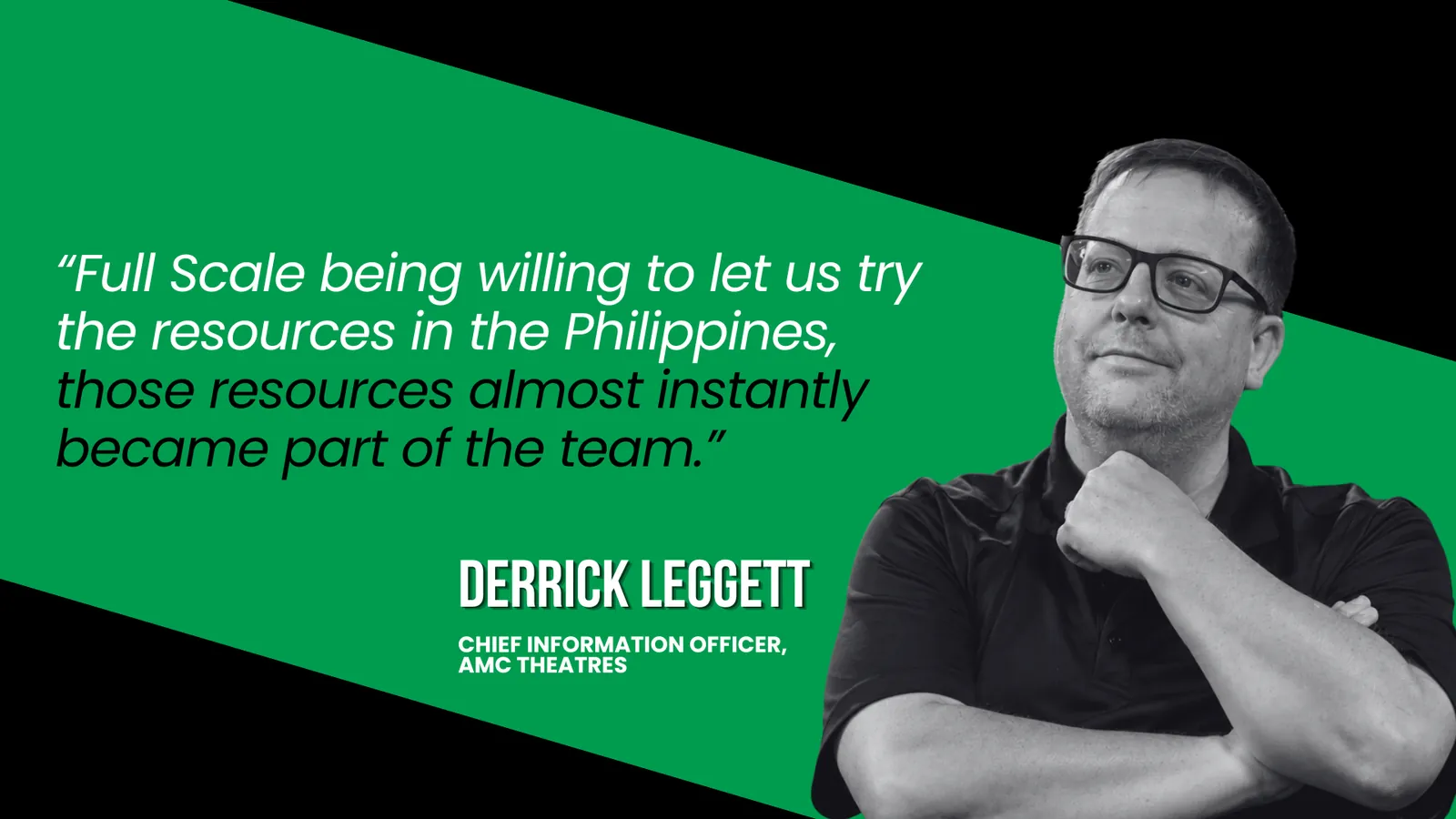
Derrick Leggett, the CIO at AMC Theatres, put it better than I can. He has built a global engineering organization with developers in the US, South America, India, and the Philippines, and he describes it like this: “It’s a fully integrated team. It’s just some of the people happen to be living in the Philippines.” That is the whole philosophy in one sentence.
Run one team, not two
Once leadership stays in-house and the middleman is gone, managing distributed teams becomes a question of integration. The goal is simple to state and hard to fake: a new developer in Cebu and a new developer in Kansas City should have the same first week.
That means one set of everything.
- One source of truth. Same project board, same docs, same repo, same definition of done. Not a local board that the offshore team copies from.
- One standup. Offshore developers join your existing standup during overlap hours. You don’t run a separate offshore standup and relay notes.
- One code review standard. Every pull request gets reviewed the same way, by reviewers on both sides, against the same bar.
- One Slack, one set of channels. Side conversations that happen only in the local office are how silos form.
- One onboarding. The same environment setup, the same architecture walkthrough, the same buddy system, regardless of where the new hire sits.
When I look at why offshore worked for me at Stackify after failing so many times before, it came down to three things, and two of them are about exactly this. First, location: I stopped treating every country as interchangeable and found a place where communication actually worked. Second, teams not projects: I hired people to join my team, not vendors to deliver a project. Third, team structure: I had local technical leads managing the distributed group as one unit. That structure is the part you control as the manager, and it is the part that separates a team that ships from a group of contractors who wait for tickets. It is also why one good offshore developer is not enough by itself.
If your team works well remotely, it will work well globally too. The same habits decide whether team collaboration holds up across an ocean. The habits that make remote work, written communication, clear ownership, async-friendly process, are the same habits that make a distributed team work. Geography just raises the stakes on getting them right. For the practical mechanics of folding new offshore developers into an existing group, we cover the first 90 days of integration in detail.
The hardest part of managing local and distributed teams is a culture change
This is where running one team gets genuinely hard. The trouble starts when you have spent years running an all-in-office company and then you hire a few people who work remotely.
Your in-office team gets all the natural conversations, the ones that come from people bumping into each other in the hallway or talking something out over a desk. The offshore team isn’t there for any of it, so they get left out. They don’t get cut out on purpose. It’s just that the office is where half the decisions quietly get made, and they’re not in the office.
Fixing that takes a real culture change, and it’s a hard one. You have to run the team as if it’s remote-first, even on the days when some of you are sitting in the same building. Every decision that matters, and every bit of context behind it, has to land somewhere written down. It is the hardest part of building a remote work culture that includes the people you cannot see.
If something gets decided in a hallway and never makes it into Slack or the docs, you don’t really have a distributed team. You have an in-office team with a few people watching from the outside.
The other trap is out of sight, out of mind. It is genuinely easy to forget about the people you can’t see. You under-train them, you skip the casual check-ins, you forget to loop them in, and none of it is because you don’t care. They just aren’t in front of you. Managing a distributed team means working harder at the thing a co-located manager gets for free, going out of your way to spend more time with the offshore team than feels strictly necessary, because the building isn’t doing it for you.
Some things you flat out can’t do the same way either. When something is on fire at an all-in-office company, you can pull everyone into a conference room and say nobody goes home until it’s fixed. That move doesn’t really exist on a distributed team. You can’t manufacture the same stay-late, solve-it-together energy across a few time zones, so you have to plan for the crunch ahead of time instead of leaning on proximity to force it.
Time zones are a design problem, not a dealbreaker
The objection I hear most about managing geographically distributed teams is the clock. The Philippines runs about 14 hours ahead of my office in Kansas City. People assume that gap kills collaboration. It doesn’t, as long as you treat it as something to design around instead of something to complain about. That is what managing remote teams across time zones really comes down to.
At Full Scale we staff three overlap patterns, and most clients are surprised by how little overlap they actually need.
- Half-day overlap. The most common setup, with four to six shared hours. Enough for standups, planning, and real-time problem solving, with the rest of the day for heads-down work.
- Full US hours. The team works a US-aligned schedule, sometimes the 9 PM to 5 AM Philippine “graveyard shift,” when you need constant real-time contact.
- Async-first with a daily overlap window. A short shared block for the standup and handoffs, with the bulk of the work documented and handed off across the day.
The trick is to pick the pattern on purpose and then build your process to fit it. Reserve your shared hours for the things that genuinely need everyone live, like thorny technical decisions, planning, and remote pair programming. Push everything else, status updates, code review, documented decisions, into async channels where the time gap stops mattering. A team that runs this way often gets more done than a co-located one, because the time difference forces the kind of written clarity that sloppy in-person teams never bother with.
A shared async stack, Slack for day-to-day channels, Loom for quick video handoffs, a single source of truth for decisions, matters more than the hours on the clock; see our breakdown of asynchronous communication tools for developers for the specific stack.
Communication is the whole job
Running a distributed team is about communication more than anything else, and it surfaces the same communication challenges in software development that show up on any team, just with the volume turned up. With engineers I would put that above raw coding skill when I size up a team, and it is the single biggest predictor of whether managing distributed teams will work for you.
A few things matter more than the hourly rate on anyone’s invoice. English fluency matters. Cultural expectations matter. And whether someone will speak up when they don’t understand something, or push back when the spec is wrong, matters most of all. A team member who silently builds the wrong thing for two weeks because they didn’t want to ask a question costs you far more than the few dollars an hour you saved.
Mike Paradela, one of our customer success managers at Full Scale and a twenty-year veteran of software, says the same thing to his teams in plainer words:
“The client doesn’t care how pretty your code is. The real question is, did you deliver it at the right time, and is it working? You use Facebook. You don’t care how it’s implemented. You care that when you post something, people see it.”
That is a communication habit before it is a technical one. A distributed developer who keeps the outcome in view, not just the ticket, is one you can trust across a time zone.
This is a big part of why the Philippines works so well for distributed engineering teams. There’s no language barrier. Filipino developers speak English fluently and grow up consuming American culture, so the communication is top notch and the cultural distance is small. It is also why the Philippines is the third-largest English-speaking country in the world and a natural fit for hiring developers who slot into a US team.
Get distributed team communication right and most of the other problems get smaller. Two habits make it work in practice:
- Video calls are non-negotiable. On a distributed team you need to see whether someone actually understood you. A thumbs-up emoji is not confirmation. Faces are.
- Build a speak-up culture on purpose. Ask questions in a way that makes it safe to admit confusion. Reward the person who flags a bad requirement early. The whole point is to surface misunderstanding before it becomes a two-week detour.
Treat your offshore team like employees, not resources
The fastest way to wreck a distributed team is to treat half of it as disposable. The moment your offshore team senses they are “resources” on someone else’s spreadsheet, you lose the ownership that makes the model work.
So invest in the relationship the same way you would with a local hire. Include them in the roadmap conversations. Give them real features to own, not just the tickets nobody else wanted. Bring them to the offsite when you can. When AMC sent a group from Kansas City to our office in the Philippines, they spent time doing karaoke with the engineers, went to the beach, and explored the city together. We keep that same spirit going day to day through things like the employee clubs our team runs itself, from esports nights to weekend hikes. That kind of investment is not a perk. It is what turns a distributed group into a team that has each other’s backs.
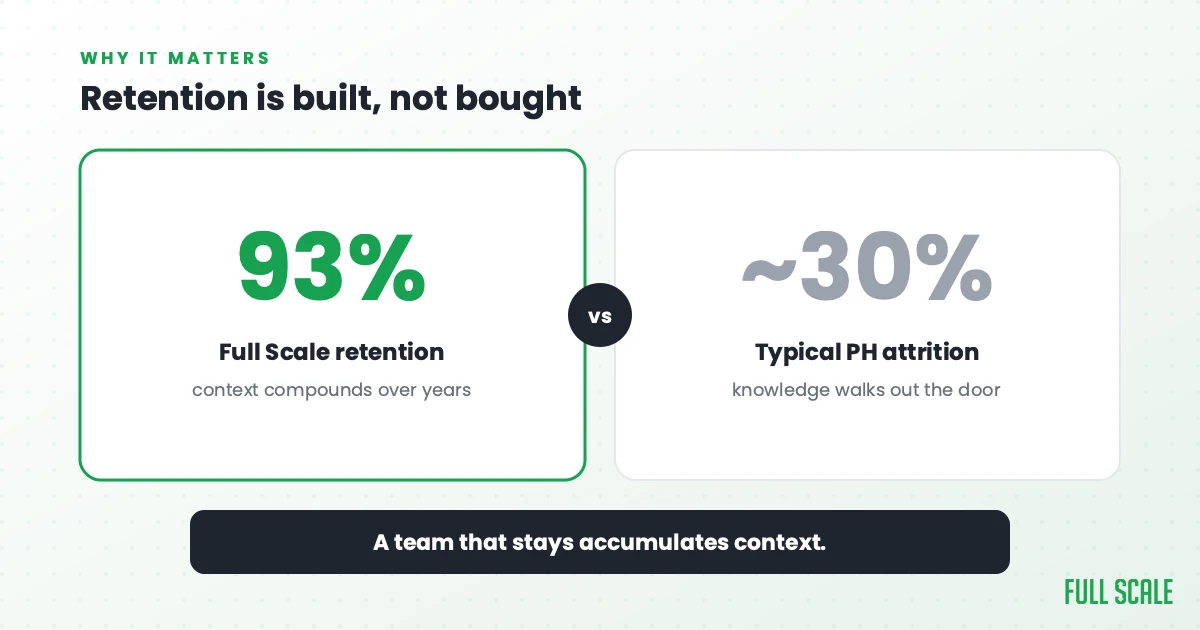
This is also why having someone responsible for the health of the relationship pays off. At Full Scale we put a Customer Success Manager on every engagement whose job is half about making sure the client gets what they need and half about making sure the engineers are happy and supported. They handle the awkward conversations that a client can’t easily have with an offshore engineer directly, and that an engineer is often too polite to raise with the client. It is a quiet role that does a lot of the work behind our 93% developer retention. It also shows up in the culture: Full Scale is Great Place to Work Certified in the Philippines, where 95% of our employees say it’s a great place to work, compared to 65% at a typical company there.
That retention number matters more than it looks. Turnover in the Philippine call-center and outsourcing industry is brutal, with voluntary attrition running around 30% in recent years. Keeping a distributed team together at 93% means your offshore team actually accumulates context instead of churning out the door every nine months. A stable team is a manageable team. For more on what poor retention quietly costs you, we broke down the hidden costs of remote development.
What it costs and what you actually get
The economics are the reason most leaders look offshore in the first place, and they are real. Roughly 90% of software developers don’t live in the US, according to the Stack Overflow Developer Survey, so insisting on local-only hiring means competing for a tiny slice of the world’s talent in the most expensive market there is.
A senior US developer runs $80 to $150 an hour all-in. A senior Filipino engineer through a staff augmentation partner runs more like $30 to $40 an hour for the client. That is a 50 to 70% difference, and it comes from cost of living, not skill. The same engineer who would cost you a fortune in San Francisco does the same quality of work for a fraction of the price, and earns a great living locally while doing it.
None of that helps if US hiring stays the bottleneck. With annual US tech turnover sitting around 13 to 15% and senior roles taking months to fill, augmenting your local team with offshore developers is often the only way to scale without grinding to a halt. If your company can afford it and you already have local talent, augmenting that talent with offshore developers is the best formula I know.
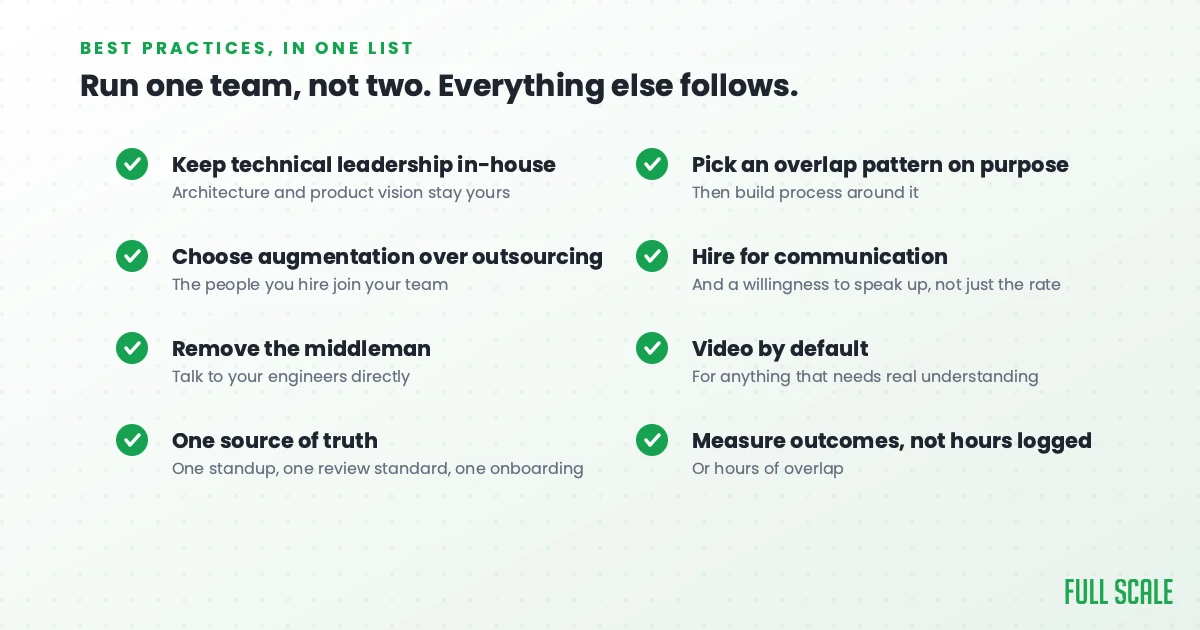
Best practices for managing distributed teams, in one list
If you want the short version to pin above your desk, here is what good distributed team management actually looks like in practice.
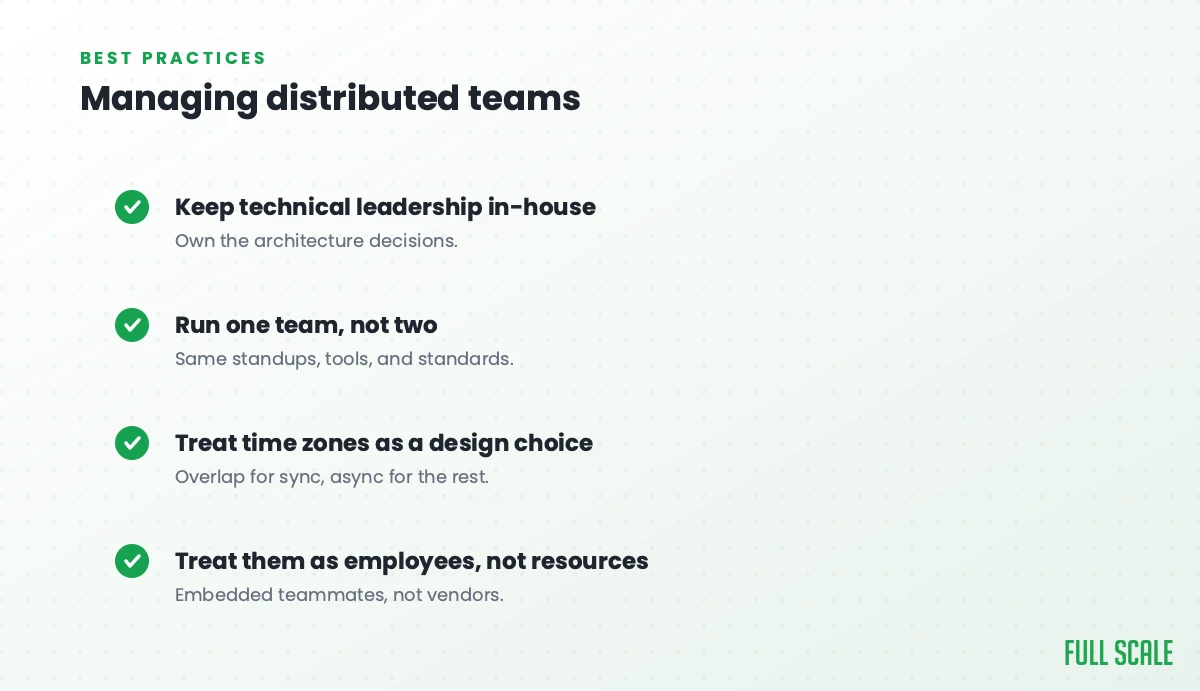
- Choose staff augmentation over project outsourcing so the people you hire join your team.
- Keep architecture, product vision, and technical leadership in-house.
- Remove the middleman. Talk to your team directly.
- Run one source of truth, one standup, one code review standard, one onboarding.
- Pick a time-zone overlap pattern on purpose and build process around it.
- Hire for communication and a willingness to speak up, not just for the rate.
- Make video calls the default for anything that needs real understanding.
- Treat your offshore team as long-term colleagues, not disposable resources.
- Give someone clear ownership of the relationship’s health.
- Measure outcomes and delivery rather than hours logged or hours of overlap.
Do those ten things and the distinction between your local and offshore team starts to disappear, which is exactly the point. The book I wrote, Product Driven, goes deeper on the ownership and clarity habits that make any engineering team, distributed or not, build the right thing instead of just building fast.
The bottom line
The companies that win with distributed teams aren’t the ones with the cleverest tooling or the most generous overlap hours. They’re the ones who stopped thinking of their offshore team as a separate thing to be managed and started treating them like the rest of their staff. Run one team, not two, and most of the hard problems of managing distributed teams quietly solve themselves.
Frequently asked questions
What is the most important factor in managing distributed teams successfully?
Communication, by a wide margin. Running a distributed team is about communication more than anything else, and the cost of a misunderstanding multiplies once people aren’t in the same room. English fluency, clear written documentation, and a culture where people feel safe asking questions and pushing back on bad requirements matter more than the hourly rate. Hire for communication first, run video calls for anything that needs real understanding, and build a single source of truth so nobody is guessing.
Is staff augmentation or outsourcing better for distributed teams?
Staff augmentation is the better fit when you already have in-house talent and want to scale around it. With staff augmentation you bring on an offshore team that works directly for you, under your own leadership, on a long-term basis. Project outsourcing hands a set of requirements to a vendor who returns a deliverable, which removes your control over the work and the context. If your goal is one integrated team rather than a vendor relationship, choose staff augmentation.
How is managing hybrid teams different from managing distributed teams?
In practice they are the same job. A hybrid team is just a distributed team where some of the people sit in your office and some sit offshore, so managing hybrid teams runs into the same questions as any distributed team: one source of truth, one standup, one code review standard, and leadership that stays in-house. The mistake people make is assuming the local and offshore halves need different rules. They don’t. Run one team, hold everyone to the same bar, and the line between your local and offshore team stops mattering.
How do you handle time zones when managing distributed teams?
Treat the time gap as something to design around. Pick an overlap pattern on purpose, whether that is a half-day overlap of four to six shared hours, a fully US-aligned schedule, or an async-first setup with a short daily overlap window. Reserve the shared hours for work that genuinely needs everyone live, such as planning and hard technical decisions, and move status updates, code review, and documented decisions into async channels. Most teams need far less real-time overlap than they expect, a pattern the research on offshore developer productivity backs up independently.
How do you keep an offshore team from feeling like second-class team members?
Run one team instead of two. Use the same project board, standup, code review standard, and onboarding for everyone regardless of location. Give the offshore team real work to own, include them in roadmap discussions, and invest in the relationship with in-person visits when you can. Treating offshore staff as long-term team members rather than disposable resources is what earns their ownership and keeps retention high. Getting that right starts with a deliberate process for onboarding remote developers from day one.
Ready to build your distributed team?
If you have an in-house team and want to scale it with senior offshore developers who work as one team with your local engineers, that is exactly what we do. Schedule a call with Full Scale and we’ll talk through how to make it work for your org.