
How We Keep Developer Retention at 93% With Offshore Teams

In this article
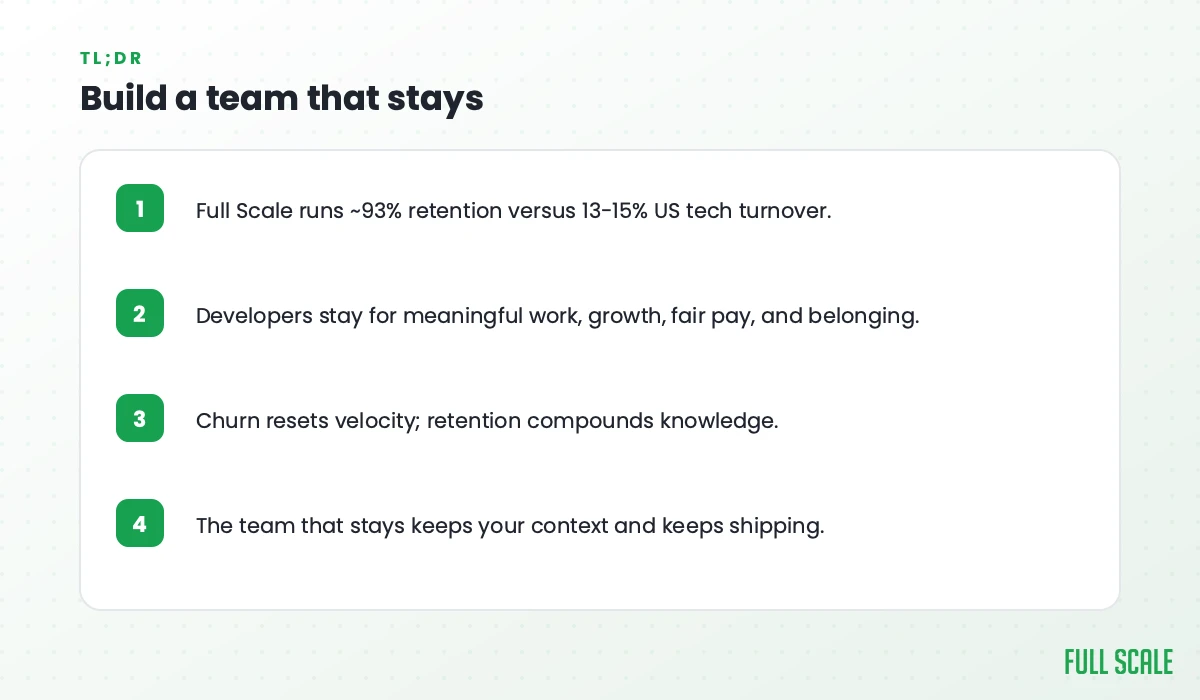
Quick Answer: Developer retention measures how many engineers stay on a team from one year to the next. The US tech industry loses 13 to 15% of its engineers annually, per the Bureau of Labor Statistics. Full Scale keeps about 93% of engineers year over year, less than half the industry’s turnover, by hiring engineers as full-time staff, paying at the top of the local market, and giving every engagement a dedicated Customer Success Manager.
Most people think offshore teams churn because they are offshore. I used to think that too. The same holds when managing an offshore backend team: retention is a management outcome, not a location problem. That retention is a security advantage too: the people who stay are the people you have already vetted. Keeping people matters even more given the shift toward global engineering teams.
Before Full Scale, I ran engineering at Stackify, and I hired developers in four countries to get there: Uruguay, Colombia, Russia, and the Philippines. Some of those bets worked and some of them were a mess. The mess always came down to how the relationship was set up, never the country itself. Retention matters just as much when you augment your team, and staff augmentation turnover is the number one reason clients tell us they're building a knowledge transfer plan and leaving their last vendor.
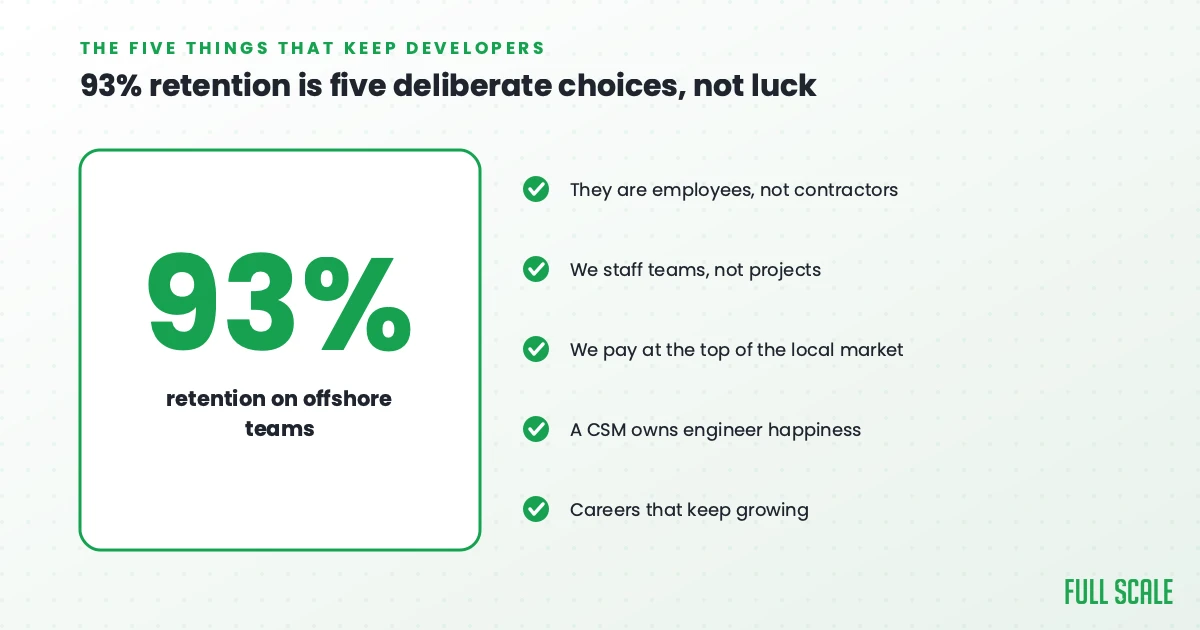
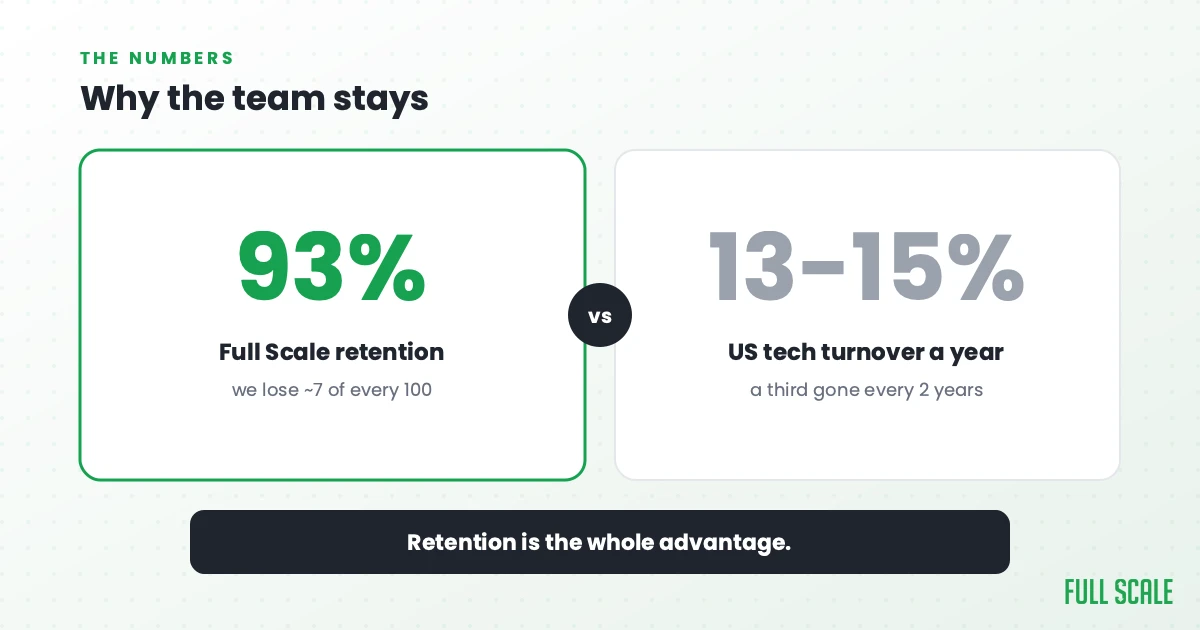
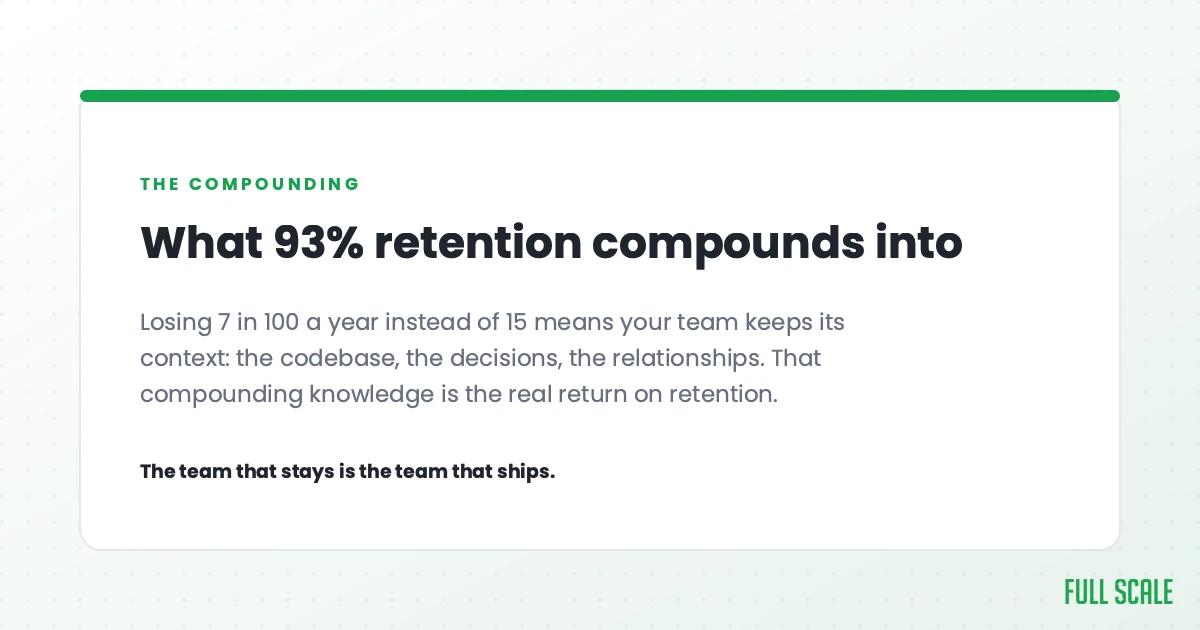
That is the whole point of this post. Developer retention is a function of your management model, not your map. Our developer retention runs about 93%, which means we lose roughly 7 of every 100 engineers in a year. The US tech industry loses 13 to 15% annually, according to the Bureau of Labor Statistics. So we keep people about twice as long as the typical shop, with a team based on the other side of the world from most of our clients.
Here is how that actually works, and just as important, here is where it stops working.
What a 93% Developer Retention Rate Actually Means
Developer retention rate is the share of your engineers still on the team a year later. If you start the year with 100 and 93 are still there twelve months on, that is 93% retention.
It sounds like a small gap. It is not.
A team that loses 15% a year is replacing about a third of its people every two years. Every one of those departures costs you more than a salary. You pay to recruit, you pay while the role sits open, and you pay again for the months it takes a new hire to learn your codebase. For a senior engineer, the all-in cost of losing and replacing one person runs well into six figures once you count the lost momentum on whatever they were building.
The expensive part is rarely the recruiting fee. It is the project that slips because the person who understood the payments service walked out the door.
The Five Things That Actually Keep Developers
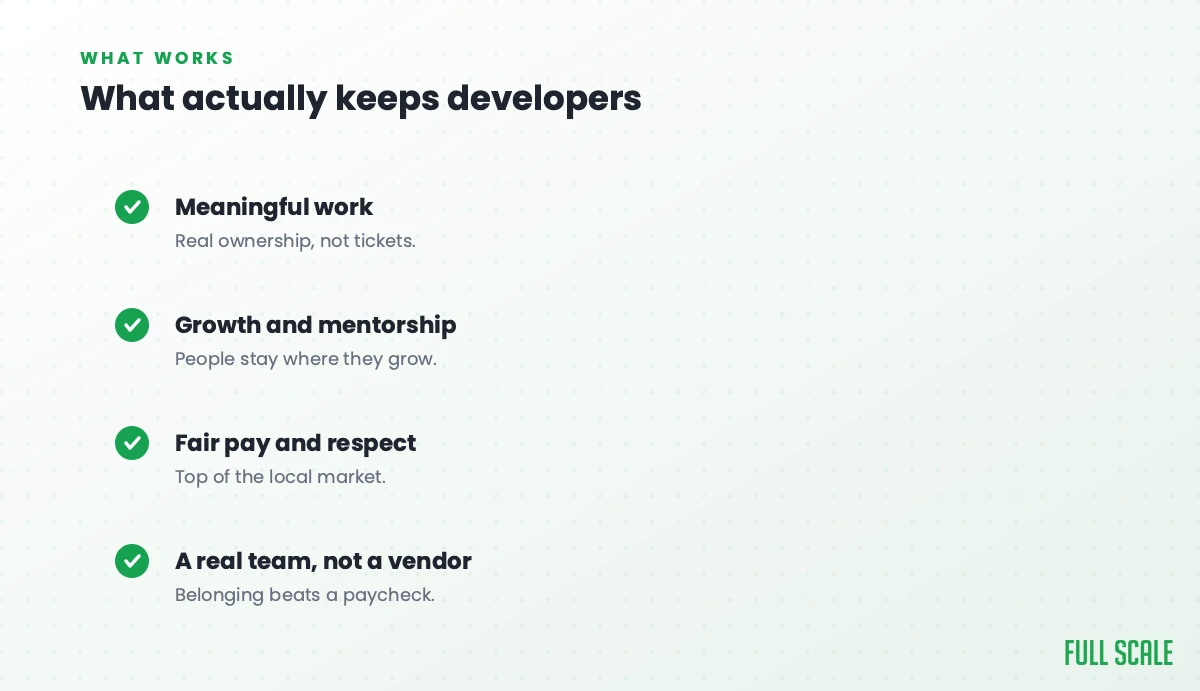
We did not land on 93% by accident, and there is no single trick behind it. It comes from five choices that most offshore shops get wrong on purpose, because getting them right costs money.
1. They Are Employees, Not Contractors
Our developers are full-time Full Scale employees, not contractors. Contractors behave like contractors: they know the work is temporary, so they treat it that way, and the good ones leave the moment a better gig shows up.
They get real benefits: health coverage for their families, paid time off, and the 13th-month pay that is standard in the Philippines. When someone has a stable job they want to keep, they write better code and they stay. We do it because it is the cheapest retention tool there is, not out of generosity.
This is also the core difference between staff augmentation and hiring independent contractors, and it is the first thing I tell founders to think about before they post a job on a freelance marketplace.
2. We Staff Teams, Not Projects
We staff dedicated teams, not projects, the opposite of traditional outsourcing. Traditional outsourcing sells you a project: you hand over a spec, a vendor assigns whoever is on the bench, and when the project ends those people rotate off to someone else’s work. Nobody on that team has a reason to care about your product six months from now. That team-versus-project distinction is the whole game.
Your developers join your standups, your Slack, your planning. They are your team, they just happen to work from the Philippines.
I have talked to founders running offshore teams where they only ever spoke to one person, the technical project manager, while every other developer hid behind that person. Sometimes it was a language gap, sometimes a rule about who is allowed to talk to the client. Either way you end up with a team you cannot actually communicate with. That setup kills retention, because an engineer treated like a hidden resource has no reason to stick around. If you want the longer version of how to run this well, I wrote it up in our guide to offshore team management.
3. We Pay at the Top of the Local Market
We pay at the top of the local market, while most offshore companies race each other to the bottom on price and then act surprised when their developers leave for a 10% raise somewhere else.
Our senior engineers earn the most. That is not a Silicon Valley salary, and I am not going to pretend it is. But when you hire senior developers in the Philippines, that pay is a genuinely good living. The country is also the third-largest English-speaking nation in the world, per the Philippine Embassy, so the communication gap people worry about mostly is not there.
Here is the context that makes that real. My brother-in-law in the Philippines works at Jollibee, the biggest fast food chain in the country, for about $1.25 an hour. My sister-in-law works as a virtual assistant for $5 an hour, four times what he makes. A senior engineering salary on top of that is life-changing, and people do not walk away from life-changing.
I call the result a win-win-win: a win for the developer who gets a real career, a win for the client who gets senior talent at a sustainable cost, and that is what makes it a win for us. You can see exactly what that costs on our pricing page, because we do not hide it.
Here is the other half of that math, the part the client sees. A senior Full Scale engineer bills at a fraction of a comparable US hire, with benefits, equipment, and recruiting already included in the rate.
| Full Scale senior engineer | Comparable US senior hire | |
|---|---|---|
| All-in hourly rate | $30 to $40 | $80 to $150 |
| Benefits, equipment, recruiting | Included in the rate | Added on top |
| Typical annual retention | 93% | 85 to 87% (industry average) |
4. A Customer Success Manager Owns Engineer Happiness
This is the piece almost nobody else does, and it is the one I would bet the most money on.
Every engagement gets a Customer Success Manager whose job is half about the client and half about the engineers. They make sure the client is getting what they actually want, and they make sure the developers feel supported. That structure is a big part of why we don’t run our business like a call center. A CSM is the relief valve for the conversations neither side can have directly.
A client often cannot tell an offshore engineer that something is going sideways without it landing wrong. An engineer often will not tell a client they are overloaded or unclear on a spec. The CSM sits in the middle and has both of those conversations before they turn into a resignation. I am convinced our CSMs are a big part of why 93% holds up year after year.
5. Careers That Keep Growing
We rotate engineers across projects and stacks so they keep growing without changing employers, because developers leave when they stop learning and most offshore shops park people on maintenance work until they quit from boredom. The leaders who keep people are the ones who put real effort into becoming a better mentor for the engineers coming up behind them.
One of our developers started writing PHP and now leads React Native work, and he did it without ever updating his resume to leave. Our engineers work remotely from across the Philippines, so the culture has to live where the team actually is. Culture here means the part of a strong remote work culture that keeps good people from leaving, not ping-pong tables. That culture is also what made us a 2026 Best Workplace in Technology in Southeast Asia. It is also why we back the ten employee clubs our team started and runs themselves, from basketball to a company esports league, and why we run five events a year that get everyone in the same room. We even back that with surprise concert ticket giveaways when the right show comes through.
Where This Model Breaks Down
I am not going to tell you this works for everyone, because it does not, and you should be suspicious of anyone who says their model has no failure mode.
If you need a cheap body to knock out a six-week project, this is the wrong fit, and the developer will rightly churn off it the moment it ends. If you cannot give your team three to four hours of daily overlap, or you are not willing to integrate the person the way you would integrate a local hire, retention drops because the engineer ends up isolated. The 93% number is for dedicated, integrated, long-term engagements. It is not a law of physics.
There is also an honest selection effect here, and I would be hiding the ball if I skipped it. We hire people who want stability, and we steer away from clients who want a disposable team. Of course our retention looks better than a marketplace that does neither. Full disclosure: this is what Full Scale sells, so weigh the number with that in mind. The model worked for me at Stackify before Full Scale existed, which is why I built the company around it, but it is still the thing we are selling you.
If you want a clear-eyed read on the costs and limits before you commit, we wrote a whole piece on augmenting your team offshore that does not pull punches.
What It Looks Like With Real Teams
The number means more when you can see it in a real engagement.
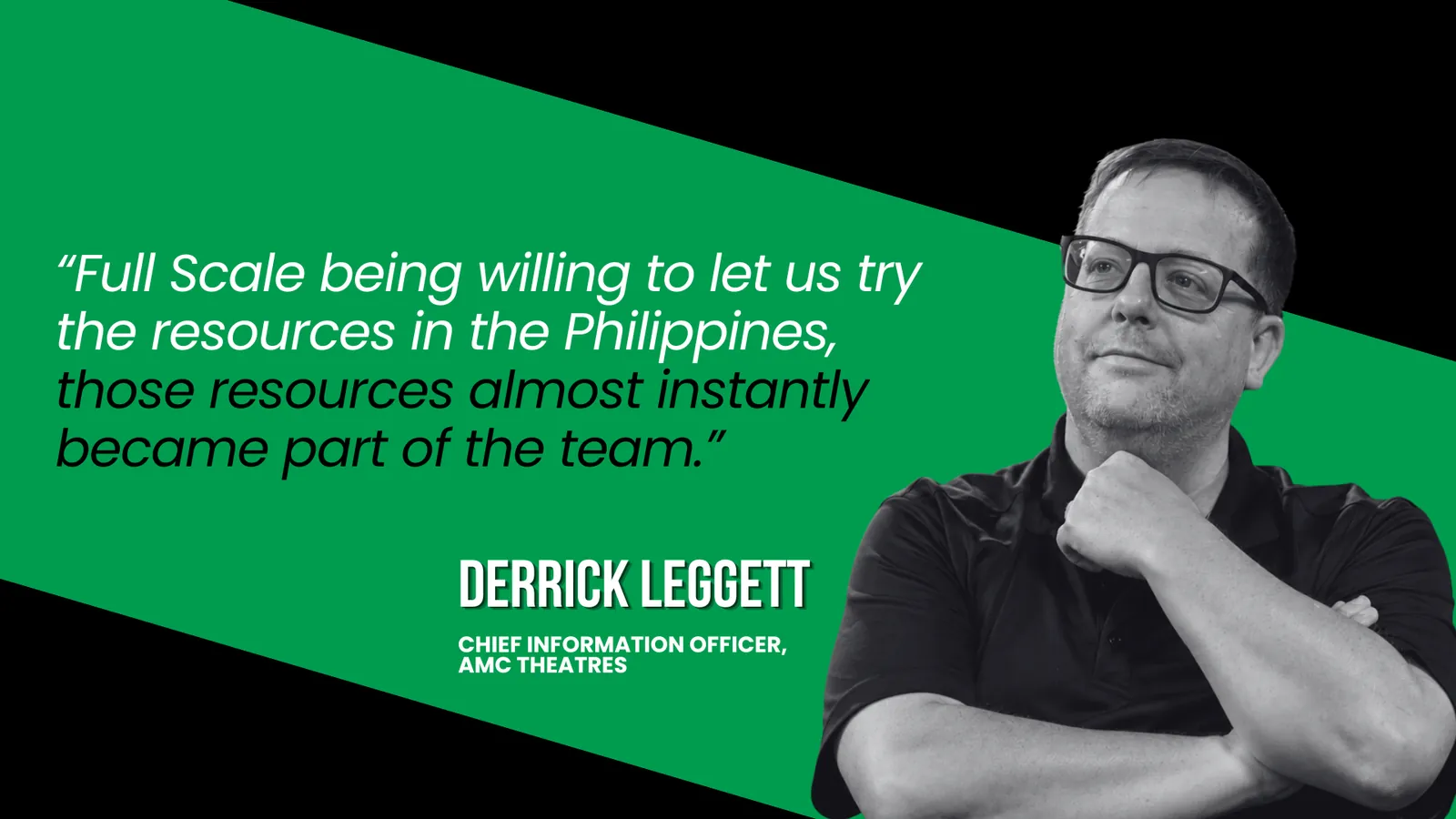
AMC Theatres is the clearest example. Their CIO, Derrick Leggett, built a global engineering organization where the developers in the Philippines are treated as full AMC engineers, not vendors. That is exactly the integration that drives retention, and it is a big reason the relationship has lasted and the team has stayed intact. That stability is part of the environment that creates 10x engineers, where people stay long enough to build real ownership.
LendingStandard came to us after local hiring stalled. Their CEO put it plainly in our case study: the most significant impact was “the seamless integration of their team with ours.” When a team is genuinely part of your company, it does not leave the way a team held at arm’s length does. That is retention and integration describing the same thing from two sides.
The Payoff of Keeping People
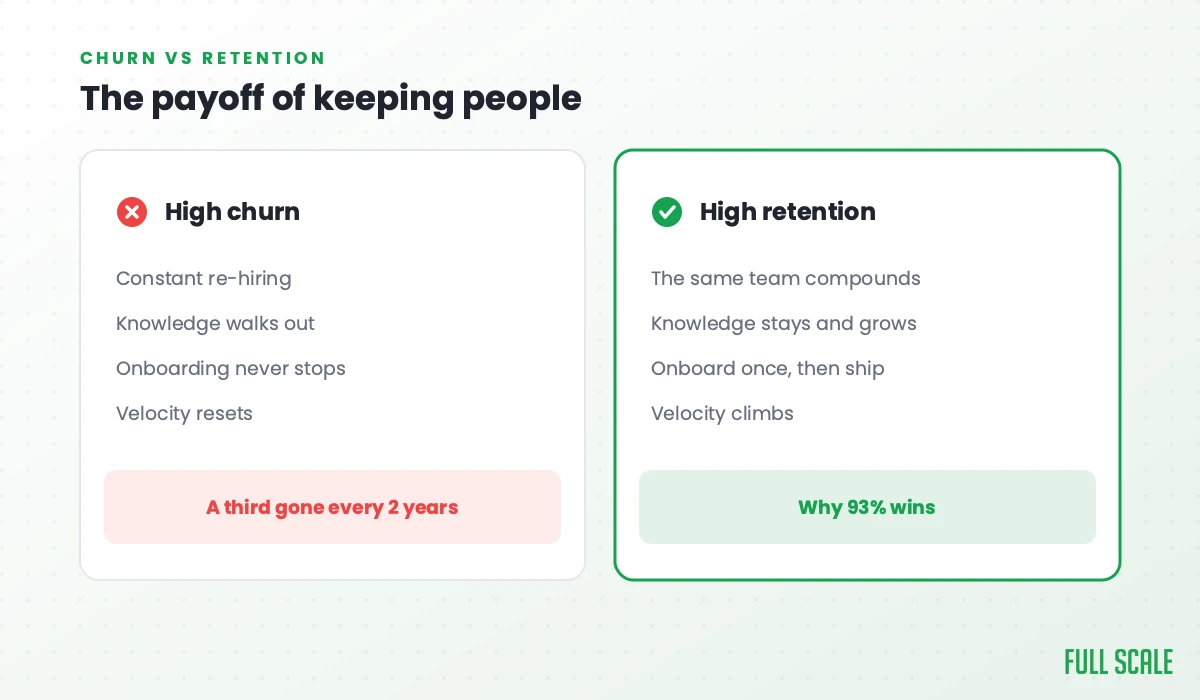
Stable teams are not just cheaper. They are faster, and the gap compounds.
An engineer who already knows your architecture ships without ramp-up, catches bugs a new hire would introduce, and does not need anything re-explained. Google’s DevOps Research and Assessment program has shown for years that the highest-performing teams are the ones with stable membership and strong ownership, not the ones constantly cycling people in and out. Every departure resets some of that, and high retention is how you stop paying the reset tax over and over.
The other payoff is your own time. A CTO who is not spending half the month on hiring and onboarding can actually do the job of leading engineering. That is the version of this work I think is worth building toward, and it is a thread that runs through my book, Product Driven.
We have been doing this long enough to have the receipts: 200+ tech companies served, 700+ developer placements since 2018, and five straight years on the Inc. 5000. The retention number is what holds all of it together.
Frequently Asked Questions
How do you calculate developer retention rate?
We track every developer who has been on a client team for at least 12 months, then measure how many are still with us 12 months after that. About 93% stay. We do not exclude anyone to make the number look better.
What developer retention metrics should you track?
Retention rate itself is the core number: how many of your engineers are still there twelve months later. Track it alongside your annual turnover percentage against the 13 to 15% US tech average, and the cost of every departure, since replacing a senior engineer runs well into six figures once you count the open-role time and the months it takes a new hire to learn your codebase. If turnover concentrates in the first six months, that points to an onboarding problem, not a pay problem.
What is a good developer retention rate?
Anything above the industry baseline is good. US tech turnover runs 13 to 15% a year per the Bureau of Labor Statistics, so a healthy team should keep at least 85% of its engineers annually. Sustained retention above 90% is strong and usually signals good management, not luck. Retention only means something if you are also honest about the ones who do not work out. Knowing why software engineers quit in the first place is the other half of this number.
Why is offshore developer retention usually so low?
Most offshore providers treat developers as contractors on temporary projects, pay them at the bottom of the market, and block direct communication with the client. All three give an engineer a reason to leave. Fix those three things and offshore retention looks like onshore retention. The fourth thing that keeps people is having somewhere to go, which is what our developer training program exists to provide.
What makes developers stay loyal to a team long-term?
Developers stay when they are treated as employees instead of contractors, staffed on one team instead of rotated across projects, paid at the top of the local market, and given someone whose job is to catch problems before they become resignations. We build a Customer Success Manager into every engagement for exactly that reason. Take any one of those away and loyalty drops, no matter how good the paycheck is.
Does staffing a dedicated team improve software team retention?
Yes. An engineer embedded in your standups, your Slack, and your planning has a reason to care about your product six months from now; a developer rotated in from a bench for a single project does not. That is why we staff dedicated teams instead of assigning whoever is free, and it is a big part of why our software team retention runs about 93% against the industry’s 13 to 15% annual turnover.
How fast can you replace a developer if one does leave?
If someone with the right skills is already on our bench, as little as 24 hours. If we need to recruit for the specific skill set, it takes longer, but you are never left without a plan. Either way, you interview and approve the replacement yourself before they join your team, the same as your first hire.
Can I interview developers before they join my team?
Yes. You interview and approve every developer, because it is your team and you should choose who is on it. We do not assign people to you sight unseen.
Ready to Build a Team That Stays?
If you are tired of treating turnover as the cost of doing offshore business, let’s talk about what a stable, integrated team would look like for your roadmap. Book a 15-minute discovery call and we will walk through it.