

How we hire
How Full Scale hires
Hiring and retaining the top talent in the Philippines is our goal. This is our guide on how we actually recruit and interview your new team members.
Our clients come to us because they trust us to hire top talent and help them build a long-term team. That means recruiting people who are looking for a long-term job opportunity and are someone you would want to work with day in and day out.
Since 2018 we have done exactly that. We are proud to also be Great Place to Work certified, and that rating comes straight from our own employees!

Eight years, across 200+ companies, with 300+ engineers on staff today. Long enough to know what works and what does not.
In an industry where offshore attrition is the standard complaint. Your team next year is mostly the same people as your team this year.
95% of our employees say Full Scale is a great place to work, against 65% at a typical Philippine company.
It starts with what we don't do
Full Scale finds candidates the same way most companies do: job ads, employee referrals, and a lot of outbound recruiting on LinkedIn. The most powerful asset we have is our database of 15,000 candidates built since 2018. It is why we can fill most new job requirements in 1-2 weeks for standard skill sets.
The best candidates don't even apply for jobs. They already have one and are passively considering new opportunities. The worst candidates are applying for every job they can find, for months. This is why a strong recruiting team and that candidate database are invaluable: we go find the right people instead of waiting for them to show up.
Those same candidates also don't want to talk to an AI chatbot or take a bunch of coding tests. Our goal is to sell them on why they should work for Full Scale, not make the process difficult.
Things candidates hate
- Automated AI-only screening
- Multiple-choice screening quizzes
- Online coding tests
- Take-home projects
The best candidates won't do these things.
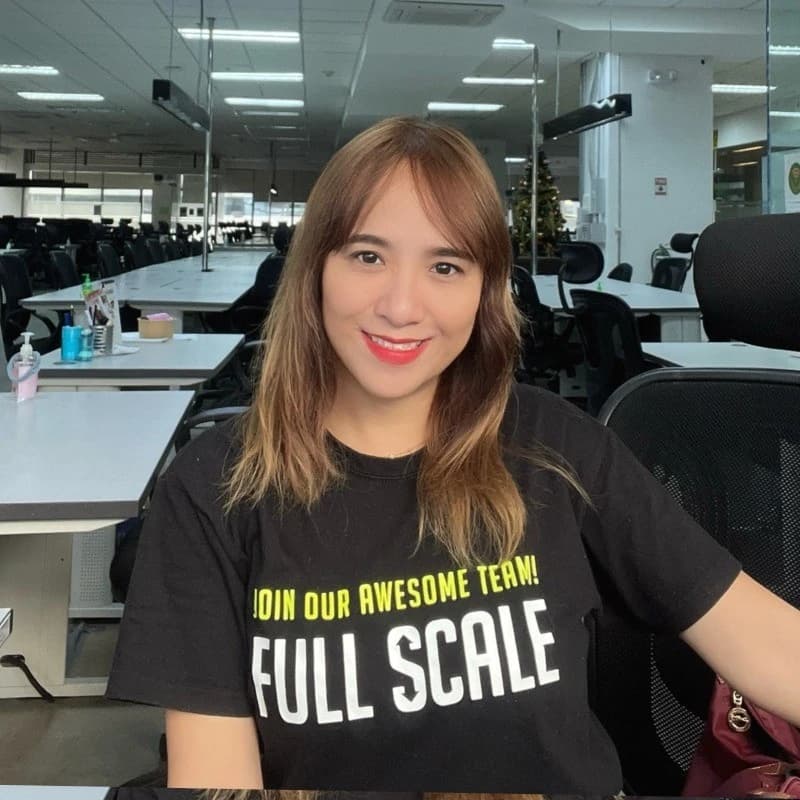
“The incoming applicants mostly fit the role, but they're not the best for that role. We have to find them.”
Four-stage process that ends with you
Full Scale runs every candidate through four stages before they join your team.
Recruiter screening
One of five technical recruiters
Technical background against open roles, communication, light problem-solving, career goals, and availability.
Engineering-manager interview
One of five engineering managers
Candidates go through a structured technical interview built for the specific role and seniority, scored on six weighted dimensions.
Sales-team review
Our sales team
The people who know your requirements review the scored candidates, make the final call on who to endorse, and send you a recommendation rather than a stack of resumes.
Your interview
You
You meet the talent and decide. Some long-time clients eventually trust our recommendations enough to skip this step, but it is always yours to take.
Where candidates drop out
Our recruiting numbers so far in 2026, from application to hire.
Not every drop is a rejection: some screened candidates go to our hot list for future roles, and some roles get canceled mid-search. And yes, the last row is under 1% of the first. We would rather show you the whole curve than put that number in a headline.
Six dimensions, and we will show you the weights
Full Scale scores every candidate against a six-dimension rubric, and the dimensions were not invented in a marketing meeting. They were derived from analyzing real client interviews, which is to say we went back through what our clients actually probe for when they interview our candidates, and built the rubric around that.
Each dimension is scored 1 to 5 on demonstrated behavior, not potential. Pick one to see exactly how we grade it. For the reasoning behind the weights, and why we stopped giving coding tests in the first place, read how we interview developers.
Can they communicate clearly in async, offshore environments without hand-holding?
What it measures
Clear, professional communication in real time and asynchronously: verbal clarity, written communication, explaining technical concepts to non-technical audiences, proactive updates, and operating without constant check-ins.
Why it matters
Communication is the number one failure mode in offshore roles, which is why this is the highest-weighted dimension. A technically strong engineer who communicates poorly is a liability in the offshore model.
Scoring anchors
- 1
Persistent difficulty being understood. Incoherent, too terse, or non-responsive. Would create immediate client friction.Auto-disqualify
- 2
Can be understood but requires patient interpretation. Answers lack structure. Would struggle in client-facing async work.Auto-disqualify
- 3
Communicates clearly in conversation. Organized, on-topic. Functional in most async environments with some coaching.
- 4
Communicates with clarity and initiative. Proactively structures responses, anticipates follow-ups, aware of async norms.
- 5
Exceptional communicator. Adapts instantly between technical and non-technical registers. Concise, accurate written updates.
Note it is async presence, not charisma. We are scoring whether an engineer is legible to a team that is asleep while they work.
Can they communicate clearly in async, offshore environments without hand-holding?
What it measures
Clear, professional communication in real time and asynchronously: verbal clarity, written communication, explaining technical concepts to non-technical audiences, proactive updates, and operating without constant check-ins.
Why it matters
Communication is the number one failure mode in offshore roles, which is why this is the highest-weighted dimension. A technically strong engineer who communicates poorly is a liability in the offshore model.
Scoring anchors
- 1
Persistent difficulty being understood. Incoherent, too terse, or non-responsive. Would create immediate client friction.Auto-disqualify
- 2
Can be understood but requires patient interpretation. Answers lack structure. Would struggle in client-facing async work.Auto-disqualify
- 3
Communicates clearly in conversation. Organized, on-topic. Functional in most async environments with some coaching.
- 4
Communicates with clarity and initiative. Proactively structures responses, anticipates follow-ups, aware of async norms.
- 5
Exceptional communicator. Adapts instantly between technical and non-technical registers. Concise, accurate written updates.
Note it is async presence, not charisma. We are scoring whether an engineer is legible to a team that is asleep while they work.
What a scored candidate looks like
Every candidate is scored twice, once by the human interviewer and once by AI, and the two scores are compared. Here is what that output looks like on our actual evaluation board: two real records, anonymized, one hire and one no-hire, so you can see how the scoring and the hard rules behave.
Human powered + AI assisted process
Some companies rave about their AI powered screening. Some say they don't use it at all. We believe recruiting and interviewing are still done best by humans. But that doesn't mean AI can't help us be smarter at it.
Human-only interviewing has real problems that nobody advertises. Five engineering managers cover every discipline we staff, which means one of them is regularly interviewing outside their own stack. Interviews happen on good days and bad days. Two candidates for the same role get asked different questions by different people and then get compared as though the inputs were identical. That is what happens when a judgment call has no second reader and no record.
So the AI is our second reader. It preps the interviewer with the right questions, double-checks their read afterward, and flags it when a score and a transcript disagree. But there is still a human driving the process and the final decision. Nobody wants to be hired by a chat bot. The future is still humans hiring humans at Full Scale.
Pre-screen assessor
Checks the CV and the recruiter's interview transcript against the job description, and returns proceed, proceed with caution, or do not proceed.
Question generator
Builds the structured interview per role and seniority, so two candidates for the same job face a comparable set of questions.
Scoring dashboard
Scores the interview against the rubric for comparison with the interviewer, and retains the history so scores stay calibrated over time.
Our candidate pipeline runs in Zoho Recruit, roughly 15,000 people deep, with AI matching new requirements against it and outbound sequencing through MetaView.
Background checked. Every single hire.
Your engineers will have access to your code, your systems, and sometimes your customer data. So every person Full Scale hires goes through a full background investigation run by Infovision Research Systems, an independent Philippine firm, plus two government-issued clearances, including the NBI, roughly the Philippine equivalent of an FBI check. Every employee, every role, contractors included. No exceptions.
This is a real part of what you are paying for. Hire a random developer off Upwork and nobody has verified they are who they say they are, which is how companies keep ending up with North Korean operatives on the payroll under stolen identities. Our people are verified against government records, in person. You can rest assured your new developer is not secretly a hacker from North Korea.
What the investigation covers
- Identity, against government records
- Nationwide criminal records (NBI clearance)
- City police and barangay records
- In-person address verification
- Education, confirmed with the registrar
- Employment history, per employer
- Character references
- Global sanctions screening: OFAC, PEP, watchlists
If you are in fintech, healthcare, or anything with a compliance function, the sanctions screening is the part your auditors will ask about, and if you need placements held until a check fully clears, say so on the discovery call and we will run yours that way. The finer details, including how long it takes and how often anyone fails, are in the FAQ below.
What happens after we hire them
Hiring them is just the beginning. For what we do, retaining them is the key to success, and across the offshore industry, losing a big share of the team every year is the norm. We work really hard to keep our retention at 93%+ a year, because that is what keeps your team together for the long term. Here is what happens after we hire new employees to get them up to speed, train them, and retain them.
Onboarding into your codebase
Starting and being fully up to speed are different. An engineer can start in as little as 7 days when the role is already in our pipeline. Getting genuinely onboarded into a codebase, the conventions, the deploy process, and who to ask about what, takes more time.
A daily status report from every engineer
Every team member fills out a simple report about what they accomplished for the day, what they plan to do tomorrow, and where they could use some help. We analyze these reports to ensure everyone is making progress and being held accountable for their deliverables.
A customer success manager who keeps them engaged
Our customer success managers meet with our team members every week. They ensure the teams are being productive and getting the support and help they need.
Training, mentoring, and team engagement
Employee retention requires ongoing upskilling and career growth. It also requires employee engagement and community work. Full Scale has 5 large company events a year to get our team members together plus 9 employee clubs.

“You hire the best and brightest people who can act as a team. If you do that, it doesn't matter where they're sitting.”
Derrick has been a client for years and his read on the model is the one we would pick if we were allowed to write it ourselves. His words for the engineers we placed with his team: those resources in the Philippines almost instantly became team members, almost like family with some of our team.
If you want the longer version of how that actually gets managed, we wrote both halves up in detail: why our customer success managers are the reason offshore works and the retention strategies behind the 93%.
What you control, and how fast this actually goes
You interview every engineer before they join your team. That is the final stage of our process, not a courtesy. If you pass on a candidate, we go back to the pipeline, where people who have already cleared our technical interview sit on a tracked list, kept warm.
And the person you interview is the person you get. Every placement is dedicated and full-time: your engineer works for you and nobody else, and we never swap in somebody different after you approved them. No bait and switch, ever. The only fractional placements we do are project managers and UX designers, and only when a part-time allocation is what you asked for.
Once they start, you direct the work. There is no project manager between you and the engineer, which is covered on why Full Scale and in more detail in what a customer success manager actually does.
And it is worth knowing that our engineers stay. Full Scale holds 93% or better engineer retention, which is the other half of hiring well. Selecting carefully does not help much if the person leaves in eight months.
On speed, the honest version
A role already in our pipeline moves fast, because we hire it continually and there are vetted candidates to check against your requirements. That is what makes a start in as little as 7 days possible. A role we have not hired before takes two to three days just to source, before any interviewing. About two weeks from brief to start is a good outcome. Notice periods run from immediate to 30 days and skew short.
The stage that stalls most often is not ours. Clients who were responsive all the way through the sales process take days, sometimes a full week, to say yes or no on candidates we have endorsed. If you want this to move quickly, the highest-leverage thing you can do is turn candidate feedback around inside 48 hours.
And if it still does not work out, the first two weeks are money-back. After that, 30 days' notice to cancel, and no long-term contract.
Frequently asked questions
Meet the engineers this process produces
These are real Full Scale team members who came through everything you just read about. Their stories are worth two minutes each.