How We Train 300+ Engineers (and Why Half Our Courses Are About AI)

In this article
- It starts with interns we are trying to keep
- The gap has to be one step wide
- More than half our course catalog is now about AI
- The people teaching are the people doing the work
- The Growth Portal tracks a career, not just a course
- What it costs, honestly
- Frequently asked questions
- Ask your vendor for their completion rate
Every development firm on earth says it invests in its people. It is the easiest sentence in the world to write, and almost none of them publish a number you could actually check.
So here is ours.
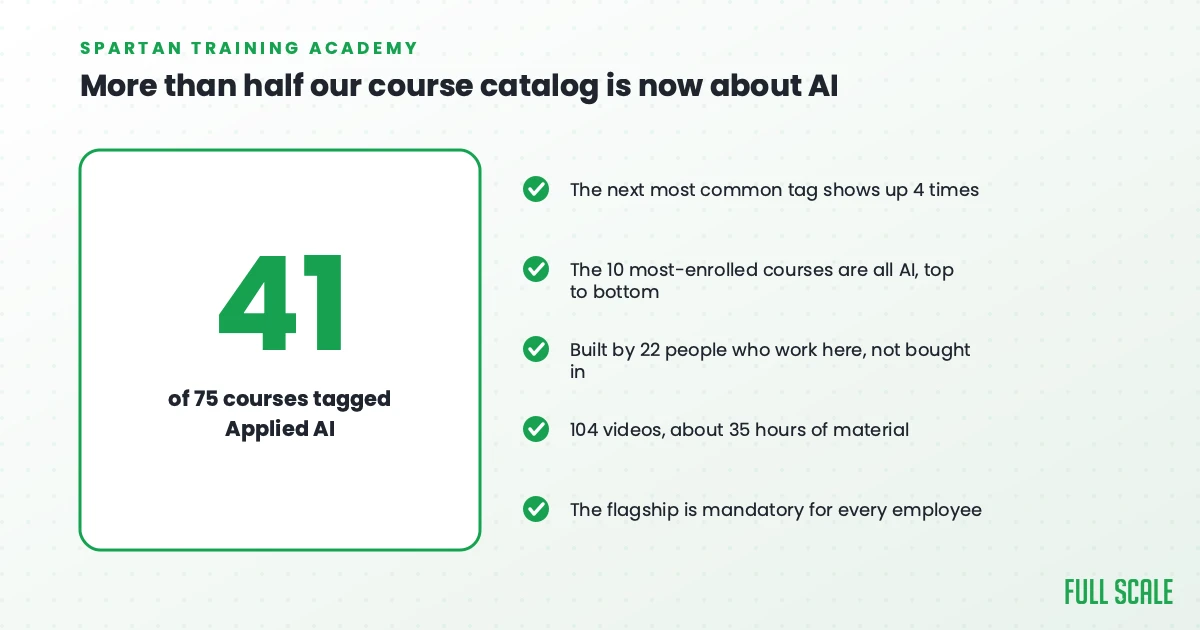
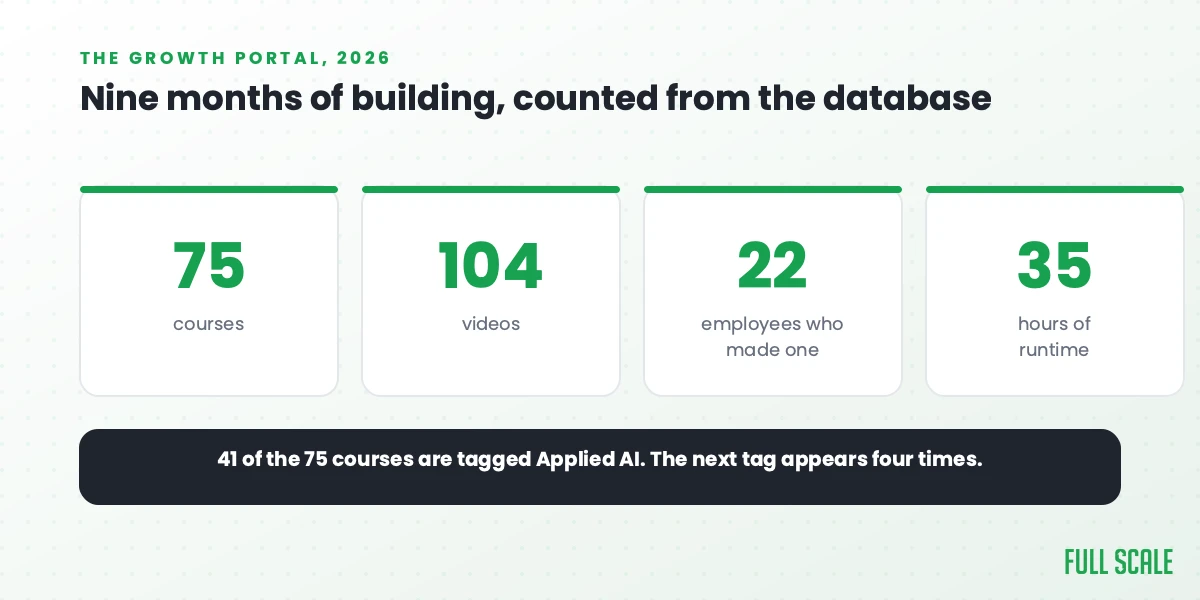
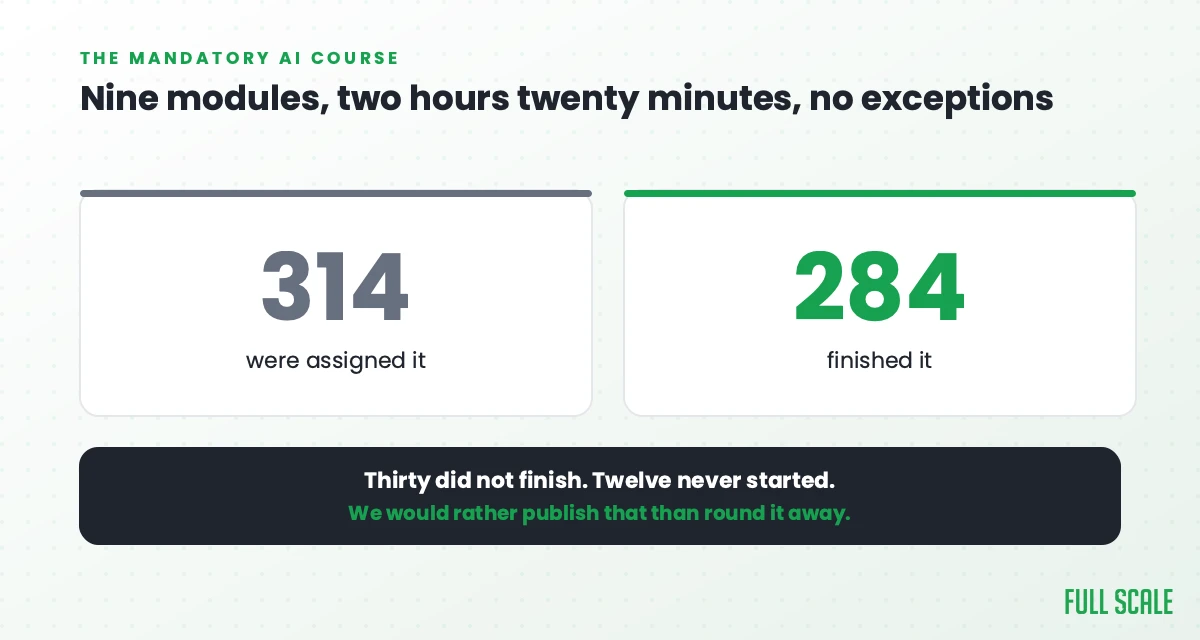
At Full Scale we run an internal training program called the Spartan Training Academy. Right now it holds 75 courses, 104 videos and about 35 hours of material, built by 22 different people who work here. Since December, 314 of our engineers have been assigned a mandatory two-hour AI course, and 284 of them finished it.
That last figure is the one I would look at if I were you. Ninety percent completion on required training is not normal. I say that as someone who has personally ignored a great deal of required training.
Here is the whole machine, from the interns we are trying to keep all the way to the system that tells us whether any of it stuck.
It starts with interns we are trying to keep
We hire 15 to 20 interns a year out of local colleges in the Philippines. The goal is to keep at least 10 of them as full-time engineers once they graduate.
Internally we call them our wonder kids, which is exactly as corny as it sounds and nobody has any intention of stopping.
The program is called Fast Track, and it exists because of something I have written about before in how we interview developers: we hire fresh graduates who would fail most of our own rubric. Somebody has to hire those people. Some of the best engineers on our team walked in exactly that way.
An internship solves the problem that an interview cannot. An interview asks you to predict whether someone can learn. An internship just shows you, over several months. By the time we make an offer, we have seen how they take feedback, whether they ask questions or quietly guess, and what they do on the third day of something hard.
Half of them convert. The ones who do not usually leave with better skills than they arrived with, which I have made peace with.
The gap has to be one step wide
The honest version of upskilling is narrower than the marketing version.
Here is the case that comes up constantly. An engineer is joining a team that works in Next.js. They have never shipped Next.js, but they have years of React and Node.js behind them. That is a real gap and it is also a one-step gap, and a couple of weeks of focused work closes it.
For that kind of thing we lean on Pluralsight and structured self-study more than our own material. No point recording a course on a framework that already has forty good ones.
What we do not do is claim we can train anyone into anything. Nobody goes from writing CSS to owning a distributed data pipeline because they watched some videos. When we tell a client an engineer is ready for their stack, we mean the distance was short and we watched them cover it.
The timing usually works out because engineers rotate through the bench between projects. That is the natural window: they are on payroll, they are not billing, and the next assignment is visible enough to know what to study for.
More than half our course catalog is now about AI
This one surprised me when I actually counted it.
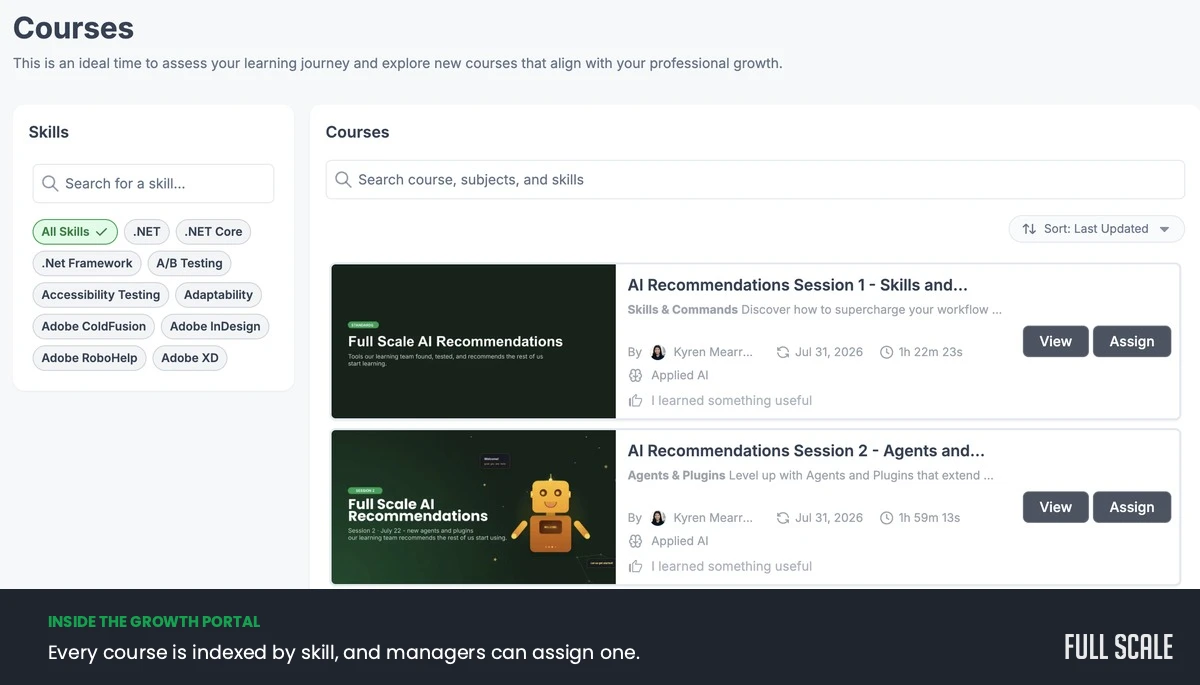
Of the 75 courses in the portal, 41 are tagged Applied AI. The next most common tag shows up four times. And the ten most-enrolled courses in the entire catalog are all AI courses, top to bottom.
Nobody planned that ratio in a strategy meeting. It is simply where the demand went.
The flagship is a course we made mandatory. Nine modules, two hours and twenty minutes, assigned to every single person here. 314 enrolled, 284 completed. We also run a live series we call our Claude Masterclasses, running from “what is a prompt” through agents and plugins, and the two most recent sessions ran 82 and 119 minutes because nobody wanted to stop.
My reasoning is not complicated and it is not especially noble. I do not want to spend a call eighteen months from now explaining why the engineer a client has been paying for cannot work the way their own team now works. That gap would be ours to close. We would be closing it late, on our dime, for a client who had already run out of patience.
Cheaper to just do it now. We wrote more about why the economics point this direction in upskilling developers.
The people teaching are the people doing the work
Twenty-two different employees have authored a course. That is the number I am proudest of, because it is the one that cannot be faked by buying a content license.
Our most prolific instructor is Lloyd Gam, a solutions architect, with sixteen courses. Second is John Jason Taladro, a senior software developer, with fifteen. I am fourth, with nine, a ranking I have chosen to interpret generously.
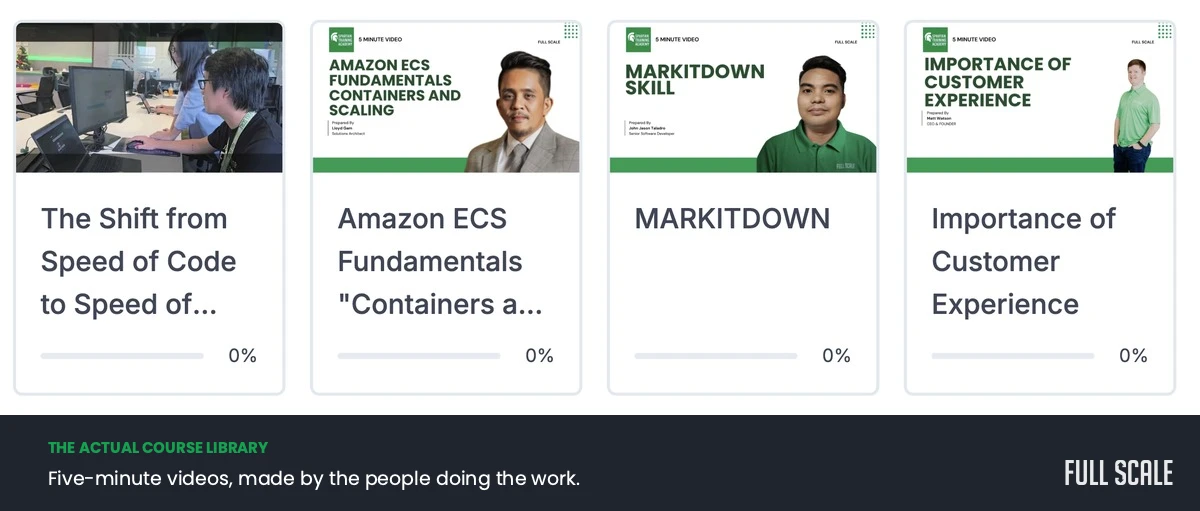
The format is deliberately small. Most of it is five-minute videos, published weekly, and the range in any given week is genuinely wide: container orchestration on Monday, a document-conversion tool on Tuesday, something about customer experience from me. Twice a month we publish something longer, in the twenty to thirty minute range.
Producing this content is a formal management goal, not a thing that happens when somebody has a slow afternoon. That distinction is the entire reason the catalog exists. We have pushed harder on volume recently, and it shows in the numbers: about half of everything in the portal was made in the last month.
Five minutes is the right unit for most of it. A senior engineer will watch a five-minute video from a colleague. The same engineer will not watch a forty-minute webinar, and I say that with total confidence because I am that engineer.
The Growth Portal tracks a career, not just a course
All of it lives in an internal system we built called the Growth Portal, and calling it a training library undersells it by a lot.
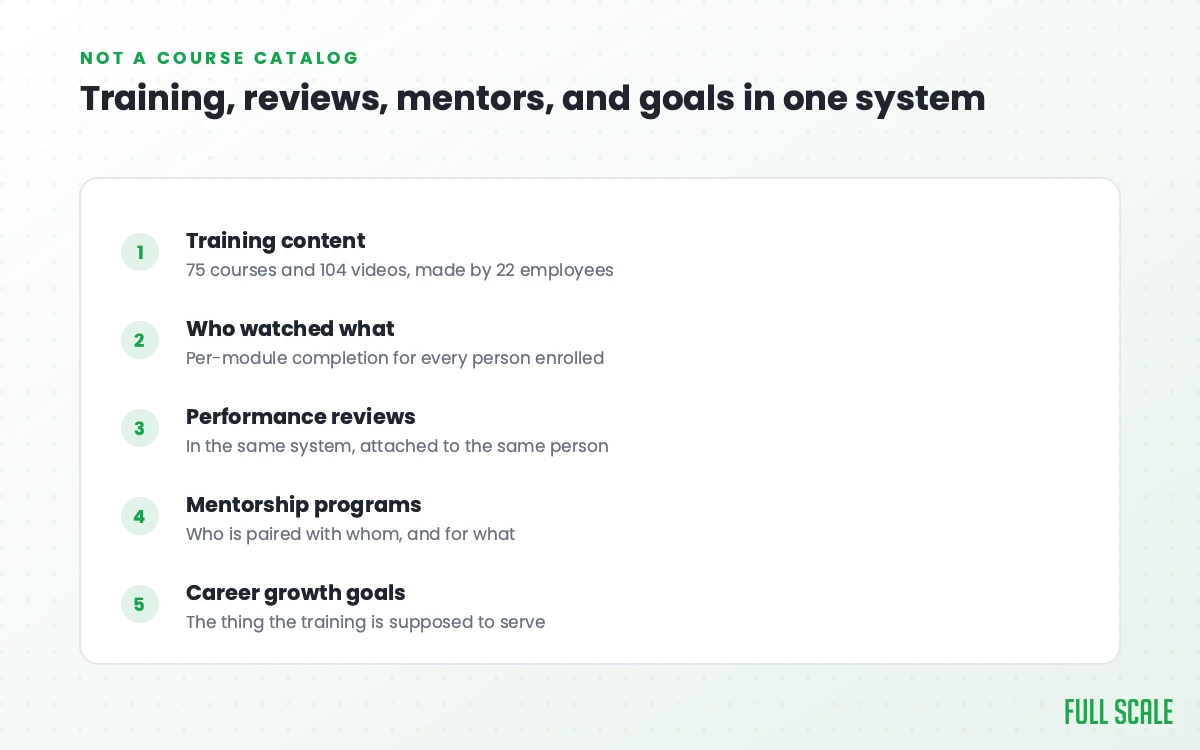
It holds the courses and the videos. It also holds performance reviews, mentorship programs and career growth goals, in the same place, attached to the same person.
That combination is the actual point. A course catalog tells you what is available. A career record tells you whether anyone moved. When a manager sits down for a review, the training history is right there next to the goals it was supposed to serve, instead of living in a spreadsheet somebody forgot to update.
A few things it does that matter more than they sound:
- Managers can assign a course to a person, which is how the mandatory AI training reached 314 people instead of sitting on a shelf.
- It tracks reactions, not just completion. There is a control on every course that says “I learned something useful,” which is a lower bar than a quiz and a much better signal than a checkbox.
- The skills taxonomy runs about 50 deep and indexes soft skills as skills. Adaptability sits in the same alphabetical list as .NET and A/B testing, which was a deliberate decision.
- Courses are searchable by skill, so when a client needs someone with a specific gap closed, we are looking at a real index instead of asking around.
It also sits next to the other record our managers live in, the daily reports every engineer files at the end of a shift. Between the two, a manager can see what somebody has been working on and what they have been learning without asking anybody to assemble it.
The whole thing is nine months old. The first course went in at the end of October last year.
What it costs, honestly
Training time on the bench is unbilled time. We are paying salaries for people to study, and at 300 plus engineers that adds up to a real number on a real budget line.
Not everyone finishes, either. Thirty people out of that 314 have not completed the mandatory course, and twelve of them have not started it. I would rather publish that than round it away.
And a training program does not make a mediocre engineer good. It makes a good engineer current, which is a much smaller claim and the only one I am actually making.
The objection I hear most is that training people makes them more marketable, so you end up funding your own turnover. I think it runs the other direction. About 93 percent of our engineers are still here a year later, and the investments we make in them are part of the reason why they stay. Nobody walks away from a place that is visibly spending money on where they are going next.
I also want to be precise about what it is for, because this gets oversold constantly. People pitch training as the way to get ahead, or as a way to collect new skills. In this business it is neither. Ongoing training is what it takes to merely keep up. Software moves fast enough that standing still is just a slower way of falling behind, and the training is the price of staying level.
What we get back is the thing clients are really buying when they pay for staff augmentation: engineers who are still the right engineers in two years. A big part of why people stay is that there is somewhere to go. Nobody builds a career at a company that treats them like billable inventory.
Frequently asked questions
Do clients pay for training time?
No. Training happens on bench time or on our own schedule, and clients are billed for the hours their engineers work on their projects. When an engineer needs to close a specific skill gap before joining a client’s team, that preparation is on us.
Can we request specific training for the engineers on our team?
Yes, and it happens regularly. If your team is moving to a new framework or adopting a new toolchain, we can point an engineer’s bench time at it and assign relevant courses through the portal. Tell your customer success manager what is coming and we will get ahead of it.
How do you know anyone actually watches the training?
Every course tracks per-module completion for every enrolled employee, so we can see exactly how far each person got rather than guessing. That is how we know 284 of 314 people finished the mandatory AI course and precisely which modules the other 30 stopped at.
What happens to the interns who do not get hired?
They finish the internship, and half of each cohort converts to a full-time offer. The others leave with real production experience and a reference, a considerably better outcome than most internships produce. We would rather run a program with an honest conversion rate than promise everyone a job.
Is any of this actually different from what other firms do?
Most staffing firms buy a content license and count logins. The difference here is that the material is made by the engineers doing the work, that the training record lives in the same system as performance reviews and career goals, and that we will tell you the completion rate. Ask any vendor you are evaluating for theirs. That training history also feeds the profile a client actually sees, since a profile is only as good as what the person has genuinely been doing.
Ask your vendor for their completion rate
Training is one of the quieter parts of what you are buying when you hire an offshore team, right up until the moment it matters. An engineer who was excellent in 2024 and has learned nothing since is a problem you pay for quietly. You will feel it long before anyone puts it in writing.
We have been building engineering teams in the Philippines since 2018, and these are the numbers we actually run on. If you want to talk about what your team would need and how we would prepare someone for it, schedule a call and we will get into specifics.