

Why Full Scale
The offshore partner our clients don't leave
Most companies that go offshore are looking for a reason to stay. After six-plus years with the same clients, we think we've found what actually keeps them, and it isn't the rate card.
We're not perfect, but how we handle that is the whole point
I'll say it before anyone else does: Full Scale isn't perfect. No company is. But the way a partner handles imperfection tells you more about them than any sales pitch ever will.
When I talk to founders who've been burned by another offshore vendor, the story is almost always the same. They didn't leave over one catastrophic failure. They left because small problems kept getting ignored until they turned into expensive ones. The account manager was unreachable. The developers kept getting swapped out. Nobody was steering the ship.
That's not a problem I'm willing to have. We've built Full Scale around four things I genuinely believe make us a different kind of partner. The clients who've been with us six-plus years aren't loyal out of inertia. They stay because what we do works.
Matt Watson
CEO of Full Scale · 4x founder · author of Product Driven
Let's name it
What you're actually worried about
If you're evaluating offshore, you have real concerns, and you should. Here are the five we hear most, answered straight.
“We got burned by an offshore team before.”
That's the most common thing I hear, and it's almost never one big failure. It's small problems nobody caught until they got expensive. Our entire operating model exists to fix that one thing: a CSM who meets your team weekly and meets you monthly, so issues surface while they're still small. The last vendor probably had an account manager too. You just never heard from them.
“Aren't cheaper developers just junior developers?”
No. We accept fewer than 3% of applicants, and the engineers we place ship production code for U.S. companies that depend on them. The savings come from labor economics, not from staffing you with people who need babysitting. Affordable and senior aren't opposites here.
“What happens when the developers keep leaving?”
That rotating-door problem is real, and it's the single biggest reason offshore engagements fail. Our annual developer retention is 93%. The people who start on your project are usually still there a year later, two years later. Continuity isn't a perk. It's the whole point.
“Communication across time zones will be a constant headache.”
The Philippines has English as an official language, and our engineers work hours that overlap with your team. They push back on a vague requirement, ask the clarifying question, and write documentation your team can actually read. That's the difference between a vendor and a teammate.
“What if we commit and it doesn't work out?”
Then you didn't really commit. You get a two-week money-back guarantee, and no long-term contracts after that, just 30 days' notice. We make it easy to leave on purpose. That's exactly why people don't.
Three reasons most vendors can claim
These are real, and they matter. But they're also things other offshore companies will tell you. The fourth reason, the one that actually keeps clients, comes next.
Real cost savings, without the trade-offs
The Philippines delivers software development at a large discount to comparable U.S. talent, and that gap is real. The savings come from labor economics, not from cutting corners on the people. If cost is the only reason you go offshore, you'll probably be fine. If cost is the only thing you evaluate in a partner, you'll get hurt.
Genuinely strong engineers
There's a perception that affordable means junior. It doesn't. The Philippines has a deep, mature tech workforce, with universities producing thousands of computer science graduates every year. The country has been a global technology hub for decades, for real product development, not just outsourcing.
Communication that actually works
This is where offshore partnerships go wrong most often, and it's rarely about technical skill. It's language and cultural friction that makes every conversation harder than it needs to be. The Philippines is one of the few countries where English is an official language, the medium of instruction in schools, and woven into daily life.
The reason clients stay
A CSM model built to catch problems while they're still small
When founders tell me they've worked with offshore companies before, the complaints are remarkably consistent. The account manager was never available. They kept losing developers and starting over. Nobody caught the problem until it was a crisis. And when I ask whether those companies had account managers, the answer is almost always yes. The competitor had one. The client just never heard from them.
Our Customer Success Managers aren't account managers in name only. They're the structural backbone of how we deliver.
Monthly checkpoint meetings
Every client gets a real meeting with their CSM, on the calendar, every month. Not a quarterly email summary.
Weekly team meetings
The CSM meets with the actual dev team weekly, not just the client stakeholder, so problems surface before they escalate.
A cap of 70 developers per CSM
No CSM manages more than 70 developers. The cap is intentional: they know the people and the accounts, not triaging a queue.
Quarterly account reviews
Formal QARs delivered to Full Scale senior leadership every quarter. Accountability to the client and to us, built into the structure.
When a client mentions that a developer is struggling, we don't note it and move on. We build a real plan to fix it, with real follow-through. The client sees results, not reassurances. Small fires don't become big ones.
That job has a page of its own, including why the cap sits at 70 and what a checkpoint meeting actually covers: what a customer success manager does. The signal a CSM reads every single day is in daily reports.
The team that starts your project is the team that finishes it
Almost every founder who came to us from an India-based firm says the same thing: their developers kept leaving. Not one or two, a rotating door. Every time a developer left, they lost time, lost context, and had to spend again getting someone new up to speed. That cost adds up fast, and it never shows up on the vendor's rate card. It's a big enough pattern that we wrote up the evidence behind why outsourcing to India so often fails.
The Philippines is different, starting with a meaningfully lower developer attrition rate, and we work hard to keep ours even lower. Our annual developer retention is 93%, against a Philippine BPO industry where turnover is the highest of any sector. When you build a team with us, that team tends to stay together. The people who started on your project are usually still there a year later, two years later.
That continuity is one of the most undervalued things in offshore software development, and one of the biggest reasons our clients don't leave.
People stay when there is somewhere to go, which is what our training program and the career ladder exist to provide.
How AMC Theatres scales engineering teams with Full Scale
A Fortune 500 client runs a fully integrated team through Full Scale, embedded alongside their in-house engineers.

For any long-term staffing relationship to evolve into a partnership, you have to start with trust. You have to lead with trust through the process and adjust with trust when things go wrong.
Full Scale vs the other ways to add engineers
Every path to more engineering capacity has trade-offs. Here is how a dedicated Full Scale engineer in the Philippines stacks up against the alternatives most teams weigh first. If you want the underlying numbers, our pricing page lays out how a single hire and a full pod scale per month.
| What you get | Full Scale | Cheap offshore shop | Freelance marketplace | US in-house hire |
|---|---|---|---|---|
| Pre-vetted senior engineers | ||||
| Time to first developer | ~7 days | varies | 1-3 days | 3-6 months |
| Dedicated full-time, not shared | ||||
| Dedicated CSM + dev leadership | n/a | |||
| Long-term retention | 93%+ | low | low | varies |
| US-company contract + IP assignment | ||||
| Two-week money-back guarantee | ||||
| Handles payroll, HR, equipment | ||||
| Fully-loaded cost vs US hire | ~40-50% | varies | varies | 100% |
What it costs
The math your champion can forward to the CFO
You're often not the only person who has to say yes. Here's the comparison in a form you can paste into an internal email.
A comparable US senior engineer
$150K–$200K
all-in per year, salary, benefits, recruiting fees, equipment, and overhead, on a 3-6 month hiring cycle.
A full-time Full Scale engineer
~$73K
per year starting at $35/hr, fully loaded ($35/hr at full time), with no recruiting fees, benefits, or equipment to carry.
Less than half the cost, per engineer, every year.
See full pricingLongevity isn't a coincidence. It's the result of a model built to keep teams together and problems small.
Happy engineers stay, and that's how your team keeps the same people year after year


Great Place to Work surveyed our Philippines team, and 95% said it's a great place to work, compared to 65% at a typical company in the Philippines. Retention isn't a number we chase. It's the natural result of treating engineers like professionals, which is exactly why your team doesn't reset every six months.
See the Great Place to Work profile
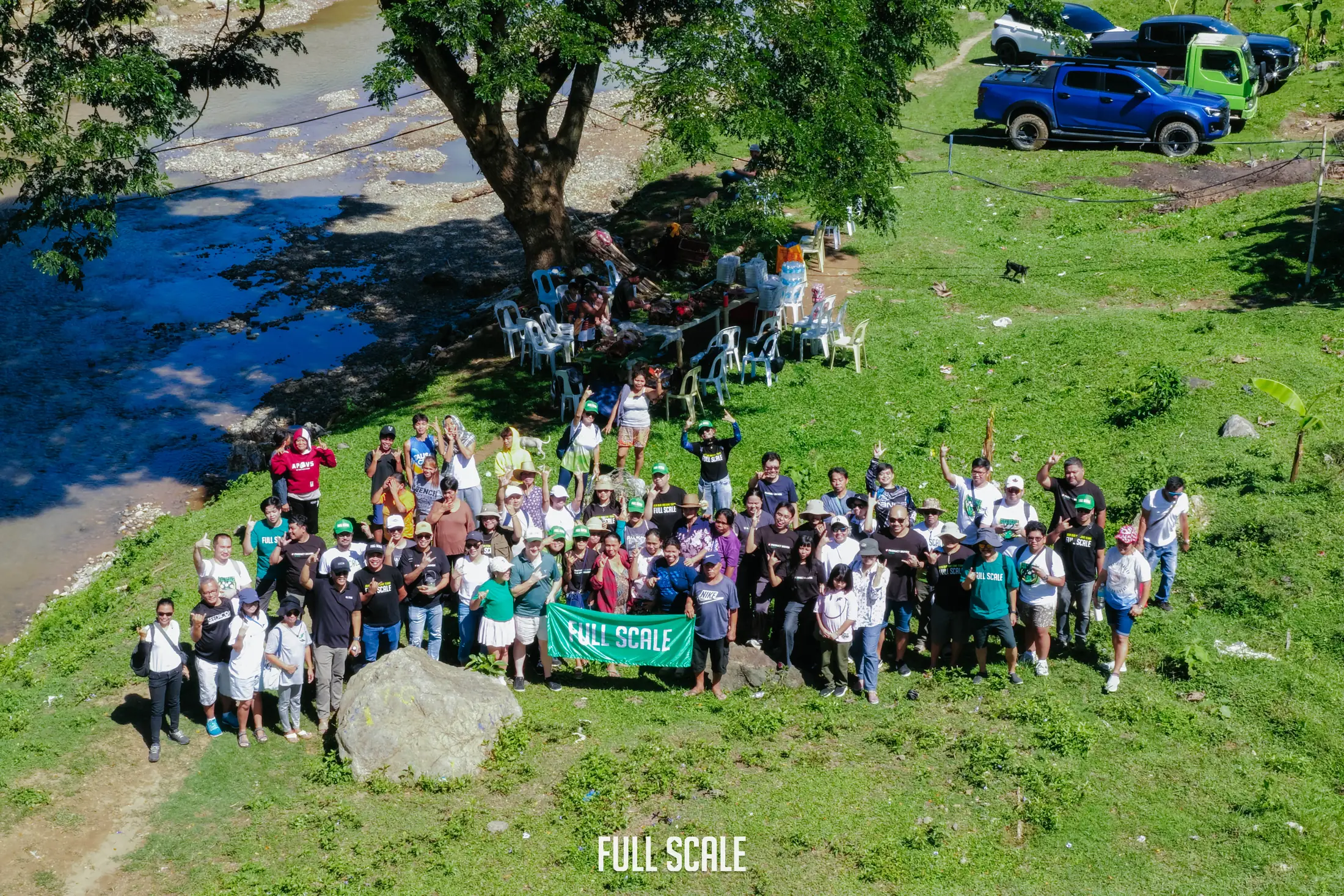
We put real money back into the communities our engineers come from
A vendor bills you and forgets the people who did the work. We went the other way. Every year the whole company takes a paid day to give back to the places we hire from in the Philippines, from donating computers to schools to planting mangroves to funding animal shelters. We call it CSR Day. It's the same instinct that makes our engineers stay: we treat the Philippines as somewhere we belong, not somewhere we pull talent out of.
Meet some of our engineers in the Philippines
Get to know the talented engineers and specialists who power our clients' success.






Don't take my word for it, look at who stayed
Anyone can make claims about service quality. So let me point you somewhere more useful than my word: our clients.
“It's a fully integrated team. It's just some of the people happen to be living in the Philippines.”
Derrick Leggett
CIO, AMC Theatres
“We really highly value retention, and Full Scale has been a great partner on the retention front to ensure we have continuity with the folks we really value on our team.”
Dustin Johnson
Co-Founder and CTO, SOTA Cloud
Security & IP
The part that lets your CTO say yes
The risks that scare a CTO away from offshore, IP, data, legal exposure, are exactly what a real partner is supposed to absorb. A cheap shop or a marketplace freelancer leaves you carrying all of it alone.
One US contract, one accountable company
Your contract is directly with Full Scale, a US company. If anything ever goes wrong, an IP dispute, a data issue, a non-performance question, you're dealing with a US company under US law, not trying to track down a freelancer in a jurisdiction you can't name.
An unbroken chain of custody for your code
Your MSA assigns confidentiality and intellectual property to you. We hold real employment contracts with every engineer and a legal entity in the Philippines, so your IP assignment runs client to Full Scale to engineer with no gaps. That's stronger protection than handing source to an unattached freelancer.
Background checks beyond the US standard
We vet every hire more thoroughly than is normal in the US. That includes an investigator who physically goes out and verifies the candidate's home address, so we know where our engineers actually live before they ever touch your codebase.
Retention is a security feature
People who stay know your systems. Constant churn means a rotating cast of strangers touching your code and data. Our 93%+ retention means the same trusted engineers, year after year, not a new face every quarter.
All eight checks are listed in how we background check every developer we hire, and the IP chain of custody is broken down in how your code stays yours.
We make it easy to leave, which is why clients don't
We have clients who've been with us six-plus years. Not because switching vendors is hard, it isn't, and not because nobody's tried to poach them, they have. They stay because it's working, and they know it.
A two-week money-back guarantee
If it isn't working out in the first two weeks, you get your money back. That's the whole promise, no fine print.
No long-term contracts
After the first two weeks, you can step back from a developer with 30 days' notice. We earn the relationship month to month.
You interview before you commit
We pull pre-vetted senior engineers from our bench, and you interview them yourself. You decide who joins your team, not us.
We're not perfect, and I won't pretend otherwise. Problems come up, they always do in software. What we're very good at is catching them early, taking them seriously, and fixing them before they become your problem.
We also wrote down what happens on the day a developer is not working out, including the thing we deliberately do not offer: read the whole process.
What happens next
From first call to first commit in days, not months
Book a discovery call
We learn your stack, your roadmap, and the roles you need. No pressure and no obligation, just a real conversation about whether we're a fit.
Meet your candidates
We pull pre-vetted senior engineers from our bench and you interview them yourself. Want to be sure? You have a two-week money-back guarantee, so you can start and judge the work with no risk.
Start in as little as 7 days
Your engineer joins your standups, your tools, and your roadmap. Full onboarding into the codebase runs about two weeks, and a CSM is on the account from day one.
Step two in detail, including the profiles we write for every engineer: how our clients pick their team members. The funnel that fills the bench in the first place is how we hire.
Ready to build a team that actually sticks around?
See what our clients say, then let's talk about what we can build together.