Team Extension vs Staff Augmentation: Same Model, Different Names

In this article
- Are team extension and staff augmentation the same thing?
- Where the labels come from (and why nobody can agree)
- Side-by-side: staff augmentation, team extension, dedicated team, and project outsourcing
- Dedicated team vs. extended team: the difference that actually matters
- What actually matters when picking a partner
- When the labels matter, and when they don’t
- FAQ
- The honest summary
Quick Answer: Team extension and staff augmentation are the same engagement model under different marketing names: developers who join your team directly under your direction, rather than a vendor delivering a finished project. The benefit is control and cost, you direct the work and pay roughly 50-70% less than a comparable US hire; the real challenge is that the responsibility for managing the engineers moves to you, since there is no project manager absorbing it on the vendor’s side. Which structure to pick, extended team or dedicated team, depends on whether you already have in-house leadership or are standing up a new product from scratch.
Most buyers shopping for offshore engineers run into the same confusion. One vendor’s website calls the engagement staff augmentation. The next one calls it team extension. A third uses extended development team or dedicated developer model, and a few default to team extension services, and others bundle the same arrangement as resource and staff augmentation. All four appear to be describing the same arrangement, but the buyer can’t tell whether they’re looking at four products or one. There is also the PEO vs EOR question, and where staff augmentation fits in.
You’re looking at one. Most of the labels are the same engagement under different marketing, and picking the right vendor has very little to do with which phrase they print on the homepage. What actually matters is the team structure of the engagement and the operational quality of the partner. Here’s how I think about both, after running offshore engineering teams at three companies and helping 200+ tech companies do the same at Full Scale. For a .NET shop, that same model is how you hire C# developers who stay on your team long term.
Naming gets muddled on the employment side too, which is why teams end up deciding between an employer of record and a staffing agency when the question they actually care about is who keeps the developer. The model is the same either way, and so is what to look for in the contract.
Are team extension and staff augmentation the same thing?
Yes. The engagement model is identical, and so is what you actually get when you sign the contract. What you sign is a different story next to a statement of work; see staff augmentation sow for that comparison.
In both cases, a partner sources and employs senior engineers who work full-time on your team under your direction. The engineers attend your daily standup, push to your codebase, get assigned tickets in whatever tracker you use, and stay on your team for years. The partner handles payroll, benefits, recruiting, HR, equipment, and retention in the background. You handle the engineering work and the team direction. None of that changes whether the partner uses “staff augmentation” or “team extension” on the contract. IT staff augmentation, defined without the vendor spin, comes down to exactly that arrangement.
The same is true of every adjacent term. Extended development team, extended software development team, team extension model, IT team extension, outsourcing IT team extension, software team extension, dedicated developer model: all of them describe the same setup. Vendors pick the term that ranks in their market, market around it, and the underlying engagement is identical. I’ve hired engineers under all of these labels personally across VinSolutions (which I co-founded and which exited for nine figures), Stackify (which I founded and sold in 2021), and Full Scale, and the operational reality is the same in every case.
The full breakdown of the model, what it costs, when to use it, and how to pick a partner without getting burned is in the development team extension guide. This post focuses specifically on the comparison question.
Where the labels come from (and why nobody can agree)
The vocabulary split is mostly a story about regional outsourcing markets.
Staff augmentation traces to US IT staffing in the 1990s. American Fortune 500s needed contract IT labor that integrated with their in-house teams, the staffing agencies that served them branded it “staff augmentation,” and the term stuck. It’s the dominant phrase in the US market today and the one most American buyers reach for first.
Team extension came out of the Eastern European outsourcing boom in the 2010s. Polish, Ukrainian, Romanian, and Czech shops needed a way to differentiate the embedded-engineer model from generic project outsourcing, and they branded it “team extension” or “the team extension model.” That term dominates the European market and shows up most often when you Google in those regions. We break down outsourcing to Eastern Europe vs the Philippines directly if you're weighing the two markets.
Extended team and extended development team are mostly LATAM and some Eastern European usage. Same model, slightly different framing. An extended development team is the small-headcount structural variant of this engagement, and the call between that and a dedicated team is the part most buyers actually need to think through.
Dedicated developer model and dedicated team are global and ambiguous. They sometimes refer to the same model under yet another label, and sometimes refer to a specific structural variant (more on that below).
Google’s search results still reflect that split. Searching “team extension” pulls up mostly European shops. Searching “staff augmentation” pulls up mostly US shops. The thing you’re shopping for is the same.
Side-by-side: staff augmentation, team extension, dedicated team, and project outsourcing
The comparison that actually matters is between staff aug/team extension on one side, and project outsourcing on the other. Those are different engagement models with different control structures. The the tradeoffs of staff augmentation itself are worth weighing before you pick a side.
| Model | Who directs the work | Engagement length | Team size | What you actually buy |
|---|---|---|---|---|
| Staff augmentation | You | 12+ months, often years | 1 to 3 engineers, scales up | A senior engineer on your team, minus the recruiting |
| Team extension | You | 12+ months, often years | 1 to 3 engineers, scales up | Same as staff augmentation. Different word, same model. |
| Extended team | You | 12+ months, often years | 1 to 3 engineers | Same as staff augmentation, slightly different marketing |
| Dedicated development team | You | 12+ months, often years | 4+ engineers, self-contained unit | A whole team that owns a slice of work end-to-end |
| Project outsourcing | The vendor | Defined by deliverable | Whatever the vendor staffs | A finished deliverable against a fixed spec |
The first four rows are the same model with size and naming variations. The fifth is genuinely different. Project outsourcing flips who’s in charge: you write a spec, the vendor staffs the work, they deliver code against the contract, and you accept or reject the result. That works for a scoped one-off integration or a data migration. It does not work for ongoing product engineering, because no one outside your company understands your product as well as you do.
Dedicated team vs. extended team: the difference that actually matters
This is the comparison most buyers should care about, and it gets buried under the staff-aug-vs-team-extension vocabulary debate.
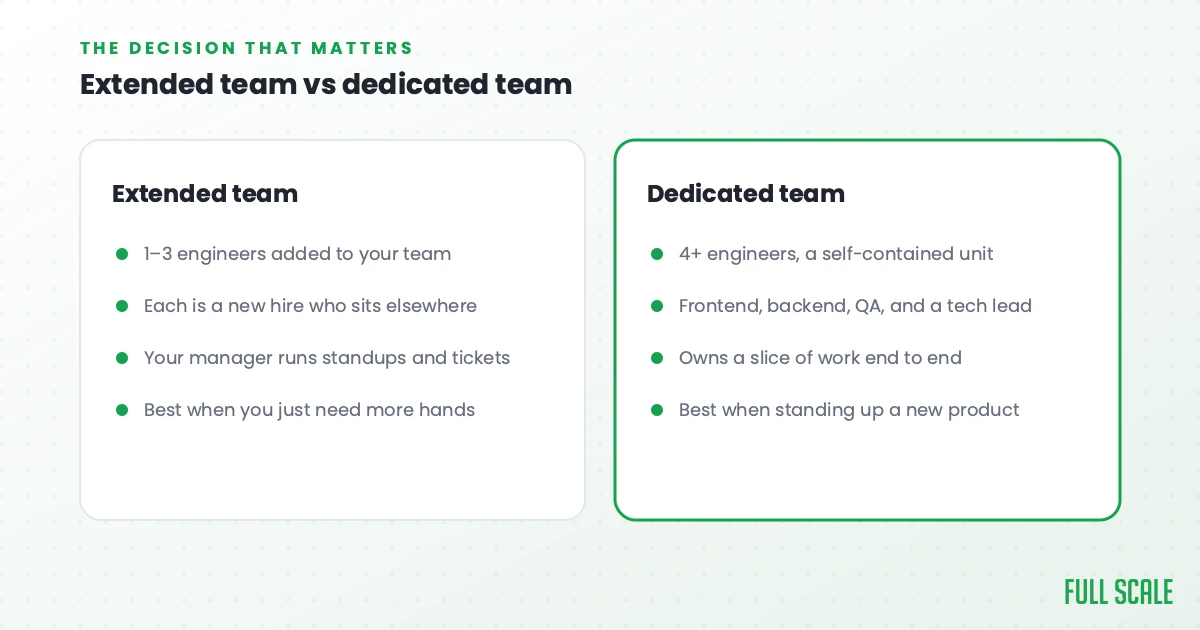
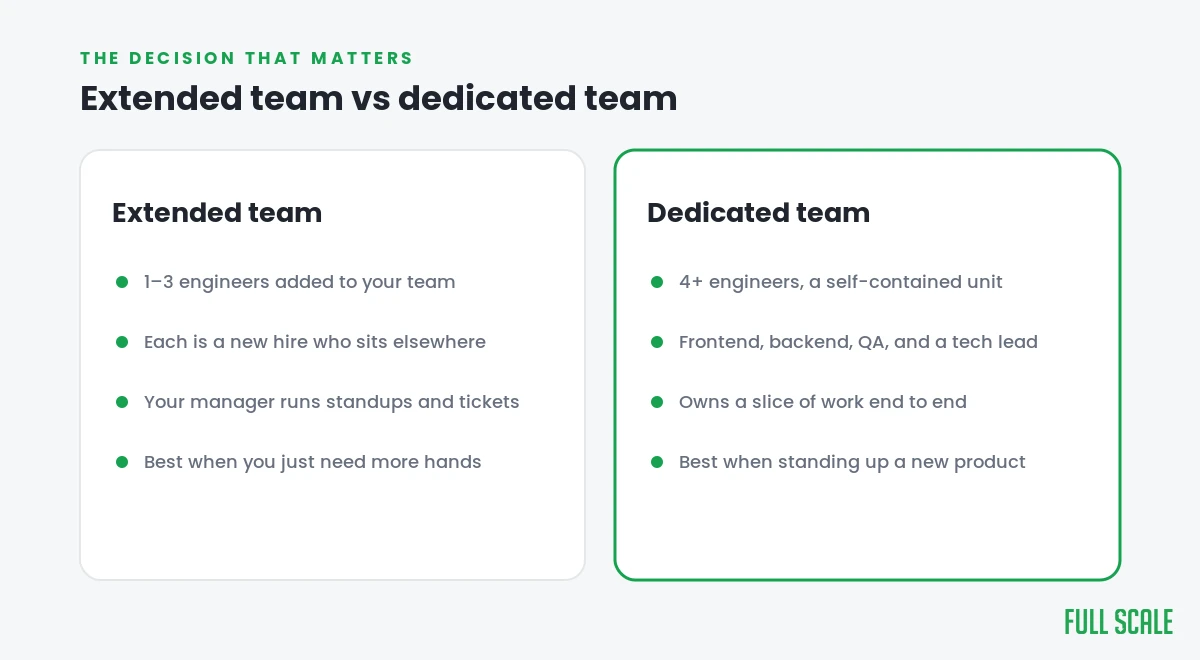
An extended team is one to three external engineers added to your existing in-house team. Each engineer is treated as a new hire who happens to sit somewhere else. Your engineering manager runs the standup, assigns tickets, reviews PRs. You’re not getting a team. You’re getting individuals who join the team you already have. If you are leaning toward the marketplace route instead, see comparing Toptal and Turing.
A dedicated team is a self-contained group of four or more engineers that owns a slice of work end-to-end. The makeup usually includes frontend, backend, and QA engineers, with a tech lead and sometimes a designer rounding out the group. They report up to your engineering leadership, but they operate as a unit. The work gets broken down inside the team rather than assigned from outside. You give them the roadmap and the constraints, and they decide how to execute.
Both are the same partner relationship. The difference is the team structure.
Pick an extended team when you have a functional engineering org that just needs more hands. Your processes work, your backlog is real, your roadmap is set, and the bottleneck is headcount. Adding a senior backend engineer or two frontend developers fits this perfectly. The new engineers slot into the rituals you already run.
Pick a dedicated development team when you’re standing up a new product, a major feature initiative, or a parallel platform that needs its own group. You want the team to be self-managing because you don’t have the engineering bandwidth to direct four to seven individual engineers in detail. You want a tech lead inside the team driving day-to-day decisions, with you setting direction at the strategic level.
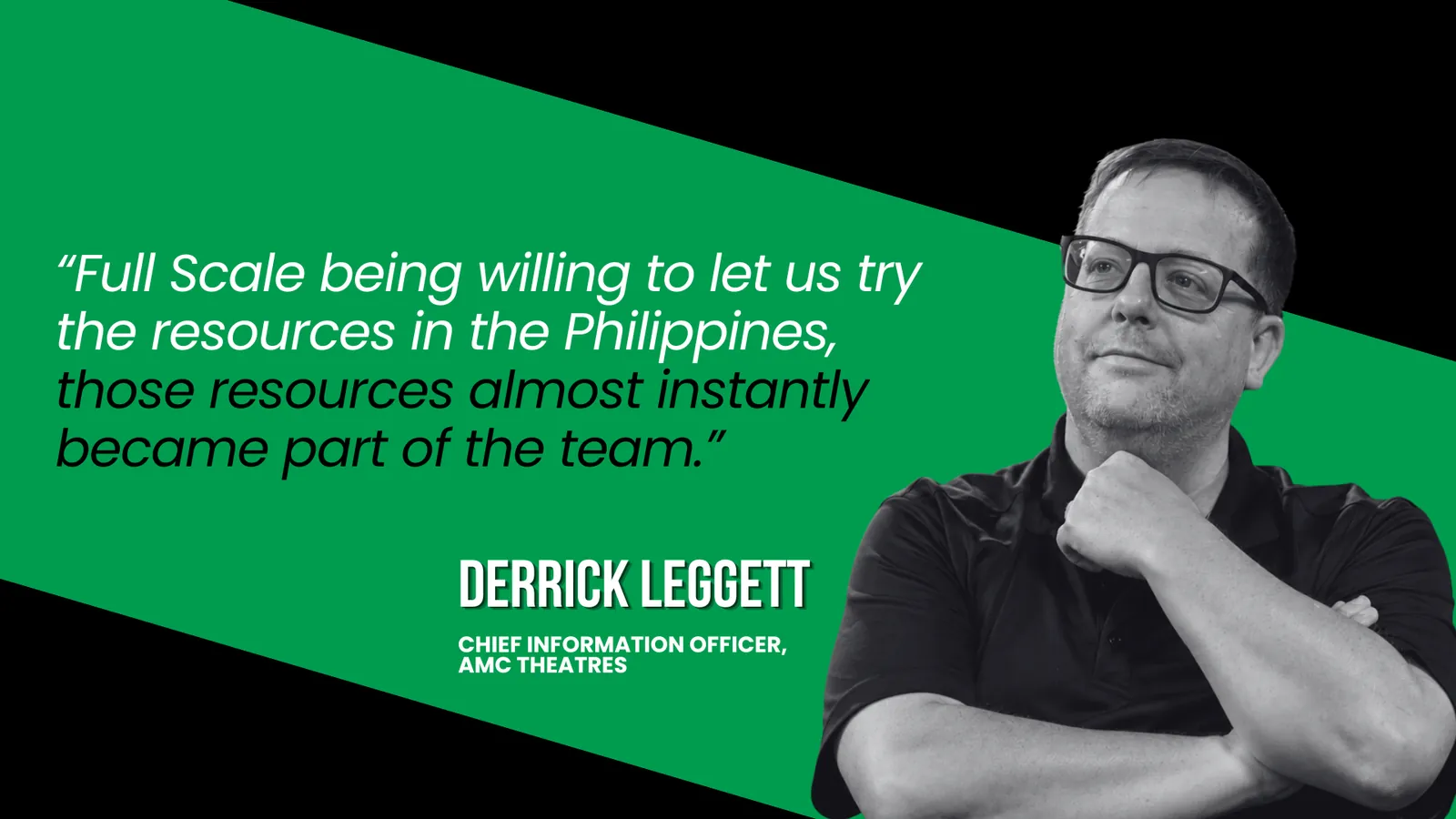
Most engagements that start as an extended team grow into a dedicated team over time. Year one is one or two engineers helping with the backlog. Year three is six engineers owning a whole product surface. AMC Theatres followed roughly this trajectory with their Full Scale .NET engineers. So did PMI Rate Pro, which started with a small extended team and grew into a self-contained product team rebuilding their mortgage insurance platform.
What actually matters when picking a partner
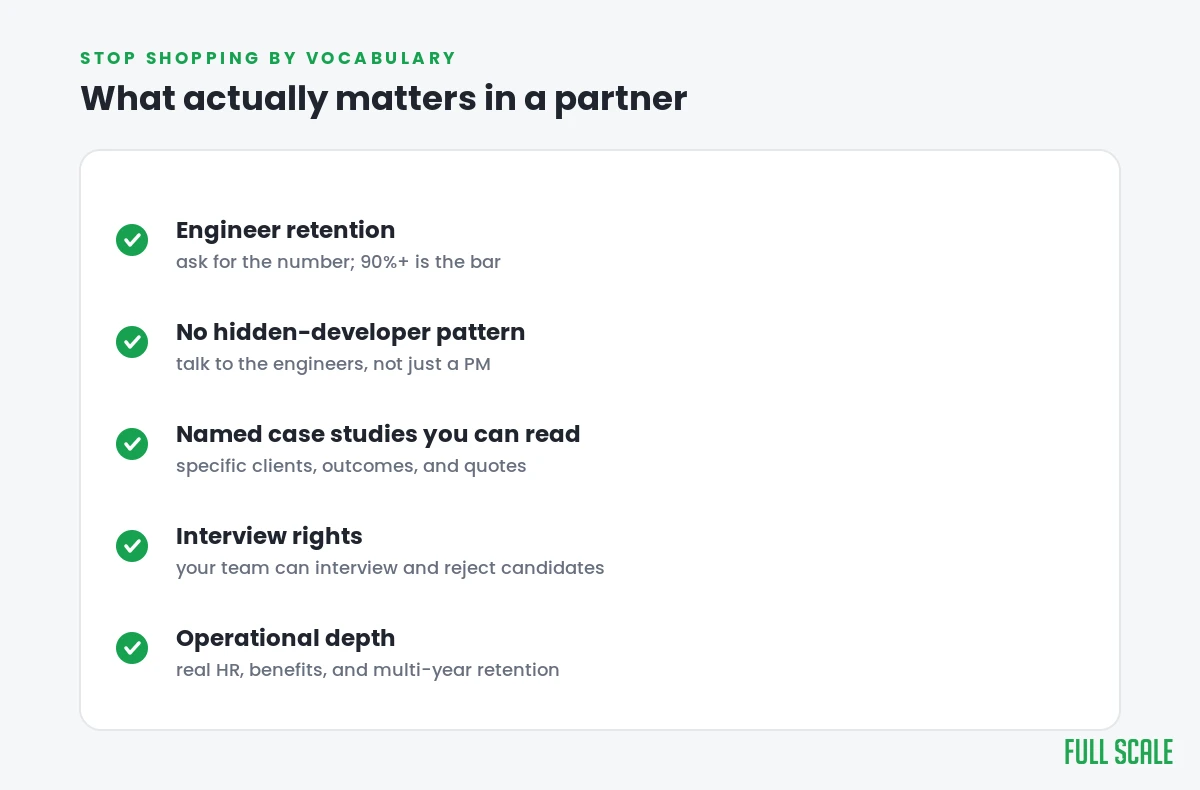
Stop shopping by vocabulary. The label on the partner’s homepage tells you almost nothing about whether they can run the engagement well. Five things tell you everything. The same logic applies when you’re vetting a custom web application development partner, where the label on the service matters far less than the people behind it.
Engineer retention. If the partner’s developers leave every nine months, you’ll be re-onboarding every nine months. Full Scale’s developer retention is over 93%, which is what makes the long-term engagements actually work. Most providers won’t give you a number. That tells you what you need to know.
No hidden-developer pattern. If the partner wants you to talk only to a technical project manager and never directly to the engineers, walk away. That setup is usually a mix of two things: an English-language gap that makes the PM the only person comfortable on client calls, plus a cultural rule about who’s allowed to talk directly to the client. Either way, you’re paying for engineers you can’t actually direct.
Named case studies you can read. Specific clients, specific outcomes, specific quotes. LendingStandard, whose CEO described the engagement as “every challenge surmountable and every success sweeter,” is the kind of reference you want from any partner you’re considering. If a provider can’t show you named clients with real testimonials, ask why.
Interview rights. “We have a rigorous interview process” is not an answer. You want to know how many candidates the partner screens per hire, what their technical assessment looks like, and how much of the vetting your own team gets to participate in. Anything less than your team being able to interview and reject candidates is a red flag.
Operational depth. Long-term engagements require long-term operational infrastructure: real HR, real benefits, real career paths for the engineers. That’s expensive to build and impossible to fake. Ask the partner how they’ve built it, what their tenure curve looks like, and how they retain senior engineers across multi-year client relationships.
None of these criteria change based on whether the partner calls their service “staff augmentation,” “team extension,” “extended development team,” or anything else.
When the labels matter, and when they don’t
The labels matter at exactly two points in the process.
The first is when you’re searching. If you Google “staff augmentation,” you’ll get a US-heavy list of vendors. If you Google “team extension,” you’ll get a European-heavy list. If you Google “extended development team,” you’ll get a mix of LATAM and Eastern European shops. The vocabulary you search affects which vendors show up, not which model you’d be buying from any of them.
The second is at contract time. The contract should describe the actual engagement (who employs the engineers, who directs the work, how long the engagement runs, what the rate covers) in plain language, not in whatever marketing term the vendor uses elsewhere. If the contract is written around the marketing term instead of the substance, push back.
Everywhere else, the labels don’t matter. Three other things should drive your shortlist instead. The structural question comes first: extended team or dedicated team, depending on whether you have a functional in-house team that needs more hands or you’re standing up a new product surface that needs its own group. The operational question is engineer retention, direct access to the engineers themselves rather than to a project manager who sits between you, and named references you can actually call. The contractual question is who owns the IP, what the all-in rate covers, and what happens if a developer leaves. The marketing vocabulary is downstream of all three.
FAQ
Is team extension the same as staff augmentation?
Yes. The engagement model is identical. The terms are different because providers in different regional markets adopted different vocabulary. US shops branded it staff augmentation, Eastern European shops branded it team extension, and LATAM shops use extended team or extended development team. The thing you sign up for is the same in all three cases.
What’s the difference between extended team and dedicated team?
Extended team is one to three external engineers added to your existing in-house team, each treated as a new hire under your engineering manager. Dedicated team is a self-contained group of four or more engineers (frontend, backend, QA, sometimes a tech lead) that owns a slice of work end-to-end and operates as a unit. Pick extended team when you need more hands inside an existing process. Pick dedicated team when you’re standing up a new product or a parallel platform. For a one-off task rather than an ongoing team, a freelance platform fits better, so it helps to weigh the Toptal alternatives by what you are hiring for.
Which is cheaper, team extension or staff augmentation?
Neither, because they’re the same model. The price depends on the geography of the engineers and what’s included in the all-in rate. A senior developer through Full Scale in the Philippines runs $30 to $40 per hour all-in. Eastern European partners typically run $40 to $70 per hour. LATAM partners run $35 to $65 per hour. Indian partners run $20 to $35 per hour. The label on the service (“team extension” vs “staff augmentation”) has no impact on the rate.
Which model is better for ongoing product development?
Either is fine, because they’re the same model. The structural decision (extended team vs dedicated team) matters more. For ongoing product work where the in-house team is functional and just needs more capacity, extended team. For ongoing product work where you’re building a new surface area and need a self-managing group, dedicated team.
Is staff augmentation just another name for outsourcing?
No. Staff augmentation and outsourcing are genuinely different models. Staff augmentation means hiring developers who work directly for you on a long-term basis under your direction. Outsourcing means handing a defined project to a vendor who builds it under their own management and delivers a finished result. Team extension is staff augmentation under a different name, not outsourcing under a different name. Consulting is a third category worth keeping separate from both, since it answers what to build rather than who staffs it. The staff augmentation vs. consulting breakdown covers that split.
What are the real challenges of the team extension model?
The model puts more responsibility on you, not less. You need someone in-house who can manage and direct the engineers day to day, since there is no vendor project manager absorbing that work for you. Time-zone overlap has to be built into your process deliberately, not assumed. And because the engineers integrate into your existing team, a weak internal process gets exported to them instead of fixed. None of that is a knock on the model, it is the tradeoff for the control and cost savings you get in exchange. See the full staff augmentation pros and cons for the complete list.
The honest summary
If you’ve been trying to decide between team extension and staff augmentation, stop. They’re the same model. The decision that actually matters is the structural one: extended team or dedicated team, depending on whether you’re adding capacity to an existing team or standing up a new one. The rest of the decision is about the operational quality of the partner: retention, direct access to engineers, named references, interview rights, and the long-term infrastructure that makes multi-year engagements work. Team extension and staff augmentation are only one naming mix-up; the word “staffing” hides several more, project-based staffing, managed services, recruiter placement, EOR arrangements, laid out in staff augmentation vs. staffing.
If you want a deeper read on how the engagement model actually works, what it costs by region, and how to pick a partner without getting burned, the development team extension guide walks through every part of it. If you want to talk through whether the model fits your situation, Full Scale’s staff augmentation services page covers what we offer, and you can schedule a call to discuss it without a sales pitch.