
Team vs. Contract: The Real Staff Augmentation vs. SOW Debate

In this article
Should this be a statement of work, or should you bring someone onto the team? You don’t need a chart to answer that. You need one question:
Who’s going to write next Tuesday’s ticket?
If the answer is “whoever the vendor assigns, based on what the document says,” you’re looking at a statement of work (SOW). If the answer is “my own product owner, regardless of what any document says,” you’re already doing staff augmentation. You just haven’t admitted it, and you’re probably still paying vendor prices for it.
Cost and flexibility get all the attention in this debate.
What decides it is whether the engineer building your product ever has to look you in the eye.
That single fact changes the relationship, and it changes something people don’t expect: the quality of engineer you end up with.
What You’re Buying: Staff Augmentation vs. a SOW
Quick definitions, because the terms get mushed together constantly.
A statement of work is a contract for a deliverable. You describe what you want. A vendor quotes a price and a date, then owns getting it done. You’re buying an outcome. Staff augmentation is a contract for a person’s time. You hire an engineer who works inside your team, on your priorities, for as long as you need them. You’re buying capacity, which is the model our own staff augmentation services are built around.
Nobody has ever gotten excited reading a statement of work. If someone tells you they have, don’t hire them. They’re lying about something else too.
I’ve written a whole separate piece on why a statement of work in software development tends to go sideways once you get past a simple, well-understood deliverable. This post is narrower. It’s about the moment you’re choosing between the two models for an actual software team, and what that choice quietly does to who ends up writing your code.
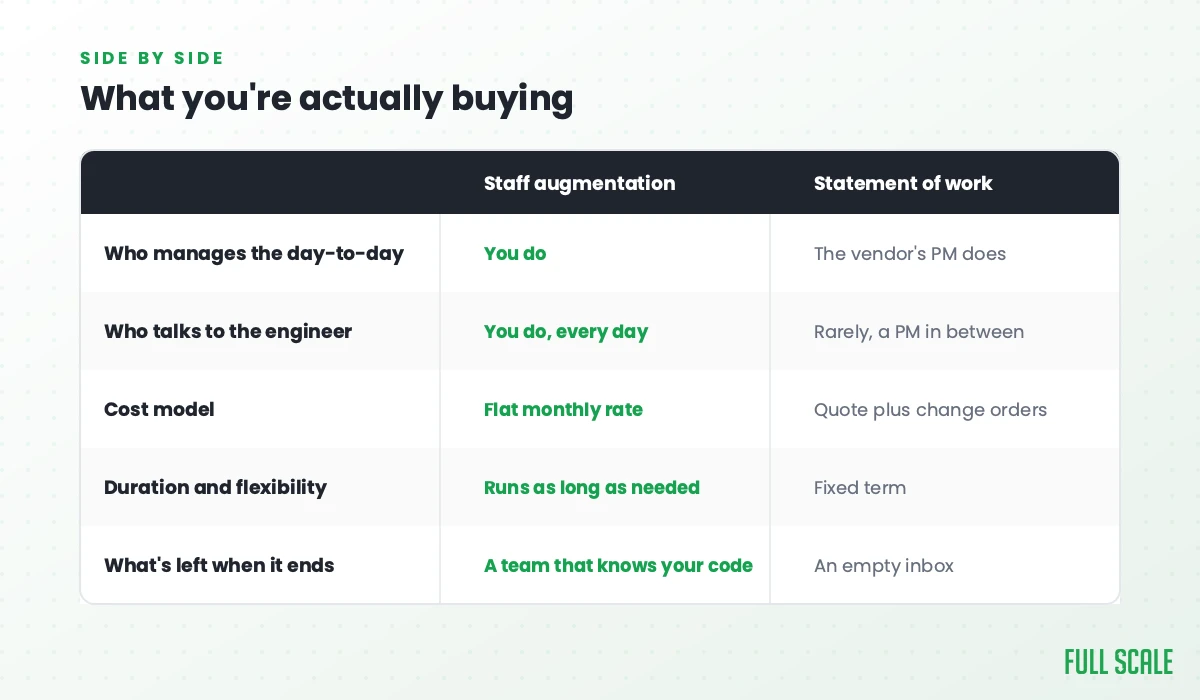
Here’s the side-by-side:
| Staff augmentation | Statement of work | |
|---|---|---|
| Who manages the day-to-day | You do | The vendor’s project manager does |
| Contract structure | Ongoing, per person, per month | Fixed scope, fixed price, fixed date |
| Duration and flexibility | Runs as long as the work does; priorities can shift anytime | Fixed term; a shift means a change order |
| Cost model | A flat monthly rate per engineer | A quoted price, plus padding, plus change orders |
| Who talks to the engineer directly | You do, every day | Rarely. There’s usually a PM in between |
| What’s left when it ends | A team that knows your codebase | A finished deliverable and an empty inbox |
That last row is the one people undervalue. When a SOW ends, the knowledge walks out the door with the vendor. Staff augmentation is different: run it for years and the knowledge just keeps compounding.
I’ve gone deep on staff augmentation vs. outsourcing as a broader business decision elsewhere, and on what actually belongs in a staff augmentation contract too.
People also ask how this stacks up against staff augmentation vs. consulting, staff augmentation vs. managed services, and even team extension vs. staff augmentation, which is mostly the same model with a different label. This post is about the SOW comparison specifically, and about the one thing none of those cover: what the contract structure does to the engineer on the other end of it.
Make sure you work with a dev agency that cares about your product, not just your project. The contract you sign is usually the tell.
“It’s a Fully Integrated Team”: What AMC’s CIO Told Me
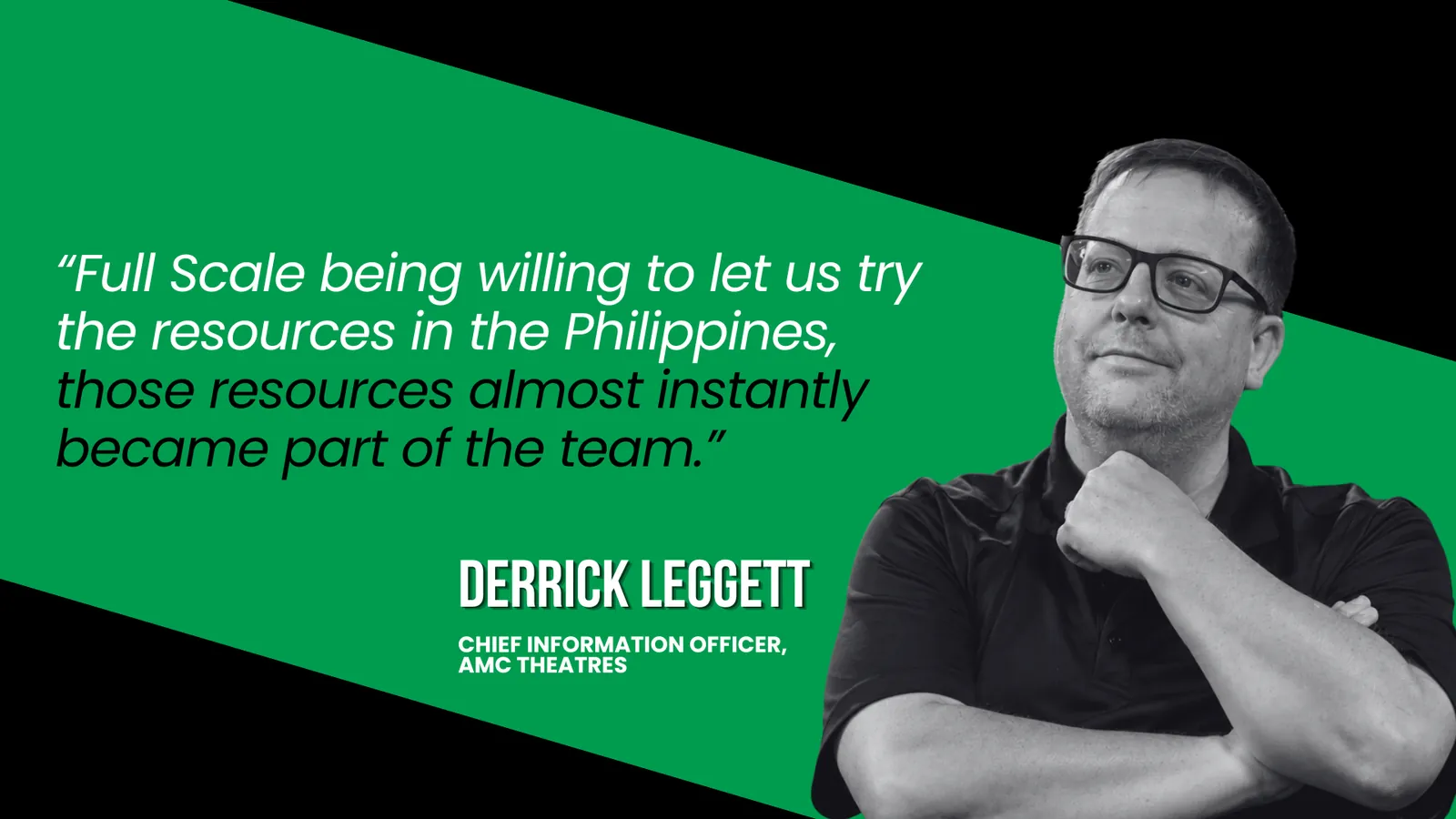
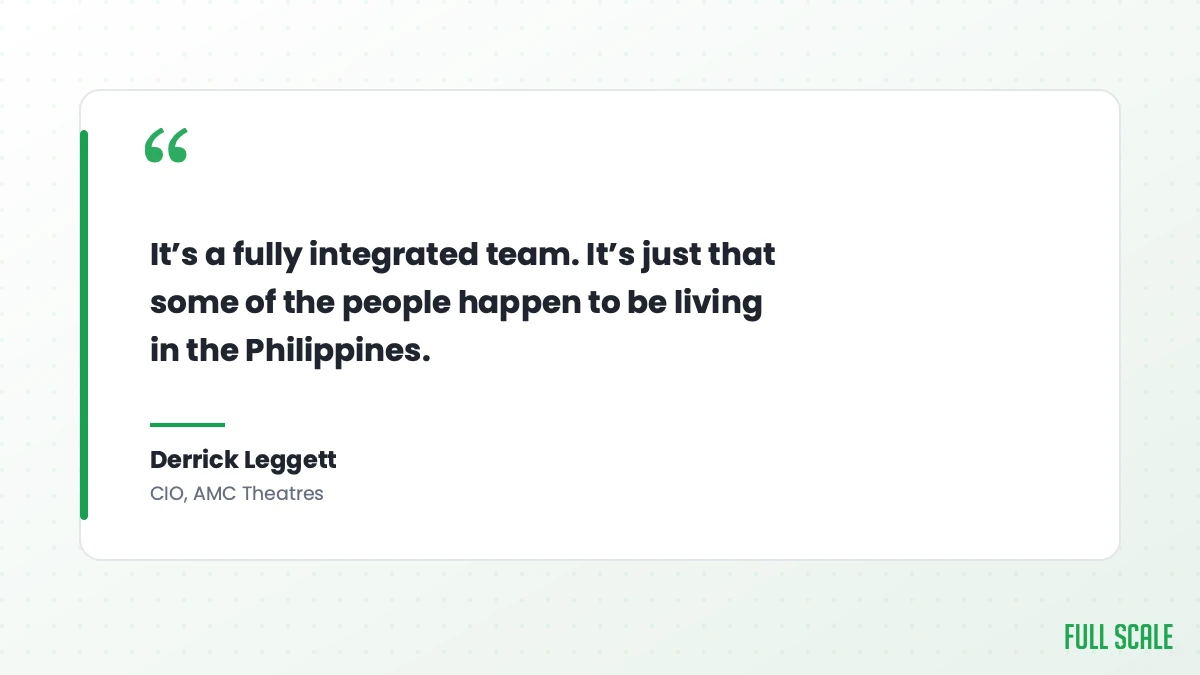
AMC Theatres runs one of the largest movie theater chains in the world, and its CIO, Derrick Leggett, has spent years building a global engineering organization that spans the US, South America, India, and the Philippines. Derrick and I have known each other for twenty-five years, since before Full Scale existed, and when we talked about how his team is structured, he didn’t hedge:
“It’s a fully integrated team. It’s just that some of the people happen to be living in the Philippines.”
AMC never signed a SOW for its Philippines engineers, because the work was never going to hold still long enough to make one worth the paper.
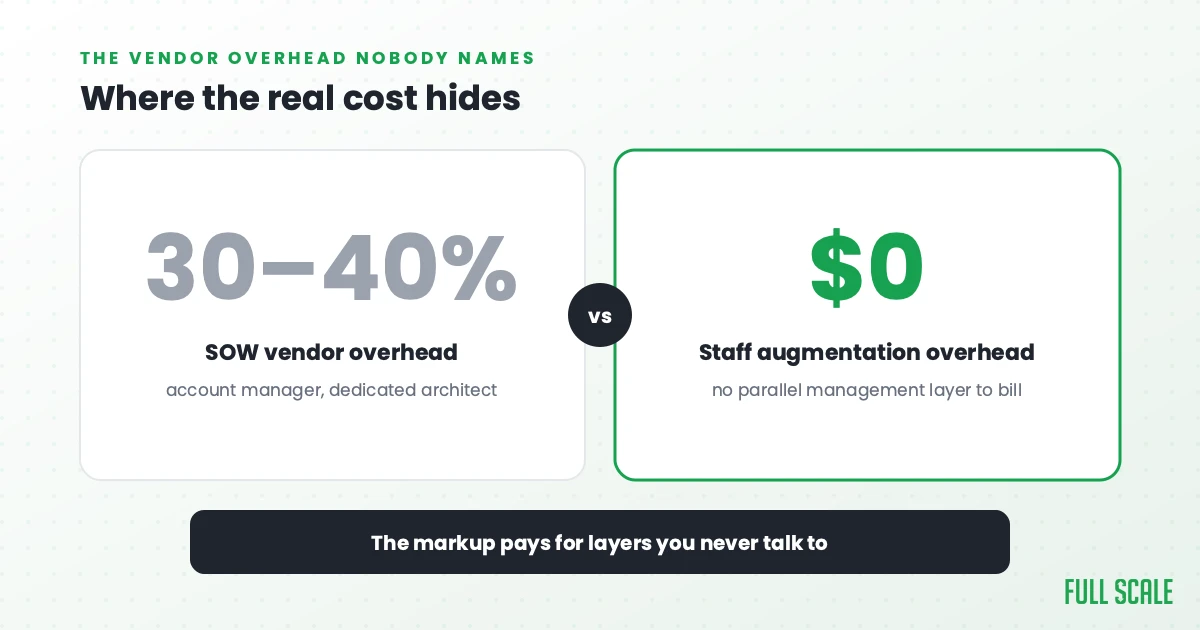
Derrick has also seen the traditional alternative up close: a vendor hands you developers who sit behind their own account manager and their own project layer. He’s blunt about what that actually is. You’re not part of the same team. You’re on opposite sides of a contract. And every one of those extra layers gets billed to you: an account manager here, a dedicated architect there. It runs an extra 30 to 40 percent on top of the actual engineering work, for people whose job function you can barely describe.
Compare that to a model with no parallel PM layer at all. Engineers join your standups, use your tools, and answer to your tech lead the same way a full-time hire would. There’s no project manager translating your feedback before it reaches the person who actually wrote the code. We aren’t in this for some three-month project.
The Hidden Cost of a SOW: Who You End Up Hiring
The PM layer’s real cost never makes it into a SOW’s cost comparison spreadsheet.
When a vendor structures an engagement as a SOW, the engineers doing the work almost never talk to you directly. A project manager sits between you and them, absorbing every question, every clarification, every piece of feedback.
That’s a filter, and it filters for the wrong thing.
I’ve sat in on interviews where a candidate spent their entire career behind that kind of wall, ten years of “experience” and not one client conversation to show for it. They can’t explain a technical decision to the person paying for it, because nobody ever made them. They’ve never had to defend a piece of code in a room where the client could push back. And it shows.
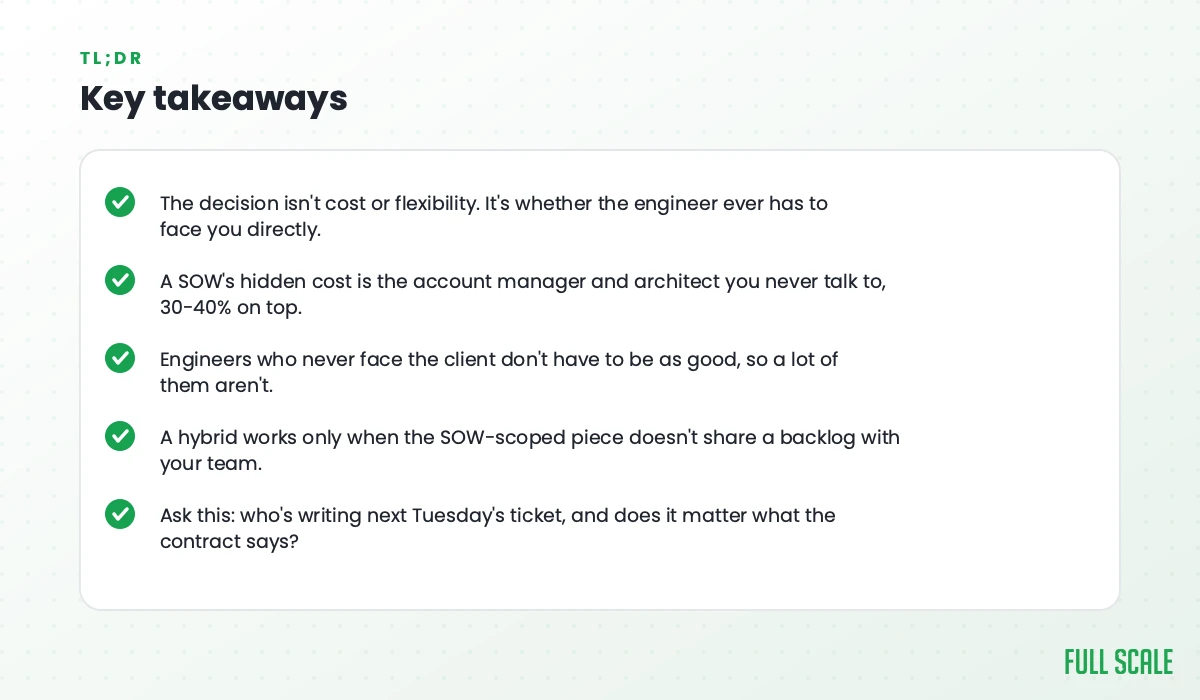
Engineers who never have to face the client directly don’t have to be as good, so a lot of them aren’t.
That’s not a knock on offshore talent, or any specific country. It’s a knock on the wall a SOW puts between you and the person actually doing the work. To be fair, a SOW doesn’t force that wall to exist. You could staff a fixed-price project with engineers who sit in your standups too, and plenty of staff-augmented engineers coast because nobody on the client side ever bothers to engage them directly. But the two correlate hard in practice, because the whole point of a SOW is that the vendor, not you, owns talking to the people doing the work. Hide the communication layer behind a project manager long enough, and you’ll end up keeping engineers on staff who couldn’t explain their own code. They’d have to check whether their manager was going to answer for them first. Staff augmentation removes the hiding place, if you actually use it. The engineer is in your standup. If their communication is weak or their reasoning is shaky, you see it in week one, not eighteen months into a project that’s quietly gone sideways.
So the real bill for a SOW isn’t just the markup.
Somewhere in that vendor org chart is a $300-an-hour architect nobody on your team has ever met. Hope he’s doing great.
I go deeper on this same markup problem, minus the talent angle, in staff augmentation vs. outsourcing.
When a SOW Fits
None of that means a SOW is always the wrong contract for the job. We use them ourselves at Full Scale.
In that same conversation, I made a point I’ve landed on after twenty years of doing this: sometimes a scoped, fixed-price engagement is exactly right. Even at Full Scale, if I need a WordPress site built, I don’t hire a full-time WordPress developer to sit on staff for the next three years. I get a quote, I get the thing built, and everybody moves on. Not every piece of work needs to be a staff augmentation project.
A SOW fits when the scope is genuinely well understood before anyone quotes a price, and the work has been done a hundred times before by the people doing it. You also need to have no interest in keeping that skill set on staff once it ships. A marketing site, a one-time data migration, an integration against a spec that isn’t going to change: all fine candidates for a SOW. There’s also a plain budget reason to like it: a fixed price transfers the execution risk to the vendor and gives Finance a number they can plan around. That’s a real advantage, not just a spreadsheet illusion, and it’s the honest reason a lot of companies reach for a SOW first.
What you give up in exchange is what stays with the vendor when the engagement ends: the “oh yeah, we tried that in March and it broke” context that only lives in people who were there. That memory barely matters for a WordPress site. Losing it on your actual product costs you for years.
Can You Have a Hybrid “Staff Augmentation SOW”?
People ask this a lot. Yes, but only in a narrow case. If you’re already running a staff-augmented team and a genuinely separate, self-contained piece of work shows up, a one-off integration, a migration, a module nobody’s going to touch again after launch, you can scope that piece as its own fixed-price SOW without disturbing the rest of the relationship. The test is whether that scoped piece shares a backlog with your ongoing team.
If it doesn’t, if it’s really its own island of work with its own start and end date, a hybrid is fine.
If it does, if the “scoped” work keeps needing input from the same roadmap and the same people who are already embedded with you, what you really have is a staff-augmented team wearing a SOW’s paperwork. Eventually somebody’s going to be confused about which contract governs which conversation. Keep the two engagements structurally separate, or don’t bother pretending they’re different things.
The One Question That Tells You Which One You Need
Skip the decision matrix with twelve boxes. Ask this instead: who’s writing next Tuesday’s ticket, and does it matter what the contract says?
If the honest answer is “the vendor’s PM decides, based on what’s in the document,” you have a SOW, and that’s fine as long as the work is genuinely bounded. If the honest answer is “my own product owner decides, and the document is basically along for the ride,” you already have a staff-augmented team. The only question left is whether you’re still paying vendor-shaped overhead, the account manager, the mystery architect, the change-order process, for a relationship that’s already functioning like an embedded one.
Most of the SOW-vs-staff-aug confusion I see isn’t a hard case. It’s a company that outgrew the SOW model eighteen months ago and never updated the paperwork.
Frequently asked questions
What’s the difference between staff augmentation and a SOW?
A statement of work is a contract for a finished deliverable. A vendor quotes a price and a date, then owns getting it done. Staff augmentation is a contract for a person’s time. You hire an engineer who works inside your team, under your direction, for as long as the work continues. One buys an outcome. The other buys capacity.
Is SOW vs staff augmentation mostly a cost decision?
Cost is part of it, but it’s not the deciding factor. A SOW’s initial quote often looks cheaper, then real money comes back through vendor overhead, an account manager, a dedicated architect, layers you’re paying for but rarely interact with. AMC’s CIO, comparing Full Scale to the vendor-managed model he’d used elsewhere, puts that overhead at 30 to 40 percent. Staff augmentation costs more per hour on paper but skips that overhead entirely, since there’s no parallel management layer to bill for. The bigger factor is structural: who directs the work, and whether the person doing it ever answers to you directly.
Can you have a hybrid staff augmentation SOW?
Only when the SOW-scoped piece is genuinely separable from your ongoing team’s work, meaning it doesn’t share a backlog, a codebase, or day-to-day priorities with the people you’re already staff-augmenting. If the “scoped” work keeps pulling from the same roadmap as your embedded team, what you actually have is a staff-augmented relationship with confusing paperwork.
Is a staff augmentation agreement a statement of work?
No. A staff augmentation agreement is the contract between a company and a provider that supplies engineers to work as part of the company’s own team. It covers how you pay, who owns the code, how rates change, and how either side can end it. A statement of work describes a deliverable, a price, and a date, and the vendor owns hitting all three. If the document you’re reading is mostly about deliverables and milestones, you’re buying a project, whatever the cover page calls it. The terms worth negotiating in the first kind are covered in our guide to staff augmentation contract terms.
Is misclassifying a SOW as staff augmentation a legal risk?
It can be, and it’s a real, separate question from the engagement-model decision this article is about. On my podcast, David Siegel, a startup and venture attorney at Grellas Shah, told me that diligence teams routinely catch companies that labeled someone a contractor when the day-to-day reality made them an employee, and that a signed document alone doesn’t settle the question if the actual working relationship says otherwise. Siegel’s point was about classifying an individual, contractor versus employee, which is a related but separate question from how you structure a vendor engagement. The underlying principle carries over either way: paperwork doesn’t override what the relationship actually is. And it’s worth knowing the test itself is a moving target right now: the Department of Labor has a new rule proposed for 2026 that would replace the current one. Outside our own conversation, other firms in this space size the exposure in real dollars: Dahl Consulting puts the markup on a misclassified engagement at more than double a properly managed one, and SolveByTalent estimates 20 percent or more in avoidable cost from routing engagements incorrectly. Worth knowing, but it’s a different question than which model fits your work, and it’s an attorney’s job to answer it, not a blog post’s.
When should I use a SOW instead of staff augmentation?
When the scope is fully understood before you ask for a price, the work has been done many times before, and you have no interest in keeping that skill set on staff once it’s done. Think a marketing website, a one-time data migration, or an integration against a spec that isn’t going to move. The moment the work is your actual product, and you’ll be extending it for years, you’re better off with a team than a document.
If you’re staring at a SOW quote in one hand and a staff-aug pitch in the other, schedule a call and we’ll walk through which one actually fits what you’re building. Either way, stop paying for an architect nobody’s ever met.