Custom Web Application Development Company in the Philippines: How to Hire One Without Getting Burned

In this article
- What a “custom web application development company” actually sells you
- Why most offshore web app builds go wrong
- Communication beats cost beats country
- What a custom web app company in the Philippines actually costs
- The model that actually works: a dedicated team you direct
- How to vet a custom web application development company in the Philippines
- What AI changes about hiring a web app team in 2026
- Why companies pick Full Scale
- Frequently asked questions
- Build your web app with a team that sticks around
Search “custom web application development company in the Philippines” and you get a wall of near-identical results. Half of them are directory listings ranking the “top 10” firms, and the other half are agency landing pages promising senior developers at a fraction of US rates. Every one of them says the same things about English skills, time zones, and cost.
None of them tell you the one thing that actually decides whether your project succeeds.
The decision that actually matters is the engagement model you hire them under, and most of the companies ranking for this term push you toward the wrong one.
I’ve been on every side of this. I co-founded VinSolutions and sold it for $147 million, founded and exited Stackify, and over 20+ years I’ve personally hired developers in Russia, Latin America, and the Philippines. The company I run now, Full Scale, is a US company with a 350+ engineer development team in the Philippines. This isn’t theory for me. I built a business on this exact model, mostly by accident, after a Philippines team I set up at Stackify in 2018 worked so well that friends started asking for access to the same thing.
So here’s the honest version of how to hire a custom web application development company in the Philippines, including when you shouldn’t hire one at all.
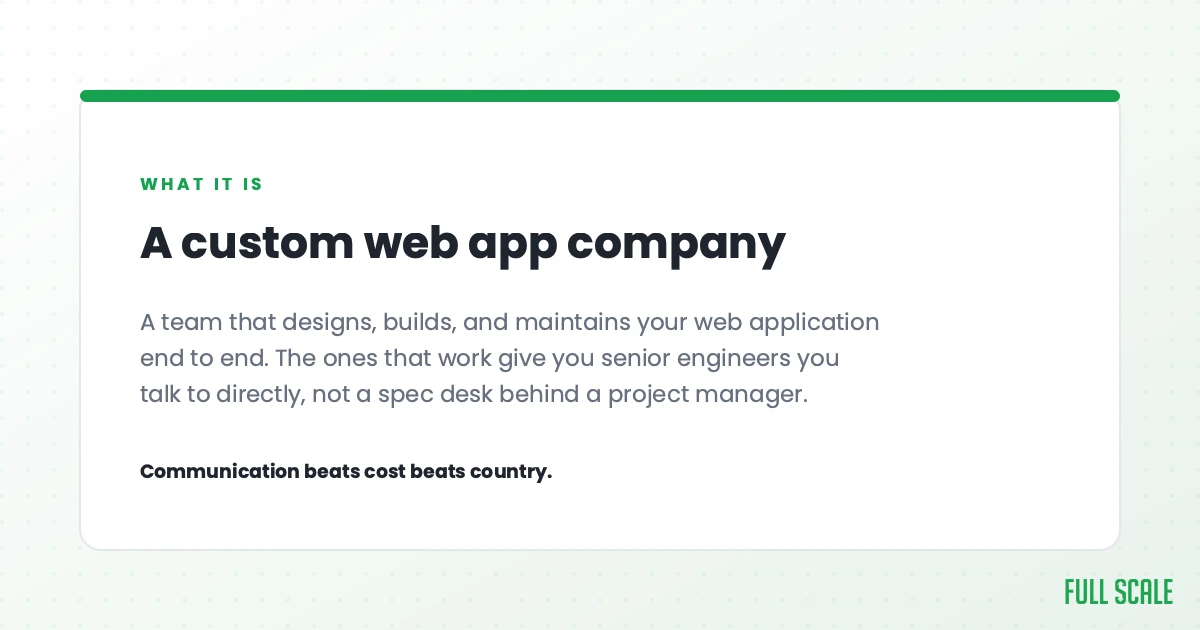
What a “custom web application development company” actually sells you
When you hire a company to build a custom web app, you’re really choosing between three different engagement models. They look similar on a sales page. They are not the same thing, and picking the wrong one is how most offshore builds go sideways.
| Model | What you get | Best for | The risk |
|---|---|---|---|
| Project shop (fixed-bid) | You hand over requirements, they hand back a finished deliverable for a set price | A scoped, one-off build you won’t keep changing | You don’t own the team or the knowledge; changes cost extra; quality is a black box until delivery |
| Dedicated team | A team that works only on your product, long-term, but managed by the vendor | Ongoing product work when you have your own technical leadership | A vendor layer can still sit between you and the engineers |
| Staff augmentation | Developers who join your team directly, work in your tools and standups, report to your manager | A real product you’ll build and run for years | You need to actually lead them, the same as in-house hires |
A project shop is built around the statement of work. You write the spec, they quote a price, they build it, you pay, the engagement ends. That model is fine for the right job. I’ve used it myself. I outsourced WordPress builds and an Elasticsearch project to project shops because they were quick, well-scoped, and I didn’t need a full-time specialist sitting around after the work was done. For WordPress work that needs an owner rather than a one-off, our WordPress development services place a dedicated team.
The trouble starts when people use that same model for a real web application.
A custom web application is not a project. It’s a product you’ll keep changing for years. You’ll add features, fix bugs, respond to customers, rebuild the parts that didn’t work, and react to the market. A fixed-bid project shop is the wrong shape for that, because the moment the deliverable ships, the relationship and the institutional knowledge walk out the door. The people who learned your codebase move on to the next client’s project.
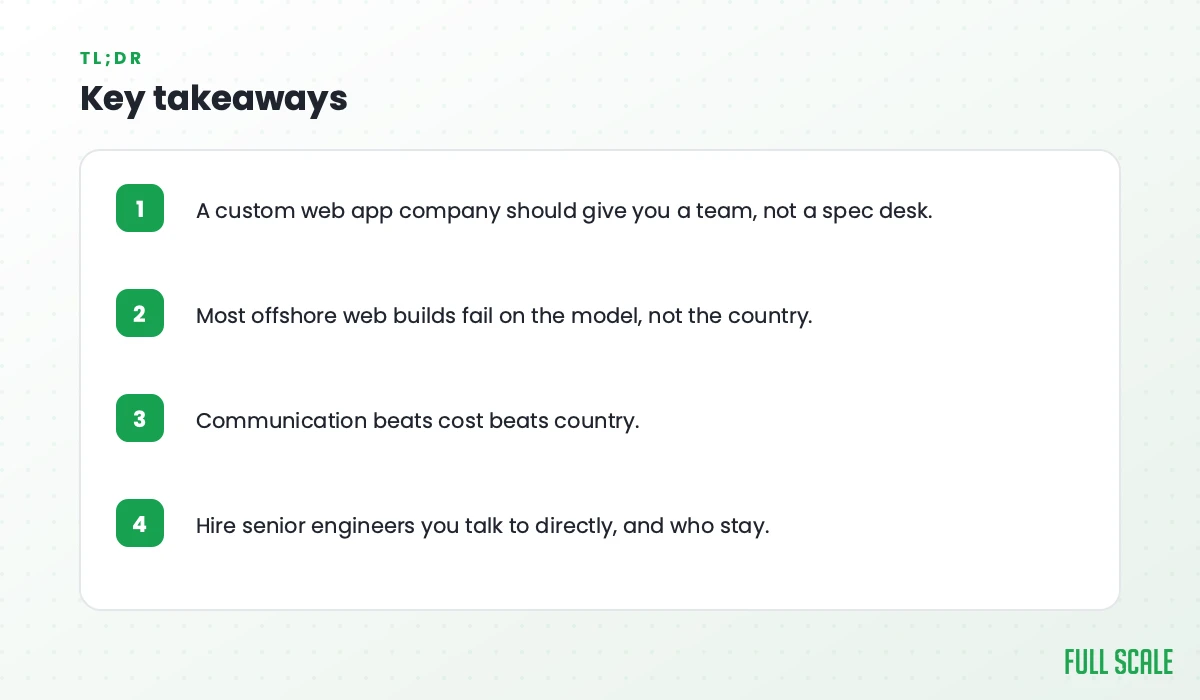
That’s why the model matters more than the company. For ongoing product work, you want a team that sticks around, which usually means a staff augmentation model or a true dedicated team rather than a fixed-bid project shop.
Why most offshore web app builds go wrong
Ask anyone who tried offshore once and swore it off, and you’ll usually find one of two failure patterns underneath.
The first is hiring on price alone. I call it cheapshoring. If cheap is your only reason for trying offshore web development, you’ll buy the cheapest thing available, which is a freelancer who vanishes mid-sprint or a project shop that bills for ten developers while three do the actual work. You save money on paper and pay for it in rework, missed deadlines, and a half-finished app you have to rebuild. Cost is a perfectly good reason to hire in the Philippines. It just can’t be the only one. I wrote a whole piece on cheapshoring if you want the full argument.
The second pattern is subtler, and it’s the one that quietly kills long-term builds.
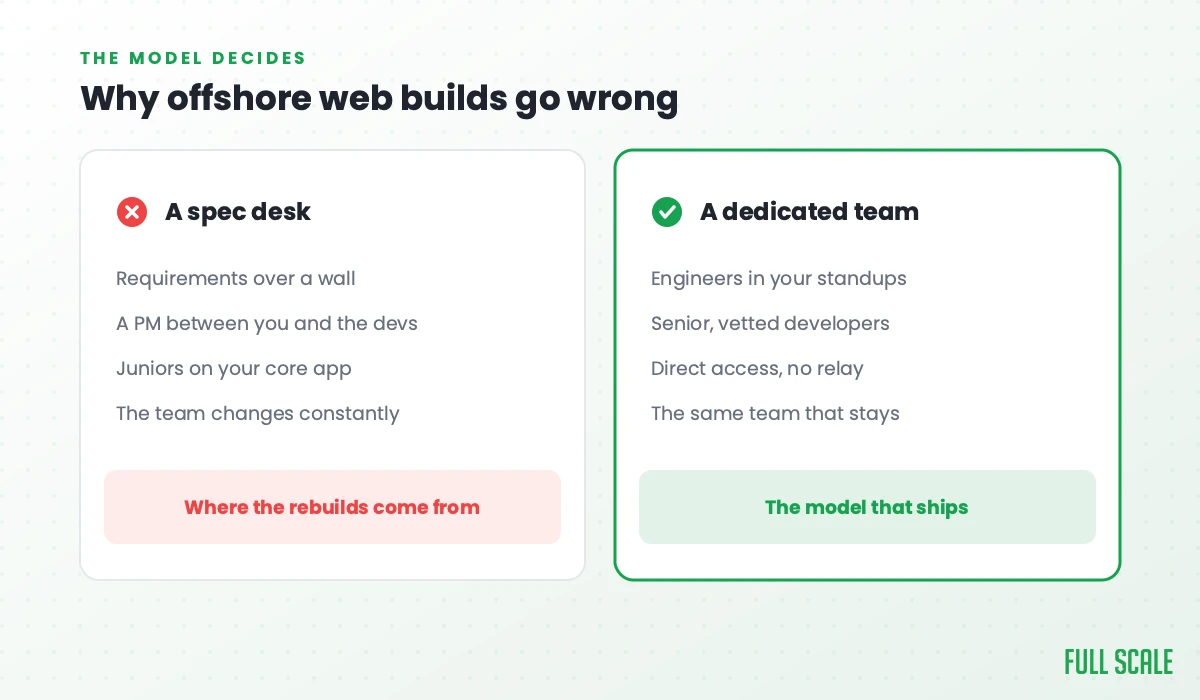
I’ve talked to plenty of founders running overseas teams who only ever speak to one person, the “technical project manager.” Every other developer hides behind that person. Sometimes it’s a language gap. Sometimes it’s a cultural rule about who’s allowed to talk to the client. Either way, you end up with a team you can’t actually communicate with and a middleman standing in the way of every decision.
On a one-off project, you might survive that. On a web application you’ll run for years, it’s fatal. The knowledge about your product lives in a relay you don’t control, the feedback loop is slow, and you never build a real relationship with the people writing your code. If you want the full collection of how these go wrong, the outsourcing horror stories are worth reading before you sign anything.
Both failure modes come back to the same root cause. The model put a wall between the client and the people doing the work.
Communication beats cost beats country
When people ask me how to choose where to build, I give them the order I actually use: communication first, cost second, country third.
Communication comes first because software development is about communication more than anything else. You can have brilliant engineers, but if you can’t explain what you want and they can’t tell you what’s getting in the way, the build fails. Cost comes second, because cheaper talent that you can’t direct is not a deal. Country comes last, because it’s really just the result of optimizing for the first two.
This is exactly why the Philippines keeps winning for custom web app work, and it’s the part the directories get backwards. They lead with cost, when communication is what actually decides whether the build works.
Filipino developers grow up speaking English and consuming American culture, so there’s almost no language barrier. The Philippines ranks 28th out of 123 countries on the EF English Proficiency Index, well above the global average and in the “high proficiency” band, and it’s the third-largest English-speaking country in the world. On my own teams, the communication has been the best of anywhere I’ve hired.
The country also has a deep, proven talent pool. The Philippine IT and business process industry brought in roughly $40 billion in 2025 and employs about 1.8 million people. None of this is new. The country has handled custom software application development for Western companies for two decades.
Yoni Kosminski, who builds offshore teams in the Philippines and joined me on the Startup Hustle podcast, makes the same point I do: the talent is there and it’s excellent, but you have to define the role and the expectations clearly before you hire, or even great developers can’t succeed. That comes back to communication too.
And the cost advantage is real, but it’s worth understanding where it comes from. It’s cost-of-living arbitrage, not skill arbitrage. A senior developer in the Philippines earns less than one in San Francisco because a dollar goes much further in Cebu than it does in California, not because the work is worth less. That distinction matters, because it means hiring in the Philippines gets you genuinely senior engineers at 50 to 70 percent below US rates. You pay less for the same quality of work.
What a custom web app company in the Philippines actually costs
The hourly rate is the number every directory and agency leads with, and it’s the most misleading one. Here’s the fuller picture.
A good Filipino developer earns roughly $15 to $30 an hour locally, with seniors at the top of that range. A custom web application development company like Full Scale typically bills a client $30 to $40 an hour for a senior engineer’s time, which covers the developer’s pay plus recruiting, payroll, benefits, equipment, HR, and the local legal and management overhead you’d otherwise carry yourself.
Now compare that to building the same team at home. The US median software developer salary is about $133,000 a year, and a senior engineer runs $150,000 to $185,000 in base pay alone. Once you add benefits, payroll taxes, equipment, and recruiting, the fully loaded cost lands at roughly 1.25 to 1.4 times that base, so a senior US developer costs you around $200,000 a year all in. The arbitrage is not subtle.
But the hourly rate is rarely where an offshore engagement wins or loses money. The hidden costs decide that.
The biggest one is turnover. A custom web app is a multi-year build. The bigger expense is the team that knows your codebase walking out every nine months, which forces you to re-hire, re-onboard, and re-explain everything all over again. Philippine call-center attrition runs around 30 percent, which is normal for the wider outsourcing industry there. At Full Scale, our developer retention is over 93 percent. A team that compounds knowledge year over year will out-build one that resets every time someone quits. If you want the country-by-country breakdown, we keep a guide to offshore development rates that goes deeper.
So when you compare quotes, don’t just compare hourly rates. Compare the total cost of keeping a working team together for the life of your product. A slightly higher rate with low turnover beats a rock-bottom rate that churns.
The model that actually works: a dedicated team you direct
After hiring developers in several countries and running engineering at three companies, the model I trust for a real web application is staff augmentation. You hire developers who work directly for you, long-term, on your Slack, in your standups, accountable to your product manager. There’s no parallel vendor PM relaying messages. The engineers care about your product the same way your in-house team does, because they are your team. They just happen to live somewhere else.
We aren’t in this for some three-month project, and the best clients aren’t either.
The time zone works better than people expect. The Philippines runs about 12 to 13 hours ahead of the US, so most of our clients keep a few hours of live overlap, usually their morning, and let the rest of the day run asynchronously. Teams that want full US-hours coverage can have it, since some engineers in Manila work an evening shift to match a US workday. Your developers sit in your standups either way, instead of being reachable only through a relay.
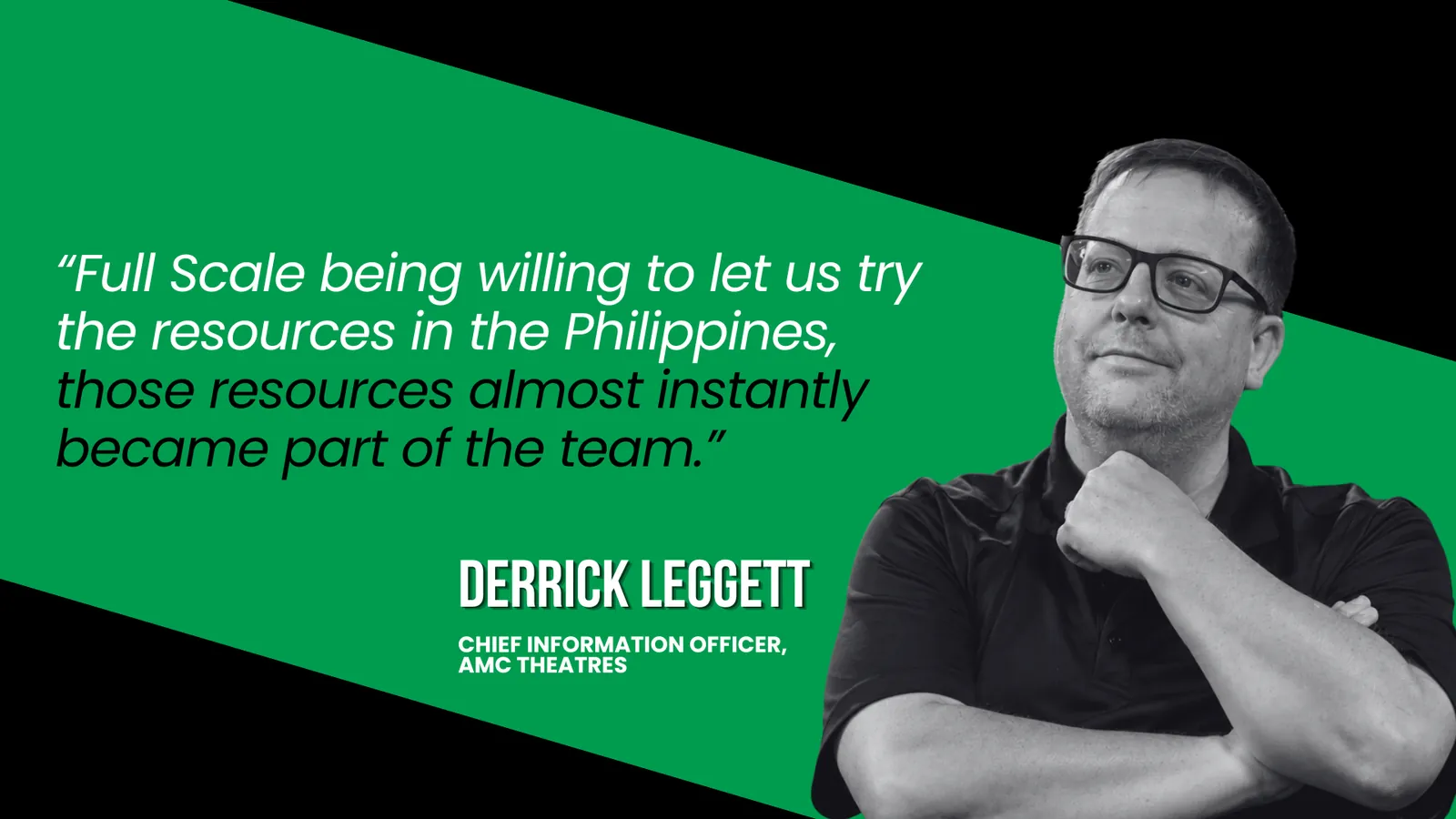
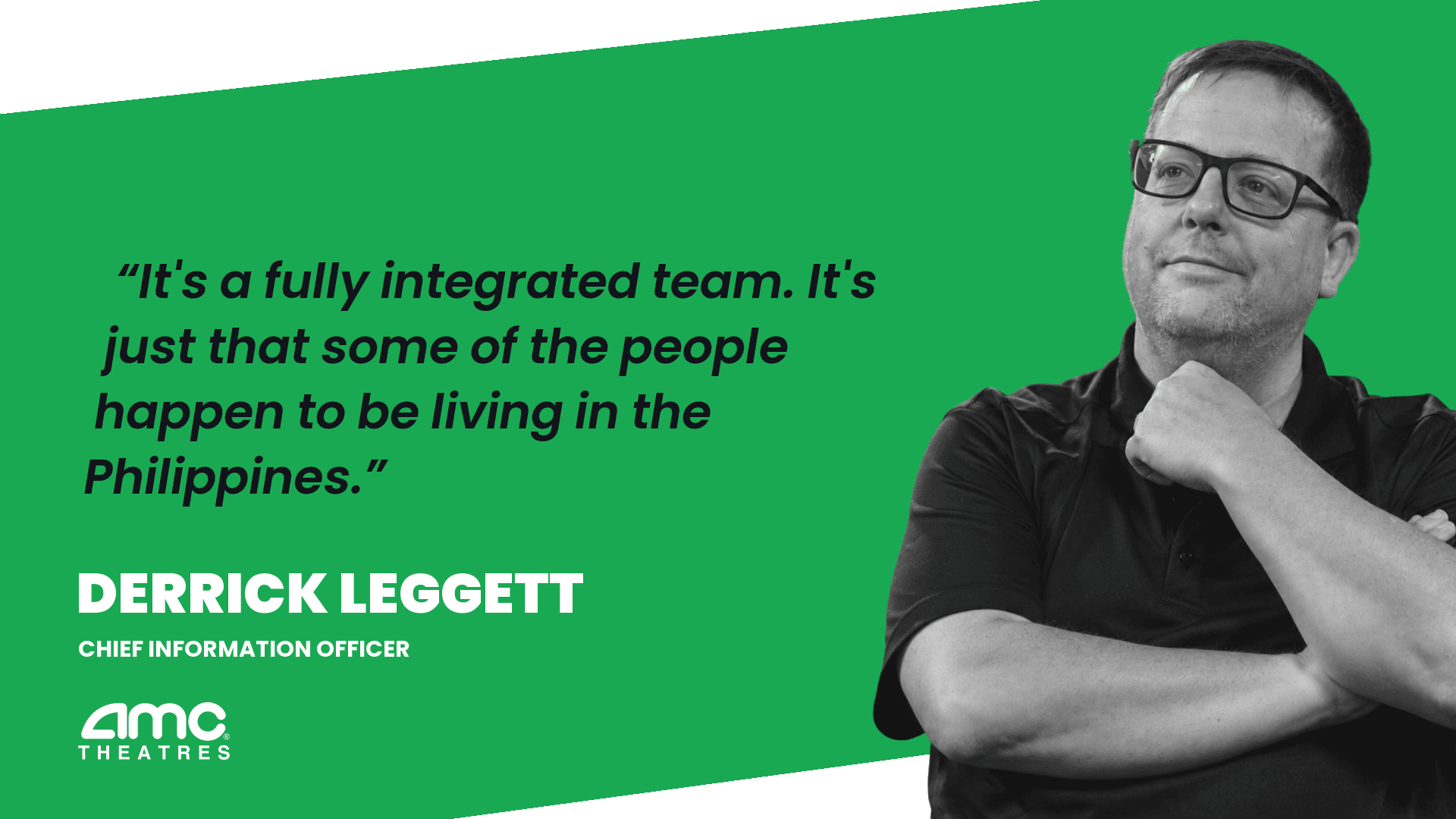
AMC Theatres is the clearest example I can point to. Derrick Leggett, their CIO, has built a global engineering organization where the Full Scale developers join AMC’s standups, use AMC’s tools, and work off AMC’s roadmap with no middleman in between. The way Derrick describes it: “It’s a fully integrated team. It’s just some of the people happen to be living in the Philippines.” That’s the model working at enterprise scale. AMC deliberately rejected the traditional outsourcing setup, where engineers sit walled off behind a vendor account manager who adds 30 to 40 percent of overhead for layers nobody asked for. For a Microsoft-stack web app, the leaner path is to hire ASP.NET developers in the Philippines who sit directly on your team.
LendingStandard, another client, came to us after local hiring stalled, and their CEO said the most significant impact was “the seamless integration of their team with ours.” Same model, same result, with the wall between client and engineers taken down.
Here’s the part founders push back on: what if I don’t have engineering leadership to direct a team?
Then put some in place first, even fractional, before you hire anyone offshore. Building software with a vendor works a lot like building a house with a general contractor. You, the homeowner, stay involved and make the daily calls, while your general contractor manages the trades who do the actual building. It comes down to how much you trust that general contractor, which is exactly why it should be someone you chose and who answers to you, never a subcontractor who volunteered to supervise their own work.
A technical leader on your side is leadership you control. A vendor’s project manager relaying messages between you and the developers is the middleman pattern that burns people. Knowing the difference is most of the battle, and it’s the whole reason staff augmentation beats project-shop outsourcing.
If you want the deeper version of why this model beats the alternatives, we cover the benefits of staff augmentation and how to run a dedicated development team in their own guides.
How to vet a custom web application development company in the Philippines
Once you know the model you want, vetting the company gets a lot easier. The worry I hear most is quality, the fear that offshore code will come back sloppy. The honest answer is that quality is the same problem as turnover: it comes down to who the company hires and whether those people stay long enough to get good at your product. So here’s what I’d actually check, in order.
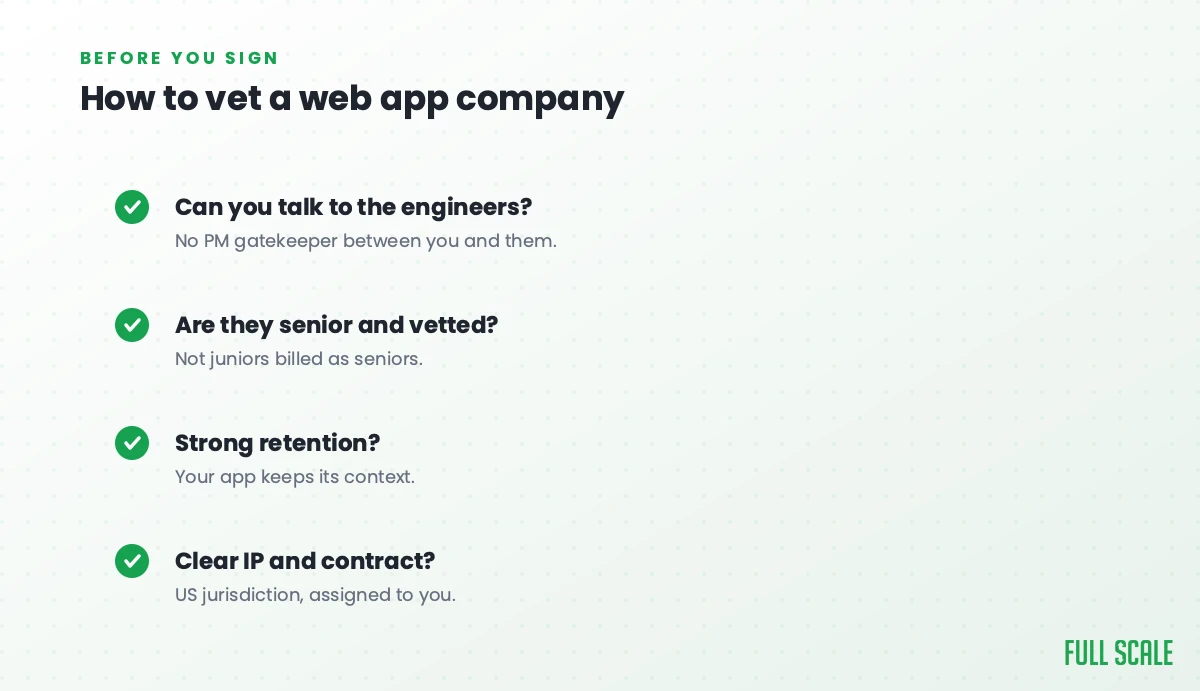
Ask who legally employs the developers. With a good partner, the developers are real employees of the company, and the company is a real legal entity in the Philippines with the right contracts in place. Your master services agreement assigns the intellectual property and covers confidentiality, and there’s an unbroken contract chain from you, to the company, to the engineer. With Full Scale, you’re contracting with a US company, so if anything ever goes wrong, you’re dealing with a US entity under US law, not trying to track down a freelancer of unknown jurisdiction. A cheap project shop or a marketplace freelancer leaves you carrying all of that risk alone.
Ask how they recruit. The best developers already have jobs and aren’t browsing job boards. A real partner has full-time recruiters who go out and pull passive senior candidates away from their current employers, plus referrals from their existing team. If a company’s answer is “we post the job and screen who applies,” you’ll mostly get people who have applied to a hundred roles and landed none. The engineers you want are the ones a recruiter had to talk out of a job they already had.
Ask about retention, and make them give you a number. Turnover is the single biggest hidden cost on a long build, and most companies won’t volunteer their attrition rate because it’s bad. Ask directly. A company that keeps its people is a company whose developers will still know your codebase three years from now.
Test communication before you sign. Get on a call with the actual developers, not just the salesperson. Can they explain a technical tradeoff clearly? Do they ask good questions about your product? If the company only lets you talk to one designated contact, that’s the hidden-developers pattern, and you should walk.
Check references that matter. Ask to talk to a client who has been with them for years, the kind of multi-year relationship that proves the model holds up over time, rather than a logo on a slide.
These are the same offshore hiring fundamentals that decide whether the engagement is a win for everyone: a real opportunity for the developer, top engineering at a sustainable cost for you, and a partner that earns the relationship by making both happen.
What AI changes about hiring a web app team in 2026
AI has changed how much a small team can build, and it makes the case for a dedicated offshore team stronger, not weaker.
A smaller team that’s fluent in tools like Cursor, GitHub Copilot, and Claude gets far more done per engineer than a team of the same size did a couple of years ago. 84 percent of developers now use or plan to use AI tools. But that same survey found that close to half of them don’t fully trust the output, which is the important part. AI writes a lot of the code now, and a human still has to own the judgment, the review, and the decision about what to build in the first place.
That’s why I tell our engineers that typing speed is no longer the thing that matters most. What matters now are the Three C’s I write about in Product Driven: communication, curiosity, and courage. As AI handles more of the mechanical work, the human skills become the job. The developers who understand the problem, ask the right questions, and speak up when something’s wrong are the ones who will run technology, while the ones who just write code to spec are the first ones AI replaces.
So when you evaluate a custom web app team in 2026, don’t just ask whether they use AI, because everyone will say yes. Ask whether the people can think, communicate, and own the outcome, because that’s the part AI can’t do for them. As DORA’s research keeps showing, AI amplifies what’s already there: a strong, well-led team gets faster with it, while a weak, walled-off team just ships its problems quicker.
Why companies pick Full Scale
I’m obviously biased, so take this as the operator explaining the model rather than a pitch.
Full Scale is a web development company built entirely around the model in this post. We don’t sell fixed-bid projects. We recruit senior Filipino engineers, vet them, and place them directly onto your team where they work in your tools and standups for the long haul. We handle the recruiting, payroll, benefits, HR, equipment, and the local legal side, and we put a customer success manager on the relationship whose job is to keep both you and the engineers successful.
The numbers behind it: 350+ engineers, 200+ tech companies served, 700+ developer placements since 2018, over 93 percent developer retention, Great Place to Work Certified in the Philippines two years running with 95 percent of our people saying it’s a great place to work, and a spot on the Inc. 5000 five years in a row. We can usually have vetted senior engineers in front of you within days and on your team within two to three weeks, which is faster than most US IT staffing.
If you want to see the model on a real web app build, the NavMD case study is a good place to start, or you can look at how we approach hiring developers in the Philippines directly.
Frequently asked questions
What does a custom web application development company in the Philippines cost?
Most companies bill a client around $30 to $40 an hour for a senior engineer, which is roughly 50 to 70 percent less than the all-in cost of an equivalent US hire. That rate usually covers the developer’s pay plus recruiting, payroll, benefits, equipment, and local management. When comparing quotes, weigh total cost over the life of the product, including turnover, not just the headline hourly rate.
Should I hire a project shop or a dedicated team for a custom web app?
For a scoped, one-off build you won’t keep changing, a fixed-bid project shop can be fine. For a real web application you’ll develop and run for years, a dedicated team or staff augmentation is the better fit, because the engineers stay, learn your codebase, and work directly with you instead of handing back a deliverable and moving on.
Why hire web developers in the Philippines specifically?
The Philippines combines strong English communication, deep familiarity with American business culture, a large and mature software talent pool, and a meaningful cost-of-living advantage. The communication quality is the real reason to choose it, and the cost savings come along for free.
How do I protect my intellectual property when hiring offshore?
Work with a partner that is a real legal entity, signs a master services agreement assigning IP and covering confidentiality, and holds proper employment contracts with its developers. Contracting with a US-based company means any dispute is handled under US law. That unbroken contract chain protects your code better than handing it to an unattached freelancer.
How long does it take to get a developer onto my team?
With a partner that recruits proactively, you can usually be reviewing vetted senior candidates within days and have a developer integrated into your standups within two to three weeks, which is typically faster than filling the same role through US-based IT staffing.
Build your web app with a team that sticks around
A custom web application is a long-term product, so hire the way you’d build for the long term. Choose the model before the company, put communication ahead of cost, and pick a partner whose people will still know your codebase years from now. For that model in practice, our web app development services give you the dedicated team shape this decision calls for.
If you want to talk through what that looks like for your product, schedule a call with Full Scale and we’ll walk you through how a dedicated team in the Philippines would work for what you’re building.