
Extended Development Team: When to Pick This Structure Over a Dedicated Team

In this article
- What an extended development team actually is
- Extended team vs. dedicated team: the structural difference
- When to pick an extended team
- When to pick a dedicated team
- How an extended team actually works day-to-day
- What an extended development team costs
- How extended teams compound into dedicated teams over time
- How to pick a partner for an extended team
- Common ways extended team engagements fail
- FAQ
- The honest summary
Picking between an extended team and a dedicated team is the structural decision that actually determines whether the engagement works. The vocabulary debate (team extension, staff augmentation, extended development team, dedicated developer model) almost never matters as much as buyers think it does, because the labels describe the same engagement model in different markets. What changes between extended and dedicated is the structure of the team you actually get.
I’ve hired offshore developers in four countries personally. I co-founded VinSolutions, which exited for nine figures, founded Stackify, which I sold in 2021, and now run Full Scale, which supports 200+ tech companies on the staff augmentation model. The choice between extended team and dedicated team is the one I see new clients get wrong most often, and it’s the one that determines whether the engagement compounds into something useful or quietly fizzles.
An extended team is one to three external engineers added to your in-house team and run by your engineering manager. A dedicated team is a self-contained group of four or more engineers that owns a slice of work end-to-end and runs itself under your roadmap. Both engagements are long-term and both run under your direction, but the difference between slotting engineers into your existing team versus standing up a unit alongside it is the part that changes everything about how the work actually goes. For a .NET product, that embedded unit is where you hire dedicated C# developers who own features end to end.
What an extended development team actually is
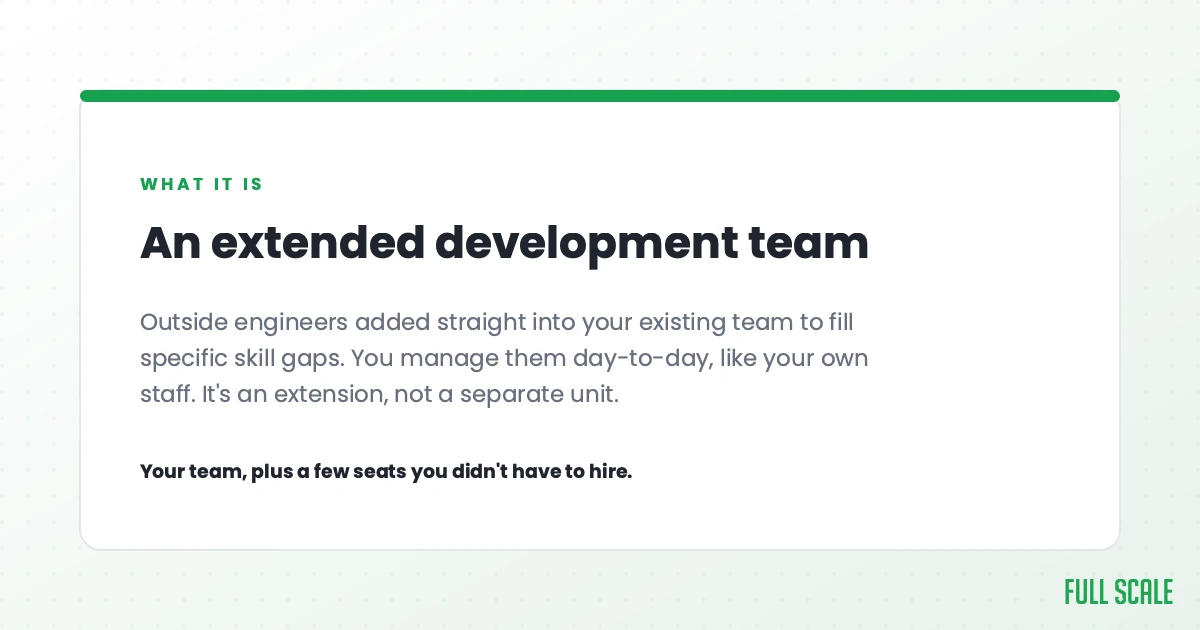
An extended development team is a small group of external engineers (usually one to three) who join your in-house team and work full-time on your product under your engineering manager. They attend your daily standup, push to your repos, get assigned tickets in whatever tracker you already use, sit in code review, and stay on the team for years. The partner who employs them handles payroll, benefits, recruiting, HR, and equipment in the background. You handle the engineering work.
The defining feature is that each engineer is treated as a new hire who happens to sit somewhere else, not as a vendor resource you brief through a project manager. They’re part of the team, and they go on the team page if you have one.
The model goes by several names. Staff augmentation, team extension, extended development team, extended software development team, and dedicated developer model all describe the same engagement under different marketing labels. We use staff augmentation and extended team interchangeably at Full Scale because those are the terms our US clients actually search for. The labels follow the market, but the underlying engagement is the same in every case.
Extended team vs. dedicated team: the structural difference
Both fall under the broader team extension umbrella, and both are the same partner relationship. What changes is who decides how the work gets broken down.
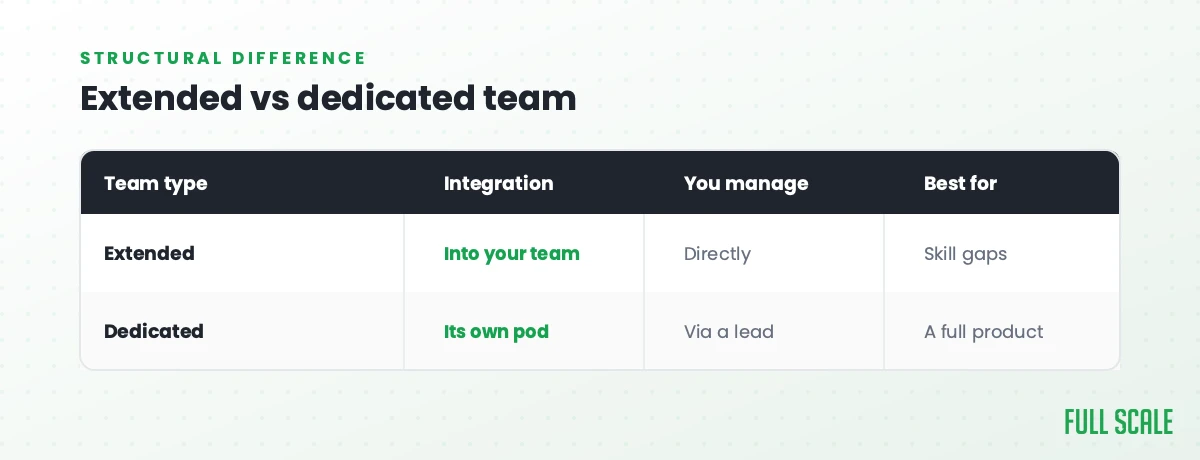
On an extended team, your engineering manager runs that decision. The new engineers receive tickets, attend the standup, participate in architecture conversations, and ship features the same way a recent hire would. There’s no internal hierarchy among them and no separate tech lead. They’re individuals who joined the team you already have.
On a dedicated team, the team itself decides how the work gets broken down. A tech lead inside the group drives day-to-day decisions, the engineers self-organize across frontend, backend, and QA, and you give them a roadmap and constraints rather than a ticket queue. You set the strategic direction and they figure out the execution.
The decision comes down to one question: do you have engineering bandwidth in-house to direct individual engineers in detail, or do you need a self-managing group?
When to pick an extended team
An extended team is the right call when all of these are true.
- You have a functional in-house engineering org. Your standups work, your code review process works, your sprint planning works, and the bottleneck is headcount rather than process.
- You have a real backlog. Tickets that nobody has time to work on are exactly what an extended team handles well. The roadmap is set, the priorities are clear, and what you need is hands.
- You need one to three specific roles filled. A senior backend engineer, two frontend developers, or a QA engineer dropped into the team you already have, rather than a whole new team standing up alongside it.
- You have an engineering manager who can onboard them. Each new engineer goes through the same onboarding any in-house hire would. If nobody in-house has the bandwidth to do that, the model breaks.
Most companies who reach out to Full Scale fit this profile. They’ve grown past the point where local hiring keeps up, they have working engineering process, and they need a way to add senior engineers without spending six months in a recruiting cycle. Adding one or two engineers through an extended team gets them moving inside two to three weeks.
When to pick a dedicated team
A dedicated development team is the right call when the work is structurally different.
- You’re standing up a new product surface. A parallel platform, a new mobile app, a separate B2B product. Something that needs its own team rather than capacity inside an existing one.
- You don’t have engineering bandwidth to direct individual engineers. If your CTO and tech leads are already at capacity, adding four engineers under their direct supervision will make the bottleneck worse.
- You want the team to be self-managing. You set the roadmap, the dedicated team breaks down the work, makes architecture decisions inside the group, and delivers against the roadmap.
- The scope is four or more engineers from day one. Below that headcount, a dedicated team doesn’t have the internal range to self-organize well, and you’re better off running the same engineers as an extended team.
The structural shift is real. A dedicated team is its own engineering unit operating alongside your in-house team, with internal range to make its own decisions. An extended team is a small set of engineers operating inside the team you already have, with your existing managers making those calls.
How an extended team actually works day-to-day
The operational reality of an extended team is closer to hiring than to contracting. Here’s what the first 30 days look like when the engagement is set up well.
In the first two weeks, the new engineer is in your Slack, in your standup, has push access to your repos, and has been introduced to the team by name. By week three, they’re picking up small tickets to learn the codebase and the product. By week four, they’re contributing to substantive work and participating in architecture conversations.
The day-to-day rhythm after that is the same as any in-house engineer: standup during the overlap window with Manila in your morning, tickets pulled from your sprint board, PRs reviewed by your tech leads, retros every two weeks. There’s no separate project manager between you and the engineer, and you talk to them directly every day.
The single biggest predictor of whether an extended team works is whether the engineer is treated as a team member rather than a vendor resource. The companies who get this right invite the engineer to architecture discussions in week one. The ones who get it wrong run the engagement through a project manager intermediary for six months and then conclude that offshore didn’t work for them.
When I was running engineering at Stackify, we had over 20 developers in the Philippines, and they contributed directly to the product I exited in 2021. They were not “the offshore team,” they were the team. The Philippines time difference is 14 hours from Kansas City, and we ran the engagement with a four-hour overlap window in the morning. It worked because we treated those engineers the same way we’d have treated them if they had joined us in person.
What an extended development team costs
Pricing in this market is opaque on purpose. Most providers won’t quote anything until you’ve sat through a sales call. Here’s the actual range.
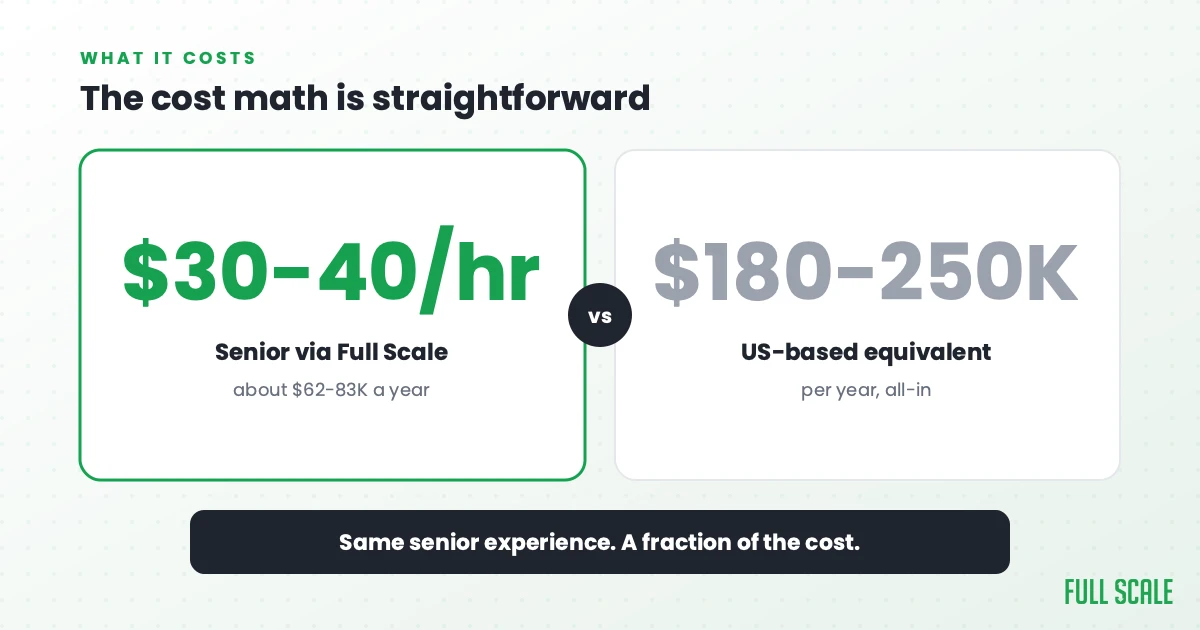
A senior developer in the Philippines through Full Scale runs $30 to $40 per hour, all-in. That’s roughly $62,000 to $83,000 annually for an engineer with 7+ years of experience. Compared to a US-based equivalent at $180K to $250K all-in, the math is straightforward. A two-engineer extended team in the Philippines costs less than one senior engineer in San Francisco.
The range across regions is wider than most buyers expect. Engineers in the Philippines run $30 to $40 per hour through Full Scale, Eastern European partners typically run $40 to $70 per hour, LATAM partners run $35 to $65 per hour, and Indian partners run $30 to $55 per hour. The all-in rate should include payroll, benefits, equipment, HR, office space, and an account manager who runs the operational side of the engagement. If a quote looks unusually low, the savings are almost always coming out of one of those line items rather than out of developer pay. For current senior rates across the major offshore countries, see our offshore software development rates by country guide.
How extended teams compound into dedicated teams over time
This is the part most providers don’t talk about, and it’s the most useful frame for thinking about the model.
Most Full Scale engagements that start as an extended team grow into a dedicated team within two or three years. Year one is usually one or two engineers helping with the backlog, and by year three that has gradually grown into six engineers owning a whole product surface. The transition happens as the company’s needs grow rather than as a discrete restructuring decision.
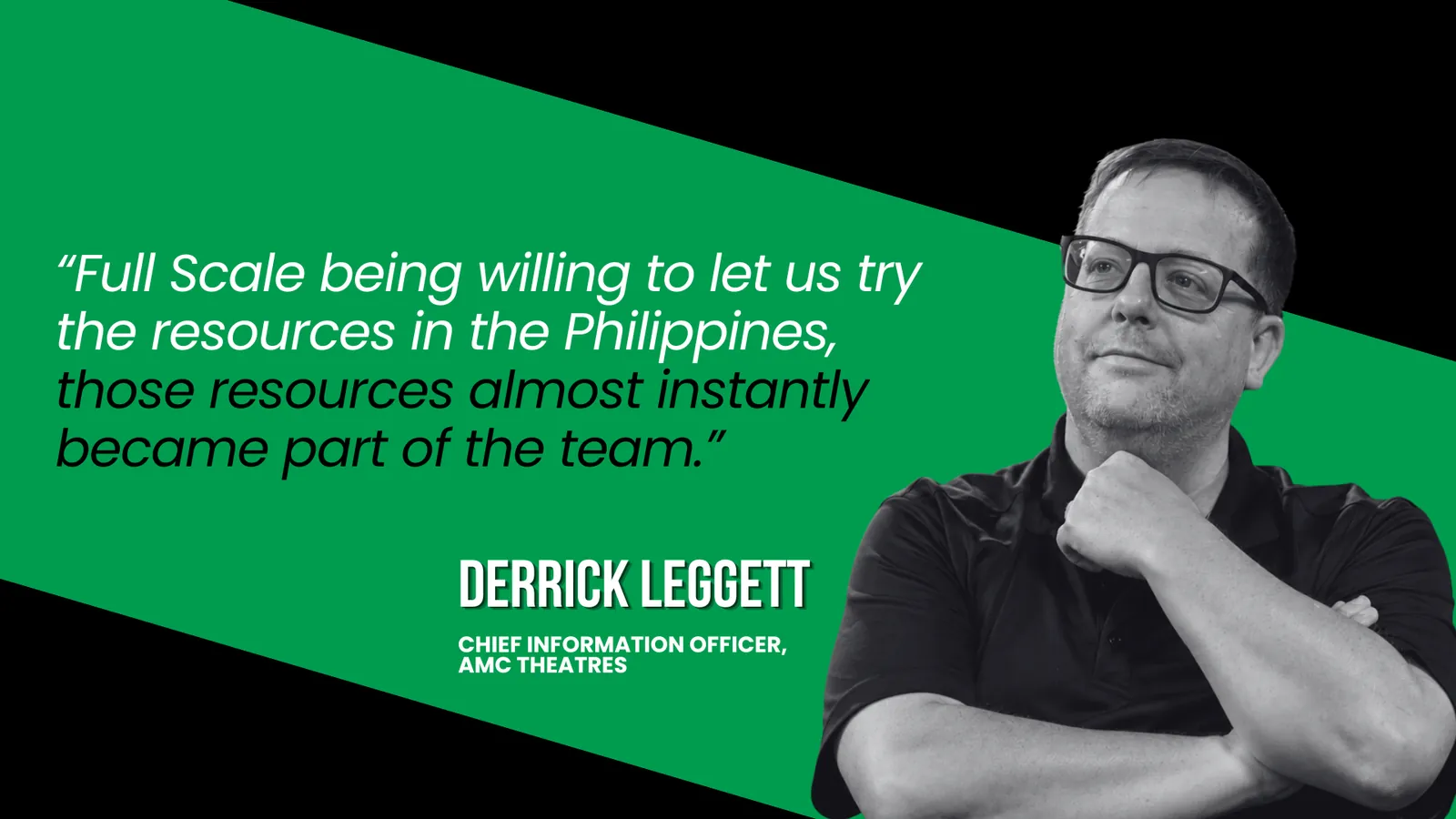
AMC Theatres followed roughly this trajectory. They started small on the .NET stack and now run a multi-engineer team through Full Scale that operates as part of their engineering org. LendingStandard built their engineering capacity the same way, with the CEO describing the engagement as “every challenge surmountable and every success sweeter.” At PMI Rate Pro, what began as a small extended team grew into a self-contained product team that rebuilt their mortgage insurance platform from the ground up.
The trajectory matters when you’re picking a partner. A partner who can run an extended team well but can’t scale into a dedicated team is going to cap your growth. A partner who can do both lets you start with the structure that fits today and grow into the structure that fits in two years, without changing vendors and re-onboarding everyone.
How to pick a partner for an extended team
The market has hundreds of providers, most of them mediocre and a handful actually good. Five things tell you which is which.
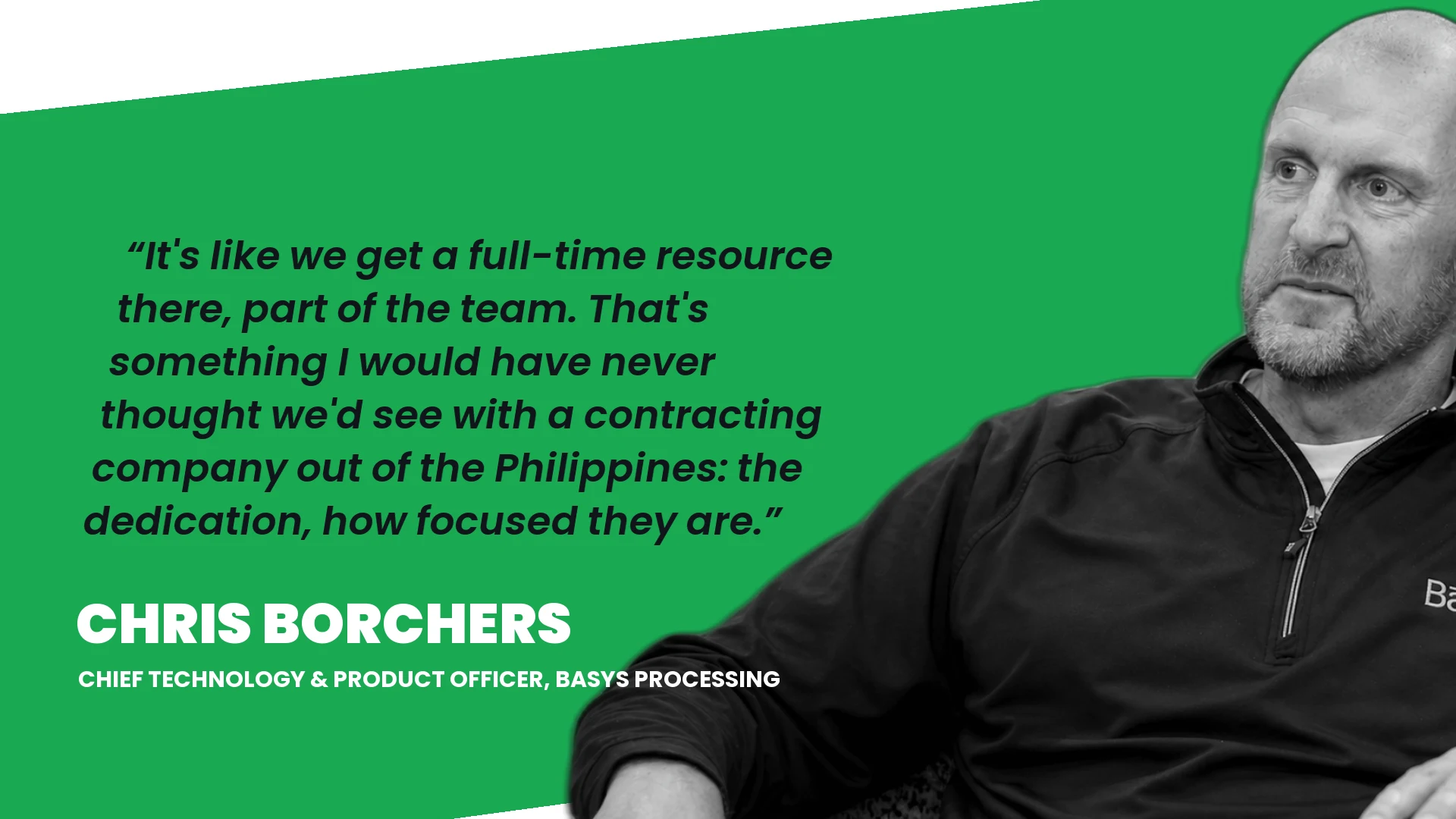
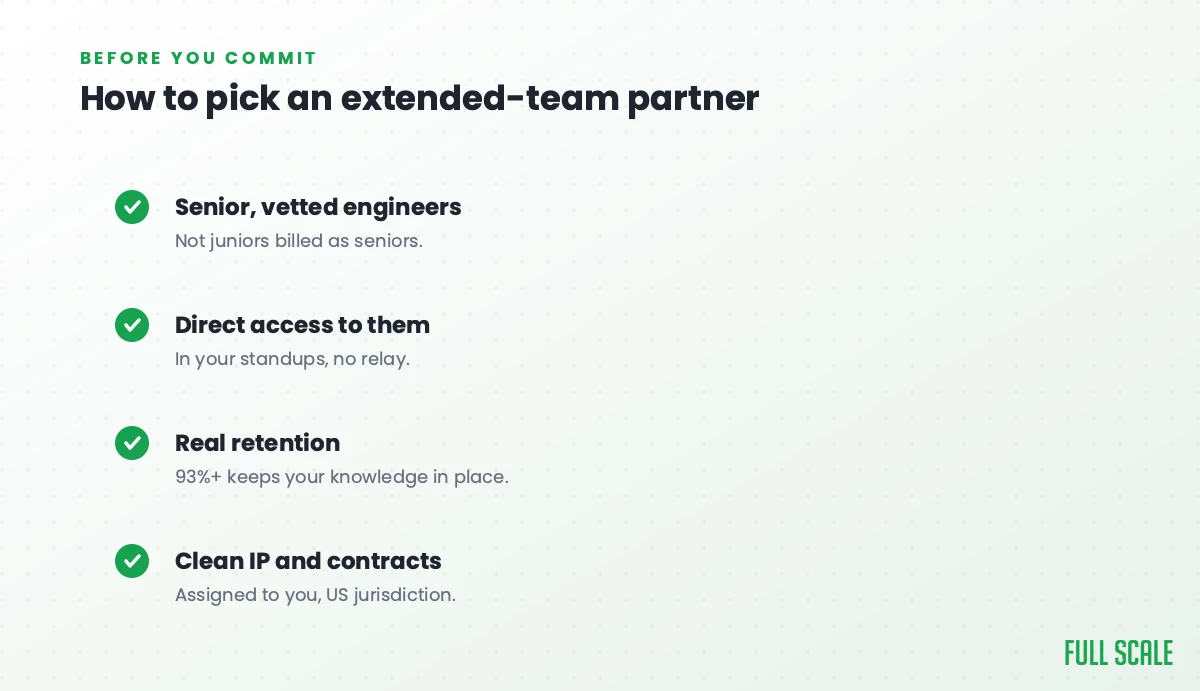
Engineer retention. If the partner’s developers leave every nine months, you’ll be re-onboarding every nine months. Full Scale’s developer retention is over 93%. Most providers won’t quote a number, which tells you what you need to know. A repeatable approach to onboarding software developers is what keeps a growing team productive instead of constantly re-ramping.
Direct access to the engineers. The bad pattern in this industry is the hidden-developer setup, where the client talks only to a technical project manager and the engineers stay behind the curtain. Walk away from that. You want a partner where the engineers themselves are in your standup and your Slack every day.
Named case studies you can read. Specific clients, specific outcomes, specific quotes. If the partner can only show you anonymized “Client X” testimonials, ask why. Real references tell you the engagement worked. The absence of them tells you it usually doesn’t.
Interview rights. “We have a rigorous interview process” is not an answer. Your own team should be able to interview every candidate before they join your engagement, and reject anyone who doesn’t fit. Anything less means the partner is matching people to billable slots rather than to your team.
Operational depth. Long-term engagements require long-term infrastructure: real HR, real benefits, real career paths for the engineers. That’s expensive to build and impossible to fake. Ask how the partner has built it and what their tenure curve looks like.
Common ways extended team engagements fail
I’ve watched these engagements fail in five specific ways, and the failure mode is always the same shape: the structure of the engagement was right, but the operational reality didn’t match it.
Treating the engineer as a vendor rather than a team member. This is the biggest failure mode by a wide margin. The engineer gets tickets handed to them, never gets invited to architecture conversations, never speaks in standups beyond a status update. After eight months, the company decides “offshore didn’t work” and ends the engagement. The engineer was capable. The integration never happened. I’ve seen this play out at companies who came to Full Scale after their first attempt failed elsewhere, and the pattern is always the same.
No architecture seat at the table. An extended team engineer who never participates in architecture decisions becomes a ticket-taker who builds whatever shows up in their queue. That’s a waste of a senior engineer, and the engineer will eventually leave because the work isn’t engaging. The fix is straightforward: invite them to the architecture conversations from week one.
Communication through a project manager intermediary. If the partner inserts a PM between you and the engineer, you’ve signed an extended team contract but you’re getting project outsourcing in disguise. The engineer can’t be directed by your team, your team can’t ask them questions in real time, and the work slows to the speed of the intermediary’s bandwidth.
Six-week engagements masquerading as long-term. The model only works at 12+ month engagement lengths because the first two months are mostly onboarding investment. A six-week engagement burns the onboarding cost and ends before the engineer has paid it back. If you genuinely need someone for six weeks, hire a contractor instead.
No engineering leadership in-house. An extended team adds capacity to your engineering org. It doesn’t replace the leadership of it. If there’s nobody on your team who can review code, set architecture, and run a standup, adding extended team engineers won’t fix the underlying gap. You’ll need a different model, usually a fully managed engineering partner.
The common thread across all five is that the partner can do their part well and the engagement can still fail if the in-house side isn’t set up to integrate the engineers. The model assumes integration into your team, and when that integration doesn’t happen, the engineers turn into expensive ticket-takers and the engagement stops being worth the cost.
FAQ
What’s the difference between an extended team and staff augmentation?
They’re the same model under different marketing labels. The vocabulary varies by region: US shops use staff augmentation, Eastern European shops use team extension, LATAM shops use extended team or extended development team. The engagement is identical in all three cases. The full vocabulary breakdown is in the team extension vs staff augmentation post.
How many engineers should be on an extended team?
Usually one to three. Above three engineers, you’re effectively running a dedicated team and should restructure the engagement accordingly. Below one is just a contractor relationship, which is a different model.
What does an extended development team cost?
A senior engineer in the Philippines through Full Scale runs $30 to $40 per hour all-in, which is roughly $62,000 to $83,000 annually. Eastern European partners typically run $40 to $70 per hour, LATAM partners $35 to $65 per hour, and Indian partners $30 to $55 per hour. The all-in rate should cover payroll, benefits, equipment, HR, and account management. If a quote looks unusually low, ask what’s not included.
How long does it take to onboard an extended team?
A good partner has vetted senior engineers available in two to three weeks from contract signing. The engineer is in your standup within 14 days. Productive contribution to substantive work usually starts in week four, after the engineer has learned enough of the codebase and product context to ship safely.
Can an extended team turn into a dedicated team?
Yes, and that’s the most common trajectory at Full Scale. Most engagements that start as an extended team of one or two engineers grow into a dedicated team of five or six over two to three years. The same partner runs both structures, so the transition doesn’t require changing vendors.
How does an extended team differ from outsourcing?
In an extended team engagement, you direct the work and the engineers join your team. In project outsourcing, you hand a defined spec to a vendor who builds it under their own management and delivers a finished result. Outsourcing makes sense for bounded one-off projects. Extended team is built for ongoing product development where the work depends on what shipped last quarter.
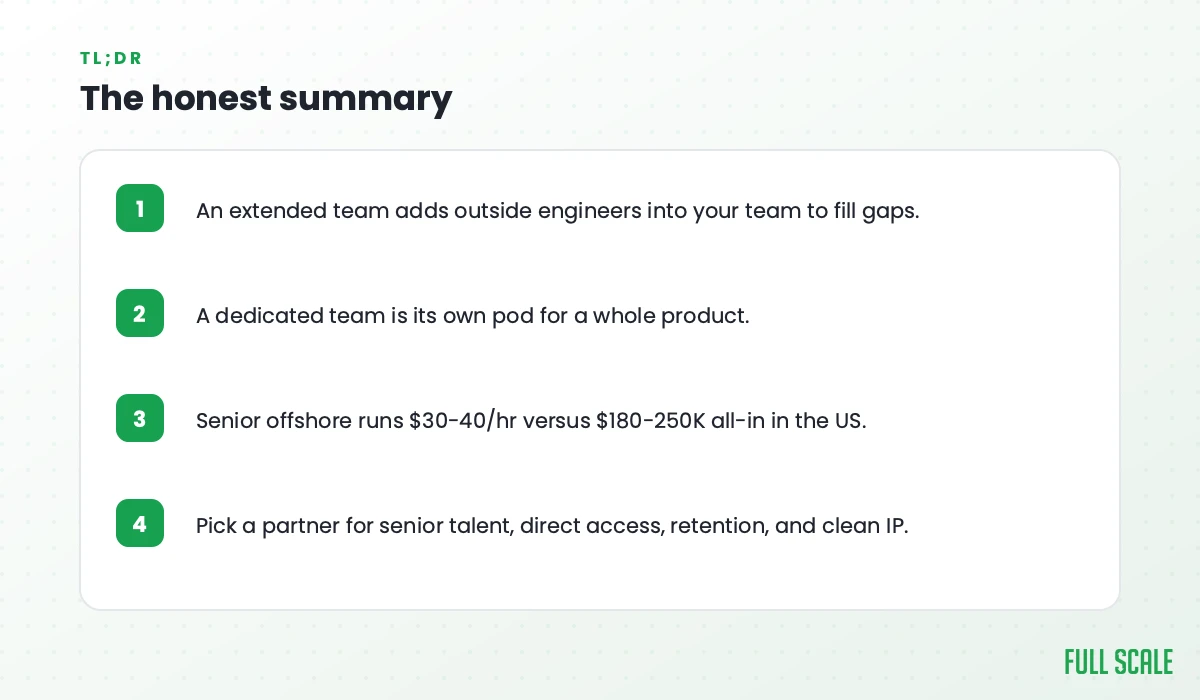
The honest summary
The structural decision is the one that matters. An extended team is the right call when you have a functional engineering org that needs more hands and one to three specific roles filled. A dedicated team is the right call when you’re standing up a new product surface that needs its own self-managing group.
The operational reality is what determines whether the engagement actually works. Engineer retention, direct access to the engineers, named references, interview rights, and the long-term infrastructure that makes multi-year engagements possible. The vocabulary debate (“is this team extension or staff augmentation?”) is downstream of all of that and almost never changes the decision.
If you want a broader read on the engagement model, what it costs by region, and the comparison with adjacent models like outsourcing and contracting, the development team extension guide walks through every part of it. If you want to talk through whether the model fits your situation, Full Scale’s staff augmentation services page covers what we offer, and you can schedule a call to discuss it without a sales pitch.