

He avoided offshore "like the plague." Then Full Scale felt like a full-time team
A conversation with Chris Borchers, Chief Technology & Product Officer at Basys, a Kansas City payment processor serving 20,000+ merchants, on why he'd avoided offshore development for years, and what changed his mind.
A CTO who avoided offshore like the plague
Basys had built up 60+ full-time engineers on its core payment processing platform, hired deliberately over years. As the company grew, so did the peripheral work: integrations with partner systems like Epic, QuickBooks, and Business Central, the kind of fast-moving edge work that didn't justify pulling core headcount off the main product.
Chris's starting position on offshore development wasn't neutral. It was skepticism bordering on avoidance, built from real experience catching bad code and rewriting it as it came in. His read on why offshore engagements usually fail: they only work with constant, on-site micromanagement, something that doesn't fit how Basys runs its culture of empowerment.
It felt like a full-time team member, not a contractor
Basys started working with Full Scale in the Philippines in 2020, initially to move faster on integration work without pulling resources off the core product. What Chris found surprised him: dedication and focus he didn't expect from a contracting arrangement.
Critically, the team operates inside Basys's empowerment culture rather than needing the micromanagement layer Chris had come to expect from offshore work.
"It's like we get a full-time resource there, part of the team. That's something I would have never thought we'd see with a contracting company... the dedication, how focused they are on solving the problems at hand."
— Chris Borchers, Chief Technology & Product Officer, Basys
Professionalism and communication
Chris credits the level of talent directly: professionalism, good communication skills, and at the end of the day, good code.
Accountability
When something isn't going right, the team owns it and steps up to make it right, rather than waiting to be told.
No middle manager in the way
Full Scale engineers sit in Basys's standups and are available on Basys's hours. There's no project manager shielding them from the customer.
Unscripted ownership
Chris's engineering manager was out one week. He came back expecting a mess and found an engineer had already solved the problem, unprompted.
"Offshore, I've almost avoided it like the plague because of the experiences I've had in the past."
— Chris Borchers, Chief Technology & Product Officer, Basys
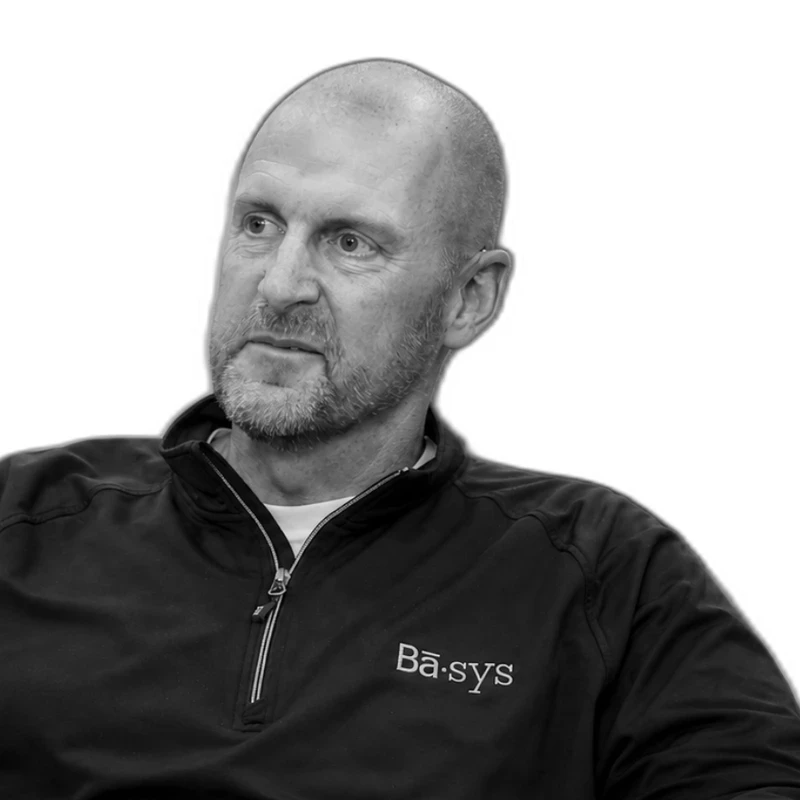
"I think it's a level of talent, honestly. Just the professionalism, good communication skills. And then, obviously, at the end of the day, good code."
— Chris Borchers, Chief Technology & Product Officer, Basys
One of the largest ISOs in America, built on its own stack
Basys is a 25-year-old, privately held payment processor and one of the largest ISOs (independent sales organizations) in the US, serving 20,000+ merchants across physical, e-commerce, and other channels. The business collects money for its customers through credit card, ACH, and other methods, on a fully owned, fully omnichannel platform rather than a resold third-party stack.
Chris Borchers is Basys's Chief Technology & Product Officer, a role that deliberately keeps technology and product under one leader so the two teams build together instead of pointing fingers. He came to Basys from healthcare, where he built systems for processing insurance claims, experience he draws on directly when explaining why payment processing is just as complex.
No middle manager, no shielding layer
Chris points to direct integration, no layer between the Full Scale engineers and the rest of the Basys team, as the mechanical reason the relationship works. They have standups together and make themselves available on Basys's hours.
He names the alternative as the actual failure mode of most offshore relationships: hiring a project manager or technical manager who shields the developers, pushing them farther from the customer and the problem they're solving.
"I came back expecting a hot mess in my product. The owner of the team was like, 'Hey, JD figured it out.' He stepped in, heard the problem, figured it out, and we're still a go on this special project."
— Chris Borchers, Chief Technology & Product Officer, Basys
Retention that surprised him, and an AI-era argument for it
Turnover is one of the most common complaints companies bring to offshore development: a revolving door of new faces every six months. Chris's experience with Full Scale's staff augmentation model has been the opposite, engineers who've stayed on the account for years against a 12-18 month industry baseline.
He connects that tenure directly to the AI era: as more raw coding gets automated, the domain knowledge a long-tenured engineer builds up about the product and the customer becomes more valuable, not less.
"We've been working together for over a couple of years now, and I'm almost certain that all those engineers that were on at the beginning are still on."
— Chris Borchers, Chief Technology & Product Officer, Basys
Don't hire order-takers
Asked what advice he'd give other engineering leaders considering a partner like Full Scale, Chris's answer was about the kind of people to look for, not the staffing math.
"You're definitely not looking for order-takers. You're looking for people that can think outside the box, people that can not just take the order, but really think about edge cases and think about how to do things differently."
What other engineering leaders can take from how Basys staffed
A skeptic's turnaround is worth more than a first-timer's praise
Chris avoided offshore "like the plague" from past bad experiences. His endorsement of Full Scale carries the weight of that scar tissue.
The failure mode is micromanagement, not offshore itself
Chris's read on why offshore engagements usually fail: they only work with someone on-site constantly managing the work. Full Scale's model doesn't need that layer.
Cut the shielding project manager
Chris names the exact failure pattern: a project manager or technical manager who shields developers from the customer, pushing them farther from the problem.
Retention shows up as trust
Multi-year tenure against a 12-18 month baseline means Basys isn't re-explaining the product to a new face every few months.
Staff augmentation can feed a large in-house team
Basys keeps 60+ engineers in-house on its core product and uses Full Scale for the peripheral integration work (Epic, QuickBooks, Business Central), not as a replacement for its own team.
Domain knowledge appreciates as AI absorbs more code
Chris's framing: writing code isn't the hard part anymore. Writing the right code for the right customer is, and that only gets more true as AI writes more of the code itself.