
Staff Augmentation vs. Staffing: ‘Staffing’ Isn’t One Model

In this article
- Six staffing models hiding under one word
- Project-based staffing (outsourcing with a friendlier name)
- Managed services
- Traditional staffing agency or recruiter placement
- Employer of record or PEO
- Independent contractors and marketplace freelancers
- What consulting sells you
- Where staff augmentation fits
- Side-by-side comparison
- Five questions to ask any vendor who says “staffing”
- Frequently asked questions
- The model underneath the word is what matters
Quick Answer: Staff augmentation vs staffing is not a like-for-like comparison, because staffing is a category and staff augmentation is one model inside it. The category also covers recruiter placement, project-based staffing, managed services, employer of record, and freelancers. At Full Scale we run staff augmentation: the engineer joins your team, reports to your tech lead, and stays as long as the product does.
I spent an afternoon this month reading a “strategic framework” for choosing between staff augmentation and project-based staffing. It was written by a staffing agency that also recruits dental hygienists, oil rig hands, and legal assistants. Full Scale has never placed a dental hygienist in its life. That’s exactly why I could tell, two paragraphs in, that the framework wasn’t written for anyone building a product.
The piece had four strategic questions, a hybrid model, and not one mention of a codebase. It read like it was written for a caterer who also handles hazmat cleanup. Technically food service either way, but you’d want different questions for each job.
The stakes are also just different for software. Get the model wrong staffing a dental hygienist and you re-post the job next month. Miss it with a developer, and you’ve handed a stranger admin access to your codebase, or watched the one person who understood your auth service walk out the door with the knowledge and nothing written down.
That’s the actual problem with the word “staffing.” It’s not a model. It’s a category, and at least six structurally different models live inside it. If staff augmentation is the model you landed on, I cover the real IT staff augmentation companies in the Philippines separately. A recruiter charging a placement fee, a firm that delivers a finished project, a provider running a function under an SLA, a payroll rail with no recruiting function, a marketplace freelancer, and staff augmentation all get called “staffing” by somebody, somewhere, in a sales deck. Ask which one you’re being sold before you sign anything.
Six staffing models hiding under one word
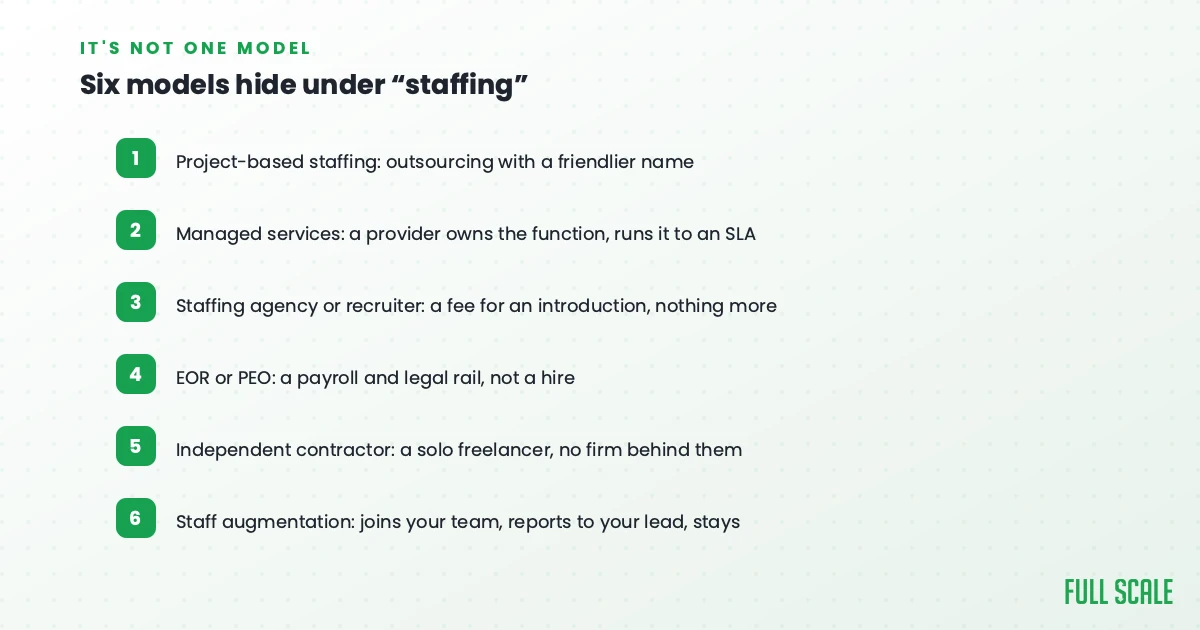
Six different models get called staffing, listed here in the order people usually run into them:
- Project-based staffing: a firm delivers a scoped project. This is outsourcing wearing a friendlier name.
- Managed services: a provider owns an ongoing function and runs it to an SLA.
- Traditional staffing agency or recruiter placement: you pay a fee for an introduction to a candidate you then employ.
- Employer of record (EOR) or PEO: a legal and payroll rail for someone you already found.
- Independent contractor or marketplace freelancer: a solo person you hire directly, no firm standing behind the work.
- Staff augmentation: a firm’s employee joins your team, reports to your tech lead, and stays for years.
Consulting shows up in the same conversations too, even though it isn’t a staffing model at all. More on that below. So does “team augmentation,” also called “team extension” by some shops, presented as if it were a separate thing from staff augmentation. It’s the same model, applied to more than one person at a time, and I’ve never seen a real distinction hold up past the marketing page. The full case is in team extension vs. staff augmentation.
Every one of these gets called “staffing” casually, and none of them is the same purchase. Mixing them up is how a CTO ends up disappointed by a model that did exactly what it was built to do, just not what he needed.
Project-based staffing (outsourcing with a friendlier name)
Project-based staffing means a firm takes a defined deliverable, staffs a team to build it, and hands you the result at the end. The vendor owns the outcome. You own the acceptance criteria you wrote at the start, and whatever the contract says about what happens when the scope moves, which it always does.
This is the model people mean when they say “staffing” but are describing outsourcing. You’re buying a finished deliverable here, built by the vendor’s own team on the vendor’s own timeline. They answer to the vendor’s PM, and the relationship ends when the contract does. That distinction, ownership and time horizon, is the whole argument, and it matters far more than who signs whose contract. I’ve gone deep on exactly where each model wins in staff augmentation vs. outsourcing. Read that one if this is the axis you’re actually deciding on.
Managed services
Managed services means a provider owns an entire function outright. You write an SLA describing what “good” looks like, and the provider figures out how to hit it. I’ve bought this myself, for server hosting and for running Elasticsearch at Stackify, because both were steady-state functions I had no interest in staffing internally.
The trap is applying this model to your actual product. Managed services fits a function you can define in an SLA. Your product, changing every sprint, needs a team who can adapt with it. Full breakdown in staff augmentation vs. managed services.
Traditional staffing agency or recruiter placement
A recruiter placement is a fee for one introduction to a candidate you then hire yourself. This corner of “staffing” is enormous. US staffing companies placed 12.7 million temporary and contract workers in 2023, according to the American Staffing Association. Most of it has nothing to do with software.
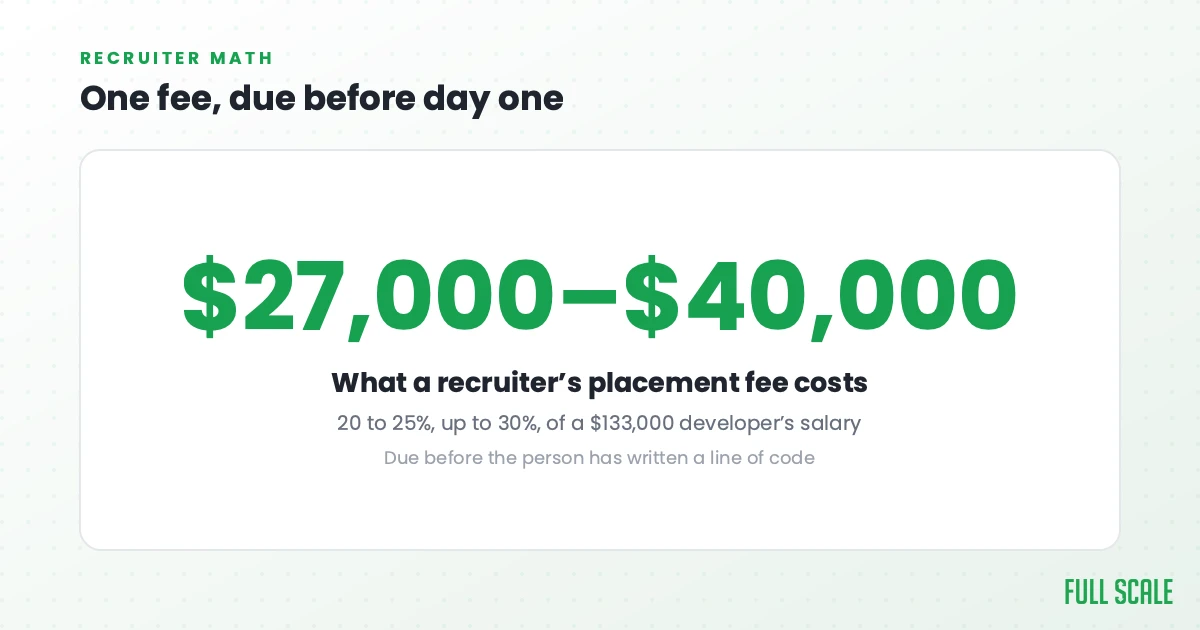
The mechanics are the ones your HR department already knows. A recruiter finds a candidate and you hire them directly. The recruiter collects a placement fee for that introduction. Recruiters generally quote 15 to 25 percent of first-year salary on average, per Eddy HR. For developer and IT roles specifically, the number I’ve actually been quoted runs 20 to 25 percent, up to 30 percent for senior or hard-to-fill roles. On a $133,000 developer, that’s a check for $27,000 to $40,000, due before the person has written a line of code, and the fee buys exactly one introduction.
Once the fee clears, the recruiter’s job is done, whether the hire works out or not. That math is what sent me looking for a better way years ago, and I’ve written up the full comparison in are staffing agencies worth it, including why this model is worse for engineering roles specifically than almost any other role a company hires for.
Employer of record or PEO
An employer of record is a legal and payroll rail, nothing else. You find the person and negotiate their pay. The EOR’s job starts after that: making it legal to employ them where you have no entity, running payroll, and handling compliance.
A PEO is a close cousin: co-employment where you already have a legal entity. An EOR, by comparison, employs people where you have none. Neither one is a talent partner, so neither one should be compared against staff augmentation on features, since one handles paperwork and staff augmentation handles people. Full comparison in employer of record vs. staffing agency and PEO vs. EOR.
Independent contractors and marketplace freelancers
An independent contractor is a solo person you found on Upwork, Toptal, or through a referral, working under their own LLC, juggling your project alongside two or three others. The person doing the work is the only one standing behind it.
When that goes well, it’s fine. When it doesn’t, you’re the one holding the bag. I’ve talked to enough founders over the years to hear the range: one fired a developer and got told the developer still had a copy of the code, another found out mid-project that the “developer” wasn’t who the resume said he was. That second one is a real, documented pattern. The Department of Justice has indicted multiple North Korean nationals for posing as remote IT workers at US companies using stolen or fabricated identities, some of it landed through freelance-style placements.
Freelancers are a legitimate tool for a scoped, one-off job. They’re a bad fit for anything you’ll keep building past month three, for reasons I go through in detail in staff augmentation vs. independent contractors.
What consulting sells you
Consulting gets lumped into “staffing” conversations constantly, even though it isn’t a staffing model at all. A consultant sells you a recommendation: whether the plan holds up, where the real risk sits, and what a similar company already learned the hard way. You still make the call, and you still need to staff the work afterward.
If you don’t know what you’re building yet, no staffing model fixes that, project-based, managed, or augmented. You need consulting first, and staffing second.
Where staff augmentation fits
Staff augmentation, the model Full Scale sells, means a firm’s employee becomes part of your organization in every way that matters except the actual paycheck. You set their priorities, review their work, and decide what they build next. The firm handles recruiting, employment, payroll, and retention. It’s every model above, minus the parts that don’t fit a product you intend to keep building.
There’s no placement fee, no SLA standing between the two of you, and no solo freelancer you’re vetting on your own. You get a team member with a different name on the paycheck.
This is the model for a product you intend to keep building. The code you ship this quarter, you’ll extend next quarter, and the developer who wrote it needs to still be around when it breaks. That continuity is the entire pitch. Full Scale’s own developer retention runs north of 93 percent. Contracts run month-to-month with no long-term lock-in, and a senior engineer usually starts contributing inside one to two weeks, as little as seven days if the bench already has the right skill set on it.
It has one hard precondition, and I’ll say it plainly instead of burying it: somebody in your company has to be able to direct the work. If there’s no CTO or tech lead who can review the code, set the priorities, and answer the questions that come up every day, staff augmentation will not work, no matter how good the developer is. That’s simply the one thing the model requires in return for everything else it gives you.
If that’s not you yet, don’t force the model to work anyway. Get the technical leadership in place first, even if that means one strong internal hire before anything else. A project-based vendor can bridge the gap in the meantime, since that model runs on the vendor’s own direction. And if you’re not even sure what to build, start with a consultant.
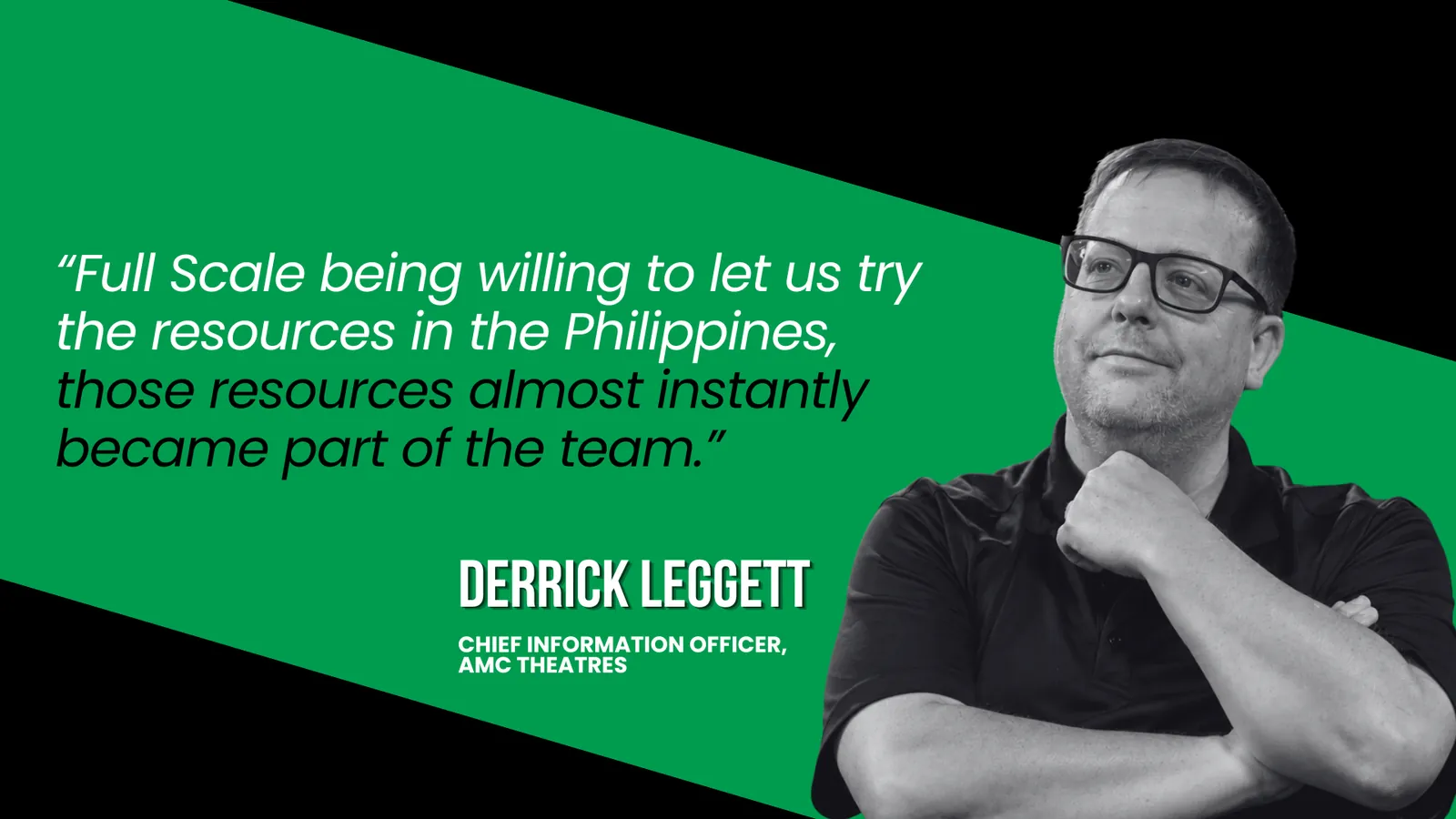
We aren’t in this for some three-month project. Neither are the companies that get real value out of the model. AMC Theatres and LendingStandard, both Kansas City companies, built out engineering teams this way, treating every hire as a long-term member of the team from day one. Their developers in the Philippines have stayed on those codebases for years, the same as any hire sitting in Kansas City would.
Side-by-side comparison
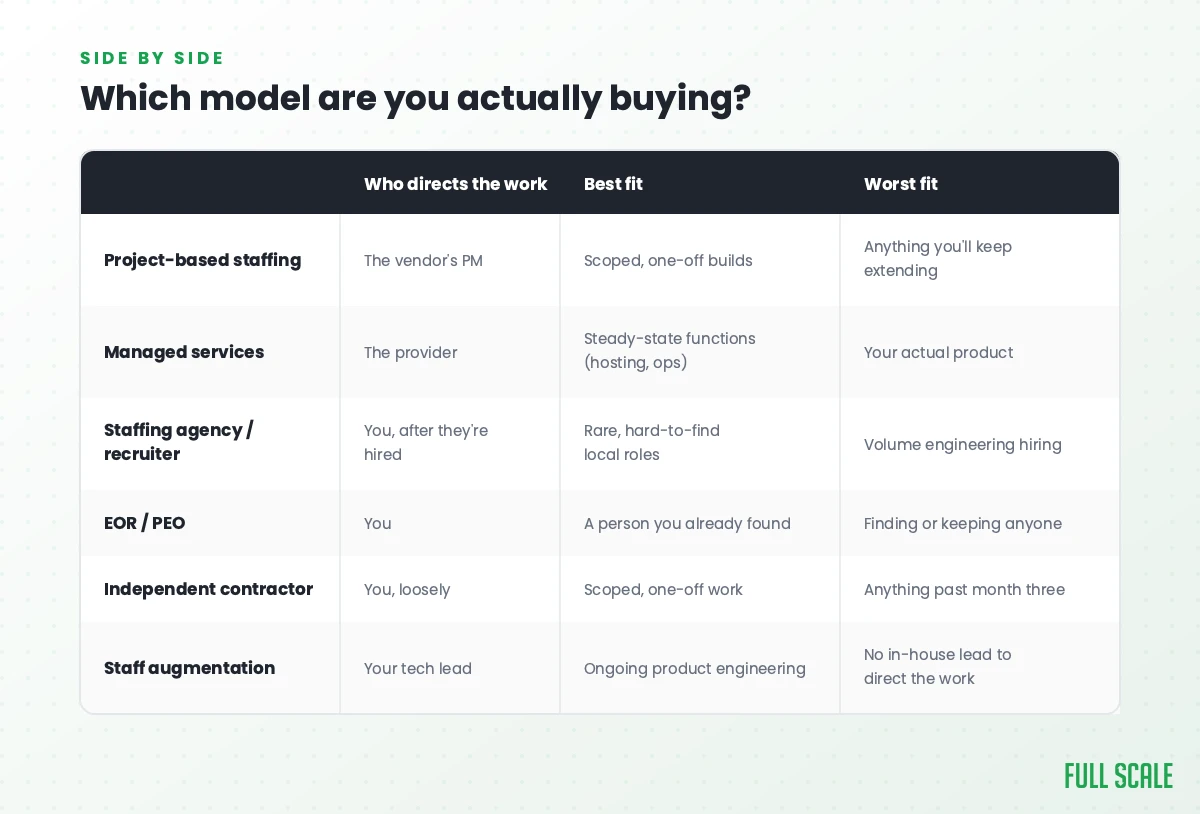
Here’s how all six models stack up, including the “worst fit” column most vendor pitch decks conveniently leave out.
| Model | What you’re buying | Who directs the work | Typical cost shape | Best fit | Worst fit |
|---|---|---|---|---|---|
| Project-based staffing | A finished deliverable | The vendor’s PM | Fixed bid or milestone | Scoped, one-off builds | Anything you’ll keep extending |
| Managed services | An outcome under an SLA | The provider | Fixed retainer | Steady-state functions (hosting, ops) | Your actual product |
| Staffing agency / recruiter | An introduction to a candidate | You, after they’re hired | 20-30% placement fee | Rare, hard-to-find local roles | Volume engineering hiring |
| EOR / PEO | Legal employment infrastructure | You | Flat fee or % of salary | A person you already found | Finding or keeping anyone |
| Independent contractor | One freelancer’s time | You, loosely | Hourly, no overhead | Scoped, one-off work | Anything past month three |
| Staff augmentation | A long-term team member | Your tech lead | Predictable monthly rate | Ongoing product engineering | No in-house lead to direct the work |
Read the “worst fit” column twice. That’s the one every vendor’s pitch deck skips, and it’s the one that tells you something.
Five questions to ask any vendor who says “staffing”
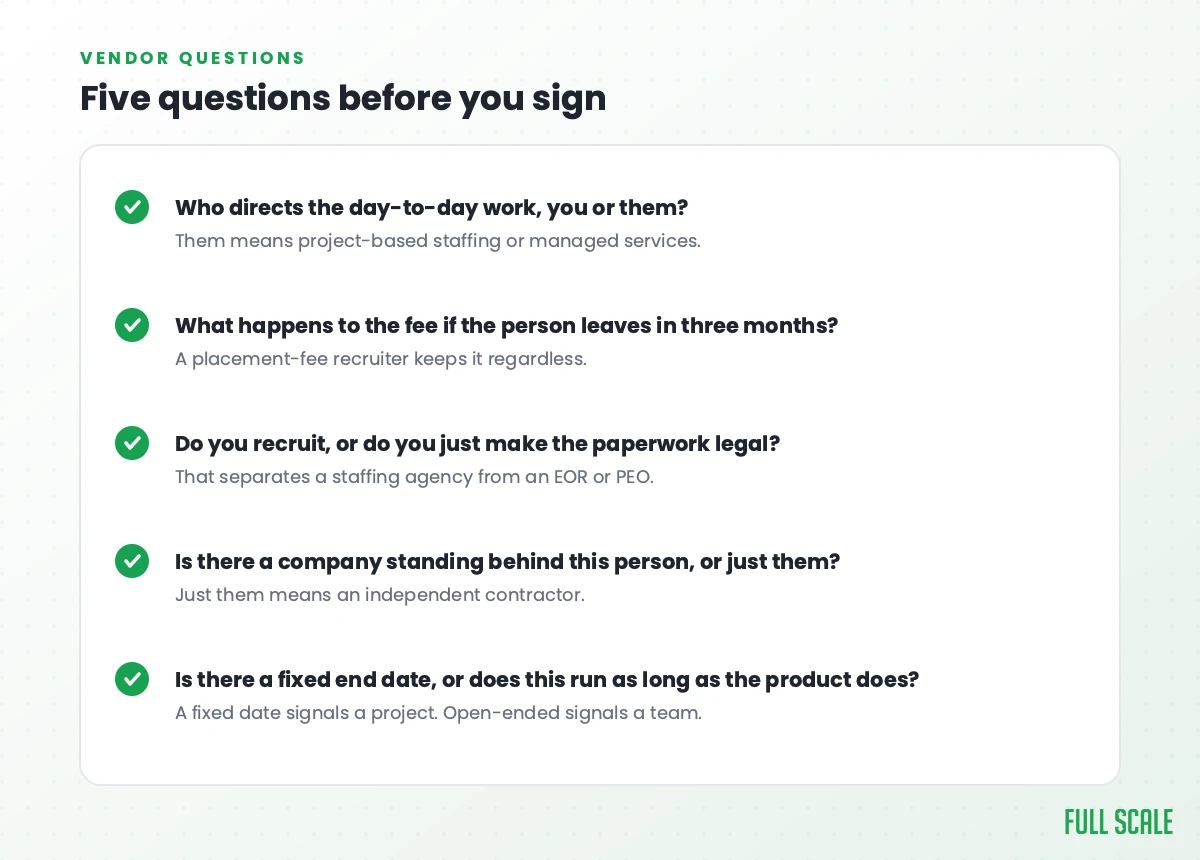
The table tells you the shape of each model. These five questions tell you which one you’re being handed. Before you sign anything with a company that describes itself as a “staffing” partner, make them answer these directly. A vendor who’s confident about their model answers all five in under a minute. One who gets vague is telling you something.
- Who directs the day-to-day work, you or them? If it’s them, you’re looking at project-based staffing or managed services, whatever word is on the homepage.
- What happens to the fee if the person leaves in three months? A placement-fee recruiter keeps it regardless. A real staffing partner has a retention stake in the answer.
- Do you recruit, or do you just make the paperwork legal? That question alone separates a staffing agency from an EOR or PEO.
- Is there a company standing behind this person, or is it just them? If it’s just them, you’re looking at an independent contractor, however long the relationship runs.
- Is there a fixed end date, or does this run as long as the product does? A fixed end date signals a project. An open-ended engagement signals a team.
Frequently asked questions
What are the types of staffing models?
There are six common ones: project-based staffing, managed services, traditional staffing agency or recruiter placement, employer of record or PEO, independent contractors or marketplace freelancers, and staff augmentation. They differ in who directs the work, who owns the outcome, and whether the engagement has an end date. Full Scale sells the last one, where a firm’s employee joins your team long-term.
Is staff augmentation the same as staffing?
No. “Staffing” is a broad category that includes staff augmentation along with project-based staffing, managed services, traditional recruiter placement, and EOR/PEO arrangements. Staff augmentation is one specific model inside that category: a firm’s employee joins your team long-term, under your direction, instead of delivering a project or filling a payroll rail.
What is project-based staffing?
Project-based staffing is a firm delivering a defined, scoped project through its own team, on its own timeline, for a fixed bid or milestone payments. It’s functionally close to outsourcing. The vendor owns the outcome and manages the people; you own the requirements you wrote at the start.
Is staff augmentation cheaper than using a staffing agency?
For most engineering roles, yes, often by a wide margin. A traditional staffing agency’s placement fee alone can run $27,000 to $40,000 on a single US developer hire, before any salary is paid. Staff augmentation through an offshore partner typically runs 50 to 70 percent below the all-in cost of an equivalent US hire, with no separate placement fee.
How do I know which staffing model a vendor is actually offering?
Ask who directs the day-to-day work, whether the vendor recruits or only handles payroll, what happens to their fee if the hire doesn’t last, whether a company stands behind the person, and whether the engagement has a fixed end date. The answers place the vendor into one of the models in this article faster than their marketing page will.
Can a company use more than one of these models at once?
Yes, and most growing engineering organizations do. Staff augmentation for the core product team, managed services for infrastructure you don’t want to staff, and an occasional freelancer or project-based vendor for a scoped, one-off deliverable outside that core. The mistake isn’t using several models. It’s not knowing which one you’re using for which piece of work.
Why do so many vendors avoid naming their model clearly?
Because “staffing” sounds flexible and low-commitment, and every one of these models benefits from sounding like the others until you’ve signed something. A generalist agency selling the same framework for dental hygienists and software engineers has no reason to draw sharp lines between models. A vendor that only staffs software engineers has every reason to.
The model underneath the word is what matters
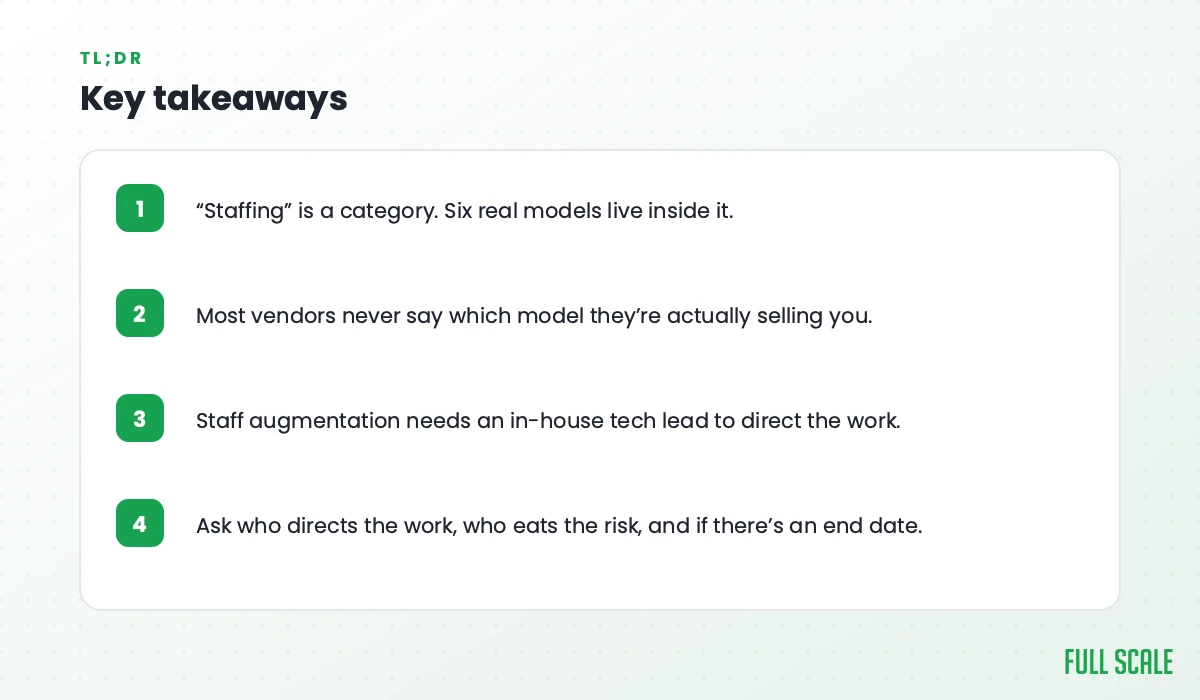
“Staffing” will keep showing up as the word every vendor reaches for, because it’s vague enough to cover whatever they’re selling that quarter. The model underneath it is the only thing that matters: who directs the work, who eats the risk if it doesn’t pan out, and whether there’s an end date.
Say you already know what you’re building. You have someone in-house who can direct the work, and you need senior developers on your team in as little as seven days. That’s Full Scale’s staff augmentation model. Book a discovery call and we’ll tell you plainly whether staff augmentation is the model you need, or point you to the one that is.