
Staff Augmentation vs. Consulting: Do You Need Help or Expertise?

In this article
- Staff Augmentation vs. Consulting: The Real Question Is Certainty
- What Staff Augmentation Actually Is
- What Software Consulting Actually Is
- The Rate Gap, With Real Numbers
- The Fractional CTO Comparison
- Duration Is the Tell, Too
- AI Changed Part of This, Not All of It
- Side-by-Side Comparison
- How to Decide
- One Thing a Consultant Can’t Do for You
- Frequently Asked Questions
- The Bottom Line
A few times a year, someone comes to Full Scale wanting to hire developers, and about ten minutes into the call I have to tell them we’re the wrong vendor.
Not because we can’t staff the role. We can staff almost anything. It’s because they don’t actually know what they want built yet. They have a market they’re excited about, a rough idea, and a budget, but nobody in the room has made the actual product decision. What they need is someone to help them figure out what to build and why, before a single developer touches a keyboard.
That’s consulting, and it’s not what we do.
I could take the money anyway. Plenty of shops will. But handing a team of developers to someone who doesn’t know what to build is how you burn a budget building the wrong thing, competently. So we say so, and we point them somewhere else. It’s a strange business model, turning away paying customers, but it’s the honest one.
I’ve also been on the other side of this mistake, and I didn’t have anyone to blame but myself. At my company At Capacity, we built websites and ad-management tools for home services businesses, plumbers, HVAC companies, electricians, and the honest version of that story is that we spent far more energy validating what to build and how to find the next customer than we spent writing code. Nobody handed us that plan. We figured it out the expensive way, in public, with our own money on the line.
Staff Augmentation vs. Consulting: The Real Question Is Certainty
Ask ten people what separates staff augmentation from consulting and you’ll get ten different axes: hourly versus retainer, embedded versus independent, tactical versus strategic. Every one of those is downstream of a single question nobody asks first.
The actual decision is this: do you know what you’re building?
Answer yes, and the rest is logistics: you need more engineers, on your team, building toward a plan you already own. Answer no, or “sort of,” and logistics won’t save you. You need someone whose job is to remove the “sort of” before anyone starts writing code.
We’ve written before about the line between staff augmentation and outsourcing (team vs. project) and the line between staff augmentation and managed services (product vs. function). Consulting is a third, different line, and it’s the one people confuse most, because both staff augmentation and consulting involve smart people you don’t employ directly showing up to help. Consulting is not even a staffing model, and it is one of at least six labels that get confused this way; I lay out all six staffing labels in one place. SDaaS muddies it further, since it sounds like a fourth category when it is usually staff augmentation with a subscription wrapper.
What Staff Augmentation Actually Is
Staff augmentation adds developers to a team you already run, and the org chart doesn’t change to make room for them. They slot into the seat you already drew, take orders from the person who already runs engineering, and get measured against the same sprint goals as everyone else on the team. You already know what you’re building. You just don’t have enough hands to build it on schedule. That’s what IT staff augmentation means in practice, regardless of which comparison brought you here.
The precondition is that somebody in your org already made the hard calls: what the product does, who it’s for, what the architecture looks like. Staff augmentation multiplies execution. It does not supply direction, because you’re supposed to already have it.
What Software Consulting Actually Is
Software consulting is a different job entirely. A consultant’s whole value is the opinion, not the output. They come in, look at your situation, and recommend what to do: which architecture to bet on, which market to build for first, whether the idea is worth building at all. You still make the call. Sometimes they stick around to help execute. Often they hand you a plan and leave. Software consulting services are quoted a few different ways, a flat fee for the engagement, a milestone-based deliverable, or straight hourly, but even the flat-fee versions work out to an hourly rate once you divide it by the time spent, which is why the rate comparison below still holds.
A consultant’s paycheck is for having already made a hundred decisions like the one you’re stuck on, and knowing which way to jump. Day to day, they usually direct their own process and report findings up to you, rather than taking direction from your engineering leadership the way a staff-aug developer does.
The Rate Gap, With Real Numbers
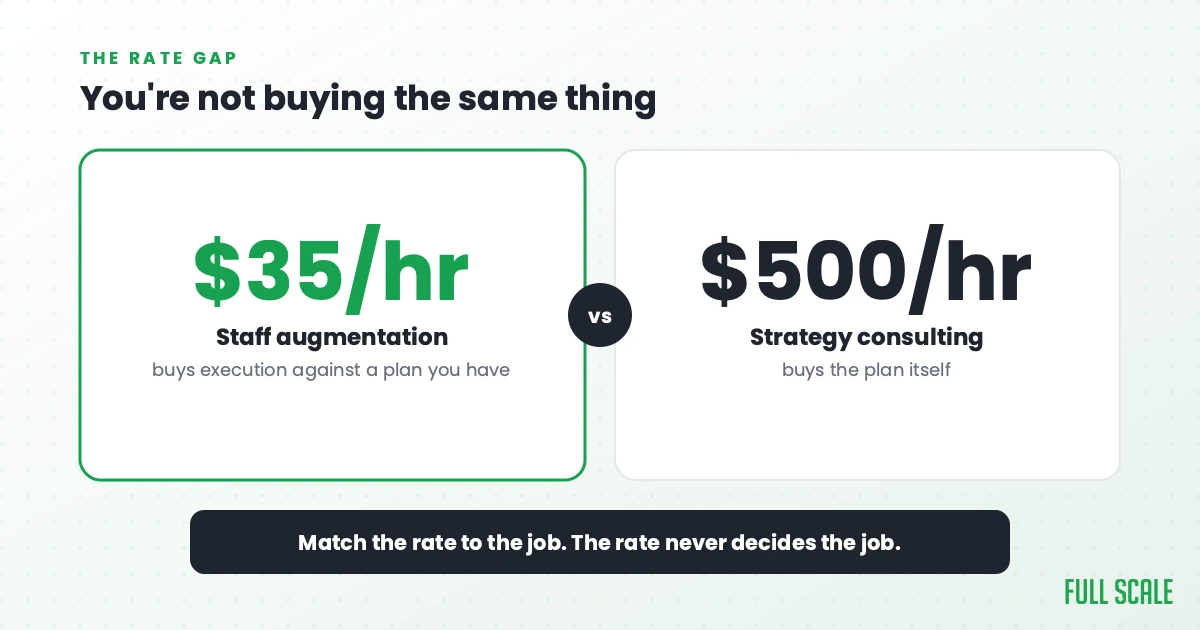
Full Scale’s staff augmentation rate starts at $35/hr. Senior, specialized strategy consulting, the kind that resolves genuine product-direction ambiguity, runs up to $500 an hour. Fractional CTO engagements land in a similar range, commonly $150 to $350 an hour and climbing toward $450 to $500 for specialized or high-demand markets, according to current 2026 pricing benchmarks. General technology consulting sits a bit below that, typically $100 to $300 an hour, climbing past $300, and up to $500 or more at large firms, for specialized work like AI strategy or cloud architecture.
It would be a strange kind of humility for Full Scale to charge $500 an hour for the wrong reason. The gap exists because $35 an hour buys execution against a plan you already made, and $500 an hour buys the plan itself. Ask a $35/hr developer to invent your product strategy and you’ll get a developer’s best guess. Ask a $500/hr strategist to write your CRUD endpoints and you’re paying luxury prices for work that doesn’t need it. This is the same math behind cheapshoring, the mistake of picking a rate before you’ve named the job. Get the job right first, then the rate makes sense.
The rate should follow the job, always.
The Fractional CTO Comparison
Hiring a consultant to figure out what to build is a lot like hiring a fractional CTO instead of a developer.
A developer executes a plan. A fractional CTO helps you shape the plan, they don’t own it for you. Both roles are valuable, and they’re priced on completely different scales, because you’re buying different things: a developer’s time, or a strategist’s judgment, earned the hard way by being wrong about this exact kind of decision enough times to finally get it right.
One honest wrinkle in the analogy: a fractional CTO’s engagement often runs longer than a typical strategy-consulting project, sometimes for years, because the judgment they’re selling doesn’t stop being useful once the first plan is made. The pricing logic still holds even when the duration doesn’t match the “consulting is always short” pattern below.
A senior consultant, fractional or project-based, is priced like judgment, and judgment doesn’t come cheap.
Duration Is the Tell, Too
The certainty question usually answers a second question for free: how long is this engagement?
Consulting tends to be short, scoped, and front-loaded. A consultant studies the problem, delivers a recommendation or a plan, and moves on. Once the decision is made, the engagement is done.
Staff augmentation has no natural end date, because the work doesn’t either. You’re building something you intend to keep building, quarter after quarter, and the team needs to still be there next year when the codebase they wrote needs to change. This is Product Driven in a sentence: ownership doesn’t work if the people who own it leave.
If the engagement you’re picturing has a natural finish line where somebody hands you a document and leaves, that’s consulting. If it doesn’t, and honestly it probably shouldn’t, that’s staff augmentation.
AI Changed Part of This, Not All of It
A few years ago, resolving real uncertainty about what to build usually meant paying someone to help you think it through, because building anything at all was slow and expensive enough that you couldn’t afford to just go find out. That part has changed. A founder or a product team can now throw together a working prototype in days and put it in front of real users instead of guessing. Some of the demand that used to go to “help us figure out what to build” consulting is quietly being replaced by “we built three versions ourselves and users only liked one of them.” Yes, I recognize the mild irony of a staff augmentation company telling you to go build your own prototype first.
There’s a catch, and it’s the same catch that’s always been there with fast AI-built software: a prototype that runs isn’t the same thing as a validated business. Vibe coding a demo doesn’t tell you whether the thing survives contact with paying customers, scales past the first hundred users, or holds up to a security review. You can slap a bunch of things together and build your little shack, and it can still catch on fire. AI made the cheapest, earliest mile of certainty a lot cheaper. It didn’t touch the actual hard part, which is knowing what you’re looking at once the prototype tells you something, and having the judgment to bet real money on it.
So AI has genuinely shrunk the group of people who need to pay for consulting to answer “what should we build.” It hasn’t shrunk it to zero. A working demo and the right strategic bet are still two different things, and mixing them up is exactly how a founder ends up staff-augmenting a team to build the wrong prototype at scale, just faster than before.
Side-by-Side Comparison
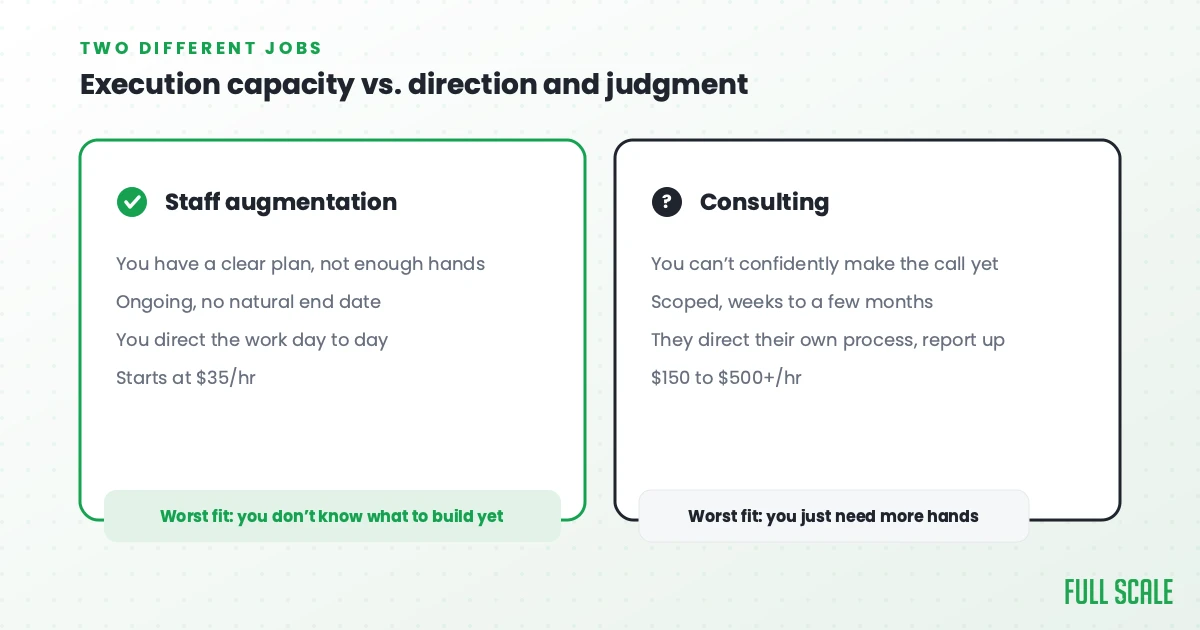
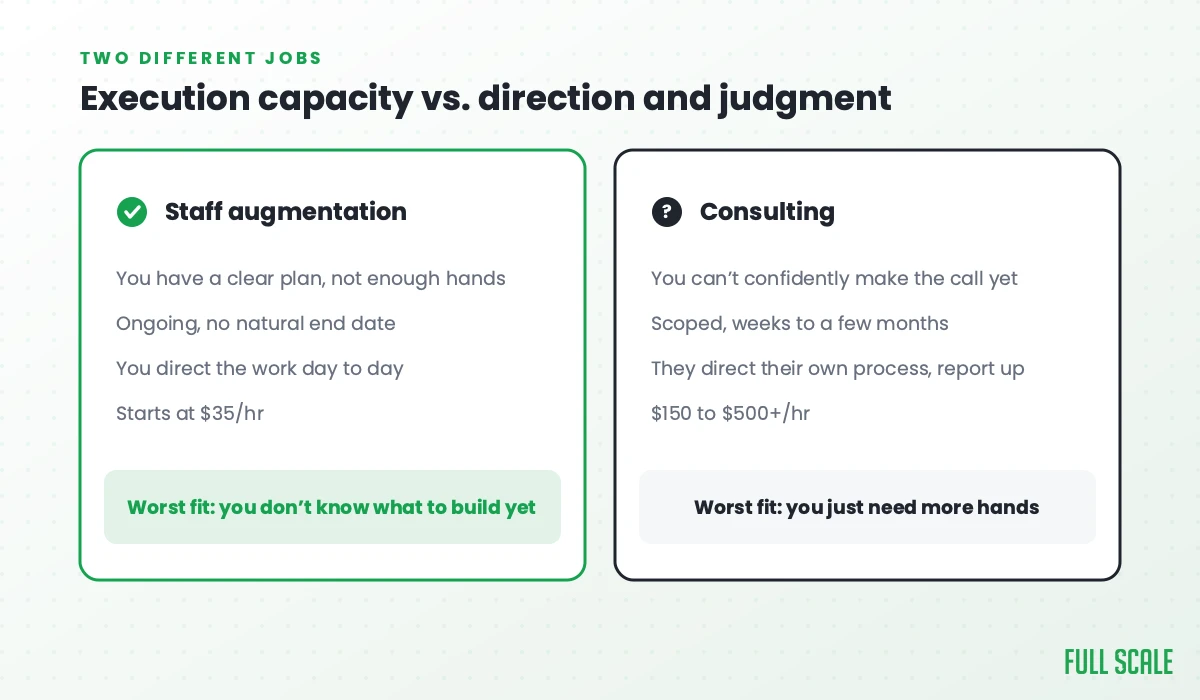
| Dimension | Staff Augmentation | Consulting |
|---|---|---|
| What you already have | A clear plan, not enough hands | A decision you can’t make confidently yet |
| What you’re buying | Execution capacity | Direction and judgment |
| Typical rate | $35/hr and up | $150 to $500+/hr, often higher for specialized strategy |
| Typical duration | Ongoing, no natural end date | Scoped, weeks to a few months (fractional CTO work often longer) |
| Who owns the outcome | You, always | You, even though the consultant informed it |
| Best fit | Building or extending a product you understand | Deciding what to build, or resolving a strategic fork |
| Worst fit | You don’t know what to build yet | You just need more hands on a known plan |
How to Decide
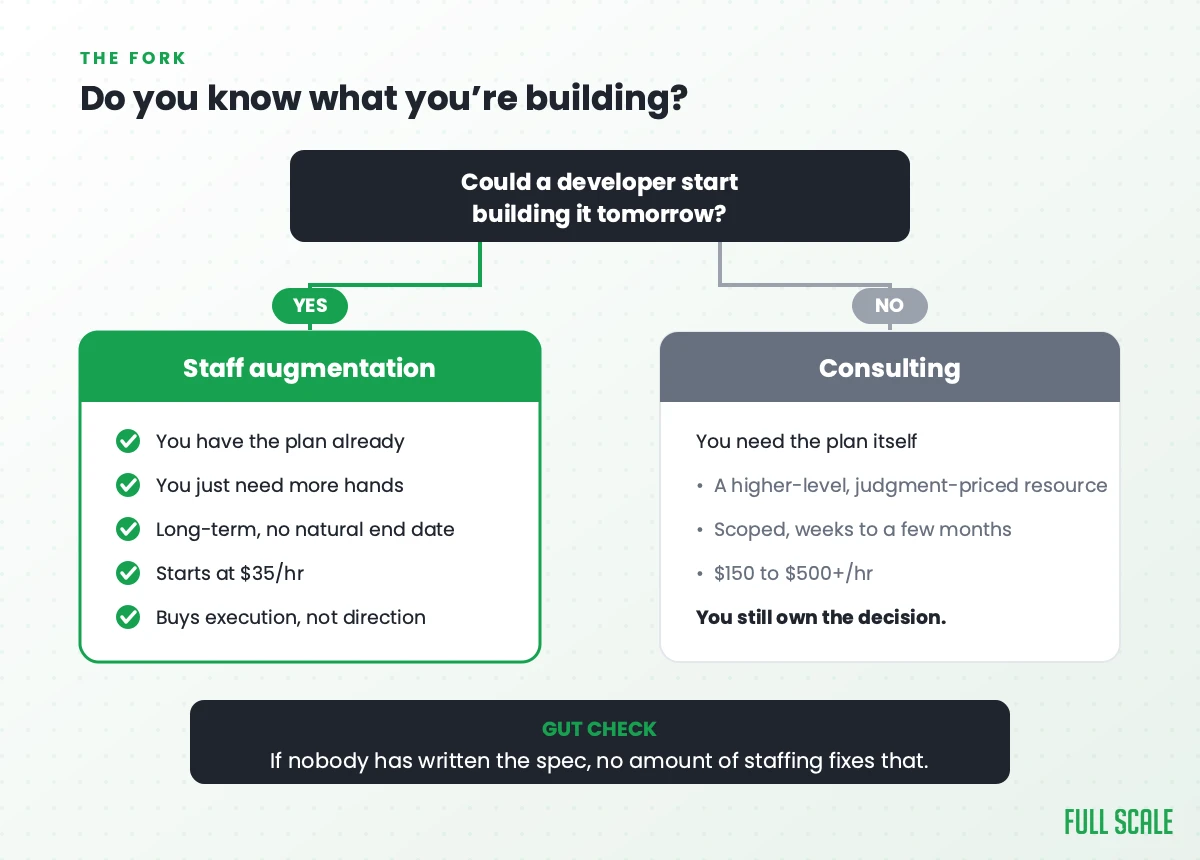
Ask yourself one question before you write an RFP for either kind of engagement:
If you handed a developer the spec today, could they start building something real tomorrow?
If yes, you have a plan. You need staff augmentation, and the only remaining question is how fast you can get qualified engineers into the seats. If no, and the honest answer is that nobody’s written a spec because nobody’s sure what the spec should say, you need consulting first. Buy the direction before you buy the hands. Building the wrong thing quickly is not a win.
One Thing a Consultant Can’t Do for You
It’s easy to hear “hire a consultant to figure out what to build” and think that means you can hand off the decision itself. You can’t, and you shouldn’t want to.
A consultant can sharpen your options, tell you what similar companies did, and flag the risks you can’t see from inside your own head. What they hand back is better information. The decision stays yours. If you’re the founder or the CTO, you still own the call. Buying the analysis is smart; outsourcing the actual judgment, the part where you decide what your company is betting on, is a much worse idea. The best consultants know this too, which is why the good ones frame their work as a recommendation, not a verdict.
Frequently Asked Questions
Is consulting more expensive than staff augmentation?
Per hour, usually yes, often by a wide margin. But the comparison isn’t apples to apples. Consulting engagements are typically shorter and scoped to a specific decision, while staff augmentation is an ongoing monthly cost for a team that keeps building. Compare total spend for the actual outcome you need, not the hourly rate alone.
Do staff augmentation companies also offer consulting services?
Some do. Full Scale doesn’t, on purpose. The two jobs create an incentive problem when the same shop does both: the people who diagnosed what you should build are also the people getting paid to build it, and that’s a conflict of interest even when nobody’s acting in bad faith. When a lead needs product strategy instead of build capacity, we say so and point them elsewhere.
Do I need consulting before staff augmentation, or can I skip straight to hiring a team?
If you already know what you’re building, skip straight to staff augmentation. Consulting exists to answer the “what should we build” question. If that question is already answered inside your company, paying for someone to answer it again is money spent solving a problem you don’t have.
What’s the risk of using staff augmentation when you actually needed consulting?
You get a team that executes well against a plan that was never solid to begin with. The code quality can be excellent and the product can still be wrong, because nobody validated the direction before the building started. That’s the exact scenario that sends people back for a consulting engagement six months later, at a much higher total cost than getting the direction right the first time.
Can you use both, in sequence?
Sequenced, yes. A consultant resolves the direction first, and once the plan is real, a staff augmentation team builds it. What doesn’t work is asking one group to do both jobs at once. A team hired to write code will write code, whether or not the plan underneath it is any good, because that’s simply the job they were hired to do.
The Bottom Line
Staff augmentation and consulting aren’t competing services. They answer different questions. One assumes you know what to build and helps you build it faster. The other exists because you don’t know yet, and it costs what it costs because figuring that out is genuinely harder work than most people give it credit for.
If you already know what you’re building and just need senior developers in your repo in the next couple of weeks, that’s Full Scale’s staff augmentation model. Set up a discovery call and tell us what you’re building. If you’re still not sure what to build, do that work first. We’ll be here when you are.