
Development Team Extension Guide: Models, Costs & Partners

In this article
- What development team extension actually is
- Team extension, staff augmentation, dedicated teams, project outsourcing: same model, different labels
- Extended team vs. dedicated team: which structure fits your project
- Why companies extend their team instead of hiring locally
- Team extension only works if you treat them like your team
- When development team extension is the right call
- When it’s the wrong call
- What development team extension costs
- How to pick a partner you won’t regret in six months
- What good integration looks like in the first 30 days
- FAQ
- The honest summary
Most companies don’t actually need a new vendor. They need more of the team they already have.
That’s the whole pitch of development team extension. You take the engineering team you’ve built and add senior developers who plug into it the way a new hire would. They join your Slack workspace, sit in your standups, push to your repos, and review code alongside your in-house engineers. The only difference is where they sit and who handles payroll. Deciding which types of developers to add to that team is the first call you make.
I’ve hired offshore developers in four countries personally. I co-founded VinSolutions, which exited for nine figures. I founded Stackify, which I sold in 2021. Both of those companies leaned hard on offshore engineers, and Full Scale, my current company, exists because friends kept asking how we’d done it.
Development team extension is the model that has worked for me and for the 200+ tech companies Full Scale supports. Below is what it actually is, how it differs from the adjacent models people confuse it with, when it’s the right call, and how to pick a partner without getting burned.
What development team extension actually is
Development team extension is a hiring model where a partner company sources, vets, and employs developers who then work full-time on your team. These aren’t contractors juggling four other clients on the side, and the model is not a black-box project shop where you hand over specs and wait for code. The engineers attend your daily standup, push to your codebase, and stay on your team for years.
The model has a few defining traits:
- One client per developer. The engineer’s full week goes to your work. There is no context-switching across other companies.
- You direct the work. Backlog priorities, architecture decisions, and what ships when are all your call. The partner handles employment, not engineering direction.
- Long-term by default. Most development team extension engagements run 12+ months, and many run for years.
- Integrated into your team. Engineers join your tools, your meetings, and your team norms, and there’s no project manager intermediary between you and them.
If you’ve heard this described as staff augmentation, extended development team, team extension services, dedicated developer model, or team extension model, those terms all describe the same setup. The industry has never settled on one name, which is part of why this is confusing to shop for. We’ll untangle the labels in the next section.
Team extension, staff augmentation, dedicated teams, project outsourcing: same model, different labels
The four terms below sound like different things. Three of them aren’t. Knowing which is which is the difference between hiring engineers and handing your roadmap to a vendor.
| Model | Who directs the work | Engagement length | Closest to |
|---|---|---|---|
| Development team extension | You | 12+ months, often years | Hiring senior engineers, minus the recruiting |
| Staff augmentation | You | Months to years | Same as team extension. Different word, same model. |
| Dedicated development team | You | 12+ months, multi-engineer | Same model when the engagement is 3+ engineers |
| Project outsourcing | The vendor | Defined by deliverable | A statement of work with a fixed scope |
| Freelance contractors | You or them, depends | Days to weeks | Burst capacity, not team capacity |
The first three rows are the same model with different marketing. Most offshore partners pick one term and stick with it. At Full Scale, we use staff augmentation because it’s the term US buyers search for most. Eastern European shops tend to use team extension because that’s what their market searches for. The model underneath is identical.
That list of synonyms is not exhaustive. Extended development team and extended software development team are how Eastern European shops phrase it on services pages. IT team extension and outsourcing IT team extension are how staffing-led firms describe the same engagement when they’re pitching against pure outsourcing. Software team extension is what most LATAM partners brand it as. Team extension model is the label people reach for when they’re explaining the concept rather than selling it, which is why most “what is team extension” articles use that phrasing in the headline. Extended teams, plural, shows up when a partner runs multiple parallel teams for a single client. Every one of these phrases describes the same arrangement: external developers, employed by your partner, working full-time on your team under your direction. We use development team extension and staff augmentation interchangeably throughout this guide because those are the terms our US clients actually search for.
Project outsourcing is the one that’s genuinely different. You write specs, the vendor writes code, you accept or reject the deliverable. The vendor controls how the work gets done. That works for a one-off integration or a scoped migration. It does not work for ongoing product development, because no one outside your company understands your product as well as you do.
Staff augmentation is the right way. Project outsourcing produces software you didn’t build, that nobody on your team can maintain, and that breaks in subtle ways the first time you try to evolve it. On a Next.js app that risk is real, so an extension team that knows server components matters; you can hire dedicated Next.js developers for exactly that.
Extended team vs. dedicated team: which structure fits your project
Inside the team extension umbrella, there are two structures that work, and the difference matters more than most providers admit. An extended team is your in-house team plus one to three additional engineers, each treated as a new hire under your engineering manager. A dedicated team is a self-contained group of four or more engineers that owns a slice of work end-to-end and operates as a unit.
Pick an extended team when you have a functional in-house engineering org that needs more hands inside an existing process. Pick a dedicated team when you’re standing up a new product surface or a parallel platform that needs its own self-managing group. Most Full Scale engagements that start as an extended team grow into a dedicated team over time, and the structural decision is the one that actually matters for picking the right partner.
The full breakdown of the extended team model, including the day-to-day operational mechanics, the cost structure, the common ways extended team engagements fail, and the criteria for picking a partner, is in the extended development team guide.
Why companies extend their team instead of hiring locally
Three things drive the model right now.
The talent shortage is real. US engineering hiring has not gotten easier. Bureau of Labor Statistics data shows tech turnover running 13-15% annually, and the engineers you most want to hire are usually employed and not looking. A senior backend hire in a US tech hub still takes about two to three months from job posting to their first day, and the offer often comes in 20% above what you budgeted.
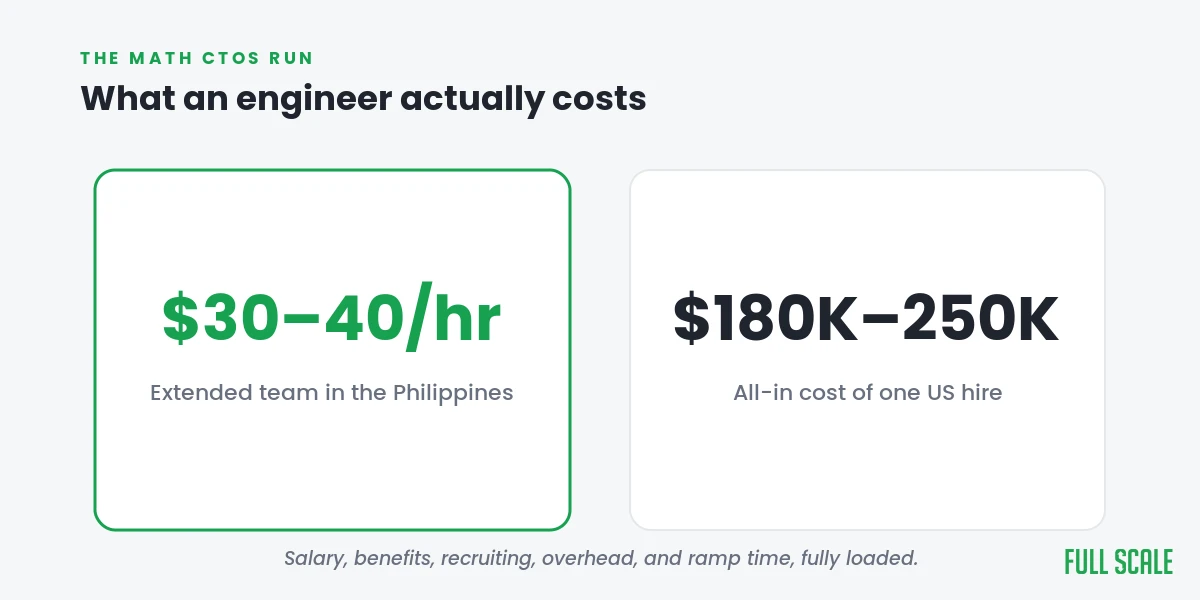
Cost is asymmetric. A senior developer in the US runs $180K to $250K all-in. The same skill level in the Philippines through Full Scale runs $30 to $40 per hour, which is roughly $62K to $83K annually. The gap is not about quality. It’s about cost of living. About 90% of software developers don’t live in the United States. The pool you can hire from when you extend your team is, by definition, larger than the pool you can hire from on a 30-mile radius around your office.
Remote work normalized cross-border teams. Five years ago, hiring a developer in Manila or Cebu required convincing your team that the geography was workable. That argument is over. Every engineering team already runs on Slack, remote-friendly standups, and a Notion or Linear board that doesn’t care where anyone sits. The operational overhead of integrating a remote engineer dropped to roughly zero, and the cost-of-living arbitrage stayed.
That combination is why development team extension stopped being an emerging trend and became how serious engineering orgs scale.
Team extension only works if you treat them like your team
Here’s the part most companies get wrong.
They sign a team extension contract, get a developer in week two, and treat that person as a vendor resource for the next six months. The developer never gets invited to architecture discussions. They get tickets handed to them and questions ignored. After eight months, the company decides “offshore didn’t work for us” and goes back to hiring locally.
I’ve seen this play out at companies who came to Full Scale after their first attempt failed elsewhere. The pattern is always the same. The engineer was capable, and the problem was that the team never actually integrated them.
Hire talent to work directly for you on a long-term basis. The point is to add team members. Staffing up for a project is a different model entirely.
When I was running engineering at Stackify, we had over 20 developers in the Philippines, and they contributed directly to the product that I exited in 2021. Those engineers were not “the offshore team.” They were the team. They went to standups with our Kansas City group, owned features end to end, sat in code review, argued about architecture. The Philippines time difference is 14 hours from KC, and we ran the engagement with a four-hour overlap window in the morning. It worked because we ran it the same way we’d have run it if those engineers had moved to Kansas City and joined us in person.
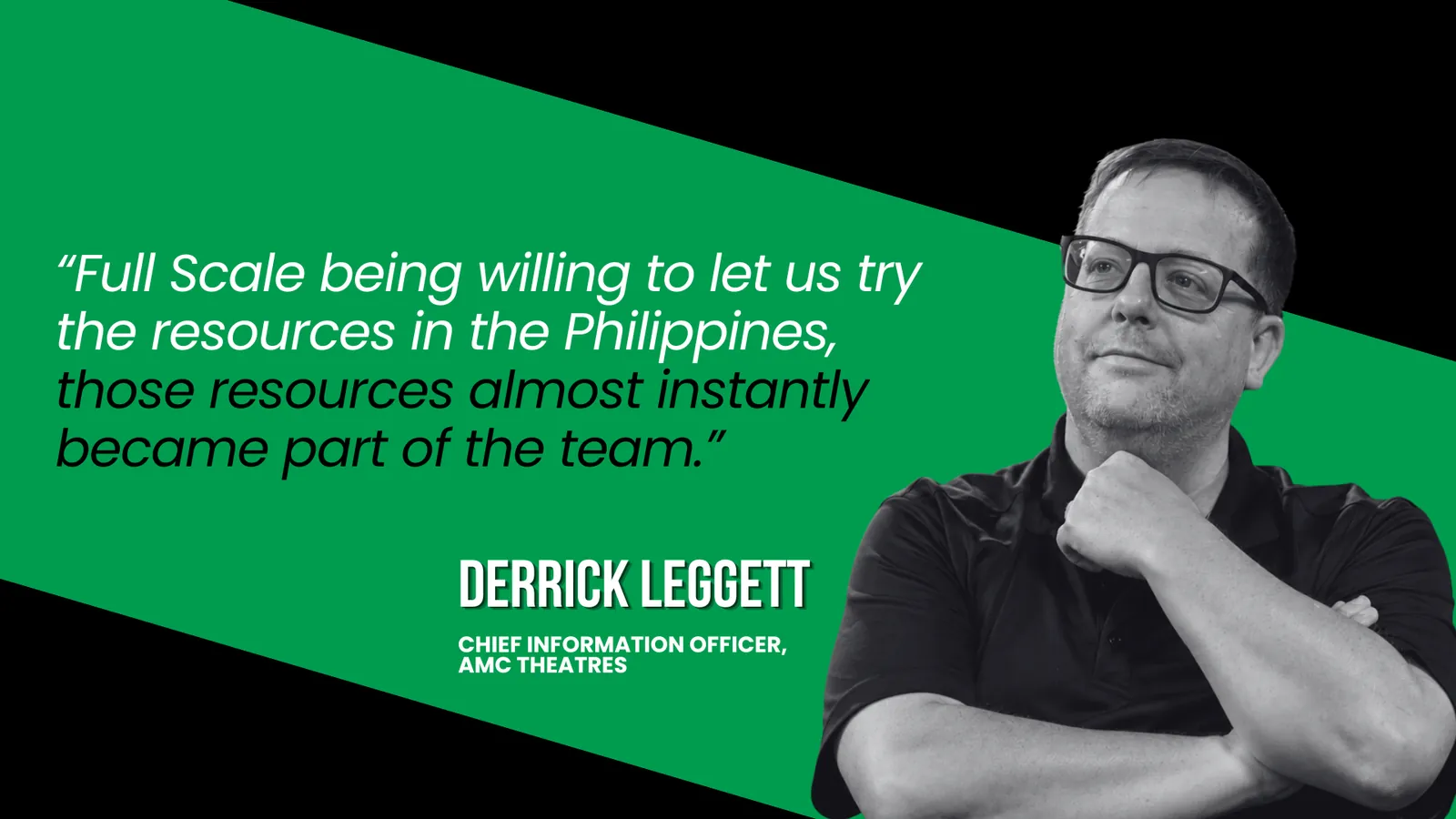
AMC Theatres operates the same way with their Full Scale engineers. So does LendingStandard, whose CEO described the integration as “every challenge surmountable and every success sweeter.” At PMI Rate Pro, Full Scale engineers helped rebuild the company’s mortgage insurance platform from the ground up, working as part of the in-house team rather than as an outside vendor.
Software development is about communication. The model fails the moment the offshore engineers stop talking to your team. It works when those engineers become indistinguishable from your in-house engineers in every conversation that matters.
When development team extension is the right call
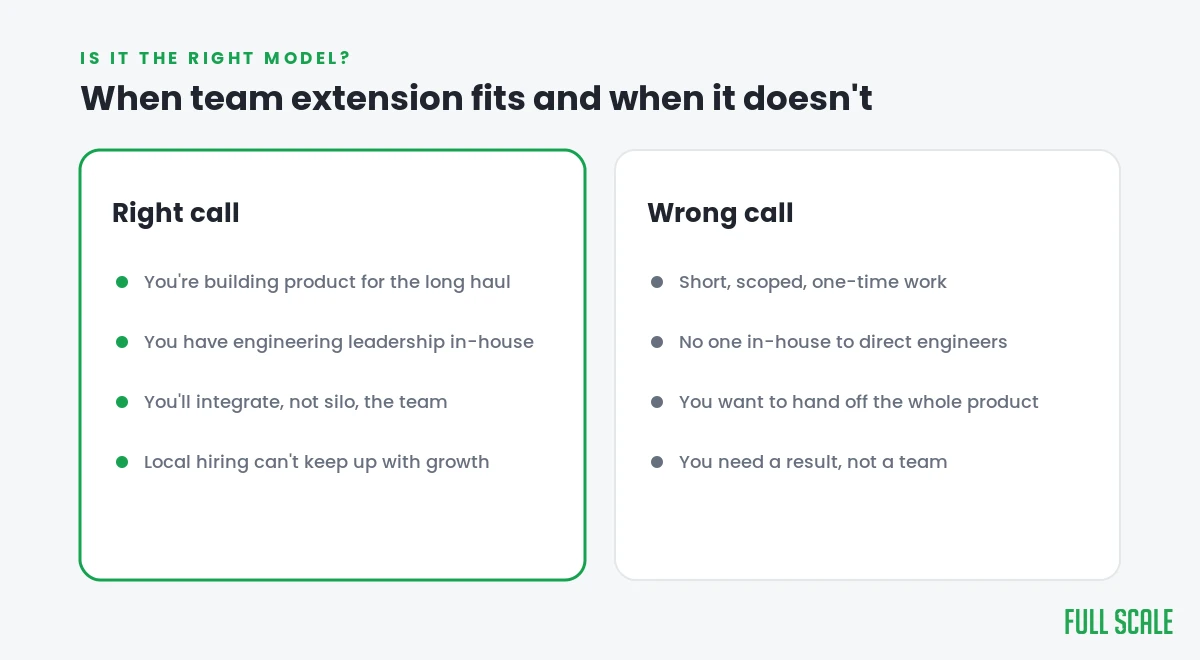
It’s the right model when the work is ongoing and the team is real.
- The work is ongoing product engineering. Roadmap-driven work, where what ships next quarter depends on what shipped this quarter, needs people who understand the product. Vendors with rotating staff cannot give you that. Team extension can.
- You need to scale your engineering team faster than local hiring can deliver. Hiring senior engineers locally takes a quarter or two. A good team extension partner has vetted, senior developers available in two to three weeks, running as either an extended team or a full dedicated development team depending on the engagement size.
- You want to keep technical leadership in-house. This is the version that works. Your CTO, your tech leads, your architects stay local. The engineers extending the team plug into the structure you already have. You always need technical leadership in-house. Team extension does not replace it.
- You’ve maxed out local hiring or local budget. A startup spending $250K per senior hire is going to run out of runway. The same money buys three or four senior developers offshore, which is the difference between shipping the product and shutting down the company.
- The work is sensitive to who’s doing it. Domain knowledge, security context, product opinions all live in people’s heads. You want those people to stay. Team extension developers stay. Project shops rotate their staff every quarter.
When it’s the wrong call
I’m not going to pretend this works for everyone.
Team extension is the wrong choice if any of these apply to you.
- The work is genuinely one-off and scoped. A short integration project, a data migration, or any work with a clear end date fits a different model. I outsourced exactly these kinds of projects myself back at Stackify. Use a freelancer or a project shop and move on.
- You don’t have technical leadership in-house. If there is no one on your team who can review code, set architecture, and run a standup, extending your team won’t help. You will need a partner who provides engineering leadership alongside the engineers. That’s a different model.
- You can’t commit to a long-term engagement. The team extension model assumes 12+ month engagements. If you genuinely need someone for six weeks, a contractor will fit the situation better.
- You’re not willing to integrate. If you want to throw specs over the wall and get code back, fine, but that’s project outsourcing. Don’t sign a team extension contract and run it like project outsourcing. The model fails when you do.
The honest answer is that team extension is the right call for most ongoing product development at most companies. It is the wrong call for short, scoped work and for companies without internal engineering management.
What development team extension costs
Pricing in this market is opaque on purpose. Most providers won’t quote anything until you’ve sat through a sales call. Here’s the actual range.
A senior developer in the Philippines through Full Scale runs $30 to $40 per hour, all-in. That number includes the developer’s salary, payroll, benefits, equipment, HR, office space, and our customer success manager who runs the operational side of the engagement.
That’s roughly $62,000 to $83,000 annually for a senior engineer with 7+ years of experience. Compared to a US-based equivalent at $180K to $250K all-in, the savings are real. A team of four senior engineers offshore costs less than one senior engineer in San Francisco.
Why is the gap that big when the skill is the same?
The gap is cost-of-living arithmetic. The skill is the same. My brother-in-law in the Philippines works at Jollibee, the largest fast food chain in the country, for about $1.25 per hour. My sister-in-law works as a virtual assistant for $5 per hour. $30 to $40 per hour for a senior engineer is excellent local compensation, and the cost-of-living math just happens to work in your favor too. Some people look at the numbers and call the arrangement exploitation. The people working those jobs would tell you something very different.
The other thing to ask any provider about: what’s included in the rate.
- Recruiting and vetting? Should be.
- Payroll, benefits, equipment? Should be.
- HR, employee retention, performance management? Should be.
- Account management or a customer success manager who runs the operational side? You want this, and not every provider includes it.
- Office space, security, IP protection? Should be.
If a provider quotes you a rate that looks too low, ask what’s not in the price. The low quote usually means you’re getting a developer but not the operational layer that keeps the engagement working.
How to pick a partner you won’t regret in six months
The team extension market has hundreds of providers, most of them mediocre and a handful genuinely good. Here’s how to tell the difference.
Ask about retention. Engineer turnover is the single biggest predictor of how well your engagement will go. If the partner’s developers leave every nine months, you’ll be re-onboarding every nine months. Full Scale’s developer retention is over 93%. Most providers won’t give you a number, which tells you what you need to know.
Ask who you talk to day-to-day. If the answer is “your dedicated technical project manager,” walk away. The bad pattern in this industry is the hidden-developer setup, where the client only ever talks to one technical PM and every other developer hides behind that person. It’s usually a mix of two things: an English-language gap that makes the PM the only person comfortable on client calls, plus a cultural rule about who’s allowed to talk directly to the client. Either way, you’re paying for engineers you can’t actually direct. You want a partner where you talk to the engineers themselves in your standup and your Slack, every day.
Ask for case studies you can read. Specific clients, specific outcomes, specific quotes. Full Scale publishes named case studies for AMC Theatres, LendingStandard, PMI Rate Pro, Realquantum, and others. If a provider can’t show you named clients, ask why.
Ask how they vet developers. “We have a rigorous interview process” is not an answer. You want to know how many candidates they screen per hire, what the technical assessment looks like, who interviews, and how much of the vetting your own team gets to participate in. Anything less than your team being able to interview and reject candidates is a red flag.
Ask about time zone overlap. Most engagements need at least three to four hours of overlap between your team and theirs. Full Scale staffs three different schedule patterns: half-day overlap (most common), full US business hours (engineers work the graveyard shift in the Philippines), and async-first with one daily overlap window. Half-day overlap works for most teams. Decide what your team actually needs before signing.
Ask whether they’re set up for the long term. A partner who says “yes” to every six-week engagement is going to churn through engineers. We aren’t in this for some 3-month project. Long-term engagements require long-term operational infrastructure: real HR, real benefits, real career paths for the engineers. That’s expensive to build and impossible to fake. Ask how the partner has built it.
What good integration looks like in the first 30 days
The first month is where the model succeeds or fails.
A good engagement looks like this. In the first two weeks, your new engineer is in your Slack, in your standups, has push access to your repos, and has been introduced to the team by name. By week three, they’re picking up small tickets to learn the codebase. By week four, they’re contributing to substantive work and participating in architecture discussions.
A bad engagement looks different. The first week is a Zoom call with the partner’s project manager. Week two brings an email introduction to “your developer,” but you don’t actually speak with them. By week four, with no direct conversations yet, you’re starting to wonder what you’re paying for.
The first 30 days tells you which kind of partner you actually picked. The simplest test is whether the engineer talks to your team directly, without the partner sitting in the middle of every conversation. That’s what working looks like. When the partner is acting as a middleman, you’ve signed a team extension contract but you’re getting project outsourcing under a different label.
FAQ
Is development team extension the same as staff augmentation?
Yes. The terms describe the same engagement model, branded differently by different vendors. The industry uses both because providers in different regions ended up marketing around different words. The underlying setup, where developers work directly on your team long-term and you direct the work, is identical. The full side-by-side comparison, including the dedicated vs extended team distinction that matters more than the vocabulary debate, is in our team extension vs staff augmentation post.
What’s the difference between an extended team and a dedicated team?
Both fall under the team extension umbrella. An extended team adds one to three engineers to your existing in-house team, each treated as a new hire under your engineering manager. A dedicated team is a self-contained group of four or more engineers (frontend, backend, QA, sometimes a tech lead) that owns a slice of work end-to-end and operates as a unit. Pick extended team when you need more hands inside an existing process. Pick dedicated team when you’re standing up a new product or a parallel platform.
What’s the difference between team extension and outsourcing?
In team extension, you direct the work and the engineers join your team. Project outsourcing flips that arrangement. The vendor takes a spec, writes code, and delivers a finished result. Outsourcing makes sense for scoped one-time projects, while team extension is built for ongoing product development.
How much does development team extension cost?
A senior developer in the Philippines through Full Scale runs $30 to $40 per hour, all-in. That’s roughly $62,000 to $83,000 annually for an engineer with 7+ years of experience, compared to $180K to $250K all-in for a US-based equivalent. Pricing from Eastern European partners typically runs $40 to $70 per hour, LATAM partners $35 to $65 per hour, and Indian partners $30 to $55 per hour. The all-in rate should include payroll, benefits, equipment, HR, office space, and account management. If a rate looks unusually low, ask what’s not included. For current senior rates across the major offshore countries, see our offshore software development rates by country guide.
How long does it take to onboard an extended team developer?
A good partner has vetted senior developers available within two to three weeks. Most Full Scale engagements have the developer in standups within 14 days of contract signing. After that, the integration into your codebase and product context takes another two to four weeks.
Can I scale up or down as needed?
You can scale up easily. Scaling down works too, but the model assumes 12+ month engagements per engineer rather than weekly headcount adjustments. If you genuinely need elastic capacity by the week, freelancers fit that situation better than a team extension contract.
What roles can I extend my team with?
Full Scale staffs full-stack, backend, frontend, mobile, DevOps, QA, data engineering, AI/ML, and product engineering roles, and specialty positions like senior architects and engineering managers are available too. The pool is broad. Full Scale supports 350+ engineers and operations staff across most modern stacks.
Where are the developers based?
Full Scale is concentrated in the Philippines, with offices in Cebu City and Manila. Other team extension providers run from Eastern Europe, Latin America, India, and elsewhere. If Eastern Europe specifically is on your shortlist against the Philippines, here's how the two actually compare on cost and risk. The geography matters mainly for time zone overlap and cost. The Philippines has one of the best cost-to-quality ratios available in 2026.
How does this compare to hiring a freelancer?
Freelancers juggle multiple clients, set their own hours, and rarely integrate into your team rituals. Team extension engineers work one client, follow your processes, and stay for years. The model is closer to hiring than to contracting.
What about IP and security?
A real team extension partner contractually assigns all work product to you, runs background checks, enforces NDAs, and provides secure devices and office space. Treat this like any other employment-equivalent relationship. Ask for the contract terms in writing.
The honest summary
Development team extension is the right model for ongoing product engineering at companies that have technical leadership in-house and the willingness to integrate the engineers they hire. It is the wrong model for short scoped work and for teams without engineering management.
If that’s the situation you’re in, the next step is finding a partner who actually runs the model the way it’s supposed to be run. Full Scale has been doing it since 2018, has made the Inc. 5000 list of fastest-growing private companies three years running, and we built our book on engineering leadership around what we’ve learned from running 200+ extended teams.
If you want to talk through whether the model fits your situation, schedule a call. We won’t pitch you on anything, and there’s no obligation on your side. It’s a real conversation about your team.