
How to Hire Remote Workers in the Philippines: The Employer's Guide

In this article
- The first decision when you hire remote workers in the Philippines is who the legal employer is
- Why the Philippines still works for engineering teams
- The 13th-month bonus and three government contributions, line by line
- What it costs to hire a developer in the Philippines once the statutory bill is added
- The employee benefits you owe beyond the statute are what keep people
- Philippines vs India: the Philippine bill has ceilings, and India's works differently
- The four risks are classification, IP, data privacy and tax presence, and each has a named owner
- Ending the arrangement is where the legal employer matters most
- Management time stays with you whichever route you pick
- Finding candidates is the part no legal structure solves
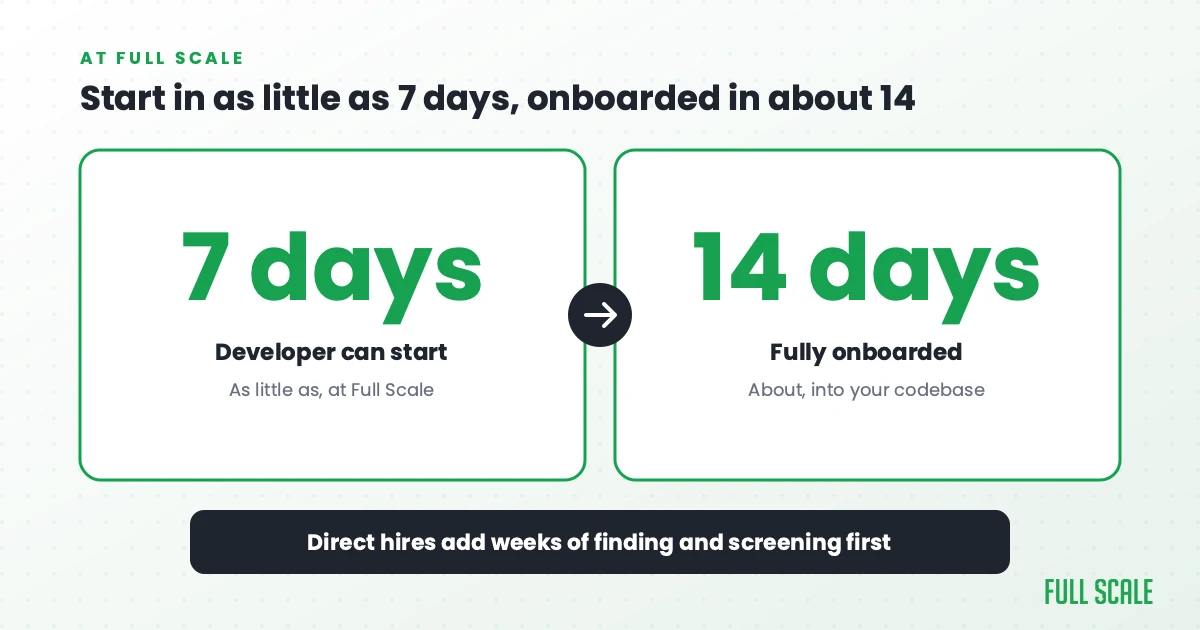
- A developer can start in as little as 7 days and be onboarded in about 14
- Three things are genuinely harder than hiring down the street
- Feedback lands better in the Philippines when it is private and specific
- Frequently asked questions
- Talk to us about building your Philippine team
Quick Answer: To hire remote workers in the Philippines, you can use your own Philippine entity, an employer of record, a staff augmentation partner like Full Scale, or true independent contractors. The employer owes a 13th-month bonus plus SSS, PhilHealth and Pag-IBIG contributions on top of salary. Those add roughly a fifth at entry-level pay and the low teens for a senior developer, because the contributions stop growing at pay ceilings.
You can hire remote workers in the Philippines in four ways: through your own Philippine company, through an employer of record, through a staff augmentation partner, or as independent contractors. Which one you pick decides who owes the government what, and that is most of the legal question.
The money question is smaller than the guides make it look. On top of salary, a Philippine employer owes a December bonus and three government contributions. All three contributions have a ceiling, and the two big ones stop growing at ₱35,000 and ₱100,000 of monthly pay. What you owe the person beyond the law is the part that decides whether they stay.
I have a stake in this, so here it is up front. Full Scale employs more than 350 engineers through our own Philippine entity and places them with US and European teams, and has made 700+ placements with clients since 2018. That means I am the one who actually pays the 13th month. Many of the guides that rank for this topic come from payroll and EOR vendors who sell software that does it for you.
The cost examples are for engineering roles, and a support or design hire will price differently. I am the CEO of Full Scale and have no law degree, so treat the legal parts as a map and take the final answer to your own accountant and attorney.
The first decision when you hire remote workers in the Philippines is who the legal employer is
The question underneath is whose name is on the employment contract in the Philippines.
If the answer is yours, you need a Philippine company, a payroll, and registrations with several government agencies. If the answer is somebody else's, they carry those duties and you carry a contract with them. A fourth answer, nobody's, is only honest for a genuine freelancer who serves several clients.
Full Scale runs the third route. Our client contracts are with Full Scale as a US company, and most of our engineers are regular employees on our payroll. A few elect independent contractor status for their own tax situation. Either way, a client has one company to call when something breaks.
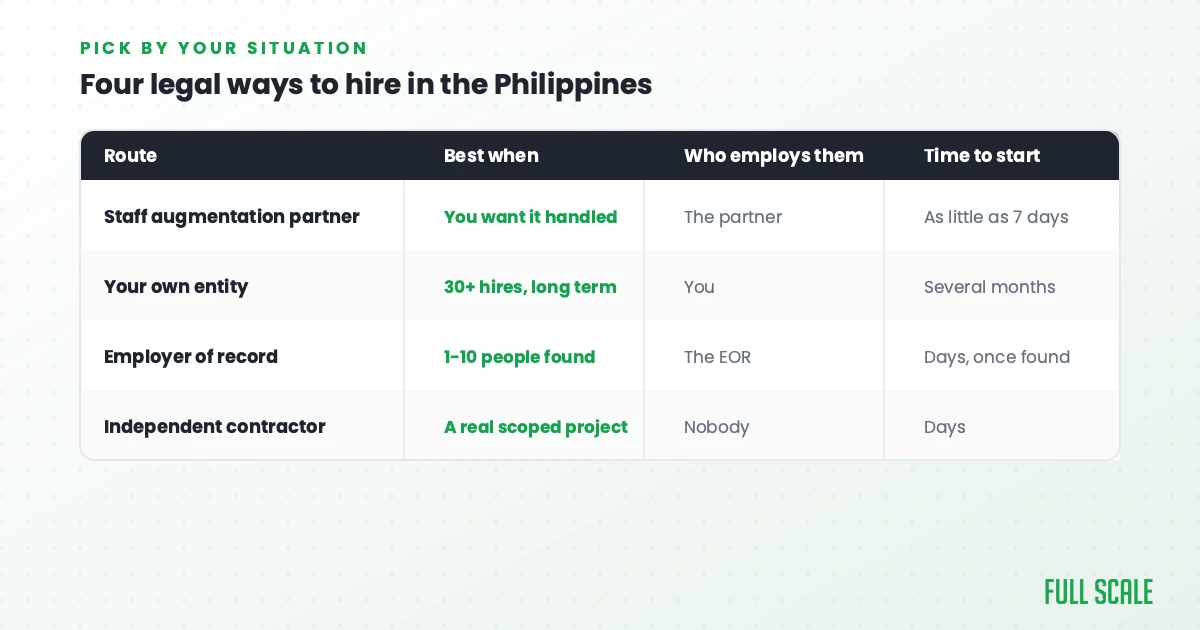
The four routes, compared by situation
Here is how the four routes compare, framed by five situations you might be in.
| Your situation | Route | Who legally employs the person | Who files in the Philippines | Time to start |
|---|---|---|---|---|
| You want a team recruited, employed and kept for you, with no Philippine paperwork | Staff augmentation partner (Full Scale's model) | The partner's Philippine entity | The partner | As little as 7 days |
| You already found one to ten people and only need someone to employ them | Employer of record (EOR) | The EOR, on your behalf | The EOR | Days, once you have found the person |
| You will hire 11 to 29 people and have no Philippine presence | An EOR or a partner, then revisit an entity as you near 30 | The EOR or the partner | The EOR or the partner | Days to a few weeks |
| You will hire 30 or more people and want to own everything | Your own Philippine entity | Your Philippine company | You | Several months |
| You have a scoped project with a person who really runs their own business | Independent contractor | Nobody | The contractor | Days |
A partner is not always the right pick. Hiring directly or through an EOR makes sense when you have a strong recruiter, only a few people to hire and no need to scale up or down quickly, though direct hirers often overpay on local wages and vet less than they think. A partner's rate earns its place when that work would otherwise land on your own team.
Three things to know about the routes
First, the contractor row has a trap. Philippine labor tribunals generally decide who is an employee from the facts of the relationship, not the title on the contract. A developer who works 40 hours a week for you, attends your standups and takes direction from your manager looks like an employee, whatever the paperwork says. The legal requirements guide covers classification, intellectual property and enforcement in depth. I will not repeat it here.
Second, the choice between an EOR and a PEO trips up a lot of buyers. An EOR becomes the sole employer, while a PEO is a co-employer and you stay on the hook. I broke that down in PEO vs EOR and compared an EOR with a staffing agency in employer of record vs staffing agency.
Third, the taxable-presence question, which lawyers call permanent establishment, lands differently by route. With an EOR or a partner, the Philippine presence can sit with their entity rather than yours, though that depends on how the work is directed and on your home country's rules. With your own company it is yours. If your own country's tax rules matter to you, the European guide walks through all four routes with a cost comparison.
Why the Philippines still works for engineering teams
English is the working language of business there, and the Philippines ranked 28th on the 2025 EF English Proficiency Index. That matters more than the rate. Software is mostly talking, and an engineer who can say "I don't understand this ticket" in plain English saves a sprint.
One number from our own team tells the rest: 93%+ of our engineers stay with us each year. I watch it more than any other, because a cheap developer who leaves in nine months is the most expensive kind. I call hiring on the lowest number alone cheapshoring, and it is the usual way this goes wrong.
For the longer argument, including why I picked the Philippines over countries where I hired before, read why hire developers in the Philippines.
The 13th-month bonus and three government contributions, line by line
If you only want the compliance list, this is it. I put it in one table because I would rather you could find it again in six months.
| Item | Employer pays | Employee pays | Cap or floor | What it is |
|---|---|---|---|---|
| 13th-month pay | One twelfth of basic salary earned in the year | Nothing | None | A bonus due by December 24 |
| SSS | 10% of monthly salary credit | 5% | Credit floor ₱5,000, ceiling ₱35,000 (employer maximum ₱3,500) | Retirement, disability and sickness benefits |
| PhilHealth | 2.5% of monthly basic income | 2.5% | Income floor ₱10,000, ceiling ₱100,000 (employer maximum ₱2,500) | National health insurance |
| Pag-IBIG | 2% of fund salary | 2% (1% at ₱1,500 or less) | Fund salary ceiling ₱10,000 (₱200 each) | Housing savings and loans |
That is three agencies and three acronyms, and the smallest one costs about $3 a month.
The 13th month is the one that surprises new employers. For rank-and-file employees it is an extra month of pay, not an optional holiday bonus, so you accrue about 8.3% of salary every month and pay it in December. Build it into your budget from the first day and it never feels like a surprise.
Income tax is the other item employers handle. The Philippines taxes employees on a graduated scale that starts at 0% on the first ₱250,000 of taxable income and climbs to 35% above ₱8 million, according to the PwC tax summary. You withhold it from their pay each cycle and remit it, and it never touches your cost.
Pay rules that scale with schedule
The table covers what you owe every employee. Several more rules from the Labor Code apply to rank-and-file employees and scale with schedule and pay, so I list them separately:
- Overtime: work beyond eight hours a day pays the regular hourly wage plus at least 25%.
- Night shift differential: at least 10% more for each hour worked between 10 p.m. and 6 a.m.
- Rest day and holiday premiums: at least 30% more for work on a rest day or special non-working holiday, and double pay for work on a regular holiday.
- Service incentive leave: five paid days a year after one year of service.
- Maternity leave: 105 paid days under RA 11210.
The night differential matters most to US teams, because hours that overlap an American morning can fall inside that 10 p.m. window. Managerial employees, among other categories, are generally exempt from some of these rules, and very small employers get an exemption on leave. That is why classification matters. Rules and rates change, so confirm the current figures with counsel. Then ask any provider in writing how shift pay is handled in their rate.
Minimum wage rules exist too. Developer pay sits far above any minimum wage, so it does not drive this decision.
What it costs to hire a developer in the Philippines once the statutory bill is added
Full Scale runs payroll and files these items for the large majority of our 350+ engineers who are regular employees, so I can show the arithmetic instead of describing it.
A developer's monthly pay is the number everyone quotes. Good senior developers in the Philippines earn about $2,000-3,500 a month before benefits and overhead, which is their pay and not what employing them costs. The employer then owes a 13th-month bonus and contributions to three government funds: SSS, PhilHealth and Pag-IBIG. The reference table above lists each rate, cap and source.
The arithmetic at six pay levels
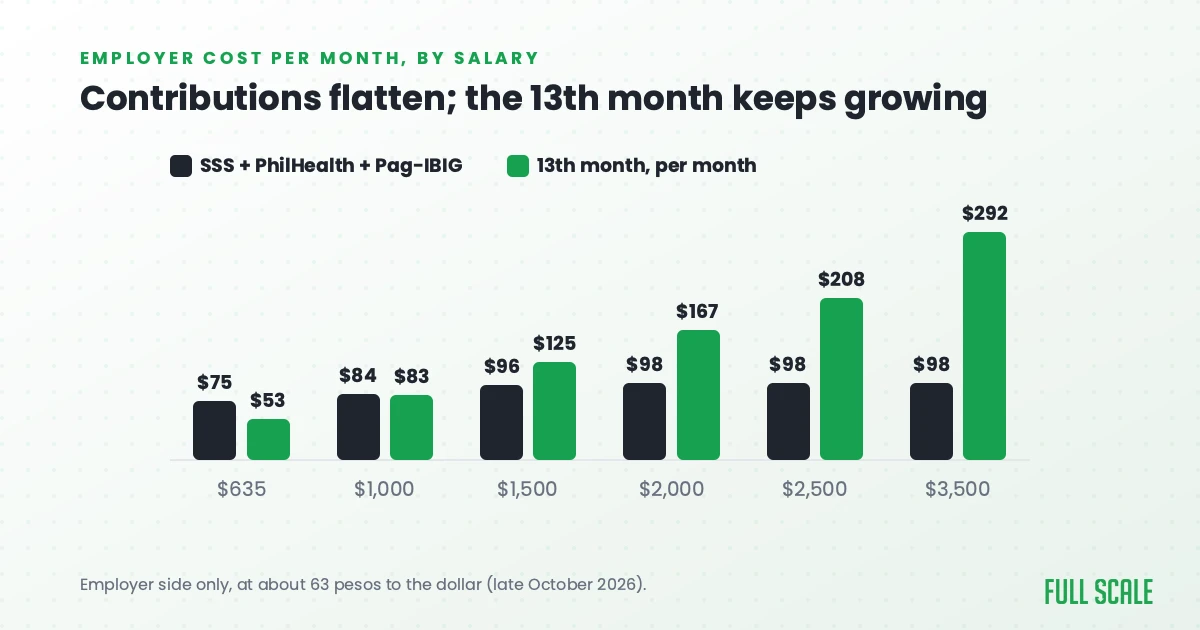
Put those items together at a handful of salary levels and you get the table below. I converted at about ₱63 to the dollar, which is roughly where the peso sat in late October 2026, so treat the dollar column as a weather report and not a price list.
| Example monthly pay | Employer contributions (SSS + PhilHealth + Pag-IBIG) | 13th month, per month | Total on top of pay | As a share of pay |
|---|---|---|---|---|
| $635 (entry level) | $75 | $53 | $128 | 20% |
| $1,000 | $84 | $83 | $167 | 17% |
| $1,500 | $96 | $125 | $221 | 15% |
| $2,000 | $98 | $167 | $265 | 13% |
| $2,500 | $98 | $208 | $307 | 12% |
| $3,500 | $98 | $292 | $390 | 11% |
This table covers the employer side only. Here is the part the rate lists rarely say out loud: the government's share of a senior developer's pay stops growing at about ₱6,200 a month, or about $98, no matter how much more you pay them.
The ceiling comes from three published caps, and SSS also adds a small flat employer-only contribution that I left out of the table. SSS stops counting salary at ₱35,000, PhilHealth stops at ₱100,000, and Pag-IBIG stops at ₱10,000. Past those points, a raise costs you the raise and the extra 13th month and nothing more. The statutory bill, as a share of pay, shrinks as developers get more senior.
At entry-level pay the picture is different. An entry-level developer earning roughly $635 a month costs you about a fifth on top of pay once the bonus is included, which is where the old rule of thumb comes from. It is a decent rule for junior roles and an overestimate for senior ones.
Two more cautions. Income tax stays out of the table, since it comes out of the developer's pay and the employer only withholds it and remits it. And the rates change. PhilHealth's 5% is the last scheduled increase under the Universal Health Care law, but a circular can move any of these, so check the agency page before you run payroll.
The stack changes the number less than people expect. Seniority changes the cost far more than whether someone writes Rails, React or Node. If you plan to hire Filipino developers in a particular stack, the posts on offshore Ruby on Rails, offshore React and Node.js cover how each market looks.
What the table leaves out
The table also leaves out the costs that are not statutory. Health insurance beyond PhilHealth comes first, and the section below on what you owe the person covers it. After that come equipment, the recruiting work to find the person, and the manager's time, which is the cost buyers underestimate most. A partner like Full Scale folds pay, benefits, equipment and recruiting into one rate that starts at $35 an hour, with a customer success manager supporting you, so the fair comparison is that rate against your own total and not against the salary line.
The cost lines, route by route
Here is every cost line a Philippine developer carries, who pays it on each route, and what makes it grow. I left dollar figures off the non-statutory lines because they vary too much by company to print one number.
| Cost line | Your own entity or direct hire | Employer of record | Staff augmentation partner | What makes it grow |
|---|---|---|---|---|
| Salary | You | You | In the rate | Seniority |
| 13th month and the three contributions | You | You, passed through | In the rate | Pay, then it caps |
| Health insurance and benefits beyond the statute | You | You choose, the EOR processes | In the rate | Headcount and family size |
| Entity setup, accounting or platform fee | You pay for the entity and its accountants | A monthly fee per employee | In the rate | Headcount |
| Recruiting and screening | You | You | In the rate | Every hire and every replacement |
| Equipment | You | You | In the rate | Headcount |
| Manager time | You | You | You, with a customer success manager helping | Team size and time-zone gap |
Run the comparison on the total of those lines for your route against the $35-an-hour starting rate. Direct hiring costs the least cash when you already have the person and the bandwidth to manage them. Full Scale's rate earns its place when the hiring and benefits work would otherwise land on your own team, though direction and review stay with you either way.
Paying people in pesos is a small problem with a few easy fixes
Philippine employees are paid in pesos, so your dollar cost moves with the exchange rate even though their pay does not. If you hire directly, you take on the currency conversion and the transfer fees, and you need a payment method your developer can cash out easily. An EOR typically runs peso payroll for you and bills you in dollars, with a fee on top. With Full Scale, you pay one invoice in dollars through ACH, and we run peso payroll for the engineer.
Whichever route you use, state the exchange rate you assumed and re-run the numbers each quarter.
The employee benefits you owe beyond the statute are what keep people
The statutory bill is the small, knowable part of employing someone in the Philippines. It fits in a table, most of it is capped, and a payroll provider can run it for you. What it does not buy is a developer who is still on your team in three years.
I think about the second layer as the things a person would miss if you took them away. At Full Scale that means health insurance and group term life coverage from day one for a spouse and all of an employee's children, 10 vacation days and 10 sick days a year with five more vacation days after five years, about 17 paid holidays, and an optical reimbursement of up to ₱5,000 every two years.
The law does not require any of that at those levels, and 93%+ of our engineers stay each year. I can't prove the first causes the second, but I would not run the experiment of dropping the health plan to find out. Replacing a senior developer means months of recruiting and ramp-up, and I would take the health premium over that bill. An EOR will process whatever benefits you specify, but it won't decide them for you.
This is where the cheap version of hiring in the Philippines quietly fails. Someone pays the statutory minimum, skips the extras, and then spends months wondering why good people leave for the company across the street that offers a health card. The full retention picture is in developer retention strategies. The 13th month is the minimum you owe, and what keeps people is the rest of that list.
Philippines vs India: the Philippine bill has ceilings, and India's works differently
Plenty of buyers price both countries, so here is the honest comparison on employer obligations. I am keeping the India side qualitative on purpose. India's rules changed with its new labour codes in late 2025, and the percentages vary by how an establishment is registered, so any single figure I printed would go stale.
| Question | Philippines | India |
|---|---|---|
| What the employer owes by law | A 13th-month bonus, SSS, PhilHealth and Pag-IBIG | A provident fund share, state insurance below a wage ceiling, and gratuity that builds with tenure |
| What happens as pay rises | Contributions stop growing at published ceilings, so the bill flattens | Some schemes carry wage ceilings and the wage base changed in late 2025, so price it with an Indian payroll provider |
| Notice periods and offer risk | The Labor Code sets 30 days' notice for resignation, and counter-offers happen here too, so ask every candidate about both before you plan a start date | In my Stackify experience, 60-to-90-day notice periods were common, and accepted offers could fall through to counter-offers |
| Communication in daily work | High English proficiency, and the communication culture lines up with US teams | Strong English on many teams, with a formal, indirect style that can hide "I don't understand" |
The notice-period row comes from my own experience. At Stackify we worked with an outside engagement in India, where I made offers, waited out the notice periods and sometimes found out the candidate had taken a counter-offer. The talent was fine, but doing that a few times wore down our trust in the hiring process. I wrote the full comparison in India vs the Philippines, including when India is the better call.
The four risks are classification, IP, data privacy and tax presence, and each has a named owner
Every route carries the same four risks, and the difference is who holds each one.
| Risk | Your own entity or an EOR | A staff augmentation partner | An independent contractor |
|---|---|---|---|
| Worker classification | You or the EOR, depending on the contract | The partner, for engineers it employs | You, and this is the most common failure |
| Intellectual property assignment | Your employment contract or the EOR's contract chain | Covered in the client agreement, with the partner holding the employment contracts for its employees | Only what the contractor's agreement says |
| Data privacy | You, under your own rules and the Philippines' Data Privacy Act | Covered in the client agreement and the partner's security controls | You |
| Taxable presence in the Philippines | Yours with your own entity, the EOR's with an EOR | The partner's entity | Usually low for a genuine contractor, but ask a tax adviser |
Full Scale handles the second row with a client agreement that covers confidentiality and assignment of intellectual property to you, while we hold real employment contracts with the engineers who are employees. For the first row, the question is control: who tells the person what to work on and when. If it is you, treat them as an employee.
That test applies to a partner arrangement too, and I will say how ours works. Our engineers are our employees, or contractors engaged directly by us, and they report to the client and take day-to-day direction from the client's team. That is what staff augmentation is. It means the daily direction is yours on every route, so the contract has to say who the employer or contracting party is and who carries the classification risk. Ask any provider to put that in writing. The legal post goes through the contractor risks and what enforcement looks like in practice.
If your developers will touch customer records, the Philippines' Data Privacy Act is the law to check, and you should decide who can reach that data before the first commit.
Ending the arrangement is where the legal employer matters most
Philippine law protects employees from being dismissed without a valid cause and a fair process, so letting a direct hire go is a legal procedure and not a phone call. Direct hires usually start on probation of up to six months, then become regular employees. Letting a regular employee go for business reasons can carry separation pay, so budget for the exit as well as the entry. A contractor who is really an employee can bring the same claim after the fact, which is the risk the legal guide describes.
With a partner, the employment relationship sits with us. After the first two weeks, a client can drop a developer with 30 days' notice and no long-term contract, and we handle the Philippine side of what happens next. Inside the first two weeks, the money-back guarantee applies. Whichever route you choose, read the exit terms before the entry terms, because that is the page you will want in a bad month.
Management time stays with you whichever route you pick
A legal structure tells you who employs the person. It does not tell a new developer what to build on Monday. Someone has to give direction, review the work, notice when a person has gone quiet, and cover a long time-zone gap. With a direct hire or an EOR, that someone is you.
This is why I think the paperwork gets more attention than it deserves. I think the offshore hires that go wrong usually go wrong because nobody had time to manage them, not because of a filing, which is why our customer success managers take part of that load. Budget your own hours before you budget anything else.
Finding candidates is the part no legal structure solves
An EOR will employ the person you found and a payroll platform will pay them, but neither one finds them or tells you whether they are any good.
Candidate sourcing is its own topic, and I wrote the long version in platforms to hire developers in the Philippines, which compares job boards, freelance marketplaces and vetted communities. The short version is that you will post and then screen, and screening takes more of your time than you plan for. Where in the Philippines you recruit matters less for remote work than people assume, and the guide to Cebu, Manila and Davao compares them if you want the detail.
A developer can start in as little as 7 days and be onboarded in about 14
How fast you start depends on who does the finding.
If you hire directly or through an EOR, the legal part takes days, but you still have to find, screen and interview candidates, and that usually takes weeks or months. The post on time to hire a software engineer covers the direct-hire timeline in detail.
With a staff augmentation partner that keeps a bench, the finding is often already done when someone on the bench fits. At Full Scale, a client can start with a developer in as little as 7 days, and getting that developer fully onboarded into your codebase takes about 14. Those are two different claims, and I try not to blur them. Our developer onboarding guide suggests a new engineer should ship a first commit by about day three, which is a good test of whether your setup is ready.
The bench cannot do everything. If your stack is unusual or the seniority you need is rare, we recruit for the role and it takes longer. I would rather tell you that now than have you plan a launch around the best case.
Three things are genuinely harder than hiring down the street
A guide that only lists the upsides is a brochure, so here are the three that cost you something.
The first is the clock. The Philippines does not observe daylight saving time, so a 9 a.m. Eastern standup lands at 9 or 10 p.m. in Manila, depending on the season. Pacific time has it worse, since 9 a.m. in California is midnight or 1 a.m. there. Decide whose evening is on the line, write the overlap hours into the offer, and check whether the 10% night differential applies to them.
The second is infrastructure. Typhoon season brings power cuts and flooded streets, and home internet quality varies by province. Ask where your hire lives, whether they have a backup connection, and what the plan is when a storm takes out the power. It is the one line item no payroll platform will estimate for you.
The third is that good people get recruited. A developer with strong English and a few years of experience gets offers from local and foreign companies, the same way a good developer does anywhere, and that is the other reason the benefits section above exists.
Feedback lands better in the Philippines when it is private and specific
Fluent English hides a communication difference that surprises many US managers.
Filipino work culture is high-context and harmony-first. A developer may say "yes, I can do that" and mean "I heard you and I will try." A direct criticism in front of the team can feel like a loss of face, a feeling the culture names hiya. That does not mean Filipino developers lack opinions. It means they are more likely to share them privately, in writing, or after you ask in a way that makes disagreement safe.
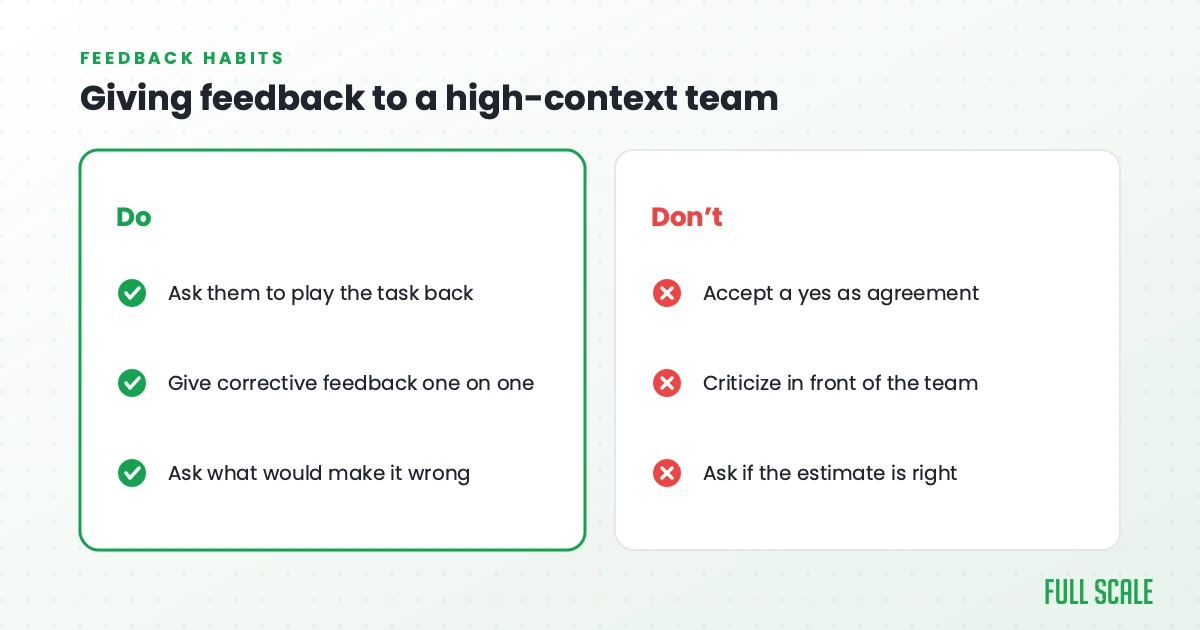
Three habits help right away:
- Ask the developer to play a task back in their own words instead of accepting a yes.
- Give corrective feedback one on one.
- Ask "what would make this estimate wrong?" instead of "is this estimate right?"
None of this is a rule. People differ, and younger developers on global teams are often more direct. But these habits clear up most of the confusion. The full guide to Filipino work culture on software teams has a decoder for what a developer says and what it often means.
Frequently asked questions
How do I hire employees in the Philippines legally?
You have four routes: set up your own Philippine company, use an employer of record, use a staff augmentation partner that employs the engineers through its own entity, or engage genuine independent contractors. The right one depends on how many people you are hiring and who should carry the Philippine paperwork. Our European guide compares all four routes with costs.
What are the mandatory benefits for employees in the Philippines?
The employer pays a 13th-month bonus of one twelfth of annual basic salary by December 24, plus contributions to SSS at 10% of the salary credit, PhilHealth at 2.5% of basic income, and Pag-IBIG at 2% of a fund salary capped at ₱10,000. SSS and PhilHealth stop counting pay above ₱35,000 and ₱100,000 respectively, so the bill flattens for senior roles. Leave and premium pay depend on the role and the Labor Code.
How much does a senior Filipino developer cost with the 13th month and contributions?
A good senior developer earns about $2,000-3,500 a month. On top of that, the employer owes roughly $98 a month in contributions and an extra month of pay in December, which adds about 11-13% to the pay figure at current exchange rates, since all three contributions stop growing at pay ceilings. Health insurance, paid leave, equipment and recruiting come on top of that, so the all-in figure is higher. Full Scale's rate starts at $35 an hour and covers pay, benefits, equipment and recruiting, with a customer success manager supporting you.
What does an employer of record cost in the Philippines?
An employer of record usually charges a monthly platform fee per employee on top of the employee's salary and the statutory contributions. Fees vary by provider and change often, so get current quotes instead of trusting a figure in an article. Our European hiring guide shows how EOR pricing compares with a partner or your own entity.
Do I need a Philippine entity to hire remote developers?
A company does not need its own Philippine entity to hire remote developers, because an employer of record or a staff augmentation partner can employ them, and genuine independent contractors need no registration from you. You only need your own entity if you plan to employ people directly, since a foreign company that wants to run Philippine payroll generally has to register locally first, and the setup typically takes several months. Our European guide puts the sweet spot for your own entity at 30 or more developers, and treats that threshold as a rule of thumb.
Does hiring in the Philippines create a tax presence for my company?
Hiring in the Philippines can create a tax presence for your company, depending on the route and how the work is directed. With an EOR or a staff augmentation partner, the Philippine presence can sit with their entity rather than yours, though that depends on how the work is directed and on your home country's rules. With your own entity, it is yours. If you direct a full-time contractor like an employee, tax authorities may treat the arrangement as an employment relationship, so check with a tax adviser. The legal requirements guide covers the details.
How is hiring in the Philippines different from hiring in India?
The Philippine employer bill is a 13th-month bonus plus three contributions, all of which stop growing at pay ceilings. India's obligations include a provident fund, state insurance and gratuity, and its new labour codes changed the wage base in late 2025, so price India with an Indian payroll provider. Beyond cost, many buyers cite English fluency and cultural fit as reasons to pick the Philippines. The India vs Philippines comparison covers when India is the better call.
Talk to us about building your Philippine team
If you would rather not set up payroll in a country you do not work in, schedule a call with Full Scale. A developer can start in as little as 7 days. If the first two weeks do not work out, you get your money back, and after that you can drop a developer with 30 days' notice.