15 Best Platforms to Hire Developers in the Philippines (2026)

In this article
- The honest way to read this list
- Philippine job boards, where you post and you screen
- Open freelance marketplaces, where you and a star rating do the screening
- The vetted marketplaces, and what a badge actually buys
- The Filipino developer communities nobody puts on these lists
- What happens after you post the job
- How to hire developers in the Philippines once the applications land
- The part no platform sells you, which is whether they stay
- Frequently asked questions
- Where this leaves you
Years ago I needed software developers for Stackify, the company I was running at the time, and I started looking at the Philippines. I did what you are probably doing right now. I went looking for the list of places to post the job.
That part took an afternoon. The list is easy to find. Talking about it on my podcast later, I put it plainly: “that’s actually how Full Scale started. I needed to hire 10 software developers for my own company.” Full Scale grew out of that Philippines team in 2018, because it worked well enough that other founders started asking me to do it for them.
What took me years to learn is that the list was never the hard part.
Before the list, a warning about what you are walking into. In the first six months of 2026, 4,869 people applied to Full Scale and 43 of them got hired. I break that number down properly further on, because the raw version of it is misleading in both directions. The short version is that finding the good ones is the expensive part, and not one platform below does that for you.
I went in assuming I could read a resume and tell whether someone was any good. I had been writing software for twenty years. Of course I could tell. I do not believe that about myself anymore, and I will come back to why.
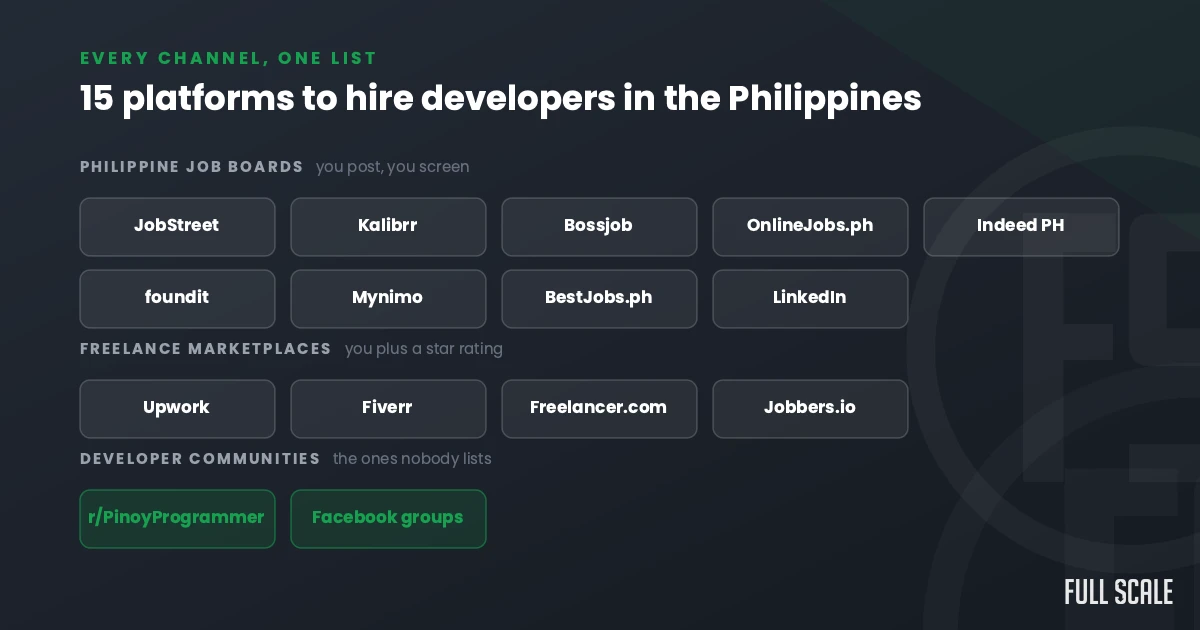
Here are the fifteen platforms worth knowing, grouped by the only thing that actually separates them: who does the screening. On some of these, nobody does. On others, you do. On a few, somebody else does and charges you for it.
The honest way to read this list
Almost none of these platforms are built for both things you need at once.
The Philippine job boards are general employment sites. They reach millions of Filipinos and they carry developer listings, but they were never designed around software hiring, and an ad for a backend engineer sits beside ads for call center agents and warehouse staff. The developer platforms have the opposite problem. They know engineering, and Filipinos are a small slice of a global pool you search by skill rather than by country.
Two channels score well on both counts, and neither one appears on any other list like this. I will get to them.
At Full Scale we recruit in the Philippines every week, and the thing that surprises people is how little the channel has to do with quality. A wider channel sends more applicants. That is all it does. Which is why, for every platform below, I have added a line about what it leaves you to figure out on your own.
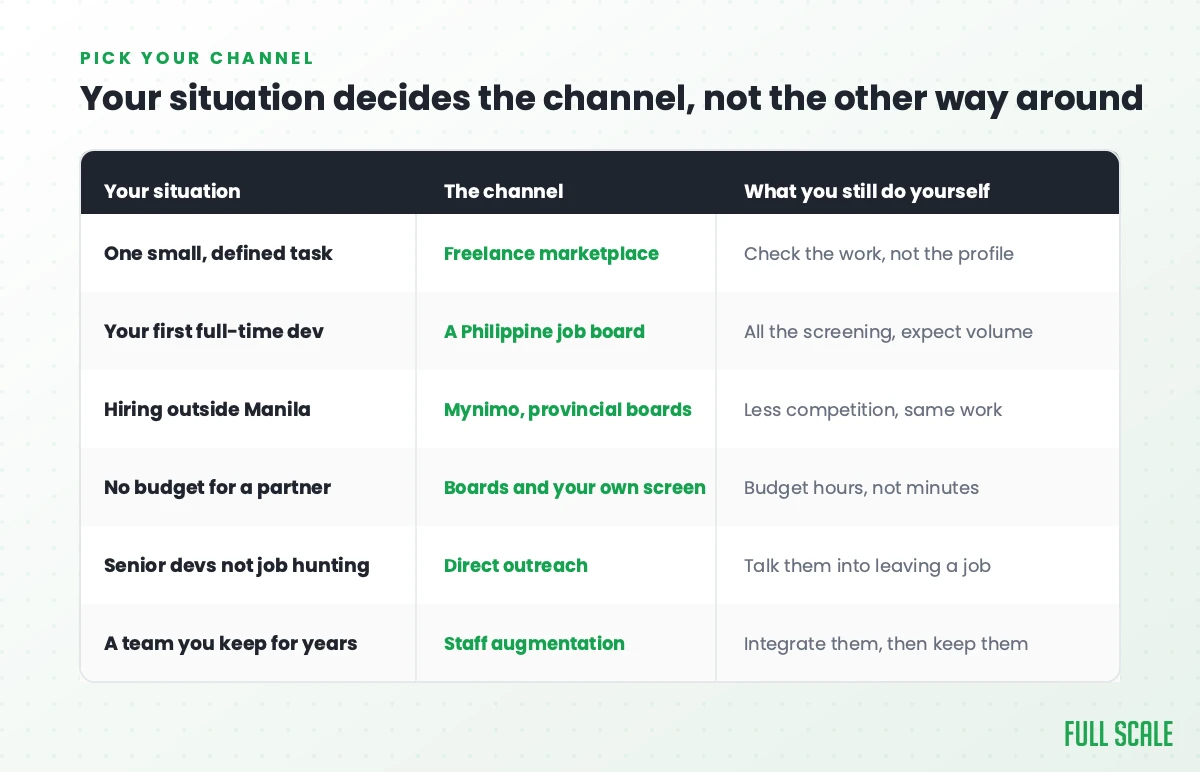
| Your situation | The channel to use | What you still have to do yourself |
|---|---|---|
| One small, well-defined task | An open freelance marketplace | Check the work, not the profile |
| Hiring your first full-time developer | A Philippine job board | All of the screening, and expect volume |
| Hiring outside Metro Manila | Mynimo or a provincial board | Everything, but against less competition |
| You have no budget for a partner | Boards plus your own real screen | Budget hours, not minutes |
| You want senior people who are not job hunting | Direct outreach, or a partner | Convince someone to leave a job they like |
| You need a team you keep for years | Staff augmentation | Integrate them, then keep them |
Philippine job boards, where you post and you screen
These all work the same way. You pay a subscription or post for free, applications arrive, and you read every one of them. There is no take rate and no vetting layer. Among the recruitment platforms in the Philippines these are the highest-volume job posting sites you can reach. The volume is the part you should be nervous about. The country itself is not the risk: Philippine IT and business process work runs to roughly $42 billion a year across about two million jobs. The infrastructure for remote technical employment is mature.
JobStreet is the default, and default means crowded
JobStreet is the Philippine arm of SEEK, which runs employment marketplaces across Australia and Southeast Asia, and it is where most Philippine employers post first. Reach is its whole argument. If you want the largest possible number of Filipino applicants to see your role, this is the one.
That is also the problem. You are posting into the same pool as every large employer in the country, and your startup’s name means nothing next to a bank’s. It is a distribution channel with a resume attached, and it will tell you nothing at all about the person behind one.
Kalibrr leans the most technical of the general boards
Kalibrr has become the board that startups and digital-first companies actually use, and it attracts younger candidates in engineering, product, design and data. It also has skills and aptitude assessments built into the flow, so you get some signal before you speak to anyone.
Treat that signal carefully. An assessment score tells you someone can pass an assessment, which is not the same as working through a problem nobody has defined yet.
Bossjob puts you in a conversation instead of an inbox
Bossjob is built around chat. Rather than posting and waiting, recruiters message candidates directly, and the platform matches on skills instead of keywords. For a small team that would rather have twenty conversations than read four hundred applications, that shape is genuinely useful.
A fast chat is still no proof that the person typing is the person who shows up in October.
OnlineJobs.ph has the deepest pool, and the most misdescribed one
Every list puts OnlineJobs.ph at the top, and most of them get the details wrong, so here is what its own site says.
The database holds more than five million Filipino profiles, not the five hundred thousand you will see quoted elsewhere. Their pricing page lists a free tier that allows three job posts capped at fifteen applications each, with no ability to contact workers. PRO runs $69 a month for three posts and seventy-five worker contacts. PREMIUM runs $99 a month for ten posts and five hundred contacts, plus background data checks. There is a money-back guarantee and no contract.
So the “unlimited access” you have read about is metered. Seventy-five conversations a month sounds generous right up until you remember how many of them end at hello.
Two more things nobody mentions. The company is, by its own footer, based in Utah. And its own headline calls it a job board for virtual assistants, which matches what the pool contains: an enormous number of capable remote professionals, most of whom do not write software. Developers are in there. They are not the product.
Indeed brings volume and nothing else
Indeed’s Philippine site aggregates listings from everywhere, which means enormous reach and no curation whatsoever. Post here in addition to something else, never instead of it. It will tell you nothing, at scale.
foundit is the old Monster, still running
foundit.com.ph carries a few thousand developer listings at any moment and a large resume database behind a subscription. It is a reasonable second post and nobody’s first choice anymore. No resume database will tell you how old the resume is.
Mynimo is the one worth knowing if you look past Manila
Mynimo is strongest outside the capital, in Cebu, Davao, Iloilo, Pampanga and Cagayan de Oro, and posting is free. Most foreign employers never find it, which is precisely why it is interesting. Less competition for the same candidates, in cities with real universities and real engineering graduates.
Our own team is spread across the Philippines rather than concentrated in Manila, and the talent outside the capital is not a consolation prize. If you are weighing Cebu, Manila or Davao, this is the board that provincial hiring actually runs through. What it will not show you is whether a strong local candidate has ever worked with a US team.
BestJobs.ph gives you a free ad and somewhere to track it
BestJobs.ph has been running for two decades, includes a free ad allowance, and bundles skills testing with a light applicant tracking layer. For a founder with no recruiting software, having the pipeline live somewhere other than a spreadsheet is worth more than it sounds. Whether the person who took the test is the person you end up interviewing remains yours to work out.
LinkedIn is not a Philippine board, and it is where the good ones are
LinkedIn earns a place here on usefulness rather than fit. Nobody in the Philippines browses it for work the way they browse JobStreet. But it is where you find the senior developer who is employed, content, and never going to answer your posting.
That is the entire reason our recruiters live in it. The advantage is that you start a conversation rather than read a profile.
Open freelance marketplaces, where you and a star rating do the screening
Different model. The work is project-shaped, the platform sits between you and the person, and it takes a cut. You are buying a deliverable more than you are hiring a human.
Upwork is the biggest, and the fees are worth reading
Upwork is the open marketplace, with bidding, profiles and reviews. What most posts skip is the cost. Per Upwork’s own published help documentation, clients on the basic plan pay a marketplace fee of up to around 8% of what they pay out, plus a one-time contract initiation fee of between $0.99 and $14.99. Freelancers give up anywhere from nothing to 15% on their side.
Whether you want a task done or a team built is a genuinely different question, and I have written about task or a team elsewhere rather than relitigate it here. What the reviews will not settle is whether five stars on small jobs predicts anything about a big one.
Fiverr sells packages, which is a feature
Fiverr is priced and scoped as a product. You buy a defined thing for a defined price. For a logo, a landing page, a script, that clarity beats running a hiring process. Work that cannot be packaged does not belong here.
Freelancer.com runs on bids, and bids run down
Freelancer.com is a bidding marketplace, and bidding pushes toward the lowest number. That mechanism is the whole trouble with hiring the cheapest developer, a mistake I call cheapshoring, where cost becomes the only variable anyone optimizes. You will learn the price long before you learn why it was that low.
Jobbers.io says it takes nothing, which would be the interesting part
Jobbers.io bills itself as commission-free, with no platform fee on either side, and it runs city pages including Manila. I could not verify that claim independently, so treat it as the platform’s own statement rather than as a fact. If it holds, paying a developer’s actual rate with no markup is a real difference from an 8% marketplace fee.
One warning applies to all four. Anonymous marketplaces attract people who are not who they say they are, and software projects are a favorite target. Bait-and-switch and borrowed identities are common enough that I wrote up the scams to watch for separately. Read that before you wire anyone money.
The vetted marketplaces, and what a badge actually buys
There is a third category where somebody else screens first and charges a premium for it. Toptal is the one everyone knows, built on a top-3% acceptance claim and priced accordingly. Several vetted platforms now focus specifically on Philippine engineers with the same pitch.
Here is the uncomfortable part, and I include us in it.
Full Scale advertises an acceptance rate under 3%, and I do not think that number should decide anything for you. Everyone in this business advertises an elite screen. The percentile is the easiest statistic in the industry to shape, because you get to choose the denominator.
A vetting badge tells you how somebody performed on a test one afternoon. It says nothing about whether they will still be on your team in a year, and the second thing is the only one that compounds. If you want the real comparison of when a premium marketplace earns its price, I have laid out choosing between them in detail. The question a badge leaves open is whether the screen measured the thing your work actually requires.
The Filipino developer communities nobody puts on these lists
Now the two channels that score on both axes, and that I have never once seen in a post like this.
r/PinoyProgrammer describes itself as a “community of Pinoy programmers to share ideas, projects, job vacancies and socialize with fellow programmers.” Job vacancies are in the charter. It is where Filipino developers talk honestly about salaries, employers and stacks. Read it for a week and you will understand the market better than any vendor page will teach you.
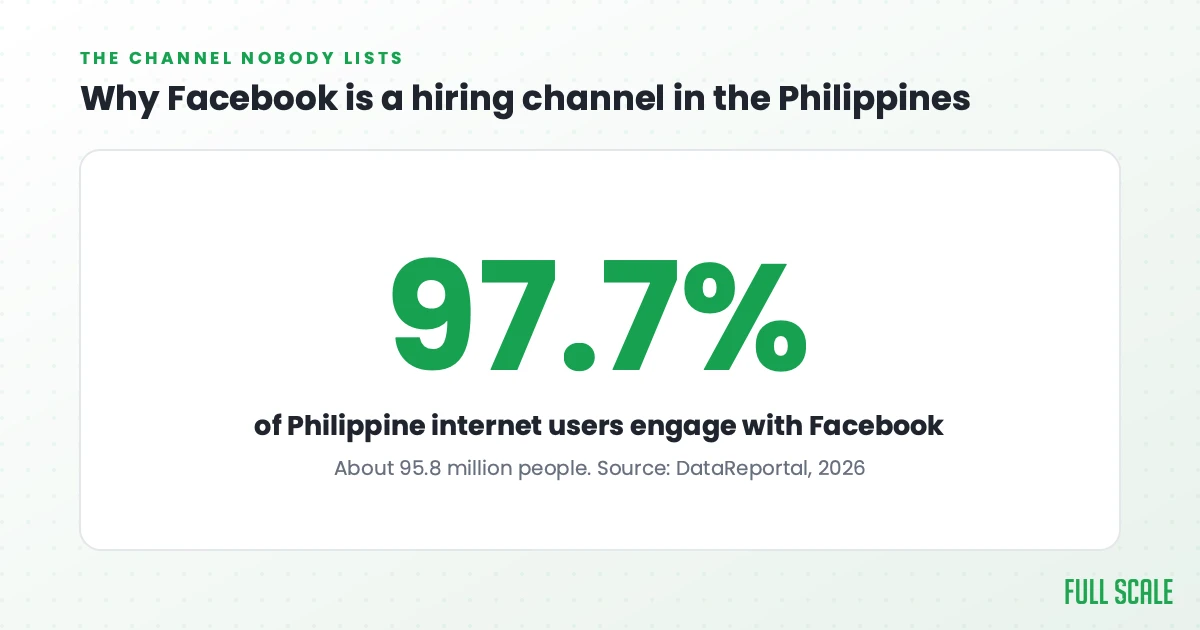
Then there is Facebook, where the numbers are hard to argue with. In the Philippines, 97.7% of internet users engage with Facebook, roughly 95.8 million people, or about 82% of the population, according to DataReportal’s 2026 country report. Groups like Software & Web Developer Jobs Philippines, ReactJS Manila and Python Philippines are active, and they are where working developers spend their time.
Every other list treats Facebook as somewhere to run ads. In the Philippines it is closer to the professional network.
The honest tradeoff: no applicant tracking, no filtering, no pipeline. You are joining a conversation, which makes it slower and smaller. What you get back is signal, because you are watching people discuss real technical problems instead of reading what they wrote about themselves.
That matters more than it sounds. English fluency matters, cultural expectations matter, and whether a developer will speak up when they do not understand something or push back when the spec is wrong matters more than the hourly rate on their invoice. A forum thread shows you that. A resume never will.
What happens after you post the job
Post a developer role on two Philippine job boards and you will meet the real bottleneck, which is volume. Here is what arrives.
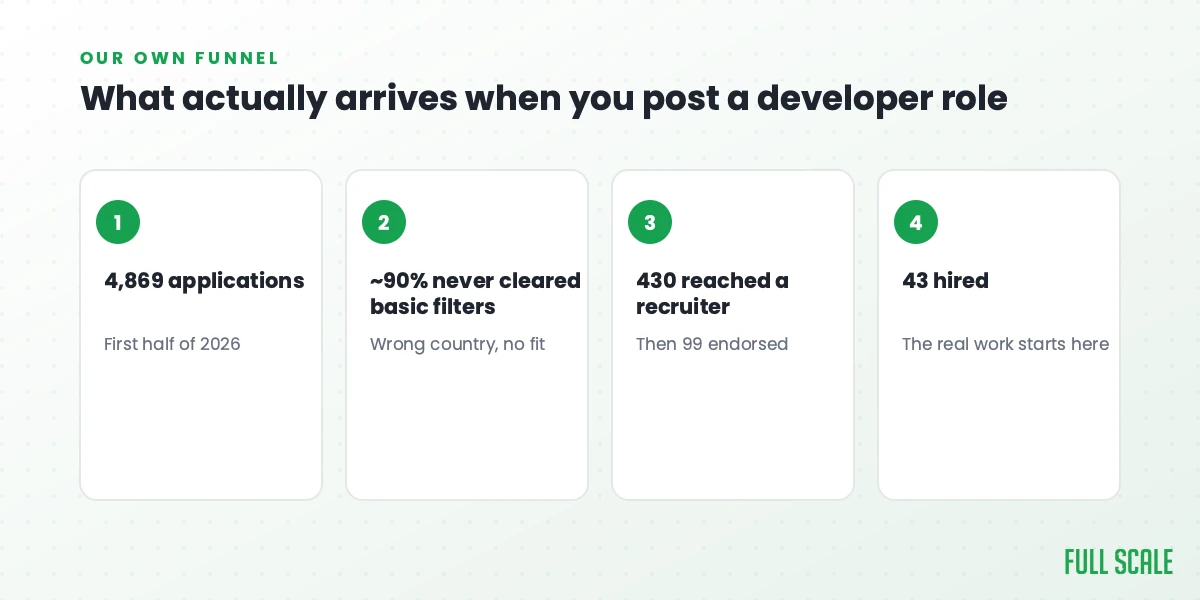
In the first six months of 2026, Full Scale received 4,869 applications. Around 430 reached a recruiter, 99 were endorsed for an offer, and 43 people were hired. Some months clear a thousand applications on their own.
That last number is not a brag about our standards, and I want to be clear about why. Roughly 90% of those 4,869 never cleared basic filters at all. They applied from countries we do not hire in, or sent the same resume to every company in the country, or had no overlap with any role we had open. The denominator is stuffed with applications that were never real, which is exactly how selectivity statistics get inflated across this industry. Our full process is written up at how we screen.
I have been saying the same thing in my newsletter for a while: at Full Scale we receive hundreds of job applications a month for software engineers, which makes it nearly impossible to give each person multiple rounds of interviews.
You will inherit that math the moment you post, with none of the recruiters.
It has also gotten worse lately, for reasons that have nothing to do with the Philippines. A Robert Half survey released in March 2026 found that 65% of HR leaders say skills are harder to verify in AI-optimized resumes, while 67% say those resumes slow their hiring down. Everybody now has a tool that makes them sound like the perfect candidate.
The resume pile has never been bigger or less informative. Congratulations on your new part-time job.
How to hire developers in the Philippines once the applications land
Now the part I got wrong for years, which is what a resume is actually worth.
On my podcast earlier this year, the founder of a hiring startup asked me directly whether I could look at his resume, knowing nothing about him, and tell whether he actually knew anything. I run a company that places engineers for a living. My answer was “no, not at all.”
I am not being humble about it. A resume in 2026 simply does not carry that information anymore, and the timed coding test people reach for instead is now trivially easy to pass with AI open in another window.
Here is what we do, and what you can copy for free.
Give the candidate one real problem, with context, constraints and some pieces deliberately missing. Not a whiteboard algorithm, and not a two-hour take-home. A genuine, open-ended problem from your actual product, followed by a conversation about it.
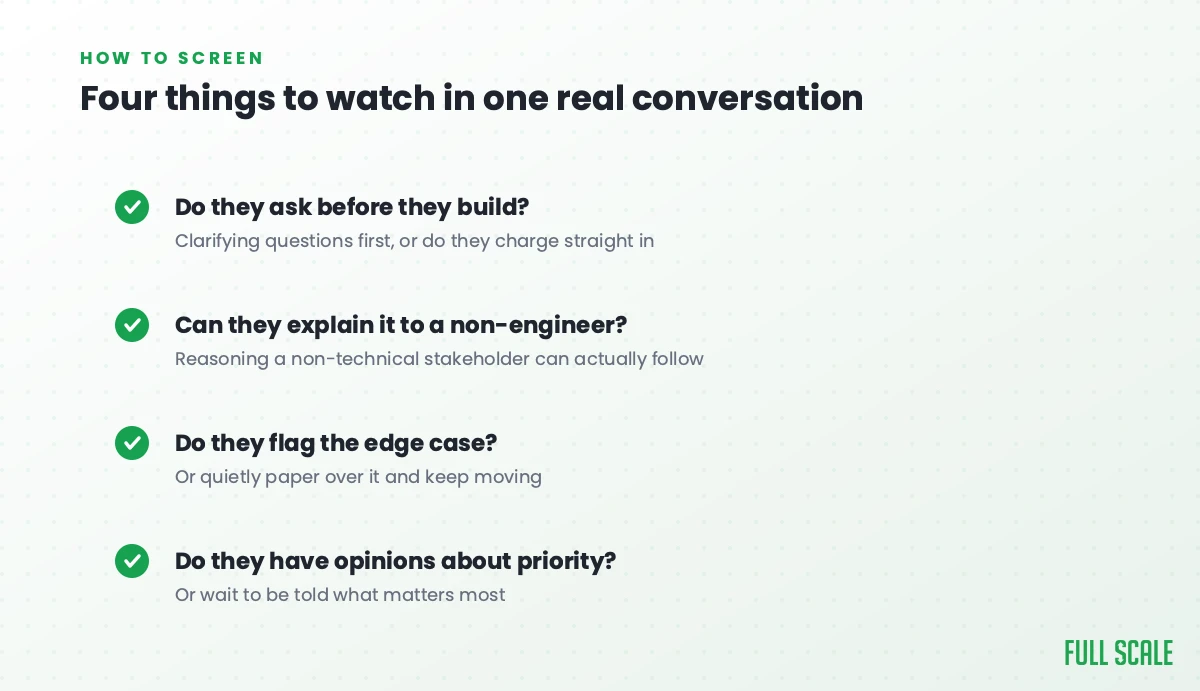
Then watch for four things:
- Do they ask clarifying questions before they start, or charge straight in?
- Can they explain their reasoning to somebody non-technical?
- When they hit an edge case, do they flag it or paper over it?
- Do they have opinions about what matters most, or wait to be told?
You do not need four rounds of technical screens to find out whether somebody has good judgment. You need one real conversation. The longer version of this is in AI Exposed What Your Interview Process Already Missed.
This is also the honest answer if you have no budget for a partner. Post on the Philippine boards, expect the flood, and set aside real hours to screen properly. You will be doing the work our recruiters do, which is completely doable, and it costs time instead of money.
One practical wall to know about before you reach it. Once you have found the person, you still have to employ them legally, which means either your own Philippine entity or an employer-of-record service that holds the contract for you. No job board handles that part.
And on pay, so you go in calibrated rather than insulting: what developers actually earn in the Philippines is public, and paying at the top of the local market costs you far less than the churn of paying at the bottom.
The part no platform sells you, which is whether they stay
A job board and a marketplace are both ways to meet somebody. Neither has any stake in whether that person is still there next year.
This is not an offshore problem, either. Turnover, weak loyalty and communication breaking down are what happens on distributed teams, and hiring in another country is just the sharpest version of it. If you run a remote team across three US states you already know this.
Which brings me to the biggest hiring lesson of my career. The best developers are not looking for a job, because they already have one and nobody is letting them go. They will never see your posting. You have to go find them and talk them into leaving. Meanwhile a large share of the people who do apply have applied to a hundred jobs in six months and landed none of them, and they are flooding every opening you create.
That is why active recruiting beats any job board, and it is most of what a partner is actually selling.
What to ask any partner before you sign
Full Scale runs in-house recruiters whose job is recruiting employed developers away from their current jobs, plus referrals from our own 350-plus engineers, who earn a ₱25,000 bonus when someone they refer gets hired. Retention sits above 93%. Our fully loaded rates start at $35 an hour, and we have been doing this since 2018.
I am not going to tell you that retention number is dramatically better than the good vetted platforms, because it is not. What I will say is that we publish the funnel behind it and the method underneath it, and you should make anyone you evaluate do the same. Ask what happens to their applications, how they screen, and how many of last year’s hires are still on the same team. The vendors who cannot answer are telling you something.
None of which makes the fifteen platforms above bad. They are genuinely good at what they do, and for a defined project or a first hire you screen yourself, a board or a marketplace is the right call and cheaper than any alternative. The model only breaks when you need a team you keep. Hire talent to work directly for you on a long-term basis, and do not hire them just for a project. If that is where you are, we hire developers in the Philippines as dedicated team members rather than as tickets.
Frequently asked questions
What are the best job boards in the Philippines?
For a full-time hire, the strongest Philippine job boards are JobStreet for reach, Kalibrr for technical roles, Bossjob for direct outreach, and OnlineJobs.ph for sheer database depth. For a defined project, an open freelance marketplace such as Upwork or Fiverr fits better. Two channels almost nobody lists are worth adding: the r/PinoyProgrammer subreddit and the active Filipino developer groups on Facebook.
Where can I hire Filipino developers directly without an agency?
You can hire Filipino developers directly through any Philippine job board or freelance marketplace, and OnlineJobs.ph is built specifically for that, with a stated five million-plus worker profiles and no salary markup. The catch is that direct hiring makes you responsible for every step an agency would otherwise cover: screening the applications, running the interviews, and legally employing the person through either your own Philippine entity or an employer-of-record service.
How much does it cost to hire a developer in the Philippines?
Filipino developers typically earn between $15 and $30 an hour locally, with senior engineers commonly in the range of $2,000 to $3,500 a month, and Full Scale bills fully loaded rates starting at $35 an hour. Hiring through a platform adds its own layer: a Philippine job board charges a posting subscription of roughly $69 to $99 a month, while an open marketplace such as Upwork charges clients up to around 8% of what they pay out plus a small per-contract fee.
Can I hire remote developers in the Philippines without a local entity?
Yes. You can either engage the developer as an independent contractor, which is common on freelance marketplaces and simplest for project work, or use an employer-of-record service that legally employs the person in the Philippines on your behalf and handles payroll, taxes and statutory benefits. Setting up your own Philippine entity only makes sense once you are hiring a sustained team rather than one or two people.
Is OnlineJobs.ph good for hiring software developers?
OnlineJobs.ph states a database of more than five million Filipino profiles, which is deeper than any comparable Philippine platform publishes, and its pricing is transparent at $69 a month for the PRO tier and $99 for PREMIUM. The important caveat is that the platform’s own positioning is built around virtual assistants and general remote work rather than software engineering, so developers exist in the pool without being the focus, and worker contact is metered at 75 or 500 a month depending on the tier.
Do Filipino developers speak good English?
The Philippines scores 569 on the EF English Proficiency Index and ranks 28th globally, which places it in EF’s “High” proficiency band and well above the global average of 488. Written English is the country’s strongest skill on that index, which matters for engineering teams that run on documentation, pull request comments and asynchronous updates rather than meetings.
Where this leaves you
The list was the easy part, exactly as it was for me in 2018. Fifteen channels, and every one of them is only a way to get a stranger’s attention.
The hard part is working out whether that stranger is any good, and then being somewhere they want to stay. If you would rather not build a recruiting function to find out, let’s talk about your team.