Why Hire Developers in the Philippines? I’ve Hired 700 of Them

In this article
- Communication Comes Before Cost
- There’s No Language Barrier, and That’s Rarer Than It Sounds
- The Culture Actually Matches
- Why This Still Matters in the AI Era
- The Training Pipeline Is Bigger Than Most People Realize
- The Cost Math Works, But It’s Not Why I Picked the Philippines
- What 700 Hires Actually Taught Me
- Frequently asked questions
Quick Answer: The benefits of hiring developers in the Philippines are strong English fluency, cultural alignment with US business norms, and a deep, retention-focused talent pool, at 50-70% less than a comparable US hire. Full Scale has placed more than 700 individual engineers with clients since 2018, almost all of them in the Philippines, with retention running 93%+. The real advantage is not the rate, it is that the people who learn your product actually stay on it.
Full Scale has placed more than 700 individual engineers with clients since 2018, and almost all of them work out of the Philippines. I didn’t plan that. I was trying to ship a monitoring product at Stackify, ran out of developers to hire in the US, and started looking wherever good ones were: Russia, Uruguay, Colombia, and eventually the Philippines, working through most of the channels available for hiring there along the way. Lately more of those calls come from the EU, so I also wrote up how European companies hiring Philippine developers should structure it.
My first offshore hire wasn’t a strategy. A friend ran a small dev shop in St. Petersburg, I trusted him, and it worked out. That was 2012, well before the war in Ukraine changed the calculus for hiring in Russia, and it’s not a call I’d make today. But it’s the one that got me looking at offshore at all. I’d love to tell you the rest was a calculated bet. It was closer to throwing a dart and hitting the board twice in a row.
By hire 500 or so, it stopped being luck. I’ve hired in four countries, and the Philippines is the one I’d pick again every time. The developers aren’t the cheapest. What makes the difference is what happens after you sign the contract.
What follows is the version I’d actually say out loud, not the one that sounds good in a slide deck. If you’d rather watch me make the case than read it, I recorded that too:
Watch “Why Hire Full Scale for Offshore Staff Augmentation” on YouTube
Communication Comes Before Cost
Every bad offshore story I’ve ever heard has the same shape. A company hires a vendor, gets handed a single point of contact who happens to be the only person who speaks fluent English, and every developer behind that person stays invisible. Requirements go in one direction. Nothing comes back. Six months later the founder is telling anyone who’ll listen that offshore doesn’t work.
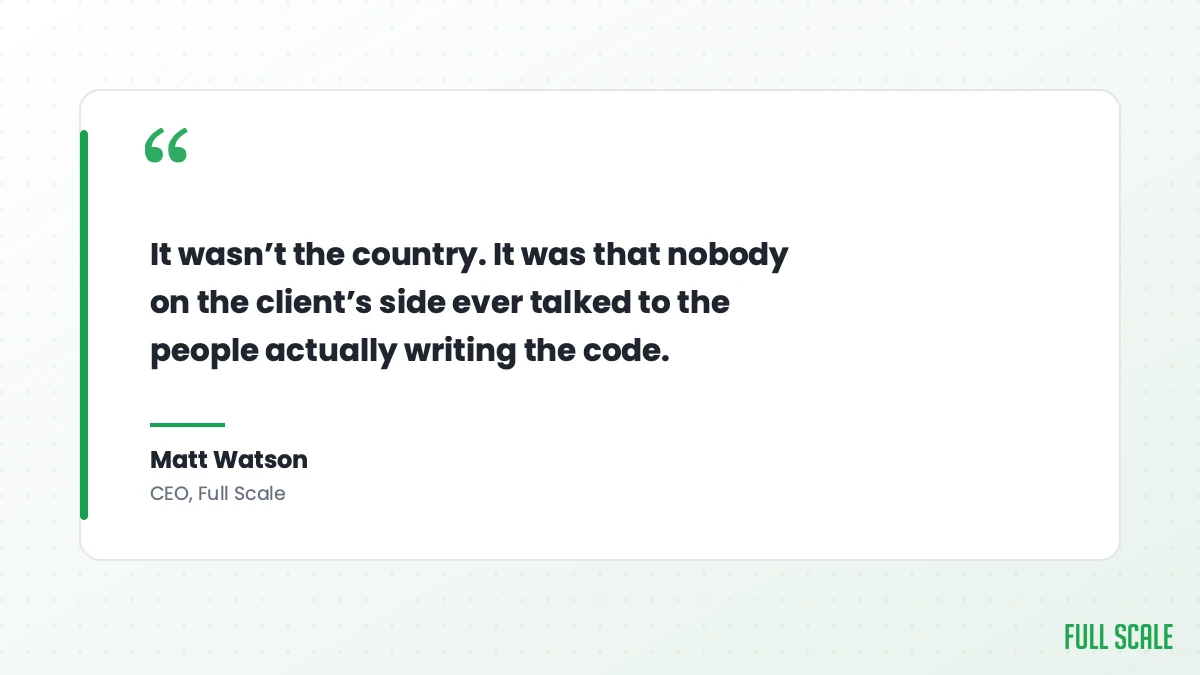
It wasn’t the country. It was that nobody on the client’s side ever talked to the people actually writing the code.
India is the obvious challenge to what I just said, and it deserves a real answer instead of a link-out. India has more developers and a more mature outsourcing industry than the Philippines will likely ever have, and if you need to staff 40 engineers next quarter, that scale is a genuine advantage the Philippines can’t match. I still don’t pick India first, for the same reason offshore engagements fail everywhere: offers get accepted and then quietly walked back, a manager sits between the client and the developer more often than not, and getting a straight answer out of a stand-up takes longer than it should. I’ve written the fuller version of that comparison here.
That’s the filter I run every hiring decision through now: can this person communicate well enough to push back on a bad spec, or will they just build whatever they’re told and hope it’s right? Cost comes after that question, never before it.
There’s No Language Barrier, and That’s Rarer Than It Sounds
Communicating well starts with a shared language, and this is where the Philippines wins before the conversation even gets started. It’s the third-largest English-speaking country on earth. On the EF English Proficiency Index, only one country in Asia scores higher, and the gap to the worldwide average is a full tier, not a rounding error. That’s the difference between a stand-up meeting and a translation exercise.
Quick facts that matter more than they look:
- English is a co-official language, taught from grade school, used in higher education
- Filipino engineers spend their whole childhood around American film, music, and television, so a reference lands the first time instead of after an explanation
- There’s no delay while someone mentally translates before answering, and no re-explaining a request three different ways to get a straight answer
I’ve hired developers who were technically strong but couldn’t tell me, in a stand-up, that the spec I wrote didn’t make sense. That gap costs more than a slower typist ever will.
The Culture Actually Matches
Cultural fit gets thrown around as a soft, hand-wavy reason. In practice it’s the most concrete one on this list. SOTA Cloud, a Full Scale client building FDA-cleared dental imaging software, put it better than I can:
“The Philippines is great because the cultural similarity between folks in the United States and the Philippines is very strong relative to other regions that we could be getting talent from.” (Dustin Johnson, Co-Founder and CTO, SOTA Cloud)
That similarity shows up in small, unglamorous ways. Developers admit they’re stuck instead of quietly missing a deadline. They ask a clarifying question in the group channel instead of guessing, and they treat “the client’s Slack” as their Slack, not a foreign system they’re renting access to. None of it shows up on a resume, and all of it is the actual job. It’s the same personality that makes Filipinos good at hospitality work, aimed at a keyboard instead of a front desk.
Why This Still Matters in the AI Era
The old offshore model was a hand-off: you write requirements, the team builds exactly what you described, and they hand it back. A prompt can do that job now, so if that’s still the whole job, an offshore team isn’t buying you anything.
| Old offshore model | What actually works now |
|---|---|
| Hand off a spec, wait for the build | A team that questions the spec before building it |
| One “technical PM” filters every conversation | Direct access to the engineers doing the work |
| Success = it matches the ticket | Success = it’s the right ticket in the first place |
The honest counter to my English-fluency argument above is that AI translation is closing the raw language gap for other countries faster than most people expect. Fair. But translation software can hand someone the right words. It can’t hand them the instinct to speak up when a spec is wrong, or the standing to do that inside a culture that trained them not to. What AI can’t replace is a developer who cares about the outcome the customer actually wanted, not just whether the code compiles against the ticket. That’s a communication skill and a service mindset dressed up as an engineering one, and it’s exactly where Filipino engineers, coming out of a culture built around hospitality work, tend to be strongest.
That’s the entire argument of my book, Product Driven: stop grading engineers on whether they matched the ticket and start grading them on whether the customer actually got what they needed.
The Training Pipeline Is Bigger Than Most People Realize
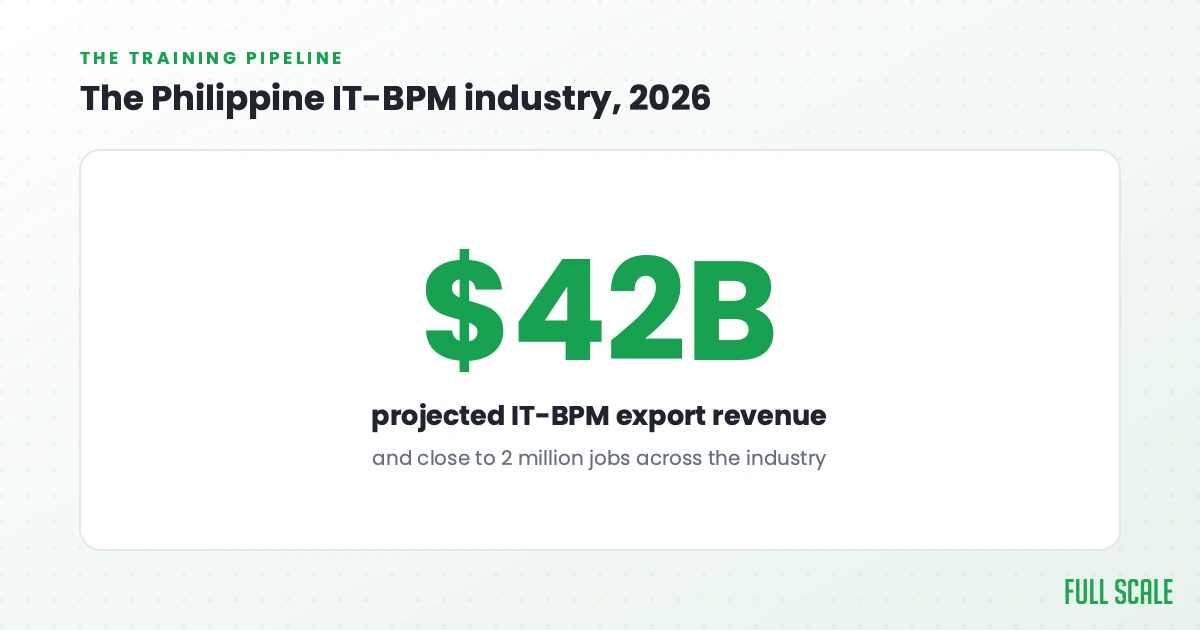
None of this happens without a deep bench behind it. The Philippine IT-BPM industry is on track for $42 billion in export revenue and close to 2 million jobs in 2026, and while most of that is call centers and back-office work rather than software specifically, it’s two decades of universities and training programs built around the same broader industry. Software engineering has grown up right alongside it, which means the pipeline of junior engineers coming up behind the senior ones is deep and gets refilled every year.
I notice it in interviews more than in resumes. Candidates who came up inside that pipeline tend to have already worked with a US or European client by the time I talk to them, which means the culture-and-communication fit I care about most has usually already been tested by somebody else before it gets tested by me. We score that explicitly rather than hoping to notice it, which is the point of our interview process.
The Cost Math Works, But It’s Not Why I Picked the Philippines
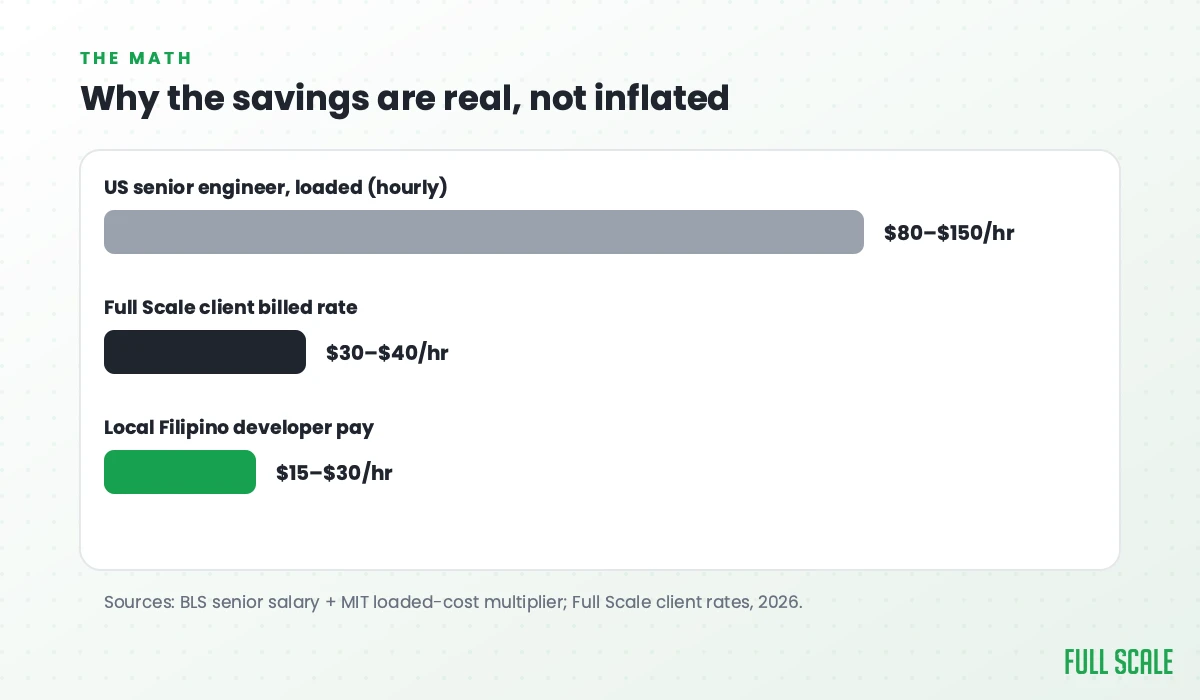
Full Scale’s rates start at $35 an hour, fully loaded. A senior US engineer costs a company somewhere between $80 and $150 an hour once you count benefits, taxes, and overhead. That gap is real, and it’s typically 50 to 70 percent in savings, not the inflated 80-percent-plus numbers you’ll see on someone’s landing page.
| Local developer pay | Client billed rate | |
|---|---|---|
| Philippines | $15 to $30/hr | $30 to $40/hr |
| United States | $80 to $150/hr (loaded) | Same |
That gap exists because of cost of living, not because the developer is worth less. Everyone wants the $15-an-hour miracle hire who ships like they cost $150 an hour. I want one too. I’ve never met one, in any country, at any price.
Hiring purely on the lowest number is a mistake specific enough that I gave it a name: cheapshoring. Chase the rate and ignore everything else here, and you’ll get exactly what you paid for: a developer you have to replace in four months.
What 700 Hires Actually Taught Me
The pattern that shows up over and over: the hires that work out are the ones where, within a month, new teammates stop introducing them as “the offshore developer” and just start using their name. The ones that fail almost always trace back to a structure, not a person: too many layers between the client and the engineer, or nobody on the client’s side actually accountable for the outcome.
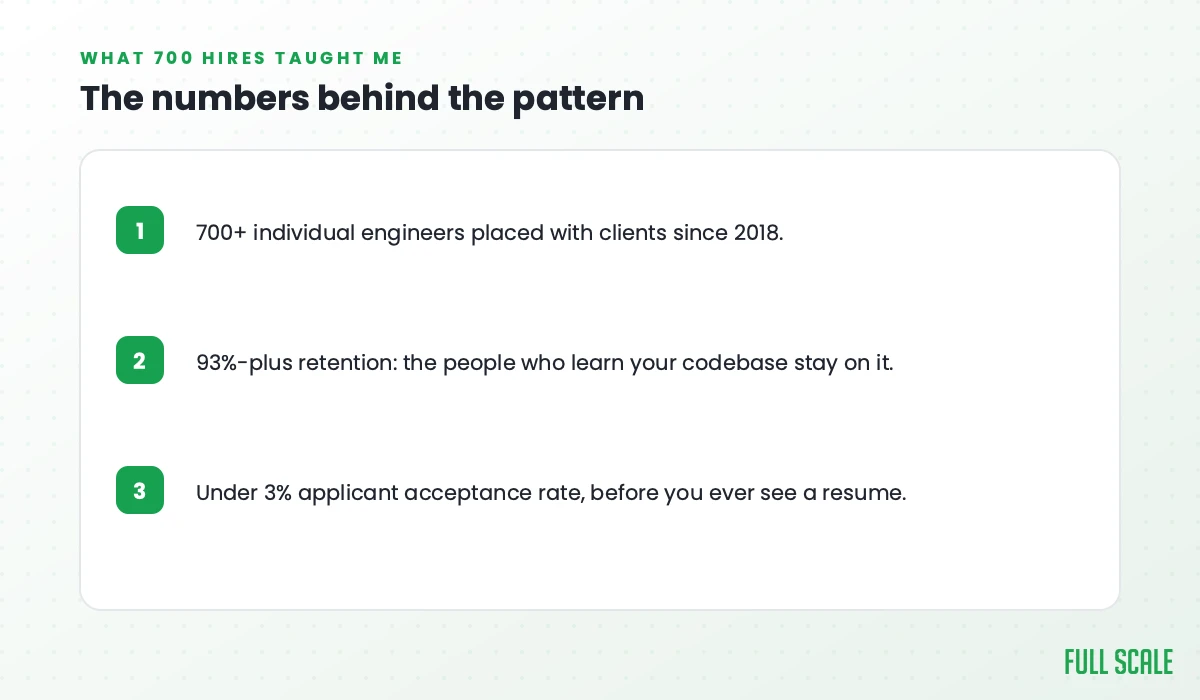
The single most common shape across those 700 placements: a senior .NET engineer slotting into an existing US product team. The extremes tell the same story. The shortest engagements we have run ended inside the first two weeks, which is exactly why the money-back guarantee exists, and the longest have been with the same client for more than six years.
Dustin Johnson’s team has felt the difference directly:
“The capability of the folks that Full Scale has brought to our team has been phenomenal. The Full Scale team has staffed us with top performers in our company, even relative to some of the folks that we have here in the US.” (Dustin Johnson, Co-Founder and CTO, SOTA Cloud)
That’s the bar. Full Scale’s retention rate sits at 93%-plus, and our own acceptance rate for candidates is under 3%. Both numbers exist because of everything above, not instead of it.
If you want the fuller country-by-country version of how I got here, including India, Russia, and Latin America, I’ve written that up in my honest case for offshore developers. If retention is the part you’re worried about, I go deeper on retention here.
Frequently asked questions
How much does it cost to hire a developer in the Philippines?
Full Scale’s rates start at $35 an hour, fully loaded. Local Filipino developer pay typically runs $15 to $30 an hour, and the billed rate to a US client is usually $30 to $40 an hour once a vendor is involved. Compared to a US senior engineer at $80 to $150 an hour loaded, that’s a savings of roughly 50 to 70 percent.
Is it hard to communicate with developers in the Philippines?
No. The Philippines is the third-largest English-speaking country in the world and ranks second in Asia on the EF English Proficiency Index. English is taught from grade school on, and American film and TV are part of everyday life there, so there’s no language barrier and no back-and-forth to get to a clear answer on client calls.
What’s the best way to hire developers in the Philippines?
Staff augmentation, where developers join your team directly and work in your standups and your codebase, beats project outsourcing for anything that isn’t a tightly scoped, one-time SOW project. A vendor with a less than 3% acceptance rate and a 93%-plus retention rate, like Full Scale, has already done the filtering work before you ever see a resume.
Do Filipino developers work US business hours?
Most engagements run on a shifted schedule: the Philippine side pushes into its evening so a real-time window opens up with the US day, typically 3 to 4 hours and more if the schedule shifts further. Full US-hours coverage is available for roles that need it, but most teams find that window is plenty.
Can you hire developers in the Philippines from the UK, Canada, or Europe?
Yes. The engagement is remote by design, so the only real constraint is time-zone overlap. The Philippine side shifts into its evening to open a real-time window with your business day, and that works as well for London or Toronto as it does for the US. Full Scale is headquartered in the US and most of our clients are US companies, but we place engineers with teams anywhere the overlap window works.
I’ve hired in four countries and run the company that came out of doing it in the Philippines. If you want to see whether that same math works for your team, let’s talk.