
Hire Offshore Developers Directly or Through a Partner: How to Decide

In this article
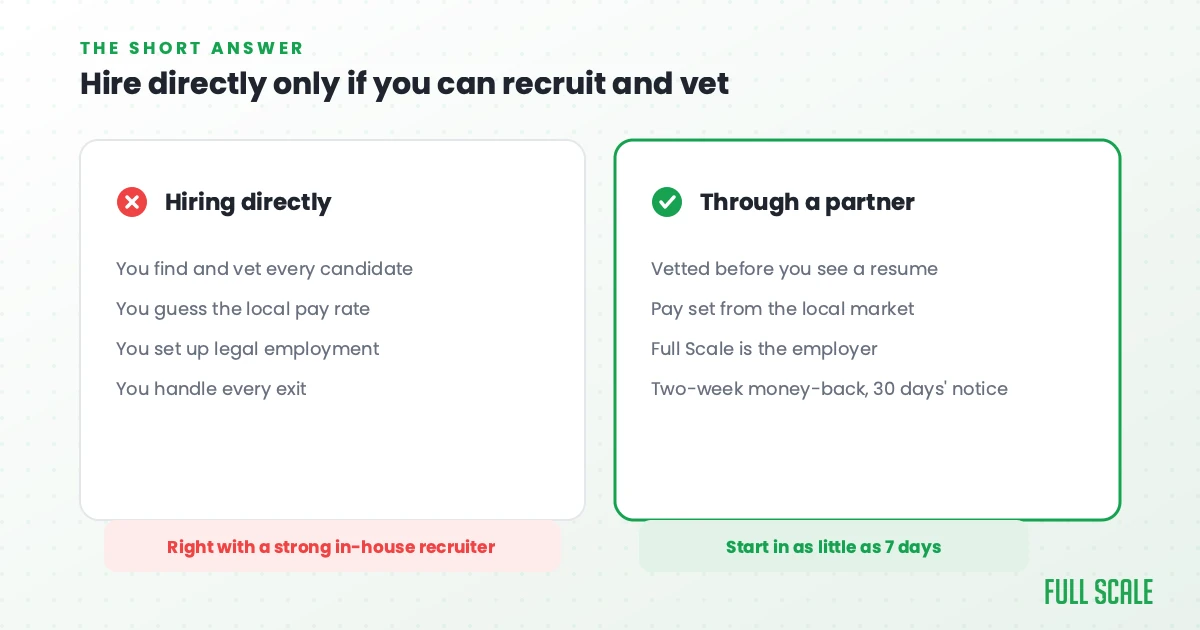
Quick Answer: Hire offshore developers directly only if someone on your team is already good at recruiting and vetting, and you have a legal way to employ people in the Philippines. Without both, companies tend to overpay for the local market and still hire weaker developers. A staffing partner such as Full Scale can cost less in total, even after the 30 to 50 percent overhead that IT staffing firms typically charge.
What I see when companies go direct is the same pattern over and over. They pay well above the local market, and they still end up with weaker developers than a partner would have found for them.
Going through a staffing firm costs more on paper, since overhead for IT staffing typically runs 30 to 50 percent. What that overhead buys, and what going direct leaves you paying for, is the rest of this post. I haven't put a single total on it, because the answer depends on the situation you're in.
Yes, the guy who runs Full Scale, a staffing company, is telling you to consider a staffing company. Fair. I'll cover when you should skip us, too.
What it takes to hire offshore developers directly
When you hire directly, you take over every job a partner would otherwise do. That means finding candidates, telling the good ones from the polished ones, setting pay, employing them legally, keeping them, and letting some go without a lawsuit.
The table shows which of those jobs land on you if you hire directly and which ones Full Scale handles.
| Job | Hiring directly | Through Full Scale |
|---|---|---|
| Finding candidates | You source, post, and screen | Full Scale recruits and vets before you see a resume |
| Setting pay | You guess, or you pay someone for a salary study | Full Scale sets pay from the local market |
| Employing them | You need your own entity or an employer of record | Full Scale is the employer |
| Benefits and local labor law | Yours to get right | Full Scale handles it |
| Keeping them | Your problem | Full Scale's retention is 93%+ |
| Starting | Weeks to months | As little as 7 days |
| Shrinking the team | Depends on the contract you wrote | Two-week money-back, then 30 days' notice, no long-term contract |
The time cost alone is real. Workable's data puts the global average for filling a tech role at 62 days. If you hand the search to a local recruiter instead, expect a placement fee. Eddy cites 15 to 25 percent of first-year salary, and in my experience it's 20 to 25 percent, higher for senior people.
Then there's the other side of hiring. When a developer leaves, SHRM puts the cost to replace them at 50 to 200 percent of their annual salary.
Why direct hires overpay and still hire weaker developers
Companies that hire directly in the Philippines tend to overpay for the local market, and then they hire below-average people on top of it.
The overpay comes from not understanding local salaries. A developer in the Philippines earns roughly $15 to 30 an hour locally, and the developers we place earn $20 to 30. If you price a Manila hire off a US salary band, you are off by a wide margin before the first interview. The post on what developers earn there has the full breakdown.
Because the local market tops out around $30 an hour, even a $40 offer is already above it, and you haven't paid for recruiting, payroll taxes or benefits yet. For comparison, Full Scale's rate starts at $35 an hour, fully loaded.
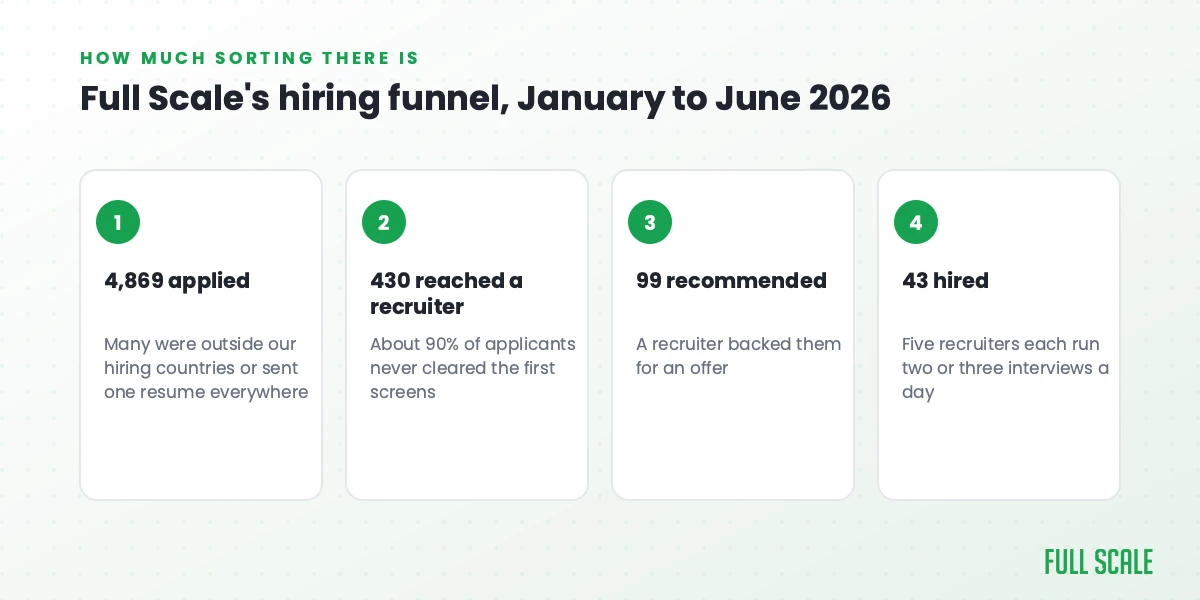
The weaker hires come from vetting, which is a skill that takes volume to build. About 90 percent of the people who apply to Full Scale never get past the first screens, and plenty of those are people outside the countries we hire from or the same résumé sent to every company online, so don't read the numbers below as a pass rate. They show how much sorting there is.
| Stage | People |
|---|---|
| Applied to Full Scale | 4,869 |
| Spoke with a recruiter | 430 |
| Recommended to hire | 99 |
| Hired | 43 |
That is Full Scale's funnel from January through June 2026. Most of our hires come from outbound sourcing, where we go find people who weren't applying anywhere, and five of our recruiters each run two or three interviews a day. You would be doing that part in the evenings, after your actual job.
A hiring manager who has never hired in the Philippines can't tell a strong candidate from one with a great English-language résumé, and a few mediocre hires later the pattern is set. I call picking the cheapest developer you can find cheapshoring, and the freelancer-marketplace version of this story is in that post. Overpaying for a weak hire is the same mistake in a more expensive suit, because in both cases the buyer can't tell what a good developer looks like or what one costs. Our guide on how to interview offshore developers covers what to test for if you're doing it yourself.
Employer of record or contractor: the legal fork
If you hire directly, you also have to choose how to employ people, and the two options are very different.
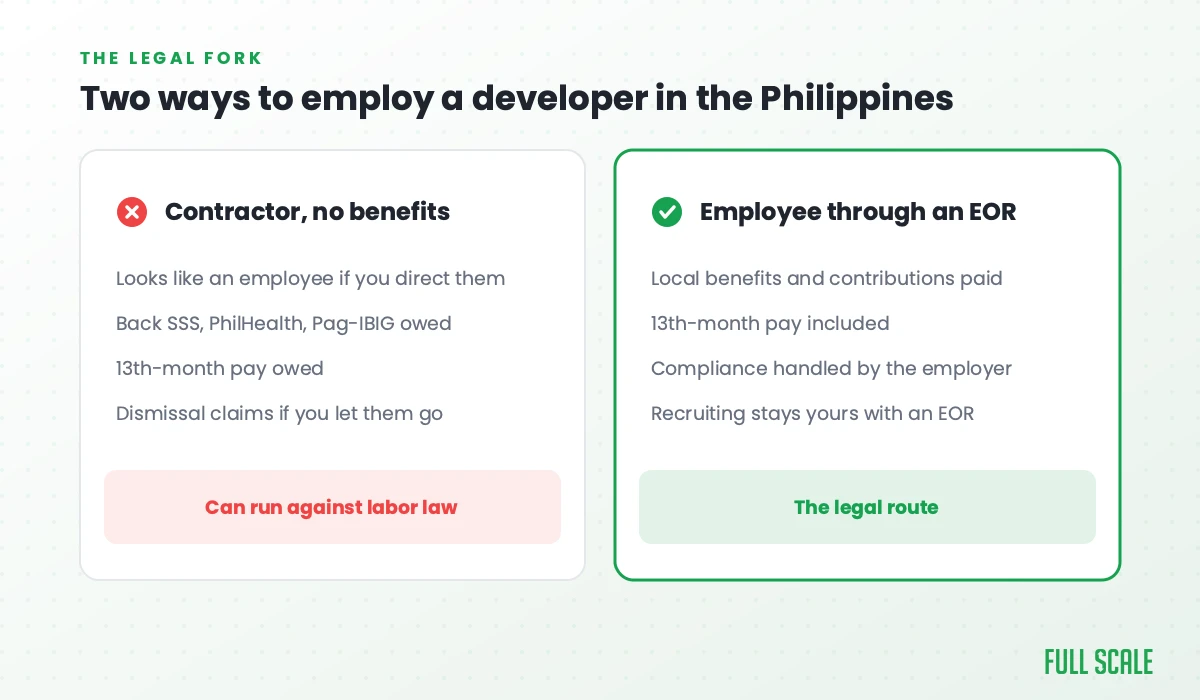
The first option is to hire them as employees, with local benefits, through an employer of record (EOR) or your own Philippine entity. That's the legal way to do it. You still do all the recruiting and vetting yourself, and the EOR only handles payroll and compliance. We compare the two routes in employer of record vs staffing agency and PEO vs EOR, and our post on legal requirements covers what Philippine law asks of you.
The second option is to hire a freelancer or independent contractor, pay them with no benefits, and skip the paperwork. Plenty of founders do this, and it can run against Philippine labor law. Philippine courts, according to GRATA International on Legal 500, look at how much you control the work, not at the label on the contract. A developer in your standups, on your tools, taking direction from you for a year looks like an employee, whatever the paperwork says.
If a court agrees, the same analysis lists the bill: unpaid contributions to SSS, PhilHealth and Pag-IBIG, the country's social security, health and housing funds. Add unpaid 13th-month pay, tax surcharges, and illegal dismissal claims if you let the person go. A contract that says "independent contractor" protects you about as well as a sign that says "gravity does not apply here." Our comparison of staff augmentation vs independent contractors goes deeper on the difference. This is general information, not legal advice.
With a partner like Full Scale, the contributions, the 13th-month pay and the dismissal risk don't land on you, because staff augmentation through Full Scale means we are the employer of nearly all the developers we place in the Philippines.
What a partner costs and what it buys
A firm charges for its overhead. For IT staffing, the markup is typically 30 to 50 percent over what the developer is paid. That is the price of the recruiting, vetting, employment and retention work listed in the first table.
What you get for it is a team you can grow and shrink without a contract fight. You can start in as little as 7 days. Walk away within the first two weeks and you get your money back. After that, 30 days' notice ends the engagement, and there's no long-term contract. When it isn't working out lays out those terms in full. A random freelancer you found on a job board comes with none of that.
You also get developers who stay. Full Scale's retention is 93 percent or better, which matters because replacing a developer costs 50 to 200 percent of their annual salary, according to SHRM.
A good partner also isn't a middleman. The developers we placed with AMC are treated as full AMC engineers, with no layer in between. That's the same idea behind my book Product Driven: engineers do their best work when they own the product, and that only happens when they're part of your team, however they got there.
When going direct is the right call
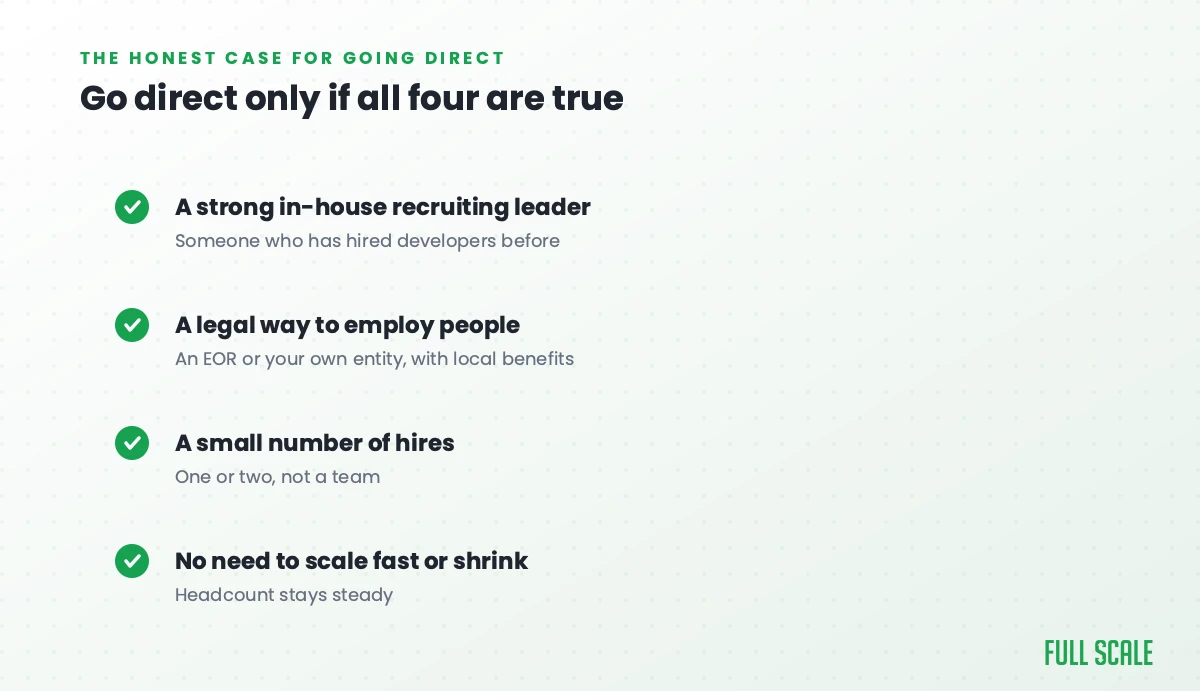
Going direct is the right call for a company that has all four of these:
- Real in-house leadership who are good at recruiting and vetting, someone who has hired developers before and knows what strong looks like
- A decision on how you'll employ people, which means an EOR or an entity, with local benefits
- A small number of hires rather than a team
- No expectation of scaling up fast or shrinking the team later
If that's you, you're paying for recruiting capacity you already own, and skipping the overhead makes sense. The trouble starts when one of those four things is missing and you go direct anyway.
How to decide
The choice usually works out like this for a team hiring in the Philippines, with Full Scale as the partner.
| Your situation | Best fit |
|---|---|
| Strong recruiting leader, an EOR in place, one or two hires | Hire directly |
| Nobody on your team has hired in the Philippines | A partner like Full Scale |
| You need to staff a team faster than one recruiter can vet | A partner like Full Scale |
| You might need to shrink the team within a year | A partner like Full Scale |
| You don't know what developers there earn | A partner, or a salary study first |
| You're planning to pay people as contractors, no benefits | Neither. Fix the plan first |
If two or more of those rows describe you, a short call with Full Scale is faster than a spreadsheet.
Frequently asked questions
Is it cheaper to hire offshore developers directly?
On the rate alone, yes, because you skip the partner's overhead. But the total is often higher. Direct hirers tend to overpay relative to local pay, and then they also carry the recruiting time or fee and the cost of every bad hire and departure. A fair comparison counts all of it.
Can I hire a developer in the Philippines as an independent contractor?
You can hire a genuine independent contractor for defined project work. A full-time developer who works under your direction can look like an employee in the eyes of Philippine courts, regardless of the contract. If a court reclassifies them, you can owe back social contributions, 13th-month pay and tax surcharges, so speak to a Philippine labor lawyer before relying on a contractor setup.
Do I need my own entity to hire developers in the Philippines?
No. You can use an employer of record, or a partner like Full Scale that employs nearly all of its developers directly. Your own entity brings incorporation, accounting and payroll work before you've hired anyone, which only makes sense at a larger scale.
How much does a staffing partner add to the cost?
For IT staffing, the typical markup across the industry runs about 30 to 50 percent over what the developer is paid. What you get in return is recruiting, vetting, employment, and the ability to scale a team up or down.
Can I hire directly and move to a partner later?
Yes. A team can start with a direct hire or two and bring in a partner when it needs to scale. The main thing to check is how those first developers are employed, so that a contractor setup doesn't turn into a back-pay problem you carry forward.