Hire Affordable Developers, Skip the Cheapshoring Trap

In this article
- What cheapshoring actually is
- What affordable developers actually cost
- The cheapest developer comes with the worst structure
- The cheap rate hides the real cost
- Why the savings are real
- More cheap developers won’t fix a broken team
- What actually makes offshore work: recruit, manage, retain
- Staff augmentation beats the project shop
- When cheap and fast is actually fine
- How to avoid the cheapshoring trap
- Frequently asked questions
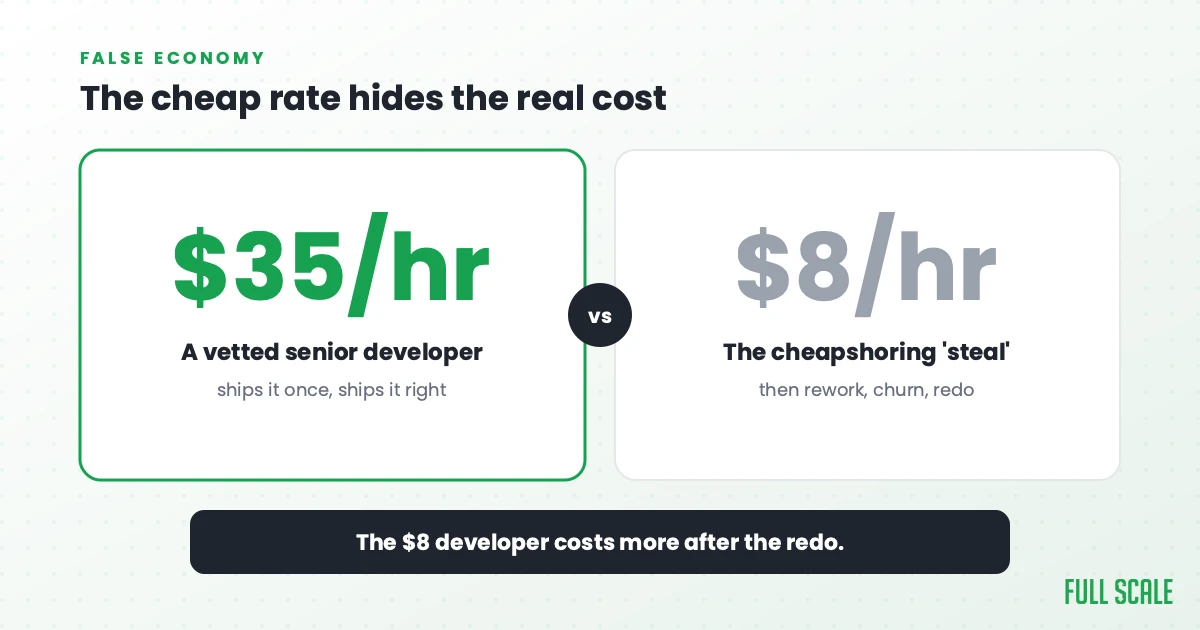
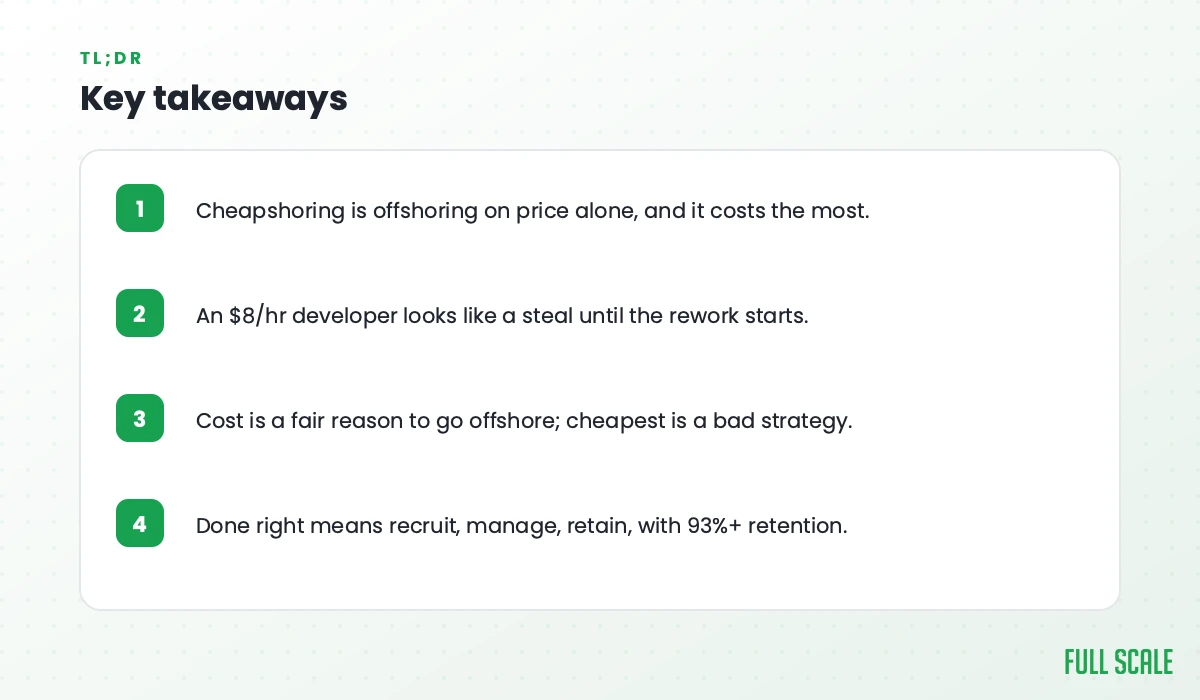
Quick Answer: Affordable developers means hiring top talent in a lower-cost market, not the cheapest person you can find. Hiring the cheapest possible developers is the mistake I call cheapshoring, and it costs more than it saves: at Full Scale we’ve watched an $8-an-hour “steal” turn into more expensive rework and churn than a vetted $35-an-hour developer would have cost from the start. Real savings come from cost of living, not from chasing the lowest bid.
Most companies that try offshore software development are chasing one thing: a lower bill. I get it. A senior engineer in the US runs you a small fortune, and the same skill set in another country can cost a fraction of that. The math is real, and it’s a perfectly good reason to look offshore in the first place. The trick is to actually reduce software development costs without cutting quality, which comes from hiring senior and managing the team yourself, not from buying the cheapest hour you can find. Cost pressure like this is one of the forces driving developer hiring trends in 2026.
If you’re looking for affordable developers, you should hire the best people you can find in a place with a lower cost of living. Not the cheapest people you can find. In the world. Most US companies never get to choose the best talent at all. Senior US engineers cost enough that a lot of teams end up hiring below-average talent in a market with a very high cost of living, because that’s what the budget actually stretches to cover. Nobody writes “we settled” in the job posting, but that’s what a lot of budget-constrained US hiring actually is. The Philippines flips that math. The same budget that buys a mediocre developer in the US buys a genuinely strong one there, because the cost of living is the variable that moved, not the skill level. That’s what makes hiring in the Philippines the affordable option done right. Cheapshoring is a different animal: it’s taking that same low-cost market and squeezing it further, hunting for the least expensive person you can find inside an already inexpensive place. That’s not affordable. That’s the trap.
But here’s the trap.
If cheap is the only reason you’re doing this, you’ll buy the cheapest thing you can find. That’s usually a project shop or a freelancer who disappears mid-sprint. And then you’ll join the long line of people who tried offshore once, got burned, and swore it off forever.
I call this cheapshoring.
It’s one of the most expensive mistakes I see companies make with global talent. I’ve spent more than 20 years building software, and I’ve personally hired developers in Russia, Belarus, Latin America, India, Pakistan, and the Philippines. Here’s what I’ve learned: what matters is what you get back for what you spend. The cheapest developer you can find, the one who barely ships or breaks more than they build and costs you days of cleanup, was never actually cheap. Cost only means something next to the value you get back. The deeper lesson is that communication decides whether offshore works, not the rate.
I’ve talked to a lot of founders who started exactly here. They pieced together cheap, talented help on Upwork, and for a while it got the job done. The risk on a marketplace is running into one of the scams that target people hiring on Upwork. What wore them down wasn’t only the flakiness. It was everything they had to handle themselves: writing the posts, sifting through proposals, interviewing one stranger after another, and starting over every time someone moved on. Eventually they stop looking for the cheapest freelancer and start looking for a partner, someone who finds the right people, does the vetting, and runs it so they don’t have to. That shift, from chasing a rate to wanting a team they can rely on, is what cheapshoring is really about. I mapped the fuller decision tree in alternatives for hiring developers, matched to the job you’re actually hiring for.
What cheapshoring actually is
Cheapshoring is offshore development where price is the only thing you optimize for. You sort the options by hourly rate, pick the bottom of the list, and call it a strategy. You see the same mistake when companies treat leasing offshore staff as the cheapest seat they can rent. Chasing the cheapest city is the same trap: where you hire in the Philippines should follow the talent, not the lowest rate.
It feels smart in a spreadsheet. A developer at $8 an hour looks like a steal next to one at $35. So you hire the $8 developer, or the agency promising a finished app for a flat fee that seems too good to be true.
It usually is too good to be true.
The cheap developer usually isn’t dumb. There are smart people all over the world, and most software developers don’t even live in the US. The trouble is that the lowest price tends to come attached to the worst structure: no real vetting, no management, no accountability, and nobody who cares whether your product succeeds after the invoice clears. What that price actually buys is a transaction, and a transaction walks away the second something better comes along.
What affordable developers actually cost
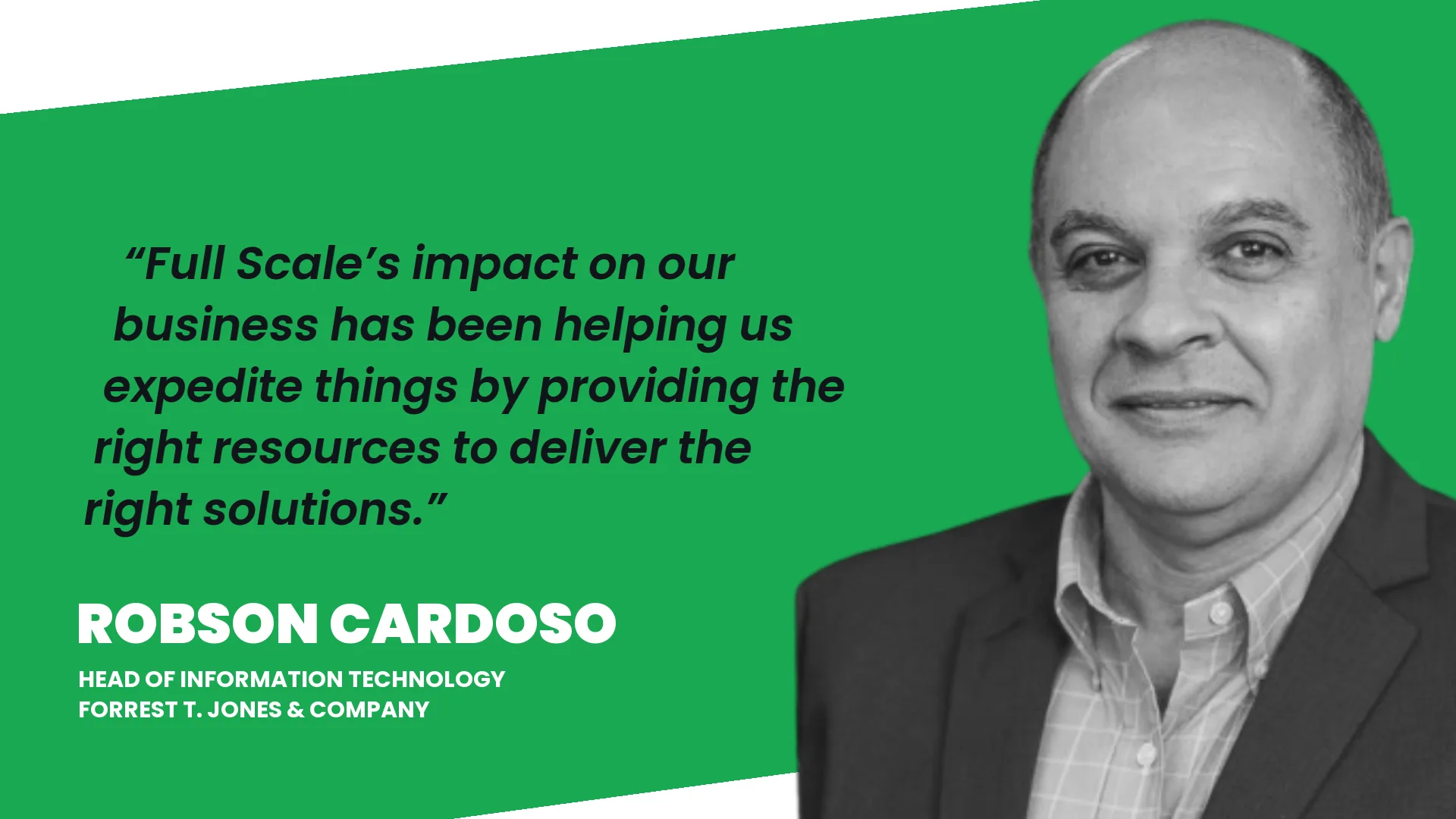
Here’s what affordable actually looks like in dollars: senior talent in the Philippines running $15 to $30 an hour, against Full Scale’s fully-loaded rate starting at $35, next to a US senior hire that runs closer to $200,000 a year once you add benefits and taxes. That’s where the 50 to 70% savings most companies see comes from. What that number doesn’t tell you is whether the developer on the other end of it is any good.
That’s the part that actually separates affordable from cheap. Full Scale hired 43 developers out of 4,869 applicants this year, fewer than 1%. You’re not paying less for a worse developer. You’re paying less because the cost of living is lower where we recruit, and the same bar our own team would set in the US is the bar every one of those 43 had to clear.
This holds across the stack, not just for generalist engineers. Affordable web developers, affordable app developers, backend engineers, QA, and DevOps all price the same way: Philippines-based, fully vetted, starting around $35 an hour, across React, Node.js, .NET, Java, PHP, iOS, and Android. A new hire can start in as little as seven days if the right person is already on the bench. That’s the version of affordable worth chasing. Cheapshoring is what happens when you skip the vetting and go straight for the lowest number, like grabbing the cheapest parachute and hoping gravity’s having a slow day.
The cheapest developer comes with the worst structure
When you shop on price alone, you end up in one of two places, and both of them tend to fail.
The first is the freelancer marketplace. You can find a developer for almost nothing, and sometimes you get lucky. More often you get someone juggling six clients, who takes your deposit, ships half of what you asked for, and goes quiet right when you need them most. There’s no one to escalate to and no bench to pull from. When they go dark halfway through, your project goes with them. If that’s the road you’re on, I wrote about choosing between Toptal and Upwork when you go the marketplace route.
The second is the project shop, the kind of agency that takes a pile of requirements, disappears for three months, and hands back something that isn’t what you wanted. I’ve watched this happen to founders over and over. Most offshore collaboration fails because people simply hand a bunch of requirements over to an outsourcing firm and expect to get back a successful product. Software doesn’t work that way. It’s built through constant communication, and a cheap project shop is built to avoid exactly that.
There’s a specific version of this I’ve seen again and again. You hire an overseas firm and you only ever talk to one person, the technical project manager. Every other developer hides behind that person. Sometimes it’s a language gap, sometimes a cultural rule about who’s allowed to talk to the client. Either way, you end up with a team you can’t actually communicate with, and a middleman in the way of every decision. That’s not a team. That’s a wall with a phone number.
The cheap rate hides the real cost
The reason cheapshoring burns people is that the sticker price was never the actual cost.
Say you save $20 an hour by hiring the cheapest developer you can find. If that developer ships code you have to throw away, misses the point of the feature, or quits after two months, you didn’t save anything. You paid for the work twice, and you lost the calendar time in between. For most companies, the lost time hurts more than the wasted money. While you’re re-hiring and re-explaining the project, your competitor ships the feature you decided not to build. The judgment you skip includes knowing how risky a given change really is, which is one of the first things cheap help gets wrong.
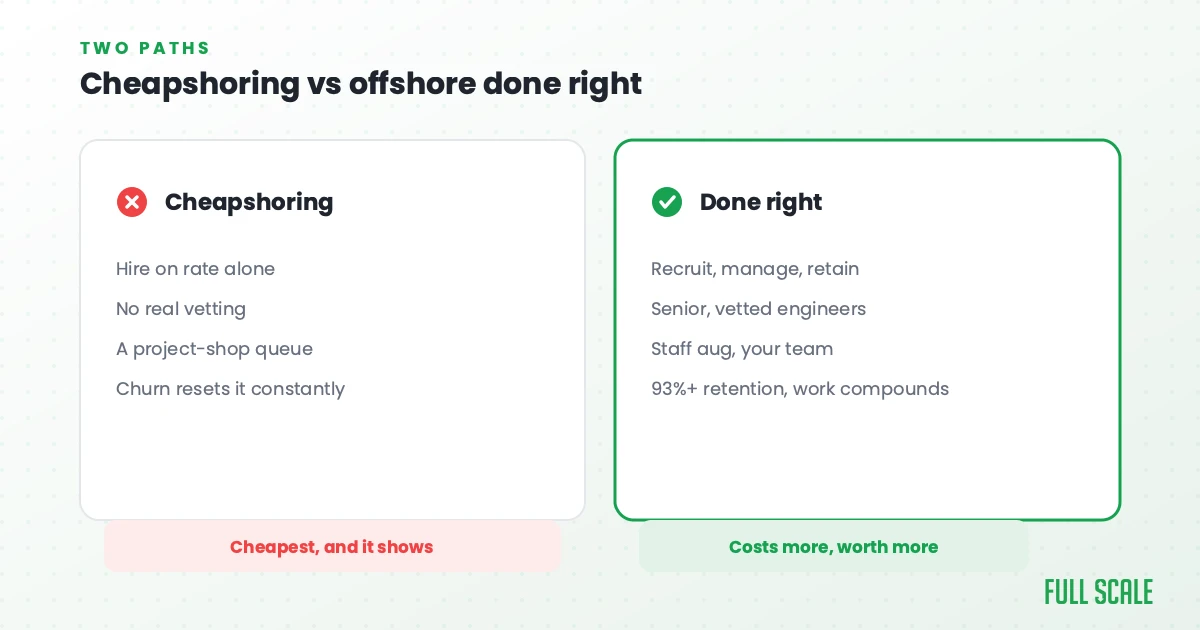
Turnover is the quiet killer here. The cheapest shops run on the highest turnover. To put a number on it, voluntary attrition in the Philippine call-center and business process outsourcing (BPO) industry hit 31% in 2022 and has historically run far higher. At Full Scale, our developer retention runs over 93% year over year, and that’s exactly the difference cheapshoring can’t buy. When your developers leave every few months, you never build the institutional knowledge that makes a team fast. Every new person starts from zero. You’re paying a low rate for a team that’s permanently junior to your product, no matter how senior the resumes look. Software developer turnover like that is not a coincidence. It is the business model.
None of that is on the invoice. You pay it later anyway. Once you've made that math work out, a vendor transition plan that overlaps the old team with the new one is what keeps the fix from costing as much as the original mistake.
Why the savings are real
I want to be clear about something, because it’s easy to read this as “offshore is a scam.” It isn’t. I built Full Scale on offshore developers, and we have more than 80 active clients today.
Hiring globally to save money is completely legitimate. The rate gap is real, and it’s worth understanding why it exists. A developer in the Philippines earns $15 to $30 an hour depending on experience, and that’s a great living there. The reason companies hire globally isn’t talent scarcity, it’s cost of living. A good salary in Manila and a good salary in Manhattan are just very different numbers, and that gap reflects where someone lives rather than how good the work is.
Compare that to the US. The Bureau of Labor Statistics puts the median US software developer salary at about $133,000 a year, with senior engineers landing well above that. Once you add benefits, payroll taxes, equipment, and recruiting, the fully loaded cost of an employee runs 1.25 to 1.4 times base salary. For a senior US developer, that’s roughly $200,000 a year, all in. So yes, the savings are huge. That gap only holds if the vendor actually passes it through, and not every nearshore staffing platform does. Some price senior and specialist roles close enough to that same US number that the savings disappear, which is the exact trap I break down in our nearshore rates guide.
Saving money is fine. The trap is letting the savings make every other decision for you. Cost matters, but only next to value. What you really want to know is what you get for what you spend, and a team that costs a bit more and ships reliably will beat a bargain team that stalls your roadmap.
More cheap developers won’t fix a broken team
Cheapshoring has a second form too. You hire a pile of cheap developers and assume that gives you a team.
A friend of mine has 16 software developers in Pakistan. He calls me all the time, frustrated, because something is clearly wrong with the team and he can’t figure out what. Every time, I tell him the same thing. The developers aren’t the problem. He poured everything into hiring them and nothing into what has to surround them: engineering leadership, project management, a product team, QA. He assumed the answer was the largest number of affordable bodies he could put on the work. Engineering doesn’t run on bodies.
Sixteen developers with no one setting the technical direction, no one deciding what to build, and no one owning quality are just sixteen people guessing. Adding a seventeenth won’t fix it. The offshore teams that actually succeed are the ones with real leadership wrapped around the developers, instead of just piling on more of them.
So I gave him blunt advice: cut the team in half and use the savings to bring in a fractional CTO or an engineering leader who can actually run it. Eight developers with real leadership will outbuild sixteen without it, which is really just the readiness test I use for every offshore hire. The cheap-bodies instinct feels like progress because the headcount keeps climbing. The product of their work is what tells you it isn’t working.
What actually makes offshore work: recruit, manage, retain
Here’s what I learned the hard way, building teams across four countries at my last company, Stackify, before any of it became Full Scale. The companies that win with offshore are the ones working with a partner that knows how to do three unglamorous things well: recruit the right people, manage them like real teammates, and keep them around.
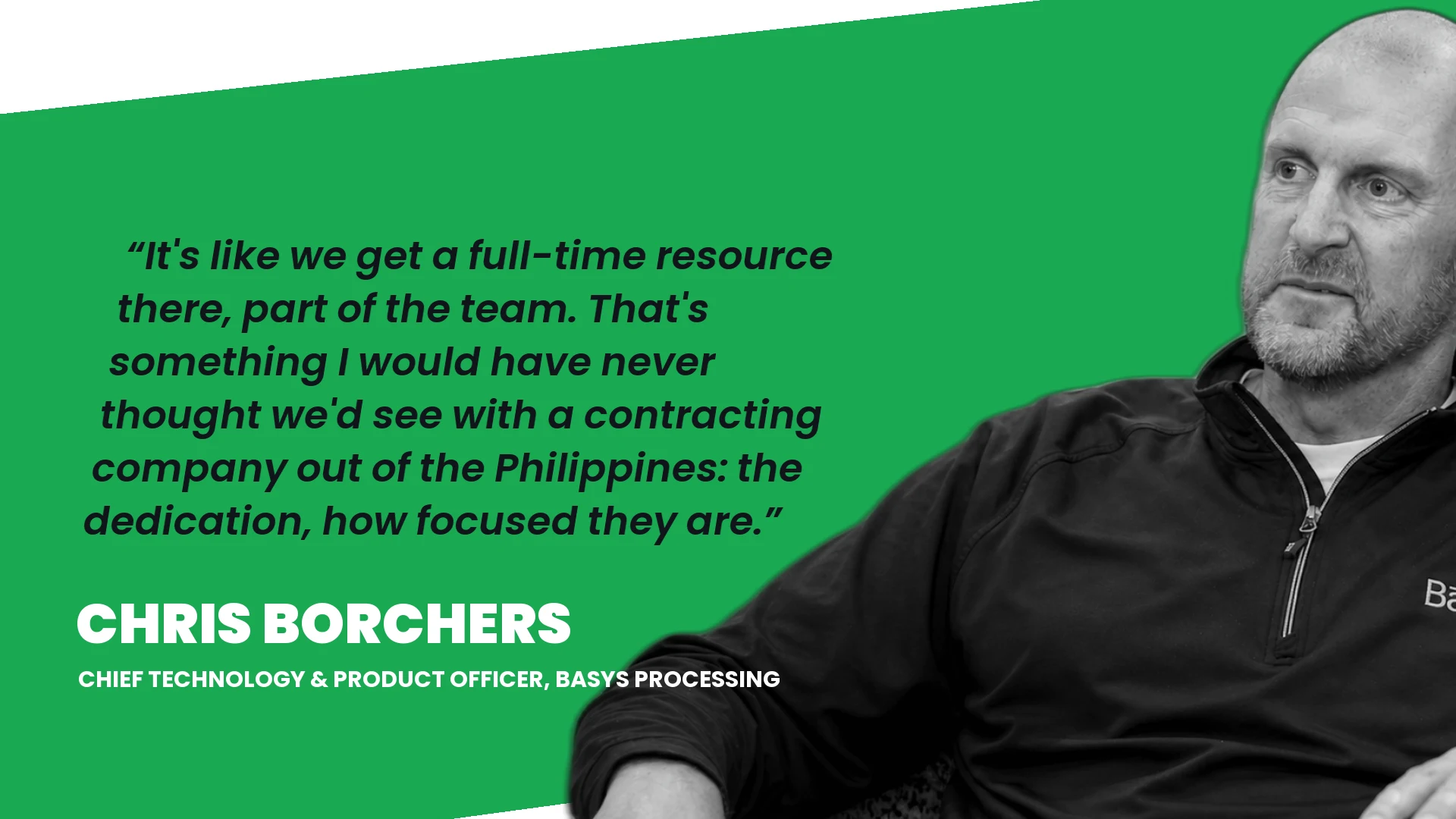
Recruiting is the part the cheap option skips entirely. Finding a developer who is both technically strong and a genuinely good communicator is hard work. I’ve made the fuller case for why hire developers in the Philippines specifically, cost aside, elsewhere. English fluency matters, cultural fit matters, and whether someone will speak up when they don’t understand something or push back when the spec is wrong matters more than the rate on their invoice. A marketplace doesn’t filter for any of that. A real partner does, and it’s most of the job.
Managing is where a good offshore company earns its keep. At Full Scale, every engagement has a customer success manager whose job is to make sure the client gets what they actually want, and to make sure the engineers are happy and supported. They have the hard conversations behind the scenes that a client can’t easily have with an offshore engineer, and that the engineer can’t easily raise with the client. They’re the relief valve that keeps the relationship healthy.
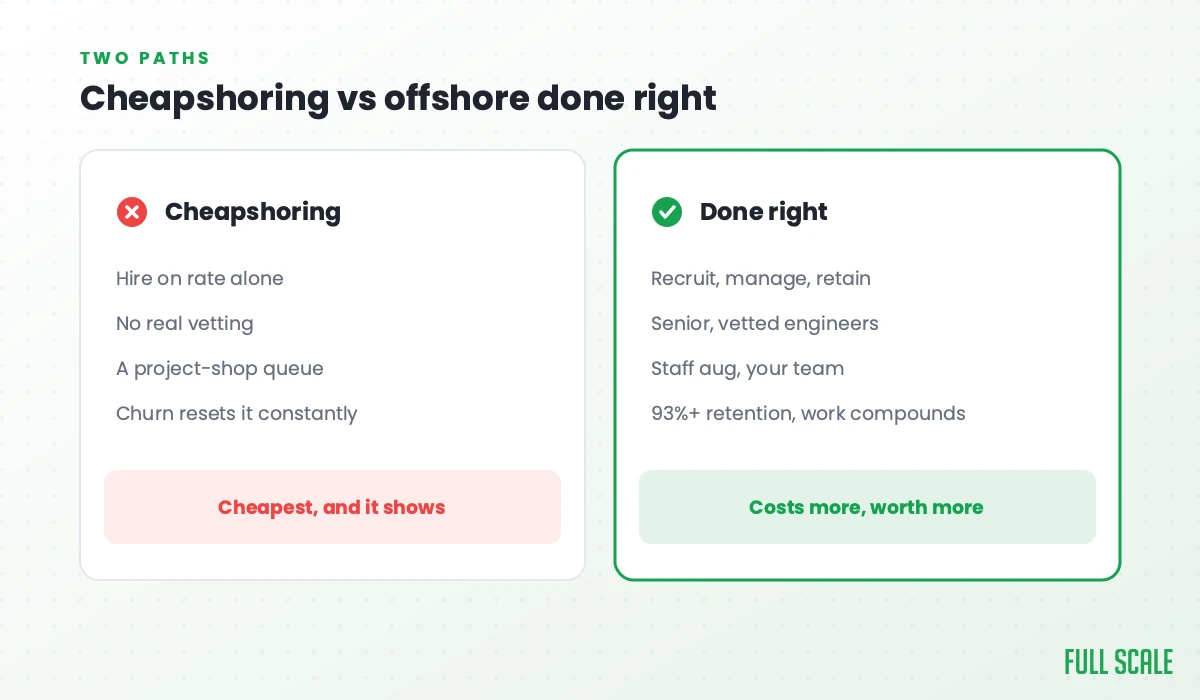
Retaining is what cheap can never buy. Our developer retention is over 93%, and we’re Great Place to Work Certified in the Philippines two years running, with 95% of our employees saying it’s a great place to work versus 65% at a typical company there. That isn’t a feel-good stat. A team that stays gets faster every month, because the knowledge compounds instead of walking out the door.
You don’t get any of that from the bottom of a price list.
Staff augmentation beats the project shop
The structure that makes offshore work is staff augmentation. The difference comes down to who the developers belong to.
In the cheapshoring model, you hire a vendor for a project, and the developers belong to the vendor. In the staff augmentation model, you hire dedicated developers who work directly on your team, on your Slack, in your standups, accountable to your product manager. There’s no middleman in between, and the developers care about the product the same way your in-house engineers do. That is what makes offshore actually work.
Plenty of vendors sell this exact setup as “software development as a service” now, which is a marketing relabel of the same thing. The tell that separates the honest version from a dedicated engineer or a shared pool is whether the vendor will name your specific engineer before you sign.
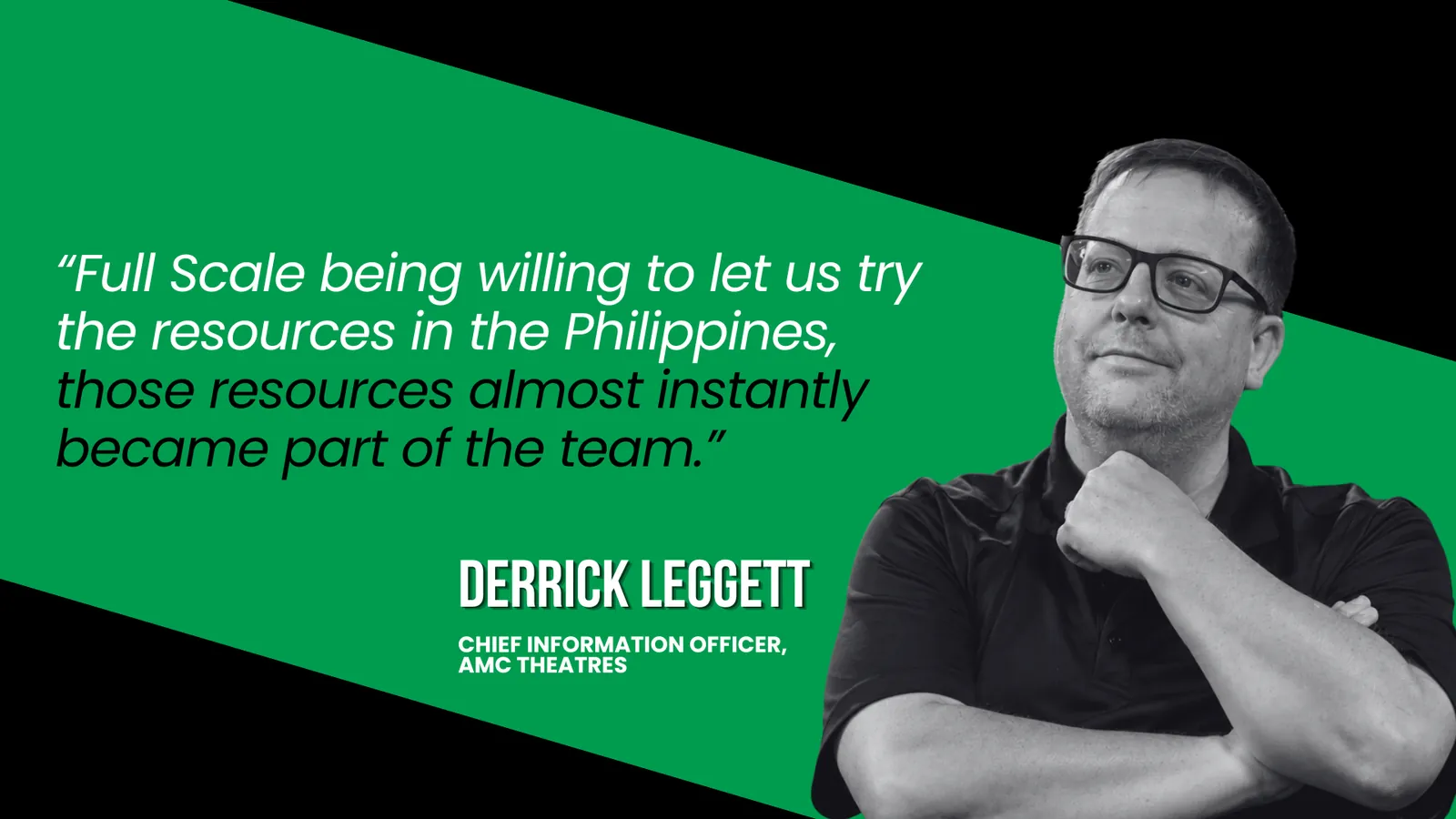
AMC Theatres is the best example I can point to. The developers we placed in the Philippines are treated as full AMC engineers, not contractors. As their CIO, Derrick Leggett, put it: “It’s a fully integrated team. It’s just some of the people happen to be living in the Philippines.” That’s the opposite of the wall-with-a-phone-number model. LendingStandard came to us the same way, after local hiring stalled, and built a team that became part of how they run.
When it works, it’s what I call a win-win-win. It’s a win for the developer, who gets a real opportunity. It’s a win for the client, who gets top engineering at a cost they can sustain. And that makes it a win for us. Aligned incentives are the whole game, and cheapshoring breaks them on day one.
When cheap and fast is actually fine
There’s one honest exception, because I’ve done this myself. Years ago I outsourced some WordPress builds and an Elasticsearch project to cheap, fast help, because they were small, well-defined, scoped projects I didn’t need to think about much. That’s a fine use of a freelancer or a fixed-price shop.
The line is simple. If the work is a one-time, scoped project with a clear deliverable and a clean handoff, cheap and fast can be the right call. Once you are past a scoped project and into building a software engineering team offshore, the calculation changes. If the work is your actual product, the thing you’ll be building and maintaining for years, buying a project instead of a team is one of the outsourcing mistakes that costs the most, and cheapshoring will cost you far more than it saves. Deciding to build a custom CRM instead of buying one is exactly that kind of decision. Most companies who get burned offshore made the mistake of treating their product like a scoped project. That mistake, run at massive scale for two decades, is half the story of why outsourcing to India earned its reputation.
How to avoid the cheapshoring trap
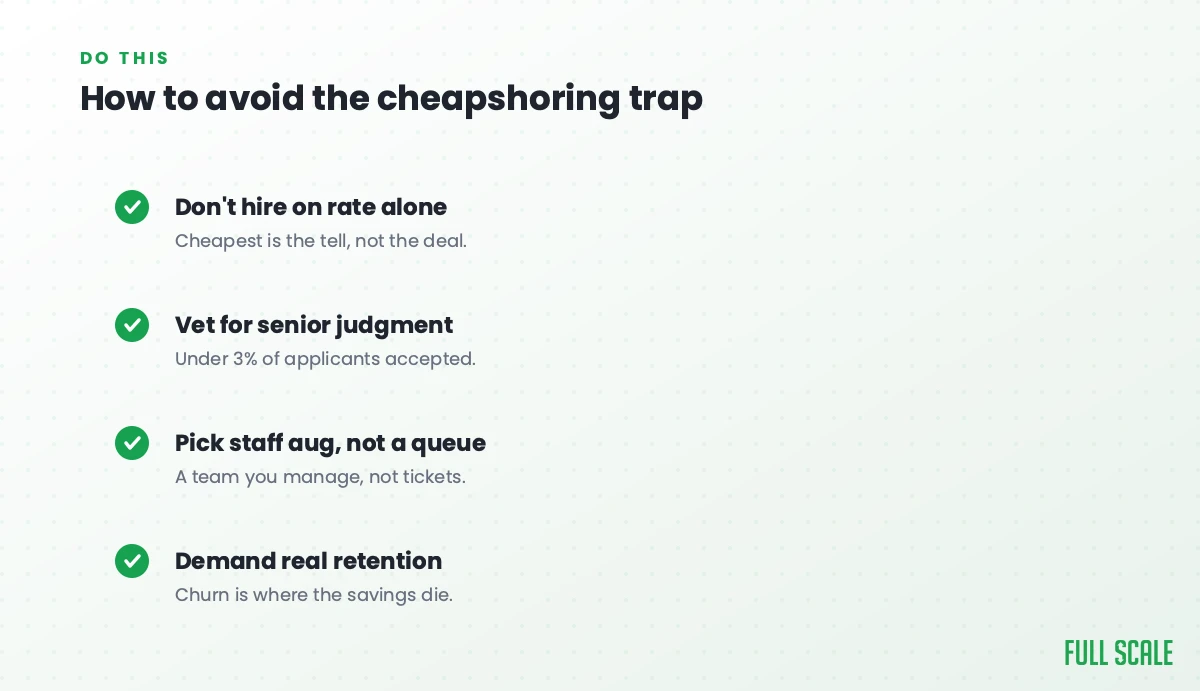
The fix is to change the order of your decision. Most companies pick the cheapest country first and hope communication works out. Flip it.
First, figure out which teams can actually communicate with yours. Software development is about communication more than anything else, so this is the filter that matters most. Then look at cost of living, which is where the real, sustainable savings come from. Let the country fall out of those two filters instead of driving the decision.
Practically, that means hiring a long-term team instead of buying a one-off project, and insisting you talk to the developers directly instead of through a middleman. Then ask any partner you’re considering how they recruit, how they manage the engagement, and what their retention actually is. If they can’t answer those three questions clearly, you’ve found a cheapshoring operation, and the low rate is the bait. This is the same thinking I wrote about in my book, Product Driven: the cheapest path and the right path are rarely the same one.
A low rate is fine on its own. The damage comes from chasing the low rate instead of the value you get back. Judge any developer or partner by what they actually deliver, build the team you’d want to keep, and the savings take care of themselves.
Cheapshoring is a choice, and so is building a team that lasts. If you want offshore developers who work like part of your own team, let’s talk about what you’re building.
Frequently asked questions
What is cheapshoring?
Cheapshoring is offshoring software development where the lowest hourly rate is the only thing you optimize for. Instead of weighing communication, vetting, management, and retention, you sort options by price and pick the bottom of the list. It usually leads to freelancers who disappear mid-sprint or project shops that hand back the wrong thing, which is why so many companies try offshore once, get burned, and swear it off.
Is offshore development cheaper because the developers are worse?
No. The rate gap is cost-of-living arbitrage rather than skill arbitrage. A developer in the Philippines can earn a great local living at $15 to $30 an hour, while the same skills in the US carry a far higher cost because the cost of living is far higher. There are strong developers in every region. What separates a good engagement from a bad one is communication and structure, regardless of how big the rate gap looks.
How much can you really save by hiring offshore developers?
Hiring global talent typically costs 50 to 70% less than US rates. A senior US developer runs roughly $200,000 a year all in, once you add benefits, taxes, and overhead to a base salary that the Bureau of Labor Statistics puts near $133,000. The savings are real, and you can see a fuller breakdown in our guide to staff augmentation cost. The mistake is letting the savings drive every other decision, which is what turns offshoring into cheapshoring.
What’s the difference between staff augmentation and a project shop?
In a project shop, you hand over requirements and the developers belong to the vendor, with a project manager standing between you and the people writing your code. In staff augmentation, you get dedicated developers who work directly on your team, in your standups and tools, accountable to your product manager. The staff augmentation model removes the middleman and aligns the developers with your product, which is why it tends to succeed where project shops fail. The newest disguise for this is agent-shoring, where the cheap option is an AI agent instead of a cheap freelancer and the trap is exactly the same.
How do I avoid getting burned by offshore development?
Hire a long-term, dedicated team instead of a one-off project, talk directly to the developers rather than through a middleman, and ask any partner how they recruit, manage, and retain their engineers. Filter for communication first, cost second, and let the country be the result. If a provider’s only real selling point is a rock-bottom rate, that’s the cheapshoring trap, and the low price is bait for a structure that will cost you more later. A real structure also means real terms, which for us is a two-week money-back guarantee rather than a promise to swap somebody out.
Can I hire affordable developers for a specific stack, like web or app development?
Yes. Affordable web developers, affordable app developers, and affordable backend or QA engineers are all sourced the same way: senior talent in the Philippines at a fully-loaded rate starting around $35/hr, instead of junior talent in the US at a much higher one. Full Scale staffs across React, Node.js, .NET, Java, PHP, iOS, and Android, so the stack changes but the math that makes it affordable doesn’t.