
Best Cities to Hire Developers in the Philippines: Cebu vs. Manila vs. Davao


In this article
- How the best cities to hire developers in the Philippines compare
- Manila: the biggest pool, and the most expensive one
- Cebu and Central Visayas: the balanced middle
- Davao and Mindanao: the value play
- The other hubs filling in the map
- The provinces: the option the lists never include
- The real answer: don’t pick the city first
- How we think about it at Full Scale
- Frequently asked questions
Quick Answer: The best cities to hire developers in the Philippines are Manila for the deepest specialist bench, Cebu for the best balance of talent and cost (about 14% cheaper to live in than Manila), and Davao for the lowest cost (about 22% cheaper). For a remote team, Full Scale hires across the whole country and screens for skill first, since the city mostly sets the salary.
If you have decided to hire developers in the Philippines, the next question everybody asks is where. Cebu, Manila, or Davao? Every list online will rank them for you. Manila is the biggest, Cebu is the balanced middle, Davao is the cheap up-and-comer, now pick one.
I have been building engineering teams in the Philippines for over a decade, and I will give you the honest city-by-city breakdown, with real numbers. The lists all stop at the ranking, though, and skip the thing that actually matters: the city is mostly the wrong thing to pick first. In a remote world, it matters a lot less than it looks.
How the best cities to hire developers in the Philippines compare
Here is the comparison you came for, using the 2024 census and current cost-of-living data instead of vibes.
| Metro Manila (urban area) | Cebu / Central Visayas | Davao / Mindanao | The provinces (everywhere else) | |
|---|---|---|---|---|
| Population (2024) | 24.2M | 6.6M (Metro Cebu 3.2M) | 5.4M (Davao City 1.85M) | ~76M (the other ~68% of the country) |
| Cost of living vs. Manila | Baseline (highest) | ~14% lower (rent ~39% lower) | ~22% lower | Lowest |
| Developer salary level | Highest: a good senior runs $2,000 to $3,500 a month | Middle | Lower | Lowest: 20 to 30% below Manila for the same role |
| Talent depth | Deepest, most specialized | Deep in tech and creative | Emerging, less competition | Dispersed, reachable only remotely |
| Traffic and congestion | Worst | Moderate | Lightest | Minimal |
| Best for | Niche specialists, enterprise | Balanced cost and strong talent | Cost-sensitive, growing teams | Remote-first teams, retention |
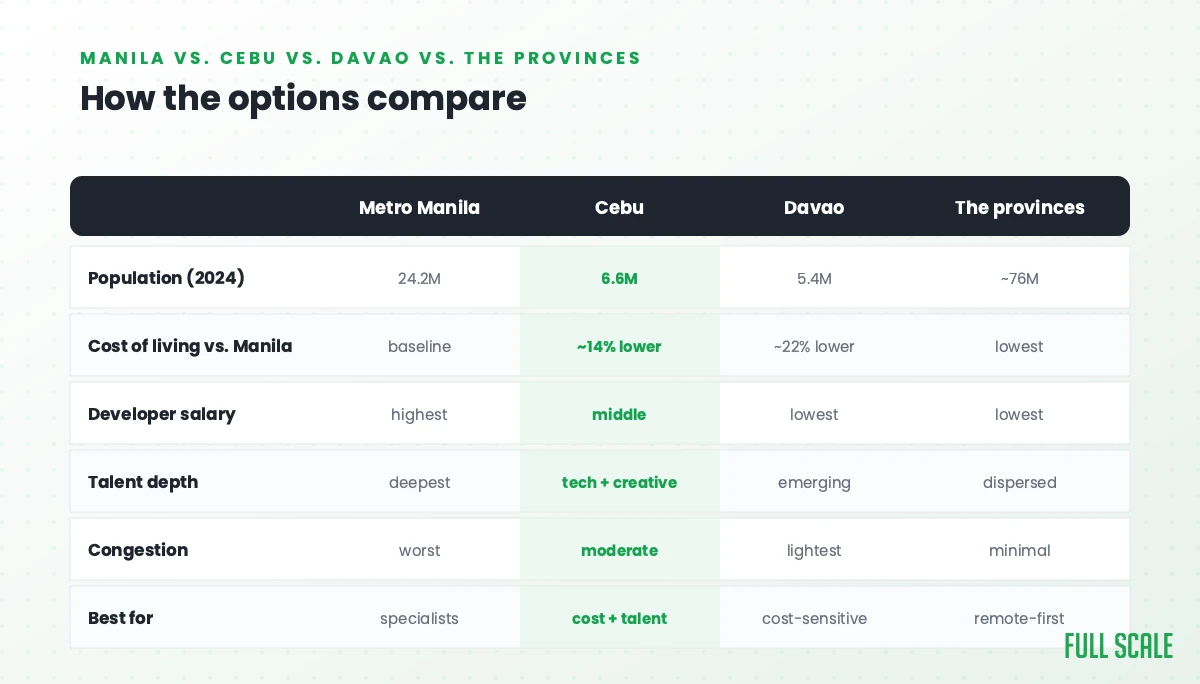
That table is the whole genre of “best cities” articles in one screen. The rest of this post is what the table leaves out.
Manila: the biggest pool, and the most expensive one
Manila is the capital, and once you count it the way people actually live in it instead of stopping at an administrative line, it holds close to 24.2 million people, one of the largest urban areas on Earth, in the same tier as Tokyo and Jakarta.
Here is how you get to that number. The National Capital Region on its own is 14 million people, about 12.4% of the entire country, per the 2024 census. But NCR stopped being a clean boundary years ago. The built-up city has physically spilled into Bulacan, Cavite, Laguna, and Rizal, so people commute, work, and get hired across that line every day without noticing it. Demographia’s World Urban Areas report counts that whole continuous built-up mass as one metro, and it lands at 24.2 million. When people say “Manila” they usually mean that whole sprawl, which folds in Makati, Taguig and its Bonifacio Global City business district, Quezon City, a dozen more NCR cities, and the built-up edges of four neighboring provinces, not just the City of Manila itself.
Manila’s density is a real advantage. If you need a deep bench of a specific, hard-to-find skill, Manila has more of everyone. It is where the banks, the enterprise shops, and the multinationals set up, so the specialist talent for finance and large-scale systems runs deepest there. The universities are stacked too: UP Diliman, Ateneo, De La Salle, UST, and PUP, which graduates more IT students than anywhere else in the country.
You pay for all of it. Manila is the most expensive place to hire in the Philippines, and the same role there costs 20 to 30% more than it does in the provinces.
The premium buys you a more expensive city, not a better average engineer. You get scale and a deep specialist bench, which is worth real money if you need a rare skill in volume. The developer living three regions over is every bit as good. You also get Manila traffic, which is its own tax on everyone’s day. (Reading this as a job seeker instead of a hiring manager? We wrote guides to IT jobs in Manila and IT jobs in Cebu for that side of the table.)
Cebu and Central Visayas: the balanced middle
Cebu is the one people mean when they say the Philippines has a “second” tech hub. Most of the IT companies actually operating in Cebu cluster inside Cebu IT Park and Cebu Business Park, about ten minutes apart. It sits inside Central Visayas, the country’s fourth most populous region at 6.6 million people, with about 3.2 million in Metro Cebu itself. Locals call it the Queen City of the South, and it has earned a nickname I have used myself: the Silicon Valley of the Philippines.
The talent pipeline is real and it is deep. Central Visayas has well over a hundred colleges and universities, and Cebu alone has more than 20 CHED-recognized schools, including the University of San Carlos, the University of Cebu, and Cebu Institute of Technology. That pipeline is not an accident. As Rodolfo Nacu, who ran engineering in our Cebu operation, explained on the Startup Hustle podcast, Cebu’s IT industry grew out of an early-2000s push to build computer science and engineering programs that could compete with US standards. The schools came first, then the industry. Today the city’s shops lean into software development, creative and design work, and game and animation studios.
Full Scale’s roots in the Philippines are in Cebu, going back to our 2018 founding, and it is still our home base there. We care enough about the pipeline that we run a university partnership program with local schools.
The “Silicon Valley of the Philippines” nickname carries a nice tension. Cebu has the talent depth that earns the comparison, and it still costs about 14% less to live there than in Manila, with rent running close to 40% cheaper. It is the tech hub without the capital-city price tag.
Davao and Mindanao: the value play
Davao is the cheapest of the three big hubs by a clear margin, running about 22% below Manila on cost of living. It sits on Mindanao, the country’s second-largest island group. The Davao Region has 5.4 million people, and Davao City, with about 1.85 million residents, is the region’s only highly urbanized city. It is known for being safe, clean, and orderly, which matters more to an operations team than it sounds.
The talent pool is smaller and younger than Cebu’s, with UP Mindanao and Ateneo de Davao anchoring it and most of the tech work still in BPO, customer support, and a growing set of software teams. Competition for that talent is lighter, so you are not fighting the whole market for every hire. For a cost-sensitive team that wants room to grow, Davao is a genuinely good answer.
The other hubs filling in the map
The three big names are not the whole story anymore. The Philippine IT-BPM industry hit $38 billion in revenue and 1.82 million workers in 2024, and the growth has spread well beyond Manila. Quezon City is its own tech district inside the capital region, and a second tier of hubs is pulling real technical work of its own. The quick tour, since the listicles never give you one:
- Iloilo. Two decades as a BPO town, now graduating into real software work, with a deep university bench across Western Visayas feeding it. Costs sit well below Cebu levels.
- Bacolod. A similar profile over on Negros: an established BPO base, some of the lowest costs of any city on this list, and a small but growing software scene.
- Clark and Angeles. The former US airbase turned freeport zone, about two hours north of Manila, with its own international airport and a growing list of IT-BPM locators that want to be near the capital without being in it.
- Baguio. The mountain city with the cool climate and a pile of universities, quietly one of the bigger BPO and support centers up north. Also the only city on this list where anyone owns a jacket.
- Cagayan de Oro. Northern Mindanao’s commercial hub, pulling most of that region’s technical work with roughly Davao’s cost profile and even less competition for talent.
The map of where good developers live keeps filling in, all over the country, which is the whole point of what comes next.
You can see the same effect at a smaller scale. Measured as a continuous built-up area instead of an administrative region, Cebu City runs about 2.5 million and Davao City about 1.4 million, both well below the regions above because a lot of each region’s population lives outside the built-up core. Manila is the same math, just at a scale that puts it in the same tier as Tokyo and Jakarta instead of Iloilo and Bacolod. These urban areas spill across regional and provincial lines, so they overlap the census regions above rather than adding up to them.
| Urban area (continuous built-up) | Population |
|---|---|
| Manila | 24,156,000 |
| Cebu City | 2,482,000 |
| Davao City | 1,379,000 |
| Cagayan de Oro | 723,000 |
| Angeles City | 712,000 |
| Bacolod | 611,000 |
| Iloilo City | 542,000 |
| Zamboanga City | 539,000 |
| General Santos | 529,000 |
Source: Demographia World Urban Areas, 2023.
The provinces: the option the lists never include
Add up all three big hubs, using Manila’s real urban footprint instead of the bare NCR figure, and you get about 36 million people. The country has 112.7 million. So roughly two-thirds of Filipinos, and a big share of the developers, live somewhere that is not Metro Manila, Cebu, or Davao. The listicles skip that entire population because it does not fit a “top cities” headline.
For an office, that gap is the whole ballgame. For a remote team, it is the opposite. The cheapest cost of living in the country is out in the provinces, so the same salary stretches furthest there, and the talent is genuinely spread across it. The one thing you give up is infrastructure certainty, and that is a screening problem, not a dealbreaker. More on that below.
Treat “everywhere else” as a real fourth option, because for a remote-first team it is often the best one.
The real answer: don’t pick the city first
Every one of those differences is real. And in a remote world, most of it does not decide anything.
I do not default to Manila, and it is the same instinct that keeps me out of Silicon Valley. A high cost of living just means higher salaries. That premium buys you the address. The engineer is the same either way, because pay tracks geography, and geography does not make anyone smarter. The city sets the price. It does not set the talent.

Remote work is what makes this obvious. Our team is remote, so the talent pool is the whole country instead of one city. And good developers are not clustered in the capital. The Philippines graduates something like 172,000 IT students a year, and the same research shows the country still short about 100,000 specialized engineers every year. Read that the right way: raw graduates are everywhere, and the ones actually worth hiring are scarce. Finding and vetting them is a search-and-screening problem, and the city has nothing to do with it. It is why we accept fewer than 3 of every 100 people who apply, and why sorting your search by IT park solves nothing.
The better reason to go remote is the people, not the cost. When you are not forcing everyone into one office, your engineers get to live where they actually want to live, near family, in smaller cities, out in the provinces. A strong salary in a province stretches a very long way compared to grinding it out in a congested metro where everything costs more. Some of our people live in places like Moalboal and Bantayan Island, closer to a vacation than to any IT park. They are happier, and happier engineers stay. That is where retention actually comes from, not a dot on a map.
The one thing location genuinely changes is infrastructure. Internet and power on a small island are not what they are in a business district, so we screen for it: home fiber with a backup connection, and a way to keep working when the grid blinks. Handle that up front and where someone lives stops being an uptime risk.
So the order that actually works is skill first, then communication, then cost of living. I walk through how to hire developers in the Philippines using that same order in more detail elsewhere. Communication mostly means English and working style, and English is strong across the whole country, so it is a reason to hire in the Philippines at all and never points you toward one city. The whole country sits in a single time zone, so your US overlap hours are the same from Manila or a province. Cost of living is the last piece, and it just follows wherever your engineer chooses to live. The city is a consequence of those three, never the first thing you decide.
One step up from the city question is the country question, and it is a different comparison with different numbers. If you are still weighing the Philippines against India, Latin America, or Eastern Europe, I keep the current offshore development rates by country in a separate guide. Settle the country first. Then this post’s argument applies: pick the engineer, not the city.
How we think about it at Full Scale
Full Scale does not sell you “our Cebu team” or “our Davao team.” We find the best developer at the right level for the work, wherever that person happens to live, and we integrate them into your team like any other engineer through staff augmentation. Then we keep them. Our retention runs above 93%, and that is the whole game in offshore. The value sits in people who stick around long enough to really know your product, not in churning through the cheapest bodies you can find. If your instinct is to sort by lowest rate, that is a different mistake with its own name, and I have written about cheapshoring separately. This is what hiring developers in the Philippines with us looks like in practice, starting at $35 an hour.
Quit sorting cities and go find the right engineer. If you want help doing that, book a call with us and we will find them, wherever they live.
Frequently asked questions
Cebu or Manila: which is better for hiring developers?
Manila and Cebu both have deep developer talent. Manila has the bigger, more specialized pool and the higher price tag. Cebu gives you strong tech talent at roughly 14% lower cost of living. If you need a rare specialist skill in volume, Manila has more of it. For most teams, Cebu is the better balance. But in a remote setup, the honest answer is that neither city should be your first filter.
Which Philippine city is cheapest for hiring developers?
Of the three main hubs, Davao is the cheapest, at about 22% below Manila on cost of living, with Cebu in the middle at about 14% below. Smaller cities and provincial areas can be lower still. Since salaries track local cost of living, the cheaper the area, the lower the salary for the same skill.
Does the city even matter if the team is remote?
For a remote developer team, the city matters far less than the ranking lists imply. The city mostly determines cost of living, which sets salary. It does not determine talent, since strong developers live all over the country, not just in the capital. The whole country is one time zone, so US overlap hours are the same wherever your engineer lives, and English is strong nationwide. What does vary is home internet and power, so screen for a reliable setup instead of screening for a city. Hire for skill and fit first, and let location follow. If you are still vetting providers, that decision matters far more than geography, and I have written a separate guide to judging IT companies in the Philippines.
Where does Full Scale hire developers in the Philippines?
Full Scale’s home base in the Philippines is Cebu, where the company started in 2018, and we hire across the country, wherever the right engineer lives. We look for the best person at the right level for the job rather than staffing by city, and we run a fully remote model so our engineers can live near their families instead of relocating for work.
Where are the best software developers in the Philippines?
The best software developers in the Philippines live all over the country. Manila has the deepest specialist bench, Cebu is strong in software and creative work, Davao is an emerging market with less competition for talent, and plenty of excellent engineers live in the provinces. The country graduates about 172,000 IT students a year, but the ones worth hiring are scarce wherever they live, which is why Full Scale accepts fewer than 3 of every 100 applicants and screens for skill instead of location.