
How to Hire Software Developers in the Philippines from Europe: Entity, EOR, Contractor, or Partner


In this article
- Why European companies hire Philippine software developers
- The four legal ways to hire software developers in the Philippines from Europe
- Route 1: A staff augmentation partner that already runs the entity
- Route 2: Your own Philippine entity, the one I actually run
- Route 3: Using an employer of record (EOR) in the Philippines
- Route 4: Hiring Filipino developers as independent contractors
- Switching routes later
- GDPR compliance when your developers sit in the Philippines
- The time-zone math Europe gets for free
- Hiring developers in the Philippines from the UK
- Hiring from Germany and the DACH region
- Hiring from Sweden, Denmark, and the Nordics
- Hiring from the Netherlands and Belgium
- Frequently asked questions
- Talk to someone who has already filed the paperwork
You can legally hire software developers in the Philippines from Europe in four ways: hire them via a staff augmentation partner, set up your own entity, hire them using an Employer of Record (EOR), or hire them as contractors. That’s it. I also answered the same question from the other side of the Atlantic, walking through the legal requirements for hiring remote developers in the Philippines for a US company, including the tax forms and the data-transfer paperwork.
I know, because I chose the hard way. My company, Full Scale, employs 300+ engineers through our Philippine entity. We allow US and European clients to assign those developers to their projects without setting up Philippine payroll for them. I did all the work, so you don’t have to. There was lots of paperwork.
It’s the route that matters. They cost different amounts, they fail differently, and they leave a European buyer with two more questions: What about GDPR? What about time zones? Both have better answers than you think.
The savings are real, the talent is real, and the legal setup only appears to be the hard part. Finding and retaining the people is the hard part, just like anywhere else.
Why European companies hire Philippine software developers
Short version: the Philippines has a lot of great engineers, they are fluent in English, and they’re 50-70% cheaper than local hires.
The English part is more important than the rate. Filipinos grew up on US TV and movies, business runs in English, and their communication is straightforward enough that daily stand-ups work. Software development is about communication more than anything else, and that’s the variable that decides whether an offshore team succeeds.
Most Europeans default to looking at Poland or Romania. Poland and Romania both have excellent engineers, but senior devs there bill $40-90 an hour via agencies. The war in Ukraine scrambled rates and availability across the region too. A senior dev in the Philippines makes $2,000-3,500 per month, and I’ve broken down offshore rates by country if you want the complete list. After you add compliance and management costs, Philippine software developers for European companies still come out ahead.
The four legal ways to hire software developers in the Philippines from Europe
I sell the first one at Full Scale and run the second at 300-engineer scale, so I’ve seen every single one in action, including the failure modes.
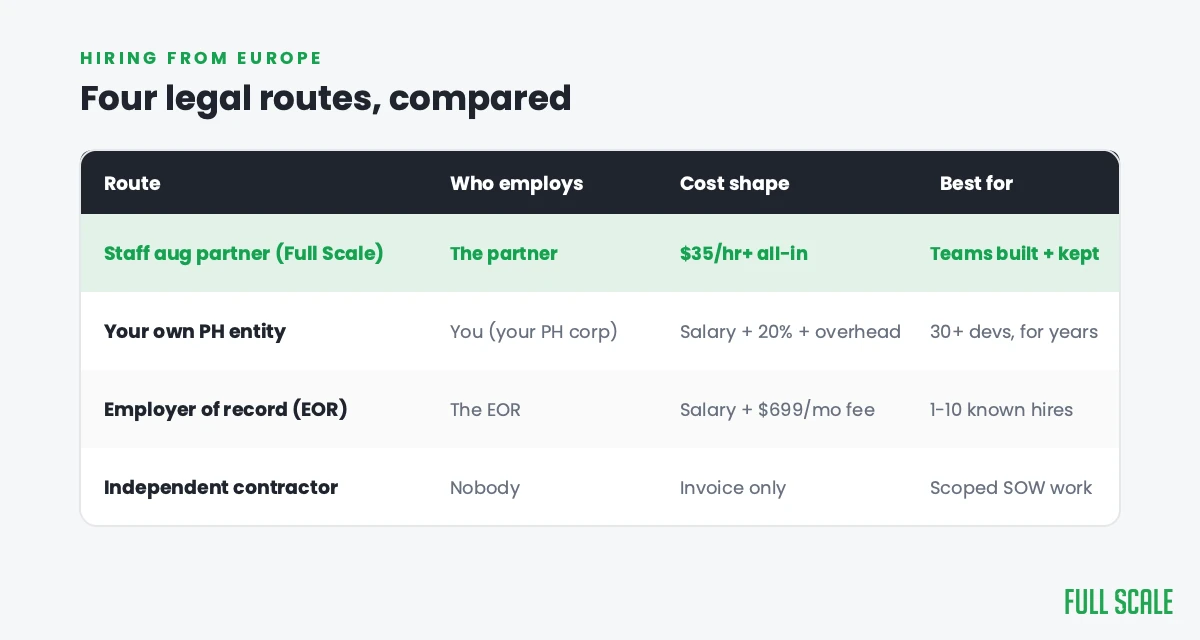
| Route | Who legally employs the developer | Cost shape | Time to first developer | Best for |
|---|---|---|---|---|
| Staff augmentation partner (Full Scale’s model) | The partner’s Philippine entity | One all-in hourly rate, $35/hr+ | As little as 7 days, including the finding | Teams you want built and retained for you |
| Your own Philippine entity | You (your Philippine corporation) | Salary + ~20% statutory and 13th-month, plus entity overhead | 6-12 months to set up | 30+ developers, permanent commitment |
| Employer of record (EOR) | The EOR, on your behalf | Salary + platform fee (~$699/employee/month) | Days, once you’ve found the developer | 1-10 known hires |
| Independent contractor | Nobody (that is the problem) | Contractor invoice only | Days | A scoped project or SOW |
The route determines which party is legally responsible, who sources the candidates, and how a developer quitting gets handled. Cost is the least compelling part of the equation.
There are two other things that go on your lawyer’s to-do list. Taxable presence, what the lawyers call permanent establishment: with an EOR or a partner, the Philippine taxable presence belongs to their legal entity. Your own entity is yours, and so is its tax reporting. IP assignment: your legal entity gets it from your employment contracts, and an EOR gets it via their contract chain. With a contractor, your IP protection is what you wrote in your contract. With a partner, it lives in the master services agreement.
Route 1: A staff augmentation partner that already runs the entity
Staff augmentation means an agency with a local Philippine entity hires the devs, gives them actual jobs and benefits, and sticks them on your team long-term. You receive the benefit of the own-entity route (route 2, below) without having to set any of it up.
This is the model Full Scale sells, so take this section for what it’s worth. The truth of it sounds like this:
- One all-in rate starting at $35 an hour (your rate will probably land between $30-$40 an hour based on seniority and team size). The rate covers salary, the 13th-month bonus, statutory contributions, health insurance, equipment, recruiting, and retention.
- Recruiting is the service. We do the sourcing, screening, and testing so you only have to interview 3 devs instead of 300. Some of our clients are European firms doing this right now from CET time.
- Time-to-hire. You can hire Philippine developers who start in as little as 7 days if they’re already a good fit on our roster, more if we need to hire for the role.
- Honest exits. There’s a two-week money-back guarantee at the beginning, and after that no long-term contract, just 30 days’ notice to end it. Retention is over 93% because devs aren’t freelancers being invoiced but actual employees building careers.
You pay for the entire machine whether you need all the parts or not. If you already know who you want to hire and have plenty of experience managing remote devs, an EOR is cheaper because you bring the devs and do the work yourself. The partner route makes sense when the hardest part of hiring offshore is actually hiring, keeping, and managing the people. One more honest risk: with an EOR or a partner, your team’s legal employer is a company that can itself fail, so ask how long they’ve been operating and what the contract says about transition.
Route 2: Your own Philippine entity, the one I actually run
The “just open an office” path is several months of work before someone writes any code. You register as a business with the SEC, register with the BIR for taxes, register with the Social Security System, register with PhilHealth, and register with Pag-IBIG. That’s 5 government acronyms before you make your first hire, and there are monthly filings for each. And if your company is foreign-owned and serving no Philippine customers, you generally need US$200,000 in paid-in capital just to incorporate, with carve-outs your counsel can walk you through.
Then, you process actual Philippine payroll, which means:
- 13th-month pay. Every employee gets an additional month’s salary each December. It’s required by law (PD 851), adds roughly 8.3% on top of base pay, and no Filipino candidate will consider your offer without it.
- Social Security System (SSS). They take 15% of your employee’s monthly salary credit (SSS Act of 2018). Your portion of that is 10%, on a salary credit capped at ₱35,000 per month.
- PhilHealth. This is the national health insurance program, costing 5% of the employee’s salary, paid 50% by the employer and 50% by the employee, up to ₱100,000 of salary.
- Pag-IBIG. The Philippine Home Development Mutual Fund, with a 2% employer contribution that caps out around ₱200/month per side. Small money, but another registration, another monthly remittance, and another monthly report.
None of that is difficult the thousandth time. It’s hard the first time, in a legal system you’re unfamiliar with, thousands of miles away.
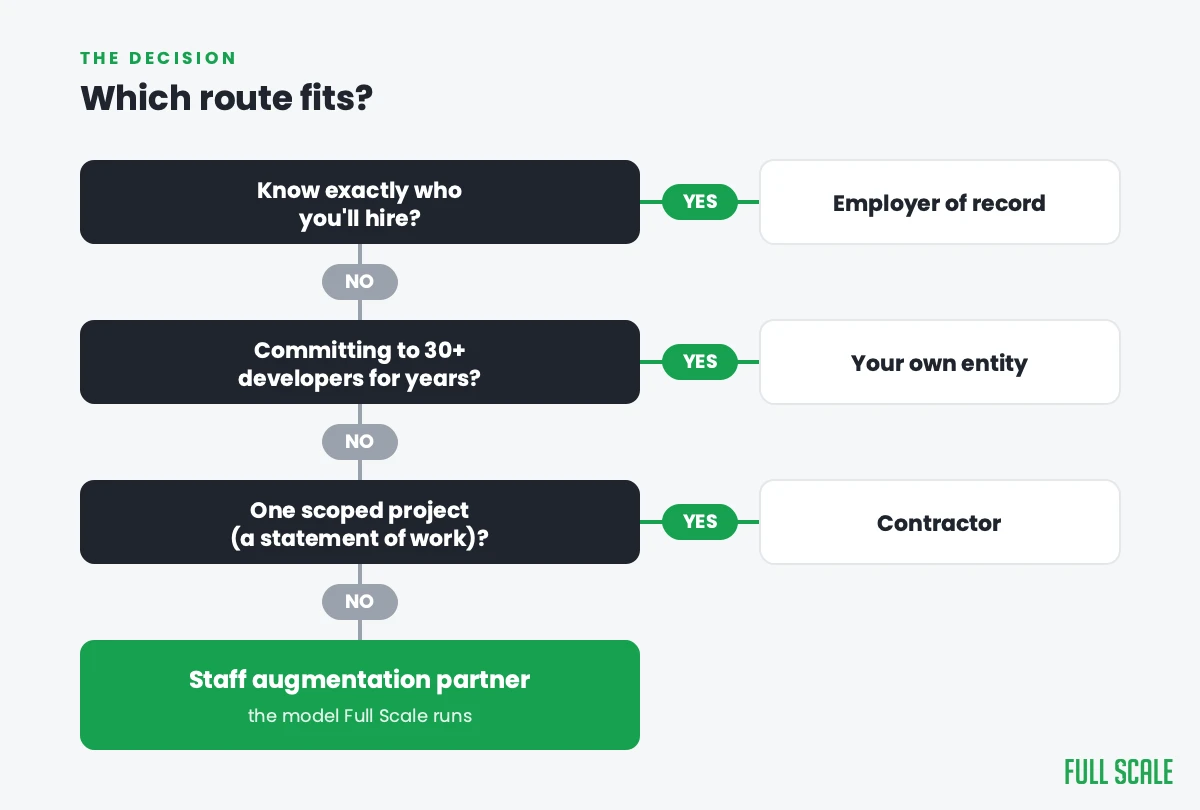
Only open your own entity if you’re ready to commit to 30+ developers for years. At smaller scales, the cost of running a business outweighs the savings, and you’ve now got two businesses to run.
I advise most companies not to take this route. I’m the guy who made it work for my company.
Route 3: Using an employer of record (EOR) in the Philippines
An employer of record is just another name for a company that already completed all the steps in route 2 and now sells you the finished product. An EOR will act as the legal employer of your developer in the Philippines and pay their salary and mandatory taxes. You manage the daily operations of the work. If you want to read more about the mechanics, I have a comprehensive guide on PEO vs EOR vs Staff Augmentation.
EORs in the Philippines charge on a per-seat basis. The biggest platforms list up to around $699 per employee, per month over and above the developer’s salary. One to ten devs will generally be much more affordable than setting up an entity and involve way fewer headaches. Sourcing is a separate problem from employing, and the platforms you source on are their own decision.
Here’s what the EOR pitch leaves out: an EOR doesn’t do any of the finding. They don’t find candidates, they don’t interview them, and they don’t replace them when they leave. You provide the developer and the EOR provides the employment. Finding quality devs across 10,000 kilometers is the difficult 80% of the process, and that stays your responsibility. Your retention responsibility stays yours too. Read more about that in my post EOR vs Staffing Agency.
When should you use an EOR? When you know exactly who you want to hire. It is the logical legal solution if you’ve found a developer already.
Route 4: Hiring Filipino developers as independent contractors
This is the first option most European companies go for because it’s the cheapest looking one. Find a developer, sign a contractor agreement, pay a monthly bill, and skip the entity, the EOR fee, and the statutory contributions. This was how I got into offshore.
My second startup, Stackify, hired a friend’s dev agency for Java developers in 2012. On our first call I learned the devs were in St. Petersburg, Russia, which is less than the recommended level of due diligence. (That was 2012, long before the war. I wouldn’t hire in Russia today.) The devs were good, and the accident worked out for me. I wouldn’t run a company based on this level of luck, particularly on the hiring side. The contractor route fails in a couple of ways.
A full-time contractor with set hours, on your equipment, under your direction, looks like an employee to Philippine labor law. That misclassification risk creeps up slowly as things seem to be going well. At the same time, you’re not providing the contractor with a 13th month, SSS, PhilHealth, or an HMO, so the first employer who does will poach them. The attrition happens before the legal risk.
You can also have IP assignment and equipment issues that template contracts don’t protect you from. I’ve written about this failure mode at length in staff augmentation vs independent contractors.
Contractors are fine for a project or a statement of work. For a team long-term, hiring only by price and no benefits is what I refer to as cheapshoring, and that’s the recipe for all the horror stories you want to avoid paying for.
Switching routes later
Exit routes differ across models, and exits are more important than on-ramps. A contractor can be easily upgraded: hire them as a real employee via an EOR or move them into a partner arrangement, and your relationship remains intact but with benefits. An EOR employee could transition to your local entity in a resign-and-rehire process; their employment and benefits tenure would be preserved by agreement. Your own entity is the one-way door, since unwinding it means closing a Philippine company.
With a partner, your developer is still an employee of the partner. If you provide 30 days’ notice, the developer moves onto another client team rather than out of work, which is one reason retention stays high. If you think you may want to move a partner’s developer into your own company someday, find out what the contract allows before you sign.
GDPR compliance when your developers sit in the Philippines
European customers ask this question first, and it’s got a boring, solvable answer.
Boring is what you want from compliance.
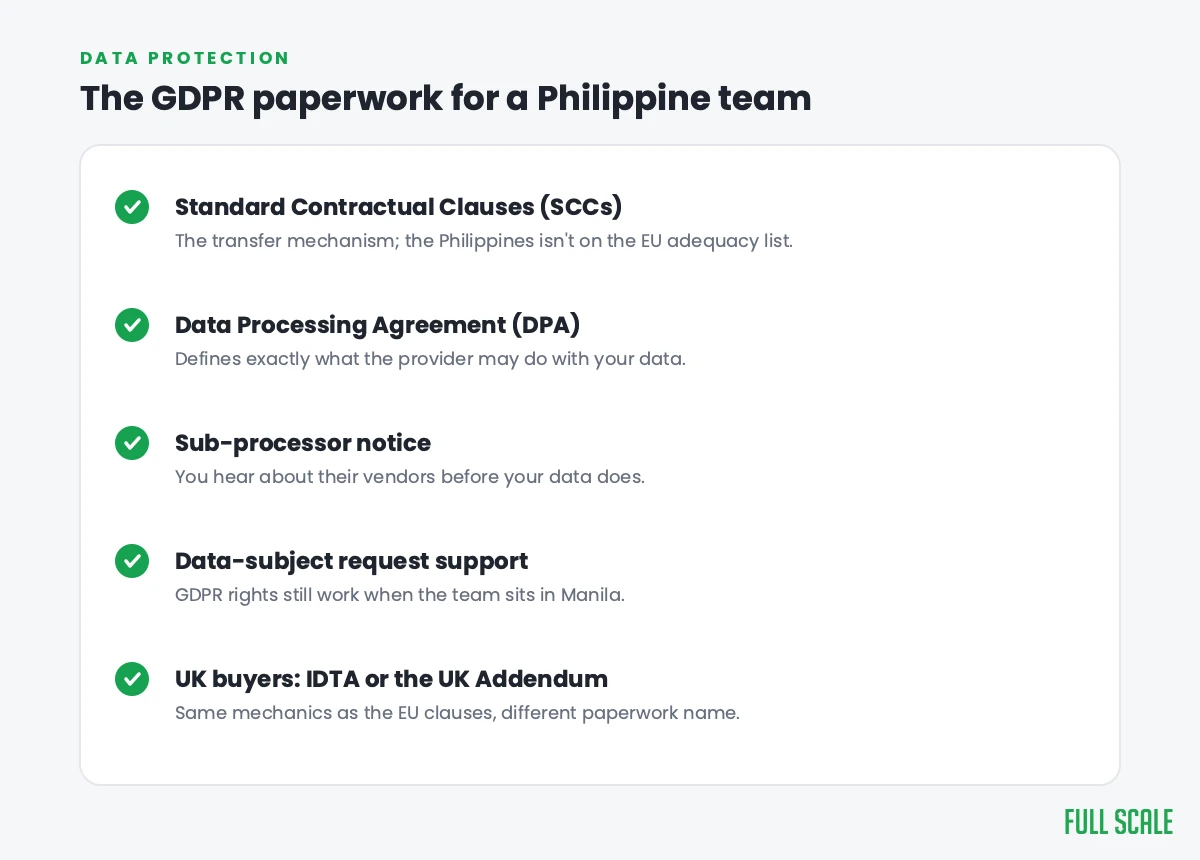
The Philippines isn’t on the EU’s adequacy list, which means personal data moving to your Philippines team must be transferred via an approved mechanism. Typically, this means Standard Contractual Clauses combined with a Data Processing Agreement, plus provisions for notifying about sub-processors and supporting data subject requests. A vendor that regularly services EU customers will have already executed these agreements. If the vendor you’re vetting hasn’t, that tells you everything you need to know.
This is simpler than the horror stories for two reasons. The Philippines has had a Data Privacy Act since 2012, four years before GDPR was adopted. Their National Privacy Commission has been enforcing it, its standards were explicitly intended to align with international data protection frameworks, and your developers have spent their whole careers inside a system that protects data. Second, in a staff augmentation model your developers work within your infrastructure, your repositories, and your access controls. They’re exposed to fewer data subjects than a project shop that takes your code and puts it on their servers.
The paperwork needs to be right because fines can reach 4% of global turnover under GDPR. But it’s paperwork, and paperwork gets handled. I go through all the paperwork in more detail, including HIPAA and SOC 2 for regulated sectors, in my offshore IP protection framework.
The time-zone math Europe gets for free
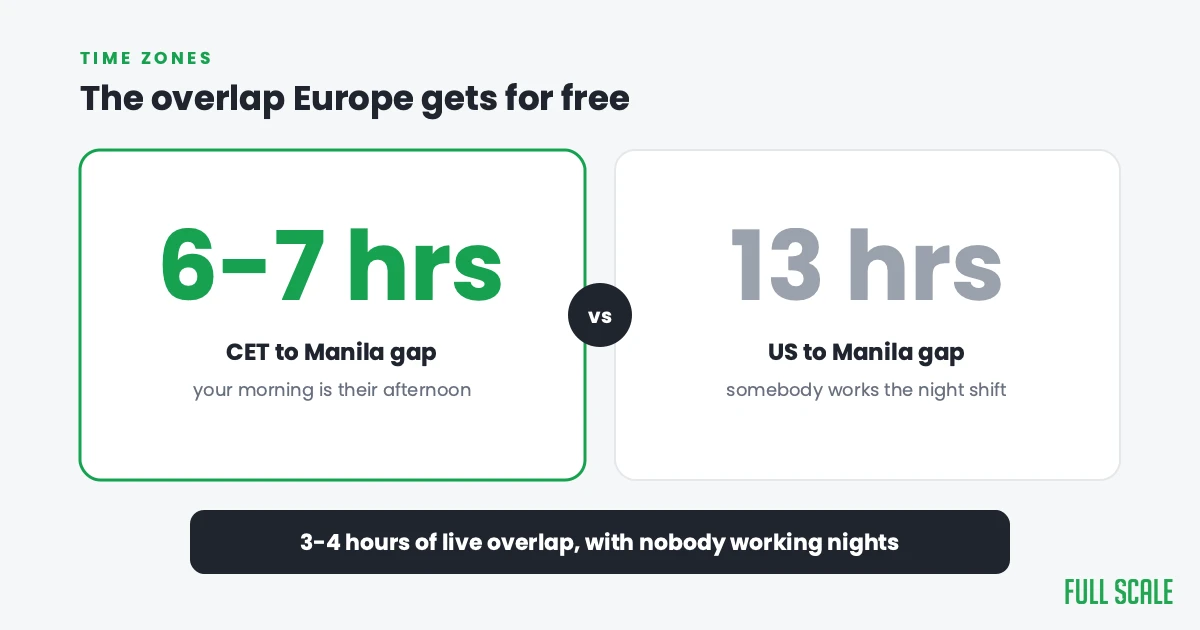
Europe gets the version of this math worth having: a Philippine afternoon overlaps a European morning, so nobody works nights to make it happen.
The 13-hour time difference between Kansas City, where I was, and my first Philippine team pushed me into an overnight cycle of handoffs, and my Philippine devs worked off-hours to align with the US day. It works, but at the cost of someone being up late or early all the time.
Europe doesn’t require that, and I’m still slightly resentful of that fact.
Manila is six hours ahead of Berlin in the summer, seven in the winter, and seven to eight hours ahead of London. A typical Philippine workday finishes at 6 pm, which is noon in Berlin. You get your colleagues’ entire afternoon, every day, as your morning, and no one is up during the night. A 9 am scrum in Berlin is 3 or 4 pm in Manila, depending on the season. You arrive each morning, and everything your team finished before your day started is ready and waiting in the code repository.
But don’t overstate the value of the timezone argument. It’s communication that makes an offshore team productive. The timezone only determines how tired everyone gets during that communication. I set a bar of three to four hours of daily overlap with my own teams, and Europe exceeds that, even if no one shifts their schedule.
The mechanics above are the same everywhere in Europe. What changes country by country is the math.
Hiring developers in the Philippines from the UK
Everything in this guide applies to UK companies, with two local caveats.
- UK GDPR maintained the EU’s cross-border rules post-Brexit. You’ll be signing the UK’s version of the standard contractual clauses (International Data Transfer Agreement or UK Addendum). Same deal as the EU.
- Your gap is the widest in Europe. Manila runs 7-8 hours ahead of London, and you’ve still got a good chunk of your morning overlapping with Manila’s afternoon. Given what London senior devs cost, the math here is the easiest on the continent. The billing currency for most providers is US dollars; allocate a single FX line item for that.
Hiring from Germany and the DACH region
German companies feel the arbitrage on two fronts since local recruitment is both slow and costly. The notice period is measured in months, so a single employee departure may take six months to replace. Offshore software development between Germany and the Philippines fills the vacancy in a matter of weeks.
The DACH region has the most demanding data protection requirements in Europe, which is why the SCC-plus-DPA section above matters most here. Vet your provider using those criteria, and the Datenschutz discussion with your own legal counsel stays brief.
Hiring from Sweden, Denmark, and the Nordics
Nordic salaries are among Europe’s highest, and in Sweden employer contributions add another 31.42% on top of gross pay. Denmark funds its system through income tax instead, but the salaries do the work there. Either way, the fully loaded gap to a Philippine team is among the widest on the continent.
It’s cultural fit, too. Nordic teams are already distributed-first, with great written English. Add a 6-7 hour time difference with real afternoon overlap, and it’s the same combination I watch succeed on distributed teams everywhere.
Hiring from the Netherlands and Belgium
The Dutch are ranked as the best non-native English speakers in the world, and Filipino engineers work in English all day, every day. There isn’t a Europe-Philippines pairing with lower communication barriers than this.
Benelux startups compete with the big tech companies in Amsterdam for the limited local talent available. The smart thing is keeping product leadership local and building the delivery team in the Philippines. This is precisely what staff augmentation is for.
Frequently asked questions
Can a European company hire software developers from the Philippines?
Yes. A European company can hire Philippine software developers legally in four ways: via a staff augmentation partner, via the company’s own Philippine entity, via an Employer of Record (EOR), or as independent contractors. Generally, no permit is needed on the European side. Employment compliance sits on the Philippine side; the European side’s job is the GDPR transfer paperwork (Standard Contractual Clauses and a Data Processing Agreement). At Full Scale, we employ 300+ engineers through our own Philippine entity, and support European clients through a staff augmentation partner approach, where all three things (employment, recruitment, and retention) are included in a single hourly rate.
Is an employer of record the best way to hire developers in the Philippines?
If you already have the developer you want, and just need someone to hire them, a Philippines employer of record is the way to go. The best employer of record in the Philippines is the one that does statutory compliance (13th-month pay, SSS, PhilHealth, Pag-IBIG) and GDPR paperwork correctly, and you can expect around $699 per employee per month on a per-seat model. If you still need the developer to be found, vetted and retained, then an EOR doesn’t help with that at all, and a staff augmentation partner covers both parts.
How do you hire employees in the Philippines without a local entity?
There are three ways to hire employees in the Philippines without your own entity. You can use an employer of record (EOR), which will legally employ your hire for you on a monthly fee basis. Another option is to directly engage contractors through a contractor agreement, but that approach carries misclassification risk for full-time hires. The third option is to hire through a staff augmentation partner, which will employ the developers via its Philippine entity and deploy them to your team. Most European companies with 1-10 developer hires choose either the EOR or partner route and don’t bother setting up an entity.
How much does it cost to hire a software developer in the Philippines from Europe?
A senior developer in the Philippines can command $2,000 to $3,500 a month in salary. If you employ directly, add about 8.3% for 13th-month pay plus the statutory contributions; with an EOR you pay all of that plus the platform’s fee of about $699 a month per seat. At Full Scale, fully loaded rates begin at $35/hr, with most engagements ranging from $30 to $40, which puts you 50 to 70% below the fully loaded cost of the same seniority in most of Western Europe, with the biggest gaps in London and the Nordics. Most providers bill in USD, and there’s generally no VAT on the invoice for EU and UK companies, since the reverse charge applies and is cash-neutral for most VAT-registered businesses.
Do Philippine developers work European business hours?
They don’t need to. The Philippines is 6-7 hours ahead of Central European Time. A typical 9am-6pm day in Manila translates to a full European morning until noon CET. That gives European teams three to four hours of live overlap for standups and pairing, with nobody working late nights. European mornings start with finished work to review, not a status call.
Talk to someone who has already filed the paperwork
I’ve been doing the entity route since 2018, and it’s the right choice for almost no one reading this.
Choose the route that fits your needs: an EOR for a couple of known hires, or a partner when you want them to find, hire, and keep talent for you. If that sounds like you, set up a time to chat with Full Scale. If an EOR is the better option, we’ll let you know.