
How Long Does It Take to Hire a Software Engineer? It Depends.

In this article
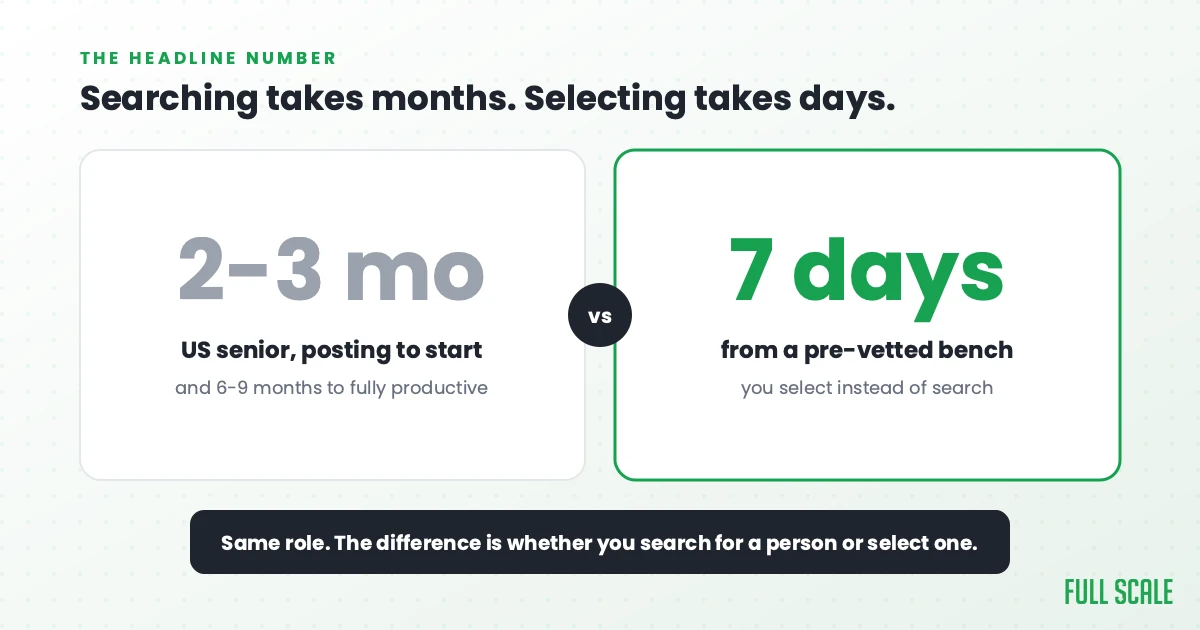
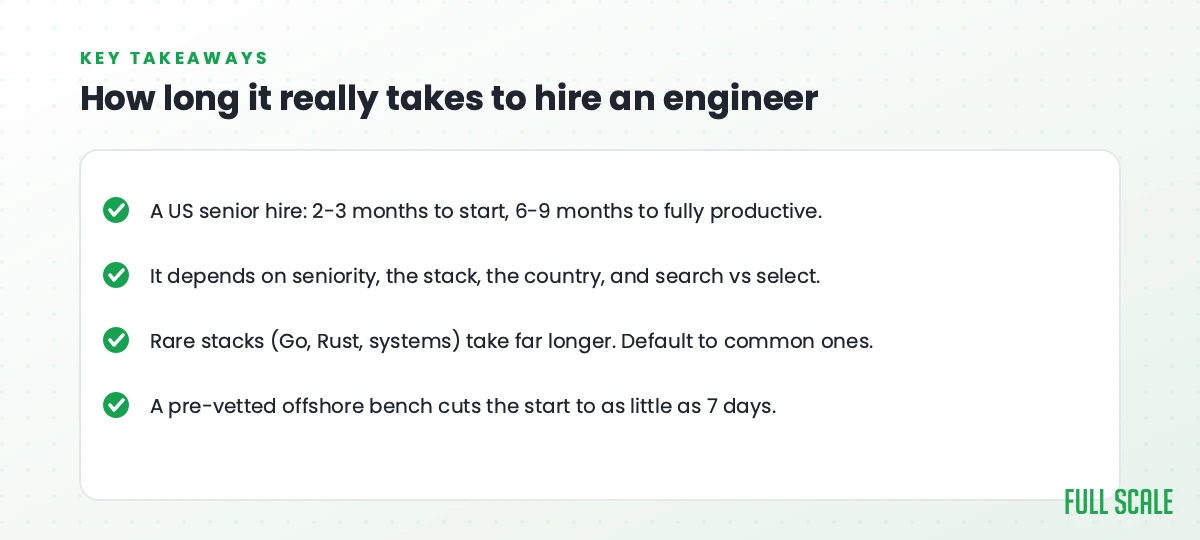
Here is the short answer, because that is what you came for. Hiring a senior software engineer in the US takes about two to three months from the day you post the role to the day they start. The job requisition itself sits open around 62 days before an offer is accepted, which makes engineering one of the slowest categories to fill, and it gets slower the more senior the role.
That average is true and almost useless, because it hides the four things that actually move the number.
I have run engineering at three companies and hired developers in Russia, Latin America, and the Philippines before I built Full Scale, which is the fourth. The honest answer to “how long does it take to hire a software engineer” is that it depends on how senior the role is, what skill set you need, what country you hire in, and whether you are searching for a person from scratch or selecting one from a bench that already exists. Change any of those four and the timeline swings by months. There is also a fifth number almost nobody counts, the ramp, and it is the one that actually hits your roadmap. I will get to it right after seniority, because the two sit on top of each other.
Let me take them one at a time.
The straight numbers, by seniority
Here is the rough benchmark I plan against, as time-to-fill, measured from the day the role is posted to an accepted offer.
- Junior engineer: roughly 20 to 30 days.
- Mid-level engineer: roughly 30 to 45 days.
- Senior or staff engineer: roughly 45 to 90 days.
Hiring a senior engineer takes more than twice as long as hiring a junior one. The 62-day figure from the intro is the blended average across all engineering roles; senior and staff roles sit at the top of that range. The senior people you want already have jobs, they often field two to four competing offers at once, and they negotiate hard once you make one. Every one of those things adds calendar time.
It also helps to separate two numbers people use interchangeably. Time to fill is measured from the day you open the req to the day someone accepts. Time to hire is measured from a candidate’s first contact to their acceptance, so it ignores the sourcing time before anyone applied. Time to fill is the honest one for planning, because the sourcing stretch is usually the longest part.
A typical senior search breaks down something like this: two to three weeks of sourcing and screening, two to three weeks of interviews, one to two weeks to get an offer accepted, and then the notice period before they actually start. Sourcing is the bottleneck almost every time. You are not slow at interviewing. You are slow at finding people worth interviewing. Scoring every interview the same way is part of how we keep that middle stretch short, and how we run technical interviews covers the rest.
The number nobody puts in the timeline: ramp
Here is the part that gets left out of every “average time to hire” article. An accepted offer is not a productive engineer.
A new senior hire takes another three to six months to get fully productive in your codebase, your domain, and your team. So the real clock, from “we need to hire” to “this person is pulling their weight,” is closer to six to nine months for a senior US role. I wrote more about why that full ramp matters in the developer shortage piece, because it is the number that actually hits your roadmap. When someone asks how long hiring takes, they usually mean “when do I get the output,” and the honest answer is much longer than the offer-acceptance date suggests.
It depends on the skill set you need
The skill set you need surprises people, and it is the factor I would check first. The stack you are hiring for swings the timeline more than almost anything else.
Common stacks are fast because the pool is deep. If you need a PHP, .NET, or JavaScript engineer, there are a lot of them, and you will fill the role on the timelines above. Move to Ruby or Ruby on Rails and it gets noticeably harder, because fewer people work in it and the ones who do are in demand. Go to something like Go, Rust, or genuine low-level systems programming and it gets very hard, very fast. Specialized skills, embedded work, niche frameworks, and anything close to the metal can take you far past the senior-role timelines, anywhere in the world.
So here is the rule I give people: default to the most common tech stacks unless you have a specific, real reason not to. The talent is easier to find, easier to replace, and easier to scale. A rare language is sometimes the right call for a real technical reason, but a surprising number of teams pick one for taste and then spend a year fighting a hiring market that barely exists. The rarer the skill, the longer everything else in this article stretches.
It depends on the country
Where you hire changes both the speed and the failure modes. Here is the honest version by market.
| Market | Time to a started senior hire (hiring directly) | The catch |
|---|---|---|
| United States | 2-3 months | Slowest for senior and rare stacks; counteroffers and bidding wars |
| Latin America | 3-6 weeks | Great US time-zone overlap; thinner pools for rare stacks |
| Eastern Europe | 4-8 weeks | Deep benches for complex systems; 30-60 day notices; regional risk |
| India | 1-3 months to a reliable start | Enormous pool, but the best are taken and the start is unreliable |
| Philippines | 3-6 weeks direct, or as little as 7 days from a pre-vetted bench | You need a partner who actually keeps a bench |
A couple of those rows deserve a sentence. Latin America is the easiest offshore market to work with on US East Coast time, so the overlap is great, but the senior pool for rarer stacks is thinner than India’s or Eastern Europe’s. Eastern Europe has some of the deepest benches in the world for complex systems and platform work, with the tradeoff of longer notice periods and the regional risk that comes with the war in Ukraine.
One detail inside that table matters more than buyers expect: the notice period, and what happens during it. India runs on 60-to-90-day notices, and the problem is not the length, it is that offers renege during them. A candidate accepts, keeps interviewing for two or three months, and takes a better offer before they ever start. The Philippines norm is closer to 30 days and reneging is far less common. At Full Scale our engineers sign a contract that requires a 90-day notice if they ever leave, and we enforce it, so a client gets a long, predictable runway instead of a two-week scramble. That is separate from the client’s own right to release a developer on 30 days’ notice. One keeps the team from vanishing on you; the other keeps you from being stuck with one.
Why India is the cautionary tale
Of the markets in that table, India is the one that trips buyers up most. The trouble is not the people. It is the time to a reliable start. I want to be fair, because India genuinely wins on raw scale. If you need to staff 50, 100, or 500 engineers on a common stack in a hurry, India is the only offshore market that can do it. I learned the reliability problem the hard way at Stackify.
Indian IT runs on those 60-to-90-day notice periods, and offers fall through in a way US hiring never prepared me for. A candidate accepts, you wait out the notice period, and partway through they take a counter-offer and never show up. After a couple of rounds of that, you stop trusting the process. We worked with genuinely talented people in India, but the mechanics wore us down and we stopped trying to grow there.
There is a deeper structural story behind why the start is so unreliable, about a thin layer of job-ready talent and the strongest engineers getting absorbed by the captive centers that global companies run in India. That is a talent-quality story more than a timeline one, so I will point you to the full breakdown rather than retell it here. For planning a timeline, the takeaway is simpler: in India, budget for the notice period and the real chance your hire never starts.
None of that means India is a bad choice. It means the headline “developers are cheap and plentiful” hides a real cost in time and reliability, and you have to plan for it.
How to hire developers fast: select, don’t search
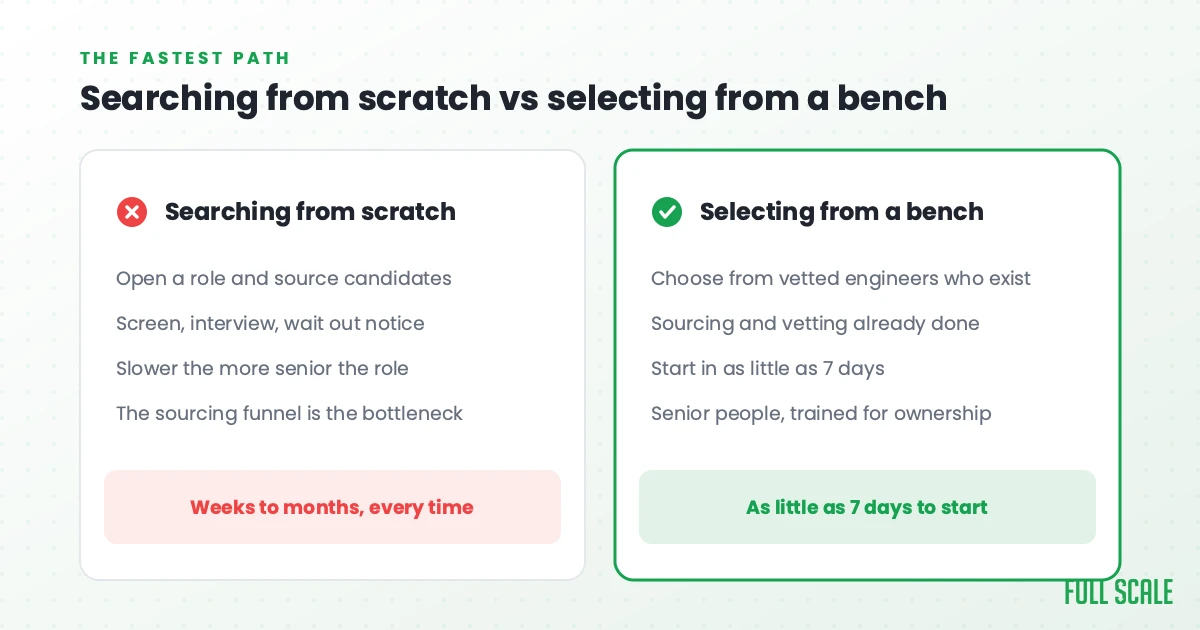
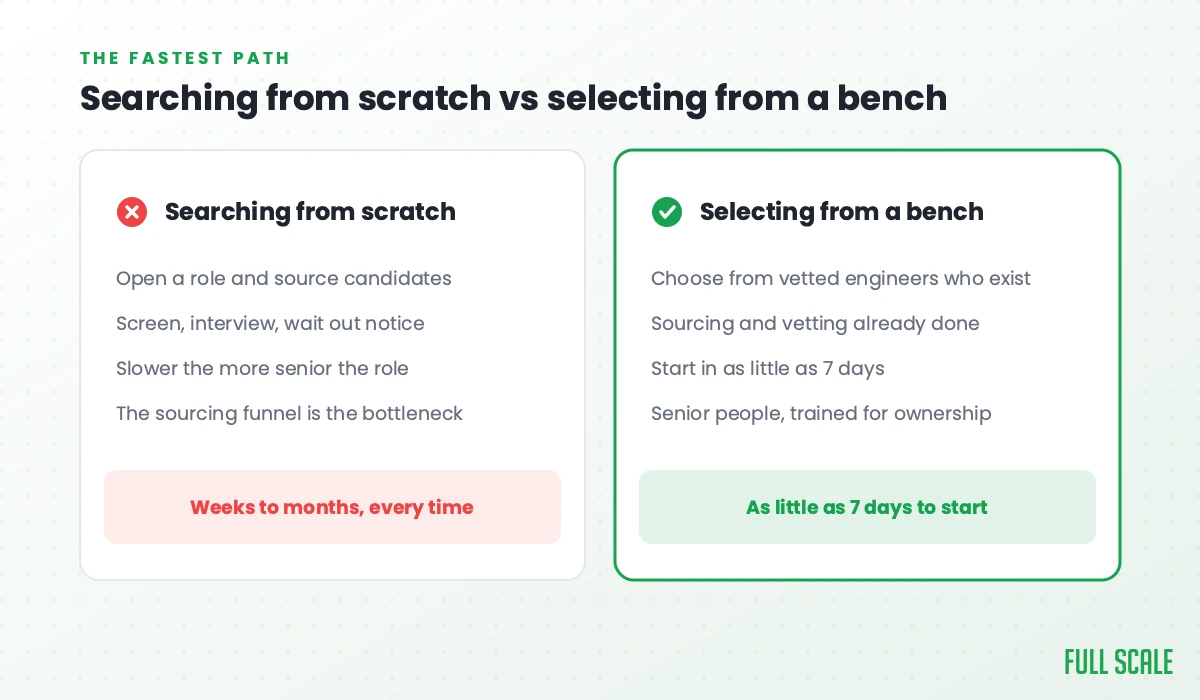
The fastest way to hire a software developer is to stop searching and start selecting from a bench that already exists. Every timeline above assumes you are running a search instead: you open a role, source candidates, screen them, interview them, and wait out a notice period. That is the slow part, and it is slow everywhere.
When you work with a staff augmentation partner that keeps a real bench of vetted engineers, you are choosing from people who already exist instead of running a funnel to find them. That is how Full Scale can start a senior engineer with your team in as little as seven days, against the two to three months a US req takes. The engineers are already employed, already vetted, and trained on Product Driven, the engineering-ownership philosophy from my 2025 book, so they ramp faster because they think about the product instead of waiting for tickets.
The one trap to avoid is picking on rate alone. The cheapest developer is almost never the fastest or the most reliable, and chasing the lowest hourly is what I call cheapshoring. The goal is a senior engineer who starts fast and sticks around. The cheapest developer usually does neither.
How to actually reduce your time to hire
If you only change a few things, change these.
- Select from a bench instead of searching from zero. This is the single biggest lever, and it is the difference between weeks and months.
- Default to a common stack unless a rare one earns its keep. You cannot out-recruit a market that does not exist.
- Run your interview loop in parallel, not in series, and decide fast. Senior candidates have other offers and the slow process loses them.
- Pick a market on reliability, not just rate. A start you can count on beats a cheaper one that may never show up.
- Count the ramp. Plan for time-to-productive so your roadmap is honest about when output actually shows up.
FAQ
How long does it take to hire a senior software engineer?
In the US, plan for two to three months from posting the role to the new hire’s first day. The requisition typically stays open around 45 to 90 days for a senior or staff role before an offer is accepted, and then the notice period runs on top of that. Senior roles take more than twice as long as junior ones because the people you want already have jobs and field competing offers.
What is the difference between time to hire and time to fill?
Time to fill is measured from the day the role is posted to the day a candidate accepts, so it includes sourcing. Time to hire is measured from a candidate’s first contact to their acceptance, so it ignores the time spent finding them. Time to fill is the better number for planning, because sourcing is usually the longest stage.
Why does hiring a software engineer take so long?
Sourcing is the bottleneck, not interviewing. The senior engineers worth hiring already have jobs, so finding and attracting them is slow, and a competitive market adds counteroffers and bidding wars. Rare tech stacks and very senior roles stretch it further because the pool of qualified people is small to begin with.
How long does it take to hire a developer in India?
The pool is enormous, but a reliable start is the hard part. Indian IT runs on 60-to-90-day notice periods, and accepted offers fall through often as candidates keep interviewing and take counteroffers before they start. Plan for one to three months to a dependable start, and expect the strongest engineers to already be taken by the captive centers that big global companies run there.
What is the fastest way to hire a software developer?
The fastest way is to select from a pre-vetted bench rather than running a fresh search. A staff augmentation partner that keeps vetted engineers on staff can place someone in as little as seven days because the sourcing and vetting already happened. Running your own offshore search from scratch is not faster than a US search and is often slower.
Does AI shorten the time to hire a software engineer?
Barely. AI can speed up the coding part of the ramp a little, but it does not touch the slow parts: sourcing the right senior person, running the interview loop, and waiting out the notice period before they start. It also does not shorten the time it takes someone to learn your domain, your codebase, and your team, which is most of the ramp. If anything, AI raises the bar on seniority, because a junior leaning on AI ships code nobody fully understands. Plan your timeline as if AI does not change it much, because it does not.
How long until a new software engineer is actually productive?
Budget another three to six months after they start for a senior hire to get fully productive in your codebase and domain. The offer-acceptance date is not when you get output. If you do not count the ramp, your timeline looks fast on paper and then misses on the roadmap. One thing that does compress the timeline is starting from who is available right now instead of opening a fresh search.
When is the best time to hire a software engineer?
Start before you are desperate for the seat, not after. A US senior search alone runs two to three months, plus another three to six to ramp, so if you wait until the gap is already costing you on the roadmap, you are already behind. If you cannot see that far ahead, selecting from an existing bench is the only way to compress the timeline into days instead of months.
Ready to skip the search?
If your roadmap cannot wait two to three months for a US hire and another six for them to ramp, the fastest honest path is to select a senior engineer from a bench that already exists. Book a call and we will talk about building your team.