
Offshore Ruby on Rails Development – Hire Trusted, Affordable Talent from the Philippines

In this article
- Why Rails Offshore Teams Work Better Than You Expect
- The Talent Pool Is Smaller. The Quality Cliff Is Steeper.
- Why the Philippines for Rails
- What to Look For in an Offshore Rails Developer
- Staff Augmentation or Project Outsourcing?
- What AI Changes About Offshore Rails Development
- What the Cost Comparison Looks Like
- Frequently Asked Questions
- Ready to Add Rails Engineers to Your Team?
Most offshore horror stories follow the same plot. A company hands a codebase to an offshore team and gets back something that technically runs but is structured in a way no one on the in-house side recognizes. Custom patterns instead of framework conventions. Logic scattered across layers with no clear reason. A codebase that only the people who wrote it can maintain. They are no longer on the engagement. The same dynamic applies to offshore Laravel work: convention-following engineers write maintainable code, while engineers who learned PHP syntax without the framework’s idioms create the maintenance problems that generate those horror stories. It also shapes what a Rails developer actually does now.
That story happens more often in frameworks where the team makes most of the architectural decisions. Rails makes most of them before the team arrives. Django plays that same opinionated role in Python, so you can hire remote Django developers who already respect its conventions.
Convention over configuration is the design principle that made Rails famous. The MVC structure, the ORM conventions, the routing patterns, the test layout: Rails prescribes all of it. A good Rails engineer in the Philippines writes code that looks like a good Rails engineer anywhere else, because the framework enforces a shared language. That shared language travels across time zones in a way that ad-hoc architecture decisions do not. Angular applies the same discipline on the JavaScript side: offshore Angular teams benefit from the same convention-over-configuration logic. TypeScript, dependency injection, and module structure create a shared framework language that distributed teams can rely on.
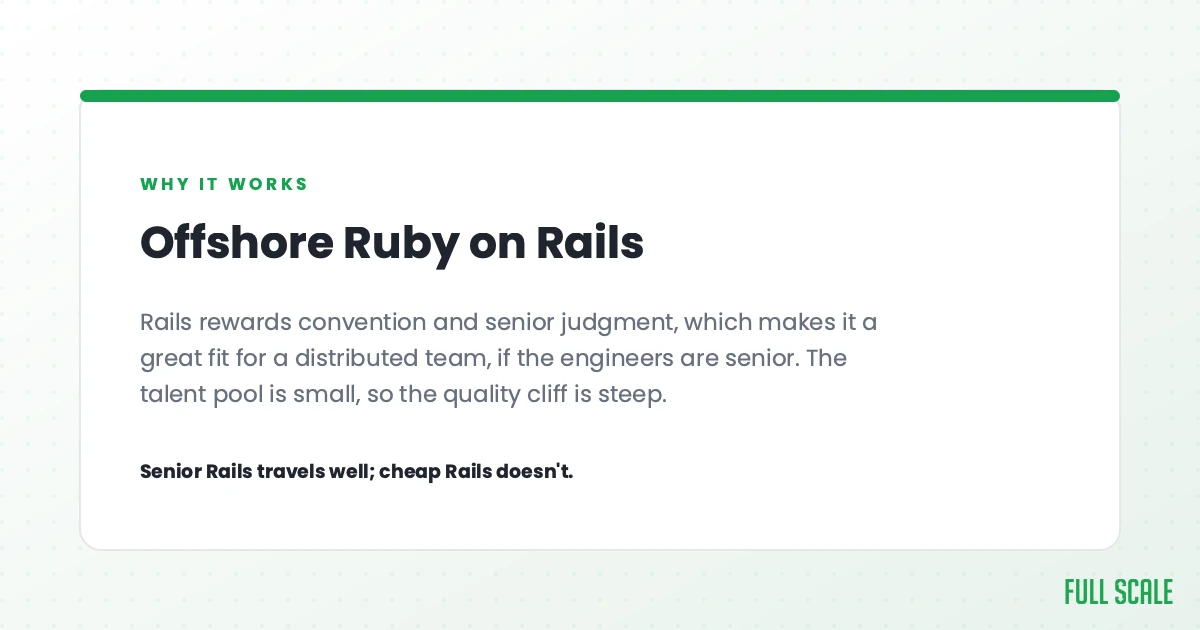
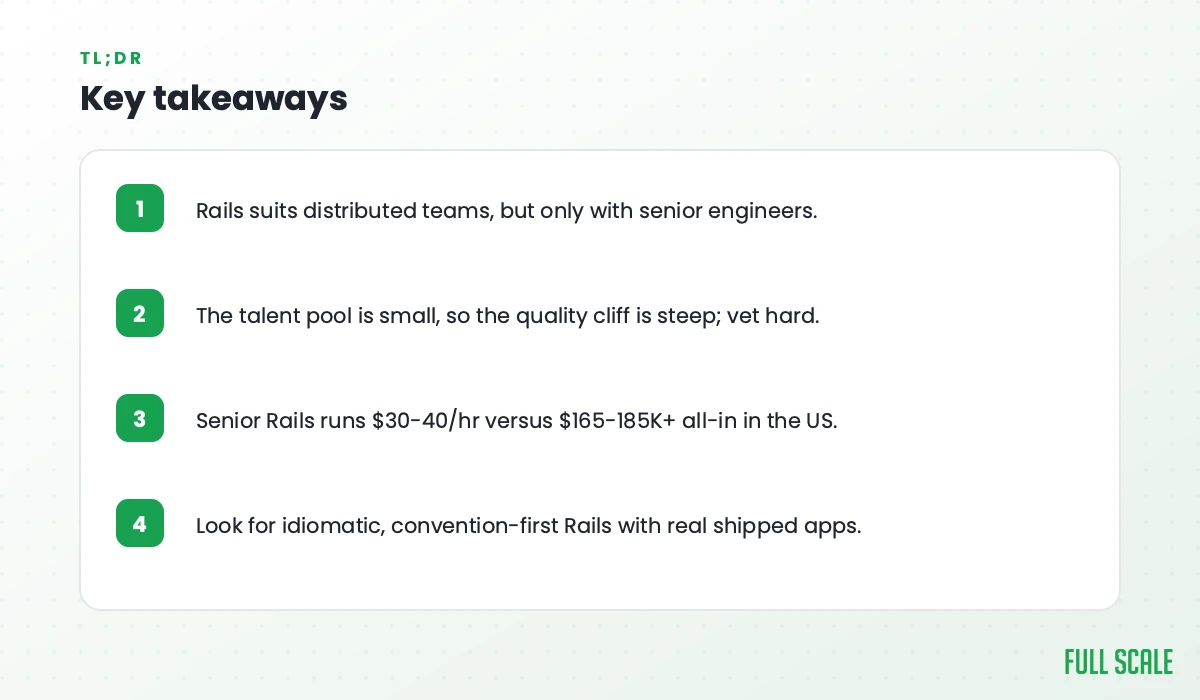
Rails is not the largest offshore talent pool. But it is one of the best stacks for offshore team performance when you find engineers who actually know the framework.
I run Full Scale, which staffs offshore software development teams in the Philippines. Rails engineers are part of our regular staffing flow. Here is what I have learned about offshore Rails development from the operator side.
Why Rails Offshore Teams Work Better Than You Expect
The offshore challenges that matter most are communication and consistency. An engineer who is twelve time zones away cannot easily ask clarifying questions in real time, and a codebase where every developer makes their own structural decisions becomes unreadable fast in a distributed environment.
Rails’s conventions address both problems.
When a Rails engineer joins a codebase, they already know where to look for things. Models go here. Controllers go there. ActiveRecord handles this pattern this way. The framework has established defaults for nearly every common web application decision. A new engineer on an offshore Rails team does not spend their first week learning how this particular team has organized its code. They read the conventions documentation once and know most of it already.
This is not unique to offshore teams. Every Rails engineer knows this experience: join a new Rails project and feel the familiarity immediately. But the offshore context amplifies the value, because remote teams pay a higher overhead for confusion and inconsistency than co-located teams do. The less ambiguity in the codebase, the more productive a distributed team becomes.
Rails’s conventions reduce the offshore ambiguity tax. That is the non-obvious reason Rails offshore teams work well: it is not just cost savings, it is that the framework’s architecture discipline travels across the Pacific in a way that frameworks with more freedom do not.
The Talent Pool Is Smaller. The Quality Cliff Is Steeper.
This is the honest counterweight. Ruby on Rails has a smaller global developer community than Python or JavaScript. The Stack Overflow Developer Survey consistently places Ruby usage well below Python, JavaScript, and even PHP. That means the offshore talent pool is thinner, and thin pools have their own offshore hiring risk.
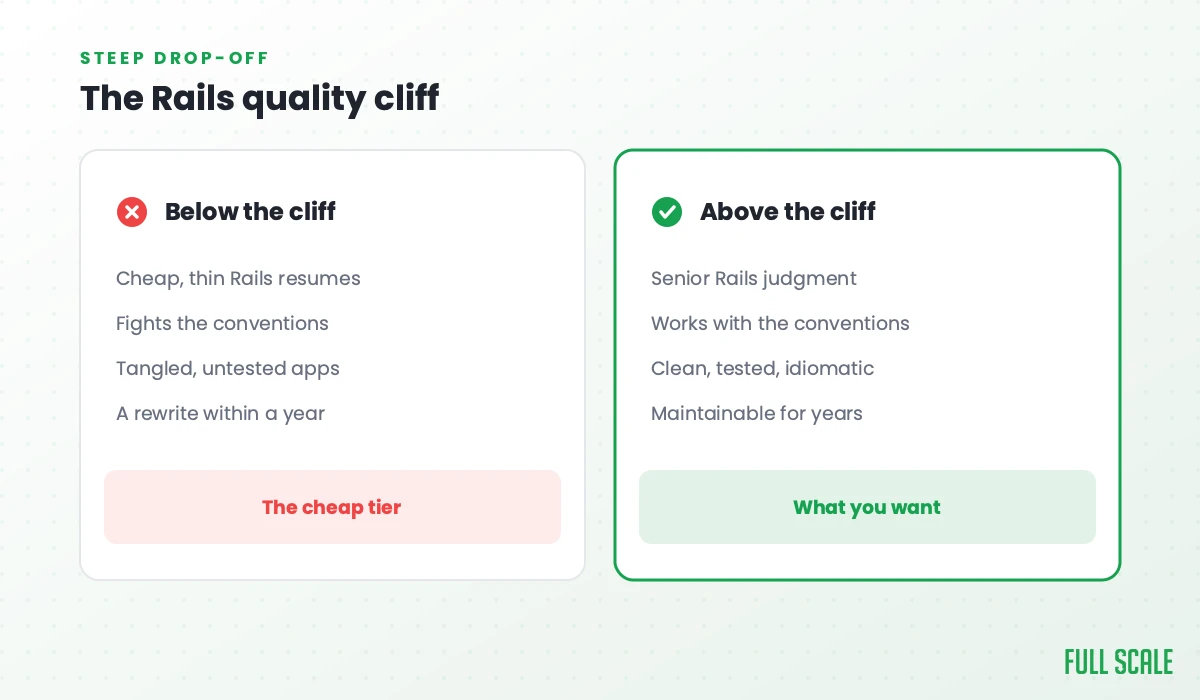
When talent pools are large, you can hire cheap developers without necessarily hiring bad ones. The supply is so abundant that even the cheaper end of the market has working engineers. When talent pools are thin, the cheap end tends to be developers who learned enough Rails syntax to pass a screening test without learning the framework deeply. I call this cheapshoring. It hits hardest when the pool you are hiring from has a wider quality spread at the bottom.
The tell for a thin-pool cheapshoring problem with Rails: code that uses Rails syntax but not Rails conventions. Models that do not use ActiveRecord’s built-in scopes and validations correctly. Controllers that are hundreds of lines long because the developer did not know about service objects or understand how fat models cause pain. Tests written to pass, not to catch regressions. All of it looks like Rails on the surface. None of it behaves like Rails when you need to extend it.
The answer is not to avoid offshore Rails hiring. It is to evaluate more carefully than you would with a larger pool, because the fraction of genuinely strong Rails engineers is smaller and the distance between the strong and the weak is more visible in a framework this opinionated.
Why the Philippines for Rails
There are Rails developers across Southeast Asia, Eastern Europe, and Latin America. The Philippines has a specific combination of factors that makes it the right offshore destination for Rails teams specifically.
The Philippines is the third-largest English-speaking country in the world. For a framework built around the premise that code should be readable and convention-following, the communication quality of the engineering team matters more than in less opinionated frameworks. Rails engineers who can explain what their code is doing, ask the right questions when a spec is ambiguous, and push back when a feature request conflicts with the framework’s conventions are significantly more valuable than engineers who only execute instructions.
Filipino developers bring a service culture to software development that translates directly into the kind of collaborative engineering Rails teams need. The framework expects engineers to make good judgment calls within its conventions, not just follow orders. The Philippines delivers that orientation consistently.
The Philippine IT-BPM industry generates $40 billion in annual export revenue and employs 1.8 million workers. Rails has been part of that industry since the startup boom years of 2007 to 2015, when Rails was the dominant web framework and offshore Rails development was a common model for startups building on tight budgets. The Philippine Rails talent pool is smaller than its Python or JavaScript pools but it is real, and the developers who came through that era are now senior engineers with production Rails experience.
At Full Scale, the Spartan Training Academy makes sure our Rails engineers stay current with how AI is reshaping the framework’s development environment. The Claude Masterclass series covers practical AI workflow integration: using Claude Code for real-time Rails debugging and scaffolding in the terminal, MCP integrations connecting Claude to GitHub and databases, and agentic workflows for Rails testing and code review. Weekly five-minute training videos and bi-weekly thirty-minute sessions, most recorded by Full Scale engineers.
What to Look For in an Offshore Rails Developer
Evaluating Rails developers offshore follows the same principle as the Python evaluation: the resume is the starting point, not the answer. Here is what actually separates a strong offshore Rails hire from one who will create long-term maintenance debt.
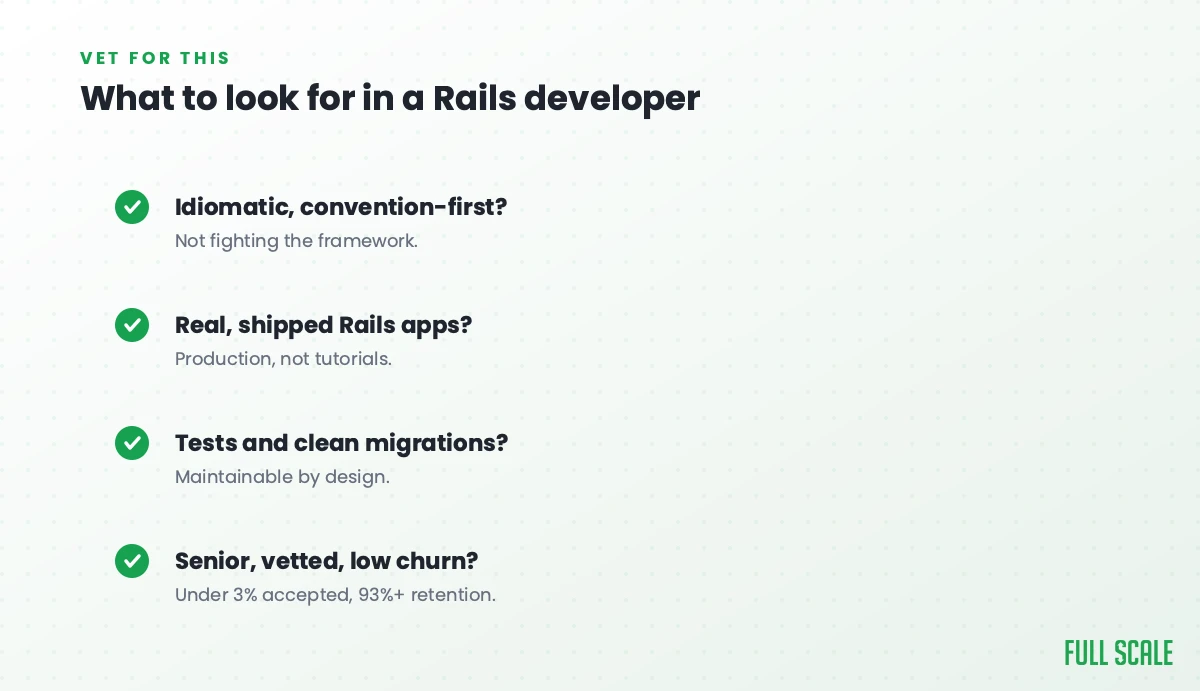
How they use ActiveRecord. ActiveRecord is the core of every Rails application’s data layer, and it has depth that takes years to use well. Ask candidates how they handle N+1 queries. Ask about their approach to scopes, callbacks, and validations. Ask whether they use concerns and when they avoid them. An engineer who has built real production Rails applications will have opinions about these tools. An engineer who has learned Rails for interviews will repeat what the documentation says.
Their testing philosophy. Rails has a strong testing culture baked into the framework: RSpec, Minitest, and a rich set of testing helpers. Ask what a good test suite looks like to them. Strong Rails engineers will talk about coverage, regression prevention, and the difference between unit and integration tests in a Rails context. Weak Rails engineers will say they test their code and not have much more to say.
How they approach the “Rails Way” vs. custom solutions. The framework has prescribed patterns for common problems. Ask a candidate about a time they chose to diverge from the Rails Way and why. The engineers who can articulate when the Rails defaults work and when they do not are the ones who understand the framework rather than just knowing its syntax. This is the difference between a software engineer and a software developer in a Rails context.
Whether they take ownership of what they build. Ask about a feature they are proud of from a previous project. Listen for whether they talk about why the product needed it, not just what it does. Engineers who understand their own code in context are the ones who will care about your codebase.
Staff Augmentation or Project Outsourcing?
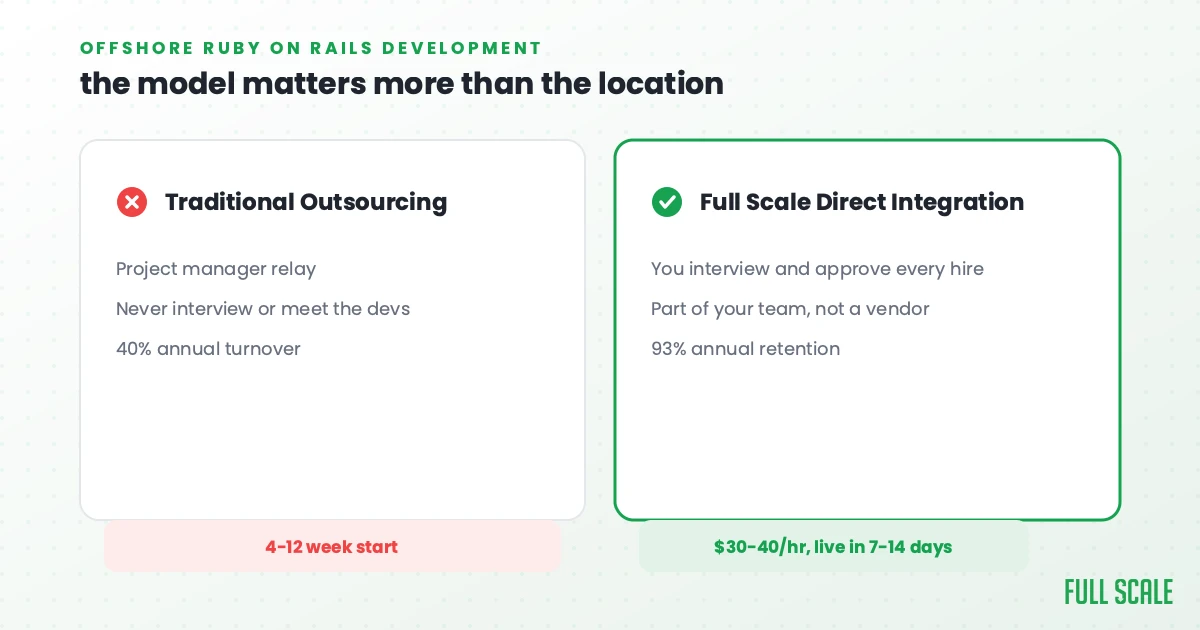
For ongoing Rails applications, the answer is almost always a team, not a project shop. An offshore Rails engineer who becomes a full member of your team, attends your standups, reviews code alongside your in-house developers, and develops institutional knowledge of your application is what makes Rails’s conventions pay off. The framework’s shared language means the offshore engineer and the in-house team are reading the same codebase. A project vendor who delivers a Rails feature and rotates off eliminates that advantage.
For genuinely scoped Rails work with a locked spec and a defined completion point, project outsourcing can work. The Rails conventions make handoffs cleaner than in some other frameworks. But most Rails applications are ongoing products, not deliverables, and ongoing products need engineers who stay.
If you are evaluating whether to outsource a Rails project or build a long-term team, our outsource Ruby on Rails development guide covers the model decision end to end.
What AI Changes About Offshore Rails Development
Rails has generators and scaffolds that produce working code instantly. Run a generator and you get a model, a migration, a controller, a set of views, and a test file. The Rails community built this tooling to speed up development, and AI does the same thing at a higher level.
For Rails specifically, the AI-review problem is almost literal. An AI system asked to scaffold a Rails feature will produce code that looks correct and may even run. Whether it follows the Rails Way, handles edge cases the Rails community knows to handle, and integrates cleanly with the existing application is a judgment call that requires someone who understands Rails deeply.
The offshore Rails engineers who are most valuable in 2026 are not the ones who write the most code. They are the ones who can read AI-generated Rails output and tell you whether it is actually idiomatic, whether the migrations are safe to run in production, and whether the tests are testing the right things. That requires years of Rails experience, not just familiarity with the framework.
Product Driven is about building engineers who take ownership of what they build, not engineers who produce code when handed a ticket. That principle is sharpest in a framework as opinionated as Rails, where the engineers who understand the “why” behind the conventions are the ones who make good decisions when the AI-generated scaffold does not quite fit the problem.
What the Cost Comparison Looks Like
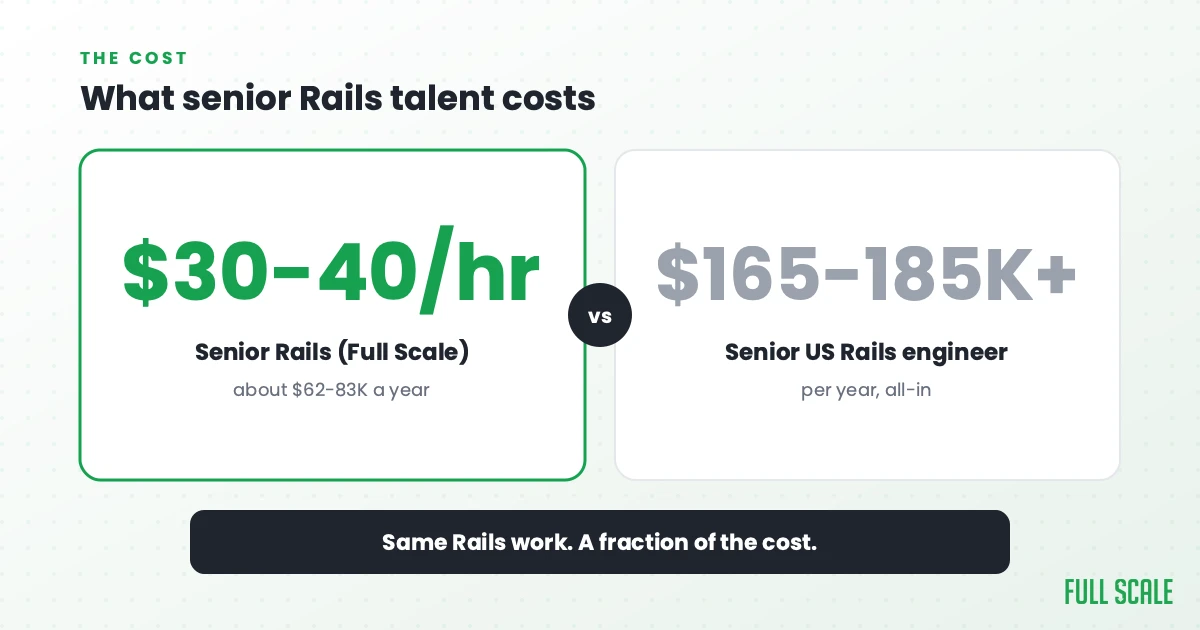
Full Scale clients pay $30 to $40 per hour for senior Rails engineers in the Philippines. A comparable engineer in the US earns a BLS median of around $133,000 per year in base salary, and when you add benefits, payroll taxes, and overhead (what MIT research estimates at 1.25 to 1.4 times base salary), the all-in cost runs $165,000 to $185,000 or more per year.
| Full Scale (Rails, Philippines) | US Senior Rails Engineer | |
|---|---|---|
| Hourly / annual cost | $30-$40/hr (~$62K-$83K/yr) | $133K base → ~$165K-$185K all-in |
| Time to staff | ~14 days | 6-12 weeks |
| Recruiting fee | None | 20-25% of first-year salary |
Rails engineers are generally priced similarly to Python and JavaScript engineers in the Philippines; the framework commands a premium over entry-level generalists but not a significant one relative to the stack’s productivity advantages. Over a multi-year Rails engagement the gap compounds: an engineer who already knows your models, your migrations, and your conventions is worth far more than the same seat re-hired every eighteen months at a US loaded cost.
Frequently Asked Questions
What is offshore Ruby on Rails development?
Offshore Ruby on Rails development means engaging Rails engineers based outside your country to build, maintain, or extend your Rails applications. The model can be staff augmentation (engineers embedded directly in your team) or project outsourcing (a vendor delivers a defined scope). For most Rails applications that will keep evolving, staff augmentation delivers better outcomes because the engineers develop deep knowledge of the codebase they are maintaining.
Why is Rails well-suited for offshore development?
Rails’s convention-over-configuration philosophy is the primary reason. The framework makes most architectural decisions for the team, which means a strong Rails engineer in the Philippines writes code that looks familiar to an in-house Rails engineer, regardless of geography. The shared framework language reduces the ambiguity and inconsistency that cause offshore teams to fail in more configuration-heavy stacks.
How do you evaluate offshore Ruby on Rails developers?
Focus on framework depth rather than syntax knowledge. Ask candidates how they use ActiveRecord scopes, how they approach N+1 queries, and how they think about the Rails Way versus custom solutions. Ask about their testing philosophy. The engineers who can articulate why they make Rails decisions, not just what the documentation says, are the ones worth hiring.
How much does it cost to hire offshore Ruby on Rails developers?
At Full Scale, senior Rails engineers in the Philippines are staffed at $30 to $40 per hour, with onboarding timelines of roughly 14 days. A comparable US engineer costs $133,000 or more in base salary before benefits and overhead. The cost gap is real, but it only materializes as a win when the engineer is genuinely strong. In a smaller talent pool like Rails, quality evaluation is more important than cost negotiation.
Ready to Add Rails Engineers to Your Team?
Full Scale has been staffing offshore software development teams since 2018. We have placed 700+ developers with clients across 200+ tech companies. Our Rails engineers work inside product organizations across North America, maintaining and extending production Rails applications.
If you want to hire Ruby on Rails developers who work inside your team, know the framework deeply, and own the codebase they build, that is what we staff.
Schedule a call to talk through your Rails team needs.