
13th Month Pay in the Philippines: Formula, Rules, Deadline

In this article
- What is 13th month pay in the Philippines?
- Who gets 13th month pay?
- How do you compute 13th month pay?
- When is 13th month pay due?
- What counts as basic salary?
- How is 13th month pay pro-rated?
- Do resigned or terminated employees get 13th month pay?
- Is 13th month pay taxable?
- How do 13th month pay rules differ for special workers?
- How is government year-end bonus different from 13th month pay?
- Why does the Philippines have 13th month pay?
- How has the 13th month pay law changed since 1975?
- Which laws govern 13th month pay?
- Can an employer stop paying more than the minimum, or count a Christmas bonus as 13th month pay?
- What happens if an employer doesn't pay 13th month pay?
- What does 13th month pay cost a foreign employer?
- Who pays 13th month pay when you hire in the Philippines?
- Frequently asked questions
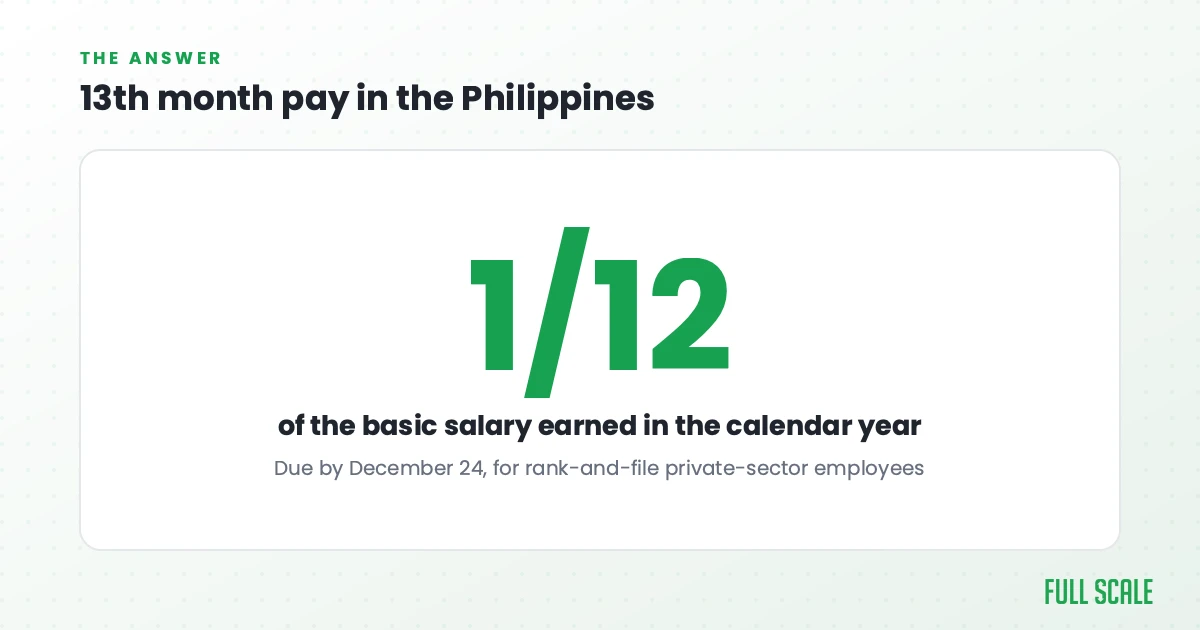
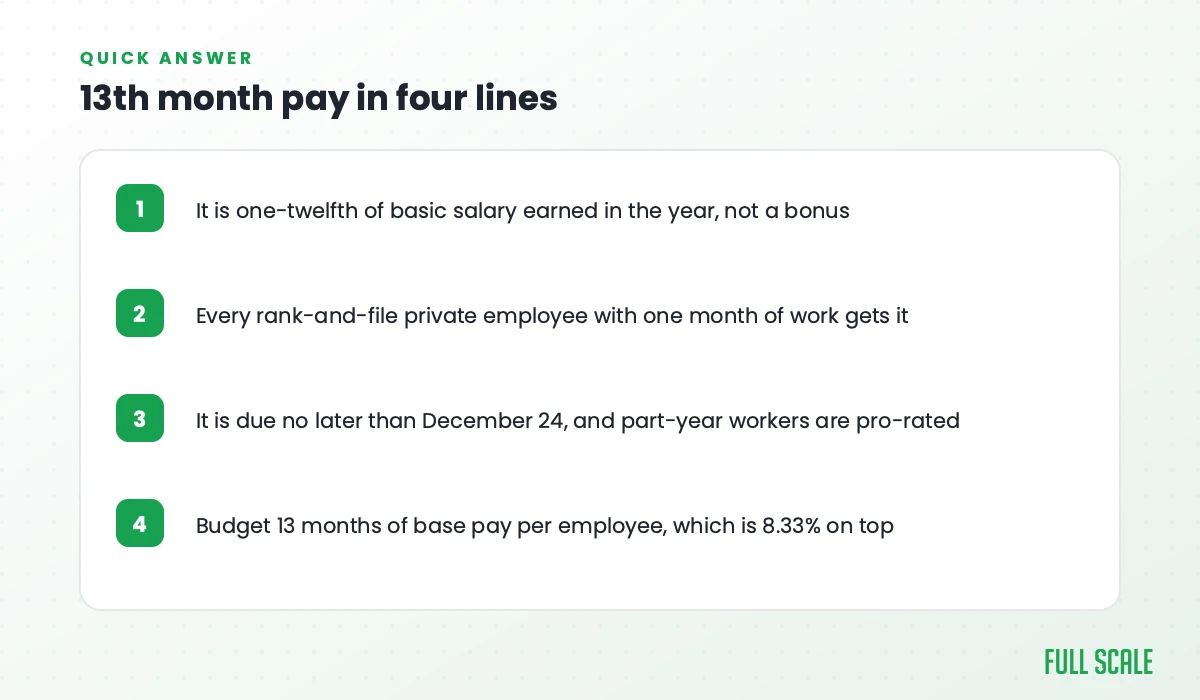
Quick Answer: 13th month pay in the Philippines is a mandatory payment equal to one-twelfth of the basic salary an employee earned in the calendar year, due by December 24. Every rank-and-file private-sector employee who worked at least one month gets it, pro-rated for partial years. Full Scale employs its Filipino engineers directly, so the cost sits inside the fully loaded rate and clients never pay it separately.
The first four sections below give you the whole answer. Everything after that is reference depth: the edge cases, where the law came from, what each statute does, and what the payment costs a company hiring from abroad. Last verified: October 31, 2026.
What is 13th month pay in the Philippines?
13th month pay in the Philippines is a yearly payment that private employers must make to rank-and-file employees, equal to one-twelfth of the basic salary each employee earned during the calendar year. Presidential Decree No. 851 created it in December 1975.
Employers like to call it a bonus. It is one month of salary paid late, a salary with a better publicist.
13th month pay is deferred salary, so anyone budgeting a Filipino employee should budget 13 months of base pay.
Who gets 13th month pay?
Every rank-and-file employee in the Philippine private sector gets 13th month pay if they worked at least one month during the calendar year, regardless of job title, employment status or how they are paid. The Revised Guidelines set the coverage rule, and the table below applies it.
| Situation | Gets 13th month pay? |
|---|---|
| Rank-and-file private-sector employee with at least one month of work in the year | Yes, at any salary level |
| Managerial employee (sets management policy, or can hire, fire or discipline) | No |
| Government employee | No under PD 851; a separate year-end bonus applies |
| Household worker (kasambahay) with at least one month of service | Yes, under the Kasambahay Law |
| Employee whose employer already pays an equivalent of at least one-twelfth of basic salary | Employer owes only any shortfall |
| Genuine independent contractor | No, because the law covers employees |
How do you compute 13th month pay?
To compute 13th month pay, divide the total basic salary an employee earned in the calendar year by 12. The number is one month of pay for a full-year employee and a smaller share for anyone who worked part of the year.
13th month pay = total basic salary earned in the calendar year ÷ 12
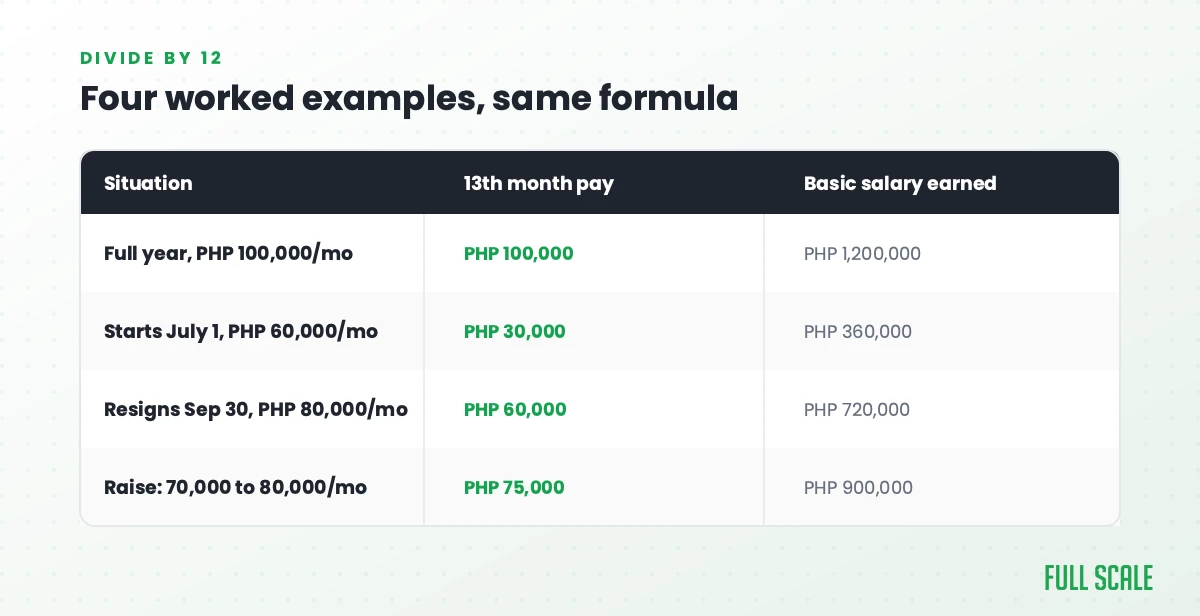
Take a developer paid ₱100,000 a month for all twelve months. ₱100,000 × 12 = ₱1,200,000 in basic salary, and ₱1,200,000 ÷ 12 = ₱100,000. The employer pays that ₱100,000 on top of the regular salary. The year's cost comes to ₱1,300,000, or 8.33% above base pay. At about ₱60 to the dollar, the salary is roughly $1,670 a month and the 13th month payment is the same amount.
When is 13th month pay due?
13th month pay is due no later than December 24 of every year. PD 851 sets that date, and the Department of Labor and Employment (DOLE) reminds employers every year that it enforces the deadline.
Employers may split the payment. Under the Revised Guidelines, half can go out before the school year opens and the other half before December 24. Nothing stops an employer from paying it all earlier, and DOLE has encouraged early release.
Full Scale pays its employees' 13th month usually around December 1, as early as it can, well ahead of the legal deadline.
What counts as basic salary?
Basic salary for 13th month pay means all remuneration paid for services rendered, minus a short list of items the guidelines exclude. The table shows what is in and what is out.
| Pay item | Counts toward basic salary? |
|---|---|
| Regular monthly or daily wage actually paid for work | Yes |
| Fixed wage plus commission (total earnings) | Yes |
| Cash value of unused vacation and sick leave | No |
| Overtime pay and premium pay | No |
| Night shift differential | No |
| Holiday pay | No |
| Cost-of-living allowance (COLA) | No, unless integrated into basic pay |
| Any excluded item that a contract, company policy or established practice treats as basic pay | Yes |
The last row matters most in practice. If a company has always folded an allowance into the base figure it uses for 13th month pay, it cannot quietly stop doing that. The non-diminution section further down explains why.
How is 13th month pay pro-rated?
13th month pay is pro-rated by the number of months an employee worked, because the formula divides the basic salary actually earned in the year by 12. Anyone who started mid-year or earned different rates during the year gets a smaller or blended amount.
Example B, mid-year hire. An employee starts July 1 at ₱60,000 a month. Six months is ₱360,000, and ₱360,000 ÷ 12 = ₱30,000.
Example D, raise during the year. An employee earns ₱70,000 from January through June and ₱80,000 from July through December. That is ₱420,000 plus ₱480,000, or ₱900,000, and ₱900,000 ÷ 12 = ₱75,000.
Do resigned or terminated employees get 13th month pay?
Resigned and terminated employees are entitled to a proportionate 13th month pay based on the basic salary they earned from January 1 to their last day. The Revised Guidelines say the employee can demand the payment once the employment relationship ends.
Example C. An employee resigns on September 30 at ₱80,000 a month. Nine months is ₱720,000, and ₱720,000 ÷ 12 = ₱60,000, owed even though the December 24 deadline has not arrived.
Is 13th month pay taxable?
13th month pay is exempt from income tax up to a combined ₱90,000 a year, and anything above that is taxed as ordinary compensation income. The TRAIN law, Republic Act 10963, raised the cap from ₱82,000 in 2018. It covers 13th month pay together with other bonuses, such as Christmas bonuses and productivity incentives.
Example E. An employee receives ₱75,000 in 13th month pay and ₱20,000 in other bonuses. The total is ₱95,000, so ₱90,000 is exempt and ₱5,000 is taxable. Tax treatment can change, so employers should confirm the current cap with their accountant or the Bureau of Internal Revenue each year.
How do 13th month pay rules differ for special workers?
The core rule stays the same for special workers, but eligibility and the pay base change with how the person is paid and under which law they work. This table covers the cases that cause the most confusion.
| Worker type | Rule |
|---|---|
| Piece-rate worker | Covered. The law defines piece-rate pay as a standard amount per regularly repeated unit of work, and these workers are entitled to 13th month pay |
| Fixed wage plus commission | Covered, computed on total earnings including the commission |
| Paid purely on commission, boundary or task basis | Not covered under the Revised Guidelines |
| Probationary, project, seasonal, casual or part-time rank-and-file employee | Covered, because the guidelines apply regardless of designation or employment status |
| Household worker (kasambahay) | The original guidelines excluded household employers. The Kasambahay Law (RA 10361) and its implementing rules now give workers with at least one month of service a 13th month pay of one-twelfth of basic salary |
| Managerial employee | Not covered |
| Government employee | Not covered by PD 851; receives a year-end bonus instead |
How is government year-end bonus different from 13th month pay?
The government year-end bonus is a separate benefit for public employees, while 13th month pay under PD 851 applies to the private sector. Republic Act 6686, as amended, gives government employees one month of basic pay as of October 31 plus a ₱5,000 cash gift.
| Private-sector 13th month pay | Government year-end bonus | |
|---|---|---|
| Legal basis | PD 851 and its guidelines | RA 6686, as amended |
| Amount | One-twelfth of basic salary earned in the year | One month of basic pay as of October 31, plus ₱5,000 cash gift |
| Release | By December 24 | With the first agency payroll of November, under DBM rules |
| Service requirement | One month in the calendar year | At least four months of service from January 1, still in service on October 31 |
Why does the Philippines have 13th month pay?
The Philippines has 13th month pay because the government wanted to protect workers' real wages from inflation, and it made a practice some employers already followed into a legal requirement. The decree's own preamble cites "the ravage of worldwide inflation" and notes that legal minimum wage rates had not risen since 1970.
President Ferdinand Marcos issued PD 851 on December 16, 1975, as a presidential decree, which is how law was made during martial law. The decree's final preamble clause also points to the Christmas season as a time to show concern for working people.
The decree also said that employers already paying a 13th month pay or its equivalent were not covered by it. That exemption shows the practice existed at some companies before the law did, and it is the reason the "equivalent" question still comes up today.
How has the 13th month pay law changed since 1975?
The 13th month pay law has changed through a presidential order that widened coverage, a set of revised guidelines, a court ruling that protects employee benefits, and tax and enforcement updates. The timeline below shows each step.
| Date | What happened |
|---|---|
| December 16, 1975 | PD 851 signed. It covered employees earning not more than ₱1,000 a month and set the December 24 deadline |
| December 22, 1975 | Implementing rules issued, including the rule that non-payment is handled as a money claim |
| August 13, 1986 | Memorandum Order No. 28 removed the ₱1,000 salary ceiling, so every rank-and-file employee became covered |
| 1987 | Revised Guidelines issued under Labor Secretary Franklin Drilon, setting out coverage, basic salary, resignation and split payment |
| 1988 | Republic Act 6686 granted government employees a year-end bonus and cash gift |
| July 26, 2010 | Supreme Court, in Central Azucarera de Tarlac v. Central Azucarera de Tarlac Labor Union (G.R. No. 188949), held that an employer could not cut an established 13th month practice |
| 2013 | Republic Act 10361, the Kasambahay Law, extended 13th month pay to household workers |
| 2018 | TRAIN law (RA 10963) raised the tax-exempt ceiling for 13th month pay and other benefits from ₱82,000 to ₱90,000 |
| 2023 | DOLE Department Order No. 238 set up compliance monitoring |
| Every year | DOLE issues an advisory restating the December 24 deadline, and private employers file a compliance report by January 15 |
Which laws govern 13th month pay?
Several instruments govern 13th month pay in the Philippines, and each one covers a different piece: the entitlement, the rules for applying it, who is included, how it is taxed and how it is enforced. The table lists each law with its effect.
| Instrument | What it does | Who it affects |
|---|---|---|
| Presidential Decree 851 (1975) | Requires 13th month pay by December 24 | Private-sector rank-and-file employees |
| Memorandum Order No. 28 (1986) | Removed the ₱1,000 salary ceiling | All rank-and-file employees |
| Revised Guidelines (1987) | Define coverage, basic salary, proration, resignation, split payment and "equivalent" payments | Employers and employees |
| Labor Code, Article 100 | Prohibits eliminating or reducing existing benefits | Employers who already pay more than the minimum |
| Labor Code, Article 306 (formerly Article 291) | Money claims generally prescribe three years from when they accrue | Employees filing a claim |
| Republic Act 6686, as amended | Year-end bonus and ₱5,000 cash gift | Government employees |
| Republic Act 10361 (2013) | Gives household workers 13th month pay | Kasambahay and their employers |
| Republic Act 10963 / TRAIN (2018) | Sets the ₱90,000 tax-exempt ceiling | Employees and payroll teams |
| DOLE Department Order 238 (2023) and annual labor advisories | Monitor compliance and restate the deadline | Private employers |
Can an employer stop paying more than the minimum, or count a Christmas bonus as 13th month pay?
An employer cannot stop paying a 13th month benefit it has long granted on better terms than the law requires, but it can count a Christmas bonus toward the legal minimum if the payments total at least one-twelfth of basic salary. Article 100 of the Labor Code bars eliminating or reducing benefits employees already enjoy.
The Supreme Court applied that principle in Central Azucarera de Tarlac, ordering a sugar mill to return to its long-standing way of computing 13th month pay.
On the Christmas bonus question, the decree's implementing rules treat "its equivalent" as Christmas bonuses, mid-year bonuses, profit-sharing payments and other cash bonuses that total at least one-twelfth of basic salary. If the total falls short, the employer pays the difference. Cash and stock dividends, COLA, regularly enjoyed allowances and non-cash benefits do not count.
What happens if an employer doesn't pay 13th month pay?
An employer that doesn't pay 13th month pay faces a money claim from the employee and compliance orders from DOLE, but PD 851 itself contains no penalty clause. Section 9 of the implementing rules says non-payment is handled as a money claim, under the Labor Code rules and National Labor Relations Commission procedure.
In practice, the exposure comes from three places. DOLE can inspect employers and order payment. Employees can file money claims, usually within three years of when the claim accrued. And private employers must file a compliance report by January 15 through the DOLE Online Compliance Portal, a date DOLE restates each year.
The general penalty provisions of the Labor Code also apply to violations. The amounts depend on the specific provision, so check the current text or ask counsel before quoting a figure.
What does 13th month pay cost a foreign employer?
13th month pay costs a foreign employer one extra month of base salary per Filipino employee per year, which is 8.33% on top of annual base pay, before the government contributions that make up the rest of the employer bill. For the Filipino engineers Full Scale employs, the cost sits inside the fully loaded rate. That rate starts at $35 an hour, as the pricing page shows.
| Monthly base salary | 13th month pay | Total annual base cost | Set aside each month |
|---|---|---|---|
| ₱60,000 | ₱60,000 | ₱780,000 | ₱5,000 |
| ₱100,000 | ₱100,000 | ₱1,300,000 | ₱8,333 |
| ₱150,000 | ₱150,000 | ₱1,950,000 | ₱12,500 |
These salaries are illustrative figures from the junior-to-senior range described in the software engineer salary guide, and they exclude other statutory contributions. The full cost build is in the offshore development cost analysis.
A quote that leaves 13th month pay out is quoting 8.33% too low. That kind of cost-only shortcut is what I call cheapshoring.
Full Scale treats 13th month pay as deferred salary. Every month the company sets aside part of it in a separate bank account so the money is there when December arrives. A separate account is boring, and nobody has ever been ambushed by a boring bank account.
Full Scale pays the 13th month to its own employees, and the client's invoice does not change because of it.
Who pays 13th month pay when you hire in the Philippines?
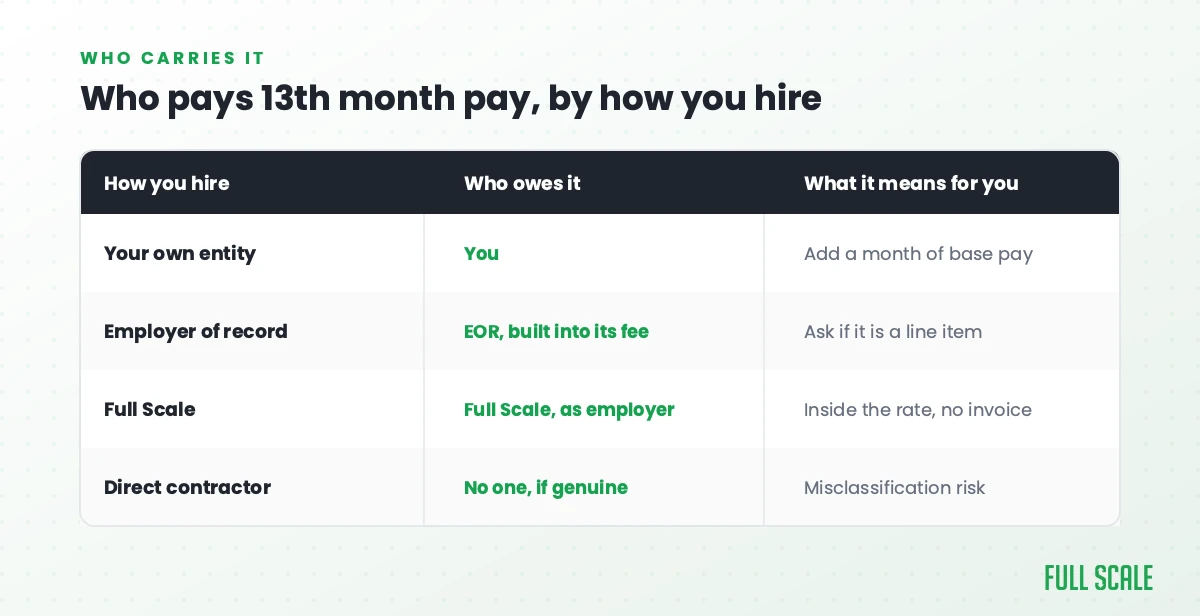
The party that employs the person pays 13th month pay, so who carries it depends on how you hire. With a Philippine entity you carry it yourself, with an employer of record it passes through to you, and with a staffing partner such as Full Scale it is the partner's cost inside the rate.
| How you hire | Who owes 13th month pay | What it means for your budget |
|---|---|---|
| Your own Philippine entity | You, as the employer | Add one month of base pay per employee, plus the payroll work and December cash flow |
| Employer of record | The EOR pays the employee, and the cost is built into what you pay the EOR | Ask whether 13th month pay is a line item or folded into the EOR's rate |
| Staff augmentation partner such as Full Scale | Full Scale, as the employer of its Filipino engineers | Included in the fully loaded rate, with no separate invoice and no client obligation |
| Direct independent contractor | No one, if the person is a genuine contractor | Risk: a contractor who works full time under your managers can be treated as an employee, and the legal requirements post explains why |
Talk to Full Scale about hiring Filipino engineers and see what the full cost looks like for your team.
Frequently asked questions
Is 13th month pay mandatory for all employees?
13th month pay is mandatory for all rank-and-file private-sector employees who worked at least one month in the calendar year, regardless of position, status or how they are paid. Managerial employees and government employees are not covered by PD 851, and household workers are covered under a separate law.
How much is 13th month pay for a ₱25,000 monthly salary?
An employee who earns ₱25,000 a month for the full year receives ₱25,000 in 13th month pay. The math is ₱25,000 × 12 = ₱300,000 in basic salary, and ₱300,000 ÷ 12 = ₱25,000.
Can a Christmas bonus replace 13th month pay?
A Christmas bonus can count as the equivalent of 13th month pay if the employer's payments in the year total at least one-twelfth of the employee's basic salary. If they total less, the employer must pay the difference.
Do I owe 13th month pay to a Filipino contractor on Upwork or Wise?
You do not owe 13th month pay to a genuine independent contractor, because the law covers employees. If the person works full time, exclusively and under your managers, they may be an employee in practice, and a claim for 13th month pay can be made retroactively.
Can an employer pay 13th month pay in installments?
An employer can split 13th month pay into two payments under the Revised Guidelines, with half paid before the school year opens and the rest before December 24. The full amount must be paid by December 24.
Do government employees get 13th month pay?
Government employees do not receive 13th month pay under PD 851. They get a year-end bonus equal to one month of basic pay plus a ₱5,000 cash gift under Republic Act 6686, as amended.
Do kasambahay get 13th month pay?
Kasambahay get 13th month pay if they have worked at least one month. The Kasambahay Law, Republic Act 10361, and its implementing rules set it at one-twelfth of the worker's basic salary earned in the calendar year.
Is 13th month pay included in Full Scale's rate?
13th month pay is included in the fully loaded rate Full Scale charges, which starts at $35 an hour. Full Scale employs its Filipino engineers directly, pays their 13th month itself, and does not bill clients for it separately.
When should a foreign company set aside money for 13th month pay?
A foreign company should set aside 13th month pay every month, at one-twelfth of each employee's monthly base salary, so the full amount is ready by December. For a ₱100,000 monthly salary that is about ₱8,333 a month.