
Legal Requirements for Hiring Remote Developers in the Philippines: A 2026 Guide

In this article
- The legal requirements for hiring remote developers in the Philippines, in one place
- Calling someone a contractor doesn’t make them one
- When any of this actually bites
- Who owns the code your contractor writes
- Enforcement is the other real risk
- Industries where offshore development genuinely isn’t allowed
- The industries people worry about, and shouldn’t
- If you’re hiring from the United States
- If you’re hiring from the UK or Europe
- What Philippine labor law makes an employer owe, and why it isn’t you
- Freelancers don’t get any of that, and the good ones notice
- Three ways of hiring remote workers in the Philippines, ranked by how much law you own
- Frequently asked questions
- Talk to someone who already files the paperwork
Quick Answer: If you’re hiring a developer in the Philippines as a genuine independent contractor, there are no legal requirements to get started. You need a simple contract covering intellectual property and pay, and a US company should collect a Form W-8BEN for its own records. Most people never do. You register nothing in the Philippines. The catch is the word genuine: Philippine law decides who’s an employee from the facts of the relationship, not the label on the contract, so a full-time dedicated developer who works like an employee can make you an employer under Philippine law whether or not you ever set up an entity there.
If you’re thinking about hiring developers in the Philippines and wondering what you have to do about it, the good news is that getting started takes almost nothing. Staying out of trouble is a different question, and it turns on how you run the relationship, not on whether you ever registered an entity there.
I have been on the employer side of that question since 2018. Full Scale runs a real Philippine entity with 350+ employees, so I file the returns, remit the contributions, and pay the 13th month pay every December. I didn’t sign up for a second career in Philippine labor law. I got one anyway.
Most of the guides that rank for this question read like a compliance nightmare, and most of them are published by companies that sell compliance. If your product is an employer of record, then Philippine labor law is your sales pitch.
One caveat before any of this. I run a software company, not a law firm, and nothing below is legal or tax advice. Take whatever structure you land on to your own accountant and attorney before you sign it.
The legal requirements for hiring remote developers in the Philippines, in one place
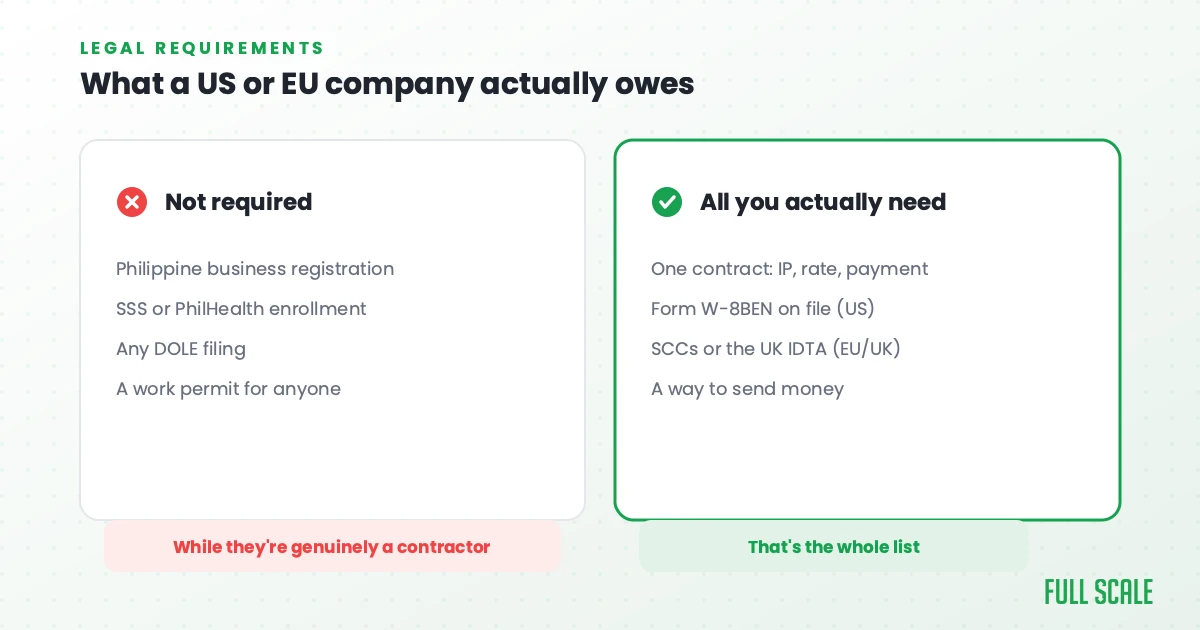
It’s one document. A written contract that says who owns the intellectual property, what the rate is, and how you’re going to pay them.
That’s the whole minimum for a contractor relationship.
A US company is also supposed to collect a Form W-8BEN before the first payment. Almost nobody does, and the form never leaves your own internal records anyway.
Everything after this is either a real risk worth your attention or a detail specific to where you are.
Calling someone a contractor doesn’t make them one
All of the above assumes that the person you’re paying is truly an independent contractor. That term is carrying more weight than most people realize.
In Philippine law, someone’s status as an employee or a contractor isn’t determined by the language in the agreement. Labor tribunals adhere to the labor department’s policy on the primacy of facts: instead of looking at what the agreement says, they look at what is happening on the ground. The Supreme Court uses a two-tiered test: the four-fold test, along with whether the worker is economically dependent on a particular business.
| Factor | The question |
|---|---|
| Hiring | Who hired and engaged the worker? |
| Wages | Who pays the wages, and how regularly? |
| Dismissal | Who has the power to dismiss? |
| Control | Who controls the means and methods by which the work is accomplished? |
Control is the determining factor. The court says it is “the most significant factor in the four-fold test.”
Consider two different developers. Developer A serves three US clients, invoices by project, owns her own tools, controls her own schedule, and has the right to reject assignments. She is a true independent contractor, regardless of which test you use, and there’s nothing wrong with the deal. The BIR treats freelancers as self-employed individuals for tax purposes, and both SSS and PhilHealth have self-employed classifications. Working as a freelancer for overseas clients is completely aboveboard in the Philippines.
Developer B works 40 hours per week for one US company. He goes to its standups, checks in with its engineering manager, has to ask that manager if he can take time off, gets reviewed by that manager, gets paid twice a month for the exact same sum, and the same manager can fire him. That’s an employee. The header on his contract is the sole element of the relationship that indicates otherwise. And placing “Independent Contractor Agreement” at the top of page one doesn’t change anything. Philippine courts have seen that header before.
A majority of direct offshore hires look like Developer B. They’re full-time, they’re working exclusively for you, they’re on your standups, they’re supervised by your manager. If this is your arrangement, then you don’t have a contractor working an unusual schedule. You have an employee with no registered employer, and Philippine legislation addressed this exact situation. The Social Security Act defines an employer as “any person, natural or juridical, domestic or foreign, who carries on in the Philippines any trade, business, industry, undertaking, or activity of any kind and uses the services of another person who is under his orders as regards the employment”. The words “domestic or foreign” make it clear who that provision is pointed at.
Classification, though, is merely the first of three issues that a scaled-up direct contracting arrangement brings up, and each of the three questions can come back with a different answer:
| Question | Whose law |
|---|---|
| Is your “contractor” really an employee? | The Labor Code and the social-contribution statutes |
| Are you doing business in the Philippines without a license? | The Foreign Investments Act and corporate law |
| Have you created a taxable presence there? | The tax code and the US-Philippines treaty, covered below |
A single genuinely independent designer taking on occasional projects raises none of these questions. Forty exclusive full-time “freelancers” attached to your management, your email, and your performance review cycle raises all three. The space in between is up for interpretation, and that is the actual problem: you never know where the line sat until somebody tests it.
That gap is what Full Scale exists to close. The engineers on our clients’ teams are Full Scale employees. We employ them, compensate them, advance them, and shoulder every employer obligation outlined further down this page, which makes the classification question boring.
When any of this actually bites
Now the honest part, and here is where it cuts against the compliance vendors for a change. There are thousands of companies running the direct-contractor model for years, with nothing happening. There is no Philippine agency out there scouring Upwork looking for misclassified developers. The risk comes not on a timetable, but on a trigger. And there are two triggers.
The first trigger is a breakup. Nobody sues over a labor violation while they’re being treated right. You let a “contractor” of four years go, just as you would drop a vendor, and now the question of classification suddenly becomes real. If they were really an employee, the claim becomes retroactive: 13th month pay for every year worked, unpaid SSS, PhilHealth, and Pag-IBIG contributions, holiday and overtime pay where applicable, plus illegal dismissal, because there is no such thing as at-will employment in the Philippines. Trying to collect against a US company with no assets in the Philippines is difficult, which is the part the fear-mongers don’t tell you. You’ll still have to pay lawyers to prove that, while you are already distracted with whatever problem led to the breakup.
The second trigger is the diligence room. If you raise money or sell the company, the buyer’s lawyers will look through your headcount and ask who employs each person. A pile of offshore contractor agreements for people who appear to be employees is a known contingent liability that gets factored into the price, whether as an escrow or a holdback. I’ve been in this room. When I sold Stackify in 2021, our offshore devs did not slow down the deal at all, because none of them were independent contractors. They worked through Full Scale, and what the buyer did due diligence on was one US company’s agreement with another US company.
Misclassification accumulates silently for exactly as long as things are going right, and this is why it can be so easily overlooked. This isn’t a form you missed filing, or the worst-case scenario described by EOR ads. It’s a risk that grows proportionally to how much like employees your workers look and how long they stay that way.
Who owns the code your contractor writes
In the US, a contractor owns the copyright in what they create unless a signed agreement moves it. And the “work made for hire” language people paste into contracts doesn’t cover software. The statutory definition in 17 U.S.C. §101 lists nine kinds of commissioned work, and source code isn’t one of them.
So a contract whose IP section says “all work shall be considered a work made for hire” and stops there can leave your developer holding the copyright in your own product. The fix is one clause: an express, present-tense assignment of all rights, with the work-made-for-hire language kept as a fallback. Every startup lawyer knows this. Plenty of founders working off a template they found online don’t, and they find out during diligence.
That gets you ownership on paper. Paper is the easy half.
Enforcement is the other real risk
Say your contractor takes your source code. Now what?
You have a signed agreement with one individual, eight thousand miles away, in a legal system you’ve never used, in a country where you have no entity, no lawyer, and no standing. Are you flying to Manila? Retaining Philippine counsel and litigating in a court you have never seen, over a dispute with someone you were paying a few thousand dollars a month?
The enforcement costs more than the claim before you file anything.
That’s the actual offshore intellectual property risk, and it has almost nothing to do with what your contract says. Your contract is probably fine. Your remedy is theoretical. In my experience this is what companies should worry about, and it’s what they think about least. A signed NDA feels like protection right up until the day you need to use it.
It gets worse at scale, and this connects back to the second question in the table above. If your direct-hire setup has grown into what the Foreign Investments Act calls doing business in the Philippines, an unlicensed foreign corporation can’t sue in Philippine courts at all, though it can still be sued in them. Hire enough people directly and the courthouse door closes from your side only.
Structure solves this in a way a clause can’t. When the developer is an employee of a real company inside that country, somebody local can actually do something about it. There’s an employment relationship, an HR file, a criminal-record check already on record, a person subject to local law, and a company with a name and assets in that jurisdiction. That company has every reason to resolve it fast. And your own contract is with a US company you can walk into a US court and sue.
At Full Scale, our clients sign one US contract with a US company, not sixteen agreements with sixteen individuals. The engineers on their team are our employees. Whatever we build for a client stays that client’s, and we have never had a single IP or confidentiality issue in the history of the company. That’s partly process. It’s partly the background check everyone clears through the Philippine National Bureau of Investigation. And it’s partly that our people have a career to lose.
A freelancer who disappears costs you a contractor. An employee who does it answers to their employer.
I go deeper on the contract and access side in the offshore IP protection framework.
Industries where offshore development genuinely isn’t allowed
A few industries have a real prohibition, and if you’re in one of them you already know it.
Export-controlled work. Defense, aerospace, satellites, certain encryption, advanced semiconductors. Giving a developer in the Philippines access to controlled technology or source code is a licensable export under the Export Administration Regulations. Some federal contracts go further and require US persons on US soil, full stop.
Your own customer contracts. This one catches far more companies than the regulations do. A business associate agreement with unusual terms, a SOC 2 commitment you already made, or one line in an enterprise agreement restricting where data can be accessed from all outrank anything else on this page. More offshore hires die on a customer contract than on anything in the tax code. Check your largest agreements before you check the law.
The industries people worry about, and shouldn’t
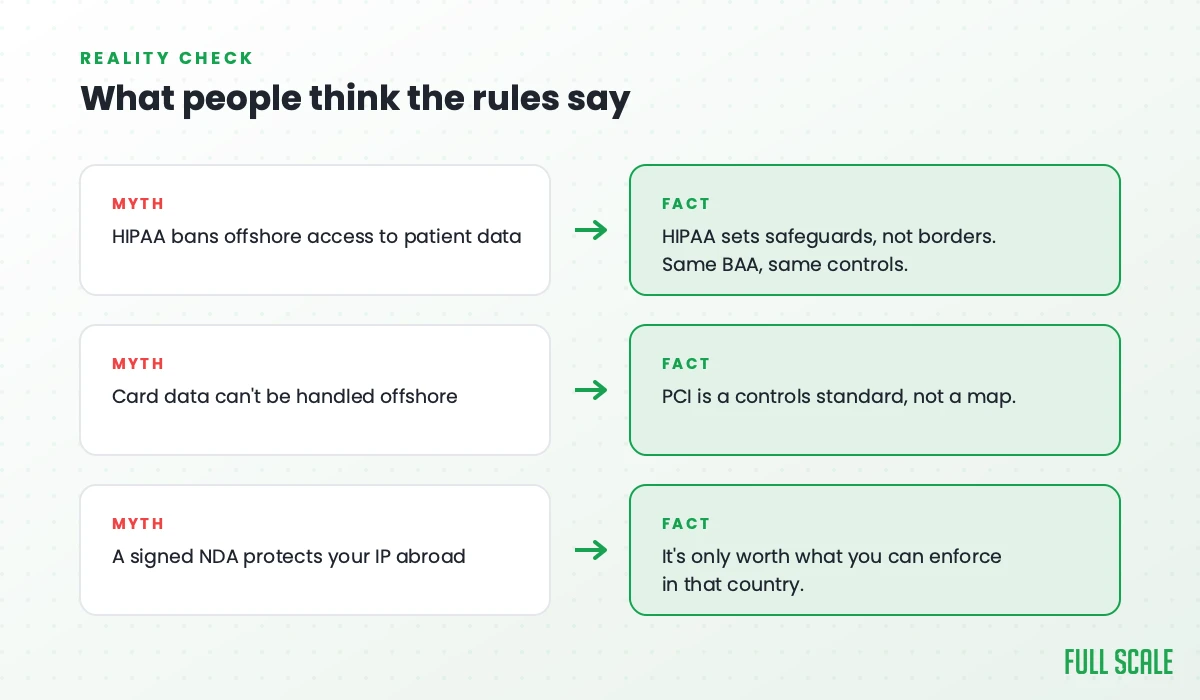
Healthcare is the big one. Founders assume HIPAA prohibits offshore access to patient data. It doesn’t. What HIPAA cares about is who is handling protected health information and under what safeguards, and it draws no line at the border. An offshore engineer working under your direction, on your systems, in your sprints, counts as part of your workforce under HIPAA’s own definition, so your compliance program is the one that governs them. Same access controls, same audit trail as anyone else on the team. A firm that builds on its own systems and hands you a finished product is a business associate instead, with its own direct liability.
There’s an irony worth naming here, and it points back at the last section. HIPAA has no explicit extra-territorial reach, which is exactly why the structure you hire through matters more than the paperwork you sign. A regulator’s practical remedy against a lone offshore freelancer is thin. Against a company, it isn’t.
We do this work every day. SOTA Cloud is FDA-cleared cloud dental imaging software running in more than 1,000 dental locations, built with Full Scale .NET engineers in the Philippines. AG Mednet runs clinical trial process-management software with an offshore QA team we staffed. Payments is the same story: Basys is a merchant processor, and card data does not care about geography either, because PCI is a controls standard rather than a map.
Compliance is about controls, not zip codes. Least-privilege access, code review, audit logs, signed agreements, background checks, and no production data in a developer’s local environment. Those rules apply identically to the engineer in Cebu and the engineer in Chicago. If your controls only work when everybody is in the same time zone, you had a controls problem before you ever considered offshore.
If you’re hiring from the United States
Three things worth understanding, and only one of them can cost you money.
Form W-8BEN is the W-9’s opposite number
If you’ve paid an American contractor, you know the drill. You collect a W-9 so you have their taxpayer ID, and at the end of the year you send them a 1099. Form W-8BEN is the same move pointed the other way. Your developer signs it to say they aren’t a US person, and the result is that you file nothing at all. Use W-8BEN for an individual and W-8BEN-E if you’re contracting with their company instead of with them.
You never send it to the IRS. It exists purely for your own internal records.
Plenty of companies never collect one. They find a developer, set up a Wise or PayPal transfer, and pay them every month for three years without a single form on file, and nothing happens to them. That’s structural rather than lucky. There’s no filing where a missing form would show up, and the presumption rules only apply to a payment you owed withholding on in the first place.
Treat the W-8BEN as cheap insurance rather than a gate. It costs one email, and it’s the difference between telling your accountant you know the income was foreign-source and telling them you assumed. It also becomes load-bearing the moment your developer does any work on US soil.
The scariest document in this entire process is a free PDF.
You don’t file a 1099, and you don’t withhold anything
Compensation is sourced where the work happens. The IRS puts it plainly: “The place, where the personal services are performed, generally determines the source of the personal service income,” regardless of where the contract was signed, where you paid from, or where you are. Code written in Cebu is foreign-source income.
Form 1099-NEC covers US persons, and your developer isn’t one. Payments to foreign persons run through Form 1042-S instead, and the IRS general instructions scope that form to US-source income. Foreign-source income paid to a foreign person lands outside both.
The exception is travel. Fly that developer to Kansas City for two weeks of onboarding and the days worked inside the US become US-source income, allocated on a time basis. Tell your accountant in advance rather than in April.
Permanent establishment is the only one with a tax bill attached
Everything above is paperwork. Permanent establishment can produce an actual tax bill, and I could not find it covered on any of the guides currently ranking for this question.
If your company’s activity in the Philippines looks enough like a business operating there, the Philippines can tax the profits attributable to it. Article 5 of the US-Philippines income tax treaty defines a permanent establishment as a fixed place of business used to carry on commercial activity. It also finds one where employees or dependent agents habitually sign contracts in the company’s name.
For a developer writing code, the risk is low. Nobody is signing your customer agreements from a laptop in Davao. The risk climbs when the person you hire starts selling on your behalf or running an office you lease. If your first hire in the Philippines is a salesperson rather than an engineer, have that conversation with a tax advisor before you make the offer.
If you’re hiring from the UK or Europe
A UK or European company has the same short answer as a US one, plus a data-protection step. The UK sits in its own category, because it left the EU regime and built a parallel one.
IR35 almost certainly doesn’t apply. The off-payroll working rules run through UK tax and National Insurance. Where there’s no UK charge, there’s nothing for them to attach to. A contractor who isn’t UK resident and works entirely outside the UK generally creates neither, which is the analysis Pinsent Masons walks through.
The data-protection step is real, and it’s small. The Philippines appears on neither the EU’s adequacy list nor the UK’s. I read both to be sure. So if your developer will touch personal data about people in the EU or UK, and for a product engineer with database access the answer is usually yes, you need a transfer safeguard.
From the EU, that’s the standard contractual clauses adopted in June 2021, plus a transfer impact assessment. From the UK, either the ICO’s International Data Transfer Agreement or those same EU clauses with the UK addendum attached. Sign the module that fits, write down your reasoning, keep it on file. EU companies also account for the value-added tax themselves on their own return, which your finance team already does for other non-EU vendors.
The route-by-route version for Europe, including entity setup and country detail, is in my guide to hiring from Europe. And if you’re somewhere else entirely, Canada or Australia or the Gulf, the shape holds. Ask your accountant the same two questions with your country’s name attached: do I withhold or report anything at home, and do I have a cross-border data rule that needs a contract clause.
What Philippine labor law makes an employer owe, and why it isn’t you
None of the following lands on you while the person you’re paying is genuinely a contractor. You don’t register a business in the Philippines, don’t enroll anyone in Philippine social security, and don’t file anything with the Philippine Department of Labor and Employment. Nobody needs a work permit either, because a Filipino developer working from home in their own country isn’t immigrating anywhere. I only mention that last one because several of the big country guides on this topic have a whole section about work permits, which tells you those pages are templates with the Philippines pasted in.
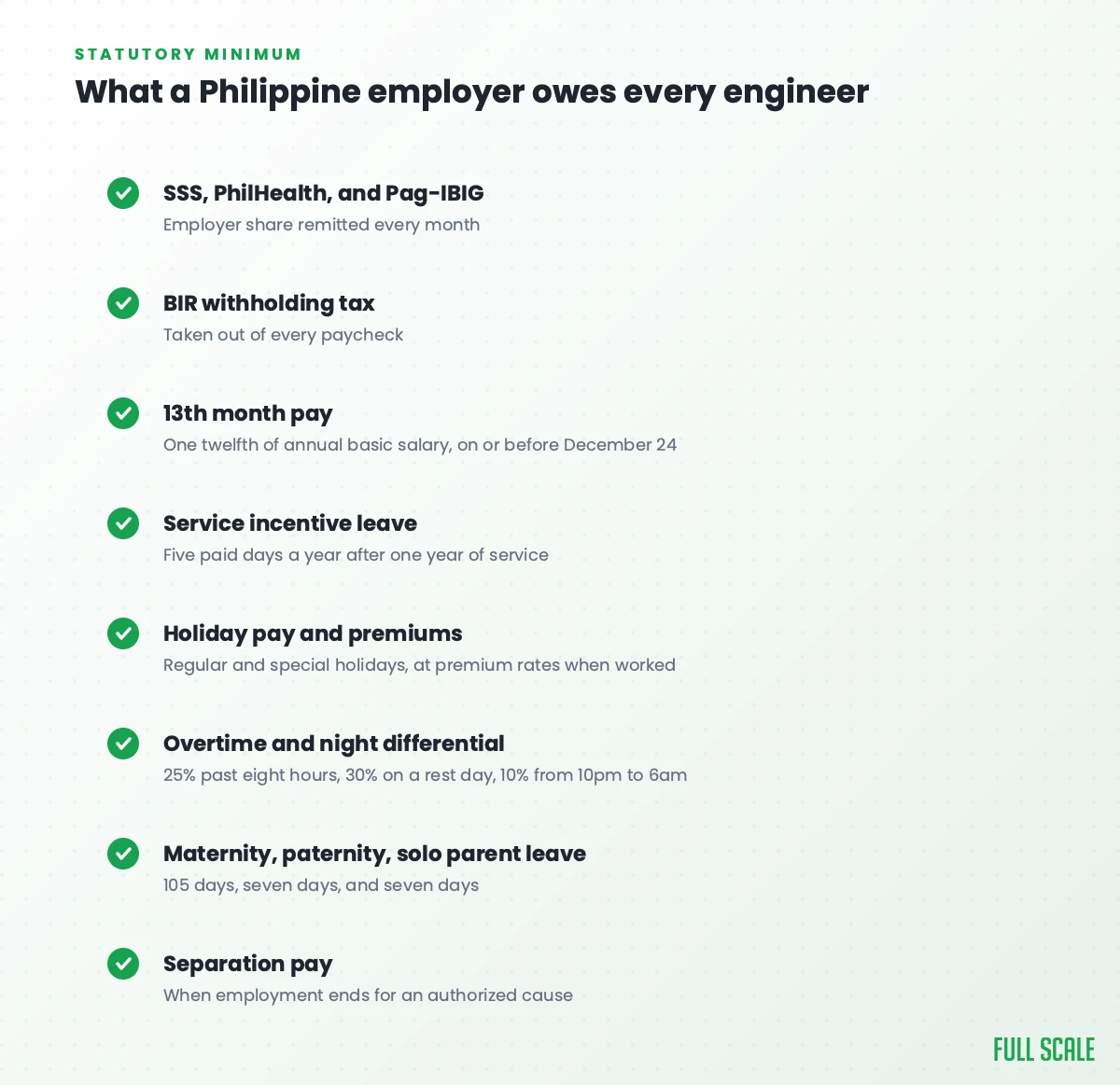
Here’s what Full Scale remits, files, or pays for each of its 350+ employees in the Philippines, and what you’d owe if you set up your own entity there. All of it is required by the Labor Code of the Philippines and the statutes around it:
- Social Security System (SSS) contributions, employer share, every month
- PhilHealth national health insurance, employer share, every month
- Pag-IBIG Fund housing contributions, employer share, every month
- Withholding tax to the Bureau of Internal Revenue on every paycheck
- 13th month pay, one twelfth of annual basic salary, released on or before December 24, with a compliance report to the labor department the following January and no exemptions available. Grant Thornton’s Philippine guidance lays it out year by year
- Service incentive leave, five paid days a year after one year of service
- Holiday pay on regular and special holidays, at premium rates when someone works them
- Overtime at 25% above the hourly rate beyond eight hours, and 30% on a rest day
- Night shift differential of 10% for any hour worked between 10pm and 6am
- Maternity leave of 105 paid days, and paternity leave of seven
- Solo parent leave of seven paid days
- Separation pay when employment ends for an authorized cause
- An employment contract that meets Labor Code minimums, and probationary hires who convert to regular employment on a schedule the employer doesn’t control
Read that list again and remember it’s the floor, not the offer. Nobody recruits engineers on the statutory minimum. We go well past it, and I laid out what we actually give people in Full Scale employee benefits.
Wages are only the start of the number. Every line above sits inside the fully loaded rate, which at Full Scale starts at $35 an hour.
You can’t end employment the way you can in most of the US
The Philippines has no at-will employment. Ending someone’s employment requires a just or authorized cause, a documented process, and in the authorized-cause situations, separation pay. I talked about this on Startup Hustle in the episode about my first 90 days running Full Scale:
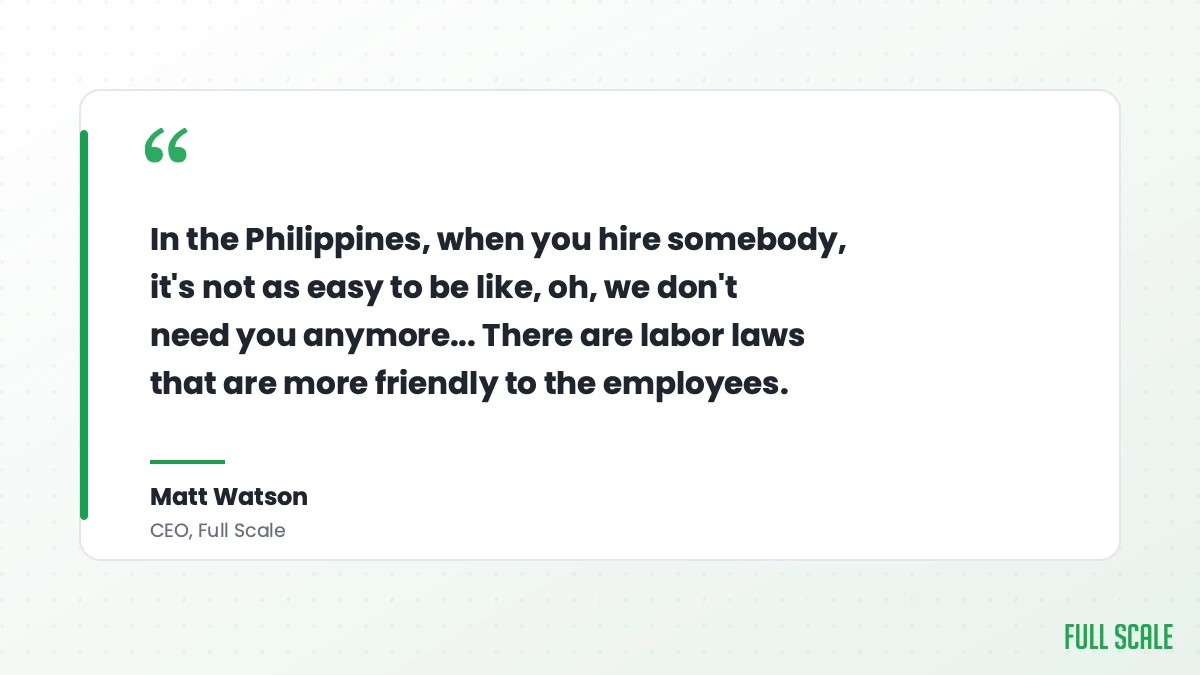
“In the Philippines, when you hire somebody, it’s not as easy to be like, oh, we don’t need you anymore, or we’re terminating employment… There are labor laws that are more friendly to the employees. And so that’s always one of the risks that we’re trying to figure out.”
Your labor is less expensive, and your commitment to it lasts longer. If half your customers cancel next month, a US company can adjust headcount in a week and a Philippine employer cannot. No cost comparison shows you that trade.
My honest advice, from the person who owns the entity: you don’t want a local entity. Not for your first hire, and probably not for your tenth. The setup isn’t what gets you. It’s everything that never stops, and then the part that actually hurts. Letting someone go means a documented cause and separation pay, on a timeline you don’t control, at the exact moment your revenue moved.
Use a partner and all of that stays on our side of the wall. Full Scale holds the employment relationship, so a client can drop a developer with 30 days’ notice and never touch any of it: no separation pay, no government filings, no entity, no long-term contract. There’s a two-week money-back guarantee at the front end too, and I wrote up how it works in when it isn’t working out. The developer keeps a stable job with real benefits while the client keeps its flexibility, and our entity absorbs the mismatch. That mismatch is the actual product.
Freelancers don’t get any of that, and the good ones notice
Most people hiring in the Philippines skip the entire list above. They find a developer, set up a PayPal or Wise transfer, and send money every month. The developer gets cash and nothing else. No SSS or PhilHealth contributions building up in their name, no Pag-IBIG, no 13th month in December, no health coverage, no paid leave. If that developer is also full-time and exclusive, go reread the classification section, because at that point this list isn’t savings, it’s an IOU.
That works fine until it doesn’t, and it usually breaks on retention rather than on law.
The best engineers in the Philippines know exactly what a real employer provides, because plenty of employers there provide it. If you’re paying cash only, and a company down the street offers the same money plus an HMO that covers their spouse and every one of their kids, plus a 13th month, plus actual paid leave, you’re going to lose that person. The attrition shows up long before any legal problem does.
This is the real argument for an employer of record, or for a staffing firm like Full Scale. It isn’t compliance. It’s that somebody has to actually be the employer for your developer to get treated like one, and if nobody is, they don’t. Our engineers are Full Scale employees, which is why they get the statutory list plus health insurance from day one covering unlimited dependents, life insurance, equipment, a work-from-home allowance, and a real promotion path. I broke all of it down in Full Scale employee benefits.
Now the honest other side of it, because this isn’t one-directional. Plenty of Filipino developers would genuinely rather have the cash. The Philippine tax code helps them: a self-employed person can elect a flat 8% tax on gross receipts above the first ₱250,000 in place of the graduated brackets, as long as they stay under ₱3 million in receipts and aren’t VAT-registered, which Grant Thornton walks through. A salaried employee doesn’t get that option. So the same gross can be worth meaningfully more take-home as a contractor, and some engineers are perfectly happy to take twenty percent more in cash and skip the benefits entirely.
It comes down to the individual. Ask them what they want, and understand which trade you’re making either way.
Three ways of hiring remote workers in the Philippines, ranked by how much law you own
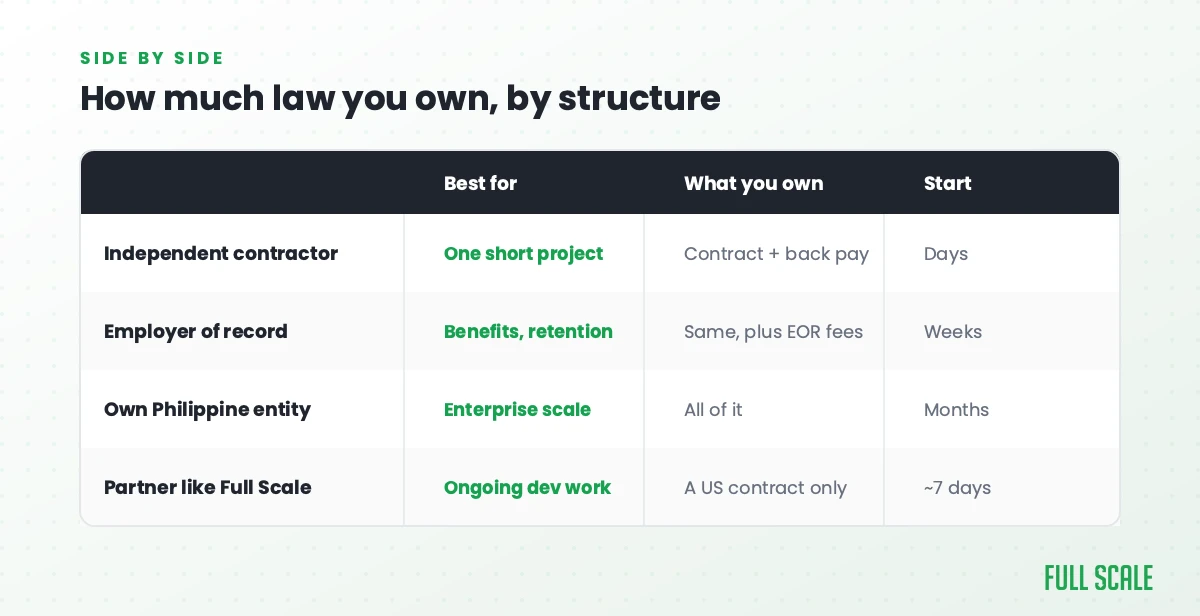
There’s no fixed list of legal requirements here. What you owe depends entirely on which structure you pick.
| Structure | What you own legally | Best for | Time to start |
|---|---|---|---|
| Independent contractor | Your contract, your IP clause, your own country’s tax forms, and the classification risk: if the relationship works like employment, the back pay is yours too. | One person, a defined scope, a few months. No employee benefits, so expect turnover risk | Days |
| Employer of record | Same as above, plus the EOR’s fees. The EOR is the employer on paper. | Someone you already found, and getting them real employee benefits so they stay | Weeks |
| Your own Philippine entity | All of it. Registration, monthly remittances, 13th month pay, separation pay, Labor Code termination rules. | Enterprise companies building a large local team | Months |
| A staffing partner that already runs the entity, like Full Scale | A US contract with a US company. Nothing Philippine. | Ongoing engineering work, full statutory benefits, and retention you don’t have to manage | As little as 7 days |
An employer of record is a good product at what it does, which is employing someone you’ve already found so that person gets real benefits. What it doesn’t do is find you developers, and that distinction gets blurred in a lot of sales conversations. I broke down where each model fits in PEO vs EOR vs staff augmentation.
I’m obviously biased about the fourth row, so here’s when it’s wrong. For one hire, a short scoped project, or a stack we don’t staff, go with a contractor or an EOR. I compared those two arrangements properly in staff augmentation vs independent contractors. When we’re right, it’s because your legal footprint ends up the smallest of anything on this list: staff augmentation through a US company means your contract is a US contract, your IP assignment runs through it, and the Philippine side of the ledger is ours.
And for the record, none of this is what actually sinks offshore projects. What sinks them is hiring on price. I call it cheapshoring, and I’ve watched it fail more often than any compliance problem.
Frequently asked questions
Do I need to register a business in the Philippines to hire a developer there?
No. A US or European company hiring a Filipino contractor, or working with a staffing partner that already has a Philippine entity, doesn’t register anything in the Philippines. Registration with the Securities and Exchange Commission and the Bureau of Internal Revenue is only required if you set up your own entity and employ people directly.
What are the compliance requirements for offshore development in the Philippines?
For the hiring company, offshore compliance in the Philippines comes down to three things: a contract that assigns intellectual property, correct worker classification, and your own country’s rules on tax documentation and cross-border data. Full Scale carries the Philippine-side obligations for its clients, including social contributions, 13th month pay, and Labor Code termination requirements.
Do American companies hiring in the Philippines have to provide benefits?
Not for genuine independent contractors. Mandatory benefits like the Social Security System, PhilHealth, Pag-IBIG, and 13th month pay are obligations of the Philippine employer. The exception is a contractor relationship that runs like employment: full-time, exclusive, under your managers. Philippine tribunals judge the facts of who controls the work rather than what the contract calls it, and the more employee-shaped the relationship is, the more likely those obligations attach to you retroactively.
Is it legal to hire Filipino developers as independent contractors?
Yes. Freelancing for foreign companies is fully legal in the Philippines. The Bureau of Internal Revenue registers freelancers as self-employed taxpayers, and SSS and PhilHealth both have self-employed categories. What Philippine law doesn’t support is treating a full-time, exclusively dedicated developer as a freelancer to avoid employer obligations. Classification follows the facts of the relationship, with control over how the work is done as the deciding factor, not the label on the contract.
Can I just pay a Philippine developer through Upwork or Wise?
Yes, and most companies do exactly that. Payment rails are the easy part. What a marketplace or a transfer service won’t do is hand you an intellectual property assignment, a signed W-8BEN, or a defensible worker classification. Those three stay yours no matter how the money moves.
What happens if an offshore developer steals your source code?
Practically, whatever you can enforce. A contract with an individual overseas gives you a claim in a foreign court where you have no entity, no counsel, and no standing, and the cost of pursuing it usually exceeds the value of the dispute. This is why the hiring structure matters more than the contract language. When the developer is employed by a company in that country, and your own agreement is with a US company, there is somebody accountable in both jurisdictions.
Can offshore developers work on HIPAA-regulated healthcare software?
Yes. HIPAA governs who handles protected health information and under what safeguards, and it doesn’t restrict the country they work from. An offshore engineer working under your direct control counts as part of your workforce under HIPAA, governed by your compliance program, while a firm that builds on its own systems and hands you the product is a business associate. Full Scale engineers build FDA-cleared dental imaging software for SOTA Cloud and clinical trial software for AG Mednet from the Philippines.
Do Filipino developers need a work permit to work for a US company?
No. Work permits apply to foreigners working inside the Philippines. A Filipino developer working from their home in the Philippines for a company abroad doesn’t need one, and neither do you.
Talk to someone who already files the paperwork
If you’ve read this far, you probably want the version where all of this is somebody else’s job. Full Scale has been hiring, employing, and retaining engineers in the Philippines since 2018, with 700+ engineer placements and 93%+ retention, and our clients sign one US contract.
The paperwork was never the hard part of building an offshore team. Getting the right people and keeping them was. That’s most of what I wrote about in Product Driven.
If you’re still comparing options, start with hiring developers in the Philippines and the offshore development due diligence checklist so you know what to ask everyone else. Otherwise, schedule a call and tell us what you’re building.