
Filipino Work Culture Isn’t a Skill Gap. It’s a Communication Gap.

In this article
- You can watch the gap open in a single sprint
- Why your best developer goes quiet
- Filipino work culture and American norms, decoded
- Psychological safety is your half of the gap
- Communication decides whether offshore works, not the rate
- How we bridge it, and why it is not the developer’s job alone
- In the AI era, this is the whole point
- Frequently asked questions
- Ready to build a team that actually communicates?
The code is fine. That is what makes it so confusing.
Your offshore developer ships clean work. The pull requests are solid. And yet you keep getting surprised. A task you thought was on track slips a day before the deadline. An estimate turns out to be padded, or wildly optimistic, and nobody flagged it. A blocker that sat for three days finally surfaces in a status update, long after it mattered. So you start to wonder if you hired the wrong person.
You almost certainly didn’t.
I have run Full Scale for eight years. We have 350+ engineers in the Philippines and a team of customer success managers whose entire job is to sit between American companies and Filipino developers and make the two halves actually hear each other. After all that time, I can tell you the thing that trips up most offshore engagements is not skill. What most people misread as a Filipino work culture problem is really a communication gap. It comes down to how two cultures communicate, and the fact that the words are fluent English is exactly what hides it. The meaning gets lost anyway.
Smart developers are everywhere. Companies hire globally because of the cost of living, not because talent runs out at home, and the Philippines earns its place on communication grounds more than on price. This kind of friction shows up on any distributed team, in-house or offshore. It just gets sharpest across the widest cultural distance, which is why a US company working with a Filipino team tends to feel it most.
That gap is real. It is also predictable, and it can be coached. This is a field guide to what it looks like, why it happens, and what to do about it, told partly through the people who manage it every day.
You can watch the gap open in a single sprint
Forget the abstract talk about culture for a second. Here is where it actually shows up.
It is the stand-up where your developer says “no blockers,” and two days later you learn there was a blocker the whole time. Then there is the pull request that sat untouched for days because the developer had a question but “didn’t want to bother you.” Or the estimate that came back at two weeks when the honest answer was four, because saying “that is too much work” felt disrespectful. Someone spots a bug early, quietly hopes it will resolve itself, and never raises a hand.
None of those are coding problems. Every one of them is a communication problem, and communication problems are the real bottleneck in software delivery.
Christian Arches, one of our customer success managers, put the cost of it plainly when we talked about it internally. He had an engineer who built a feature without confirming the requirement first.
“He implemented it, and it turns out after that, it’s not what it’s supposed to be. So it’s a rework. Once we have this rework, it equates to time, and time equates to money. So it’s additional cost for the client.”
The developer was skilled enough to build the wrong thing quickly. What was missing was the fifteen-second question up front: are we expecting X, or Y? Validate the assumption before you write the code. That habit is not technical. It is cultural, and it is what decides the engagement.
Why your best developer goes quiet
There is a name for what is happening here, and almost nobody in the offshore conversation uses it.
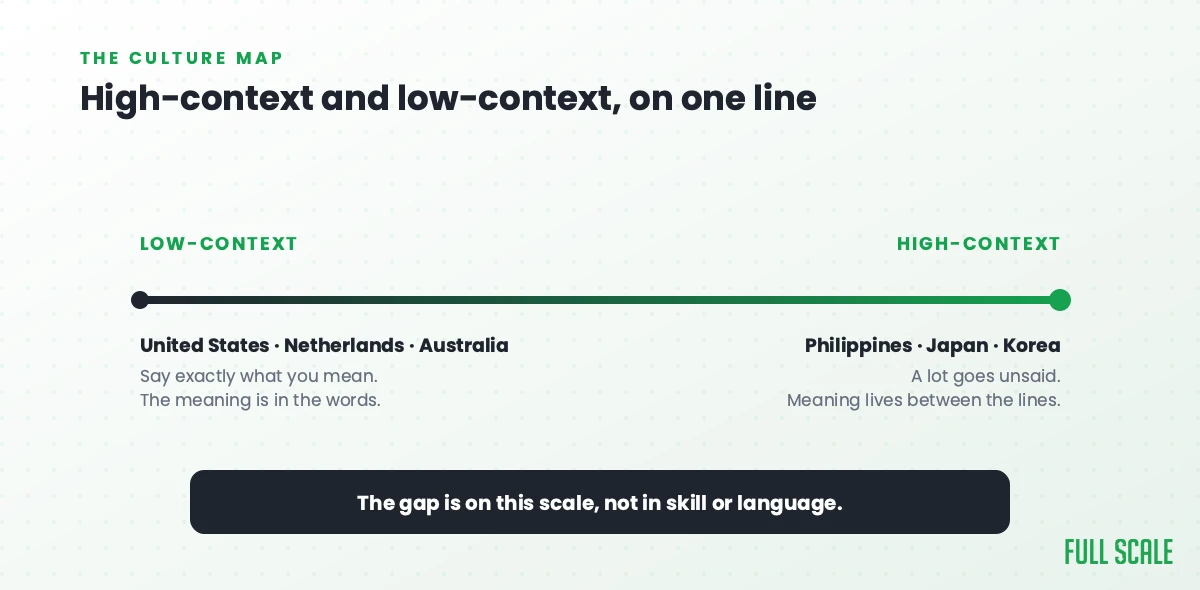
The researcher Erin Meyer, in her book The Culture Map, describes a spectrum she calls low-context versus high-context communication. In low-context cultures, good communication is precise, explicit, and literal. You say exactly what you mean, and the meaning lives in the words. The United States sits at the far low-context end, along with countries like Australia and the Netherlands. In high-context cultures, good communication is layered and implicit. A lot of the meaning lives between the lines, in tone, in what is left unsaid, in the relationship. The Philippines sits toward the high-context end, along with Japan, Korea, and Indonesia.
When a low-context manager works with a high-context developer, the gap is not a language gap. It is a wiring gap.
The American manager hears “yes, I can do that” as a literal commitment. The Filipino developer may have meant “I hear you, I respect you, and I will try my hardest,” which is a different sentence. Silence, to the American, signals a problem. To the Filipino developer, silence can be politeness, or a sign of respect for your time, or a way to avoid putting you in an awkward spot. And sometimes silence is neither. It is a strong engineer taking a beat to put a technical thought into a second language, which is harder than the fluent small talk that came right before it.
Here is the part that fools people. Filipino developers speak excellent English. The Philippines ranks in the “high” proficiency band on the EF English Proficiency Index. So the words come out fluent and correct, and the American manager assumes the communication is direct and literal like their own. It isn’t. Fluency is not the same as directness. That mismatch is exactly why this reads as a skill gap when it is nothing of the kind.
There is a second pull toward silence, and it has its own name too. In a meeting, asking question after question can make someone look like a pabida, the one who always has to be the center of attention. Nobody wants to be that person, so the safe move is to nod, say nothing, and try to sort it out alone later. Our CSMs coach a small trick that gets around it: at the end of a call, have the developer summarize what they understood and ask “did I get that right?” It surfaces the exact same questions, but as an alignment check instead of a spotlight grab, so it costs them nothing socially.
Filipino work culture and American norms, decoded
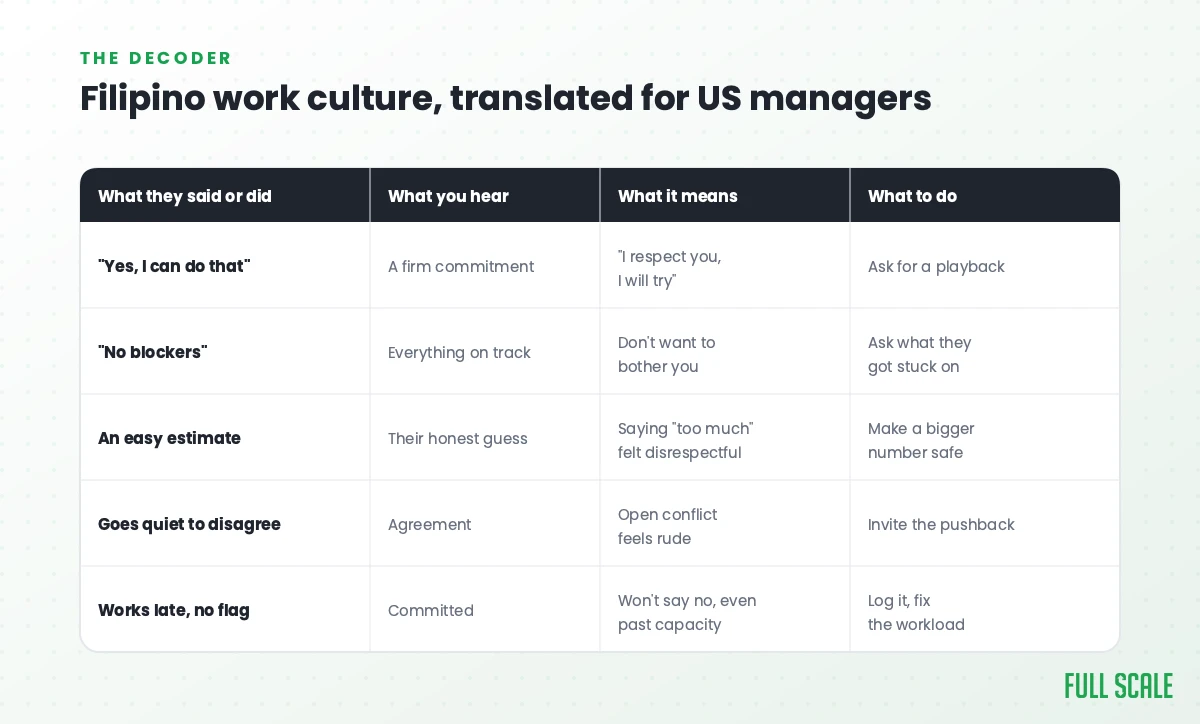
Most articles on Filipino work culture hand you a list of traits and leave you there. That does not help you on a Tuesday when your developer just said something you are not sure how to read. So here is the decoder, built from eight years of running blended teams.
| What your developer says or does | What a US manager tends to hear | What it often means | What to do |
|---|---|---|---|
| “Yes, I can do that.” (with no follow-up questions) | A firm commitment, fully understood | “I respect you and I will try.” Understanding not yet confirmed. | Ask them to play the task back to you in their own words. |
| “No blockers.” | Everything is on track | “I don’t want to look like I’m struggling or bothering you.” | Ask what specifically they worked on and where they got stuck. |
| A too-optimistic estimate | Their honest best guess | Saying “that is too much” felt disrespectful | Make it safe to give a bigger number. Ask for the risks, not just the date. |
| Going quiet when they disagree | Agreement, or no opinion | Open disagreement feels like conflict, and conflict feels rude | Invite the pushback directly and reward it when it comes. |
| Working late without being asked, and not flagging it | Great, they are committed | They won’t say no, even past their capacity | Watch for it, tell them to log the hours, and fix the workload. |
| Waiting to be asked for status | Passive, low ownership | Volunteering can read as showing off or overstepping | Set an explicit expectation that proactive updates are the job. |
Notice the pattern. Almost none of these are about ability. They are about harmony. Filipino work culture puts a high value on not causing friction, not embarrassing anyone, and not disrupting the relationship. There is even a word for the discomfort of causing someone to lose face, hiya, and steering around it is a real social instinct. Those are genuinely good instincts on a team. They just collide with an American default that treats a blunt, early “no” as useful information rather than an insult.
None of this is a hard rule, either. It is a tendency, and it varies by person and by generation. Younger developers who grew up on global teams and Western media are often far more direct than this. Read the individual in front of you, not the stereotype.
One more that trips up managers on the money side. Filipino developers will often work late without complaint, and without flagging it. Mark Simblante, another of our CSMs, made the point that this is exactly why hours have to be logged.
“Some of our members don’t feel like filing an overtime. But for me as a manager, it’s very important, because this is how we gauge if there’s really a need of an additional resource for the client. We don’t want our employees doing overtime every week.”
The loyalty is real. If you do not build a way to see it, you will burn out your best person and never know until they are gone.
Psychological safety is your half of the gap
Every other guide on this topic puts the entire burden of adaptation on the Filipino developer. Learn to be direct. Learn to speak up. Learn to say no.
That is only half the fix, and honestly the smaller half.
You are the manager. You set the weather. If your developer comes from a culture where you do not challenge the senior person in the room, then waiting for them to spontaneously start challenging you is a losing strategy. You have to build psychological safety, the conditions where disagreeing with you is safe, and then you have to prove it over and over until they believe you.
A few concrete changes to how you manage the team:
- Stop asking yes-or-no questions. “Does that make sense?” gets you a yes every time. “Can you walk me through how you’d approach this?” gets you the truth.
- Never accept a single “yes” on anything important. Ask for a playback. If they can restate the goal in their own words, you have real understanding. If they can’t, you just caught a rework before it happened.
- Give corrective feedback in private. Public criticism causes a loss of face that lands much harder in a high-context, harmony-first culture. You will get a shut-down developer, not a better one.
- Delegate decision authority out loud. Say the words: “This is your call, and I trust it.” Otherwise they will keep waiting for permission, because in their experience that is what respect looks like.
- Put decisions and disagreements in writing. A doc or a PR comment lets a high-context developer push back without the face-to-face cost of open conflict. Written channels are often where you finally hear the real objection.
And carry the other direction too. Your developer needs to know that when their American counterpart fires back a blunt “no, that won’t work,” it is not personal, and it is not disrespect. It is just how low-context feedback sounds. Mark framed it exactly right for his team:
“As Filipinos, we always tend to want to receive kind feedback. But our clients, their feedback is direct, and sometimes it hurts our feelings. That’s not personal. That’s work-related. We need to separate that thing, work and personal.”
The bridge gets built from both ends or it does not get built.
Communication decides whether offshore works, not the rate
If you take one thing from this, take the order of operations. When companies choose an offshore team, most of them sort by cost first, then country, and worry about communication last, if at all. That is backward.
The right order is communication, then cost, then country. Figure out who can actually communicate with your team. Then look at what it costs. Let the country fall out of those two answers. Picking the cheapest option first, with no thought given to whether you can hear each other, is the single most common way offshore goes wrong. I call that mistake cheapshoring, and the horror stories you have heard about offshore development almost always start there.
This is also why “can they code” is the wrong question to obsess over. Mike Paradela, who has spent more than twenty years in software, says it to his teams like this:
“The client doesn’t care how pretty your code is. The real question is, did you deliver it at the right time, and is it working? You use Facebook. You don’t care how it’s implemented. You care that when you post something, people see it.”
Ownership means seeing the thing through to a working outcome, not stopping at “my part is done.” That mindset is a communication habit before it is a technical one, and it is the difference between a developer who functions as part of your team and one who just processes tickets.
How we bridge it, and why it is not the developer’s job alone
Here is the honest part. The behavior changes above are real, and they are yours to make. But you should not expect a developer, working from a different culture and a different time zone, to carry the rest by sheer force of will. Structure closes what willpower cannot.
At Full Scale, that structure has a name. Our staff augmentation model puts a developer on your team, and a customer success manager makes the working relationship actually work. It is worth explaining what a CSM does, because it is the core of what we do. A CSM is the relief valve. They have the hard conversations the client cannot comfortably have directly with an offshore engineer, and the ones the engineer cannot raise directly with the client. They meet with the development team every week, not just the client stakeholder, so problems surface before they escalate. They run a real, calendared checkpoint with the client every month. When someone flags that a developer is struggling, the CSM builds a plan and follows through, instead of just logging it.
Every quote in this article comes from one of those CSMs, pulled from one of our internal training sessions on this exact gap. That is the part most offshore providers skip. We teach and coach these communication habits on purpose, for the engineers and for the people who manage them, so the cultural distance starts shrinking long before it reaches your standup.
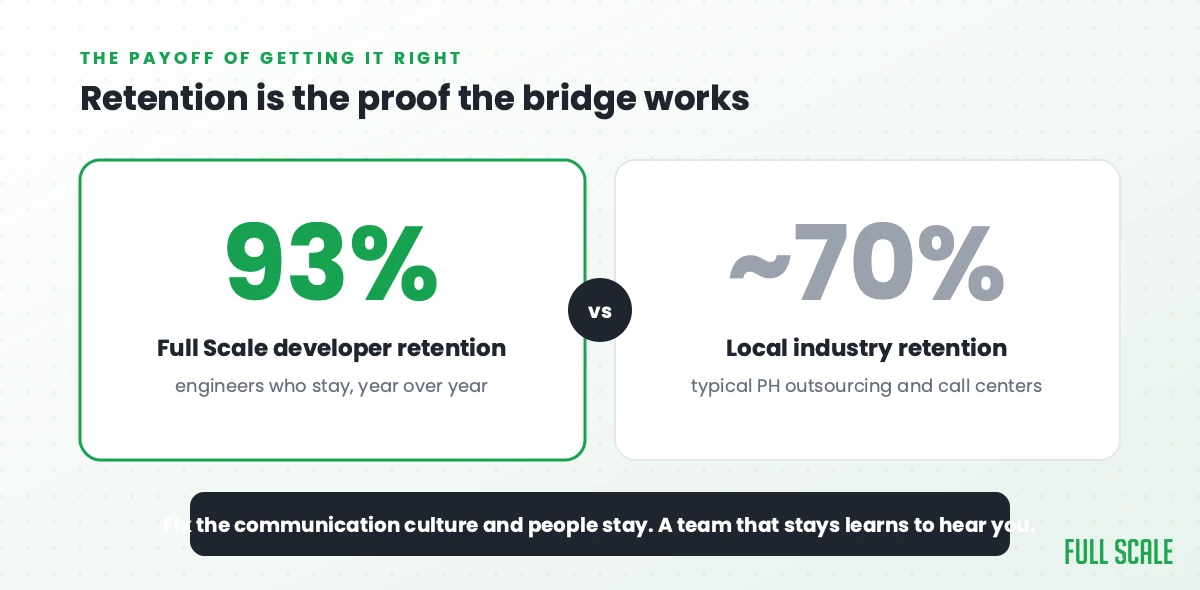
Does it work? Our developer retention runs over 93%, in a country where the outsourcing and call-center industry keeps closer to 70% of its people. We are Great Place to Work Certified in the Philippines, with 95% of our team saying it is a great place to work versus 65% at a typical local company. Those numbers are not a HR flex. They are the proof that when you get the communication culture right, people stay, and a team that stays is a team that gets good at hearing you. Some of that shows up in obvious ways, like the ten employee clubs the team runs for itself, from basketball to a mental health support group, and in the company events that bring the team together in person.
In the AI era, this is the whole point
It would have been easy, a few years ago, to treat the communication gap as a nuisance. Just hand off clean requirements, get code back, move on. If that were still the job, you would be right to minimize the communication overhead.
But that job is the one AI is eating.
If all your offshore team does is turn detailed specs into code, you do not need an offshore team anymore. You need a model. What you actually need now is a team that helps figure out the requirements, asks the questions you didn’t think to ask, challenges the assumption, and pushes toward the right solution instead of the one on the ticket. All of that is communication. All of it is the human half that does not automate.
You can already see the shift in something as small as documentation, the chore developers love to hand off to someone else. AI will now draft the first version of a design doc or a set of test notes from a few plain sentences about what you decided. The blank page, which was always the real reason it never got written, is gone. What is left is the judgment about what actually matters to capture, and that is the part worth a developer’s time. Our teams train on exactly that, using AI to lock down the decisions and clarifications that used to evaporate the second a call ended.
And this is where Filipino work culture stops being a gap to manage and starts being the advantage. The same service orientation that makes someone care deeply whether the customer got what they needed, not just whether the code shipped, is exactly the trait that matters most when the mechanical work is automated away. Filipino developers, in my experience, genuinely care about the outcome. Point that care at the right questions and you have the most valuable kind of engineer there is.
That is the first of what I call the three C’s of modern software development, communication, curiosity, and courage. Those human skills are the spine of the Product Driven philosophy my whole team runs on. Mark said the same thing back to his own developers without any of my framing:
“It starts with the vision. You need to understand the why. Know what is being built, who it serves, and why it matters. It’s all product-driven.”
The communication gap is real. It is also the last thing standing between you and a team that thinks, not just types. That is worth bridging.
Frequently asked questions
Is Filipino work culture a good fit for software development teams?
Yes, and it is one of the strongest fits in offshore development, as long as you understand how it communicates. Filipino developers combine high English proficiency with a service-oriented, relationship-first culture and low turnover. The one thing to manage is a high-context communication style, where harmony and respect can keep a developer from volunteering bad news or a flat “no.” Once a manager adapts to that, the same culture that felt like a gap becomes a real advantage.
Why do Filipino developers avoid saying “no”?
Because Filipino culture is high-context and harmony-first, and a direct “no” can feel disrespectful or like it will damage the relationship. So a developer may say “I’ll try,” give an optimistic estimate, or stay quiet rather than push back openly. It is not dishonesty or a lack of confidence. The fix is on the manager’s side too: ask open-ended questions, make it explicitly safe to disagree, and never treat a single “yes” as confirmed understanding.
What is high-context versus low-context communication?
It is a framework from Erin Meyer’s book The Culture Map. In low-context cultures, like the United States, good communication is explicit and literal, and the meaning is in the words. In high-context cultures, like the Philippines, more of the meaning is implied, carried by tone, relationship, and what is left unsaid. Most friction between American managers and Filipino developers is a gap on this spectrum, not a gap in skill or language.
How do you get offshore developers to communicate proactively?
Set the expectation explicitly and build structure around it, rather than hoping it happens on its own. Ask developers to play tasks back in their own words, ask what they got stuck on instead of “any blockers,” give corrective feedback privately, and state clearly when a decision is theirs to make. At Full Scale, a customer success manager reinforces this with weekly team meetings and follow-through, so small issues surface before they become missed deadlines.
Are offshore communication problems a sign of a skill gap?
Usually not. In our experience running teams in the Philippines, the developers can do the work. What looks like a performance problem is far more often a communication-culture difference, where questions go unasked and blockers go unraised until they are expensive. Diagnosing it as a communication gap instead of a skill gap is the first step to fixing it, because the two problems have completely different solutions.
Why do offshore developers say yes to everything?
Because in many offshore cultures, including the Philippines, saying no to a client or a boss feels disrespectful. Researchers call the underlying traits high power distance and face saving: you do not contradict the senior person, and you do not put anyone in an embarrassing spot. So “yes” often means “I heard you and I will try,” not “I understand and agree.” The fix is not pushing harder for honesty. It is asking questions that cannot be answered with a yes, like “walk me through your approach” or “what would make this take longer than we think?”
How do I get honest feedback and pushback from offshore developers?
Make disagreement cheap and agreement expensive. Ask for a playback instead of accepting a yes, ask what would make the estimate wrong instead of asking if it is right, and give corrective feedback in private so nobody loses face. Put decisions in writing, because written channels let a developer from a harmony-first culture push back without open conflict. And when someone does push back, thank them in front of the team. Pushback that gets rewarded once will happen twice.
What techniques help offshore developers push back more?
A few have a strong track record on our teams. A pre-mortem, where you ask the team to imagine the project failed and explain why, gives everyone permission to voice doubts as a game instead of a confrontation. The five whys turns a missed deadline into a root-cause exercise instead of a blame exercise. Assigning a rotating devil’s advocate in design reviews makes disagreement someone’s actual job for the hour. And anonymous retro tools surface the concerns people will not yet attach their name to. Every one of these works because it separates the criticism from the person delivering it.
Ready to build a team that actually communicates?
Skill is the easy part to hire for. The communication culture that makes an offshore team feel like your team is the hard part, and it is what we have spent eight years getting right as we help companies build development teams in the Philippines. Schedule a call and let’s talk about building yours. It is also why agent-shoring misreads offshore teams, treating skilled engineers as routine work an AI can absorb.